Introduction
Diethylstilbestrol (DES) is a non-steroidal estrogen that was prescribed to pregnant women from the mid-1940s until 1971, and was discontinued when it was found to cause vaginal clear cell adenocarcinoma in young women exposed prenatally.Reference Herbst, Ulfelder and Poskanzer 1 DES has also been linked with reproductive tract malformations, infertility, poor pregnancy outcomes, breast cancer and earlier natural menopause.Reference Hoover, Hyer and Pfeiffer 2 DES was used for years as a growth promoter for meat production in chicken and cattle,Reference Noller and Fish 3 , Reference McMartin, Kennedy and Greenspan 4 but laboratory animal studies of prenatal DES exposure and postnatal growth are conflicting, perhaps due to different experimental protocols.Reference Newbold, Padilla-Banks, Jefferson and Heindel 5 – Reference Ryan, Haller and Sorrell 7 Several animal and laboratory studies have suggested that prenatal exposure to endocrine-disrupting chemicals (EDCs),Reference Grun and Blumberg 8 , Reference Heindel 9 including DES,Reference Newbold, Padilla-Banks and Jefferson 10 , Reference Hao, Cheng, Xia and Ma 11 is associated with an increased risk for obesity later in life. The results of human studies assessing the association between prenatal exposure to other EDCs and obesity in adulthood are inconclusive.Reference Hatch, Nelson, Stahlhut and Webster 12 , Reference Tang-Peronard, Andersen, Jensen and Heitmann 13 The only previous study to evaluate whether prenatal DES exposure may affect body size in humans found a positive association between DES and childhood obesity at age 7.Reference Jensen and Longnecker 14 To our knowledge, this is the first study to assess the potential role of prenatal DES exposure in relation to obesity and weight gain in adulthood.
Methods
Study population
The study population consisted of DES-exposed and unexposed daughters who have been followed-up since 1994 as part of the National Cancer Institute’s (NCI’s) Collaborative DES Follow-Up Study. The methods of this study have been described in detail.Reference Hoover, Hyer and Pfeiffer 2 , Reference Hatch, Palmer and Titus-Ernstoff 15 A total of four individual cohorts were included in the study. Participants from three cohorts – the Diethylstilbestrol Adenosis Project (DESAD),Reference Labarthe, Adam and Noller 16 the Dieckmann cohort and the Horne cohort – initially identified and studied during the 1970s – were traced and contacted for follow-up by the NCI in 1994. The majority of exposed and unexposed women from the DESAD project were identified by prenatal record review; unexposed women were frequency matched to exposed women by year of birth and age of the mother, or were siblings of the exposed. Additional exposed daughters were referred to the study and were enrolled if exposure could be documented by a letter from the physician who gave prenatal care. The Dieckmann cohort originated from a clinical trial conducted from 1951 to 1952 to test whether DES was effective in preventing miscarriage and premature birth among women presenting for routine prenatal care at the University of Chicago.Reference Dieckmann, Davis, Rynkiewicz and Pottinger 17 The Horne cohort consists of exposed and unexposed offspring of mothers from an infertility practice in the Boston area. The fourth cohort consisted of offspring from the Women’s Health Study (WHS) of mothers originally identified by prenatal record review as exposed and unexposed to DES during pregnancy. These offspring were included to the NCI study in the early 1990s.Reference Greenberg, Barnes and Resseguie 18 All study participants had medical record documentation of DES exposure status; the majority (68%) was based on prenatal medical record review and the remainder (32%) was based on a letter from the physician who provided prenatal care. Participants gave their informed consent, and the study was approved by Institutional Review Boards at the NCI and the individual study centers.
Data collection
During the 1970s and 1980s, women from the DESAD, the Dieckmann and the Horne cohorts were followed-up with clinical exams and self-administered questionnaires. Data on the presence or absence of vaginal epithelial changes (VEC), a marker of susceptibility to DES, were available from baseline clinical examinations in the DESAD and Dieckmann cohorts. Beginning in 1994, the NCI collected data on medical and reproductive history, and selected lifestyle factors from mailed questionnaires every 3–5 years (1994, 1997, 2001 and 2006). Of the 4566 prenatally exposed and 2151 unexposed eligible participants for the NCI follow-up, 3999 (88%) exposed and 1802 (84%) unexposed women responded to the baseline NCI questionnaire. Cohort retention ranged from 72 to 88% over the three follow-up cycles and was similar for the exposed and unexposed.
Detailed data on total dose of DES during pregnancy were available for 34% of the exposed women. The cohorts that comprise the NCI DES Follow-Up Study originated from different geographic regions, with different prescribing practices. Virtually all the exposed women in the Dieckmann and Horne cohorts were exposed to very high doses (>10,000 mg), following the Smith and Smith regimen,Reference Smith, Smith and Hurwitz 19 whereas the doses in DESAD study varied by geographic location. We were unable to obtain information on prescribing practices for a subset of the WHS daughters born in New Hampshire and Maine, and therefore we excluded these women from the dose analyses (142 exposed and 244 unexposed). We created a variable for estimated low v. high doses, based on the location of the original cohort (details are described elsewhere).Reference Palmer, Wise and Hatch 20 In participants with data on dose, a comparison of actual doses supported the estimated low- (median dose of 2510 g) and high-dose classification (median dose of 11,631 g). The 1st week of exposure during gestation was known for 74% of the exposed women.
In 1994, we asked participants about their current height and weight; if they were currently pregnant, we asked them to recall their weight before pregnancy. We also asked what they weighed at age 20. In 2006, we again asked for current weight and also mailed a tape measure with instructions for measuring waist circumference (WC). Using data from both the 1994 and 2006 questionnaires allowed us to assess the timing of any weight differences by exposure status. For the present study, we restricted the primary analysis to 3307 (72% of cohort) exposed and 1533 (71% of cohort) unexposed women who responded in both 1994 and 2006. Of these, 149 exposed and 59 unexposed were missing data on weight, and 60 exposed and 26 unexposed were missing other covariates. We excluded 323 (227 exposed, 96 unexposed) women who reported a diagnosis of cancer, leaving a total of 2871 prenatally exposed and 1352 unexposed women for analysis. In the secondary analysis, we evaluated the potential for selective loss to follow-up in 2006 by repeating our analyses in all women who responded in 1994, regardless of whether they responded in 2006.
Statistical analysis
Body mass index (BMI) was calculated using the standard formula, weight in kilograms/(height in meters2). We used multivariable linear regression to estimate mean differences (β) and 95% confidence intervals (CIs) in self-reported BMI (at age 20 and in 1994 and 2006), self-reported height (1994), WC (measured in 2006) and weight change from age 20 to 2006 (adjusting for variable years of follow-up) according to DES exposure status.
We used log-binomial regression to estimate risk ratios (RRs) and CI for overweight (BMI⩾25 v. <25) and obesity (BMI⩾30 v. <25) in 2006, comparing women prenatally exposed to DES with unexposed women. We included year of birth, original study cohort, daughter’s educational level and smoking status (current, former, v. non-smoker) as confounders. We also considered in utero smoke exposure, post-menopausal hormones, menopausal status and parity, but we did not include them in the final models because they had minimal effects (<10% change) on the estimates. We evaluated the associations within estimated low- and high-dose categories and timing of first exposure during gestation (⩽7, 8–10, 11–14, ⩾15 weeks), and according to whether the women had VEC diagnosed at their baseline examination in the 1970s.
We evaluated the associations separately within each of the four original cohorts and also by educational level (<16 v. ⩾16 years), menopausal status (pre- v. post-menopausal), parity (nulliparous v. parous), smoking (current, former and never) and birth weight (<3000, 3000–3499 and ⩾3500 g). To evaluate the potential for differential loss to follow-up, we repeated our analyses of BMI at age 20 and adult BMI in the complete set of women who responded in 1994, regardless of their response in 2006 (635 exposed and 250 unexposed women did not respond to the 2006 questionnaire). We used SAS Statistical Analysis Software, version 9.2, for all the analyses. 21
Results
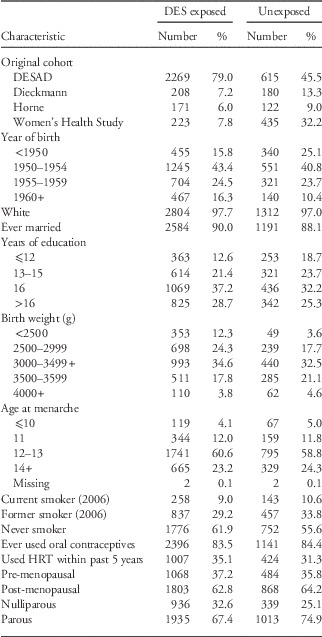
Most of the participants were originally from the DESAD cohort (79% of exposed and 46% of unexposed; Table 1). DES-exposed women were somewhat younger (mean age in 2006 was 52.0 and 53.3 for exposed and unexposed women, respectively) and had a higher level of education, but marital status at baseline was similar. Exposed women were somewhat less likely to smoke and were more likely to be nulliparous compared with unexposed women. Use of exogenous hormones (oral contraceptives and post-menopausal hormones) and menopausal status in 2006 were similar. DES-exposed women were more likely to have had a low birth weight.
Selected characteristics of DES-exposed and unexposed daughters

DES, diethylstilbestrol; DESAD, Diethylstilbestrol Adenosis Project; HRT, hormone replacement therapy.
Adjusted mean BMI at age 20 was virtually identical in DES-exposed women compared with unexposed women (21.12 in exposed and 21.10 in unexposed; β=0.02; CI: −0.20, 0.24). Overall, DES-exposed women had slightly higher BMI in 1994 and 2006 compared with the unexposed women (24.47 in exposed v. 24.25 in unexposed; β=0.22; CI: −0.13, 0.57 in 1994 and 26.60 in exposed v. 26.30 in unexposed in 2006; β=0.30; CI: −0.11, 0.72; Table 2). The association between DES and BMI in 2006 was stronger among women who were estimated to be exposed to lower doses (β=0.69; CI: 0.18, 1.21) than higher doses (β=0.06; CI: −0.40, 0.51) compared with unexposed women. After adjusting for years of follow-up and other covariates, the mean weight gain between age 20 and 2006 was 14.1 kg among DES-exposed women v. 13.4 kg among the unexposed women; the mean difference in weight gain was 0.70 kg (CI: −0.27, 1.66). The DES associations were stronger in women with lower estimated doses who gained an average of 1.8 kg more than unexposed women (Table 2). We found little association between DES exposure and WC or height. In a sub-analysis among 3687 (87%) women who had complete data on weight, height, WC and weight change since age 20, results were similar (data not shown).
AdjustedFootnote a mean differences (βs) and 95% confidence intervals (CIs) for selected anthropometric factors in prenatally DES-exposed women, overall and by estimated high- and low-dose cumulative exposure, compared with unexposed women

DES, diethylstilbestrol; BMI, body mass index.
a Adjusted for year of birth, education, smoking status and original cohort.
b Adjusted for year of birth, education, smoking status (original cohort was not adjusted for because it was highly correlated with estimated dose).
c Additionally adjusted for number of years of follow-up.
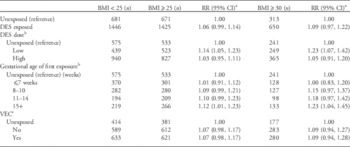
The RRs for overweight and obesity, based on self-reported BMI in 2006, were slightly elevated in the DES-exposed compared with the unexposed women [RR=1.06 (CI: 0.99, 1.13) and 1.09 (CI: 0.97, 1.23), respectively; Table 3]. In a sub-analysis excluding underweight women (BMI<18.5), results were virtually identical [RR=1.06 (CI: 0.99, 1.14) and RR=1.09 (CI: 0.97, 1.23) for overweight and obesity, respectively]. Associations with obesity were stronger among women with lower compared with higher estimated doses of DES based on the original cohort [RR=1.23 (CI: 1.07, 1.42) and RR=1.05 (CI: 0.91, 1.20), respectively] compared with women with no exposure. Among the subset (34% of exposed) with complete information on total dose of DES during pregnancy, all three dose groups had elevated risks for obesity in 2006 compared with unexposed women, with slightly higher RRs for the middle- and high-dose groups than for the lowest-dose group [RRs=1.14 (CI: 0.92, 1.43), 1.28 (CI: 1.03, 1.59) and 1.25 (CI: 1.05, 1.50) for <2500, 2500–9999 and 10,000 mg, respectively] (data not shown). Inclusion of an indicator variable for unknown dose in the model had little effect on these estimates. The risk for obesity also increased with later age at first exposure during gestation [RR=1.00 (CI: 0.83, 1.20) for <7 weeks, RR=1.15 (CI: 0.97, 1.37) for 8–10 weeks, RR=1.18 (CI: 0.97, 1.42) and RR=1.23 (CI: 1.04, 1.45) for 15+ weeks] compared with unexposed women (P<0.001 for trend in exposed only). We found no difference in risk for overweight or obesity among the DES-exposed according to the presence or absence of VEC (Table 3).
Risk for overweight and obesity in 2006 in DES-exposed women compared with unexposed women, overall and by estimated cumulative dose, timing of first exposure and presence of vaginal epithelial changes

DES, diethylstilbestrol; BMI, body mass index; RR, risk ratio; CI, confidence interval; WHS, Women’s Health Study; DESAD, Diethylstilbestrol Adenosis Project; VEC, vaginal epithelial changes.
a Adjusted for year of birth, education and smoking; overall models comparing the exposed with unexposed, additionally adjusted for original study cohort.
b Excludes 244 unexposed and 142 exposed women born in Hanover, NH or Portland, ME, for whom DES dose and gestational age could not be estimated; remaining WHS daughters were all estimated to be high dose.
c Includes subset of DESAD and Chicago cohorts with VEC status.
Results differed across the four original cohorts, with the largest associations between prenatal DES exposure and obesity found in the DESAD [RR=1.13 (CI: 0.96, 1.32)] and WHS [RR=1.22 (CI: 0.85, 1.76)] cohorts; associations in the Dieckmann [RR=1.04 (CI: 0.77, 1.40)] and Horne [RR=1.02 (CI: 0.53, 1.97)] cohorts were close to the null, but confidence limits around the estimates were very broad and overlapping. Associations differed only slightly among women with a college education or higher and women with less education [RRs=1.14 (CI: 0.96, 1.36) and 1.05 (CI: 0.90, 1.23), respectively] and among nulliparous and parous women [RRs=1.15 (CI: 0.94, 1.42) and 1.06 (CI: 0.92, 1.22)]; these small differences in estimates may be due to random error. Results were also similar within categories of birth weight, and by menopausal status and smoking history status (data not shown).
To evaluate the possibility for selection bias due to loss to follow-up, we repeated our analyses among all women who participated in 1994, including 635 DES-exposed and 250 unexposed women who did not respond to the 2006 questionnaire. Similar to the results in the group that remained in follow-up until 2006, there was little difference in mean BMI at age 20 among the exposed compared with unexposed women (β=0.03; CI: −0.16, 0.22). There was a small increase in mean BMI reported in 1994 (β=0.29; CI: −0.02, 0.60), which was slightly higher than the association in the group who answered both 1994 and 2006 questionnaires (β=0.22; CI: −0.13, 0.57).
Discussion
Overall, we found a small association between prenatal DES exposure and BMI in adulthood, weight gain and risk for obesity. One previous human study, based on data from the Collaborative Perinatal Project, found that prenatal DES exposure was associated with childhood obesity at age 7. The magnitude of the association was considerably stronger than that in our study, with odd ratios for obesity ranging from 2.5 to 2.8 for exposure during gestational months 3–6; however, the estimates were very imprecise, no dose data were available and the mothers’ DES exposure was based on self-report. Similar to our study, the association was stronger for first exposure later in gestation.Reference Jensen and Longnecker 14
DES has been associated with several outcomes that may be related to a higher risk for obesity, including lower birth weight,Reference Hatch, Troisi and Wise 22 earlier menarcheReference Hatch, Troisi and Wise 22 , Reference D’Aloisio, DeRoo, Baird, Weinberg and Sandler 23 and cardiovascular disease and diabetes.Reference Troisi, Hyer and Hatch 24 There is also evidence from agricultural research that DES promotes weight gain in animals.Reference McMartin, Kennedy and Greenspan 4 Starting in the late 1940s, DES was commonly used as a growth promoter in animal production; it was banned for use in chickens in 1959 and in cattle production in 1979 due to concerns over occupational exposures and residues in the meat. Experimental studies in animals showed that DES increased the efficiency of food utilization; it was estimated that adult animals administered DES required 12% less food to gain equivalent amounts of weight as control animals.Reference McMartin, Kennedy and Greenspan 4
Several animal studies have examined whether prenatal DES exposure is associated with postnatal growth. Newbold et al.Reference Newbold, Padilla-Banks and Jefferson 10 found that DES was associated with significantly greater adiposity in mice at 6 months of age, and that its effects were stronger in the lower-dose group (0.001 mg/kg/day) than in the higher-dose (1 mg/kg/day) group. DES exposure was also associated with several obesity-related biomarkers including leptin, adiponectin, glucose, interleukin-6 and insulin. Hao et al.Reference Hao, Cheng, Xia and Ma 11 found a small increase in body weight among female but not male C57BL/6J mice following perinatal treatment with DES, in addition to increases in glucose and triglyceride levels. The latter study also suggested that DES promoted pre-adipocyte differentiation in a 3T3-L1 assay, activated estrogen receptor and peroxisome proliferator-activated receptor gamma (PPAR-γ) and increased the levels of glycerol-3-phosphate dehydrogenase (GDPH), an enzyme related to lipid biosynthesis. In contrast, Ryan et al.Reference Ryan, Haller and Sorrell 7 found no alterations in body weight comparing DES-exposed mice with unexposed mice prenatally, but they did find that exposed female mice were more glucose intolerant than unexposed mice.
Similar to the findings of some animal studies, associations in our study appeared to be stronger in women who were estimated to be exposed to low-to-moderate rather than high doses of DES based on regional prescribing practices. The median cumulative dose in our low-dose group was 2510 mg, or an average of 0.2 mg/kg/day, assuming 210 days of exposure in pregnancy for a 60 kg woman. The prenatally administered low dose used in the Hao et al. study was 0.01 mg/kg. Applying allometric scaling,Reference Reagan-Shaw, Nihal and Ahmad 25 this is equivalent to a dose of 0.001 in humans, far less than the dose used in the present study. Thus, if effects are truly greater at very low doses, our study may not have been able to detect them. The association with dose was less clear among the sub-group of exposed women (34%) with complete information from prenatal records on cumulative dose of DES during pregnancy, in which the obesity risk appeared to increase slightly with increasing dose. We had data on gestational week of first exposure for 74% of the exposed women. There were suggestive increases in the risk for obesity with first exposure later in gestation compared with first exposure before 8 weeks of gestation. Studies in human fetuses have found that the primary period for fat tissue development is during the second trimester;Reference Poissonnet, Burdi and Garn 26 , Reference Poissonnet, Burdi and Bookstein 27 after the 23rd week of gestation, the primary cause of increasing adiposity is through adipocyte hypertrophy as opposed to increases in the number of adipocytes.Reference Sarr, Yang and Regnault 28
Human studies on other EDCs and obesity are conflicting,Reference Andersen, Fei and Gamborg 29 although a few recent prospective studies have found suggestive associations between prenatal exposure to perfluorinated chemicals,Reference Halldorsson, Rytter and Haug 30 DDEReference Mendez, Garcia-Esteban and Guxens 31 and hexachlorobenzeneReference Smink, Ribas-Fito and Garcia 32 and higher infant and childhood weight gain, which are correlated with obesity in adulthood. Postulated mechanisms include alterations in prenatal programming of thyroid and steroid hormone function and activation of the PPAR-γ,Reference Hurst and Waxman 33 which play a crucial role in adipogenesis and may have lasting impacts on adipocyte differentiation.Reference Grun and Blumberg 34 In addition, a large number of studies suggest that prenatal exposure to smoking affects obesity later in life (reviewed elsewhereReference Oken, Levitan and Gillman 35 ), supporting the potential for obesogenic effects of in utero chemical exposures.
Mechanisms for the possible effects of prenatal DES exposure on BMI and weight gain may involve epigenetic changes (altered gene function) that arise from hormonal stimulation occurring during a critical window of prenatal development.Reference Newbold, Padilla-Banks and Jefferson 36 – Reference Nelson, Sakai, Eitzman, Steed and McLachlan 38 There is limited evidence suggesting that prenatal DES exposure may be associated with hormone levels in adulthood.Reference Peress, Tsai, Mathur and Williamson 39 – Reference Wu, Mangan, Burtnett and Mikhail 41 Thus far, DES research has focused mainly on mechanisms related to cancer and possible transmission of risk to the third generation; whether epigenetic or hormonal changes associated with DES exposure might alter the risk of obesity in humans is uncertain. One study compared gene activity in the uteri of DES-exposed and unexposed mice and found differences in activity in genes involved in fat cell distribution but not in genes involved in adipocyte differentiation,Reference Newbold, Padilla-Banks and Jefferson 10 whereas a more recent study suggested some effects on PPAR-γ and GDPH activation.Reference Hao, Cheng, Xia and Ma 11
Our study has several potential limitations. Although DES exposure statuses of all the study participants were documented through prenatal record review or a letter from the physician who provided prenatal care, some women may have chosen not to take their prescribed medication, or may have taken it only for a short period of time. In addition, we had complete information on DES dose for only 34% of the exposed women, and the use of estimated dose categories may have misclassified some women. Misclassification of BMI and WC is likely; self-reported BMI has been shown to be a poor measure of underlying adiposity and is also underestimated among individuals with high BMI and overestimated among individuals with low BMI.Reference Rothman 42 Although we provided a tape measure and instructions for measuring WC, misclassification of this variable is also likely. Misclassification of BMI and WC are likely to have been non-differential with regard to DES exposure and would have led to bias to the null.
Weight is a complicated function of genetic and environmental influences and we had limited information on potential confounding variables. Initially, DES was prescribed to women with threatened miscarriage or previous pregnancy problems, but, subsequently, routine use in normal pregnancies was common (based on advertising at the time as well as data from our study showing lack of medical indication for many of the women). We did not have individual-level information on maternal BMI before the index pregnancy, which could be associated with daughters’ BMI. DES tended to be prescribed to women of higher education and socio-economic class, characteristics that tend to be associated with lower BMI; therefore, it seems unlikely that maternal BMI would be a positive confounder of the association between prenatal DES and obesity. Furthermore, BMI level at age 50 among the DES-exposed and unexposed mothers in the WHS study was virtually identical.Reference Colton, Greenberg and Noller 43 We did not have information on maternal weight gain during pregnancy, which has been related to increased birth weight and risk of offspring obesity.Reference Tie, Xia and Zeng 44 However, DES offspring were more likely to be born early and to have lower birth weights;Reference Hatch, Troisi and Wise 22 thus, higher pregnancy weight gain in DES mothers seems unlikely. We adjusted for year of birth, original cohort (in overall exposure group comparisons only), education and smoking. Adjustment for additional potential confounders including parity, menopausal status and hormone replacement therapy had little effect on the estimates and it is unlikely that these are true confounders. We did not have information on dietary habits or physical activity; although these could represent potential confounders, it is also possible that they are mediating variables if prenatal DES exposure alters appetite regulation or proclivity to exercise. Given their higher educational level, diet may have been healthier and exercise more frequent in the DES-exposed women.
We restricted our study to women who remained in follow-up from 1994 to 2006, because we measured both BMI and WC in 2006. When we evaluated the association between DES and self-reported BMI at age 20 and in 1994 among all respondents in 1994, including those who did not respond to the 2006 questionnaire, we found similar but slightly stronger results, suggesting that selection bias due to loss to follow-up is not a likely explanation for the small positive association between DES and obesity.
Conclusions
In summary, we found a small association between prenatal DES exposure and mid-life obesity in women. We found somewhat stronger associations at estimated lower doses and first exposure later during gestation, but residual confounding and other biases cannot be ruled out as explanations for our results.
Acknowledgments
The authors are grateful for the long-standing participation of both DES-exposed and unexposed individuals, and also the study co-ordinators (Helen Bond, Hannah Lord, Diane Anderson, Suzanne Lenz, Cathy Ann Grundmeyer and Bob Saal), Dr Patricia Hartge for helpful comments on an earlier version of this manuscript and Kristen Hahn for help with the manuscript preparation.
Financial Support
The study was funded by the NCI contract HHSN261201000128C.
Conflicts of Interest
None.
Ethical Standards
The authors assert that all procedures contributing to this work comply with the ethical standards of the relevant national guidelines on human experimentation and with the Helsinki Declaration of 1975, as revised in 2008, and has been approved by the institutional committees at Boston University, the University of Chicago, Dartmouth College, Tufts New England Medical Center, Methodist Hospital, and the National Cancer Institute.