Obsessive-compulsive disorder (OCD), characterised by recurrent and disabling obsessions and compulsions, is a diagnosis under the category of Obsessive Compulsive and Related Disorders in the DSM-V (American Psychiatric Association, 2013). Unwanted mental intrusions are the main characteristic of OCD, and these intrusions usually appear suddenly, interrupt the stream of consciousness, and evoke marked anxiety or distress. Several studies (e.g., Berry & Laskey, Reference Berry and Laskey2012; Clark & Purdon, Reference Clark and Purdon1993; Purdon & Clark, Reference Purdon and Clark1994; Rachman & de Silva, Reference Rachman and de Silva1978; Salkovskis & Harrison, Reference Salkovskis and Harrison1984) have consistently shown that a majority of people experience unwanted mental intrusions that have very similar content to that seen in OCD.
The core notion in contemporary cognitive theories (e.g., Clark, Reference Clark2004; Rachman, Reference Rachman1997; Salkovskis, Reference Salkovskis1985) is that normal intrusions spiral into frequent and distressing obsessions because individuals misinterpret these thoughts as highly significant cues that portend dire consequences for themselves or others unless they do something to cease thinking in such a disturbing manner. Magical thinking is one of a number of OCD-related faulty beliefs. It refers to broader cognitive distortions about causality: real-life events are seen as being caused by a person's thoughts or actions that are physically unconnected to the events (Zusne & Jones, Reference Zusne and Jones1989). Although it may provide an increased sense of control or motivation to prevent possible harm in future when the individual is under stress (Moulding & Kyrios, Reference Moulding and Kyrios2006), several empirical studies have found that magical thinking was related to general psychopathology measures (e.g., Dag, Reference Dag1999), anxiety (Lee, Cougle, & Telch, Reference Lee, Cougle and Telch2005), dissociative experiences (Wolfradt, Reference Wolfradt1997), neuroticism (Wiseman & Walt, Reference Wiseman and Watt2004), and schizotypal personality (Raine et al., Reference Raine, Reynolds, Lencz, Scerbo, Triphon and Kim1994). Because patients with OCD have a tendency to overemphasise their thoughts, they may fear a catastrophic event will happen merely because the thought of it has entered their head. This irrelevant connection between thought and feared event may motivate a person to perform some neutralising rituals such as counting, repeating meaningless phrases, or completing actions in a particular way that would prevent a dangerous event and offer protection. Therefore, it has been suggested that magical thinking may be related to both obsessions and harm avoidance behaviours in OCD (Amir, Freshman, Ramsey, Neary, & Brigidi, Reference Amir, Freshman, Ramsey, Neary and Brigidi2001; Einstein & Menzies, Reference Einstein and Menzies2004a, Reference Einstein and Menzies2004b, Reference Einstein and Menzies2006). Accordingly, magical thinking seems to have two functions: (a) it increases sense of threat as an input; and (b) it motivates a person to regain the control by showing neutralising behaviour as an output (Bocci & Gordon, Reference Bocci and Gordon2007). Consistently, the role of magical thinking in OCD is supported by questionnaire-based studies (e.g., Einstein & Menzies, Reference Einstein and Menzies2004a; Frost et al., Reference Frost, Krause, McMahon, Peppe, Evans, McPhee and Holden1993; Sica, Novara, & Sanavio, Reference Sica, Novara and Sanavio2002; Yorulmaz, Inozu, & Gultepe, Reference Yorulmaz, Inozu and Gültepe2011; Zebb & Moore, Reference Zebb and Moore2003) and experimental manipulations (e.g., Bocci & Gordon, Reference Bocci and Gordon2007). Furthermore, Einstein and Menzies (Reference Einstein and Menzies2008) indicated that following cognitive-behavioural treatment, there was an improvement in the OCD symptoms, together with a decrease in the level of magical thinking. The authors also suggested that the level of magical ideation may be a critical construct for effective treatment and thus could be taken into consideration as a prognostic factor for OCD patients.
It is suggested that strict religious beliefs and moral codes may motivate highly religious individuals to attach strong personal meaning to the content and occurrence of intrusive thoughts (Rachman, Reference Rachman1997). For example, Rachman (Reference Rachman1997) proposed that because of thought-action fusion (TAF), highly religious individuals may easily conclude that some thoughts can represent a type of moral failure that may shake their complete faith in God; therefore, immoral thoughts should be removed from the stream of consciousness in order to regain a feeling of purity and right standing with God (Abramowitz, Deacon, Woods, & Tolin, Reference Abramowitz, Deacon, Woods and Tolin2004; Rassin & Koster, Reference Rassin and Koster2003; Sica et al., Reference Sica, Novara and Sanavio2002). These beliefs about the importance of thoughts might activate deliberate thought-control efforts, which in turn may intensify the distressing aspect of the intrusion (Rassin, Muris, Schmidt, & Merckelbach, Reference Rassin, Muris, Schmidt and Merckelbach2000). The positive relationship between TAF, as a specific form of magical thinking, and religiosity has been well documented in the literature. Recent studies have reported that highly religious individuals endorsed significantly more maladaptive beliefs about the importance and control of intrusive thoughts than did low religious individuals. For example, beliefs about the importance and need to control unwanted thoughts were only found to be related to obsessive-compulsive (OC) symptoms in the highly religious group (Inozu, Karanci, & Clark, Reference Inozu, Clark and Karanci2012; Sica et al., Reference Sica, Novara and Sanavio2002; Witzig, Reference Witzig2005). Magical thinking is usually defined more broadly than TAF alone. It is plausible to expect a positive association between religiosity and magical thinking because highly religious people who have strict codes and moral standards for themselves may show a higher tendency to believe in the power of their own thoughts.
People use diverse strategies to control their unwanted thoughts, including distraction, thought replacement, thought stopping, analysing thought, and suppression (Freeston & Ladoceur, Reference Freeston and Ladouceur1997). Unfortunately, directing awareness away from unwanted thoughts is not always easy, and failure is inevitable. Clark's cognitive-behavioural model of OCD (Clark, Reference Clark2004; Purdon & Clark, Reference Purdon, Clark, Frost and Steketee2002) underlines the important role of misappraisals of unsuccessful attempts of thought-control efforts. According to this model, individuals with OCD may have a belief that perfect control is possible and inability to achieve it is a sign of increased threat and failed mental control. In this way, these failure-specific misappraisals may contribute to the misinterpretations of intrusions in OCD further by highlighting salience, importance, and meaning of the thought. Worry (e.g., ‘I dwell on other worries’; ‘I think about past worries instead’) and punishment (e.g., ‘I punish myself for thinking the thought’; ‘I get angry at myself for having the thought’) were reported as maladaptive strategies of thought control (Wells & Davies, Reference Wells and Davies1994) and were found to be associated with OC symptoms (Amir, Cashman, & Foa, Reference Amir, Cashman and Foa1997), as well as OCD relevant cognitions, namely responsibility, overemphasis of thoughts, and perfectionism (Moore & Abramowitz, Reference Moore and Abramowitz2007).
Because neutralising efforts have been suggested to be associated with magical ideation (Bocci & Gordon, Reference Bocci and Gordon2007), ways of thought control should be related to magical thinking, as well as OC symptoms. Yorulmaz et al. (Reference Yorulmaz, Inozu and Gültepe2011) found that paranormal beliefs were associated with OC symptoms (e.g., obsessional thoughts and checking), some beliefs (e.g., TAF-likelihood, perfectionism certainty), and control strategies (e.g., punishment).
The content of magical thinking may be influenced by manifestations of a culture and thus might have cultural variation (Sica et al., Reference Sica, Novara and Sanavio2002). It is a widely supported finding that despite some cross-cultural consistencies in psychopathology (e.g., epidemiology in the OCD; Horwarth & Weissman, Reference Horwath and Weissman2000), there are cross-cultural variations in the content of OCD symptoms (Fontenelle, Mendlowicz, Marques, & Versiani, Reference Fontenelle, Mendlowicz, Marques and Versiani2004), OCD cognitions such as TAF (e.g., Siev & Cohen, Reference Siev and Cohen2007), and magical thinking (Helgadottir, Menzies, & Einstein, Reference Helgadottir, Menzies and Einstein2012), and in the type of thought control and symptoms (e.g., Yorulmaz, Gençöz, & Woody, Reference Yorulmaz, Gençöz and Woody2010). Furthermore, previous research suggests that the relationship between religiosity and OCD-related beliefs, as well as OCD symptoms, might differ across religious lines. For example, Siev, Baer, and Minichiello (Reference Siev, Baer and Minichiello2011) found that the relationship between religiosity and TAF depends on religious affiliation. Thus, it is appropriate to observe the impact of cultural context in OCD symptoms and other correlates.
Although every act of magical thinking does not need to rely on supernatural agents (e.g., a spirit, ancestor, god, angel, saint) as seen in the case of prayer, some kinds of magical thinking are dependent on supernatural agents. The basic notion of intercessory prayer is that a specific supernatural agent might cause or prevent an event on the supplicant's behalf (Markle, Reference Markle2010). Therefore, magical beliefs often manifest themselves as superstitious behaviours, religious sacraments, and personal rituals. In light of this, it is fair to say that magical thinking is a key element of religious beliefs (Vyse, Reference Vyse1997; Zusne & Jones, Reference Zusne and Jones1989). Strong devotion to religion may increase the tendency to engage in magical ideation, which in turn increases the need to remove these thoughts from the stream of consciousness through control strategies. However, these intentional thought-control efforts usually increase the frequency and intensity of intrusions.
Accordingly, the present study aimed to test two hypotheses: (1) two different thought-control strategies, that is, punishment and worry as thought-control strategies and magical thinking would separately mediate the relationship between religiosity and OC symptoms; (2) the relationship between religiosity and OC symptoms would be mediated by magical thinking via punishment and worry. Despite being culturally prescribed, in the literature, magical thinking has mostly been examined in studies with Western samples. In order to better understand the role of magical thinking, religiosity, and thought-control strategies in OC symptoms, the present study aimed to examine the association between these correlates in a Turkish sample.
Method
Participants
A total of 179 community-based volunteers, who were recruited via community outreach (e.g., flyers, snowball sampling, referrals), constituted the sample of this study. Because of the similarity in the OCD phenomena among normal and clinical samples (Salkovskis & Harrison, Reference Salkovskis and Harrison1984), the present study was conducted with a non-clinical sample (i.e., university students, community groups) that is considered reasonable for research in the relevant literature (e.g., Gibbs, Reference Gibbs1996). Fourteen of the participants reported to have a current and/or previous psychiatric diagnosis; therefore, these participants were excluded from the data. The analyses were run using 165 participants. Of this sample, 50.3% were females (n = 83) and 49.1% were males (n = 81); one participant did not specify his or her sex. The ages of the participants ranged from 23 to 67 years, with a mean of 38.47 (SD = 11.29). In terms of educational background, 76 (46.1%) participants had graduated from university, 56 (33.9%) had completed high school and 20 (12.1%) had completed primary school. Most of the participants were married or living with a partner (n = 86, 52.1%), 40.6% were single (n = 67), and the rest (n = 12) was divorced or widowed. Participants (81.8%) mostly defined themselves as belonging to middle socio-economic status (SES). All participants were natives of Turkey and their native language was Turkish. In terms of ethnicity, 144 (87.3%) were Turkish, 7 (4.2%) were Kurdish, and 14 (8.5%) did not state any ethnic affiliation. Furthermore, 150 (90.9%) reported Muslim as their religious affiliation, 10 (6.1%) stated no religious affiliation, and 5 (3%) indicated they were atheists.
Measures
Demographic Information Form (DIF; Inozu, Clark, & Karanci, Reference Inozu, Clark and Karanci2012; Inozu, Karancı et al., Reference Inozu, Clark and Karanci2012)
This questionnaire includes questions about age, sex, relationship status, religious affiliation, degree of religiousness, and five additional Likert ratings (i.e., 1 = not at all important, to 5 = extremely important) on religious behaviour and beliefs; namely, frequency of attending a place of worship, praying, reading a religious text (Bible, Koran), giving money or volunteering their time, and importance of religion in guiding decisions and behaviours in daily life. The religiosity level of participants was formed by obtaining the mean of two items only; namely, degree of religiousness and importance of religion in guiding decisions and behaviours in daily life. The internal consistency of these two items was found to be .81 in the present study. Furthermore, these two questions have been used in other studies in assessing degree of religiosity and proven to be quite reliable (Abramowitz, Huppert, Cohen, Tolin, & Cahill, Reference Abramowitz, Huppert, Cohen, Tolin and Cahill2002; Inozu, Clark et al., Reference Inozu, Clark and Karanci2012; Inozu, Karancı et al., Reference Inozu, Clark and Karanci2012).
Magical Ideation Scale (MIS; Eckblad & Chapman, Reference Eckblad and Chapman1983)
The MIS is a 30-item, true-false, self-report measure designed to evaluate subjective experience of various forms of magical ideation that is defined as a ‘belief in forms of causation that by conventional standards are invalid’ (Eckblad & Chapman, Reference Eckblad and Chapman1983, p. 215). Scores on the MIS range from 0 to 30, with higher scores indicating the presence of hallucination-like experiences and paranormal beliefs, which are described as a particular category of schizotypal beliefs. People scoring higher on the MIS were found to be more likely to have psychotic and schizotypal experiences, affective symptoms, concentration difficulties, and to be diagnosed with mood, personality, and psychotic disorders, as compared to people with lower scores (Eckblad & Chapman, Reference Eckblad and Chapman1983). The Turkish adaptation of the MIS was conducted by Atbaşoğlu, Kalaycıoğlu, and Nalçacı (Reference Atbaşoğlu, Kalaycıoğlu and Nalçacı2003). They reported the internal consistency and test-retest reliability as .78 and .84, respectively. Moreover, convergent validity was supported in the same study by significant positive correlations with related measures. In the present study, the Cronbach alpha coefficient was .76.
Thought Control Questionnaire (TCQ; Wells & Davies, Reference Wells and Davies1994)
The TCQ is a 30-item measure that examines the frequency of various mental control strategies for unwanted thoughts in five subtypes; namely, distraction, social control, worry, punishment and reappraisal, with internal consistency coefficients ranging from between .64 (for punishment subtype) and .79 (for social control subtype). Responses are assessed on a 4 point (1–4) Likert scale, with higher scores reflecting greater levels of using the given thought-control strategies. Wells and Davies (Reference Wells and Davies1994) reported worry and punishment as maladaptive ways that were found to be associated with the OCD symptoms (e.g., Amir et al., Reference Amir, Cashman and Foa1997). Therefore, in the present study, only worry and punishment subscales were included. The TCQ was translated and adapted into Turkish by Yorulmaz and Gençöz (Reference Yorulmaz and Gençöz2008). The psychometric properties were found to be very similar to those in the original study.
The Obsessive Compulsive Inventory — Revised (OCI-R; Foa et al., Reference Foa, Huppert, Leiberg, Langner, Kichic, Hajcak and Salkovskis2002)
The OCI-R is an 18-item, self-report measure of obsessive compulsive symptoms. Besides the Total Score, the OCI-R has six subscales: checking (OCI-R/C), hoarding (OCI-R/H), neutralising (OCI-R/N), obsessing (OCI-R/O), ordering (OCI-R/Or), and washing (OCI-R/W). All the responses are rated on a 5-point (0–4) Likert scale, with higher scores indicating higher levels of symptoms. The OCI-R has demonstrated excellent psychometric properties (Foa et al., Reference Foa, Huppert, Leiberg, Langner, Kichic, Hajcak and Salkovskis2002), and its convergent and divergent validity have been supported in both clinical and non-clinical samples (Foa et al., Reference Foa, Huppert, Leiberg, Langner, Kichic, Hajcak and Salkovskis2002; Hajcak, Huppert, Simons, & Foa, Reference Hajcak, Huppert, Simons and Foa2004; Huppert et al., Reference Huppert, Walther, Hajcak, Yadin, Foa, Simpson and Liebowitz2007). The OCI-R was adapted into Turkish by Yorulmaz, Inozu, Sayal, and Radomsky (Reference Yorulmaz, Inozu, Sayal and Radomsky2012). The factor structure and other psychometric properties were found to be very similar to those in the original study. In the present study, only the OCI-R Total Score (Cronbach's α = .89) was used.
Procedure
First, the rationale of the study was presented to the participants. Participants were not compensated for their participation in this study and the principle of voluntary participation was emphasised. Participants who agreed to participate into the study gave informed consent and were informed that the study was reviewed and approved by the Research Ethic Committee of the Doğuş University. They were asked to read instructions about the scales and to respond to items anonymously. Each participant completed several self-report instruments, including a demographic information form and the other measures described above. The instrument set was counterbalanced and took approximately 25 minutes to fill in. After filling out the questionnaire, participants were debriefed about the scope of the study.
Statistical Procedure for Analyses
In the present study, mediation analyses were conducted using the SPSS modelling macro procedure PROCESS (Hayes, Reference Hayes2013) rather than Baron and Kenny's (Reference Baron and Kenny1986) framework for mediation analysis, which is mainly based on recent research suggesting the use of modern statistical approaches for testing intervening variable models (Hayes, Reference Hayes2009). One crucial difference between the aforementioned statistical procedures is that for modern statistical approaches, it is not a requirement to obtain a significant total effect (IV on DV) in order to test for indirect effects (see Hayes, Reference Hayes2009).
In all the presented analyses, estimates of indirect effects were obtained using bootstrapping analysis, a non-parametric resampling method used for the estimation of the indirect effect, particularly for small samples (see Preacher & Hayes, Reference Preacher and Hayes2004; Preacher, Rucker, & Hayes, Reference Preacher, Rucker and Hayes2007; Williams & MacKinnon, Reference Williams and MacKinnon2008). Unlike the Sobel test, bootstrapping analysis does not require assumptions about the shape of the sampling distribution. In bootstrapping analysis, 95% of bias-corrected and accelerated bootstrap confidence intervals for all indirect effects are generated and then contrasted using bootstrap samples with different sample sizes.
As the zero value is not contained within the 95% bias-corrected and accelerated bootstrap confidence interval, it can be concluded that the indirect effect is statistically significant at p < .05 (two-tailed). The significant indirect effect implies that the effect of the independent variable on the dependent variable is contingent upon the effect of the mediator; in other words, the mediator variable mediates the link between independent and dependent variables (Hayes & Preacher, Reference Hayes and Preacher2010; Preacher & Hayes, Reference Preacher and Hayes2004).
Results
Correlations Among Variables
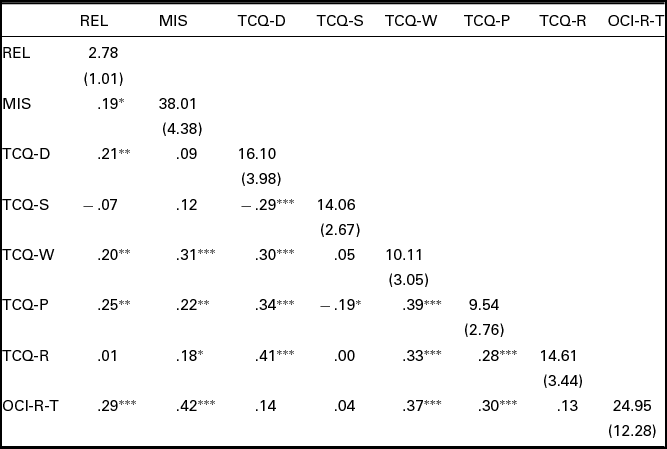
Means, standard deviations and zero-order correlations among the variables of the study are presented in Table 1. Of particular interest, the analyses showed that the OCI-R Total Score was positively associated with religiosity (r = .29, p < .001) and magical thinking (r = .42, p < .001). Furthermore, as predicted, it was positively related to only two subtypes of thought-control strategies; namely, worry (r = .37, p < .001) and punishment (r = .30, p < .001). Furthermore, religiosity and magical thinking were positively correlated (r = .19, p < .05). Lastly, both the degree of religiosity and magical thinking were associated with increased use of worry and punishment thought-control strategies.
Means, Standard Deviations for, and Intercorrelations Between the Measures

Note: Means, and standard deviations (in parentheses) are given on diagonal. REL = Religiosity Index; MIS = Magical Ideation Scale; TCQ-D = Thought Control Questionnaire — Distraction; TCQ-S = Thought Control Questionnaire-Social Control; TCQ-W = Thought Control Questionnaire — Worry; TCQ-P = Thought Control Questionnaire — Punishment; TCQ-R: Thought Control Questionnaire — Reappraisal; OCI-R-T: Obsessive-Compulsive Inventory — Revised — Total Score. For the correlations N = 165.
*p < .05, **p < .01, ***p < .001
Magical Thinking and Thought-Control Strategies as Mediators of the Relationship Between Religiosity and OC Symptoms
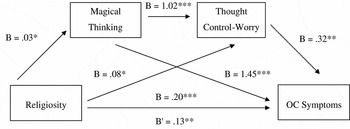
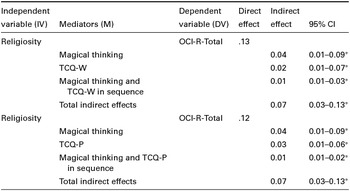
We tested the mediating effect of magical thinking and thought-control strategies of worry and punishment on the link between religiosity and OC symptoms. As well as examining the two mediators (i.e., magical thinking and thought-control strategies) at once, we also wanted to test the interactive effects of the two mediators on each other. Therefore, a test of multiple mediation (Model 6) was performed using the SPSS modelling macro procedure, PROCESS (Hayes, Reference Hayes2013). This multiple mediation procedure offered the advantage of testing two mediators simultaneously (i.e., increased magical thinking and increased tendency to use worry or punishment thought-control strategies in sequence) rather than separately, in order to determine the overall effect of both mediators, as well as to obtain a clearer picture of the unique effects of each mediator. It was therefore conducted with two separate analyses: the first one included magical thinking and thought control-worry as mediators and the second included magical thinking and thought control-punishment as mediators. In the first analysis, religiosity predicted higher OC symptoms, t(161) = 3.92, p < .001, more magical thoughts, t(163) = 2.47, p < .05, and higher levels of thought control-worry, t(162) = 2.00, p < .05. Importantly, when we entered both mediators into the analysis, the significance level of association between religiosity and OC symptoms dropped, t(161) = 2.69, p < .01. We tested for the significance of this effect using the bootstrap method. This analysis revealed that the unique indirect effect of religiosity on OC symptoms through both magical thinking and thought-control worry were significant, estimate = 0.04 (95% CI 0.01–0.09), SE = .02, and estimate = 0.02 (95% CI 0.01–0.07), SE = .02, respectively. This suggests that both magical thinking and worry as a thought-control strategy mediate the link between religiosity and OC symptoms. Furthermore, the unique indirect effect of religiosity on OC symptoms through magical thinking and thought control-worry in sequence was significant, estimate = 0.01, (95% CI 0.01–0.03), SE = .01. Lastly, the total indirect effect of all mediation paths (i.e., magical thinking, thought control-worry, and magical thinking and thought control-worry in sequence) on OC symptoms was significant, estimate = 0.07, (95% CI 0.03–0.13), SE = .03. These findings, highlighted in Figure 1, suggest that religiosity increases severity of magical thinking, which in turn increases thought control strategy-worry, and thereby leads to an increase in OC symptoms.
The mediating role of magical thinking and Thought Control-Worry in the link between religiosity and OC symptoms.

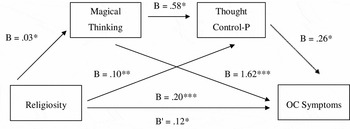
The same sets of analyses were conducted with thought control-punishment as the second mediator instead of thought control-worry. Similar to the above findings, religiosity predicted higher OC symptoms, t(161) = 3.92, p < .001, more magical thoughts, t(163) = 2.47, p < .05, and higher levels of thought control-punishment, t(162) = 2.84, p < .01. Importantly, when we entered both mediators into the analysis, the significance level of association between religiosity and OC symptoms dropped, t(161) = 2.59, p < .05. Again, we tested for the significance of this effect using the bootstrap method. Besides the significant unique indirect effect of religiosity on OC symptoms through magical thinking, as indicated in the previous analysis, the unique indirect effect through thought control-punishment was significant, estimate = 0.03 (95% CI 0.01–0.06), SE. = .01. This suggests that thought control-punishment mediates the link between religiosity and OC symptoms. Furthermore, the unique indirect effect of religiosity on OC symptoms through magical thinking and thought control-punishment in sequence was significant, estimate = 0.01 (95% CI 0.01–0.02), SE = .01. Lastly, the total indirect effect of all mediation paths (i.e., magical thinking, thought control-punishment, and magical thinking and thought control-punishment in sequence) on OC symptoms was significant, estimate = 0.07 (95% CI 0.03–0.13), SE = .02. As depicted in Figure 2, these findings suggest that religiosity increases severity of magical thinking, which in turn results in increased using of punishment thought-control strategies and thereby leads to an increase in OC. The results of all the mediation analyses are summarised in Table 2.
Summary of 5000 Bootstraps Resamples of the Indirect Effects on OC Symptoms
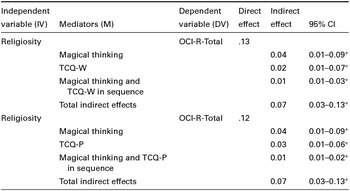
Note: TCQ-W = Thought Control Questionnaire — Worry; TCQ-P = Thought Control Questionnaire — Punishment; OCI-R-Total: Obsessive-Compulsive Inventory — Revised — Total Score.
*p < .05
The mediating role of magical thinking and thought control-punishment in the link between religiosity and OC symptoms.

Discussion
The present study investigated the mediating role of magical thinking and two thought-control strategies, namely worry and punishment, in the relationship between religiosity and OC symptoms. More importantly, we also tested the interactive effects of two mediators (magical thinking and thought control) on each other. In other words, we were specifically interested in understanding how magical thinking and thought-control strategies were related to each other in explaining the relationship between religiosity and OC symptomatology. It was expected that the relationship between religiosity and OC symptoms would be mediated by magical thinking via punishment and worry. Results showed that the relationship between religiosity and OC symptoms was found to be mediated by magical thinking via both worry and punishment.
The results of the present study confirmed previous research findings (Amir et al., 2011; Einstein & Menzies, Reference Einstein and Menzies2004a, Reference Einstein and Menzies2004b, Reference Einstein and Menzies2006, Reference Einstein and Menzies2008). As is well known, magical thinking refers to dysfunctional beliefs about the causal power of a person's thoughts or actions that are physically unconnected to the events. Therefore, individuals who have heightened magical ideations would feel responsible for controlling their thoughts using thought-control strategies to prevent the feared outcome. However, as stated by cognitive-behavioural models of OCD (e.g., Clark, Reference Clark2004), these attempts usually increase both the frequency and the intensity of the intrusions as well as further thought-control efforts. Our results suggest that certain thought-control strategies, such as worry and punishment, explain the consistently demonstrated relationship between magical thinking and OCD symptoms (e.g., Einstein & Menzies, Reference Einstein and Menzies2004a, Reference Einstein and Menzies2004b). In other words, if a person with magical thoughts uses certain thought-control strategies, such as worry and punishment, in order to control his or her thoughts, he or she may suffer from OC symptoms, mainly because the effort in controlling the thoughts would further increase the thought itself, which creates a vicious cycle.
In a similar way, the results of the present study showed that religiosity followed the same path regarding worry and punishment. In other words, religious individuals seem to use worry and punishment as thought-control strategies, which then result in increased OC symptoms. Consistent with previous studies (e.g., Abramowitz et al., Reference Abramowitz, Deacon, Woods and Tolin2004; Inozu et al., Reference Inozu, Clark and Karanci2012; Yorulmaz, Gencoz, & Woody, Reference Yorulmaz, Gençöz and Woody2009), strict religious codes and moral standards in highly religious individuals may increase catastrophic misinterpretation of the content and occurrence of thoughts that result in increased anxiety and distress. In order to decrease this discomfort caused by unwanted mental intrusions, people may use thought-control strategies of worry and punishment. This effort of control paradoxically brings about an increase in these thoughts, which then results in the emergence of OC symptoms.
The most significant contribution of this study is that the relationship between religiosity and OC symptoms was found to be mediated by magical thinking via worry and punishment. The positive relationship between TAF, as a specific form of magical thinking, and religiosity has been well documented in the literature. For example, Rachman (Reference Rachman1997) suggested that strict religious beliefs and moral codes can provide a framework for individuals to choose which behaviours and mental activities are regarded as morally unacceptable and therefore should be removed from conscious awareness. Therefore, TAF might be prominent in highly religious individuals who attach strong personal meaning to the content and occurrence of intrusive thoughts. Magical thinking is usually defined more broadly than TAF alone. It is plausible to expect a positive association between religiosity and magical thinking because highly religious people who have strict codes and moral standards for themselves may show a higher tendency to believe in the power of their own thoughts (e.g., even the thought of cheating on my husband will increase the real-life likelihood of my cheating). The findings of this study supported this notion. As stated before, these appraisals seem to motivate a person to control his or her thoughts to prevent the feared outcome through control strategies of worry and punishment. Yet, owing to the probable inadequacy of these efforts, OC symptoms paradoxically increase.
The results of this study have some implications for the treatment of OC symptoms. Our findings showed that there was a positive association between religiosity and magical thinking. As suggested by Rachman (Reference Rachman1997) and Salkovskis, Shafran, Rachman, and Freeston (Reference Salkovskis, Shafran, Rachman and Freeston1999), strict religious beliefs and moral codes may provide a suitable atmosphere to develop dysfunctional beliefs such as magical thinking and TAF (Salkovskis et al., Reference Salkovskis, Shafran, Rachman and Freeston1999). Therefore, as suggested before (Abramowitz, Reference Abramowitz2002; Wilhelm & Steketee, Reference Wilhelm and Steketee2006), a treatment plan for highly religious people should include cognitive restructuring strategies that focus on the modification of magical beliefs and recognition of how misinterpretation of intrusions increases the intensity of the intrusions as well as negative emotions, such as the anxiety seen in OCD. Moreover, the dysfunctional thought-control strategies employed by these people should be challenged in the treatment. These strategies should guide them toward a more accepting attitude about thoughts, rather than trying to control them.
Although the present study was conducted in an adult community sample rather than a university student sample, a cross-sectional research design limited the cause and effect relations of the findings. This study was comprised only of individuals with an Islamic religious affiliation and we do not know whether these findings would be observed across different religious affiliations. Therefore, future studies could overcome this limitation by comparing different religious affiliations. Moreover, the study should be replicated in a clinical sample.
In conclusion, although the findings indicate a significant association between magical thinking and OC symptoms (Bocci & Gordon, Reference Bocci and Gordon2007; Einstein & Menzies, Reference Einstein and Menzies2004a, Reference Einstein and Menzies2004b; Frost et al., Reference Frost, Krause, McMahon, Peppe, Evans, McPhee and Holden1993; Sica et al., Reference Sica, Novara and Sanavio2002), and religiosity and OC symptoms (Abramowitz et al., Reference Abramowitz, Deacon, Woods and Tolin2004; Inozu, Karanci et al., Reference Inozu, Clark and Karanci2012; Sica et al., Reference Sica, Novara and Sanavio2002; Witzig, Reference Witzig2005), the mediating role of magical thinking via worry and punishment in the relationship between religiosity and OC symptoms is a novel finding. Future studies should include experimental designs to determine whether heightened magical thinking, religiosity, and thought-control strategies are causal processes in the development of OC symptoms.
Acknowledgments
This work was supported in part by the Turkish Academy of Sciences (TUBA) under the Program for Awarding Outstanding Young Scientists (GEBIP-2013).