Introduction
The aim of this paper is fourfold: (1) to discuss the acquisition particularities of the advanced-level students, (2) to discover the sources of errors in heritage and second language learners, (3) to study the use of content-based—in this case media material—in teaching advanced-level students, and (4) to investigate the impact of teaching such material on the students’ writing ability and overall proficiency.
Some content-based materials include translation of literary texts, simultaneous translation of films, classical literature, modern literature, film studies, and media, to name just a few. The content-based material that is studied in this paper is media, with a particular focus on newspapers.
Teaching at advanced level encompasses subtleties at both the structural and lexical level, as well as at the discourse or pragmatic level of the language; therefore, any of the aforementioned topics can be adopted in order to demonstrate the higher-order complexities of the language.
In this paper, I give an example of such texts, with a focus on journalistic texts. I begin by discussing various relevant topics, including but not limited to the analysis of advanced students’ language acquisition on the one hand, and the sources of errors in heritage learners (HL) versus second language learners (SLL) of Persian, on the other. In addition, I discuss how the use of media, and in particular newspapers, as the main material in an advanced course impacts students’ writing skill and overall proficiency level.
In my discussions, I adopt a linguistic point of view with a universal grammar approach in regard to the acquisition of a second language, and an applied linguistic approach in regard to the evaluation of the effectiveness of the material used in class.
Teaching the Advanced Level
Most teaching methodologies, starting from earlier ones such as the natural approach, up to later ones, such as the task-based approach, are more apt for the beginner level or, at most, the lower intermediate level. We cannot expect advanced-level students to pick up the fine differences between their first and second language on their own, or to master different registers used in different texts and contexts without making them conscious of those differences. Therefore, a lot of care must be taken when designing material for this level so that students will attain a near-native standard of proficiency.
Birdsong compares first language (L1) and second language (L2) ultimate attainment through a comparison of the outcome of the two. Note that L2 can be any language that is learned in addition and subsequent to the first language. Therefore, the third or the fourth or the nth language that one learns is still called L2. Birdsong asserts that L1 acquisition in normal children always results in success, whereas L2 acquisition in normal adults results in varying degrees of success.Footnote 1
It should be mentioned that ultimate attainment does not mean reaching an “end point” but rather a “steady state.” We cannot consider a language to be a finite bounded system whose acquisition can be considered complete. There are many expressions, morphological rules, proverbs, etc., that are to be acquired on the acquisition path on a steady basis. This applies not only to the L1 native speakers, but also to the L2 near-native speakers.
Coppieters compares the grammatical judgment of native speakers of French and near-native speakers of French. Although he observes significant differences in the performance of the two groups, it seems that the divergence is mostly in language-specific functions or parameters of the French language, such as the passé composé vs. imperfect, rather than in the universal principles of the language, such as cliticization (e.g. the objective clitics, me, te, le in French (Je me lave; Tu te laves, etc.); beh-em goft—“to-me he said,” didam-esh—“I saw-him” in Persian).Footnote 2
The idea of principles (invariants of human language) and parameters (cross-linguistic variations) was first introduced by Chomsky in his universal grammar theory,Footnote 3 which was later on adopted in second language acquisition (SLA) by White.Footnote 4 Universal grammar entails that all languages share some principles and that these principles are present both in L1 and L2 acquisition, and that it is these shared principles that facilitate L2 acquisition.
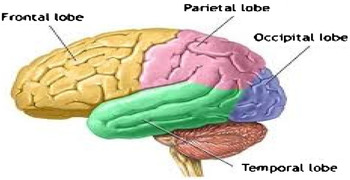
Often we have students in our advanced classes who know the rules very well, yet they cannot converse fluently in the language. According to DeKeyser, L2 learners who know the rules but cannot speak in the L2 have the following problem: they have a gap between insufficiently automatized explicit knowledge (i.e. declarative knowledge) on the one hand and very limited implicit/automatized knowledge (i.e. procedural knowledge) on the other.Footnote 5 Speaking about declarative vs. procedural knowledge, let’s look at the difference physiologically to visualize it better (Figure 1).
Different parts of the brain.

In fact, L1 speakers possess two different brain memory systems: the lexicon and rules. The former is stored in the declarative memory and rooted in temporal lobe structures (the temporal lobe is in charge of language comprehension), whereas the latter are stored in the procedural memory and rooted in frontal brain structures (the frontal lobe is in charge of speech production and syntax). Speakers of L2, however, depend mostly on the declarative memory.Footnote 6
That is why teaching grammar explicitly at the advanced level of language teaching might not be the best strategy to help L2 learners reach their ultimate attainment. On the other hand, leaving L2 learners at the mercy of their own discovery learning does not help them either and certainly will not lead to their ultimate attainment. In other words, guided instruction is necessary to put the L2 learners on the right track.
Another important point to bear in mind is the need for practicing both comprehension and production equally. DeKeyser has reported that some L2 learners who have studied abroad come back home with automatized comprehension, yet with no procedural production.Footnote 7 This is another piece of support for the significance of guided instruction in the classroom or a similar setting.
Looking back and thinking about what we discussed above, about ultimate attainment, reaching a steady state, the problem of acquisition of parameters, the implicit/explicit knowledge dichotomy, the procedural/declarative knowledge dichotomy, and the comprehension/production dichotomy, we can now see why it is crucial to provide advanced L2 learners with the necessary linguistic input to facilitate their reaching the ultimate attainment level. In other words, we cannot simply hope that L2 learners will pick up the fine particularities and complexities of the language, and we need a solid organized syllabus and curriculum to help them attain that level.
As far as teaching Persian is concerned, postgraduate advanced language courses concentrate on a linguistic/thematic theme, based on the interest and expertise of the instructor as well as the needs and majors of the students. In most advanced Persian courses, Persian literature is taught using primary sources, while in Persian literature courses, Persian literature is taught in translation through secondary sources. In a few exceptional programs, advanced Persian is adapted to heritage learners’ literacy levels. Basing the advanced level on literature is quite important and relevant; however, this alone does not lead to the students’ near native-ness. What advanced L2 learners need is exposure to the same input that native speakers have on a daily basis. Media is a good resource for reaching this goal, as it includes a variety of texts in the context of society that native speakers deal with daily.
Different Types of Media
Different kinds of media can be used in language courses. Different tasks can be assigned to students to make use of a variety of media. Some, such as such as radio, television, magazines, and newspapers, are more suitable for practicing comprehension, while others, like the internet, i.e. social media (e.g. Facebook, Twitter, and Instagram), can be used as a platform for practicing both comprehension and production.
There are some particularities which must be considered when working with media. One such particularity is the fact that there are different genres of media, each of which demands a particular structure, wording, format, presentation, etc. According to Fowler, news is a representation of the world in language, whose wording, syntactic structure, mode of presentation, etc., has a reason.Footnote 8 Therefore, when working with the media, L2 learners will not only be exposed to native-like input, but they will also be familiarized with the higher strata of the language used in the media. This in turn facilitates the automatization of the already proceduralized declarative knowledge.
Now that the efficacy of using media in language courses, especially in advanced-level courses, has been established, there is the question of selection: which types of media to select in order for the input to be more native-like for the L2 learners.
Abasi studied and reported the think-aloud accounts of advanced students’ summaries from an authentic news text in Persian and a news text translated into Persian. The participants, who were all advanced students of a Persian Media class, found it easier to comprehend and summarize the second text due to the fact that it was originally written in English, and it had a structural organization familiar to the students. The participants reported that the authentic Persian text was disorganized, indirect, and vague; that is why it took them longer to read the text. When it came to the summarizing task, it took them longer to read the original Persian text, and they used more conjunctions and made more mistakes. Abasi argues that the reason for the difference in the performance of students in the two tasks was the L2 learners’ lack of familiarity with the cultural cues. In addition, he asserted that L2 learners must not only be made aware of the cross-cultural differences in writing, but also be taught to appreciate them.Footnote 9
In order to make L2 learners appreciate the cross-cultural differences, they must be exposed to them. It is through the selection of the media and its various types that such a situation can be made possible. Therefore, a variety of media types, genres, and sources must be used to immerse the L2 learners in a similar setting to the native speakers.
As far as the use of media in academic settings is concerned, it can be noted that in Iran, an undergraduate degree in a language requires that students take more than 140 credits, at least 40 of which focus on the media. They include courses such as translation of journalistic texts, translation of audio-visual material, and simultaneous translation. There are also language courses within journalism that involve the use of media in language learning. Outside Iran, in North America and Europe, higher education programs of Persian language make use of different types of media based on the course level. Media is intertwined in the classroom activities.
Most studies in the interface of language and media have been on written media, mainly newspapers, as it is easier to study something written than to transcribe the spoken media discourse and then analyze it.
Biber et al. identify the language of newspapers as one of four registers of the English language, the other three being: spoken conversation, academic writing, and fiction.Footnote 10 Assuming that this classification also holds for Persian, our L2 learners have had some kind of input in the three latter domains throughout their studies, but that of newspapers must be presented to them so that they become exposed to all the registers in the language. Each of these registers has its own syntactic patterns and lexico-grammatical usage. Therefore, in order to acquire these subtleties in the language of newspapers, the L2 learners will have to learn the language patterns used in the newspaper.
Other than the language patterns in the newspapers, each section of the paper has its own idiosyncratic patterns. Therefore, in order to acquire mastery over all these patterns, the L2 leaners have to be exposed to different sections of the newspapers, such as the editorial, classified, business section, political section, social section, and arts section. Each of these sections has a unique pattern that is more or less standard and can be learned by the L2 learners if they are made conscious of it. This is especially helpful, as adult language learners, unlike children, attain more meaningful learning if they are conscious of what they are learning because they can make use of their higher order logic and metacognitive skills.
In addition to the linguistic significance of newspapers, their social importance should also be pointed out. According to Stubbs, texts encode representations of the world; therefore, they help to construct social reality.Footnote 11 By analyzing the text, we can observe the society. For L2 learners who are learning the language outside the host society, this can be a window to the society whose language they are studying. Therefore, reading, analyzing, and plunging into the newspaper is like living a “social life simulator.”
Consequently, when selecting the newspaper in the L2 advanced course it is imperative to choose carefully. How can we have an Iranian life simulator if we choose those papers that are published outside Iran, or if we only choose one type of newspaper, say the left-wing or the right-wing?
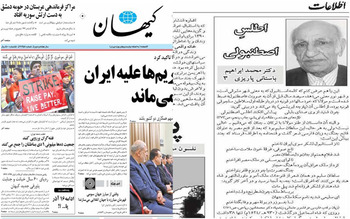
Therefore, to be close to the society in today’s Iran, we must choose among different papers published in Iran. In this way, the L2 learners will have a taste of different political factions, social problems, etc. through an elevated discourse as well as a non-elevated discourse, or polished and un-polished language, as is the case in real-life society. Let’s look at some of these variations in a selection of newspapers published in Iran (Figure 2).
Two kinds of newspapers in Iran.

Regardless of the themes of the news in the pages shown in Figure 2, a quick glance at the newspaper on the left and the one on the right reveals two very different styles of writing. While the one on the left has used unpolished non-elevated language, the one on the right is written by a renowned contemporary writer of Iran, Bastani Parizi (1924‒2014), and the language used is highly elevated and poetic. Yet both of these very different registers are familiar to Persian speakers in Iran, who are exposed to different variations of them on a daily basis. Therefore, it is imperative that a textbook for the advanced media Persian course would include both varieties of register, rather than only the polished one.
Heritage Learners versus Second Language Learners of Persian
This section will give an overview of the existing studies on Persian heritage learners relevant to the present study. Before discussing such studies, I would like to establish the definition of heritage language adopted for the purpose of the present study. There are different definitions for heritage language, the two extreme ones on the two ends of a continuum are: (1) the “broad” definition which entails that heritage language learners (HLL) could have no language at all, but rather only a cultural connection to the heritage language,Footnote 12 and (2) the “narrow” definition, which considers a person to be a heritage language learner if they are to some extent bilingual and speak or at least understand the heritage language due to exposure at home, while at school they are only educated in the majority language or the official language spoken in the country of residence.Footnote 13
For the purpose of this study, the second definition is adopted since it is based on the language proficiency of the heritage language learners rather than merely their cultural connection to their language of origin. More recent definitions are also more proficiency based, requiring a heritage learner to be bilingual, with a weaker and a stronger language, the weaker being the heritage language and the stronger being the dominant language.Footnote 14 As far as studies on Persian heritage language are concerned, the field is still quite young, and there is a handful of such studies, which I will mention briefly below.
Cagri et al.’s work is among the major studies in Persian heritage language, in which heritage language learners and L2 learners are compared for their accuracy and speed (reaction time) in tests devised to check their proficiency in Persian phonology, morphology, syntax, lexicon, collocation, and comprehension.Footnote 15 They reported that their results showed that heritage language learners perform better than L2 learners overall, except for cases like Arabic-broken plurals, which are rarely used in conversational Persian.
Unlike Cagri et al.’s study that compares the performance of heritage language learners and L2 learners, Moore and Sadegholvad compare the performance of heritage language learners and of native speakers by looking at their writing samples.Footnote 16 They find that heritage language learners show a preference for colloquial usage and simplification as well as language transfer from their most dominant language.
Sedighi highlights the differences between heritage language learners and second language learners of Persian to be language style, polite/honorific form, phonetics, phonology, orthography, lexicon and code-switching, relative clauses, passive construction, prepositions, broken plural formation, and some tenses, such as past continuous tense, present perfect tense, and future tense. She reports that heritage speakers do not seem to get the written formal language due to insufficient schooling. She also finds that L2 learners outperform the heritage language learners when it comes to using the honorific language. She attributes this to the possibility of the L2 learners being more conscious of the target language culture, while the heritage learners have not been corrected by their parents, resulting in the non-honorific forms being fossilized. Sedighi identifies two sounds (/r/ and /gh/) as being the most problematic ones for the heritage language learners of Persian. She reports that L2 learners outperform the heritage language learners, due to their conscious effort of learning these two sounds that are different from their L1. In Persian phonology, Sedighi gives the example of “bilabial assimilation” of /n/ changing to /m/ when followed by the labial sound /b/.Footnote 17 She states that heritage learners observe this assimilation both in speaking and in writing. For the orthography, Sedighi quotes an example from Moore and Sedegholvad’s study in which L2 learners are reported to write the letter associated with the familiar English sound /g/ instead of the letter associated with the new unfamiliar target language sound /gh/. Sedighi attributes the reason for the heritage language learners not making this kind of mistake to the fossilization of familiar words in these types of learners.Footnote 18
On the other hand, Megerdoomian attributes the problem with the orthography in Persian heritage language learners to the diglossic situation in Persian.Footnote 19 Diglossia refers to the situation where two variants of a language coexist simultaneously in a given society, one being the formal variant and the other the vernacular.Footnote 20
Sedighi as well as Modarresi report lexical access problems for heritage language learners, hence their resort to code-switching.Footnote 21 In addition, in broader studies on heritage languages in general, a strong correlation has been reported between the heritage speakers’ lexicon (a basic word list including 200 lexical items) and their control of certain grammatical phenomena, such as agreement, case marking, aspectual and temporal marking, pro-drop, co-reference, and embedding.Footnote 22
Sedighi attributes the mistakes in certain tenses, like the use of simple past instead of the present perfect, made by heritage language learners to their inability to make a distinction between the two, as they sound similar in spoken Persian. She reports that L2 learners, due to making conscious effort to acquire the two tenses, do not make similar mistakes.Footnote 23
In regard to relative clauses, Sedighi reports that heritage language learners tend to avoid using resumptive pronouns and relative clauses, and instead they use shorter utterances using only pronouns. For passive construction, Sedighi quotes Fani that heritage language learners do not use the passive voice in their utterances, due to the rarity of passive constructions in the spoken form.Footnote 24 Sedighi follows Moore and Sadegholvad in stating that heritage learners and L2 learners equally make mistakes in the use of prepositions, which can indicate their limited command of an unfamiliar system of prepositions rather than L1 transfer. The problem of the acquisition and production of Arabic broken plurals in heritage language learners is another area discussed by Sedighi, for which she considers lack of schooling to be the contributing reason.Footnote 25
Unlike the above issues that are reported by several studies to be difficult for heritage learners to acquire, there are certain areas that Sedighi has argued to be easy and native-like in Persian heritage language learners, some of which are: rate of speech, word order, overt subject, verb agreement, psychological verbs, generic nouns, specific direct object marker, Ezafe construction, order of nouns and adjectives, imperatives and vowel harmony, and language chunk and formulaic speech.Footnote 26
Sedighi reiterates Cagri et al. that heritage language learners perform faster than L2 learners. However, it is not clear how they would perform compared to native speakers. In regard to other areas mentioned above, Sedighi reports that heritage language learners outperform the L2 learners and are generally more native-like, while for L2 learners, their L1 transfer poses problems for their language being native-like.Footnote 27
In a seminal paper, Benmamoun et al. discuss heritage languages in general and the opportunities and challenges that studying them will present for linguistics. They state that phonology is perhaps the easiest area for heritage learners to master, while morphology, especially inflectional morphology in languages that exhibit a system of regular and irregular inflectional morphology, is most likely to show variability in heritage learners. They argue that universal properties of languages, like noun‒verb distinction, seem not to pose a problem for heritage language learners. The most problematic area to master for heritage learners seems to be syntax. Heritage language learners resort to the most basic and the most universal aspects of syntax. In semantic interpretation, heritage learners seem to perform more like L2 learners than L1 speakers.Footnote 28
Interface phenomena is another topic raised by Benmamoun et al. to pose difficulty for heritage language learners. Some of these interface phenomena are lexicon‒syntax, syntax‒morphology, syntax‒phonology, discourse‒pragmatic, etc.Footnote 29
Benmamoun et al. define what heritage language grammar is. Some of the characteristics of such a grammar are: (1) incomplete acquisition, which is caused by insufficient input; (2) attrition, which is the gradual loss of L1 in a bilingual environment; (3) dominant language transfer, which is the transfer of linguistic features of the dominant language to the heritage language; (4) incipient changes in the input, which refers to the limited baseline grammar of the heritage language community that feeds the linguistic input to the heritage language learners.Footnote 30
Sedighi calls for more research in the field of Persian as a heritage language. She enlists the areas in dire need of attention and scrutiny, as follows:
-
1. More systematic research on linguistic and cultural profiles, attitudes, behaviours, beliefs, and motivations of heritage speakers of Persian;
-
2. Study focused on developing pedagogical strategies for heritage language teaching and learning;
-
3. More level-appropriate and age-appropriate instructional material;
-
4. Appropriate placement tests and assessment tools;
-
5. Raising awareness in educational institutions on the importance of heritage Persian instruction;
-
6. Raising awareness in families/communities to foster the heritage language;
-
7. Raising awareness in the government.Footnote 31
The present study aims to address the second and third points raised by Sedighi in helping the young field of Persian as a heritage language to grow.Footnote 32
Above, I reviewed several studies on Persian heritage language learners in comparison to L2 learners of Persian as well as native speakers of Persian. Below, I will review studies on the teaching of Persian heritage language.
Coming from a linguistics background, Megerdoomian suggests a pedagogical approach to teaching Persian heritage language that is based on linguistics tenets. Similar to the current study, she is also in favor of the explicit instruction of grammar through a linguistic analysis in heritage language classes and believes that the implicit instruction is not sufficient for heritage learners, especially in the case of formal language and literacy skills. This makes perfect sense, because it is very unlikely that heritage learners would pick up formal language and literacy skills at home. They need to be exposed to a host of both positive and negative input in order to acquire a certain grammatical structure that they have never heard at home. Megerdoomian also proposes that this kind of linguistic approach and the explicit instruction of linguistic forms will enable heritage language learners to make linguistic generalizations. In other words, the common linguistic features of their universal grammar will help them in the acquisition of their heritage language. She provides some excellent hands-on techniques to teach the areas of difficulty for Persian heritage learners, such as orthography/phonology dichotomy, Ezafe construction, and complex predicate constructions.Footnote 33
Other than the explicit teaching of certain areas of difficulty for heritage learners and L2 discussed above, some studies have suggested providing negative evidence in addition to positive input to ascertain the acquisition of certain linguistic features that are different in L1 speakers and heritage learners as well as L2 learners. Mortazavinia investigates the L2 acquisition of semantic properties related to “even” across English and Persian. She suggests that providing negative input is essential in the correct acquisition of the semantics of “even” in L2 learners of Persian.Footnote 34
Other than studies on linguistic aspect of Persian heritage language discussed above, there are other studies that focus on the non-linguistic aspects. One such study is by Atoofi, who examines what kind of linguistic resources are used by heritage language learners to show their moods, attitudes, and feelings.Footnote 35 Following Beeman, Atoofi calls for more research to be done on such non-linguistic features, as, to date, most of linguistic research on heritage language has emanated from generative grammar and psycholinguistics.Footnote 36 Atoofi studied a group of Persian heritage language learners and teachers in California and reported how they used linguistic means, such as phonology, morphology, and discourse structure to show particular affective stances.
Although in an ideal world heritage language learners are placed in a different language class than L2 learners of Persian, so that the teaching approach and the material are tailored to them, in reality this rarely happens, and both heritage language learners and L2 learners attend the same class. What is more problematic is the uneven proficiency levels of heritage learners and the lack of assessment tools to evaluate their proficiency level. Shabani-Jadidi and Sedighi discuss the problem posed by the uneven proficiency levels of students, especially when these two groups of heritage language learners and second language learners are placed in the same class.Footnote 37
Shabani-Jadidi and Sedighi give an overview of the teaching of Persian as a second language in the world throughout history as well as the existing teaching material and assessment tools for the L2 learners of Persian. They also discuss the existing research on the second language acquisition of Persian, which has carried out in Iran, Europe and North America. They divide such studies into different levels of phonetics and phonology, language skills, language learning strategies, socio-linguistics, and lexico-semantic. They also focus on studies whose tested population had English as their L1 as well as those who had other language as their L1, like Arabic, Korean, and Mandarin Chinese.Footnote 38
Below, I examine the sources of errors in the writing samples of advanced Persian heritage language learners and advanced L2 learners of Persian with either English or French as their L1.
The Present Study
This study investigates the quantity and quality of the errors made by advanced-level students of Persian after studying newspapers published in Iran and their corresponding exercises for one year. These sources will be explained and discussed in detail in the results and discussion sections.
The study comprises a diagnostic post-test after a whole year of a media Persian course. The reason why the post-test was used to elicit the data for advanced-level students’ errors was so that the subjects would reach the same level of proficiency. The source of errors among heritage learners was compared to those for second language learners in order to reach some general conclusions.
In addition to discovering the source of errors, I compared the writing samples of the HL and SLL at the end of the year-long media course. The level of difficulty index, FOG—that is, the reading grade level—was measured according to the following formula:
The Gunning FOG Index Readability Formula = 0.4 (average sentence length + % words of three or more syllables)
The FOG index was used rather than other readability formulas because it was in fact originally developed by the American textbook publisher Robert Gunning, who worked extensively with writers of over 60 daily newspapers and popular magazines.Footnote 39 This comparison was done in order to see the quality change in HL and SLL students’ writing skill after a year of studying media Persian at an advanced level.
Subjects
The subjects of the study were seven students of advanced Persian, three of whom were non-native speakers of Persian (one with French L1 and two with English L1), and four were native speakers of Persian who had either learned Persian at home or at Persian language schools in Canada or had attended the first two years of primary school in Iran. Therefore, none of the students were exposed to any journalistic terminology or a high register of the language before attending the class on media Persian. They were all in their early 20s and were either undergraduate or graduate students at McGill University, Canada.
All the subjects went through all the three levels of the Persian language program at McGill; therefore, they had more or less the same kind and amount of scholastic exposure to the language for three years.
It must be noted that the low number of the subjects is one of the limitations of the study; however, in most post-secondary Persian language programs in North America, the advanced level comprises a small group of students. Since I aimed at observing the improvement of the subjects’ overall Persian language proficiency as well as their writing skill in a longitudinal study over an academic year, the low number of subjects was tolerated. Nevertheless, if the study is done with a greater number of subjects, the results may differ.
Task
The task involved writing on a media topic using the expressions that the subjects had learned throughout the year. During the academic year, they had three hours of classes per week, during which they read pages from the following newspapers printed in Iran: Ettelā’āt, Keyhān, Sharq, E’temād, Irān, and Mardomsālāri. (These pages are selected from different sections of the newspaper, encompassing a variety of topics, such as politics, art, economics, advertisements, domestic news, international news, sports, cinema.)
The students read the newspapers at home, listened to the audio recordings of the pages, and worked on the exercises and came to class prepared. In class, we did the exercises in groups. There were a variety of exercises, including the following, extracted from Shabani-Jadidi's What the Persian Media Says (2015):
-
1. Comprehension questions, with more general questions preceding the more detailed questions, which aimed at strengthening the scanning and skimming skills of the students.
-
2. Idiomatic expression exercises, which dealt with proverbs and idioms, as well as technical and non-technical expressions.
-
3. Headline understanding exercise, which contained different pieces of background information that might not be clear at their first reading.
-
4. Writing practice, which was done in class as a writing workshop, and students had to follow the style of the articles they had read.
-
5. Vocabulary exercise, where students not only practiced with the meanings of the new words, but also gained experience with connecting ideas using relative clauses.
-
6. Singular/plural exercise, in which the Arabic broken plural constructions were presented over and over until they became automatic for the students.
-
7. Sentence making, through which students practiced using the expressions and proverbs they had previously read and practiced in preceding exercises.
-
8. Conjunction exercise (paraphrasing), which familiarized students with different ways of expressing the same idea in a variety of forms.
At the end of the academic year, the subjects were given a media topic to write an essay on, using the terminology and structure they had acquired during the course. They had an hour to complete the task. No book or dictionary was allowed to be used. The aim of the task was to see the sources of errors made at an advanced level of proficiency in Persian language in HL and SLL.
Results and discussions
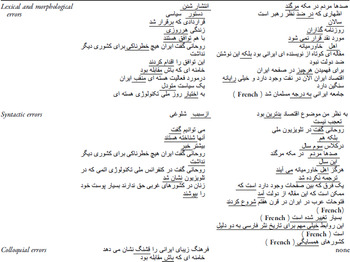
I carefully studied the seven essays written by the HL and SLL. I then analyzed the errors made by the students in order to find the error sources. Since the study aimed at evaluating students’ learning product rather than their learning process, the writing exam that was used for the analysis stage of the study was an achievement test. Table 1 illustrates the types and frequency of errors made in the essays written by the four heritage learners and the three second language learners, all of whom had English as their first language, except for one, whose error samples are marked as French.

The data in Table 1 shows that although the HL and SLL seem to be making the same number of mistakes at the lexical and morphological level, the SLL seem to make many more mistakes at the syntactic level. In addition, only the heritage learners are using colloquial words and structures in a formal setting. This study aimed at separating the sources of errors in SLL and HL; however, another study could focus on the interdependence of these different sources of errors or the interface effect.Footnote 40 Below, each of these sources of errors is illustrated with examples and discussed in detail both for HL and SLL.
Lexical and morphological errors
A closer look at the data in the Table 1 indicates that 50 percent of the lexical errors made by HL are in the selection of compound verb constituents, where they have either chosen a wrong noun or an infelicitous verb to combine with or incorporate, such as:
(1)

enteshār *shodan
publication *to be
“to be published”
(2)

Persian compound verbs include two parts: the non-verbal and the verbal. The verbal part is often called the light verb. It should be noted that although the definition of a light verb is a verb that is semantically bleached, some verbal constituents in compound verbs have meanings of their own and contribute to the meaning of the compound. The non-verbal part can be a noun (e.g. gerye kardan—“tear-to do”—to cry), an adjective (e.g. dāgh kardan—“hot-to do”—to get mad), a prepositional phrase (e.g. az bar kardan—“of-on-to do”—to memorize), an adverbial phrase (e.g. pish bordan—“forward-to take”—to succeed), or a complex nominal phrase (e.g. sar-be-sar-gozāshtan—“head-to-head-to put”—to tease).
One possible reason for the subjects using a wrong constituent in the compound verbs can be that this construction is not productive in English and French i. e. compound verb constructions in the Persian sense do not exist in English and French, hence the confusion in the selection of the nominal and verbal constituents. This finding is quite interesting as it indicates that although HL have the structure of the compound verbs right, they seem to be influenced by their dominant language and thus use an incorrect verbal element or a non-verbal element based on their dominant language. The issue of compound verbs and the infelicitous use of compound constituents by heritage language learners has been discussed in other studies.Footnote 42 However, the present study contributes to a broader understanding of this issue, as it looks at the two languages of French and English as the L1 of the subjects. In addition, Megerdoomian’s subjects seem to replace any verbal constituent with the most common one, i.e. kardan—“to do.” In the current study, however, this is not the case, perhaps due to the higher proficiency of the subjects who participated in this study.
Another source of error in HL is transfer from English, where the word or phrase is translated word for word, such as:
(3)

*dastur-e siāsi
*command-Ez political
“political order”
(4)

zendegi-e *har-ruz-i
life-Ez *each-day-adj
“everyday life”
Take a look at Example (3). In Persian, “order” has two translations, one being dastur (“command”) and the other nazm (“order”), whereas the expression “political order” is nazm-e siāsi and not dastur-e siāsi. It seems like the subject has transferred the word “order” from English to erroneously make the expression dastur-e siāsi (“political order”).
In Example (4), the subject seems to have transferred “everyday life” from English since in English the word “everyday” can be both an adverb and an adjective modifying “life,” whereas in Persian har-ruz (“everyday”) is only an adverb and har ruz-i (“any day”) is a combination of an indefinite adjective, a noun, and a suffix, and its adjective equivalent is ruzmarre or har-ruze.
First language transfer is very common in second language learning and has been reported in many studies.Footnote 43
Still another source of HL error is using the wrong part of speech of the word.
(5)

rohāni goft irān hich *khatarnāk-i baraye keshvar-i digar
Rohani said Iran no *dangerous-ind for country-ind other
na-dāsht
neg-had.3sg
“Rohani said that Iran is no danger to any other country”
In Example (5), the subject has used the adjective khatarnāk (“dangerous”) instead of khatar (“danger”). However, this error could be a spoonerism that is even made by native speakers. Spoonerisms are slips-of-the-tongue or the switching mistakes speakers make in the production of speech. They could be at the segment level, word level, or morpheme level. In Example (5), it seems to be at the word level.
Another source of error in HL is caused by creativity of the language users, which results in novel word formation or coinage of words that do not exist in the language but conform to the morphosyntactic rules of the language, such as:
(6)

dar mored-e faᶜāliat-e hasteyi-e *monqab-e irān
in case-Ez activity-Ez nuclear-Ez *neo-Ez Iran
“in regard to the (previous) nuclear activities of Iran”
(7)

yek siāsat-e *motevaddel
one policy-Ez *neo
“a (moderate) policy”
In Example (6), monqab is not a Persian word, but it certainly sounds like one. The same holds for motevaddel in Example (7). Neologisms are a very interesting phenomenon in second language acquisition and more research is needed to discover the patterns and nuances of coining new words by heritage and second language learners.
Contrary to the HL data, most of the lexical errors made by the SLL are either due to first or another second language transfer or overgeneralizations, which refer to SLL extending the rules of the SL to cases where the rules do not apply. This could be using the verb endings for non-verb stems, animate plural endings for inanimate nouns, etc. Some examples for overgeneralization are as follows:
(8)

sad-hā mardom dar makke *marg-and
hundred-pl people in Mecca *death-3pl
“Hundreds of people died in Mecca”
(9)

*sāl-ān
*year-an pl
“years”
In Example (8), the noun marg (“death”) has been conjugated using the verb ending -and, which indicates a third person plural verb. However, in Persian it is either the past stem or the present stem of the verb that takes the verb endings for conjugation. In Example (9), the animate plural marker -ān has been used to pluralize an inanimate noun sāl (“year”), whereas for inanimate nouns, the plural marker is -hā in Persian. In both (8) and (9), the subjects seem to have overgeneralized a rule to other cases that they were not supposed to.
Some examples of transfer from the first language (when English) are as follows:
(10)

ezhār-i ke *dar-zedd-e nazar-e rahbar ast
statement-ind that *in-against-Ez view-Ez leader is.3sg
“a statement that is in opposition to the view of the leader”
(11)

barāye fanhmidan-e *har-chiz dar safhe-ye irān
for to understand-Ez *each-thing in page-Ez Iran
“in order to understand everything in the page of Iran newspaper”
In Example (10), zedd-e (“against”) is a preposition and does not need another preposition dar (“in”) before. The expression dar-zedd-e is a direct translation from the English “in opposition to.” In Example (11), har-chiz (“each-thing”) is singular, whereas hame-chiz (“everything”) is plural. It seems as though the subject has directly translated “every” to har, the semantic scope of which is limited, and its closest equivalent is “each” in English.
An example of transfer from the first language (when French) is as follows:
(12)

jāmeᶜe-ye irāni *be-daraje mosalmān shod
society-Ez Iranian *to-degree Muslim became.3sg
“La société iranienne devint par degrés musulmane”
Example (12) shows the immediate transfer from the first language into second language use, as be-daraje (“by degree”) is the exact translation from the French “par degrés.”
Some examples of transfer from the second language (in this case Arabic) are as follows:
(13)

*ahl-e xāvar-e miāne
*native-Ez east-Ez middle
“the people in the Middle East”
(14)

maqāle-i kutāh az nevisande-i irāni bud *balke in
article-ind short by writer-ind Iranian was.3sg *rather this
neveshtan zedd-e dowlat na-bud
writing against-Ez government neg-was.3sg
“It was a short article by an Iranian writer; however, this writing was not against the government”
In Example (13), the subject has transferred ahl (“people”) from Arabic; in Persian, the word for people is mardom and not ahl, which is used for nationality. In Example (14), balke in Arabic means “but”, but in Persian it means “but rather.” The subject had to use vali (“but”) instead.
There are also some instances of spoonerisms—using one word instead of another due to their lexical, semantic, morphological, or phonological similarity, or even a combination of these. For example:
(15)

eqtesād-e irān alān dar naft vojud dārad va kheili
economy-Ez Iran now in oil existence has.3sg and very
*rāyāne sangin dārad
*computer heavy has.3sg
“Iran’s economy is now in the oil (industry) and has a significant computer (subsidy)”
(16)

mored-e naqd *qarār ne-mi-shav-ad
case-Ez critique *location neg-asp-be-3sg
“It is not being critiqued”
(17)

ruznāme-*gozār-ān
newspaper-*put-pl
“journalists”
In Example (15), due to phonological similarity, the subject has used rāyāne (“computer”) instead of yārāne (“subsidy”). In Example (16), the subject has used qarār instead of vāqeᶜ, both of which, when combined with a light verb can mean “to be located” (qarār dāshtan and vāqeᶜ budan). However, the word vāqeᶜ can be combined with shodan (“to be”) and passivize the verb, hence “to be critiqued.” In Example (16), the subject seems to have replaced one with the other, due to lexical similarity. In Example (17), due to morphological similarity, the subject has used the suffix gozār (“doer”) instead of the suffix negār (“writer”). It must be noted that the compound xabar-gozāri means “new agency,” and xabar-negār means “journalist.” Therefore, the subject seems to be replacing the correct second suffix with the incorrect first suffix.
Two sources of lexical errors made by HL are absent from the data of the SLL, namely novel word formation or coinage and mistaking different parts of speech of a word. This could be attributed to the SLL being more cautious and restricted by the SL rules when producing the SL. Of course, further research with a greater number of participants is required to verify this observation. Nevertheless, SLL being more cautious, resulting in making fewer errors than HL, has been reported by other studies on HLL and SLL.Footnote 44
Below, I will discuss the syntactic errors made by the HL and SLL and their possible sources.
Syntactic errors
Regarding the syntactic errors made by the HL and SLL, we can observe that in both groups the errors are mostly due to first language transfer. Some examples of first language transfer are as follows.
(Please note that all the subjects shared the same first language, that is, English, except for one, whose first language was French, which is identified by the word “French” in parentheses.)
(18)

be nazar-e man mozuᶜ-e eqtesād *badtarin bud
to opinion-Ez I topic-Ez economy *worst was.3sg
“In my opinion, the worst topic was economy”
(19)

taᶜjjob *n-ist
surprise *neg-is.3sg
“It is no surprise”
(20)

yek farq ke bein-e safah-āt vojud dārad
one difference that between-Ez page-pl existence has.3sg
*ast ke
*is.3sg that
“One difference that exists between pages is that”
(21)

keshvar-hā-ye *hamsāyegi
country-pl-Ez *neighborhood
Les pays voisins
In Example (18), the subject has transferred the syntactical structure of English, hence badtarin (“the worst”) without a noun following it. In Persian, superlative adjectives are followed by the noun, unlike all other adjectives, which follow the noun. Example (19) is the direct translation from English. How it is said in Persian is jā-ye taᶜjjob nist (“There is no place for surprise”). Similarly, Example (20) is a direct translation from English, as in Persian we need to say in ast ke (“ … is this that … ”). In Example (21), the word “voisins” in French is a noun; therefore, the French-speaking student used a derived nominal form of the word neighbor in Persian, too, hamsāyegi (“neighborhood”) instead of hamsāyeh (“neighbor”).
Other than the syntactical errors due to first language transfer, there are some syntactical errors in word order, such as:
(22)

rohāni *goft dar television-e melli
Rohani *said.3sg in television-ez national
“Rohani said on national television”
(23)

*in ravābet kheili mohem baraye tārikh-e nasr-e
*this relations very important for history-Ez prose-Ez
fārsi be do dalil ast
Persian to two reason is.3sg
“Ces relations furent très importantes pour l’histoire de la prose persane pour deux raisons”
Examples (22) and (23) both demonstrate the subject’s use of first-language word order; that is, English and French, respectively.
Sequence of tenses in Persian indirect speech is different from that in English and French. In Persian, the verb in indirect speech does not change in accordance with the main verb tense, as it does in English and French. In Persian, the verb in the indirect speech remains as it was uttered in the direct speech:
(24)

rohāni goft irān hich khatarnāk-i baraye keshvar-i digar
Rohani said Iran no dangerous-ind for country-ind other
*na-dāsht
*neg-had.3sg
“Rohani said that Iran had no danger for any other country”
(25)

momken ast ke in maqāle az dowlat *āmad
possible is.3sg that this article from government *came.3sg
“Maybe this article came from the government”
In Example (24), the tense of the embedded clause should have been present, rather than past, and in Example (25), the verb of the embedded clause should have been subjunctive because of the doubt that the word momken (“maybe”) casts on the sentence. In Persian, after hesitation modals or adverbs, the subjunctive mood of the verb is used.
First language transfer is also apparent in the subjects’ use of the passive voice, such as:
(26)

ānhā *shenākhte hast-and
they *known is.3pl
“They are known.”
(27)

rohāni goft dar konferāns-e melli-e teknoloji-e
Rohani said.3sg in conference-Ez national-Ez technology-Ez
atomi ke dar television *neshān shod
atomic that in television *showing was.3sg
“Rohani said in the national conference of atomic technology that was shown on TV”
In Example (26) the verb needs the past participle of shodan (“to be”) and in Example (27) the verb needs the past participle of dādan (“to give”) before the conjugated verb in order to make a passive verb in Persian.
(28)

*tarjome na-karde shod
*translation neg-done was.3sg
“It was not translated”
In Example (28), the subject has used shodan (“to be”) correctly, but has erroneously added an extra verb na-karde (“not done”). Therefore, the verb shodan (“to be”) should be negative, as na-shod.
(29)
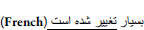
*besiār taghir shode ast
*very change been is.3sg
“Se modifia beaucoup”
(30)

fotuhāt-e arab dar irān dar qarn-e haftom shoruᶜ
conquests-Ez Arab in Iran in century-Ez seventh start
*kard-and
*did.3pl
“Les invasions arabes en Iran commencèrent au septième siècle”
In French and English, the word for “start” is both an accusative verb (a verb whose external argument is a semantic agent) and a non-accusative verb (a verb whose external argument is not a semantic agent and thus not actively responsible for the action of the verb). However, in Persian this verb takes a different verbal element based on whether there is a semantic agent in the sentence or not, hence the mistake in the use of the accusative version of the verb by the French-speaking student in Example (30) and the error in the use of the non-accusative in place of the accusative in (29).
The first two examples (26‒27) are from the HL and the others (28‒30) from SLL. As mentioned before, the SLL seem to be more conscious of the grammatical rules, which has resulted in their using the correct elements of a passive verb; that is, a past participle plus the verb “to be.” The HL, however, seem to forget one of the elements in each example. This observation that SLL outperform HL due to being more careful not to make a mistake in L2 is in line with other studies on heritage language learners’ errors.Footnote 45
Another difference between the HL and SLL source of errors is the HL use of colloquial in the formal setting, such as:
(31)

farhang-e zibā-ye irāni-rā qashang neshān mi-dah-ad
culture-Ez beautiful-Ez Iranian-rā beautiful showing asp-give-3sg
“It shows the beautiful culture of Iran nicely”
In Example (31), the subject had to use be qashangi (“beautifully”) rather than qashang (“beautiful”) as the word is modifying the verb “to show.” However, in colloquial Persian qashang (“beautiful”) is sometimes used to mean the adverb be qashangi (“beautifully”).
(32)

khāmeneyi ke bā(hā)-sh moqābele bud
Khameneyi that with-Enc contradicting was.3sg
“Khamenei who was against him”
In Example (32), the colloquial bā(hā)-sh (“with him”) is used instead of bā u (“with him”). It has even been truncated as bā-sh, which is extremely colloquial. The colloquial usage rather than the formal usage has also been reported in other studies.Footnote 46
Knowing these sources of errors in HL and SLL will equip the advanced Persian course instructor to know what to emphasize and what not to spend so much time on. In fact, there are some cross-linguistic rules that are picked up by the learners automatically through language transfer. Perhaps by giving different exercises to the HL and SLL, the instructor can cater to the individual differences and different learning styles of the students in the class.
Level of Difficulty
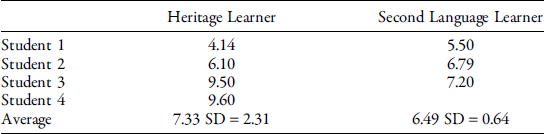
Another topic that was investigated in the study was the level of difficulty of the texts written by the HL and SLL after a one-year advanced-level course focusing on media Persian. As illustrated in Table 2, the two groups did not perform very differently from each other. Note that this study mostly concentrates on the qualitative nature of the error sources rather than the quantitative one; therefore, the statistics given in Table 2 are not developed further. I intend to do so in a later project.

In order to ensure that there exists a meaningful similarity between the two means, the T-test was run and the P-value was calculated. Based on the two samples in Table 2, the difference between the means is 0.84, the standard deviation is 2.2974 and the standard error is 1.2127. According to 95 percent CI of difference (‒1.5368 < 0.84 < 3.2168), the T-difference is 0.693, the degree of freedom is 3.1 and the P-value is 0.6717.
Therefore, the difference is not significant at 5 percent. In other words, there is no significant statistical difference between the two samples. The similar difficulty level in the two groups could be accounted for by the intensive instruction they received in their media course. Since in the calculation of the difficulty level, the number of hard words or multimorphemic words has a significant role, we can infer that the difficulty level is also an indication of textual complexity, which is indicative of a higher-level proficiency. Therefore, based on our data, the two groups of HL and SLL seem to have produced equally complex texts after one year of media Persian instruction at the advanced level.
Conclusion
This paper aimed to contribute to discussions on advanced learners of Persian, the source of errors made by the heritage learners and the second language learners, and ultimately the kind of material that is appropriate for this level that would help advanced learners reach the ultimate attainment of a native-like level of proficiency. In other words, second language material developers are encouraged to consult with second language acquisition studies, and, based on the recurring errors of the SLL and HL, choose the corresponding material. In addition, language instructors can also benefit greatly from the discussions in SLA studies in choosing the most effective tasks, approaches, and methods of instruction. The specifics of such tasks, approaches, and methods require a separate study and are thus beyond the scope of this paper.
Over the course of the paper, I have discussed how the brain functions in advanced language learning and what kind of material and what sort of teaching techniques are more suitable for advanced language learners. Then, a list of various tasks and exercises was presented to teach the advanced Persian course through media, in particular newspapers, and especially those printed daily in Iran. Through these newspapers a window to the Persian culture and society opens up to the avid advanced leaner of Persian language.
Then, the effect of an advanced Persian media course on the writing ability of heritage learners and second language learners at the advanced level was investigated both qualitatively and quantitatively. The qualitative section involved discovering the sources of errors in the essays by the two groups, and the quantitative section encompassed the level of difficulty at which the two groups had written their essays after a year-long advanced course in Persian media.
The results of the qualitative part of the study showed that although HL have various sources of lexical and morphological errors, the error source for the SLL is mostly first-language transfer. However, in the syntactical errors, both HL and SLL seemed to be influenced by their first-language transfer. Finally, HL were the only ones who made colloquial errors, which is understandable, as they learned the colloquial version of the language at home before they studied how to read and write in a formal setting. The quantitative part of the study used the FOG index to assess the difficulty level of the writing samples of the HL and SLL after the advanced media course. The statistical analyses used showed no significant difference between the two groups, indicating that the instruction might have enhanced the writing skill in both groups.