Implications
This study shows that it is possible to keep sperm motile and fertile in the epididymis for several days when semen is maintained at 4°C without dilution. The direct application of such findings may be postmortem collection of epididymal semen from animals of high genetic value or endangered species when collection of semen before death is not possible.
Introduction
The conservation of fertile spermatozoa was a major contribution to the development of artificial insemination (AI) for many species. Traditionally, semen collected in an artificial vagina from trained domestic species and by electroejaculation from several wild species is diluted in appropriate medium stored at either 5°C to 15°C or frozen and kept in nitrogen. Improving sperm storage for AI is a significant challenge for ovine species. Indeed, in contrast to most other species, very low fertility is achieved after cervical insemination with frozen–thawed ejaculated ram spermatozoa, although deposition of thawed semen in the uterus or oviducts provides high fertilization rates. As intrauterine insemination is time consuming, large flocks of ewes are inseminated cervically with fresh semen. However, as the fertility of liquid stored sperm declines at a rate of 20% to 40%/day (Maxwell and Salamon, Reference Maxwell and Salamon1993; Salamon and Maxwell, Reference Salamon and Maxwell2000), most cervical insemination is performed on the day of sperm collection. Such a short storage period imposes significant constraints on the transport of ovine semen between collection centers and farms.
The fertilizing ability of spermatozoa for all mammals is achieved during transit through the epididymis, a long tubule that can reach up to 70 m in some species such as the bull, boar and horse. The spermatozoa become fertile and motile for all species in the last part of the organ (for the ram, see (Fournier-Delpech et al., Reference Fournier-Delpech, Colas, Courot, Ortavant and Brice1979), and review by (Dacheux and Dacheux, Reference Dacheux and Dacheux2014)). Although mature spermatozoa are known to have a short life span, because they have no capacity for synthesis, they can remain viable and fertile in the epididymis for several weeks in vivo (e.g. 20 to 30 days in the guinea pig (Young, Reference Young1929), 21 days in the rat (White, Reference White1933), 28 to 35 days in the rabbit (Tesh and Glover, Reference Tesh and Glover1969), and 20 to 25 days in the hamster (Lubicz-Nawrocki et al., Reference Lubicz-Nawrocki, Lau and Chang1973)). The epididymal environment is thus an efficient storage medium, and understanding of its preservation conditions might be a way to improve in vitro sperm preservation.
Furthermore, as the number of fertile sperm present in the epididymal cauda can reach 5 to 15 times the number of spermatozoa contained in an ejaculate (Jones, Reference Jones1998), the epididymal spermatozoa might also be an ultimate source of spermatozoa for genetically valuable animals untrained for collection and wild animals that die unexpectedly.
Sperm collected from caudae epididymides has been used in reproductive techniques developed for several species, including the mouse (An et al., Reference An, Wada, Edashige, Sakurai and Kasai1999), dog (Yu and Leibo, Reference Yu and Leibo2002; Garcia-Macias et al., Reference Garcia-Macias, Martinez-Pastor, Alvarez, Garde, Anel, Anel and de Paz2006a), deer (Hishinuma et al., Reference Hishinuma, Suzuki and Sekine2003; Martinez-Pastor et al., Reference Martinez-Pastor, Garcia-Macias, Alvarez, Chamorro, Herraez, Paz and Rodriguez2006), pig (Kikuchi et al., Reference Kikuchi, Nagai, Kashiwazaki, Ikeda, Noguchi, Shimada, Soloy and Kaneko1998), ram (Kaabi et al., Reference Kaabi, Paz, Alvarez, Anel, Boixo, Rouissi, Herraez and Anel2003), bull (Foote, Reference Foote2000), horse (Vieira et al., 2012), bison (Krishnakumar et al., Reference Krishnakumar, Whiteside, Elkin and Thundathil2011), bear (Garcia-Macias et al., Reference Garcia-Macias, Martinez-Pastor, Alvarez, Borragan, Chamorro, Soler, Anel and de Paz2006b) and even humans (McLachlan, Reference McLachlan1998). The sampling of epididymal spermatozoa has been reported after mincing or cutting the epididymal tubule and collecting the exudate directly (Martins et al., Reference Martins, Driessen, Costa, Carvalho-Neto, de Sousa, Rumpf and Dode2009; Tamayo-Canul et al., Reference Tamayo-Canul, Alvarez, Lopez-Uruena, Nicolas, Martinez-Pastor, Anel, Anel and de Paz2011b) or diluting in a medium solution (Hori et al., Reference Hori, Hagiuda, Endo, Hayama, Kawakami and Tsutsui2005b; Ehling et al., Reference Ehling, Rath, Struckmann, Frenzel, Schindler and Niemann2006). To avoid any blood contamination and to obtain a maximum number of spermatozoa, epididymal sampling has also been performed by retroflushing the epididymal lumen content from the deferent duct with air (Kikuchi et al., Reference Kikuchi, Nagai, Kashiwazaki, Ikeda, Noguchi, Shimada, Soloy and Kaneko1998; Vieira et al., 2012), with physiological solution (Dacheux, Reference Dacheux1980; Martinez-Pastor et al., Reference Martinez-Pastor, Garcia-Macias, Alvarez, Chamorro, Herraez, Paz and Rodriguez2006), sodium citrate-egg yolk (Soler and Garde, Reference Soler and Garde2003) or paraffin oil (Dacheux et al., Reference Dacheux, Belghazi, Lanson and Dacheux2006). Although some differences have been reported between caudal and ejaculated sperm (Garcia-Macias et al., Reference Garcia-Macias, Martinez-Pastor, Alvarez, Garde, Anel, Anel and de Paz2006a), the fertility of epididymal sperm used either fresh or frozen–thawed for insemination has been found to be similar to ejaculated samples (Ehling et al., Reference Ehling, Rath, Struckmann, Frenzel, Schindler and Niemann2006; Varisli et al., Reference Varisli, Uguz, Agca and Agca2009; Alvarez et al., Reference Alvarez, Tamayo-Canul, Martinez-Rodriguez, Lopez-Uruena, Gomes-Alves, Anel, Martinez-Pastor and de Paz2012). However, the preservation of fertility of epididymal sperm may be influenced by many factors such as the conditions under which the epididymis is manipulated, the environment of the sperm during and after sampling or the postmortem period of storage of the epididymis before epididymal semen is collected. Different strategies have been developed for epididymal sperm preservation such as refrigerating the whole epididymis or storage of undiluted or extended epididymal sperm. Although storage of the spermatozoa inside the epididymis seems to be the easiest strategy (Tamayo-Canul et al., Reference Tamayo-Canul, Alvarez, Lopez-Uruena, Nicolas, Martinez-Pastor, Anel, Anel and de Paz2011b), a progressive decline in sperm quality, including motility and viability, is observed as early as at the end of 24 h of storage whatever the methods of preservation. However, few studies have been performed to evaluate the preservation of fertility of such stored epididymal sperm. Epididymal spermatozoa collected from the mouse cauda epididymis stored for 3 days were able to fertilize 16% to 25% of oocytes in vitro (Jishage et al., Reference Jishage, Uead and Suzuki1997), and spermatozoa retrieved from cadavers stored for more than 10 days at 4°C were still able to fertilize 3% of oocytes in vitro (Kishikawa et al., Reference Kishikawa, Tateno and Yanagimachi1999). The in vitro fertility of ram epididymal sperm declined significantly after 24-h storage (Kaabi et al., Reference Kaabi, Paz, Alvarez, Anel, Boixo, Rouissi, Herraez and Anel2003). For red deer, 24 to 48-h stored epididymal sperm were able to penetrate 13% of zona-free hamster oocytes in vitro (Soler and Garde, Reference Soler and Garde2003). Cleavage and blastocyst formation using epididymal sperm stored for 24 to 72 h did not differ significantly in bovines (Martins et al., Reference Martins, Driessen, Costa, Carvalho-Neto, de Sousa, Rumpf and Dode2009) and blastocysts were also obtained with epididymal sperm stored for 7 days (Martins et al., Reference Martins, Rumpf, Pereira and Dode2007). Pronuclear formation obtained by ICSI in equines and penetration of bovine zona-free oocytes was obtained in vitro with epididymal stallion sperm stored for up to 72 h in the epididymis at 4°C. However, few studies have been performed to estimate in vivo the fertility of stored epididymal spermatozoa, except for canines for which a high conception rate was obtained by intrauterine insemination with epididymal spermatozoa stored for 48 h (Hori et al., Reference Hori, Hagiuda, Kawakami and Tsutsui2005a).
The aim of the study presented here was to compare the motility of ram epididymal sperm stored either diluted in the most commonly used extenders or undiluted in their epididymal fluid for long periods (up to 96 h) at 4°C. As in most previous studies involving in vitro characterization of such stored epididymal sperm, we evaluated the effects of storage of undiluted epididymal sperm on in vivo fertility by intrauterine AI of stored epididymal frozen–thawed spermatozoa.
Material and methods
Animals, sperm sampling, storage and cryopreservation
The collection, storage and insemination of sperm were undertaken in France with Ile de France rams and in Uruguay with Corriedale rams and ewes. The experiment was performed with the agreement of the respective Ethics committees. All the protocols were performed during the ovine reproductive season: during July for Ile de France animals in France and during December for Corriedale animals in Uruguay. Epididymides were collected either after castration in the INRA laboratory (21 Ile de France rams) or immediately after slaughter at the local abattoir (7 Corriedale rams). Epididymal semen was sampled at 4°C to 5°C by retroperfusion from the deferent duct of the caudal epididymal tubule with 1.5 to 2.0 ml of fluid and non-toxic mineral oil (M 3516; Sigma, Saint Quentin Fallavier, France), (Dacheux et al., Reference Dacheux, Belghazi, Lanson and Dacheux2006).
Three sperm storage protocols at 4°C in a cool room were used.
Experiment 1 involved the storage of epididymal sperm from six Ile de France rams diluted at a concentration of 800×106/ml either in skim milk or in ‘Bel24’ medium extender (170 mM glucose, 50 mM potassium bicarbonate, 30 mM glutamic acid, 50 mM glycine, 10 mM proline, 10 mM myo-inositol, 20 mM d-mannitol, 0.4% BSA and 20% egg yolk) developed in the laboratory for liquid sperm preservation of ram semen.
In Experiment 2, undiluted epididymal sperm from seven Ile de France rams was collected from one epididymis immediately after castration and 1 ml of each undiluted epididymal ram sample was stored in a closed 1.5 ml Eppendorf tube at 4°C. An aliquot was then taken from each tube at 0, 24, 48 and 72 h of storage and sperm motility was analyzed. Undiluted epididymal spermatozoa were also collected from the second epididymis after 24-h storage at 4°C, and an aliquot was sampled from each tube after 24 and 48-h storage, corresponding to 48 and 72 h after castration.
In Experiment 3, mixed undiluted epididymal sperm from both epididymides of eight Ile de France rams was obtained and stored as described above in closed 1.5 ml tubes at 4°C for up to 96 h. An aliquot of 120 µl was taken from each of the eight tubes at 0, 24, 48 and 72 h of storage, motility was then analyzed and 100 µl of the sperm suspension was deep frozen according to the methods described below and stored in nitrogen until being used for intrauterine insemination.
In Experiment 4, a similar protocol to Experiment 3 was applied for seven Corriedale rams, except that ejaculated sperm was collected with an artificial vagina the day before collecting sperm from the epididymis and immediately deep frozen. An aliquot of 120 µl of undiluted epididymal sperm were taken at 0, 24, 48, 72 and 96 h of storage from tubes collected from each animal, and treated as above.
For all experiments, the percentages of total and progressive motile spermatozoa were estimated after dilution (1 : 20) in 1 M sodium citrate dehydrate at pH 8.5 and 10 min incubation at 38°C either by microscope observation (Corriedale) or by a computer-assisted sperm analysis system (IVOS Hamilton-Thorn, Lisieux, France) (Ile de France). For frozen–thawed spermatozoa, motility was assessed just before AI after 10-min incubation.
Ejaculated and epididymal sperm samples stored at 4°C were cryopreserved in 0.25 ml straws according to method of Colas (Colas, Reference Colas1975). For both species, sperm was cryopreserved with skim milk diluent at a concentration of 100×106 spz/straw for Ile de France rams and 60×106 spz for Corriedale rams.
Fertility of stored semen
The fertility of cryopreserved ejaculated and stored epididymal sperm was estimated by intrauterine insemination. AI was performed after estrus synchronization of 757 ewes. Ovulation was induced with 40 mg fluorogestone acetate for 330 ‘INRA 401’ ewes and 60 mg medroxyprogesterone acetate for 427 Corriedale ewes using impregnated sponges for 12 to 14 days, and an injection of 200 to 500 IU of PMSG according to the breed. Before insemination, straws were plunged into a water bath at 38°C for 30 s. All the ewes were then inseminated with one straw of thawed semen 60 h after withdrawal of the vaginal sponges. The dose inseminated was 100×106 total spermatozoa/ewe (50×106 gametes in each uterine horn) for ‘INRA 401’ ewes (raised in the INRA laboratory of Physiology of Reproduction and the INRA Experimental Unit in Bourges, France) and 60×106 total spermatozoa (30×106 gametes in each uterine horn) for the Corriedale ewes (raised in the ‘Dr A. Gallinal’ Experimental and Research Centre (CIEDAG)).
In all, 3 Ile de France and 7 Corriedale rams were used to evaluate fertility in 3 to 10 ewes inseminated per ram for each storage time. The conception rate (referred to as ‘% pregnant’) was assessed either by the blood level of pregnancy associated glycoproteins 30 days post-insemination according to Beckers (El Amiri et al., Reference El Amiri, Karen, Sulon, Melo de Sousa, Alvarez-Oxiley, Cognie, Szenci and Beckers2007) for ‘INRA 401’ ewes, or by ultrasonography 45 days post-insemination for the Corriedales. Fertility was also estimated by the lambing rate (% lambing), and by the ‘fecundity index’ as the average of the number of lambs per 100 ewes.
Statistical analysis
Data are presented as mean±s.e.m. and with significance at P<0.05. For each experiment, the sperm status data were evaluated using GLM procedures of the SASTM program. Conditions and/or storage times were the factors of variation in one- or two-way ANOVA for motility. Mean comparisons were obtained at 95% confidence level using Tukey HSD test and also by paired Student’s t test. Linear regression curves were calculated and drawn with Sigmaplot 10 (Systat Software, Inc.) for all the graphs. The lambing rates were compared using the χ 2 test.
Results
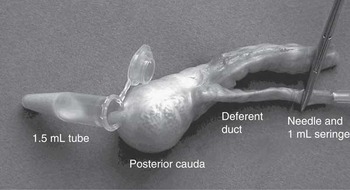
Retroflushing the posterior part of the cauda epididymis with paraffin oil provided total epididymal spermatozoa numbers per epididymis of 8.7±1.8×10⁹ spermatozoa for Corriedale rams to 13.2±2.1×10⁹ spermatozoa for Ile de France rams, corresponding to 0.8±0.2 and 1.6±0.3 ml of epididymal fluid collected from Corriedale and Ile de France rams, respectively. Most of the spermatozoa present in the posterior epididymal cauda were collected by this method (Figure 1).
Retroperfusion of the cauda epididymidis of the ram. The content of the tubule lumen was flushed by 1 to 2 ml of paraffin oil from a needle inserted into the deferent duct and fixed in place with Kocher forceps. The epididymal semen was collected from an incision at the mid cauda epididymis and collected in a 1.5 ml tube.

Characteristics of epididymal sperm collected and stored at 4°C under different conditions
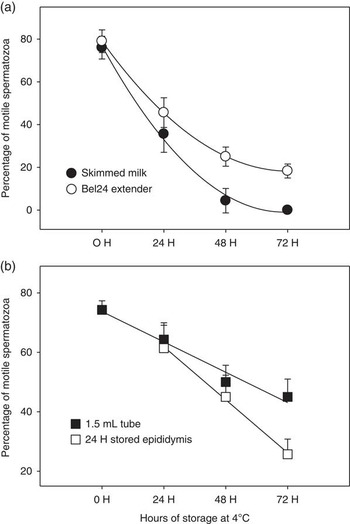
In Experiment 1, epididymal sperm diluted in two different extenders (skim milk and Bel24), (Figure 2a) showed that the decrease in the percentage of motile sperm when the epididymal sperm diluted and stored in skim milk was statistically different and more rapid than when the gametes were incubated in ‘Bel24’ extender (milk×Bel24 interaction, P=0.006). After 72 h of storage, 18% of spermatozoa were still motile in ‘Bel24’ but no motile gametes were found in milk extender (Figure 2a).
Means±s.e.m. of the percentage of motile sperm stored at 4°C for 72 h in different conditions. (a) Epididymal semen from Ile de France rams (n=6) diluted in skim milk and a synthetic diluent ‘Bel24’. (b) Undiluted epididymal spermatozoa from Ile de France rams (n=7) stored in a closed 1.5 ml tube immediately after collection from the epididymis or collected from the contralateral epididymis, which had been stored at 4°C for 24 h postmortem (day 1). Each dotted lines represent significant linear regression curves.

When the epididymal spermatozoa were collected and stored undiluted in their own epididymal fluid from the castration (Figure 2b), the percentage of motile spermatozoa decreased about 10% to 12% during the 3 days of storage. After 72 h, the percentage of motile spermatozoa varied between 40% to 45%.
For the semen collected from epididymis stored intact at 4°C for 24 h after castration, the decrease in the percentage of motile sperm stored undiluted 48 h at 4°C was around 18% to 20%/day. Only 25% of motile sperm were observed at 72 h after castration. This value was significantly lower than those observed for sperm collected immediately from the epididymis and stored for 72 h (45%±6.0 v. 25.7±5.1, P<0.05) (Figure 2b).
The mean motility observed for the undiluted sperm collected from the epididymis immediately and stored for 72 h was significantly greater than when the epididymal sperm was diluted in Bel24 extender (45%±1.9 v. 18%±0.8 P<0.08).
Survival and fertility of undiluted epididymal sperm after 4 days of storage at 4°C
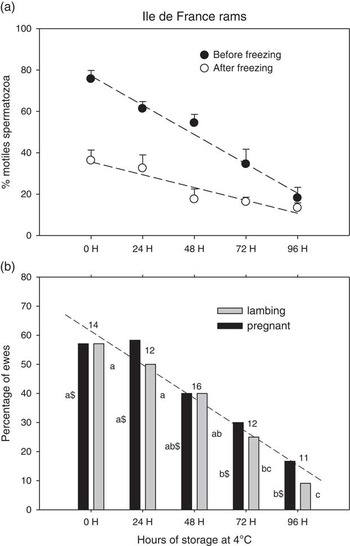
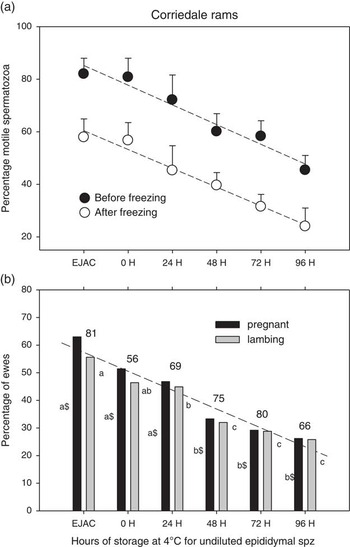
In Experiments 3 and 4 (Figures 3 and 4), the percentage of motile epididymal sperm stored undiluted decreased linearly over the 4 days of storage at 4°C, with a mean decrease of 15%/day for Ile de France and 10% for Corriedale rams. Thus, after 96 h, 22% and 45% of the sperm were still motile for the Ile de France and Corriedale samples, respectively (Figures 3a and 4a). No difference was observed between ejaculated and fresh epididymal sperm (Figure 4a).
Undiluted epididymal spermatozoa stored at 4°C for 96 h (Ile de France rams, n=8). (a) Means±s.e.m. of the percentage of motile sperm during the 4 days of storage before and after cryopreservation. (b) % lambing, % pregnant and fecundity index for epididymal sperm according to the storage period at 4°C. The number above the bars indicate the number of ewes inseminated. Different letters for the same parameter indicated a statistically significant difference between periods of storage (P<0.05). Each dotted lines represent significant linear regression curves.

Storage of ejaculated (EJAC) and undiluted epididymal spermatozoa for 96 h (0 to 96 h) at 4°C (Corriedale rams, n=7). (a) Means±s.e.m. of the percentage of motile spermatozoa during the 4 days of storage before and after cryopreservation. (b) % lambing, % pregnant and fecundity index for epididymal sperm according to the storage period at 4°C. The numbers above the bars indicate the number of ewes inseminated. Different letters for the same parameter indicate a statistically significant difference between periods of storage (P<0.05). Each dotted lines represent significant linear regression curves.

After the cryopreservation process, the mean loss of motile sperm between pre- and post-freezing was about 50% for Ile de France rams during the storage period. For the Corriedale ram sperm, the loss of motile sperm increased significantly during the 4 days storage (from 30% to 45%) (Figure 4a). The decrease in motile sperm after thawing was about 7%/day for the Corriedale and 12% for Ile de France rams. After 96-h storage following by freezing–thawing, 13% and 24% of spermatozoa were still motile for Ile de France and Corriedale sperm, respectively.
The fertility of the spermatozoa, estimated in vivo after intrauterine insemination by the percentage of pregnant and lambing ewes, decreased regularly during storage of epididymal sperm, corresponding to 7% loss/day of lambing for the Corriedale (Figure 4b) and 12% for the Ile de France rams (Figure 3b). With the 96-h-stored spermatozoa, 10% of lambing ewes were obtained with Ile de France and 25% for Corriedale rams. The fecundity index did not vary significantly with the sperm storage for the Ile de France rams (211.2±3.6) but slightly decreased for Corriedale rams after 24 h of storage (112±0.4 v. 102±0.48, P<0.5).
For both breeds, a similar decrease during sperm storage was observed between % pregnant and % lambing. The mean difference between % pregnant and % lambing was around 15% for both breeds, but not significantly different according to the storage period.
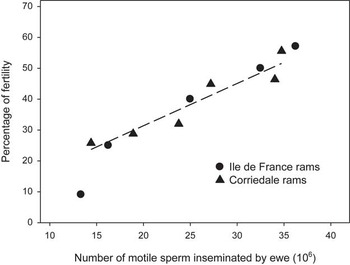
The total number of spermatozoa inseminated per ewe was constant for all experiments, but the total number of motile spermatozoa inseminated ranged from 35 to 13×106 spermatozoa. For both breeds, there was a similar linear regression relationship between fertility and the number of motile sperm inseminated for 35 to 15×106 cells. However, for insemination with <15×106 sperm, fertility was much lower than expect with the regression line (Figure 5).
Relationship between the number of motile sperm inseminated from ejaculated and tubule-epididymal stored spermatozoa and the fertility observed for Ile de France and Corriedale rams.

Discussion
The results of this study demonstrate that the preservation effect of epididymal fluid within the epididymis is partly retained when epididymal semen is incubated undiluted in vitro. When the epididymal semen was stored undiluted in vitro the percentage of motile sperm was greater than in samples diluted in skim milk, the extender routinely used for AI, or in a synthetic diluent, Bel24, developed to increase ejaculated ovine sperm survival at 4°C. Thus, after 72 h of storage, the survival of undiluted sperm was twice that obtained in diluted samples. Such a preservation effect of the epididymal fluid on sperm motility has been already described for ram sperm (Tamayo-Canul et al., Reference Tamayo-Canul, Alvarez, Lopez-Uruena, Nicolas, Martinez-Pastor, Anel, Anel and de Paz2011b) and other species (Garde et al., Reference Garde, Ortiz, Garcia, Gallego, Landete-Castillejos and Lopez1998; Songsasen et al., Reference Songsasen, Tong and Leibo1998; Hishinuma et al., Reference Hishinuma, Suzuki and Sekine2003; Kaabi et al., Reference Kaabi, Paz, Alvarez, Anel, Boixo, Rouissi, Herraez and Anel2003; Soler et al., Reference Soler, Perez-Guzman and Garde2003; Hori et al., Reference Hori, Hagiuda, Endo, Hayama, Kawakami and Tsutsui2005b; Fernandez-Santos et al., Reference Fernandez-Santos, Martinez-Pastor, Matias, Dominguez-Rebolledo, Esteso, Montoro and Garde2009b; Martins et al., Reference Martins, Driessen, Costa, Carvalho-Neto, de Sousa, Rumpf and Dode2009; Vieira et al., Reference Vieira, Gadea, Garcia-Vazquez, Aviles-Lopez and Matas2013), including humans for whom we obtained progressively motile spermatozoa from an epididymis stored at 4°C for 3 days postmortem (Dacheux, unpublished data). Such a protective effect of the epididymal fluid on spermatozoa has also been demonstrated to maintain membrane integrity and DNA integrity for several days, although motility decreases (Fernandez-Santos et al., Reference Fernandez-Santos, Dominguez-Rebolledo, Esteso, Garde and Martinez-Pastor2009a).
Tamayo-Canul et al. (Reference Tamayo-Canul, Alvarez, Mata-Campuzano, Alvarez-Rodriguez, de Paz, Anel and Martinez-Pastor2011a) found that sperm quality was better if sperm were stored at 5°C within the epididymis after collection rather than stored undiluted in a glass tube. However, we found that the motility of the sperm collected immediately after castration and stored undiluted in vitro for 72 h was better preserved than that of sperm collected from the epididymis previously stored for 24 h at 4°C. Such differences may be related to the differences in the method of collecting epididymal spermatozoa (samples obtained by cutting v. epididymal tubule flushing, which avoided any epididymal tissue and blood contamination) or to the in vitro storage conditions such as the characteristics of the storage tube, which should avoid desiccation or too much oxygen exchange.
After freezing–thawing, the reduction in percentage of motile spermatozoa was of the same order (about 35% to 50%) for epididymal spermatozoa as for ejaculated sperm, although other studies have shown that epididymal spermatozoa are more resilient than ejaculated spermatozoa (Tamayo-Canul et al., Reference Tamayo-Canul, Alvarez, Mata-Campuzano, Alvarez-Rodriguez, de Paz, Anel and Martinez-Pastor2011a; Alvarez et al., Reference Alvarez, Tamayo-Canul, Martinez-Rodriguez, Lopez-Uruena, Gomes-Alves, Anel, Martinez-Pastor and de Paz2012).
The fertility of the epididymal spermatozoa estimated after intrauterine insemination with the same number of stored sperm decreased regularly over the storage period for the two breeds studied, as was also observed for the motility percentage. The decrease in fertility began to be significant from 48 h of storage, as observed by Kaabi et al. (Reference Kaabi, Paz, Alvarez, Anel, Boixo, Rouissi, Herraez and Anel2003) for ram epididymal sperm with in vitro fertilization. Furthermore, when the total number of motile sperm inseminated was considered, a significant linear relationship was established between the fertility rate and the number of motile spermatozoa inseminated. This suggests that most of the spermatozoa, which remain motile during storage, also retain their fertilizing ability. This was also corroborated by the finding that early embryo loss did not increase with sperm storage, and little difference was observed between % pregnant and % lambing. Furthermore, the number of lambs born per ewe (fecundity index) was unchanged by the sperm storage period even when the number of motile sperm inseminated was very low. For ram epididymal spermatozoa, embryo loss has previously been observed only for motile spermatozoa for which the fertilizing was not optimal (Fournier-Delpech et al., Reference Fournier-Delpech, Colas, Courot, Ortavant and Brice1979). Such resistance of sperm during the storage period could be linked to the presence of different sperm populations in the cauda epididymis, as described by Garcia-Macias et al. (Reference Garcia-Macias, Martinez-Pastor, Alvarez, Garde, Anel, Anel and de Paz2006a).
The epididymal sperm environment was surprisingly highly protective if we consider that the sperm concentration in caudal epididymal semen reaches nearly 1010 cells/ml and that such a high sperm concentration should be highly detrimental to sperm in common semen diluents. It is suggested that the protective effect of epididymal plasma is linked to the presence of several antioxidant systems (e.g. GPX5, thioredoxin peroxidase, glutathione S-transferase P, thioredoxin peroxidase and superoxide dismutase), to the presence of powerful protease inhibitors (e.g. macroglobulin, α-1-antitrypsin, eppin, cystatin; review in Dacheux et al., Reference Dacheux, Belleannee, Jones, Labas, Belghazi, Guyonnet, Druart, Gatti and Dacheux2009) and also to the presence of several antimicrobially active compounds, such as lactoferrin (Jin et al., Reference Jin, Bannai, Dacheux, Dacheux and Okamura1997) and several β-defensins (Hall et al., Reference Hall, Yenugu, Radhakrishnan, Avellar, Petrusz and French2007).
The presence of in vitro antioxidants in refrigerated epididymal sperm has been also found to maintain quality similar to sperm kept within the epididymis (Fernandez-Santos et al., Reference Fernandez-Santos, Dominguez-Rebolledo, Esteso, Garde and Martinez-Pastor2009a).
In conclusion, our findings showed that fertile spermatozoa can be preserved for several days when the epididymal spermatozoa are stored at 4°C without any dilution. Furthermore, these spermatozoa can be cryopreserved after such storage. The exact epididymal conditions that contribute to preservation of such a mass of spermatozoa remain to be clarified. However, our study demonstrated that successful reproduction with offspring could be obtained if enough motile sperm could be obtained from undiluted epididymal spermatozoa after several days of storage at 4°C. The direct application of such results could be the postmortem collection of epididymal semen from animals of high genetic value and from endangered species when the collection of semen before death is not possible.
Acknowledgments
The French arm of this study was partially supported by a grant from the BRG (Bureau des Resources Génétique). The authors thank Russell Jones for his helpful comments and his help in the English correction of this manuscript.