There is a broad consensus in the academic literature that American political elites, especially within the US Congress and “inside-the-Beltway” communities of Washington, DC, are becoming more divided and that the two main political parties have more distinct ideological profiles particularly when cultural and social issues are considered.Footnote 1 However, despite much talk of a “red-blue nation,” a “great divide,” a “values divide,” a “divided states of America” and, not least, a “culture war,”Footnote 2 there is no such consensus whether the American public is itself divided or diverging on these cultural and social issues.
On the one hand, some scholars, such as Abramovitz and Saunders, conclude, “The American people, especially those who care about politics, have become much more polarized in recent years.”Footnote 3 On the other, several prominent studies have found little or no evidence of divergence within the mass public on even those cultural issues that provoke the most intense forms of debate.Footnote 4 As Fiorina put it in his influential book, Culture War? The Myth of a Polarized America,
The simple truth is that there is no culture war in the United States – no battle for the soul of America rages, at least none that most Americans are aware of. Certainly, one can find a few warriors who engage in noisy skirmishes … [but] the bulk of the American citizenry is somewhat in the position of the unfortunate citizens of some third-world countries who try to stay out of the crossfire while Maoist guerrillas and right-wing death squads shoot at each other.
Further, “On the whole, the views of the American citizenry look moderate, centrist, nuanced, ambivalent – choose your term – rather than extreme, polarized, unconditional, dogmatic.”Footnote 5
Most of the debate about the existence or otherwise of a culture war rests on scholars’ analyses of the extent to which America is polarized, as the second half of Fiorina's book title indicates. But where should scholars look for evidence of polarization? Should they focus on the extent of religious polarization, asking whether Americans’ partisan identification is increasingly correlated with their religious denomination or commitment? Another measure may be the extent to which political positions correlate increasingly with social and cultural characteristics or values, or whether issue positions correlate increasingly with Americans’ vote choices and assessments of incumbent politicians. Still another may be the extent and direction of geographic polarization. Are red (Republican) states getting redder and blue (Democratic) states getting bluer, perhaps as their native residents become more Republican/Democratic, or perhaps via homogenizing migratory patterns as people with similar views congregate and dissenters leave? Abramovitz and Saunders suggest that all of the above are valid measures of mass polarization, and report that “there are now large differences in outlook between Democrats and Republicans, between red state voters and blue state voters, and between religious voters and secular voters.”Footnote 6
However, Fiorina, DiMaggio and their co-authors all argue that the above measures do not speak directly to the issue of mass polarization and therefore do not support the culture war thesis. They define polarization much more narrowly, as the increasing bimodality of political opinions in the mass public. In other words, polarization means that opinion on an issue or issues should be diverging; that is, moving towards the extremes in a distribution. This definition suggests that polarization must be understood as an over-time process or trend.Footnote 7 Operationalized this way, they find no evidence to support the proposition that Americans are diverging ideologically or on the issues, even apparently on hot-button cultural ones. The red states may be getting redder and Republican Party voters may be increasingly conservative and religiously committed, but it does not follow that Americans are polarizing and at war with one another. The anti-culture war theorists demonstrate that, in the aggregate and over the past four decades, Americans political positions are best described as centrist and stable.
The rejection of the culture war thesis based on an over-time study of the modalities of public opinion is potentially problematic, however. Such a conclusion rests on an analysis of the distribution or direction of political attitudes, rather than on the strength or intensity with which they are held. Even DiMaggio et al., the authors of one of the key studies rejecting the popular polarization hypothesis, have themselves acknowledged that the dissonance between their results showing “observed stability (or convergence) in distributions of public opinion” and a widespread perception that the public discourse had become more polarized could perhaps be because “change has occurred not in what people believe but in the intensity with which they believe it.”Footnote 8 In other words, researchers may have failed to find evidence of a culture war among the US public not because it hasn't happened, but because they may have been looking, in part, in the wrong place.
In his recent review of the culture war and polarization literatures, Hetherington picks up on the potential importance of opinion salience, criticizing opponents of the culture war theory who fail to consider salience while fixating on opinion distribution. For example, race was much more polarizing in the 1960s than gay rights is today, Hetherington suggests, not because there was a wider distribution of opinion – indeed, there was not – but because the race issue was more salient, as evidenced by the 30 percent of Americans who placed civil rights as the “most important problem” facing America compared with the small percentage who label gay rights thus today.Footnote 9 Bringing saliency into the equation is important because the culture war is about both the distribution of opinions and the intensity or strength with which they are held. Indeed, suggests Hetherington's argument, even if Fiorina and others are right that the distribution of opinion on culture issues has not changed, it may still be appropriate to talk about a culture war if cultural issues have increased in importance in the eyes of the American public. Hitherto, however, no analyses have attempted to ascertain empirically whether intensity or salience offers a fix to a piece of the culture war puzzle. This paper is an attempt to do so.
Our basic approach is to identify an indicator that taps into both Americans’ position and strength of feeling on cultural issues over time. We operationalize this as our dependent variable, explore how attitudes have changed and seek to explain these shifts statistically. We find, first, that traditional moral issues have become more salient, which reinforces the perspective that cultural issues are more important to ordinary Americans and thus offers support to the culture war thesis. Our second finding complicates the picture, however. The data analysis demonstrates that the over-time increase in concern about traditional moral issues was driven by an upward and equal shift in the importance attached to them by Republicans and Democrats, conservatives and liberals, evangelicals and non-evangelicals, and frequent churchgoers and the secular alike. The culture war thesis implies divergence, however, with orthodox, religious conservatives who think in terms of absolutist values becoming increasingly concerned about traditional moral issues while progressive, secular liberals who regard values in more relativistic terms grow less concerned.Footnote 10 At least when it comes to the salience of traditional moral issues, there has been a convergence, not a divergence, of opinion that these issues matter. Fiorina, DiMaggio and others may in their analyses have missed a potentially important part of the culture war puzzle – that is, issue saliency – but our mixed findings suggest that the omission may not be critical to their thesis.
I. Data and Methodology
How should saliency and opinion distribution be operationalized? Hetherington suggests that the “Most Important Problem” (MIP) question provides a guide to an issue's saliency in society, and implies that simple survey questions (such as “should abortion be legal?” or “should gays serve in the military?”) may provide a good indicator of the distribution of opinion on the culture war issues. More sophisticated Likert-type scales, which seek to grade responses on five- or seven-point scales (“do you strongly agree, agree somewhat, neither agree nor disagree, disagree somewhat, or strongly disagree that abortion should always be legal?”) are also potentially useful and could be utilized to measure both the distribution of opinion and saliency/attitude strength because it has long been known that those with more extreme opinions (strongly agree, strongly disagree) are more committed to their position than those with only moderate opinions.Footnote 11 However, survey questions, whether of the simple or the Likert variety, are very sensitive to question wording, which is particularly problematic when trying to collate a large number of questions that tap opinions on a range of cultural issues over a long time period. Even if questions with the same or similar wording could be identified, the controls in the respective data sets vary greatly, making it difficult to move beyond basic descriptive analysis.
We thus take a different approach, and utilize the most important problem question in the American National Election Studies surveys. Within the confines of the NES, the MIP question wording varies little or not at all over time and the requisite control variables are available.
Most importantly, the MIP instrument can, if coded carefully, tap into both issue saliency and the distribution of opinion across time. The MIP question is well placed to pick up the strength of sentiment, because the open-ended NES version – “What do you think is the most important problem facing this country?” – forces respondents to consider the relative importance they attach to different issues and to reveal their most pressing concern.Footnote 12 A high level of concern on issues that are generally understood to constitute the culture war could be interpreted, according to Hetherington, in favour of the culture war thesis.
More controversial is our claim that the MIP question is also a good measure of the direction of concern. The extent to which it is or is not depends on how the variable is coded. Our approach requires us to identify a set of responses to the question that are definitively conservative/traditional, and therefore on which we would expect liberals and conservatives, Democrats and Republicans, and so on to differ. We thus coded as 1 respondents who reported any of the following as the most important problem facing America: “anti-abortion [or] pro-life” issues (NES Most Important Problem code 46); “moral/religious decay (of nation); sex, bad language, adult themes on TV” (380); “family problems – divorce; proper treatment of children; decay of family; child/elder abuse (including sexual abuse); family values” (381); and “problems of/with young people; drug/alcohol abuse among young people; sexual attitudes; lack of values/ discipline; mixed-up thinking; lack of goals/ambition/sense of responsibility” (383).
The extent to which codes 46, 380, 381 and 383 could be perceived as liberal positions or codes, as opposed to traditional conservative ones, will undermine the analysis. Code 46 may pose a potential difficulty. On its face, it appears it could capture both orthodox and progressive concerns. Someone saying “anti-abortion” or “pro-life” issues in response to the MIP question could, it seems, be very concerned about the liberalization of abortion provision or the curtailment of abortion rights. However, an analysis of the NES codebook demonstrates that code 46 was designed specifically for respondents who indicated a conservative position when mentioning the abortion issue. The NES codebook places code 46 between codes 381 and 383 to emphasize its conservative credentials. A separate code, 45, is used for respondents who indicated a liberal position on abortion, and is placed after code 330, which records mentions of women's rights, issues and equality. The number of miscodes on 380, 381 and 383 is also likely to be few because other codes were again used to register the liberal direction of sentiment on the same issues. The codes have, to our thinking, face validity and, more importantly, were designed specifically to pick up on concerns about traditional conservative values.Footnote 13 Thus, we contest, they can be utilized to investigate whether there is increasing differentiation or convergence among key groups over time on traditional moral issues. Differentiation would offer further support to the culture war thesis and convergence would challenge it.
The decision to measure and analyse only traditional issues, rather than also liberal, progressive ones, is perhaps also controversial, given that the culture war thesis implies a battle between competing sets of issues. Unfortunately, the NES MIP question does not include an adequate time series of comparable liberal cultural issues. Only the pro-abortion and women's rights categories are consistent across the period, and too few respondents chose these as their most important concern (collectively never more than 0·2 percent in any year) to be useful statistically. Nonetheless, we are able, using only traditional issues, to make some interesting observations about the culture war thesis and test our key hypotheses. We can measure whether these issues are growing in importance, as well as determine whether opinion is diverging across key groups in the population, as the culture war theory predicts.
We appended the answers from the MIP question in the NES biennial surveys, using the unique respondent identification variable, to the NES Cumulative Data File 1948–2004, a pooled cross-sectional study itself constructed from biennial surveys. The cumulative file, which contains a wealth of easily manipulated demographic and attitudinal data, is inadequate on its own because it pre-classifies MIP responses into, for our purposes, inappropriately broad categories. The original biennial surveys retain the fine-grained coding required to construct the dependent variable. In some years the NES solicited respondents’ second- and third-most-important problems, but because these data are not available for every year our dependent variable includes only respondents’ primary and most important problem. The four categories used to measure traditional moral concerns in this paper are stable between 1976 and 2004. The data points pre-1976 use slightly different codes because the four categories either are not all available or changed their wording slightly. The MIP question was not asked in 2002 and 2006. The 2004 MIP question directed respondents to think about the past four years rather than the present. In 2008 two separate MIP questions were asked, the first directing respondents to identify the “most important issue to you personally in this election” and the second, posited immediately after the first, to identify “the most important problem facing the United States today.” These compatibility problems lead us to exclude all years after 2000 from the subsequent analysis.
II. Exploring Change Over Time
To investigate the culture war thesis, we test two hypotheses: (1) The saliency of traditional, conservative culture war issues has increased over time; (2) there has been a differentiation over time between progressive and orthodox Americans as to the level of concern they express about these issues, with the orthodox expressing relatively higher levels than progressives. Confirmation of the hypotheses would support the culture war thesis that ordinary Americans are increasingly in conflict over cultural issues.
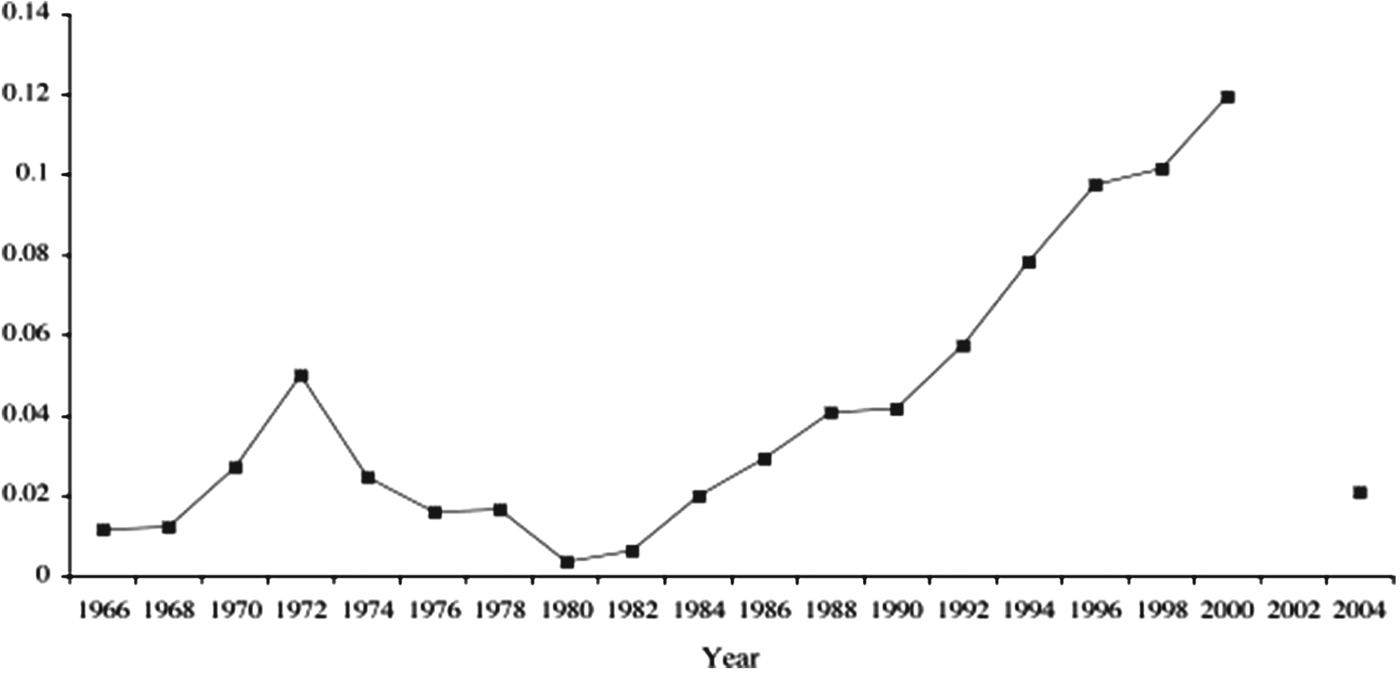
Proportion of Americans identifying traditional moral issues as most important problem, 1966–2004.

Figure 1 shows that the proportion of Americans placing a traditional moral issue as the number-one concern facing the country grew in the early 1970s, declined to almost zero in 1980, before rising more or less continuously until the beginning of the new century. It demonstrates clearly the growing saliency of traditional moral issues in the late twentieth century, thus confirming the first hypothesis. This supports the idea, suggested by Hetherington, that the culture war may in part be a consequence of the increase in salience of traditional moral issues, because the growing weight attached to them in the population as a whole increases the likelihood of conflict.
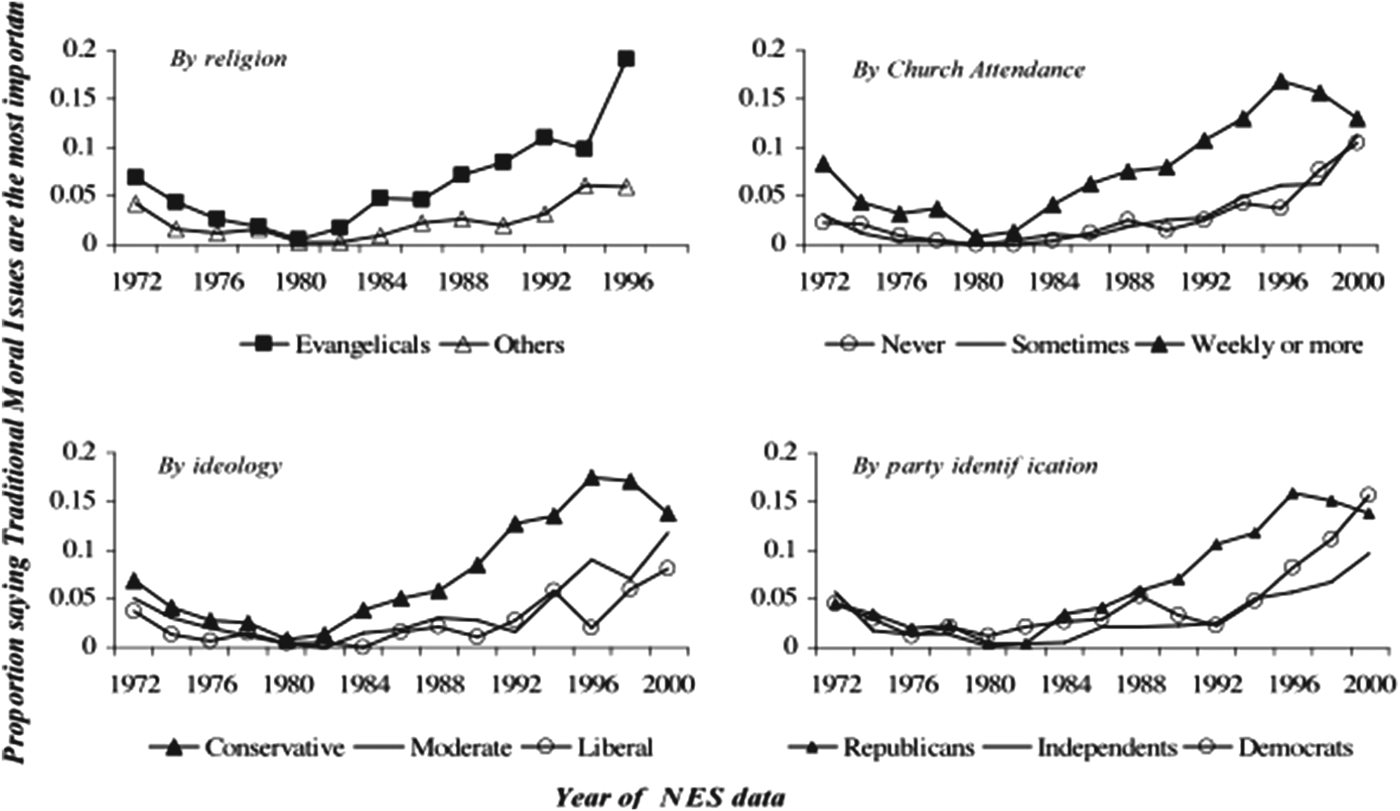
However, before making a definitive interpretation, we need to test the second hypothesis by exploring what types of people are increasingly selecting traditional moral issues as their number-one concern. The culture war story suggests and the second hypothesis predicts differential trends, with conservatives, Republicans and evangelicals (labelled the ‘orthodox’ by Hunter) increasingly concerned relative to liberals, Democrats and more secular individuals (dubbed the ‘progressives’). Figure 2 breaks down the data by religious affiliation, church attendance, ideology and party identification.
Proportion of Americans identifying traditional moral issues as most important problem, by group.
The panels in Figure 2 suggest that, at least up until 1996, concern about traditional moral issues grew more quickly among the orthodox than among progressives. This difference can be interpreted as divergence. After 1996, however, there is evidence of convergence across ideology, party identification and church attendance, although a change in the cumulative file coding scheme post-1996 means that we cannot display the later trajectory for evangelicals and non-evangelicals. The evidence, then, regarding the second hypothesis is hitherto mixed. Moreover, the trends in Figure 2 are instructive only. First, they are based on “raw” data, with no controls for other things that might cause attitudes to change or differ. Second, and most importantly, differential trends by group are a characteristic feature of any variable scored zero or one. For example, it may require a larger-ranking change for a Democrat to move from scoring zero to one on traditional moral issues than a Republican because the Democrat is further away from one than the Republican prior to the change. Thus any differences in initial levels of concern across groups necessarily result in the appearance of differential trends. We address this “threshold” problem below, but before doing so we explore three possible drivers for the over-time increase detailed in Figure 1. Testing which of these is driving the increase will provide a comprehensive response to the divergence–convergence question raised by the second hypothesis.
A Compositional change. Groups in the population that feel more concerned than average about moral issues – evangelicals or conservatives, perhaps – could have grown in size. More interestingly, people could have become more polarized based on these observed characteristics, with, for example, an increasing proportion of evangelicals identifying as Republican and fewer identifying as Democrats. Both types of compositional change will result in more people placing traditional moral issues as their most important concern, and both are consistent with the culture war story.
B Population-wide attitudinal change. All Americans could have become more concerned about traditional moral issues. This is not consistent with the culture war story, which predicts that only some – Hunter's orthodox category – will become more concerned, or at least that the rates of increase will be significantly different.
C Group-specific attitudinal change. Specific groups, such as churchgoers or Republicans, could have become politicized about moral issues, perhaps via elite cues from religious or party leaders. The culture war thesis would be supported by a larger-than-average increase in concern among orthodox Americans (implying a divergence of attitudes) and challenged by a smaller-than-average increase (implying convergence).
Our first task is to explore the importance of Driver A, compositional change. We do this by predicting the change in attitudes assuming no change in the composition of the population. The difference between this prediction and the actual change is the contribution made by compositional effects. In essence we are asking a counterfactual question similar to “What would have happened to the proportion of Americans reporting traditional moral issues as their most important concern if there were, for example, as many evangelical Republicans in 1996 as there were in 1972?” We of course look at the changing effect of all the intersecting characteristics (race, gender, region and marital status). The appendix contains precise details of the decomposition methodology. The basic idea is to find the predicted partial effect of each characteristic on attitudes in each year by estimating separate yearly logistic regressions. Thus we can predict the probability of someone with a certain set of characteristics placing traditional moral issues as their top concern in each year. We do this for everybody in the 1972 sample and then obtain a yearly prediction of the proportion of the population placing traditional moral issues as their top concern. These changes in attitude assume no change in the composition of the population.
However, the analysis is complicated by the fact that the full set of explanatory variables is not available for all years. Changes in question wording and coding in the cumulative file render the religion variable incompatible in 1998 and 2000. The solution is to estimate three separate regressions. The first contains the full set of explanatory variables but necessarily restricts the analysis to the subset of years, 1972–96, in which they are all available. The second uses the same subset of years but excludes the explanatory variables that are not available post-1996 (religion and parental birth). The last uses the same smaller set of explanatory variables on the full set (1972–2000) of years. Comparing the first to the second allows us to assess the effect of religion on the results and comparing the second to the third allows us to assess the effect of expanding the data period.
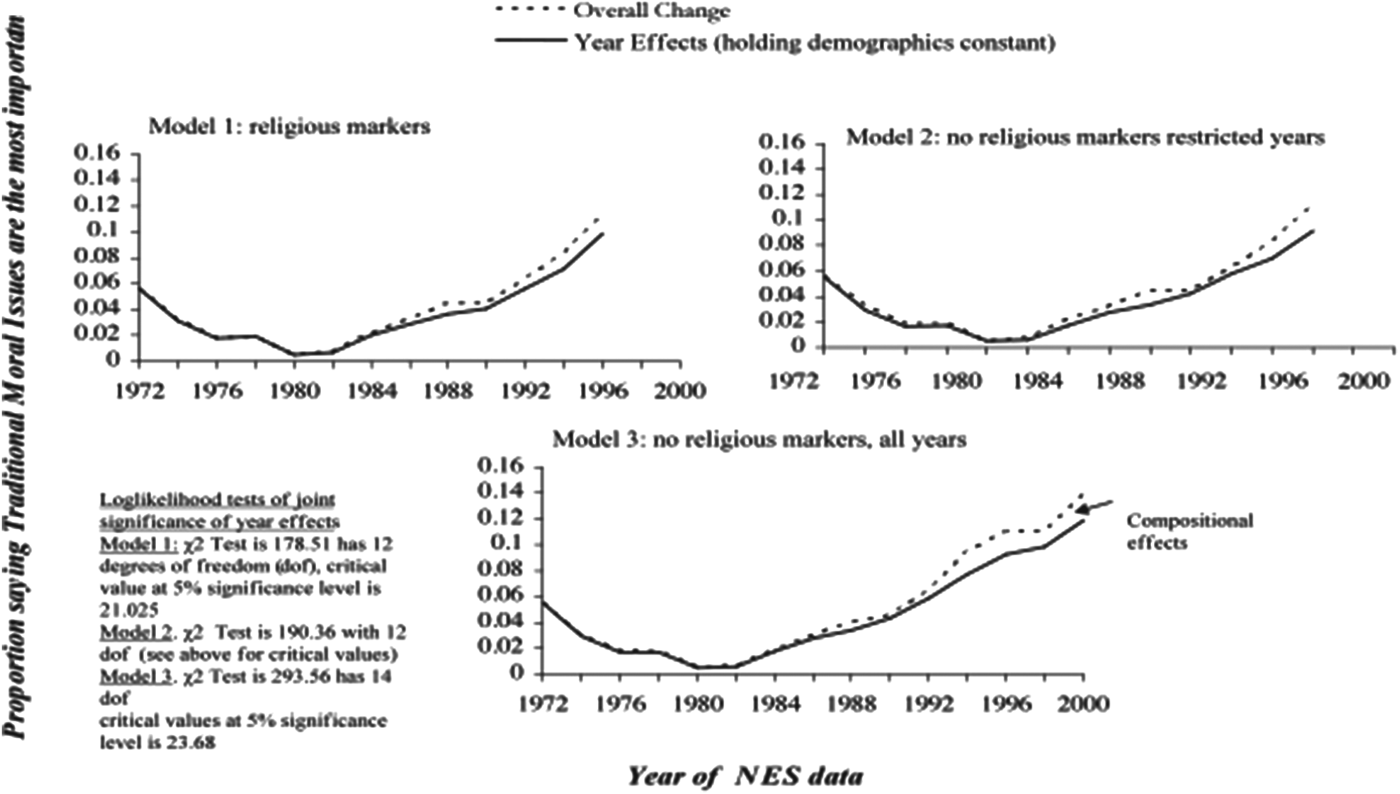
Relative size of compositional and attitudinal effects over time. Note: upper lines give the actual proportions reporting traditional moral issues to be their most important concern. Lower lines give the proportions predicted holding the composition of the sample constant at its 1972 level. Areas between the two lines represent the effect of compositional changes on the increase in concern. Areas below the lower lines represent the portions of the increase that can be attributed to changes in attitudes within each group.
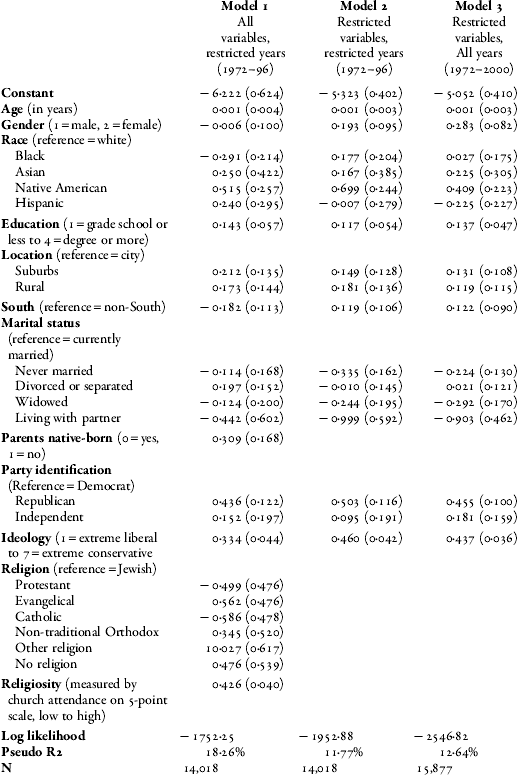
Logistic regression results for Section II time-series analysis
Notes: Year dummies included in all models. Logit results reported. Asymptotic standard errors in parentheses. Data from American National Election Surveys (ANES). Independent leaners are included as partisans in the party ID dummy variables; only true independents score 1 in the Independent variable.
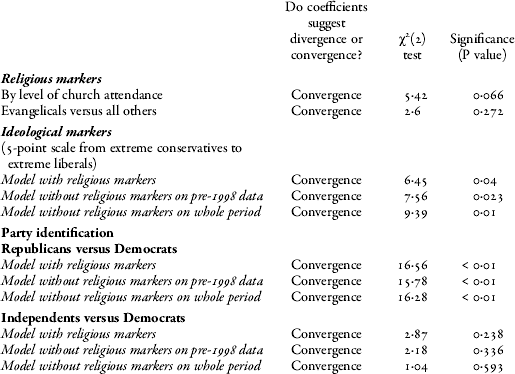
Specific tests of differential trends across groups
Notes: Test of parameter stability obtained by comparing the fit of the pooled model year dummies to that obtained by estimating separate models for each year. Convergence implies that the coefficient on the interaction between time and each variable is positive and the interaction between the square of time and each variable is negative, as this hump-shaped quadratic relationship is the opposite to the U-shaped trend seen in the population as a whole (see Figure 2).
General tests of parameter stability

Note: Table reports the differences in log likelihood between a model allowing all coefficients to vary year on year with one that constrains all of them (apart from the constant term) to remain constant.
Table 1 reports the results for all three models, and Figure 3 presents the decomposition analysis graphicly. It shows that there are no substantive differences between the models. The upper lines give the actual proportions reporting traditional moral issues to be their most important concern, while the lower lines give the proportions predicted holding the composition of the sample constant at its 1972 level. The areas between the two lines represent the effect of compositional changes on the increase in concern (Driver A). The areas below the lower lines represent the portions of the increase that can be attributed to changes in attitudes within each group (Drivers B and C collectively).Footnote 14 The results show that both attitudinal effects and compositional change matter, but the former is considerably more important than the latter. Interestingly, while the figure demonstrates a small role for composition effects post-1980, it also shows that changing demographics and political affiliation cannot explain any of the 1970s changes. Also reported in Figure 3 are formal tests of statistical significance of the year dummies. In all cases the year effects are shown to be highly significant.
Figure 3 clearly shows very weak evidence in favour of the idea that the US is diverging on traditional moral issues based on observed characteristics. Only a tiny proportion of the changes can be explained by more people belonging to groups that are more orthodox. Instead, it is the attitudes of the groups themselves that are changing. The areas below the curves do not, however, distinguish between population-wide attitudinal change (Driver B) and group-specific attitudinal change (Driver C). This is the next question that is taken to the data. Given the very weak role for compositional change shown in Figure 3, the culture war story rests on finding not only that Driver C is important but that it is the orthodox that are becoming more concerned (divergence) rather than the progressives (convergence).
The data in Figure 2 are indicative of diverging trends, but, as noted above, do not include controls for other factors and do not address the “threshold” problem. Fortunately, the estimates in a logistic regression or any censored regression estimator actually model the determination of the unobserved or latent variable – in this case the relative position of moral concerns versus other issues – rather than the probability of scoring one. Thus these regressions can be used to construct tests for differential trends that are robust to the zero–one threshold issue. This paper reports two such tests.
The first are those reported in Table 2. Here we estimate pooled regressions (all years estimated together) and we add a trend and its square to pick up the general change in attitudes over time. We then take various characteristics (churchgoers versus nonchurchgoers, for example) and see if these trends are statistically different between the two groups. This is tested by interacting the year variables with each set of demographics in turn. The first column of Table 2 identifies the type of comparison and the model employed (the relevant years and control variables). The second column indicates whether the sign of the interactions indicates divergence or convergence – that is, whether the trends are deeper or shallower for the orthodox groups. Columns 3 and 4 report the statistical significance of these interactions. Surprisingly, the table contradicts the story told in Figure 2. First, no comparison indicates divergence, and second, many of the interactions are actually statistically insignificant. Overall, the table suggests that the increase in concern about traditional moral issues has been experienced by all Americans in very similar ways, thus challenging the culture war narrative.
However, one issue with the analysis reported in Table 2 is that it forces the researcher to make an a priori assumption about the shape of the trend over time and how it might differ across groups. If the assumption is wrong, then the tests will be wrong also. Thus we also conducted a general test of parameter stability. The rationale is simple. If the changes for Republicans are taking place more quickly than for Democrats, then the coefficient on the Republican indicator variable should be larger in later years than in earlier ones. A joint test that all coefficients have remained the same can thus be interpreted as a test of differential or diverging trends. It is constructed by comparing the fit (measured by the log likelihood) of one logistic regression with year dummies that forces the coefficients to be constant over time to the fit of a set of year-on-year logistic regressions that allows the coefficients to change over time. If the coefficients have remained the same then there should be no significant difference between the two log likelihoods.Footnote 15 The results of this second test, reported in Table 3, show that the difference in fit is tiny and insignificant for all three models. This is the last and most convincing piece of evidence against the second hypothesis and against the notion of increasing divergence on traditional moral issues in US society.
In sum, and contrary to the culture war thesis, there is no evidence in the data to support the proposition that the increasing concern about traditional moral issues, highlighted in Figure 1, is restricted to evangelicals, conservatives, Republicans and frequent worshippers. The raw trends indicating divergence shown in Figure 2 can be entirely explained by the threshold problem. In fact, Table 2 even suggests that it is the more progressive groups that have experienced the largest change in attitudes, with their concern about traditional moral issues increasing at a faster rate than that of orthodox groups. The second hypothesis can thus be rejected confidently, suggesting strongly that the culture war thesis may have been overplayed. Having said that, orthodox groups are in small part responsible for the heightened anxiety about moral issues mainly because they are now larger in size than in earlier years. Moreover, the data presented in Figure 1 could be interpreted as offering some support to the idea that the cultural conflict has occurred not because Americans have diverged on traditional moral issues but because, as Hetherington has suggested, these issues are now more salient than they once were.
III. Discussion
Four principal conclusions emerged. (1) There was a notable increase during the 1980s and 1990s in the proportion of the population declaring traditional moral issues to be their most important concern, and (2) the orthodox – conservatives, Republicans, evangelicals, regular churchgoers – were most likely to exhibit concern. (3) However, the over-time aggregate increase in concern was not driven primarily by the orthodox but by a widespread upward shift in the importance placed on traditional moral issues by Americans drawn from all major political, social and demographic groups. (4) A smaller part of the over-time increase can be explained, at least on the face of it, by compositional change in the size of certain groupings – principally the orthodox – for whom traditional moral issues were disproportionately important. Of course, compositional change is in part driven by the wider value change, which helps push people toward, for example, the Republican Party or into evangelical churches.
The first two results lead to the confirmation of the first hypothesis, and offer support for the saliency hypothesis and thus the culture war thesis. The salience of cultural issues – at least traditional, conservative ones – increased through the latter half of the twentieth century. Even if the distribution of opinion remains constant, argues Hetherington, the increasing importance of these issues in people's minds and on the political agenda could engender cultural conflict. However, the third result, and to some extent the fourth, lead to the rejection of the second hypothesis and militate against the culture war argument. Opinion about the importance of traditional moral issues has not diverged or even remained constant; it has converged. The above analysis demonstrates that concern about moral and religious decay, family values and so on has grown as much among liberals, Democrats, non-evangelicals and irregular churchgoers as among their orthodox counterparts, and sometimes more so. Introducing saliency into the culture war discussion has not, therefore, produced a clear-cut answer. Political elites may be more divided on traditional cultural issues and these issues are more important, weighty and salient than they were in the past, but ordinary Americans have not diverged on the importance they ascribe to these issues. Their views have, if anything, converged.
What are the wider consequences of these findings? First, they undoubtedly complicate our theoretical understanding of the culture war. On the one hand, the increased saliency of traditional moral issues supports those who argue in favour of the thesis. On the other, the convergence of opinion among progressive and orthodox groups that these issues are important supports the argument of those who discount the thesis. It is impossible, given the analysis presented here, to weigh this conflicting evidence and determine whether the increase in salience is more or less important than the opinion convergence for culture war theory. Future research may seek to make such a judgement, but it is beyond the scope of this paper. It may also prove profitable to experiment with different ways of measuring the strength of feeling on traditional moral issues and to explore the antecedents and causes of value change either discursively or through the use of statistics. We demonstrated that the increase in saliency was due to a collective, America-wide growth in concern, and not one restricted to the politically orthodox – but the why question is left hanging. Future scholarship may find answers in the elite cues, the media's agenda-setting role, or Americans' reactions to social and political events. Most likely the answer is some combination of these, but their endogeneity will make it so difficult to determine the relative weight of their contribution.
Second, studies of the Christian right have tended to focus on its relationship with white evangelical Protestantism and the changing character of the Republican Party. The extent to which concern about traditional moral issues stretches beyond the orthodox suggests that the Christian right, the GOP and their allies may have secured, or at least have the potential to secure, a rather broader audience for their messages than is often recognized.
Third, there are implications for the Democratic Party. Its relative electoral decline during the latter half of the twentieth century is widely seen to be in part a consequence of its perceived associations with countercultural and multicultural discourses. Despite some Congressional success between 2006 and 2010 and Barack Obama's 2008 and 2012 victories against a background of economic crisis, these associations remain, and may be exploited by the party's opponents in future electoral contests. However, in recent years, some Democratic candidates (including Obama himself) have talked of their faith and stressed the ties between morality and public policy, and some “outreach” work has been undertaken to white evangelicals.Footnote 16 This is good politics, because our paper did not identify any significant groups for whom traditional moral issues have not become more important. If Democratic candidates at all levels begin to address traditionalist moral concerns in a more considered way, they have very little to lose and much to gain.
APPENDIX: DECOMPOSITION METHODOLOGY
In the paper the role of compositional change is examined by answering the counterfactual question “What would have happened to the proportion reporting moral issues as their most important concern if the relative size of each group had remained constant at their 1972 level?”
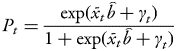
The predicted proportion in each year from a logistic regression is given as
 $$P_t = \displaystyle{{\exp (\bar x_t \hskip2\overset{\lower-7.25\hbox{$\smash{\scriptscriptstyle\frown}$}}\hskip-6 {b} + \gamma _t )} \over {1 + \exp (\bar x_t \hskip2\overset{\lower-7.25\hbox{$\smash{\scriptscriptstyle\frown}$}}\hskip-6 {b} + \gamma _t )}}$$
where P t is the proportion scoring a one in time (t)
 $\bar x_t $ is the vector of means of all the explanatory variables evaluated at time (t),
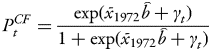
 $\hat b$ is the vector of estimated coefficients and γ t is the year-specific constant term in time (t). The counterfactual prediction is given by
 $$P_t^{CF} = \displaystyle{{\exp (\bar x_{1972} \hskip2\overset{\lower-7.25\hbox{$\smash{\scriptscriptstyle\frown}$}}\hskip-6 {b} + \gamma _t )} \over {1 + \exp (\bar x_{1972} \hskip2\overset{\lower-7.25\hbox{$\smash{\scriptscriptstyle\frown}$}}\hskip-6 {b} + \gamma _t )}}$$
The procedure is as follows. Estimate the coefficients (b and γ) using a logistic regression. Construct the x vector of means for 1972. Plug these into the equation.