

Introduction
During a Latin lesson, my class was studying Pliny’s account of the friendship between a boy and a dolphin. In Epistulae 9.33, the dolphin repeatedly approaches the boy, carries him through the water and becomes an object of local fascination. Pliny presents the animal as playful, responsive, and almost human.
At the time of writing, I am a 15-year-old student entering into my final year of secondary education, studying GCSE Latin and Ancient Greek at a school in England. The classroom practices discussed here are drawn from my own experience and are not intended to describe every Classics classroom.
The A P Bartlett translation rendered the Latin word ministeria as ‘functions’. The choice is not completely false. ‘Functions’ can describe the actions or duties something performs. Yet it also connotes something without life and personality. Machines have functions, but a lively animal with an established personality is less naturally described in this way.
In the lesson described here, the Bartlett version was read alongside the Latin as part of our study of the prescribed passage. This is a feature of my own classroom experience rather than a claim about Classics teaching generally. Whether, when, and how a published English translation is used varies between teachers and schools.
constat Octavium Avitum, legatum proconsulis, in litus educto religione prava superfudisse unguentum, cuius illum novitatem odoremque in altum refugisse, nec nisi post multos dies visum languidum et maestum, mox redditis viribus priorem lasciviam et moram et ministeria repetisse.
It is agreed that Octavius Avitus, deputy of the proconsul, having brought (the dolphin) onto the shore, poured perfume over it, (and that) it fled from the strangeness and smell of this perfume back into deep water, and, not seen except many days later, was sluggish and sad; then, when its strength was restored, it resumed its former playfulness and accustomed functions.
Another possible rendering, such as ‘habits’, ‘services’, or ‘customary activities’, would create a different impression. None is automatically perfect, and each word foregrounds something different. ‘Functions’ emphasises what the dolphin does; ‘habits’ emphasises repeated behaviour; ‘services’ may suggest its relationship with the boy as a servant. The issue is therefore not simply that one translation is right and another wrong, but that the translation determines how an English-speaking student first encounters the dolphin.
This is a problem worth discussing because students of Classics are constantly asked to analyse language. We study why an author selected one word rather than another, how imagery shapes characterisation, and how syntax affects pace or emphasis. However, when our understanding of a passage depends on an English translation, the translator’s own choices can become nearly invisible.
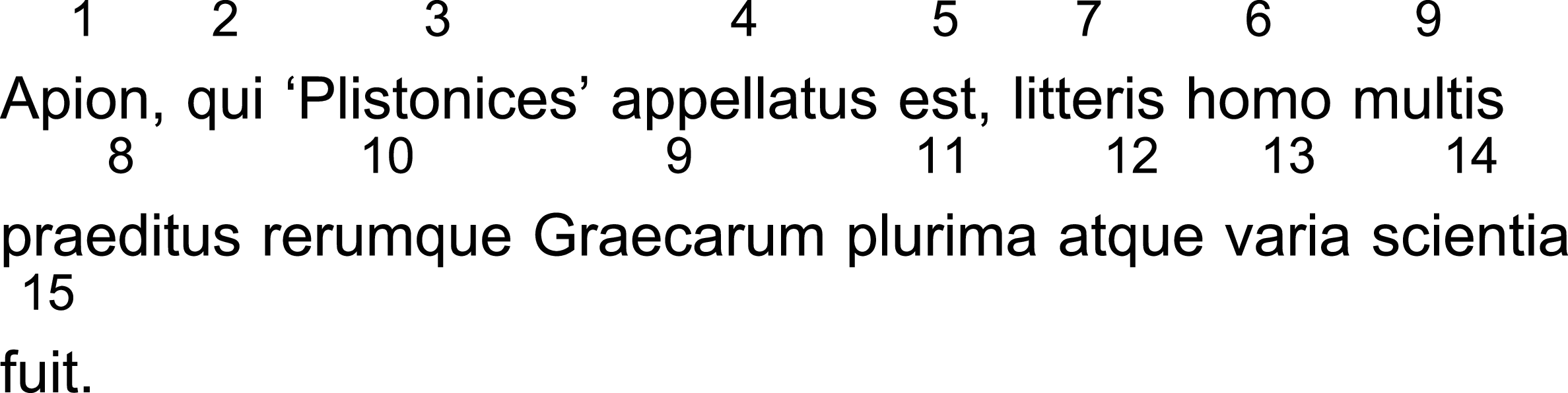
Moreover, one student I talked to commented on how translations we are provided with can prioritise reading through an anglicised lens. In my school, some aided translation materials place numbers above Latin words to indicate the sequence in which they can be rearranged into English word order (Figure 1). This is a particular form of scaffolding used in my classroom and is not universal practice in Latin teaching. For the student I spoke to, relying on the numbered sequence shifted attention away from interpreting the Latin word order itself and towards producing an English rendering. This could obscure stylistic choices such as hyperbaton, homoioteleuton, and alliteration, because their effects are less apparent once the sentence has been reorganised into English order.
An example excerpt from an aided translation for Aulus Gellius’ Noctes Atticae 5.14: Androclus and the Lion. Numbers are provided above the Latin words to indicate how to render the words with an English word order.

I use the term translation literacy to describe the ability to recognise translation as interpretation and to respond critically to its choices, alternatives, and consequences. It involves understanding that a translation is not the original text in another form. It is a new text, produced by a particular person for a particular audience under particular linguistic and cultural constraints.
Do your students know the translator?
In my GCSE study, language work and the literary analysis of prescribed texts are distinct but connected. In language work, we develop vocabulary and grammar by translating unseen, usually confected passages and answering comprehension questions. In literature study, we read prescribed passages from original Latin and Greek authors and analyse their language and literary effects. Across the course, we move repeatedly between these two modes rather than treating one as a simple continuation of the other.
Yet the relationship between these activities is not always clear. In literature lessons, students may be asked to comment on a word in Latin or Greek by memorising or relying on an English translation. This can lead to an important confusion, which I often see: are we analysing the original word, the English word or the relationship between the two?
The English version can appear transparent. Because it is written fluently in a language the student understands, it may seem to provide direct access to the ancient author, but, in fact, it provides access to a translator’s interpretation.
Naming the translator is therefore a significant classroom act. Students are accustomed to recognising Pliny, Virgil, Homer, or Euripides as authors. They are less likely to name the likes of Emily Wilson, David West, and Robert Fagles, who produced the English words through which they encounter the former authors.
Attributing a translation reminds students that the English text also has an author, as it creates a visible distinction between the ancient work and its modern mediation. Teachers do not need to provide a full biography of every translator, but even a brief acknowledgement, such as, ‘This English version was translated by…’, signals that the wording was chosen.
The aim is not to accuse the translator of distortion whenever another wording is possible, but it is to help students recognise that alternatives exist and that different choices shape interpretation.
False fluency
A fluent translation can produce an impression of certainty. The English reads smoothly, so the meaning of the original appears equally smooth. I call this condition false fluency – the gap between apparent access to a text and an understanding of the interpretive decisions that produced that access.
False fluency does not mean that students are falsely claiming to speak Latin or Greek, nor does it mean that translations are inherently deceptive. It refers to a more specific educational problem, such as students knowing what the English translation says without understanding why it says it, what has been omitted or narrowed, or what alternative renderings remain possible.
Knowing a language also does not automatically remove this problem. Vocabulary and grammar are essential, but they do not guarantee complete understanding. A reader may still miss cultural assumptions, genre conventions, humour, ambiguity, register, or historical context. Translation takes place within the distance between linguistic knowledge and interpretive understanding.
This distance can produce false interpretations as well as mistranslations. Suppose an English translation makes an uncertain statement sound definite, a colloquial remark sound formal, or a lively animal sound mechanical. A student may then analyse an effect produced partly by the translation as though it belonged straightforwardly to the ancient author.
However, we cannot abandon translations. They are indispensable, especially when students are still developing linguistic competence. Rather, the solution is to teach students how to use them critically.
Translation literacy
Translation literacy begins when students read a translation, as their access to the original is mediated. From that recognition follow several abilities.
A translation-literate student should be able to identify who produced a translation and for what context. They should recognise that words possess a range of possible meanings rather than one permanent English equivalent. They should be able to propose or assess alternative renderings. They should consider what a choice changes in the reader’s understanding. Finally, they should reach a balanced evaluation rather than describing every difference as an error.
I believe the evaluation is key. Translation criticism should not become a competition to discover mistakes and alternatives. A good translation may still contain choices worth discussing. Equally, a literal translation is not necessarily more faithful than a natural one. Literal wording may preserve a grammatical structure while losing tone, implication, or readability.
Translation choices may also make a text more familiar to its new audience or preserve aspects of its linguistic and cultural difference. Lawrence Venuti (Reference Venuti2008) describes these broad tendencies through the concepts of domestication and foreignisation. In a school classroom, students do not need to master the full theoretical debate. They can, however, ask whether a translation makes the ancient text sound comfortably modern or deliberately retains something unfamiliar.
Translation literacy therefore develops both literary criticism and metacognition. Students examine the translated text, but they also examine their own assumptions. They learn to ask not only ‘What does this mean?’ but ‘How do I know?’, ‘What else could it mean?’ and ‘What may my chosen wording cause the reader to notice?’
The TRACE framework
To make these questions usable in the classroom, I have developed a framework called TRACE:
-
• T: Text and transmission
-
• R: Range of semantic meaning
-
• A: Alternatives
-
• C: Consequences
-
• E: Evaluation
TRACE is intended as a prompt for discussion and self-examination. It can be used to evaluate a published translation, a teacher’s translation, or a student’s own work.
Because TRACE is an acronym, it can also be given directly to students as a reusable mnemonic: a short checklist to apply when they encounter a published translation or review one of their own renderings. It is not intended to prescribe a fixed sequence for every lesson; teachers can use individual elements where appropriate.
Text and transmission
The first stage establishes what kind of text is being read and how it has reached the student.
Who wrote the original? Who produced the translation? What is the genre? Who is the intended audience? Is the student reading the complete text or an excerpt? Has the translation been simplified for a school edition?
These questions affect the interpretation. A diary entry, political speech, epic poem, and private letter do not make the same demands on a translator. A colloquial expression in a personal letter may sound distorted if rendered in highly formal English. A deliberately elevated passage may lose something if translated into entirely ordinary speech.
Teachers already provide contextual information about ancient authors and TRACE extends that attention to the translated version.
Range of semantic meaning
The second stage asks what the significant words might mean.
Dictionary entries often offer several possible equivalents because words do not map neatly between languages. A Latin or Greek term may contain associations that no single English word preserves. Conversely, an English choice may introduce associations that are absent from the original.
Returning to ministeria, ‘functions’ captures one part of its possible meaning. Yet it also introduces a mechanical sense. ‘Habits’ may preserve repeated action but weaken the sense of service or activity. The purpose of considering semantic range is not to locate one flawless substitute but to understand that choices exist.
This is closely connected to literary analysis. When students discuss connotations, tone, and imagery, they are already thinking about semantic range. Translation literacy asks them to apply that same attention to the movement between languages.
Alternatives and consequences
The third stage asks students to generate or compare other possible translations.
This need not involve studying several complete published versions. A teacher can select one consequential word or phrase and ask the class for two or three plausible alternatives. Students can then explain what each version gains or loses.
Alternative generation is valuable because it challenges the idea that the supplied translation is inevitable. It also prevents criticism from remaining vague. Saying that a translation ‘sounds wrong’ is less useful than proposing another expression and explaining why it might work better.
Similarly, the fourth stage asks why the choice matters.
Does it alter the tone? Does it make a character sound more sincere, hostile, confident, or uncertain? Does it remove a joke? Does it change the apparent relationship between speakers? Does it make a religious action sound reverent, absurd, or cynical? Does it turn an animate creature into something mechanical?
This is where translation literacy connects most clearly with literary criticism. Students are already expected to explain the effects of language. TRACE asks them to distinguish between effects supported by the original and effects introduced, strengthened, or weakened by the translation.
Evaluation
The final stage brings the previous questions together.
Is the translation effective for its intended purpose? What does it preserve? What does it alter? Is there a preferable alternative, or are several versions defensible? How confident can we be?
Evaluation should be provisional and evidenced. Students should avoid assuming that every difference is a failure. A translation may be successful overall while containing one debatable choice. Equally, a grammatically accurate rendering may still produce an inappropriate tone.
The final judgement may be that the original translation should be retained. TRACE does not require change for its own sake. A student may decide that a particular wording is the best available option after considering the alternatives.
Using TRACE in the classroom
TRACE can be used as a five-minute activity attached to an existing literature passage, or as individual questions asked when analysing a word.
A teacher might display one sentence in Latin or Greek beside a published translation. The class could then:
-
1. identify the translator and genre;
-
2. select one significant word;
-
3. list its possible meanings;
-
4. propose alternative renderings;
-
5. explain the effect of each;
-
6. reach a judgement.
The same process could be used after students complete their own translations. Instead of merely correcting answers, the teacher could ask students to select one choice they made and explain it through TRACE.
This would also make uncertainty a legitimate part of language learning. Rather than treating uncertainty as evidence that a student has failed to understand the text, translation literacy allows the ambiguity to become a conclusion. Several readings may remain possible, and the evidence may not justify choosing decisively between them. This reflects Richardson’s argument that ambiguity should not always be treated as something to be immediately reduced or overcome (Richardson Reference Richardson2017).
Conclusion
Classics students should not be taught to see translations as transparent.
When an English version is treated as though it were interchangeable with the Latin or Greek, students may memorise an interpretation without recognising it as an interpretation. They may analyse the translator’s phrasing as though it belonged directly to the ancient author. They may also lack the vocabulary to explain why another rendering feels more appropriate.
Translation literacy provides that vocabulary. It asks students to identify how a text has reached them, consider semantic range, compare alternatives, explain consequences, and form balanced evaluations.
TRACE is one possible structure for making this process explicit. Its purpose is to help students become more responsible readers of the texts they study and more reflective producers of their own translations, while advancing their own knowledge.
Teaching students to say what a translation preserves, what it changes, and what they still do not know is not an optional addition to reading Latin and Greek. It is part of learning to read them well.
Competing interests
The author declares no competing interests.

 Open access

