Museums are not full of physical objects. They are full of intentional objects made manifest. This distinction is embedded at a foundational level within our highly-evolved language about these intention-enmeshed artefacts: once one knows the identity of an artefact in, say, a garage, one can rarely immediately subsequently inquire into its meaning – we can ask what an object is that we have not yet identified, and be told that it is, for example, an air compressor. That, in the ordinary course of events, settles it. (If there is a question of meaning, it will be a question of word-meaning for a speaker new to the language.) But an object (in this case a kind of DuchampianFootnote 1 object that has been both physically and ontologically moved to a museum) that used to be an air compressor but that now is part of an exhibition with a title such as ‘Invisible Density’, by contrast, reserves conceptual room for the second question. And this second question will be a question concerning meaning of the interpretive kind. That question – here is the essence of the contrast – will not proceed from, nor will it be reducible to, a question of dictionary-entry word-meaning.
We know this; yet we are, or can be, inclined to miss, or turn away from, its larger significance. A number of conceptual forces together produce this conceptual blind-spot.
1.
Because we know that the work of art is an object of a kind that invites questions of meaning, and because we know that language is the primary conveyer of meaning, we naturally derive preconceptions about artistic meaning from conceptions we may hold, or find intuitively attractive, about linguistic meaning. So however complex we know matters of the interpretation of meaning may become, the basic picture, the starting point, that often presents itself here is this: because the issue of meaning is in central position, the meaning in question will be additive in nature, with individual meaning-elements being assembled into a coherent whole. That is the first, often unexamined step, and it generates an entire conception of artistic meaning – one that yields distortions on all sides, and one that a clear-eyed look into what museum curators do can interestingly correct. We will get to that, but first: where do we find the picture of meaning that so naturally presents itself? And since artistic meaning is often thought of in terms of symbols or symbolic meaning, is there a place where language itself is thought of in symbolic terms, which would further encourage and strengthen the preliminary or basic analogy between words and works?
Bertrand Russell, in his lectures entitled The Philosophy of Logical Atomism, writes: ‘A proposition is just a symbol. It is a complex symbol in the sense that it has parts which are also symbols: a symbol may be defined as complex when it has parts that are symbols.’Footnote 2 A proposition (a sentence) is thus pictured as a complex symbol comprising a coherent set of individual symbols (words), where the meaning-content is additive in the way mentioned above. But is this actually, as Russell is articulating the picture, the structure of all meaning – does it allegedly work this way throughout all symbolic activity? Russell continues:
Perhaps I ought to say a word or two about what I am understanding by symbolism, because I think some people think you only mean mathematical symbols when you talk about symbolism. I am using it in a sense to include all language of every sort and kind, so that every word is a symbol, and every sentence, and so forth. When I speak of a symbol I simply mean something that ‘means’ something else.Footnote 3
A symbol means something else, that is, it connects to another thing, refers to another thing. The simplest instance of this, for Russell, is a name, and this (here is an important and easily-missed step) serves as the model for the more complex case of stating a fact about the world, or describing (to use the phrase from Wittgenstein's early work of the Tractatus Footnote 4 ) a state of affairs: ‘A name would be a proper symbol to use for a person; a sentence (or a proposition) is the proper symbol for a fact.’ And according to this picture, (1) we understand each sentence, taken as an additive assemblage, if we understand each word that is included within it; and (2) we understand each word if we understand the connection it makes, as symbol, to its referent. Thus Russell says:
We may lay down the following provisional definitions; That the components of a proposition are the symbols we must understand in order to understand the proposition; That the components of the fact which makes a proposition true or false, as the case may be, are the meanings of the symbols which we must understand in order to understand the proposition.Footnote 5
If we step across the analogical bridge from language to art, what then would seem natural to believe? If we harbour intuitions about language along these lines, what then do we think artistic meaning looks like and how does it function? First, the work would function as a symbol as does Russell's proposition. If simple, it has one determinate and bounded meaning. If complex, it has a larger or multi-part but still determinate meaning as a function of the added meaning-units that make it up. Second, it will not mean itself but must reach out to another thing; or to put it in Russell's terms, it is a symbol that ‘“means” something else’. Third, if the name of a person is our simplest case of a meaningful word and thus the simplest model for the meaningful work, then the simplest type of work is in essence, or in most basic form, the ‘name’ (that is, it functions in a way perfectly parallel to a name) of a referent. Fourth, if it is a complex work and we understand the individual meaning-units that make it up – the component-symbols, in Russell's terms – then we understand the work. And fifth – this will become the most important issue to reconsider below – the content of understanding will itself be correspondingly bounded: the correct understanding of the work could extend no further than the content of the symbol, and so the full understanding of it will coincide exactly with the limits of that bounded symbol. Thus to state generally the aesthetic influence on our thinking about art as exerted by a linguistic picture: As with the meaning of a word, so with the meaning of a work.
So to cross back over again to the linguistic side, Russell continues:
In a logically perfect language the words in a proposition would correspond one by one with the components of the corresponding fact…. In a logically perfect language, there will be one word and no more for every simple object.Footnote 6
Thus the picture of meaning that is steadily unfolding here includes precision, with the components of the proposition standing in one-to-one or isomorphic relation to the fact to which they refer or which they ‘paint’. Each simple (or non-complex, in the preceding sense) object has its word, and that word's meaning is invariant regardless of the context of the use of the word. For Russell – and the reason ‘atomism’ is the right word in his title – each object in the world named by a word, and each word-symbol in language, stands alone and neither is nor could be interdependent upon any other thing for its content. If a word refers to or names an individuated object, then the meaning of that name, that word, is on his picture similarly individuated. Calling these individuated referents ‘particulars’, he writes:
Particulars have this peculiarity, among the sort of objects that you have to take account of in an inventory of the world, that each of them stands entirely alone and is completely self-subsistent….That is to say, each particular that there is in the world does not in any way logically depend upon any other particular. Each one might happen to be the whole universe; it is a merely empirical fact that this is not the case.Footnote 7
With this widely-influential atomistic picture of language now in view (where its influence often continues beyond its explicit repudiation within the philosophy of language), it does not require even the slightest stretch to introduce at this point the name of a critical methodology that shaped the interpretive work of an entire generation: Formalism. A work of art is a bounded particular; it can stand entirely alone; it is completely self-subsistent; it does not depend upon any other particular; it has meaning of an internally-contained kind. And even though empirically it happens not to do so, each work logically could stand alone as the only work of art in the whole universe.
The mission of a museum, the work of a curator, would seem simple and straightforward from this point of view: exhibition would be a matter of giving each individual work its best placement, its best lighting, its best positioning unto itself. Critical writing on that work would be similarly isolationist; it would concern the contribution each individual part makes to the whole internally – which is precisely Russell's conception of the relation between the word and the proposition, the sentence. And if the work is in the above sense simple, interpretation – the determination of meaning-content – will not advance to a consideration of the relations between parts, but will remain at a level parallel to the determination of the content of the autonomous word.
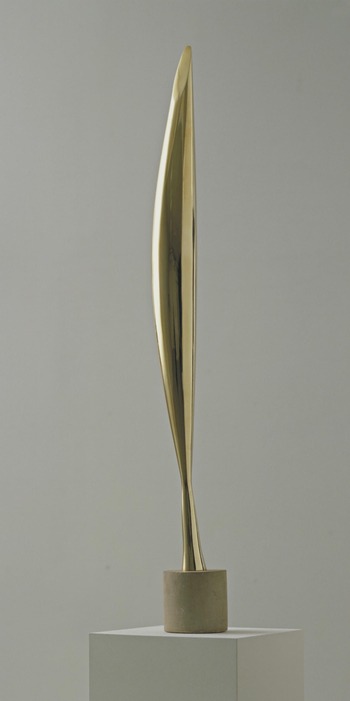
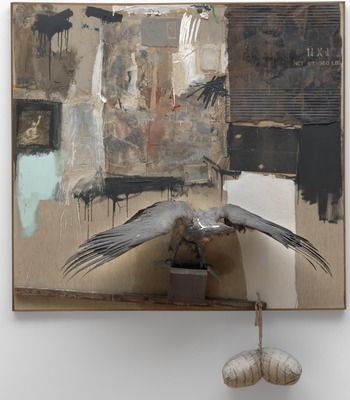
So what it is particularly important to see here is that if the meaning of the work, parallel to Russell's word, is thought to be contained within the bounds of the object (so that the meaning is construed as intrinsic within the work, which is seen as an atom unaffected by its context – I will return to this), the proper treatment of the object, the task and obligation of the curator, would be precisely to present it to its best advantage within its own space. This would be what we might now call atomistic exhibition. Brancusi's Bird in Space [Figure 1] (I choose this example because it might serve as an example of a work that might initially seem simple in the above sense) would have its own pedestal, its own spotlight, its own corner, and enough wall space around it to have the edge of no other work overlapping into the visual field within which we see it. And what was placed next to it might be another Brancusi, or another modern sculpture, or a medieval altarpiece, or a Rauschenberg Combine [Figure 2]; the point is that it would not matter to the meaning-content of Bird in Space. (The right of the Brancusi sculpture not to be visually intruded upon would be maintained to the exact degree commensurate with every other piece's equal right to autonomy – but that opens up a set of political analogies for another day.)
Constantin Brancusi (1876–1957), Bird in Space. 1928. Bronze (unique cast) 54 × 8 1/2 × 6 1/2” Given anonymously. Digital Image © The Museum of Modern Art, licensed by SCALA, Art Resource, NY. ©2014 Artists Rights Society (ARS), New York, ADAGP, Paris

Robert Rauschenberg, Canyon, 1959. Oil, pencil, paper, metal, photograph, fabric, wood, canvas, buttons, mirror, taxidermied eagle, cardboard, pillow, paint tube and other materials. 81 3/4 × 70 × 24” (207.6 × 177.8 × 61 cm). Gift of the family of Ileana Sonnabend. Digital Image © The Museum of Modern Art, Licensed by SCALA, Art Resource, NY. Art ©Robert Rauschenberg Foundation, Licensed by VAGA, New York, NY

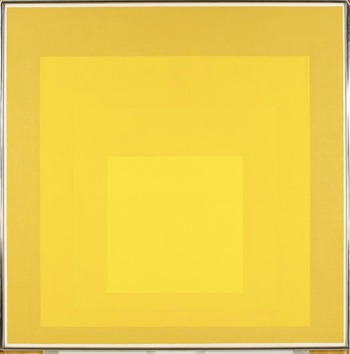
If we then turn to an example that would be complex in Russell's sense, say the Rauschenberg Combine just mentioned, we will recognize within the work fragments of clothing, urban debris of various categories, fragments of newsprint, abraded photographs of Kennedy or others, taxidermy animals, a pillow, and other mosaic elements producing a work that overlaps the border between painting and sculpture. But we see each of those elements as having internally-contained meaning (analogous to the word), and we see them combining into a composite but single whole (analogous to the sentence), where the meaning of that complex entity is a function of its elements. But still, that complex work will be positioned in a museum precisely as was the Brancusi: it is in its own space as an internally contained and meaning-bounded work. Its qualities will be described in the terms of Formalism: line, space, contour, texture, colour (insofar as colours serve to delineate), foreground, background, receding planes, and broadly, the ‘sentence-unit’ whole as produced by the ‘word-unit’ parts according to emergent organizational rules that stand directly parallel to rules of syntax. (Again, Bird in Space is by contrast simple, remaining on a single-part, and thus pre-syntactic, level; Josef Albers’ Yellow Square [Figure 3] paintings would perhaps be the next step up, bringing into play only very similar ‘atoms’ within what is thus the most simplified visual syntax.) But in all of this, what is of central importance is to keep in focus the force of a picture of linguistic meaning on our thinking about artistic meaning; Russell articulates the view under discussion here perfectly:
When you are acquainted with that particular, you have a full, adequate, and complete understanding of the name, and no further information is required. No further information as to the facts that are true of that particular would enable you to have a fuller understanding of the meaning of the name.Footnote 8
The name, as we saw above, is for Russell and any linguistic atomist the most straightforward instance of word-meaning, and when you are acquainted with the particular (in his distinctive sense as examined above) to which it refers, no further information is required, and indeed no further information could ‘enable you to have a fuller understanding of the meaning’. And just so in Formalism: every work for itself.Footnote 9 The fullest understanding of a work would be to fully see each formal element and see its syntactic formal place within the whole; the fullest criticism of the work would be the verbal articulation of that visual-syntactic comprehension of the work, which on this model is the exact visual analogue to the sentence, and so its visual coherence the exact analogue to the unity of the proposition.
Josef Albers (1888–1976). Homage to the Square: Started. 1969. Oil on Masonite, 48 × 48” (121.9 × 121.9 cm) (JAAF 1976.1.937). Photo: Albers Foundation, Art Resource, NY. © 2014 The Josef and Anni Albers Foundation, Artists Rights Society (ARS), New York

It was Wittgenstein who saw most deeply into the intellectual impulses and influences that encourage the atomistic picture of meaning; it was he who saw most deeply into this picture's power to mislead; it was he who brought about a revolution in, and a profoundly changed way of seeing, the entire matter. And: it is this encompassing way of seeing linguistic meaning that brings with it an expansive and non-reductive way of seeing artistic meaning. But what is this new way of seeing the matter of meaning?
The following passage shows at a glance that the view that Wittgenstein develops challenges from the outset the presuppositions embedded in atomism's starting points. Early in Philosophical Investigations (Sec. 5),Footnote 10 after examining a passage from Augustine claiming that the origin of meaning is found in the naming of an object, he writes, ‘one can perhaps get an idea of how much the general concept of the meaning of a word surrounds the working of language with a haze which makes clear vision impossible.’ This stands against the intuitively plausible presupposition that meaning will analyze down to the name-and-referent model, and he introduces the notion of the language-game,Footnote 11 the showing of language in play or in use, in a way that reorients our thinking, away from the picture that positions naming as the essence of the matter. Of these brief examples, he says later in the discussion that ‘language-games stand there as objects of comparison which, through similarities and dissimilarities are meant to throw light on features of our language’.Footnote 12 Objects of comparison that throw light – we will keep this theme in mind when we return to the work of museums below. But for the present, the throwing of light on multifarious features of our language is very different, a very different way of approaching the problem of meaning, from that of beginning with the standard twin-presuppositions: (a) analyzing down to basic elements (linguistic atoms), and then, having identified the atoms, (b) building up to the next-higher composite unit (the sentence).
Wittgenstein's discussion of these issues is of course extensive and complex, but for present purposes I want to turn specifically to the issue of contained or complete meaning at the level of the word as expressed in Russell's phrase, ‘no further information for a fuller understanding’. In Philosophical Investigations, Sec. 149, Wittgenstein writes, ‘If one says that knowing the ABC is a state of the mind, one is thinking of a state of an apparatus of the mind (perhaps a state of the brain) by means of which we explain the manifestations of that knowledge.’ Knowing the meaning of a word, like knowing the alphabet (indeed knowing the meaning of ‘alphabet’), would on this picture be a state of mind, and the use of that word in any context or on any occasion would be a external manifestation of that single, determinate inner state. And so meaning would be (a) invariant across cases and (b) full and complete within the mind of that speaker – the knowing of the meaning of the word would stand, like the imagined apparatus, behind the manifestations. (Wittgenstein is preparing to criticize this view by undercutting its presuppositions; he is not endorsing it.) The sum total of all external manifestations of such word-knowledge alone, that is, the complete set of all uses of the word, could not constitute the understanding in question here; this behaviouristic reduction would leave as an inexplicable mystery (and Wittgenstein sees this) why we are able to go on and use the word consistently in future novel employments. So he writes of a person acting on an instruction given in words and in a mathematical formula and thus showing in practice his understanding of the words and the formula:
But are the processes which I've described here understanding?…“He understands” must have more to it than: the formula occurs to him. And equally, more than any of those more or less characteristic concomitant processes or manifestations of understanding.Footnote 13
There is something behind (as we use this spatial metaphor) the particular actions or usages that show knowledge of the meaning in play here; it again is not reducible to those actions or usages, but is shown within them. So the question becomes: what is meant (on the part of the speaker), and how is it understood (on the part of the hearer)? As we will see below, it is these questions, focused in this way as discussed by Wittgenstein against or beneath the Russellian view, that open the new way of understanding what is meant on the part of the artist, how that is understood on the part of the curator, and how that content is made manifest within a museum. But first, what precisely is the problem here of specifying the content of the speaker, the one who knows the meaning of, and means, the words? The answer to this comes out (as it so often does in Wittgenstein's mature work) through example, when he considers the case of a pupil to whom we have taught a very simple numerical sequence, in this case “+2”. Wittgenstein writes:
Let's suppose we have done exercises, and tested his understanding up to 1000. Then we get the pupil to continue one series (say “+2”) beyond 1000 – and he writes 1000, 1004, 1008, 1012.Footnote 14
Two things immediately emerge about this: he has understood something (it is not a random error without pattern or sequence), but understood wrongly; and he has continued the series in a way we did not intend – we did not mean this. So,
We say to him, “Look what you're doing!” – He doesn't understand. We say, “You should have added two: look how you began the series!” – He answers, “Yes, isn't it right?” I thought that was how “I had to do it.” – Or suppose he pointed to the series and said, “But I did go on in the same way”. – It would now be no use to say, “But can't you see…?” – and go over the old explanations and examples for him again. In such a case, we might perhaps say: this person finds it natural, once given our explanations, to understand our order as we would understand the order “Add 2 up to 1000, 4 up to 2000, 6 up to 3000, and so on”.Footnote 15
What this is already strongly suggesting, and what Wittgenstein is about to state forcefully and directly (and the heart of the matter for artistic meaning), is that we can know exactly what we mean in this kind of case, and yet we did not think of the content that is now being included as part of what we meant at the time we gave the instruction, at the time we said the words (with no problem or question about our understanding them as we speak). Nor would we have thought of this content, had we been asked to give a full accounting of the content of the words as we were using them prior to the emergence of the need for this particular elucidation. Yet it is – in a way radically inconsistent with the intentional picture that goes along with the atomistic meaning-containment model above – part of the intention in giving the instruction. In short, we are articulating that content only after a new context has emerged in which we have an occasion, a need, and opportunity, to do so. (It is precisely here that the connection between this linguistic point and seeing how a work can function within an intelligently curated exhibition presents itself; we will return to this shortly.) Thus the imagined dialogue continues:
“What you are saying, then, comes to this: a new insight – intuition – is needed at every step to carry out the order of ‘+n’ correctly.” – To carry it out correctly! How is it decided what is the right step to take at any particular point? – “The right step is the one that is in accordance with the order – as it was meant.” – So when you gave the order “+2”, you meant that he was to write 1002 after 1000 – and did you then also mean that he should write 1868 after 1866 and 10036 after 10034, and so on – an infinite number of such sentences? – “No; what I meant was, that he should write the next but one number after every number that he wrote; and from this, stage by stage, all those sentences follow.”Footnote 16
But the content of what follows from the instruction cannot be appealed to as given – this is precisely what is in question, and as we have seen we cannot use mental content as a criterion for the correct interpretation of what we have said (consider the distance we now are from Russell's ‘no further information’). Thus with the plot thickening, Wittgenstein continues:
— But that is just what is in question: what, at any stage, does follow from that sentence. Or, again, what at any stage we are to call “being in accordance” with it (and with how you then meant it – whatever your meaning it may have consisted in).Footnote 17
To be in accordance with how one meant it – and particularly how one then meant it – is, in the development of Wittgenstein's examination, slowly but steadily mutating into a matter of what one might call hypothetical retrospection: what one would have said then, had the present consideration emerged at that time. Or: if one had known then what one knows now, what does presently follow from what we said then could have been articulated at that time. (Here, precisely, is the kind of meaning an acute viewer sees in a retrospective exhibition.)
This suggests a kind of dormancy of meaning, meaning that is awakened only by contextual change beyond what we either expected or were able to foresee at the time of speaking. One might be tempted to call this implicit rather than explicit meaning, but that I think would be a mistake: to say that it is implicit is to suggest that it could have been made articulate at first utterance but contingently was not. That perhaps would be consistent with, or at least closer to, the full-intentional view that is carried in with the atomistic picture to our thinking about meaning. What Wittgenstein has in focus here is different, and more important for the proper, non-picture-driven understanding of intentional activity. The imagined dialogue continues:
“But I already knew, at the time when I gave the order, that he should write 1002 after 1000.” – Certainly; and you may even say you meant it then; only you shouldn't let yourself be misled by the grammar of the words “know” and “mean”. For you don't mean that you thought of the step from 1000 to 1002 at that time – and even if you did think of this step still, you didn't think of other ones. Your “I already knew at the time…” amounts to something like: “If I had then been asked what number he should write after 1000, I would have replied ‘1002’. And that I don't doubt. This is an assumption of much the same sort as “If he had fallen into the water then, I would have jumped in after him”.Footnote 18
What these remarks unsettle is philosophically underground or in the intuitive sub-terrain, and as Wittgenstein has shown, it takes some patient and rather exacting intellectual archaeology to get to it: it is the conception, the picture, of meaning-content as an ingredient. Ingredients, of course, are either in the cake or not in the cake, and they invariably have a determinate, fixed quantity. And we have a clear and unambiguous criterion for determining their presence and their precise amount: chemical analysis – a rigorous examination down to basic constituents upon which all the higher-level content depends. The Russellian picture can live on in this often-buried influence on our thought about meaning, even if the surface-components of that picture have been explicitly disavowed or supplanted.Footnote 19 In short, what often remains is at the most basic level the conception of pre-closed containment of content. And it is precisely this picture that makes the phenomena Wittgenstein is examining in his examples initially seem so mysterious.
Wittgenstein voices this in his imagined interlocutor's remark in Philosophical Investigations, Sec. 193, when the interlocutor insists that the meaning-content ‘had to be really – in a mysterious sense – already present.’ But the changed way of seeing the entire issue that Wittgenstein is recommending is not wedded to any such conception, and this changed way of seeing (to which we will also return below in connection with the work of a museum curator) does not yield a solution to the sense of mystery or theory to answer it, but a dissolution or evaporation of the sense of puzzlement or the sense that if the content is not readily visible, it must be hidden somewhere and it will take a linguistic analogue to chemical analysis to find and quantify it. In this light, consider what Wittgenstein writes (extending the example of knowing the meaning of the word ‘chess’ and knowing the intentional content of wanting to play chess) in Philosophical Investigations, sec. 197:
But there is nothing astonishing, nothing strange, about what happens. It becomes strange when we are led to think that the future development must in some way already be present in the act of grasping the use and yet isn't present. – For we say that there isn't any doubt that we understand the word, and on the other hand that its meaning lies in its use. There is no doubt that I now want to play chess, but chess is the game it is in virtue of all its rules (and so on). Don't I know, then, which game I want to play until I have played it? Or is it, rather, that all the rules are contained in my act of intending? Is it experience that tells me that this sort of game usually follows such an act of intending? So can't I actually be sure what I intended to do? And if that is nonsense – what kind of super-rigid connection obtains between the act of intending and the thing intended? – Where is the connection effected between the sense of the words “Let's play a game of chess” and the rules of the game? – Well, in the list of rules of the game, in the teaching of it, in the everyday practice of playing.Footnote 20
If I am forced to say (because not all the content is pre-specified) that I do not know what game I want to play until I have played it, we have (1) been reduced to a crude behaviourist's reductive absurdity. If I am forced to say that all the rules are contained within my act of intending, I am then (2) being forced into evident counterfactuals by the picture of completed containment. If I am forced to embrace a strange scepticism and say that I cannot be sure what I actually intend to do, (3) I have imported a false criterion of intentional knowledge, that is, the criterion claiming that if I cannot say it all at once, I do not know what it is – so I cannot truly know the content of my own intentions.
Against this web of picture-driven mystery, Wittgenstein places the transparent facts of our practices, ‘the everyday practice of playing’. This appeal will seem thin (as I think it does in Wittgenstein's remark here) only so long as we refer to those practices generically, only so long as we do not truly, closely, and patiently look at them. But when we do so, we will find that the impulse to hypostasize a substantive – to make a thing that stands as the referent to which the phrase ‘the meaning’ refers, the thing that it names – slowly but inexorably degrades to irrelevance. We will find that the stark dichotomized contrast between perception and projection – either we are rightly seeing something that is there prior to our looking at it, or we are wrongly superimposing something not actually there – fades into over-general implausibility. The real nuances of particular cases do not respect, nor do they reinforce, this dichotomy.
What we will find in those cases is often that articulating meaning-content, or articulating the content of an intention, is more a matter of discerning implication, of drawing out lines of significance, of throwing light by comparison (consider remarks such as ‘this is more in line with what I meant; that perhaps to a lesser degree’; ‘this work is within the sphere of influence of the original work; that other may initially appear to be, but actually is not’), of stating now (as we saw in Wittgenstein's remarks above) what we would have said then, had the present circumstance or question arisen at that prior time. (At this precise juncture some have suggested that this means past intentional content is wholly open to revision and that anything will be as acceptable as anything else; the simple fact that we can falsify or mislead about that content shows that there are constraints on the articulation of past intentional or meaning-content and thus that the view of meaning being developed by Wittgenstein here hardly endorses a reckless subjectivism about retrospective content.) But there are at this point a number of themes to which we must now return in order to see more fully their significance on the art-side of the fundamental analogy under consideration here between linguistic and artistic meaning.
2.
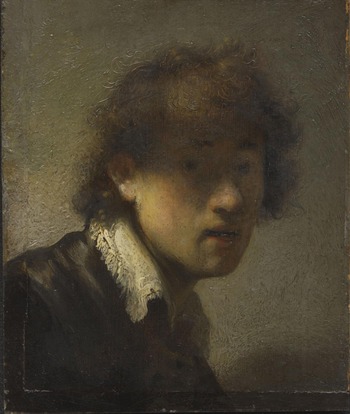
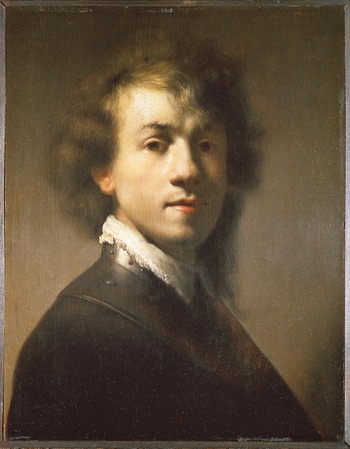
The powerful and rich series of Rembrandt's self-portraits can tell us a good deal within a relatively small set of works about what an exhibition achieves with regard to the question of meaning. In this respect they are strikingly like Wittgenstein's language-games of Philosophical Investigations, where significance is found both for the immediate case at hand and for larger issues of language and linguistic meaning. In the early Youthful Self-Portrait, 1629 [Figure 4], we see the eyes partially shrouded in shadow, with a shock of hair over the forehead also further serving to shroud the look of the eyes. But beneath that, or really emerging out of that, we see a mental posture of alertness, as though the subject had just been unexpectedly called by name and is looking up from a previous lower focal point. When we meet the eyes, we see a combination of quickness and focus, but presented with an underlayment of insecurity, of uncertainty or unsureness about the self within (the parted lips and contour of the mouth contribute to this effect). This is thus a portrait with a double aspect – maturity is emerging from youth as a faun stands on uncertainly-commanded legs. But in another work of the same year, Self-Portrait with Gorget, 1629 [Figure 5], (a gorget is a piece of neck armour) we now see a young man, with much more light on the face, the shock of hair still there but well above the eyes and only falling onto the upper forehead; lips are again parted, but now with an air of reflectiveness rather than of self-doubt, and, most importantly, here it is the eyes alone that have a double-aspect. They now look outward and slightly downward, to the left of the viewer, with attention fixed, and yet they also look inward – the portrait shows reflection on what is being perceived, or what is being said, in the act. This portrait presents an independent consciousness, one capable of independent judgment and thus a person with a more developed, a more mature, autonomy. The fact that the head rests slightly back, unlike the previous self-portrait, amplifies the effect, and the comparison of the two works on that single feature alone conveys a good deal.
Rembrandt Harmensz van Rijn (1606–1669), Self-Portrait. 1629. Oil on wood, 15.5 × 2.7 cm. Inv. No. 11427. Photo Credit: bpk, Berlin (Alte Pinakothek, Bayerische Staatsgemeldesammlungen, Munich, G.), Art Resource, NY

Rembrandt Harmensz van Rijn (1606–1669). (studio copy). Portrait of Rembrandt with a gorget, c. 1629. Oil on canvas, 37.9 × 28.9 cm. Inv.: 148. Photo credit: Scala, Art Resource, NY

In the context of discussing Wittgenstein's philosophy of language, Rush Rhees has called attention to the distinction between on the one hand saying one thing and saying another, and on the other hand saying one thing but in two different ways.Footnote 21 These two self-portraits were painted by the same person in the same year, and as one would expect they have unmistakable similarities. But they also have the differences just described. If one were to see them only as two different “sayings”, one could see them independently, as contained within their own frames. And if one were a strict Formalist, one could omit any mention of subject matter or humane content and describe light-shade differentiations, foreground-background differentiations, linear-curvilinear differentiations, hard-soft textural differentiations, and so forth. But in the presence of these works one wants to say: one can see all this – and much, much more. If one says of what a person says, where that person has recast something said earlier, that it is now much nicer, or more elegant, or more sensitive, or clearer, or sharper, or more focused, or richer, or fuller (or a thousand other things), what one appreciates in the remark at hand lies in the features or qualities that emerge as now salient as a result of seeing those differences. This is a kind of content not discernible within the sentence alone, and what we see in Rembrandt is content not in the frame alone. But this is only the beginning.
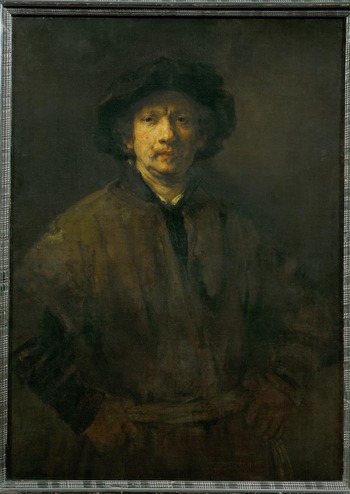
In the Large Self Portrait, 1652 [Figure 6], we encounter a man of achievement, standing, hands on hips with thumbs in waistband, and a strong, unwavering gaze now directly meeting the viewer. We can, if we wish, take it on its own: the work itself seems to embody the self-composure of the subject. Yet in truth that would here again be falsely limited, and it would deprive our understanding of much of the work's significance. The posture is erect, the look is slightly challenging (a look that is the gestural equivalent of the phrase, ‘Alright, you have asked for my attention: now you have it’), the lips together and slightly pursed (adding to the effect), the wrinkles under the subject's right eye and the folds around the chin and neck suggesting that time is finite and this is a man momentarily arrested from action (and misleadingly so, since this is a man in the action of producing an unforgettable self-portrait – but we know that of the portrait, we do not see it in it). But also: the force and directness of the eyes are now the full maturation of the quality we saw in the second portrait in contrast to the first. The slight pursing of the lips completes the trajectory of autonomous judgment we saw in the earlier two. The resolute stance is on anything but faun legs. And the head very slightly back with its attendant confidence we have seen before – but here it is said differently. This constitutes much of the human content – the meaning – of this painting, and it is relational or comparative in nature, moving across or between paintings; it is a set of qualities emergent in the differences. It is the kind of meaning Wittgenstein was pursuing and knew to be centrally important, and the kind of meaning Russell's picture could never accommodate.
Rembrandt Harmensz van Rijn (1606–1669), Large Self-Portrait. 1652. Oil on canvas, 112 × 81.5 cm. Photo credit: Erich Lessing, Art Resource, NY

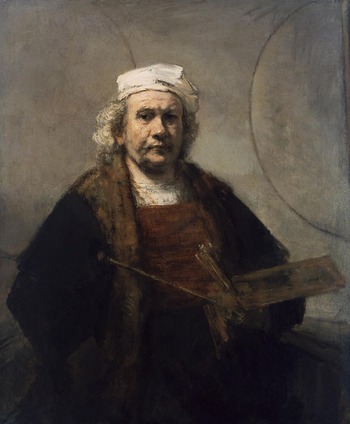
If we now turn to the late Self-Portrait, 1665 [Figure 7], what we can see within its atomistic frame is certainly engaging: we see a much gentler palette, we see softer textures, we see broader brushstrokes (especially in the headgear, with broad strokes so strong on the level of gesture that we are aware we see the stokes of paint as representation, as headgear). But if we see it in the context, in the visual language-game, of Rembrandt's lifelong series of self-portraits, and see it across and within that range of profound work, what we see is a heartbreaking masterpiece of human self-definition. The body, softly portrayed in a way consistent with the weight that fills out the earlier wrinkles and folds of flesh (which we now see in their filled-out absence, which of course we could not see within the frame alone), seems contingent: it is the soul of a person we see in these eyes, and that soul happens to find itself in this ageing body. The eyes meet the viewer with a gaze, but now in a way that is subtlety retreating, a gaze that is now challenged (by life, not by the viewer, so it is a variation on a theme of the earlier confident painting), and that is, in a word or two, quietly hurt. Thus there is a return to the double-aspected gaze – it looks outward and inward simultaneously, but now with the world and its disappointments behind him, now with a retrospective view of the great world the young man was finding the confidence to approach as his own person and aggressively explore. We now see, comparatively, and across the canvases, a revision, an emotional palimpsest, of innocence by experience – some of which has instilled heartache and the felt knowledge of what loss is like. And here again we see meaning-conveying lips, again not parted, but now with a soft downturn at the edges that the spirit within no longer can convincingly lift. Taken together, it is a look that asks: have you seen such things too?
Rembrandt Harmensz van Rijn (1606–1669), Self-Portrait with Two Circles, c. 1665–1669. Oil on canvas, 11.3 × 94 cm. Photo credit: Album, Art Resource, NY

To hear a theme as a variation, we have to keep the theme we are not now hearing in mind in order to hear the content of the variation. In order to hear the new formulation as a kinder, or more sensitive, or more humane way of saying something, we have to keep the original less-preferable version in mind. To see the younger face of many years ago in the older person we now see before us, we have to have that earlier face in mind. To see the way the head slightly sits back with unspoken resignation in the last self-portrait is to see it by contrast to the previous one in which it sits back in quietly assertive judgment. So to state it directly: to see the content of what is meant and the qualities of what is meant, we need to see more than the literal statement, more than the syntactically organized words that compose the sentence; to see a painting, we need to see more than the painting.
But then what of intentional content? What of the problems of knowing the meaning of “chess”, expressing a desire and intention to play chess, but having a world of possibilities on the chessboard, and an intertwined network of rules that govern the game in a sense present, and in a sense not present?
If anyone knows the game and the rules of chess, Garry Kasparov does. Yet even he may encounter a move, set within a web of complex relations, that he has not seen before or, if he has seen the move, he has not seen it in its present meaning-generating context. Does he exclude that from the meaning of the word “chess” because he did not foresee it? (One wonders what question has arisen such that he is considering the boundaries of the meaning of the word “chess”, but I'll leave that Austinian consideration for another day.) The answer is: of course not. Rather, his own comprehension of the meaning of the term as he uses it has deepened by one small step – one small move in the game.
Then what of the Rembrandt case? Of course he did not plan to paint the self-portraits that he did paint later in life with full foresight of exact content. But he did know he was beginning what he planned to unfold as a lifetime of self-portraits on completion of the first few. And those works put into play an intentional trajectory that was like ‘1002, 1004, 1006…’: when the positioning of the head on the shoulders slightly changed, he was developing variations on a theme he had originally identified and visually articulated. When he used the pursing of the lips as he did, he was similarly seeing in the act of painting new emergent content made possible by what preceded it. When he painted the last piece considered above, he painted in the eyes of the portrait a commentary on what he had seen in this life, what he had felt as the result of that, and who he was as a synthesis across time of over-layered earlier selves. There is thus a real sense in which he fulfilled his own early intention throughout the evolution of these great works, yet having done so in a way that was at the same time within the range of his intentions and beyond what he could precisely envision. It is, in short, exactly what Wittgenstein was showing in his examples about the nature of meaning. Rembrandt's intention was made manifest, and as it was realized in oil, like correcting the pupil writing ‘1004, 1008, 1012…’, he responded to issues that emerged as he proceeded. To insist here on an excluded middle: either the intentional content as pre-envisaged meaning was there or it wasn't; either it was present or not present; is to miss the nature of the creative phenomenon in front of us – the creative work that museums make visible. It would be to restrict our view of art to make it parallel to a false model of intentional content in language. Wittgenstein answered his own question concerning the seemingly mysterious content of the word ‘chess’ by using the phrase: ‘in the everyday practice of playing’. We might use a phrase here that shows how it is we make such cross-work content visible, how it is uncovered and displayed: ‘in the curatorial practice of exhibiting’. And we should add (as is true of chess), ‘in all its complexity and ever-new unfolding, ever-new juxtapositions, and resultant unpredictability’. Objects of comparison, in Wittgenstein's sense, throw light.
Nevertheless, as above on the linguistic side of the art-language analogy with the often-buried residual influence of the Russellian picture, here too the impulse to insist that meaning must be internal to the work is persistent; one might admit that comparisons show differences, but that still the meaning must be in, or not in, the work – to resituate the distinction above from language to art, meaning-content is either rightly perceived, or wrongly projected. Perhaps the examples that at least seem to encourage such a view, or encourage the Formalism mentioned above, are works of non-representational, high Modernist, design. So let us briefly consider the well-known ‘Red-Blue’ chair by Gerrit Rietveld [Figure 8]. The three most-visible planes interact: the blue seat slanted back, the iconic red back, and the plane implied by the flat arms. These are contained within the geometrical grid of horizontal and vertical supports, with the ends of each marked with striking yellow paint. One could say much more about the reiteration of the verticals and the receding space they describe, the differing rhythms of the receding horizontal supports, and the grounding of the whole composition on the plane of the floor beneath. One thinks one would not need to see more (recall Russell's ‘no further information’) to fully and completely grasp the composition as we see it within the boundary of the outside edges of this work. So if a museum shows it, it shows it.
Gerrit Rietveld, Armchair Red and Blue, 1918 (wood). Photo credit: Erich Lessing, Art Resource, NY. © 2014 Artists Rights Society (ARS), New York, c/o Pictoright Amsterdam

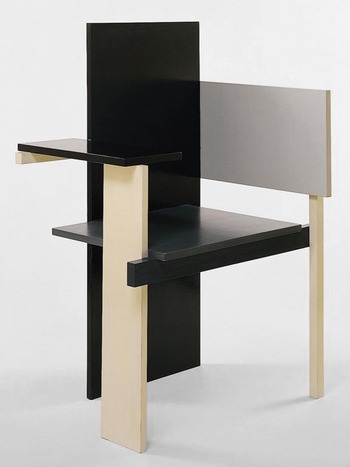
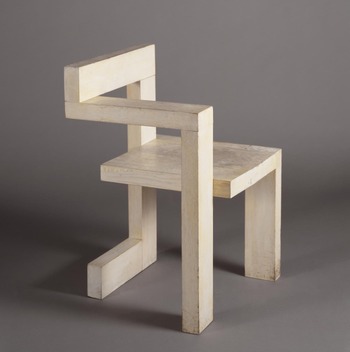
Yet when one sees his 1923 Berlin chair [Figure 9], one instantly sees significantly more in the Red-Blue chair: the Berlin chair has a geometrically straight back going down to the floor with no further support; it has one arm, not two, and that arm too is grounded directly without mediation; and the non-arm side is a flat panel describing a perpendicular plane. This chair itself could be read either as an analysis of the Red-Blue chair, revealing the essential structure that is elaborated upon in the much more complex Red-Blue, or could be read as a work of design that stands to the later chair as the early Rembrandt self-portrait stands to the later ones – it puts themes, or a visual logic, in play that the later chairs work out. The later chair would not have been fully imaginable at that time, and yet it is still internally related just as an unarticulated consequent melodic line is related to its antecedent in musical composition. We see in the simplified chair, to borrow a phrase, the condition of possibility of the later one. If we then proceed to Rietveld's extraordinarily clever Steltman Chair [Figure 10], we here see even more the idea of analysis down to essence, and this might at a superficial glance seem to support as well as does any work of art a case of internally-contained meaning. Except that: it isn't. We see this clever analysis only in relation to, and in visual contrast to, and as an analysis of, the more complex chairs. To state the matter as a kind of paradox, and like the air compressor turned work of art at the beginning of this discussion: To see what it is, we have to see more than what it is. Like the words within the sentence, and like the sentence within the language-game.
Gerrit Rietveld, Dutch, 1888–1964 “Berlin” Chair, c. 1974 (designed 1923). Painted mahogany plywood, linden ash Minneapolis Institute of Arts, The Modernism Collection, gift of Norwest Bank Minnesota 98.276.43 © Artists Rights Society (ARS), New York / PICTORIGHT, The Netherlands Photo: Minneapolis Institute of Arts

Gerrit Rietveld, 1888–1964. Steltman Chair, 1963. Limed oak: 27 1/2 × 19 × 17 5/8” (69.9 × 48.3 cm): Saint Louis Art Museum, Marjorie Wyman Endowment Fund 85:2000, © 2014 Artists Rights Society (AARS) New York, c/o Pictoright Amsterdam

The internal relations of lines and planes within Rietveld's compositions are indeed part of what we want to see, part of the compositional content to which we attend. But even with works such as these, selected to give the greatest plausibility to the aesthetic analogue to atomism, the relations internal to the work are only one part of a more complex intentional and relationally-configured object; moreover, these internally-contained formal relations are not the origin of the kind of meaning museum exhibitions make visible and that Wittgenstein, on the linguistic side of the art-language analogy, was pursuing. But still more than that: to say that the formal relations are wholly discernible within the boundary of the artefact is to concede too much to the atomistic picture. In truth, we cannot see those relations and features for what they are without comparative, cross-work, inter-relational perception. The strength of the geometrical straight back panel in the Berlin chair cannot be appreciated for what it is without seeing it as a stern insistence on geometry against the human or ergonomic conciliation of the slanted back panel of the famous Red-Blue chair. And of course, another discussion could ensue upon seeing the Rietvelds next to a set of Corbusier chairs [Figure 11] that would reveal more, and provide an occasion for the articulation of, the qualities they hold and the lines of implication they set in motion. (Here we see the aesthetic analogue of the Frege-Wittgenstein context principle, that is, that a word has meaning only in the context of a language, or a language-game.) And one should note: if we then say that the kind of cross-work, or unit-transcending meaning we find there is only projected, not perceived, we only revert to a dichotomy that, as with Wittgenstein on language, the aesthetic phenomena in question on the level of detail do not support. Like deliberate falsifications of past intentions, the fact that we can distinguish convincing from implausible comparative ‘light’ shows an important fact: we have criteria for separating (a) meaning-revealing and – extending that meaning into its implications – connection-making sets of comparative objects from (b) false, thin, misleading, implausible, and unworkable groupings of objects that, as we revealingly say, do not ‘speak’ to each other. Successful curatorial thinking is successful for a reason, a reason that I believe is best expressed, best captured, best modelled, on linguistic meaning as Wittgenstein investigated it.
Le Corbusier (Charles-Edouard Jeanneret, 1887–1965), Armchair with adjustable back, 1929, Chrome-plated tubular steel frame, canvas seat and back, 16 1/8” h. × 25 5/8” d. Gift of Thonet Brothers, Inc. (281.1934b). Digital image © The Museum of Modern Art, licensed by SCALA, Art Resource, NY. © F.L.C./ADAGP, Paris/Artists Rights Society (ARS), NY 2014

3.
In closing, I want to suggest a way of understanding what happens in a powerful museum exhibition with a density of meaning as a macroscopic version of what happens within the creation of a single painting; this will also return us to the opening distinction between an object and an intentional object. Taking the latter first, Michael Baxandall, in his Patterns of Intention, writes:
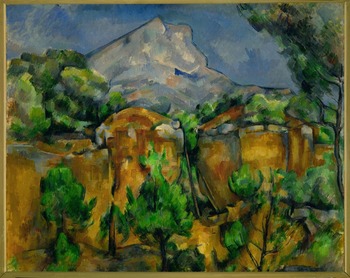
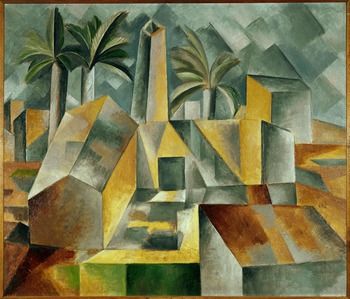
Cezanne had said, and Picasso later quoted him with approval as saying, that every brushstroke changes a picture. [Compare Figures 12 and 13 in this light]. The point they were making was not that a finished picture will look different if even one brushstroke is removed or changed. They meant that in the course of painting a picture each brushstroke will modify the effect of the brushstrokes so far made, so that with each brushstroke the painter finds himself addressing a new situation. For instance, the addition of a new tone or hue can modify the relationships and the phenomenal character of the previously placed tones and hues [See the effect of the reds on the greens and yellows in Picasso, Figure 14]; and because of the simultaneous presence of the elements of a picture this effect is very powerful, however clearly the painter has in mind a final character. This is to say that in painting a picture the total problem of the picture is liable to be a continually developing and self-revising one. The medium, physical and perceptual, modifies the problem as the game proceeds.Footnote 22
This not only implicitly suggests the analogy to Wittgenstein's language-games; and it not only claims that each move changes, or we might say holds steadily-deepening significance for, the moves made so far. It also claims that the irreducible and interrelated ways in which elements interact produce ‘a new situation’ that is in its nature, as Baxandall says, ‘continually developing’. And just as with words in the ways we have seen above, ‘a new tone or hue can modify the relationships and the phenomenal character of the previously placed tones and hues’. Our knowledge of this kind of process-based and dynamic intentional activity is essential to our appreciation of the work and our understanding of its meaning-determining intentional content. Baxandall thus continues:
Indeed some parts of the problem will emerge only as the game proceeds. The sense of a dimension of process, of re-formulation and discovery and response to contingency going on as the painter is actually disposing his pigments, is often important to our enjoyment of the picture and also to our understanding of how styles historically evolve and change. This need not be argued out on the basis of some aesthetic theory of self-discovery; it is intuitively obvious to anyone who has made anything at all.Footnote 23
One wants to say that the parallel point about language should be intuitively obvious to anyone (not presently in, as Wittgenstein put it, the grip of a picture) who has said anything at all.Footnote 24 The atomistic picture denies a great deal of what makes language meaningful in our multiform uses of it, and it enforces an anaemic conception of what a speaker does.Footnote 25 Thus Baxandall, again on the art-side of the analogy, completes the point:
A static notion of intention, supposing just a preliminary stance to which the final product either more or less conforms, would deny a great deal of what makes pictures worth bothering about, whether for us or for their makers.Footnote 26
Exactly. If intentions were static, if there were not a complex, intricate, and profoundly human process of intentional activity in play here, we could and would dispense with any consideration of intention as soon as we had the object before us. The object, as one that in a simple one-to-one way realized that static intention, would be the material manifestation of its ghostly predecessor. But that is not to understand a work of art for what it is, nor is it, on the linguistic side, what it is to understand the way intention works in verbal interaction. So then to the other of my last two considerations.
Paul Cezanne (1839–1906). Mont Sainte-Victoire. c. 1887–1890, oil on canvas, 65 × 92 cm. RF 1969–30. Photo: Hervé Lewandowski. © RMN-Grand Palais, Art Resource, NY

Paul Cezanne, Mont Sainte-Victoire, seen from the Bibemus Quarry, 1897. Photo credit: Erich Lessing, Art Resource, NY

Pablo Picasso (1881–1973), Factory at Horta del Ebro, summer 1909. Oil on canvas, 53 × 64 cm. Photo credit: Erich Lessing. Art Resource, NY© 2014 Estate of Pablo Picasso, Artists Rights Society (ARS), NY

A process-based, or problem solving, or reformulation-and-discovery centred, or a developing, unfolding, and continually self-revising undertaking, is constitutive of the meaning-content of a work and parallel to the meaning-content of a name or a sentence. Hues and strokes, like words and phrases, interact, and yield the ‘new situations’ to which the artist, and speaker, respond and with which they creatively interact. This too is the process of intelligently successful curatorial work, if on the macro-scale of an exhibition; the exhibition itself is an intentional work, and its frame is expanded to the footprint of its rooms, its architectural space. On this scale it is as if each painting becomes a brushstroke in Baxandall's sense. Or as works of art interact, it is as if each brushstroke extends in its power beyond the reach of the canvas. Other works, analogous to the preceding strokes within a given work, shift in inflection or nuance accordingly; it is for this reason that we see works anew within the new situation of a new collection of surrounding works.Footnote 27
We might ask why it is that we return to a work time and time again, why we do not stop looking once we have seen it. Or we might ask why include a work that viewers know well in a new exhibition.Footnote 28 But those questions are born of an often unspoken atomistic presupposition about meaning-containment. If we see art and its exhibition by analogy to actual language and not to an impoverished model of it, we might come to see these questions in the same light as a question asking why we do not stop using a word once we have used it. In the discussion of the Russellian picture and its significance for how we conceive of artistic meaning above, I said ‘As with the meaning of a word, so with the meaning of a work.’ That sentence itself, I hope, we now see in a new light or in a re-contextualized and enriched way. Indeed, one might go so far as to suggest that, seen one way, an entire museum with continually changing exhibitions could function as a representational depiction of language. But a more manageable claim suggests itself as well: No word is an island. Neither is a work of art.