1. Introduction
The concept of a social investment welfare state has received increasing attention from both researchers and policy professionals, especially in the European Union (EU), over the last few decades as traditional welfare institutions face new social challenges and increasing fiscal pressure (Esping-Andersen, Reference Esping-Andersen1996; Esping-Andersen et al., Reference Esping-Andersen, Gallie, Hemerijck and Myles2002; Bonoli and Natali, Reference Bonoli and Natali2012; Hemerijck, Reference Hemerijck2012a, Reference Hemerijck2017; Morel et al., Reference Morel, Palier and Palme2012b). More concretely, the social investment welfare state is a rebuttal to the neoliberal welfare strategy of retrenchment of social transfers through increased public spending on capability building social policies, e.g. education and training, that will have a productive impact on the economy and reduce worker dependency on government handouts.
The language of social investment and social investment policies made their modern appearance on the policy agenda in the EU's 2000 Lisbon Strategy, whose stated goal was ‘to become the most competitive and dynamic knowledge-based economy in the world, capable of sustainable economic growth with more and better jobs’, which would be achieved by ‘investing in people and combating social exclusion’ (European Union: Council of the European Union, 2000). Since these beginnings, the EU has issued numerous guidelines and directives to member states to bring about reform to their welfare systems through adoption of social investment policies. This culminated in the publication of the Social Investment Package for Growth and Social Cohesion in 2013, which stressed early-childhood human capital investment, guaranteeing gender equality in labour market participation and better integration of social services and benefits to help cope with social risks and transitions across the life course (Astor et al., Reference Astor, Fransen, Vothknecht and Hemerijck2017).
Unlike traditional welfare policies that have well-known supporting coalitions, which voters will make up the support base for social investment policies is less apparent (Gingrich and Häusermann, Reference Gingrich and Häusermann2015). In a series of studies based upon the INVEDUC survey of voters in eight EU member states, Busemeyer and colleagues have begun to identify some of the conditions necessary for voter support of social investment (e.g., Busemeyer, Reference Busemeyer and Hemerijck2017; Busemeyer et al., Reference Busemeyer, Garritzmann, Neimanns and Nezi2018; Garritzmann et al., Reference Garritzmann, Busemeyer and Neimanns2018). However, it is less clear what voter attitudes are in countries where social investment policies and the language of social investment are less widespread, e.g. Japan. Although social investment policies exist in Japan and are familiar to voters, policies are promoted individually and a ‘social investment’ package is not present. Using a new survey of Japanese voters and a conjoint experiment, this paper attempts to understand who the supporters of the social investment welfare state might be and in what context they would support social investment policies.
2. Previous research on social investment
2.1 The social investment paradigm
The concept of a social investment welfare state developed out of acknowledgement that existing welfare structures, developed for the post-war industrial era, were insufficient for the new post-industrial economy of the late twentieth century. The increased flexibility of a post-industrial economy and a change in social values and norms has led to new social risks in contemporary societies that the Keynesian welfare state has been unable to meet (Bonoli, Reference Bonoli2005). The post-war welfare state was built around a single male-breadwinner-based industrial economy and its policies were geared towards income maintenance when faced with ill-health, old age and unemployment (Sainsbury, Reference Sainsbury1996). However, the social investment welfare state is based around not only income maintenance, but also increasing labour market participation and opportunities for workers and citizens with the goal of simultaneously increasing economic growth.Footnote 1 This represents a clear break from the neoliberal welfare perspective of the 1970s and 1980s that saw welfare as a hindrance to the goal of economic efficiency (Morel et al., Reference Morel, Palier, Palme, Morel, Palier and Palme2012a).
The social investment strategy aims to shift the economy towards a high productivity knowledge-based economy through more inclusive utilisation of human capital, with emphasis on increased female labour market participation. In the short term, investing in the working-age population via active labour market policies that promote re-training and employment services can create better employment opportunities for low-skilled workers, who are at greater risk of social exclusion and poverty due to de-industrialisation (Bonoli, Reference Bonoli, Morel, Palier and Palme2012). In the longer term, the goal is to improve the life-chances and opportunities available to future generations. This is achieved by greater investment into education, especially in early childhood, which is argued to limit the risks of poverty more effectively than later investment in adults (Heckman and Lochner, Reference Heckman, Lochner, Danziger and Waldvogel2000). Investment in tertiary education – both in teaching and research – is also emphasised in recognition of the importance of a high-skilled workforce and technology-led growth in the post-industrial economy (Lundvall and Lorenz, Reference Lundvall, Lorenz, Morel, Palier and Palme2012).
Given the strong push towards adopting social investment packages by national governments, international organisations – e.g. the EU and OECD – and social policy professionals (Nolan, Reference Nolan and Hemerijck2017), there has been considerable research into the positive outcomes of social investment. Increasing women's labour market participation is a crucial goal for the social investment approach due to its positive impact on not just economic productivity but also poverty reduction. There is consistent evidence that households with dual-incomes have a reduced risk of poverty and social exclusion (Nolan and Marx, Reference Nolan, Marx, Salverda, Nolan and Smeeding2009). Consequently, policies that look to remove barriers to female employment, such as public provision of childcare and parental leave, form a key part of social investment packages (Esping-Andersen et al., Reference Esping-Andersen, Gallie, Hemerijck and Myles2002; Pavolini and van Lancker, Reference Pavolini and van Lancker2018). Furthermore, increases in early childhood education and human capital spending have also been shown to have positive effects on employment levels overall, but especially so in knowledge-intensive employment fields (Nelson and Stephens, Reference Nelson, Stephens, Morel, Palier and Palme2012).
2.2 Social investment in Japan
As with other areas of welfare research, research into social investment suffers from Eurocentrism, with literature predominantly focused on policies of European governments and the policy focus of the EU. Furthermore, Japan's place within the broader literature on comparative welfare is also somewhat ambiguous. As the earliest developed East Asian economy, Japan was included in many pieces of early research into welfare states (e.g., Esping-Andersen, Reference Esping-Andersen1990), but most early comparative approaches to welfare policy saw Japan as an exception and it was rarely discussed in depth. Similarly, as research into East Asian welfare states has become more common, the Japanese case has again found itself somewhat outside the comparative literature which has been more focused on China, the ‘tiger economies’ – South Korea, Taiwan, Singapore and Hong Kong – and the newly industrialising countries of South East Asia – Thailand, Malaysia and Indonesia (e.g., Kwon, Reference Kwon2009; Furuto, Reference Furuto2013).
Furthermore, recent volumes with the stated goal of expanding the discussion of social investment beyond Europe have also not included Japan (Midgeley et al., Reference Midgeley, Dahl and Wright2017; Deeming and Smyth, Reference Deeming and Smyth2019). One reason for this is that Japan has lacked ‘explicit public policy discourse on social investment’ (Peng, Reference Peng2011: 44) and has comparatively little implementation of social investment policy (Fleckenstein and Lee, Reference Fleckenstein, Lee and Hemerijck2017b; Miura, Reference Miura2018). However, this is not to say that social investment policies do not exist in Japan. In fact, given that economic growth in Japan has been stagnant since the 1990s and there is a strong insider–outsider division in the labour market between regular and non-regular workers (Thelen and Kume, Reference Thelen and Kume2006; Song, Reference Song2012), social investment policies would appear to target important social issues, especially since the relative poverty rate in Japan has rapidly increased since the 1980s (Miura, Reference Miura2012). Policies promoting better work–family balance would also tackle the issues of a rapidly ageing society and conservative attitudes towards gender roles: Japan's fertility rate in 2018 was 30th out of 37 OECD countries (OECD, 2020) and between 2005 and 2009, 62% of women quit their jobs upon becoming pregnant (Gender Equality Bureau, 2015).
However, the implementation of social investment policies has been lacklustre and often failed to deliver necessary changes. The provision of childcare facilities was noted as key to tackling the issue of declining birth rate in the 1990s (Ministry of Health and Welfare, 1996). However, although strides were made to improve the public provision of childcare services in the 1990s and early 2000s, this progress has been arrested and policy has reverted to focus on more traditional child benefits (Fleckenstein and Lee, Reference Fleckenstein and Lee2017a). Consequently, public childcare and early education services could provide places for just 32% of children aged 0–5 in 2009 (An, Reference An2013). Similarly, in 2003 the Japanese government set a target of having 30% of leadership roles be filled by women in both public and private sector employment by 2020, but the target date was recently pushed back to 2030 after the government found it was well short of meeting its goals – 5.3% in leadership positions in the public sector in 2019 and 8.4% in the private sector in 2018 (Hori, Reference Hori2020).
One important factor to note when discussing social investment policies in the Japanese context is that the term ‘social investment’ is rarely used and little understood outside of academic circles (Miura, Reference Miura2018). Direct translations of social investment into JapaneseFootnote 2 are associated with either crowd-sourcing investment for start-ups or the corporate social responsibility schemes of large enterprises. As a result, social investment policies are not presented as forming part of a complete policy package as is common in the EU and its member countries (Astor et al., Reference Astor, Fransen, Vothknecht and Hemerijck2017). Instead, they are individual policies that tackle separate unrelated issues, e.g. the expansion of public childcare services in Japan is geared towards improving child welfare and is not conceptually linked by bureaucrats and politicians to increasing women's labour market participation (Boling, Reference Boling2015).
3. Research design
The aim of this paper is to identify the extent of voter support for social investment policies in Japan and especially in which contexts they support increases in government spending on those policies. Large cross-national surveys of voter opinions on social policy, such as the International Social Survey Programme (ISSP), the Eurobarometer and the European Social Survey (ESS) have allowed researchers to investigate political attitudes towards welfare policies. However, these surveys are primarily targeted at understanding attitudes towards traditional social policies such as healthcare, pensions and benefit transfers and questions regarding social investment are limited and restricted to opinions on education policy only. Some survey research on attitudes to social investment has been undertaken and has found strong levels of support (e.g., Busemeyer, Reference Busemeyer and Hemerijck2017), but this has hitherto been restricted to surveys of voters in European countries.
3.1 Who are the supporters of social investment?
The key finding from previous research into voter attitudes towards welfare is that attitudes are highly dependent on the characteristics of voters. Overwhelmingly, it has been shown that voters from economically disadvantaged groups – low income, low educational attainment – are the strongest supporters of welfare (Blekesaune, Reference Blekesaune2007; Pfeifer, Reference Pfeifer2009). However, the social investment literature expects there to be a difference between the supporters of traditional social transfers and the supporters of social investment, with wealthier middle-class voters being the core supporters of the latter (Gingrich and Häusermann, Reference Gingrich and Häusermann2015). This is due to their more secure socio-economic standing, which allows them to make long-term wagers on policy returns that the working-class cannot (Beramendi et al., Reference Beramendi, Häusermann, Kitschelt and Kriesi2015).
Voters' normative beliefs have also been shown to be correlated with attitudes towards welfare. Voters who believe in egalitarianism are more likely to hold positive views on social transfers, whereas voters who believe that welfare leads to state dependency hold more critical attitudes, which reflects known left- and right-wing attitudes towards the welfare state (van Oorschot, Reference van Oorschot2006). However, this left-right economic dimension should not to be conflated with attitudes on the social libertarian-authoritarian dimension, which consistently finds authoritarian voters to be more supportive of traditional transfer policies (Staerklé et al., Reference Staerklé, Likki, Scheidegger and Svallfors2012). By contrast, the middle-class supporters of social investment are expected to hold social libertarian values (Kitschelt, Reference Kitschelt1993; Inglehart, Reference Inglehart1997).
Using a survey of voters in eight European countries, Garritzmann et al. (Reference Garritzmann, Busemeyer and Neimanns2018) provide information on the support for different social policy packages – social investment, passive transfers and workfare – by asking respondents for their opinion on hypothetical welfare reforms. Overall, social investment is found to be the most popular package followed by workfare and lastly passive transfers. Supporters of the social investment package were more likely to be highly-educated and hold economically left-wing and socially liberal views, whereas voters favourable to passive transfers were more likely to have lower levels of income and education and hold more authoritarian views.
Research into Japanese voter attitudes towards welfare also shows similar findings to that found in European contexts (Sumino, Reference Sumino2014), and as a result, we would expect voter attitudes towards social investment in Japan to also follow the patterns found in Europe. Finally, given that many social investment policies – including those we investigate in this paper – aim to increase the economic participation of women, it is likely that gender will also impact on voter attitudes to social investment, especially given Japan's conservative attitudes towards gender roles. Based upon this we can derive the following hypotheses for testing in this paper:
Hypothesis 1: Voters from higher socio-economic backgrounds – e.g. income, education – are more likely than those from lower socio-economic backgrounds to support social investment policies.
Hypothesis 2a: Voters holding left-wing economic views are more likely than those holding right-wing views to support social investment policies.
Hypothesis 2b: Voters holding libertarian social views are more likely than those holding authoritarian views to support social investment policies.
Hypothesis 3: Female voters are more likely than male voters to support social investment policies.
3.2 When do voters support social investment?
The literature on voter attitudes to social welfare above finds a distinction between the supporters of social investment and traditional social security policies. This dichotomy between newer investment policies and traditional security lies at the heart of much research into government social policy choices (Barbier, Reference Barbier and Hemerijck2017). Budgetary pressures mean that governments who seek to introduce social investment reforms to the welfare state, may have to do so at the expense of social security (Cantillon and van Lancker, Reference Cantillon and van Lancker2013), although there is little evidence that social security has been replaced by investment in government spending patterns (Hudson and Kühner, Reference Hudson and Kühner2012).
However, how voters would react to the introduction of social investment policies at the expense of social security policies is an open question. The literature on welfare state reform has provided a convincing argument that welfare states are path dependent and institutionally sticky in part because of the popularity amongst voters for traditional social security entitlements (Pierson, Reference Pierson2001). Research into European voter attitudes has shown that support is high when voters are asked about social investment in isolation (Busemeyer et al., Reference Busemeyer, Garritzmann, Neimanns and Nezi2018), but that once the introduction of social investment is portrayed as part of a trade-off with social security policies, the level of support drops significantly (Busemeyer, Reference Busemeyer and Hemerijck2017). Consequently, we expect there to also be objections amongst Japanese voters to the introduction of social investment policies if they come at the expense of social security benefits:
Hypothesis 4: Support for social investment policies will be lower if accompanied by a decrease in social security spending.
4. Data and experimental methods
In order to investigate these research questions, we used a conjoint experiment using the Qualtrics survey system in March 2019. Our 1,506 respondents were Japanese nationals who were eligible to vote, and the sample was stratified by age and gender in each of Japan's 47 prefectures.
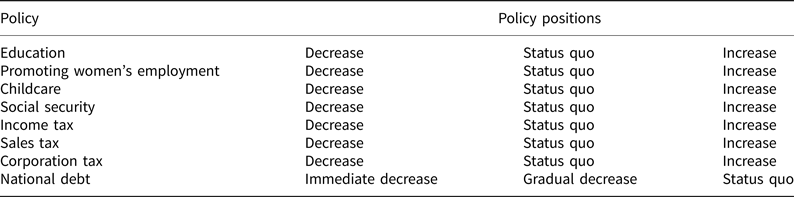
In our experiment, respondents were asked to choose between two hypothetical political candidates after seeing their policy platforms. Each candidate held positions on three social investment policies – childcare, promoting women's labour market participation and education – as well as positions on social security, income tax, sales tax, corporation tax and government debt (Table 1). For each policy area except for government debt, the candidate promised to either increase spending/taxes, maintain the current levels or to decrease spending/taxes. Due to the unlikeliness of a candidate promising to increase the national debt, the policy positions candidates could hold here were to either maintain current debt levels or gradually/immediately reduce the debt.
Conjoint analysis policy positions

The conjoint experiment allows us to estimate the causal effect of many variables on the same outcome simultaneously (Hainmueller et al., Reference Hainmueller, Hopkins and Yamamoto2014). In this case, we can see the impact of a candidate's policy positions on the respondents' decision to support a candidate. By randomising the candidates' positions on these issues for each respondent, we are able to assess average levels of support for policy positions while holding other policies ceteris paribus. Furthermore, we can also assess the impact of a candidate's policy positions for voters with different characteristics.
Our explanatory variables of interest are derived from the theoretical literature on social investment above. In order to determine whether respondents are middle-class, we use the respondents' household income during the previous year. Although we could have asked respondents for their class-identification, this provides subjective data – and has been shown in Japan to lead to 80–90% of respondents identifying as middle-class (Chiavacci, Reference Chiavacci2008) – so we prefer to categorise social class using income as a proxy. Based upon the Ministry of Health, Labour and Welfare's (2018) Comprehensive Survey of Living Conditions, the respondents were divided into three income classes: (1) low-income (0–3 million yen), (2) middle-income (3–6 million yen), (3) high-income (6+ million yen) – which in the general population corresponds to roughly a third of the population in each group.
The literature (e.g., Garritzmann et al., Reference Garritzmann, Busemeyer and Neimanns2018) strongly suggests that socially liberal and economically left-wing voters form the core supporters of social investment policies. As part of our survey, respondents were questioned on both their social and economic views. For social values, respondents were asked whether they thought individual libertarian values or collective authoritarian values were more important on a four-point Likert scale. For the analysis presented here, respondents who identified as strong or weak authoritarian are coded as 1 and those who identified as strong or weak libertarian are coded as 0 in an Authoritarian dummy variable. The same process is used for responses on a strong/weak Free-market-Redistribution scale for economic values.
5. Results and analysis
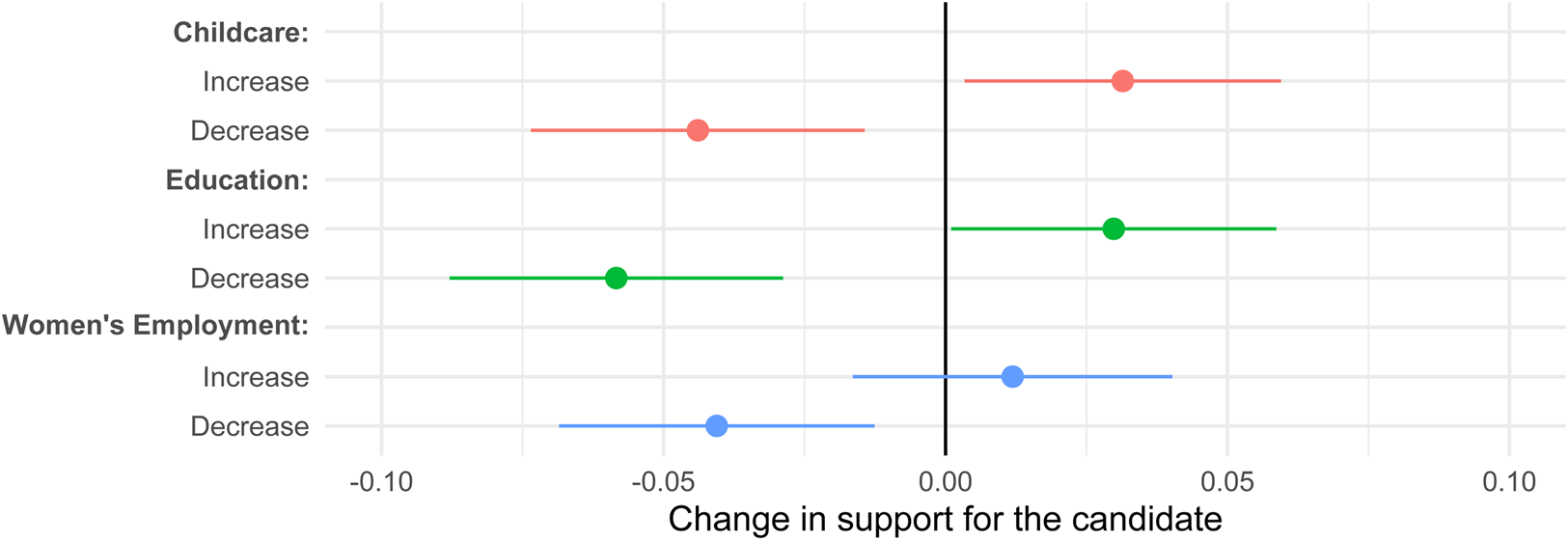
The basic results of the conjoint analysis can be seen in Figure 1 and suggest that social investment policies are popular with Japanese voters. We can see that on average candidates promising to increase spending on education and childcare receive greater voter support compared to candidates promising no change in spending levels. However, there is no significant change in support level for candidates who promise to increase spending on policies that promote women's employment. On the contrary, perhaps unsurprisingly, candidates who run on a policy platform that seeks to decrease spending on any of our social investment policies, including promotion of women's employment, will expect to see a significant reduction in support.
Conjoint analysis of respondent preferences for social investment policies. Each point shows the average marginal component effect (AMCE), the bar around the point shows the 95% confidence interval. The attributes other than social investment policies are not shown in the figure.

5.1 Characteristics of social investment supporters
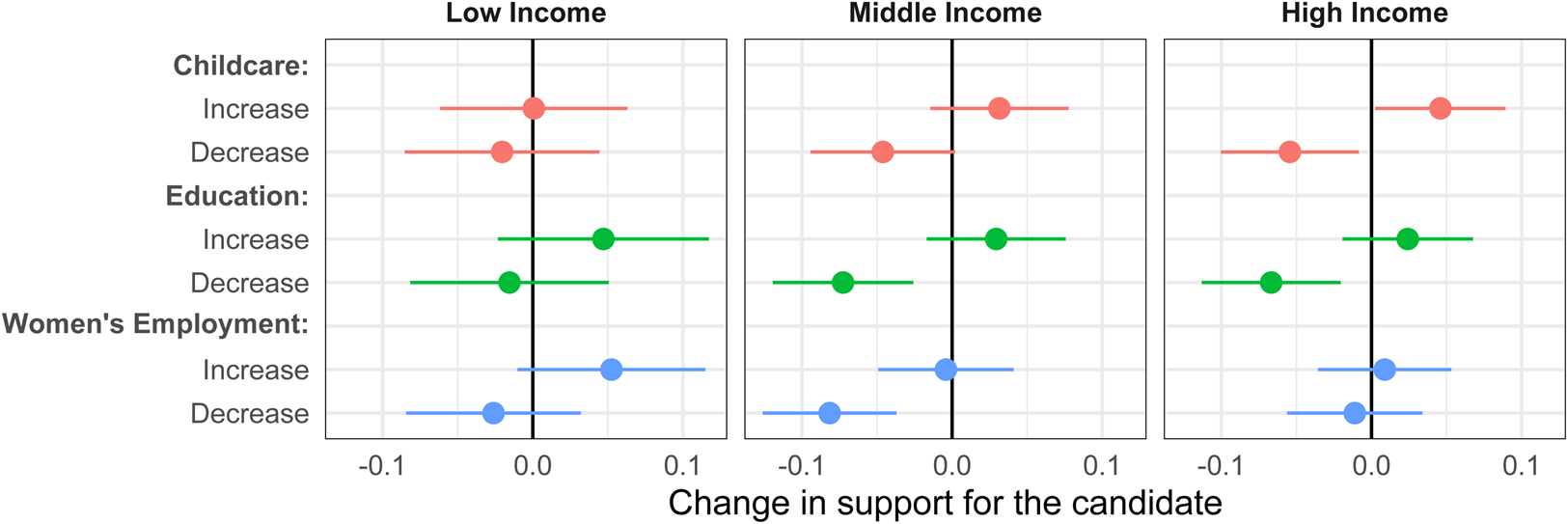
Using the conjoint analysis, we can also see how the characteristics of voters impacts on their support for candidates proposing social investment policies. Voters from higher socio-economic backgrounds are expected to be key supporters of social investment policies (hypothesis 1) and in order to investigate this we examine voter household income levels (Figure 2).Footnote 3 We see evidence that there is a decreased likelihood of middle-income voters supporting candidates promising retrenchment in all three of our social investment policies – although there is no corresponding greater likelihood of support for candidates promising increased investment. We also see decreased likelihood of support by high-income voters for candidates reducing education and childcare spending and also an increase in support for candidates promising childcare investment. Although the findings are slightly mixed, this does provide some evidence for the argument that middle-class voters are supporters of social investment policies – or at least oppose its retrenchment.
Income differences in conjoint analysis social investment preferences. The AMCEs conditional on income and 95% confidence intervals are displayed. The other attributes are omitted from the figure.

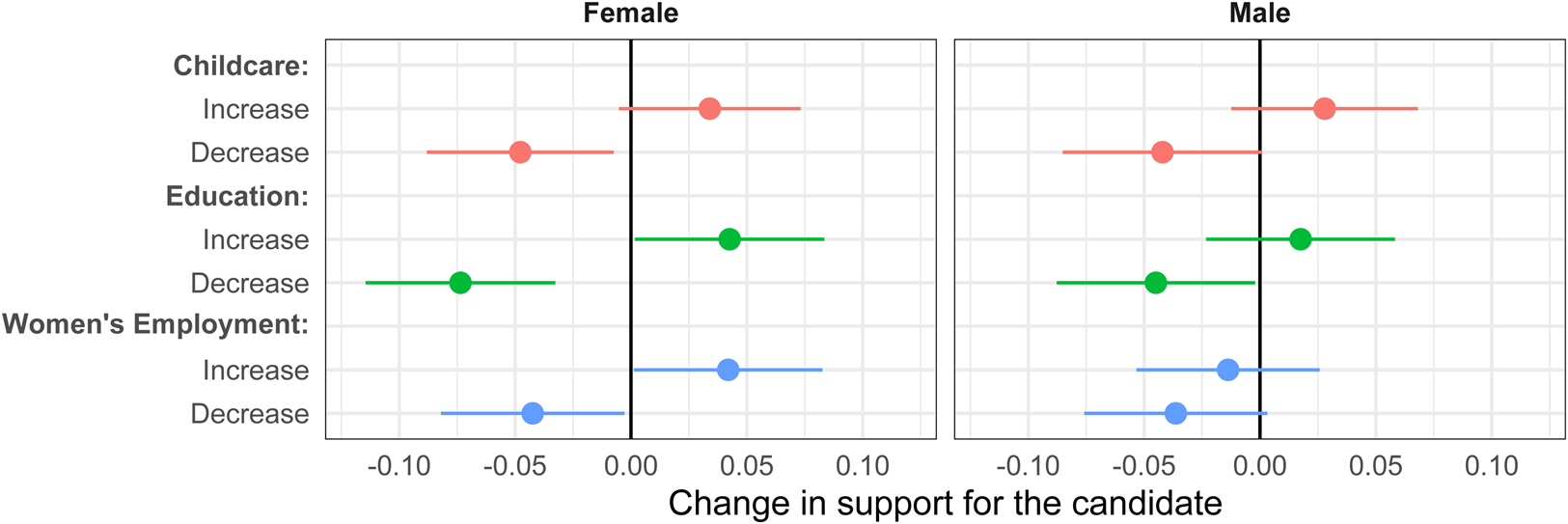
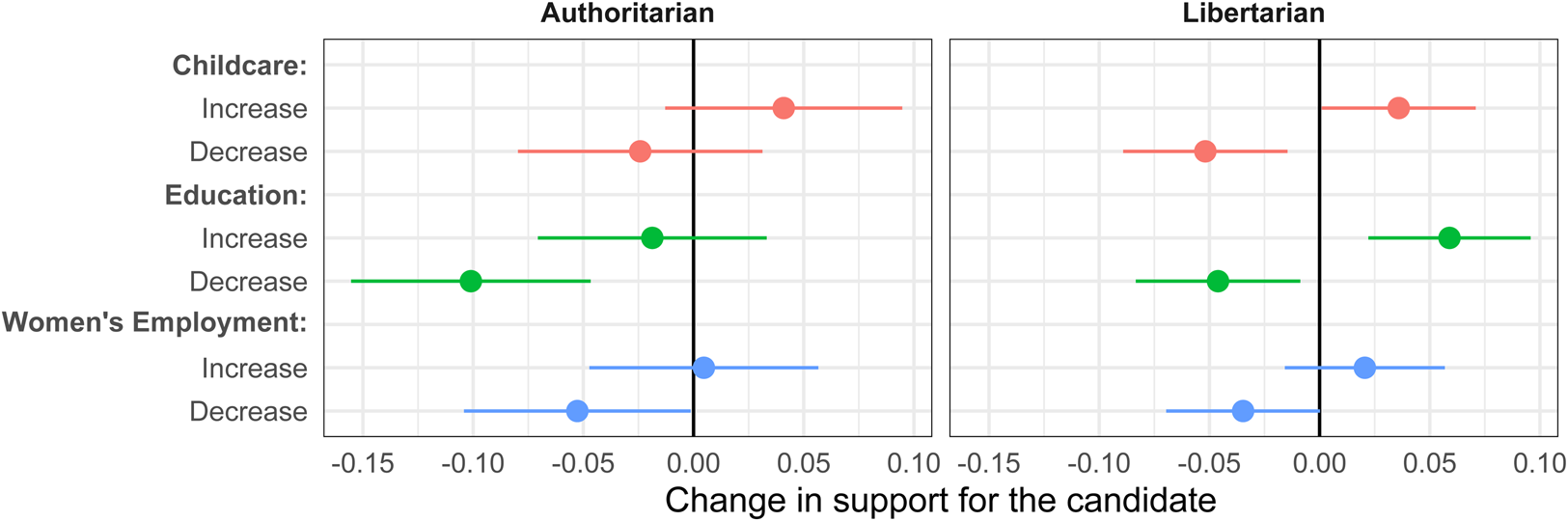
When looking at other characteristics, voter gender (hypothesis 3) appears to be the clearest factor impacting on support for social investment policies (Figure 3). We see candidates who promise increased spending on any of our three social investment policies should expect an increase in support from women. However, the same effect is not found for male respondents who are not expected to support candidates that promise any social investment increases. Looking at the ideological values held by voters (hypotheses 2a,b), we find evidence that candidates promising education and childcare spending increases receive greater support from social libertarian respondents, whereas authoritarian respondents are not significantly likely to increase their support for social investment promoting candidates. However, the economic values of voters do not appear to impact on their support for social investment policies.Footnote 4
Gender differences in conjoint analysis social investment preferences. The AMCEs conditional on gender and 95% confidence intervals are displayed. The other attributes are omitted from the figure.

5.2 Social investment and social security
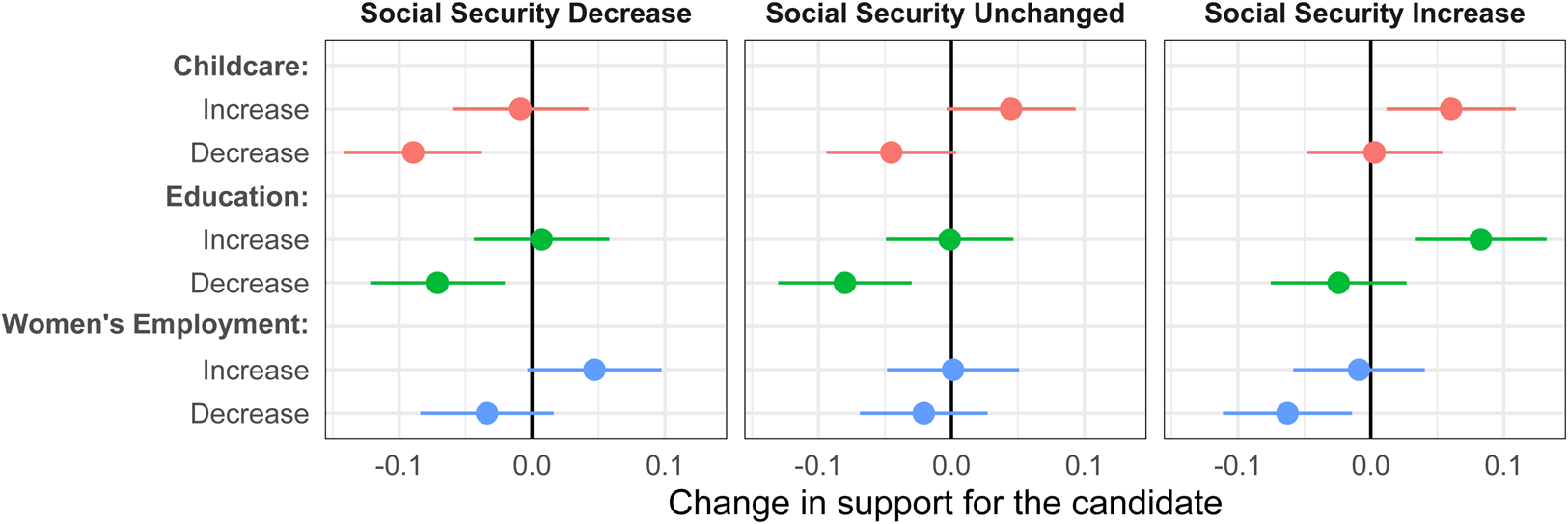
One of the key findings in the literature is that support for social investment policies declines if it is placed in a trade-off with social security policy (hypothesis 4). By subsetting our conjoint experiment data according to the position of hypothetical candidates on social security spending, we can see the differential impact of this on support for candidates who promise social investment increases.
In Figure 4, we can see that a candidate's position on social security spending is a critical factor for our respondents in determining whether they will support increased social investment spending. The analysis shows that candidates receive greater voter support for social investment increases – specifically in childcare and education – if they also promise an increase in social security spending. However, candidates who promise to make cuts to social security (or even maintain current spending levels) do not receive increased support as a result of promising increased social investment. We do not, however, see a decrease in support for candidates who promise social investment increases while also promising decreases in social security spending. This evidence suggests that instead of a trade-off between support for social investment and security, a prerequisite of winning voter support for social investment spending appears to be also promising increases in traditional social security policies.
Support for social investment modified by social security spending position. The AMCEs conditional on social security spending and 95% confidence intervals are displayed. The other attributes are omitted from the figure.

6. Discussion
One of the goals of this paper was to find what level of support social investment policies enjoy in a country – Japan – where the phrase ‘social investment’ is rarely used. We found that even though the concept of social investment is little discussed within Japanese political discourse, social investment policies themselves – in this case education, childcare and increasing women's employment – have high levels of popular support amongst Japanese voters. Yet, it should be noted that support varies according to voter characteristics, especially gender, social values and to a more limited extent income. In support of existing theories, women and socially liberal voters were associated with increased support for social investment in our findings. Previous research also expected the middle-class – or higher income voters – to be a key supporting demographic of social investment policies and we found some evidence that middle- and high-income voters are more likely than low-income voters to support candidates based upon promises of social investment spending increases.
However, the oft-hypothesised welfare trade-off between social security policies and social investment policies was not apparent in our findings. Voters do not oppose candidates who promise to decrease – or even maintain current levels of – social security spending in order to increase spending on social investment policies. In fact, voters only support candidates promising social investment spending increases if they also promise increases in social security spending. This suggests that for Japanese voters, increases in social security spending is a prerequisite for support for social investment policies.
An interesting phenomenon that can be observed in our findings is that voter support for investment in policies that promote women's employment is consistently lower than support for education and childcare. Although the reasons for this are unknowable without further research, it seems likely that this is partially due to Japan's conservative approach to gender roles. Furthermore, spending on childcare and education is promoted by the Japanese government for its benefits to children with little focus on the benefits this can have on helping women enter the labour market. From our findings, it would appear that this view is one that is shared by Japanese voters as well.
What this paper shows then is that despite the phrase ‘social investment’ being largely absent in Japan, Japanese voters react to promised social investment spending similarly to voters in countries where the social investment discourse is more widespread. For proponents of the social investment welfare paradigm, the good news is that this suggests social investment policies themselves are attractive to voters regardless of existing welfare context, albeit with the caveat that social security policies must form part of the welfare policy-mix.
The use of conjoint analysis to examine support for packages of policies allows for numerous interesting expansions of this research. For example, in this paper the characteristics of the candidates themselves did not vary beyond their policy platforms, but it is possible to experiment with whether voter support for policies varies according to the candidates' characteristics – gender, party, incumbency, etc. In future iterations of this research, we would also like to further examine the trade-off between social investment policies and specific social security policies – e.g. pensions, unemployment insurance, etc. – rather than social security spending as a whole.
Acknowledgements
The Institutional Review Board of Waseda University approved the survey experiment used in this research (No. 2018-159). We thank John Hudson, Gyu-Jin Hwang, Junko Kato, Mari Miura and Omer Solodoch for their comments. We also thank the editor Joseph Wong and two anonymous reviewers for their thoughtful advice. This project is supported by the Japan Society for the Promotion of Science KAKENHI Grant-in-Aid for Scientific Research, No. 19H00585.
Supplementary material
The supplementary material for this article can be found at https://dataverse.harvard.edu/dataset.xhtml?persistentId=doi:10.7910/DVN/5NC2AV.
Marc Brazzill is an assistant professor in the Faculty of Political Science and Economics at Waseda University. His research focuses on comparative welfare sates, higher eduction, and East Asian social policy.
Hideko Magara is a professor in the Faculty of Political Science and Economics at Waseda University. Her research focuses on the mutual impacts between party politics and economic policies in capitalist democracies.
Yuki Yanai is an assistant professor in the School of Economics and Management at Kochi University of Technology and a research fellow in the Graduate School of Law at Kobe University. His research focuses on comparative political economy of elections and voting behavior.
Appendix
Social value differences in conjoint analysis social investment preferences. The AMCEs conditional on social values and 95% confidence intervals are displayed. The other attributes are omitted from the figure.