Introduction
Public stigma in relation to people with mental disorders is defined as interrelated problems of knowledge (ignorance), attitudes (prejudice) and behaviours (discrimination) (Gaiha et al. Reference Gaiha, Salisbury, Koschorke, Raman and Petticrew2020). The negative impact of such stigma is multifaceted, posing real life problems for those suffering with mental disorders, such as difficulties with employment and access to accommodation (Stuart, Reference Stuart2006, World Health Organization, 2013), reduced access to mental and physical health care (World Health Organization, 2013), reduced life expectancy (Gissler et al. Reference Gissler, Laursen, Ösby, Nordentoft and Wahlbeck2013), and, via self-stigma, low self-esteem, and self-confidence (Corrigan et al. Reference Corrigan, Bink, Schmidt, Jones and Rüsch2016, Pasmatzi et al. Reference Pasmatzi, Koulierakis and Giaglis2016). It has been argued that the emotional impact of stigma can contribute to the physical, psychological and social burden of many mental disorders and can be as great a source, if not a greater source, of suffering than the manifestation of the illness itself (Weiss et al. Reference Weiss, Ramakrishna and Somma2006).
Approximately half of all lifetime mental disorders start by the mid-teens and three-quarters by the mid-twenties, and globally 20% of all young people experience a mental disorder (Kessler et al. Reference Kessler, Amminger, Aguilar-Gaxiola, Alonso, Lee and Ustun2007, World Health Organization, 2001). These statistics are compounded by evidence that the negative outcomes of stigma are particularly harmful for young people (Collins et al. Reference Collins, Roth, Cerully and Wong2014, Gaiha et al. Reference Gaiha, Salisbury, Koschorke, Raman and Petticrew2020, Nugent et al. Reference Nugent, Rosato, Hughes and Leavey2021) who are at a critical period of development and as such in the prevention and treatment of mental illness. Public attitudes to mental disorders negatively impact helpseeking in young people to a greater extent than among adults (Collins et al. Reference Collins, Roth, Cerully and Wong2014, Mukolo et al. Reference Mukolo, Heflinger and Wallston2010, Pang et al. Reference Pang, Liu, Mahesh, Chua, Shahwan, Lee, Vaingankar, Abdin, Fung and Chong2017), possibly because the public actually prefer to socially distance from young people with mental disorders (Martin et al. Reference Martin, Pescosolido, Olafsdottir and McLeod2007). Indeed, a recent Canadian study (Mackenzie et al. Reference Mackenzie, Heath, Vogel and Chekay2019) showed that when viewing public mental health stigma across the lifespan, older participants had the lowest levels of stigma and the most positive help-seeking attitudes. This has potential repercussions for countries with a young population, as it suggests that public mental health stigma may be particularly high in youthful cohorts. Thus, in young populations, people are doubly impacted by stigma: the youth are more likely to hold stigmatising beliefs, and the youth are more likely to be negatively impacted by this stigma via reduced help-seeking behaviour; decreasing the likelihood of obtaining treatment and entering recovery.
Ireland has the youngest population in Europe, with one-third of the population under 25 years of age (IDA Ireland, 2018). Given the difficulties young people face with stigma and reduced help-seeking behaviours, this leaves Ireland particularly vulnerable to mental ill health. According to previous research, most of Ireland’s youth who were identified as either being at risk of or meeting the criteria for a psychiatric disorder were receiving no professional help (Martin et al. Reference Martin, Carr, Burke, Carroll and Byrne2006), and only 18% were in contact with the child and adolescent mental health services (Sullivan et al. Reference Sullivan, Arensman, Keeley, Corcoran and Perry2004).
Acknowledging these statistics, it is clear that more needs to be done to encourage the youth of Ireland to seek help for mental health difficulties. The first step to achieving this is de-stigmatisation of mental disorders, which, as we have seen, is a key barrier to help-seeking in young people. In June 2020, The Irish Government published a ‘sharing the Vision’ policy, which specifically addresses the need to develop a National Stigma-Reduction Programme. One of the four Mental Health outcomes that they hope to foster is ‘Reduced stigma and discrimination arising through improved community wide understanding of mental health difficulties’ (Department of Health, 2020). Stigma-reduction programmes have already been shown to be effective in Ireland with campaigns such as the Green Ribbon Campaign, launched by See Change, Ireland’s organisation dedicated to ending mental health stigma. The Green Ribbon campaign aims to get as many people as possible talking about mental health to help end stigma and discrimination. To achieve this people are encouraged to wear a green ribbon to symbolise openness to mental health discourse and commitment to influencing positive change. Various Green Ribbon events are also organised throughout the country, and national adverts appear regularly on radio and television. Since its establishment in 2007, See Change has seen a 20% increase in the amount of people claiming to feel comfortable talking to others about mental health (See Change, 2019).
However, there is growing evidence that the reduction in stigmatisation is not felt equally across all mental disorders; that while the type of illness people feel able to identify with (such as depression and anxiety) is experiencing more compassion and understanding than ever before, stigma associated with chronic mental disorders such as psychosis may be increasing (O’Keeffe et al. Reference O’Keeffe, Turner, Foley, Lawlor, Kinsella, O.’Callaghan and Clarke2016). It is unclear which factors are driving this increase in stigma, but it is hypothesised that negative stereotypes attached to psychosis (such as violence and unpredictability) have increased due to false portrayal in the media. Given that psychosis emerges in young adulthood with a prevalence of approximately 3%, and Ireland has a particularly young population, it is becoming increasingly important to understand the stigma attached to psychosis so that Ireland’s youth are more likely to seek help when symptoms emerge, thus reducing the likelihood of suicidality and improving prognosis.
This study aims to explore Irish public perceptions and quantify stigma for two chronic psychotic mental disorders: schizophrenia and bipolar disorder. As a comparison, the non-psychotic, chronic developmental disorder of autism will be assessed. Autism was chosen as a comparison because, like schizophrenia and bipolar disorder it is a neurodevelopmental condition. Indeed, evidence suggests that these disorders share common etiologic factors, with genetic, clinical and cognitive overlap (Sullivan et al. Reference Sullivan, Magnusson, Reichenberg, Boman, Dalman, Davidson, Fruchter, Hultman, Lundberg, Långström, Weiser, Svensson and Lichtenstein2012; Carroll & Owen, Reference Carroll and Owen2009; Pina-Camacho et al. Reference Pina-Camacho, Parellada and Kyriakopoulos2016). Despite these similarities there is increasing evidence of a growing public acceptance of autism, which the psychoses do not share. Autism is currently viewed more as a neurodivergence than a disorder (Saunders, Reference Saunders2018; Grinker, Reference Grinker2019), despite all three conditions qualifying for neurodivergent nomenclature. And yet, evidence suggests that there still exists stigmatised beliefs and a desire to socially distance from people with autism (Underhill et al. Reference Underhill, Ledford and Adams2019).
With this in mind, our objectives were to:
-
a. examine the levels of public stigma towards schizophrenia, bipolar disorder and autism in Ireland; a country with a particularly young population in which both levels of stigma and impact of stigma might be troublesome
-
b. compare public perceptions of different subtypes of mental disorder. In particular, we wish to examine whether there are differences in stigma between the psychoses, for which stigma may be publicly increasing, and the related neurodevelopmental condition of autism, for which stigma may be publicly decreasing.
Methods
Participants
A campaign approach was implemented, where participants were recruited through online social media (Facebook and Twitter) and other social media platforms (Reddit, Survey Circle and LinkedIn) from January 2019 to April 2020. The online survey was programmed using SurveyMonkey Inc, a free online survey tool that allows researchers to build, distribute and analyse online surveys in real time. Participants could choose where and when to complete the survey. Three people were involved in the recruitment process; two were located in the East of Ireland, and the third was located in the West of Ireland, which aided in reaching participants from diverse locations across the country. All utilised the same recruitment methods. Participation in the study was entirely voluntary, no reimbursement was offered for participant time, and all data were stored, as per ethical approval, in a de-identified password protected file.
Measures
All participants completed an online survey adapted from research by Durand-Zaleski et al. (Reference Durand-Zaleski, Scott, Rouillon and Leboyer2012). The questionnaire had 22 questions which asked participants about their knowledge, attitudes and behaviours towards mental disorders in general (11 questions), and specifically towards schizophrenia, bipolar disorder and autism (10 questions). The final question was an open-ended question to enable participants to communicate any thoughts or feelings with the researcher. Answers to this question were not included in the analysis.
This questionnaire was chosen above other more established questionnaires for several reasons. Firstly, it specifically targets, in one questionnaire, the patient groups we wished to investigate. No other assessment tool explores these three disorders which span childhood and adulthood and constitute different types of presentations. Using a set of assessment tools for each issue we wished to target would extend testing time to between 30 and 50 minutes, which we deemed too long. Brevity of questionnaire impacts study recruitment and participation levels (Edwards et al. Reference Edwards, Roberts, Clarke, Diguiseppi, Wentz, Kwan, Cooper, Felix and Pratap2009). We anticipated that, as this study did not have the financial backing to reimburse participants for their time, other incentives, such as the promise of a short survey, would prove useful. We also surmised that despite its brevity, it would provide sufficient information (demonstrated by Durand-Zaleski et al. Reference Durand-Zaleski, Scott, Rouillon and Leboyer2012) to inform us as to whether Irish public stigmatisation was an issue for the patient groups under investigation, which would help us decide whether or not to conduct a further, more in-depth, full-scale study at a later date. Finally, this is not an entirely novel questionnaire. It was utilised in a French study (Durand-Zaleski et al. Reference Durand-Zaleski, Scott, Rouillon and Leboyer2012) that examined this precise research question and thus would enable direct comparison of findings.
Design
This study used a cross-sectional design. To test our hypothesis that Irish public knowledge, attitudes and behaviours towards schizophrenia, bipolar disorder and autism are different, we examined diagnosis as the predictor variable (in which diagnosis referred to either schizophrenia, bipolar disorder, or autism questions) and response as the criterion variable in a series of non-parametric statistical analyses.
The survey began with a series of general questions that asked participants about their opinion on a variety of topics related to mental health. In addition, the survey asked more specific questions related to schizophrenia, bipolar disorder and autism, from which we calculated the three main variables being compared across diagnoses: Knowledge, Attitudes and Behaviours. Participants were given a score of 1 for each correct answer and 0 for each incorrect/don’t know answer to five questions asking about knowledge and these were summed to calculate an overall Knowledge score. Participants were given a score of one-to-three based on whether they agreed, did not know, or disagreed with each of eight statements about attitudes, and these were summed to calculate an overall Attitudes score. Participants were also given a score of one-to-three based on whether they said, ‘Yes happily’, ‘Yes if I had to’ or ‘Absolutely not’ in response to each of three statements about behaviours, and these were summed to calculate an overall Behaviours score. This process was repeated for each diagnosis. For Knowledge, a higher score meant greater knowledge of a particular diagnosis. For both Attitudes and Behaviours, a higher score meant greater positivity towards a particular diagnosis.
Finally, if participants reported either themselves or a loved one ever suffering from schizophrenia (SZ), bipolar disorder (BD), or autism spectrum disorder (ASD) they were recorded as being personally affected (Affected variable). These groups (those who were themselves diagnosed with SZ, BD or ASD and those who had a loved one with the diagnosis) were combined in this study because a) together they represent a level of increased familiarity in comparison with the general public and b) in our sample, only 5.5% of participants were themselves diagnosed with one of the three disorders, which is not sufficient for analysis. The full procedure for calculating variables is described in the Supplementary Material.
Procedure
Study participants completed the Survey online using Google Forms. Responses were saved as a Microsoft Excel .xlsx file which was then converted to an IBM SPSS Statistics .sav file for descriptive statistics and calculation of variables of interest. Inferential statistics were carried out in R. Ethical approval for this study was granted by the National College of Ireland Research Ethics Committee in 2018, with the following Research Ethics Committee approval number: 2408201801.
Statistical analysis
To examine differences in Knowledge, Attitudes and Behaviours towards schizophrenia, bipolar disorder and autism, we conducted trimmed mean ANOVAs with 20% trimmed means using the WRS2 package in R (Mair and Wilcox, Reference Mair and Wilcox2018). Trimmed mean ANOVAs were used as a robust method for analysis of non-parametric data (Field and Wilcox, Reference Field and Wilcox2017). From here on, trimmed mean ANOVAs will be referred to simply as ANOVAs, for brevity.
Approximately 38.5% of our cohort identified as Affected. In order to examine the interaction of diagnosis and any possible effects of whether a participant was personally affected by any of these disorders, we included Affected as a between-subjects variable in each ANOVA. This made a total of six tests (three main effects and three interactions), to which we applied a Bonferroni correction for multiple comparisons, leading to an alpha level of 0.008. For each ANOVA that was statistically significant, a series of post hoc trimmed mean ANOVAs were conducted in the same way to carry out pairwise comparisons between schizophrenia, bipolar disorder and autism responses. To account for the nine post hoc trimmed mean ANOVAs conducted, a Bonferroni correction was applied to the alpha value and results were considered statistically significant at p < 0.005.
To examine relationships between Knowledge, Attitudes and Behaviours, multilevel modelling was used via a linear mixed model effects regression, fit by maximum likelihood, conducted using the lme4 package in R (Bates et al. Reference Bates, Mächler, Bolker and Walker2014). Beta values for the relevant predictors were reported and 95% confidence intervals (CI) for those beta values were calculated using a bootstrap method. Specifically, three models were fit. To analyse the relationship between Knowledge and Attitudes, we regressed participants’ Knowledge scores onto their Attitudes scores, using Affected as a further variable to examine any interactions between the effect of Knowledge on Attitudes and whether participants were affected by any of the Diagnoses. The regression formula took the format: Attitudes ∼ Knowledge × Affected + (Knowledge × Affected|Disorder), thus doing the analysis across all disorders, and using multilevel modelling to take account of Disorder as a random effect. We analysed the relationship between Knowledge and Behaviours, and Behaviours and Attitude, in the same way.
Results
Overview of participant responses to general mental health questions
Participant demographics are presented in Table 1.
Demographics of all participants presented as frequencies and percentages

a Percentages are presented for the overall sample excluding participants with missing values for this question.
A majority of participants reported knowing the difference between psychiatrist, psychologist and psychoanalyst (68%), more participants believe psychotherapies are more effective at treating mental health problems (51.8% responded ‘Yes, a lot’) than drug treatments (27.1% responded ‘Yes, a lot’), and more participants believe mental health problems are diagnosed too late (43.8%) than early enough (22.2%). A clear majority of participants believe mental health research should constitute a public health priority (97.4%). A majority of participants reported not being sufficiently informed about mental health by the media (54.8%).
Differences in Knowledge, Attitudes and Behaviours between groups
Trimmed mean ANOVAs comparing Knowledge, Attitudes and Behaviour responses were all statistically significant, indicating differences in Knowledge (F = 134.59, p < 0.001), Attitudes (F = 22.83, p < 0.001) and Behaviours (F = 29.7, p < 0.001) towards schizophrenia, bipolar disorder and autism (Fig. 1). For Behaviour, there was also an interaction between Diagnosis and Affected (i.e., whether someone had or had not been affected by any of schizophrenia, bipolar disorder, or autism), (F(2, 147) = 8.8, p = 2e-04). Post hoc ANOVAs showed the effect of Diagnosis remained significant for both Affected (F(1.8, 179.2) = 34.9, p < 0.0001) and Unaffected (F(1.4, 84.9) = 6.2, p = 0.0078) cohorts, albeit stronger for the Affected cohort.
Line plots showing (a) differences in Knowledge (y-axis) between autism (ASD), bipolar disorder (BD), and schizophrenia (SZ), (b) differences in Attitude (y-axis) between autism (ASD), bipolar disorder (BD), and schizophrenia (SZ), and (c) differences in Behaviour (y-axis) between autism (ASD), bipolar disorder (BD), and schizophrenia (SZ); each line plot presents data for Affected (blue line) and Not Affected (red line) groups; error bars represent standard error; increasing Knowledge represents greater knowledge, increasing Attitude represents more positive attitude and increasing Behaviour represents more positive intended behaviour. Please see Results section ‘Differences in Knowledge, Attitudes, and Behaviours between groups’ for more information on statistical comparisons.

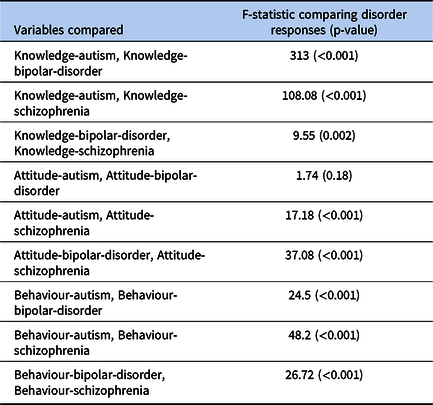
Post hoc ANOVA tests were also statistically significant, indicating pairwise differences in Knowledge, Attitudes and Behaviours towards schizophrenia, bipolar disorder and autism (Table 2). Participants demonstrated greater knowledge of both bipolar disorder (F = 313, p < 0.001) and schizophrenia (F = 108.08, p < 0.001) compared to autism (Fig. 1). Participants also reported more positive attitudes towards both autism (F = 17.18, p < 0.001) and bipolar disorder (F = 37.08, p < 0.001) compared to schizophrenia. Finally, participants reported more positive behaviours towards both autism (F = 48.2, p < 0.001) and bipolar disorder (F = 26.72, p < 0.001) compared to schizophrenia, and more positive behaviours towards autism (F = 24.5, p < 0.001) compared to bipolar disorder.
Post hoc trimmed mean ANOVA results showing pairwise differences in responses to schizophrenia, bipolar disorder, and autism questions

Linear mixed model analyses indicated a strong relationship between Knowledge, Attitude and Behaviour, across diagnoses. The level of participant’s knowledge of a given diagnosis predicted the positivity of their attitude towards someone with that diagnosis, with greater knowledge leading to a more positive attitude (Beta Knowledge = 0.78, 95% CI = [0.4, 1.15]). In addition, we found a similar effect whereby a participant’s knowledge predicted positivity of behaviour (Beta Knowledge = 0.27, 95% CI = [0.11, 0.43]). Finally, we found that a more positive attitude towards a diagnosis predicted more positive behaviour (Beta Attitude = 0.23, 95% CI = [0.19, 0.27]). Fluctuation plots of these relationships are presented in the Supplementary Material.
Discussion
This pilot study examined knowledge, attitudes and behaviours of a group of 307 adults in the Republic of Ireland towards schizophrenia, bipolar disorder and autism. Knowledge, attitudes and behaviours differed towards each of these groups, and attitudes and behaviours towards people with schizophrenia were more negative than either bipolar disorder or autism.
The questionnaire we used was previously reported in a study by Durand-Zaleski et al. (Reference Durand-Zaleski, Scott, Rouillon and Leboyer2012) who examined knowledge, attitudes and behaviours towards schizophrenia, bipolar disorder and autism in France. In their study, a higher percentage of participants also reported more negative attitudes and behaviours towards schizophrenia than either bipolar disorder or autism. As such, our findings are consistent with previous research, but extends this research to Irish society specifically.
We propose two implications from our research on future policy and campaigns aimed at reducing mental disorder stigma. Firstly, our findings that knowledge, attitudes, and behaviours towards schizophrenia, bipolar disorder, and autism are different from each other, and that schizophrenia is viewed more negatively than either bipolar disorder or autism, suggests that in addition to Irish anti-stigma campaigns such as Sea Change’s Green Ribbon campaign, Irish campaigns focused on reducing stigma of particular groups specifically may be helpful. It is particularly interesting to note that attitudes and behaviours were more negative towards schizophrenia than towards bipolar disorder, a related psychotic disorder for which there is substantial genetic overlap (Smeland et al., Reference Smeland, Bahrami, Frei, Shadrin, O’Connell, Savage, Watanabe, Krull, Bettella and Steen2020).
Durand-Zaleski and colleagues suggest that one reason for the negative view of individuals with schizophrenia observed in their study is how the group is portrayed in the media, as their sample reported that the media was their main source of information regarding psychological disorders. The authors go on to suggest that media depictions of bipolar disorder and autism have only appeared more recently and are generally more positive relative to schizophrenia. This observation is further supported by a recently published Flemish article, which assessed stigma in the media through a 10-year survey of Flemish daily newspapers (2008–2017) by comparing the way schizophrenia and autism are portrayed (Thys & Struyven, Reference Thys and Struyven2021). They found that the coverage of autism was mostly positive, whereas the coverage of schizophrenia was predominantly negative. This contrast was very substantial (p < 0.0001) and stable over the years.
Although we did not directly ask participants about how they perceived mental disorders in the media in our survey, more respondents reported that they felt not informed enough about mental illness by the media (54.8%), suggesting that people in Ireland feel the media should do more to inform them about mental disorders. Linear mixed model analysis conducted in our study also showed that knowledge was a strong predictor of behaviours, further suggesting the importance of knowledge of mental disorders. This suggests that a second implication of this research is that the anti-stigma campaigns, and the Irish media more generally, should do more to inform the public about each of these groups.
One limitation with this study relates to sample demographics. For example, a majority of participants were aged 18–25 (40.4%) and had an income less than or equal to €25,000 (48.3%). Regarding the Republic of Ireland specifically, O’Keeffe et al. (Reference O’Keeffe, Turner, Foley, Lawlor, Kinsella, O.’Callaghan and Clarke2016) reported that a number of demographic factors, including higher age and socio-economic status, predicted increased recognition of schizophrenia from vignettes. Given that different demographic groups in the Republic of Ireland have different levels of recognition of schizophrenia and different perceptions of danger associated with schizophrenia, a future aim of our research will be to examine mental disorder stigma in samples that are more representative of the overall Irish population.
Aside from demographic characteristics, a further sample bias was discovered amongst our participants. Forty-six percent of our sample had personal experience of the three disorders under investigation, meaning that either they or a loved one had a diagnosis of one of Schizophrenia (12%), Bipolar Disorder (20%) or Autism (14%). Given that the prevalence of these disorders in the general population lies between 1 and 2%, we see a clear self-selection bias in our sample, where people for whom the study is personally relevant are more likely to participate. This unexpected bias does, however, provide us with interesting data, the full analysis of which was beyond the remit of this paper. A more in-depth investigation of the data will be conducted in a follow-up analysis. The relationship between illness familiarity and stigma is complicated. In a review paper, Corrigan and Nieweglowski (Reference Corrigan and Nieweglowski2019) suggest that in general, familiarity has an inverse relationship with stigma. However, extreme familiarity (experienced by family and service providers) may actually be associated with increased levels of stigma, possibly due to family burden, associative stigma and/or burnout. Interestingly, in this current study, schizophrenia experienced the highest levels of stigma despite having the fewest participants affected by the disorder, which suggests that the stigma may be coming from members of the public unaffected by the illness.
In conclusion, this pilot study showed that in our young Irish sample, knowledge, attitudes and behaviours differ towards schizophrenia, bipolar disorder and autism, with schizophrenia viewed more negatively than bipolar disorder or autism. As such, mental health stigma policy and campaigns targeted towards young people could benefit from a focus on specific diagnoses, particularly schizophrenia, aiming to increase familiarity and understanding. It is as yet unclear whether these same educational approaches will work across the Irish population as a whole. To answer this we intend to conduct a full scale, population-representative study further examining mental health stigma in an Irish context.
Supplementary material
To view supplementary material for this article, please visit https://doi.org/10.1017/ipm.2021.81
Acknowledgements
The authors would like to acknowledge all individuals who participated in this survey. The authors would also like to extend a special acknowledgement to Marzia Mohseni, who created posters used in participant recruitment.
Conflict of interest
Author [DM] has no conflicts of interest to disclose. Author [GL] has no conflicts of interest to disclose. Author [GG] has no conflicts of interest to disclose. Author [AH] has no conflicts of interest to disclose.
Ethical standards
The authors assert that all procedures contributing to this work comply with the ethical standards of the relevant national and institutional committee on human experimentation with the Helsinki Declaration of 1975, as revised in 2008. The study protocol was approved by the ethics committee of each participating institution: HREC approval number 2408201801.
Financial support
This research received no specific grant from any funding agency, commercial or not-for-profit sectors.