Introduction
Living ‘at the edge’ is an increasingly common condition for organisms whose natural habitats are becoming fragmented by urban expansion, mining, agriculture or forestry (Forman Reference Forman1995, Laurance et al. Reference Laurance, Nascimento, Laurance, Andrade, Ewers and Harris2007). The edge effect involves changes to environmental abiotic conditions and behaviour, abundance and interactions between species along edge–interior gradients (Lidicker Reference Lidicker1999, Murcia Reference Murcia1995, Sarlöv Reference Sarlöv2001). Species conservation in anthropogenically fragmented landscapes usually requires unravelling the ecological factors affecting recruitment or survival in edge habitats (Pasinelli Reference Pasinelli2000, Sarkar et al. Reference Sarkar, Pressey, Faith, Margueles, Fuller and Stoms2006, Torres-Miranda et al. Reference Torres-Miranda, Luna-Vega and Oyama2011).
These factors include: species attributes, such as life history, edge sensitivity or dispersal constraints (Gates & Gysel Reference Gates and Gysel1978, Malt & Lank Reference Malt and Lank2007, Ries & Sisk Reference Ries and Sisk2010, Villard Reference Villard1998); ecological processes, such as predation, dispersal and intra-specific or inter-specific competition (Lahti Reference Lahti2001, Saunders et al. Reference Saunders, Hobbs and Margules1991); and boundary spatial structure, such as scale, dimensionality or patch/matrix contrast (Cadenasso et al. Reference Cadenasso, Pickett, Weatherns and Jones2003, López-Barrera & Newton Reference López-Barrera and Newton2005, Porensky & Young Reference Porensky and Young2013, Strayer et al. Reference Strayer, Power, Fagan, Pickett and Belnap2003).
In fragmented forest landscapes, the magnitude of the edge effect is influenced by the contrast in the habitat quality between fragments and their surrounding matrix, with soft and hard edges representing, respectively, low-contrast and high-contrast edges (e.g., López-Barrera et al. Reference López-Barrera, Manson, González and Newton2006, Peyras et al. Reference Peyras, Vespa, Bellocq and Zurita2013, Stamps et al. Reference Stamps, Buechner and Krishnan1987). Addressing the magnitude of the edge effect over different edge types represents a starting point of biodiversity conservation in fragmented landscapes (Lindenmayer & Fischer Reference Lindenmayer, Fischer, Lindenmayer and Hobbs2007).
However, a more mechanistic understanding of the edge effect involves the determination of the steepness of the edge–interior gradient and the spatial extent of the boundary zone (Ewers & Didham Reference Ewers and Didham2006, Gascon et al. Reference Gascon, Williamson and Fonseca2000, Strayer et al. Reference Strayer, Power, Fagan, Pickett and Belnap2003). Edge ecotones are characterized by specific, unique and local habitat conditions, resulting in a steep nonlinear gradient (Duelli et al. Reference Duelli, Studer, Marchand and Jakob1990, Lidicker Reference Lidicker1999, Strayer et al. Reference Strayer, Power, Fagan, Pickett and Belnap2003). Ecotones can arise from multiple factors, making species abundance, recruitment or survival rates disproportionately higher or lower along their edges in contrast to forest interior habitats, as observed in animal species (Kotze & Samways Reference Kotze and Samways2001, Spector & Ayzama Reference Spector and Ayzama2003, Zurita et al. Reference Zurita, Pe’er, Bellocq and Hansbauer2012) and plant species (Magrach et al. Reference Magrach, Rodríguez-Pérez, Campbell and Laurance2014, Olupot Reference Olupot2009).
In this study, we assessed the recruitment pattern of oak species (Quercus spp.) in temperate forest patches at the periphery of Mexico City. Specifically, we tested sapling recruitment at the boundaries of forest patches. Previous empirical studies in a temperate oak forest in Mexico suggest an increased level of oak seed germination (López-Barrera & Newton Reference López-Barrera and Newton2005), as well as survival and growth of oak seedlings (López-Barrera et al. Reference López-Barrera, Manson, González and Newton2006), at the edges of forest patches (e.g., García-Romero Reference García-Romero2002). Although these findings suggest a positive edge effect, there is still no evidence for a decreasing edge–interior gradient of the naturally established seedlings and saplings of oaks (López-Barrera et al. Reference López-Barrera, Armesto, Williams-Linera, Smith-Ramíez, Manson and Newton2007).
Understanding the edge effect in deciduous oak forest fragments requires us to evaluate the spatial distribution of natural oak regeneration and its dependence on multiple environmental factors. Oak regeneration might be affected by physical micro-environmental variables (e.g., soil moisture, temperature and light), co-varying ecological factors such as vegetation structure (e.g., trees, shrubs and herbs), patch attributes (e.g., slope and orientation) and seed predators (López-Barrera & Newton Reference López-Barrera and Newton2005, López-Barrera et al. Reference López-Barrera, Armesto, Williams-Linera, Smith-Ramíez, Manson and Newton2007). In particular, these physical variables can respond to the vegetation structure’s heterogeneity caused by natural or anthropogenic disturbances (Pérez-López et al. Reference Pérez-López, López-Barrera, García-Oliva, Cuevas-Reyes and González-Rodríguez2013), thus promoting the clustered spatial distribution that characterizes oak regeneration in deciduous forests throughout the Northern Hemisphere (Brooks & Merenlender Reference Brooks and Merenlender2001). Based on these considerations, we addressed the interactive nature of patch boundaries by using a gradient-based sampling design in order to distinguish between gradual and steep gradients.
Materials and methods
Study area
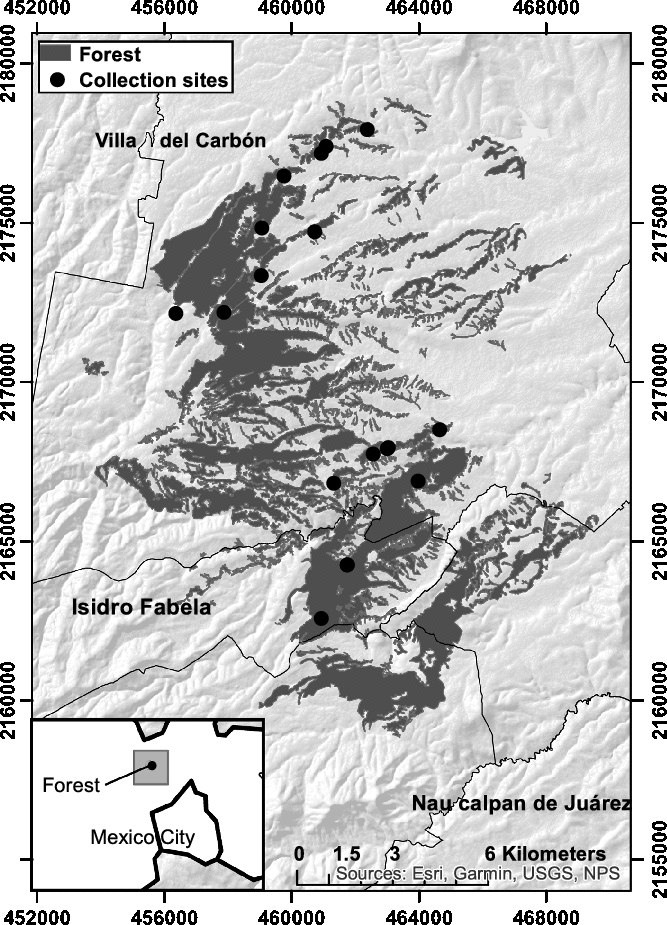
We studied fragments of temperate oak forest located in the urban periphery of Mexico City, corresponding to the eastern slope of the Sierra de Monte Alto in the middle part of the Cuautitlán River basin (Fig. 1). The studied forest fragments are located between 2300 and 2900 m a.s.l. According to Köppen classification, the climate is humid temperate C (W1) (W) and C (W2) (W), with a mean temperature ranging from 12°C to 18°C and annual rainfall from 800 to 1200 mm, respectively (García-Romero Reference García-Romero2002). The microclimate within fragments varies depending on topography, as evidenced by steep slopes facing north that comprise shaded areas and fresh sites protected from anthropogenic activities. The predominant soils are umbric andosol and haplic andosol.
Location of the study area at the periphery of Mexico City. Forest patches are shown in dark grey; dots represent collection sites.

This landscape has experienced rapid urban expansion over the past three decades, which has led to intensive land-use change and deforestation (Toledo et al. Reference Toledo, Carabias and Gonzales1989). More specifically, the suburban matrix includes secondary grassland, cultivation lands and scattered human settlements (García-Romero Reference García-Romero2002). Despite their closeness to the edge of Mexico City, the forest fragments in the study area have remained intact during the past 30 years, fostering a suitable opportunity for studying the vegetation changes associated with the edge effect (Fig. 1).
Regeneration and vegetation data
We selected five secondary forest fragments that were separated by >1000 m with a similar adjacent landscape matrix: secondary grassland, local cultivation land and scattered human settlements. Three to five transects separated by at least 100 m were established within the slope of each fragment, covering the environmental gradient between the edge and the interior of the fragments (Fig. 1 & Supplementary Table S1, available online). All transects were perpendicular to the edge, and their length (50–150 m) depended on the shape and size of the fragments. Following García-Romero et al. (Reference García-Romero, Vergara, Granados-Peláez and Santibañez-Andrade2019), we established contiguous plots of 10 m × 2 m (1 m on each side of the transect line), systematically adjacent along the transect (Supplementary Fig. S1). In each plot, vegetation variables and oak trees were quantified during 2013 and 2014. The number of plots per transect ranged from 5 to 15, resulting in a total of 167 plots in 18 transects within 5 fragments (Supplementary Table S1).
Vegetation sampling was carried out in each plot for the three strata of vegetation: arboreal, shrub and herbaceous. The regeneration of Quercus spp. was measured as the number of all living saplings within each plot measuring 1–5 m in height and/or <10 cm in diameter at breast height (DBH). Vegetation variables were coded as follows: TH = height of sapling trees (m); SH = shrub height (m); CC = canopy cover (%); SC = shrub cover (%); and HERB = presence of herbaceous species.
Data analysis
Zero-inflated Poisson (ZIP) models were used to detect differences in the abundance of oak saplings as a function of the distance from the edge. ZIP models were suitable for assessing aggregation of the spatial distribution exhibited by oak saplings, with many plots lacking regeneration, whereas a few plots had a high number of saplings. Indeed, the total abundance of oak saplings was recorded at 34% of 167 plots. Data inflation caused by traditional statistical models (e.g., Poisson or negative binomial regressions) tends to overestimate the occurrence of large counts while underestimating the incidence of zeros (Fortin & DeBlois Reference Fortin and DeBlois2007, Hall Reference Hall2000).
In contrast, ZIP models have been widely used to analyse the spatial recruitment pattern of oaks, conifers and other fagaceous species, since an excess of zero counts usually characterizes the recruitment data for these species (Benavides et al. Reference Benavides, Escudero, Coll, Ferrandis, Ogaya, Gouriveau and Valladares2016, Crotteau et al. Reference Crotteau, Ritchie and Varner2014, Gómez-Aparicio et al. Reference Gómez-Aparicio, Zavala, Bonet and Zamora2009, Navarro-González et al. Reference Navarro-González, Pérez-Luque, Bonet and Zamora2013, Russell et al. Reference Russell, Westfall and Woodall2017, Xiang et al. Reference Xiang, Lei and Zhang2016, Zhang et al. Reference Zhang, Lei, Cai and Liu2012). In addition, ZIP models constitute a robust statistical approach to analysing edge effects on the abundance of oak saplings in a fragmented forest (García-Romero et al. Reference García-Romero, Vergara, Granados-Peláez and Santibañez-Andrade2019). ZIP models treat separately the counts (i.e., observed abundance) and the probability of occurrence, thus correcting for the over-dispersion and excess zero problems (Zuur et al. Reference Zuur, Ieno, Walker, Saveliev and Smith2009).
The model included equations for two latent (unobserved) variables: an exponential regression to calculate the abundance of saplings in each plot i, which were assumed to be Poisson distributed, and a logistic regression to estimate the presence/absence of saplings per plot – in this case, a Bernoulli distribution was assumed. ZIP models were fitted to sapling count data by combining data from two consecutive 10-m plots into 20-m plots. Larger plots improved the estimation of the abundance of oak saplings, which typically have a low abundance and non-regular spatial distribution (e.g., Pawlikowski et al. Reference Pawlikowski, Coppoletta, Knapp and Taylor2019, Van Hees & Clerkx Reference Van Hees and Clerkx2003).
Nonlinear recruitment patterns were assessed using a segmented regression approach (Jones et al. Reference Jones, Kroll, Giovanini, Duke and Betts2011). Segmented ZIP models considered an edge ‘distance threshold’ (t), which was interpreted as the distance from the border at which the edge effect (measured by a model coefficient) increases or decreases. The expected sapling abundance in each plot (λ i) was modelled as:
 $$\log \left( {{\lambda _i}} \right) = {\beta _{\matrix{{0} \cr } }} + {\beta _1}\left( {{x_i} \, \lt \, t} \right) + {\beta _2}\left( {t \ge {x_i}} \right) + \mathop \sum \limits_{k = 1}^n {\delta _k}{X_{k,i}} + {\varepsilon _i}$$
where β 0 is an intercept and β 1 is a coefficient for the edge effect evaluated between the edge (x i = 0) and t, while β 2 is a coefficient for the edge effect evaluated for distances >t. The functions x i < t and (t ≥ x i ) indicate distances to the edge before and after a threshold. The coefficient δ k represents the effect of the kth vegetation variable, while ε i is a term of spatial error associated with the plot. However, vegetation variables (Supplementary Table S1) might vary with distance from the edge, which results in collinearity problems. To ensure orthogonality, first we fitted a linear mixed model (LMM) to vegetation variables with the distance from the edge as a fixed effect and fragments, transects and plots as random effects. The residuals of these regressions were subsequently used as independent covariates in the ZIP models. Random effects for the plot and fragment were included in the logit function for the probability of sapling presence per plot.
We used the deviance information criteria (DIC) and differences in DIC (ΔDIC) to interpret the strength of evidence for each competing model (Spiegelhalter et al. Reference Spiegelhalter, Thomas, Best and Lunn2003). Models with ΔDIC < 2 were supported by the data (parsimonious models). We developed a set of candidate models including different combinations of vegetation variables (as explained above). To assess the interaction of boundaries (gradual change versus ecotone), segmented ZIP models were compared with ZIP models containing the linear effect of the edge distance β 1(x i ).
An additional null model (without fixed effects) was added to the set of candidate models and used as a goodness-of-fit test of these effects. We checked for over-dispersion using residuals in order to select the best-supported ZIP model. The ratio of the sum of squared Pearson residuals over degrees of freedom was close to 1 (1.16), which indicates that over-dispersion was not a problem in ZIP models. In addition, Moran’s I correlogram analysis provided evidence against spatial autocorrelation between ZIP model residuals (Supplementary Fig. S2).
Owing to the low number of saplings of Quercus spp. and the high complexity of the ZIP models, we used ZIP models to assess the total number of Quercus saplings per plot (i.e., summing over all species). In a posterior analysis, we developed a simplified version of the ZIP model explained above (i.e., non-segmented regressions). These simplified ZIP models included a factor distinguishing between the edge zone (xi < t) and the inner sections of the fragment (t ≥ x i ).
This analysis was carried out only for the dominant species of oaks (species with relative abundances >15%). The importance of each model coefficient was evaluated by examining their Bayesian credible intervals (BCI) estimated from the posterior distribution of parameters. The 95% BCIs that did not overlap with 0 were considered as being significant. We used vague non-informative prior distributions for all model parameters. Parameter distributions were based on three Markov chain Monte Carlo (MCMC) samples, each with 35 000 iterations, discarding the first 10 000 iterations and thinning by 3. MCMC model convergence was assessed visually and diagnosed using the Gelman–Rubin test (i.e., potential scale reduction factor). Models were run using OpenBUGS via the R2 OpenBUGS package of R.
Results
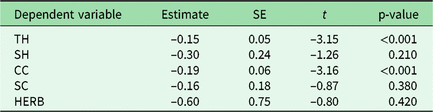
Vegetation structure changed with the distance from forest edges (Table 1). The coefficients of the LMM indicated that two of the five vegetation variables decreased significantly from the edge towards the interior of the fragment (Table 1), including CC and TH (Table 1). In the five studied fragments, the regeneration of nine oak tree species was detected, including Q. crassipes, Q. dysophylla, Q. laurina, Q. laeta, Q. castanea, Q. crassifolia, Q. rugosa, Q. mexicana and Q. obtusata. Of these nine species, the greatest abundance of saplings was observed for Q. laeta, Q. castanea and Q. obtusata (Supplementary Table S2). In all of the fragments, oak saplings exhibited a low abundance (<2.61 individuals per plot) and frequency (<34%), with Fragment 1 showing the highest frequency and total abundance of saplings (Supplementary Table S2).
Model coefficients quantifying the change in vegetation variables along edge–interior gradients in the five forest fragments described in Supplementary Table S1.

TH = height of sapling trees (m); SH = shrub height (m); CC = canopy cover (%); SC = shrub cover (%); and HERB = presence of herbaceous species.
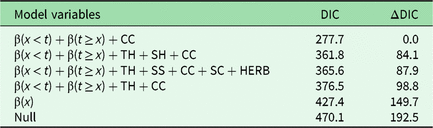
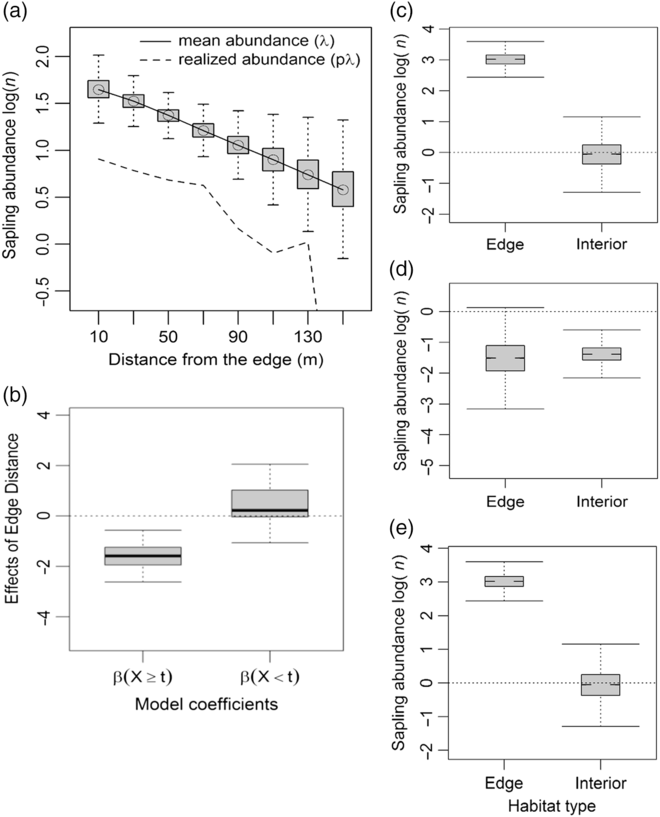
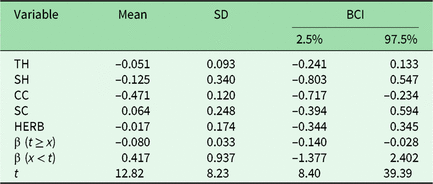
For all of the oak species, the abundance of saplings decreased nonlinearly with distance from the edge (Table 2). According to their DIC values, segmented ZIP models (i.e., with threshold parameter t) performed better (ΔDIC < 84.1) than the null model (model without parameters; ΔDIC = 192.5), as well as the model with the linear effect of edge distance (ΔDIC = 149.7) (Table 2). Segmented ZIP models showed that the abundance of saplings increased significantly at distances (from the edge) less than a threshold distance (t) of 12.82 ± 8.23 m (mean ± SD; Fig. 2(a) & Table 3). The coefficient β 1, for saplings located on the edge zone (x < t), did not significantly differ from 0 (Fig. 2(b)). However, for distances greater than the threshold distance (x ≥ t), the abundance of saplings steadily decreased with a negative β 2 slope (Table 3).
Zero-inflated Poisson models ranked according to their change in deviance information criteria (ΔDIC). Model covariates for habitat variable coefficients β(x < t) and β(t ≥ x) represent the edge effects before and after the threshold parameter t (see Table 3), whereas β is the slope of the linear edge effect.

TH = height of sapling trees (m); SH = shrub height (m); CC = canopy cover (%); SC = shrub cover (%); and HERB = presence of herbaceous species.
(a) Bayesian estimates of the mean abundance of oak saplings (λ) with 95% credible intervals and the realized abundance (pλ) as a function of the distance from the edge. (b) Zero-inflated Poisson model coefficients representing the edge effects in relation to the estimated threshold distance t = 10.3 m. (c) Bayesian estimates of Quercus obtusata mean abundance (λ) with 95% credible intervals and relative abundances in edge and interior habitats. (d) Bayesian estimates of Quercus castanea mean abundance (λ) with 95% credible intervals and relative abundances in edge and interior habitats. (e) Bayesian estimates of Quercus laeta mean abundance (λ) with 95% credible intervals and relative abundances in edge and interior habitats.

Means, SDs and the 95% Bayesian credible intervals (BCIs) of variables (i.e., the 2.5% and 97.5% quantiles of the marginal posterior distributions) in the best-supported model shown in Table 2.

TH = height of sapling trees (m); SH = shrub height (m); CC = canopy cover (%); SC = shrub cover (%); and HERB = presence of herbaceous species.
The support for the segmented ZIP models increased with the inclusion of the vegetation variables, as shown by the reduction of their DIC values (Table 2). However, from the five vegetation variables assessed, only CC was included in the best-supported model (DIC = 0). CC had a significant negative direct effect (independent of edge distance) on oak recruitment, with oak saplings increasing their abundance in canopy gaps within fragments (Table 3). When assessed for individual species, differences in sapling abundance between the edge zone and the interior of the fragment (both defined by the distance threshold t) varied among the three dominant species of oak. In Q. obtusata, saplings were significantly more abundant along the edge zone (λ = 20.9 ± 4.4 individuals per plot) than in the forest interior (λ = 3.08 ± 0.48 individuals per plot; Fig. 2(c)), whereas for Q. castanea and Q. laeta, the abundance of saplings did not differ significantly between the edge zone and forest interior (Fig. 2(d) & 2(e)).
Discussion
We found evidence for an edge effect that shapes the distribution of trees through the fragmented landscape (e.g., López-Barrera et al. Reference López-Barrera, Armesto, Williams-Linera, Smith-Ramíez, Manson and Newton2007). Oak forest fragments in the urban periphery of Mexico City present edges that are consistent with the interactive condition of boundaries, which in turn has a direct influence on the flow of organisms, matter, energy and information through the habitat boundaries (Cadenasso et al. Reference Cadenasso, Pickett, Weatherns and Jones2003, Ries & Sisk Reference Ries and Sisk2010).
Forest ecotones promote suitable conditions for the regeneration of oaks in central and southern Mexico (Ramírez-Marcial Reference Ramírez-Marcial2003). For our case, ZIP models have indicated that the abundance of oak saplings describes a steep nonlinear edge–interior gradient, with a very high abundance near the edge and low values in the interior of the fragment. The abrupt variation in the regeneration of oaks indicates that species-specific requirements for establishment or survival are met within edge ecotones. ZIP models further supported the existence of a narrow edge ecotone (i.e., up to 12.8 m of the edge), as described in fragmented landscapes where forest edges present distinctive biotic and abiotic conditions emerging from natural processes and human disturbances (Gascon et al. Reference Gascon, Williamson and Fonseca2000, Ries et al. Reference Ries, Fletcher and Battin Sisk2004, Schlaepfer & Gavin Reference Schlaepfer and Gavin2001).
The spatial extent at which regeneration of oaks peaked within fragments (12.8 m) was narrower than for species richness and habitat structure (e.g., TH or DBH), for which changes typically occur at distances >50 m from the edge (Granados et al. Reference Granados, Serrano and García-Romero2014). This narrow ecotone is bounded by an open matrix, which offers particularly unsuitable conditions for oak recruitment resulting from intensive agricultural management based on the systematic elimination of weeds (López-Barrera et al. Reference López-Barrera, Armesto, Williams-Linera, Smith-Ramíez, Manson and Newton2007, Ries et al. Reference Ries, Fletcher and Battin Sisk2004).
Such abrupt change in habitat conditions is usually referred to as a ‘matrix effect’ (Lidicker Reference Lidicker1999) or ‘hard edge’ (Cadenasso et al. Reference Cadenasso, Pickett, Weatherns and Jones2003, Duelli et al. Reference Duelli, Studer, Marchand and Jakob1990, Peyras et al. Reference Peyras, Vespa, Bellocq and Zurita2013). Edge ecotones promoted the regeneration of all oak species, particularly Q. obtusata, whose saplings were seven times more abundant in the edge than in the forest interior habitat (Fig. 2(c)). This result supports the idea that oak species respond differently to environmental conditions present at edges, depending on their habitat requirements, physiological attributes and seed dispersal patterns (López-Barrera et al. Reference López-Barrera, Armesto, Williams-Linera, Smith-Ramíez, Manson and Newton2007, Malt & Lank Reference Malt and Lank2007, Murcia Reference Murcia1995, Ries & Sisk Reference Ries and Sisk2010). The greater regeneration of Q. obtusata in the edges might be associated with its physiological attributes and habitat specificity. Indeed, Q. obtusata could be a generalist species with enough plasticity to become physiologically tolerant to the variable environmental conditions that occur in edge habitats (López-Barrera et al. Reference López-Barrera, Armesto, Williams-Linera, Smith-Ramíez, Manson and Newton2007).
Oaks may obtain competitive advantages from the biotic and abiotic conditions prevailing at forest edges, which result in high seed production and low predation rates of acorns, the large size and hardness of which reduce their consumption by seed predators associated with the matrix (Zhang et al. Reference Zhang, Shi, Sichilima, Zhu and Lu2016). Another seed dispersal vector that potentially increases the intensity of seed rain at the edge could be gravity. Indeed, the interiors of forest fragments tended to be located on high and steep slopes, thus promoting the gravity displacement of acorns in edge areas located downhill (Mack Reference Mack1995). Moreover, the germination, seedling emergence and subsequent establishment of oaks might be improved at the edges where light and temperature conditions are more suitable for regeneration (López-Barrera et al. Reference López-Barrera, Manson, González and Newton2006, Mitchell et al. Reference Mitchell, Bennett and Gonzalez2014).
Forest edges also face the anthropogenic loss of competing understory plants, which favours oak seedling establishment (Buckley et al. Reference Buckley, Sharik and Isebrands1998). Soil properties (compaction, organic matter content and availability of nutrients) also may favour the establishment of certain oak species at the edge. Saplings of white oaks (Q. obtusata and Q. laeta) are particularly tolerant to soils with low humidity and high temperature, which could be the case in sites near the forest edge (Pascual et al. Reference Pascual, Molinas and Verdaguer2002). In contrast, the seed germination and seedling growth of red oaks (Q. castanea) tend to be inhibited by the shadeless and dry soil conditions typically characterizing the edges (Oliver et al. Reference Oliver, Burkhardt and Skojac2005). However, the dense canopy cover near edges can protect seeds and seedlings by mitigating dry conditions while suppressing the establishment of light-demanding plant species competing for space, water and nutrients (Guevara et al. Reference Guevara, Laborde and Sánchez-Ríos2004, Murcia Reference Murcia1995, Pérez-López et al. Reference Pérez-López, López-Barrera, García-Oliva, Cuevas-Reyes and González-Rodríguez2013).
Previous studies indicate that vegetation structure has an important influence on oak recruitment in edge habitats (Días et al. Reference Días, Miller, Marques, Marcelino, Caldeira, Cerdeira and Bugalho2016, López-Barrera et al. Reference López-Barrera, Armesto, Williams-Linera, Smith-Ramíez, Manson and Newton2007). The opening of the canopy can promote oak recruitment because sites with high levels of luminosity would improve the survival of flowers (Pérez-López et al. Reference Pérez-López, López-Barrera, García-Oliva, Cuevas-Reyes and González-Rodríguez2013) and acorns (López-Barrera et al. Reference López-Barrera, Manson, González and Newton2006), as well as the establishment and growth of seedlings and saplings (López-Barrera et al. Reference López-Barrera, Armesto, Williams-Linera, Smith-Ramíez, Manson and Newton2007). These observations, however, are not consistent with our findings, which supported a negative association between oak regeneration and canopy openness. Specifically, the high abundance of oak saplings near the edge was associated with decreased canopy cover at the edges, suggesting that oak recruitment along edge ecotones responds negatively to high levels of luminosity.
Instead, it is possible that a denser canopy cover along the edge provides oak seeds and seedlings with shelter against dry conditions and predators while suppressing the establishment of other competing plant species. Exotic plants can limit the germination of oak seeds and cause high mortality among the seedlings, mainly through competition for resources such as light, space, water and nutrients (Guevara et al. Reference Guevara, Laborde and Sánchez-Ríos2004, Pérez-López et al. Reference Pérez-López, López-Barrera, García-Oliva, Cuevas-Reyes and González-Rodríguez2013). Native forest in the rural landscapes of central Mexico is often disturbed by logging, the introduction of cattle into the forest fragments and fertilization of the surrounding cultivated areas (García-Romero Reference García-Romero2002, Toledo et al. Reference Toledo, Carabias and Gonzales1989). These anthropogenic disturbances are usually considered to be responsible for the reduced regeneration rates of native species in these temperate forest fragments (e.g., Pérez-López et al. Reference Pérez-López, López-Barrera, García-Oliva, Cuevas-Reyes and González-Rodríguez2013). Although there is a lack of information about the fire regime (magnitude and frequency) in our studied landscape, it is highly probable that fires have a significant influence on the dynamics of oak forests (e.g., Naudiyal & Schmerbeck Reference Naudiyal and Schmerbeck2018).
Forest disturbances could cause the exclusion of competitively superior shade-tolerant species, thus favouring the establishment of oak seedlings and saplings in recently disturbed sites (Pérez-López et al. Reference Pérez-López, López-Barrera, García-Oliva, Cuevas-Reyes and González-Rodríguez2013, Ramírez-Marcial Reference Ramírez-Marcial2003). Therefore, the oaks’ ability to tolerate moderate forest disturbance (e.g., fire, grazing) as well as shade promotes oak regeneration (Quintana-Ascencio et al. Reference Quintana-Ascencio, González-Espinosa and Ramírez-Marcial1992). In this sense, some oak species can obtain competitive advantages from their massive seed production levels (Zhang et al. Reference Zhang, Shi, Sichilima, Zhu and Lu2016) in forest edges due to the presence of taller trees with a dense canopy near the edges.
The extirpation of birds and mammals that consume seeds and seedlings from forest fragments may increase the suitability of habitat conditions for the recruitment of oaks (Borchert et al. Reference Borchert, Davis and Oyler1989), but this phenomenon would be translated into an edge effect only if the activity of these species is more intensive near the edges.
Our findings provide important insights into the conservation of oak forest ecosystems and their associated diversity. Edge ecotones can be key ecosystems for supporting the demographic and, in all likelihood, the genetic processes of the dominant oak species (López-Barrera et al. Reference López-Barrera, Manson, González and Newton2006). The concentration of oak recruitment at forest boundaries may have long-term consequences for the dynamics of oak forest patches. Edge ecotones can act as reservoirs of seed-producing trees (Magrach et al. Reference Magrach, Rodríguez-Pérez, Campbell and Laurance2014, Olupot Reference Olupot2009); hence, we recommend that sustainable forest management should focus on efforts to maintain and restore forest edges. Edge-based conservation priorities can promote not only the establishment of oaks in forest interior sites, but also the expansion of forest towards the matrix, causing a long-term increase in forest cover and patch size.
Conclusions
The edge effect on the abundance of oak saplings extends up to 10 m from the forest border, creating an ecotone for oak recruitment. This edge zone is narrower than the spatial extent at which the structure and composition of the vegetation vary along the edge–interior gradient. The edge effect on oak saplings abundance is species specific with some species, such as Q. obtusata responding positively to edge ecotones, while others (Q. castanea and Q. laeta) do not show this type of response. The regeneration of oak saplings is directly and positively related to the opening of the canopy. However, the dense canopy cover along the edge may provide shelter for the seeds and seedlings of shade-intolerant oak species. The conservation and restoration of forest fragments in the urban peripheral landscapes of Mexico City require forest management practices ensuring the growth of the oak saplings established in the edge while increasing the seed production and seedling establishment in the interiors of fragments.
Supplementary materials
To view supplementary material for this article, please visit https://doi.org/10.1017/S037689291900033X
Financial support
The National Autonomous University of Mexico (DGAPA-PAPIIT, project IN301218) financed this work. PM Vergara thanks FONDECYT 1180978, Proyecto Fondo Fortalecimiento USA1799 (USACH) and 021875VE-POSTDOC DICYT (USACH). Consejo Nacional de Ciencia y Tecnologia (CONACYT) financed this work through the grant MZO2016.
Conflict of interest
None.
Ethical standards
None.