Introduction
More than half of the elderly living in a nursing home are diagnosed with dementia (Hoffmann et al., Reference Hoffmann, Kaduszkiewicz, Glaeske, van den Bussche and Koller2014). They frequently suffer from some type of neuropsychiatric symptoms over the course of the disease (Steinberg et al., Reference Steinberg2008). Resulting challenging behaviors include verbal and physical aggression, agitation, sleep disturbances, oppositional behavior, and wandering (Brodaty et al., Reference Brodaty2001). A study in Dutch nursing homes indicated the prevalence of at least one clinical relevant neuropsychiatric symptom in more than 80% of the nursing home residents (Zuidema et al., Reference Zuidema, Derksen, Verhey and Koopmans2007). These neuropsychiatric symptoms are associated with stress and burden for the patient (Backhouse et al., Reference Backhouse, Killett, Penhale, Burns and Gray2014) as well as for the professional caregivers. For professional caregivers constantly handling physical aggression can lead to emotional exhaustion (Pulsford and Duxbury, Reference Pulsford and Duxbury2006).
According to the guidelines, psychosocial interventions are the first option for the treatment of such behavioral problems (Ypma-Bakker et al., Reference Ypma-Bakker2008). When a psychosocial intervention is not (sufficiently) effective, a pharmacological approach might be used. However, in the Netherlands, it appears that the most frequently used approach is pharmacological with antipsychotics playing an important role. This implies that the problem of antipsychotics is widespread across Western European nations. In a recent review, it was shown that the Netherlands have a relatively low prescription rate of antipsychotics in residents with dementia compared to other Western European countries (Janus et al., Reference Janus, van Manen, IJzerman and Zuidema2016). The pooled percentages of residents prescribed antipsychotics of studies selecting patients with dementia were 29% (SD 27–31). Only Norway and Sweden reported lower antipsychotic drug rates for this specific group. However, the use of these medications is highly controversial. Especially the treatment of neuropsychiatric symptoms with antipsychotics is questionable, since antipsychotics are associated with an increased risk of extrapyramidal effects, stroke, pneumonia, and even death (Sink et al., Reference Sink, Holden and Yaffe2005).
The physicians are ultimately responsible for writing the prescriptions. However, physicians’ decision may be strongly influenced by others (such as nursing staff and family members). Cornege–Blokland conducted structured interviews with 23 elderly care physicians in the Netherlands. According to the physicians interviewed, the initiative for prescribing antipsychotics was taken by the nurse in 67% of the cases, whereas the physician took the initiative only in 21% of the cases and the family caregiver in 11% of the cases (Cornegé-Blokland et al., Reference Cornegé-Blokland, Kleijer, Hertogh and van Marum2012). Additionally, antipsychotics are often prescribed with pro re nata (PRN) orders. In this case, it is the nurse who decides to administer PRN medications. In addition, studies have already suggested that residents were treated to help the nursing staff (Lovheim et al., Reference Lovheim, Sandman, Kallin, Karlsson and Gustafson2006; Chen, Reference Chen2010). This puts the nurses in a prominent position throughout the prescribing process. Nursing assistants, on the other hand, are not involved in neither drug prescribing nor drug administration. However, they are the ones who spend the most time with a resident and are also required to monitor the resident's behavior. Therefore, physicians can contact or are contacted by the staff for discussing residents’ medication lists. Thus, in order to reduce antipsychotics use in people with dementia, it is necessary to understand the reasons for the nurses and nursing assistants to request antipsychotics.
The literature shows that factors related to the use of antipsychotics are multifactorial and include resident, nurse, and organizational-related factors (Wang et al., Reference Wang2005; Gill et al., Reference Gill2007; Usher et al., Reference Usher, Lindsay and Sellen2001). With regards to the resident-related factors, neuropsychiatric symptoms such as signs of aggression and agitation have been found to be associated with the prescription of (PRN) medications (Usher et al., Reference Usher, Lindsay and Sellen2001; Cornegé-Blokland et al., Reference Cornegé-Blokland, Kleijer, Hertogh and van Marum2012). The level of resident distress and the concern about the safety for the residents themselves and others influenced the decision to use antipsychotics (Baker et al., Reference Baker, Lovell and Harris2007; Usher et al., Reference Usher, Lindsay and Sellen2001). Regarding nurse related factors, a relationship was found between nurses’ knowledge and experience, the need for psychotropic drugs (Smeets et al., Reference Smeets2014), and also staff distress (Zuidema et al., Reference Zuidema, de Jonghe, Verhey and Koopmans2011) and job satisfaction (van der Spek et al., Reference van der Spek2013) were found to be associated with antipsychotic prescription. Moreover, physicians believe that better education and more nursing staff could lead to a reduction of antipsychotics (Cornegé-Blokland et al., Reference Cornegé-Blokland, Kleijer, Hertogh and van Marum2012). With regards to the organizational factors, one expects a possible association between nursing home characteristics and the use of antipsychotics (van der Spek et al., Reference van der Spek2013). Nursing home characteristics could include a wide range of factors, such as resident-staff ratio (Usher et al., Reference Usher, Lindsay and Sellen2001; van der Spek et al., Reference van der Spek2013) and total number of residents in the nursing homes (Kamble et al., Reference Kamble, Chen, Sherer and Aparasu2009).
Performed studies, as mentioned above, have identified multiple factors underlying the doctor's decision to prescribe antipsychotics. However, many of the factors and reasons are not yet widely studied together. Furthermore, the use of a theoretical framework in previous studies is lacking. Using theoretical models to measure theory-based cognitions, offers the potential of a generalizable framework within which one considers the interplay of factors influencing behavior and one develops interventions to modify them. The “Theory of Planned Behavior” (TPB, Ajzen, Reference Ajzen1991) is a behavioral theory which is widely validated to predict human behavior and was therefore used in this study. It consists of three main variables that all influence the intention or likelihood, which in turn influences ones’ behavior (Ajzen, Reference Ajzen1991). These aspects constitute “Attitude towards the behavior,” “Social Influences,” and “Perceived behavioral control” (Ajzen, Reference Ajzen1991). This study applies the request for antipsychotics by nursing staff as the behavior, which is determined by the intention. The stronger a person's intention to perform a behavior, the more likely the person will perform that behavior (Ajzen, Reference Ajzen1991).
This study aims to give an overview of the concomitant influencing factors and reasons for nurses and (certified) nursing assistants to request antipsychotics in residents with dementia in Dutch nursing homes based on the TPB.
Method
Setting and participants
We conducted an online survey among nurses and nursing assistants working in nursing homes. A link to the online questionnaire was distributed by e-mail to 296 nurses and (certified) nursing assistants working on psychogeriatric wards of one large nursing home organization consisting of several nursing homes in different towns and villages in the East of the Netherlands. In total, 81 nurses (28%) completed the questionnaire.
Instrument
Demographics and job characteristics
The socio-demographic variables in the study included as follows: the nurses’ gender, age, current position (nurse or (certified) nursing assistant), working experience (number of years working with people with dementia), knowledge of current guideline of the association regarding proper reasons to prescribe antipsychotics for people with dementia (being familiar yes/no), staff to resident ratio (number of direct care staff divided by the total number of residents on the ward), type of nursing home (small scale (refers to nursing home care which is organized in a home-like environment where residents live together in small groups with a maximum of six persons), traditional (refers to larger scale nursing homes), or combination of both), job satisfaction, and job distress (both measured with on question each on a scale from 1 to 10).
Theory of planned behavior variables
For each construct of the TPB, items were formulated based upon literature and two interviews. The interviews were undertaken with two nurses to identify the salient beliefs (Ajzen and Fishbein, Reference Ajzen and Fishbein1980). Before the questionnaire was distributed, a small-scale pilot-test among two nurses was conducted to determine the time to complete the questionnaire and to resolve any ambiguities. Based upon this pilot test, a few final amendments were made.
Behavior was measured by two open-ended questions. The nurses were asked how often they requested a physician or nurse specialist (nurse specialists in the Netherlands are allowed to prescribe on an independent basis) to prescribe antipsychotics in the past three months. The answers to the questions were summed and further categorized into four groups (nurses who never, once, twice, or three, or more times asked for prescribing antipsychotics). The sum of these groups determined the overall score of the behavior: the request for antipsychotics.
The TPB variables were all formulated as statements that could be answered on five-point Likert-type scales. Direct attitude was measured using two statements related to the desirability of prescription of antipsychotics in residents with dementia, or in residents with dementia with behavioral problems. Responses varied from “highly undesirable (1)” to “highly desirable (5).” The questions from the Direct attitude scale showed a moderate internal consistency (α = 0.69). Attitude was also measured indirectly, by assessing beliefs about treatment effects and beliefs about expected effects on staff. Beliefs about treatment effects were measured by 16 statements related to the benefits and side effects of antipsychotics (for more details, see Table 3). Beliefs about expected effects on staff were measured by six statements (see Table 3). All statements had response options between “totally disagree (1)” and “totally agree (5).” Both indirect attitude scales showed a good internal consistency with a Cronbach's α of 0.87 and 0.78, respectively.
Social influences were measured by two scales, normative beliefs and social pressures. To assess the normative beliefs, nurses were asked about their perceptions of the opinions of six important reference persons (see Table 3) regarding the use of antipsychotics in dementia (α = 0.88). In addition, nurses were also asked to indicate the extent to which these six reference persons were (1) explicitly asking for, or even (2) demanding antipsychotics. The answers on these 12 questions were averaged into a social pressure score (α = 0.86).
Perceived Behavioral Control was assessed using three statements. One statement assessed the perceived difficulty, perceived capability, and self-efficacy (When I experience behavioral problems in my residents, it is easy for me/I am capable/I am confident enough to ask the physician for the prescription of antipsychotics.). These statements were scored between “totally disagree” (1) and “totally agree” (5). The Cronbach's α of behavioral control is 0.83, showing a high internal consistency.
Intention was measured with two items related to the consideration and tendency to ask for antipsychotics (see Table 2 for exact wording) that could be answered on a five-point scale ranging from “totally disagree (1)” to “totally agree (5).” The average of the two items generated the total intention score with a Cronbach's α of 0.73.
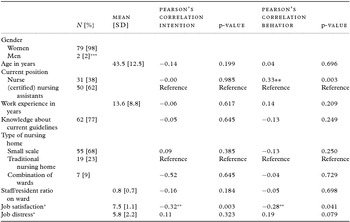
Demographics of the nurses and nursing assistants and their job characteristics (N = 81)

*Measured on a scale from 1 to 10.
**Significance < 0.05.
***Due to the skew distribution no correlation analyses were done for this variable.
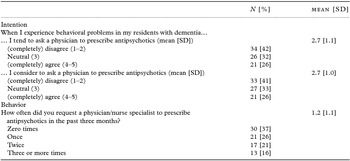
Intention and behavior to request antipsychotics of nurses and nursing assistants (N = 81)

Statistical analysis
Data were analyzed with SPSS 22 (Statistical Package for the Social Sciences). The mean scores were calculated for each construct. Pearson correlation coefficients were used to examine the association between intention/behavior and the TPB-variables as well as for associations between demographics and job characteristics and intention/behavior. Linear multiple regression analysis was used to examine the relative contribution of TPB-constructs and demographics and job-related variables in the explanation of intention/behavior which had significant univariate associations. All levels of significance were set at p < 0.05.
Results
Sample characteristics
A total of 81 nurses completed the questionnaire. Nearly all (N = 79, 98%) were women (see Table 1). Participants were on average 44 years old (SD = 13), and had on average 14 (SD = 9) years of experience in elderly care. Seventy-seven percent of the respondents reported to have knowledge about at least one of the current guidelines for antipsychotics.
Most nurses (68%) worked in small scale nursing homes. The resident/staff ratio, on the wards the participants are working, is on average 0.8, meaning that for each resident 0.8 staff members are present. Respondents were on average highly satisfied with their job (7.5 on a scale from 0 to 10), but they also considered it stressful (5.8 on a scale from 0 to 10).
Pearson correlation analyses show that none of the demographics or job characteristics were significantly associated with intention, except for job satisfaction: as nurses were less satisfied with their job, they were more inclined to call for antipsychotics. Behavior was significantly correlated to current position and job satisfaction: Nursing assistants (as compared to full nurses) and nurses, both nursing assistants as well as full nurses, who were less satisfied with their job, were more inclined to ask for antipsychotics.
Intention and behavior to call for antipsychotics
The scores on the single items of intention and behavior are shown (see Table 2). The results of the single items of intention revealed that 26% of the respondents intended to ask or considered asking a physician to prescribe antipsychotics, when they experience behavioral problems in residents with dementia. The results of the single items of behavior indicated that 63% of the respondents had requested an antipsychotic drug prescription at least once in the last three months.
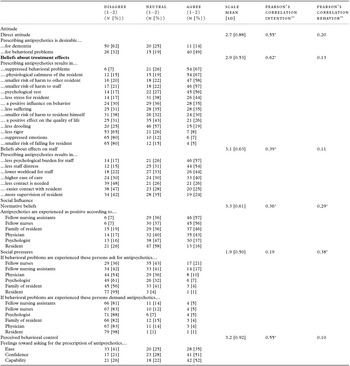
Single items of the TPB and correlation with intention and behavior to call for antipsychotics
In order to get a deeper understanding of the determinants for intention and behavior, scale scores and single items of the underlying dimensions were more closely investigated (see Table 3). The single items were ordered for each determinant according to the extent to which the respondents agreed on each specific item. The correlation of the scale scores with intention and behavior are also presented in this table.
Single items of the TPB and their correlations with intention and behavior

*p-value, 0.05.
**Correlation coefficient was computed with the original five-point scale.
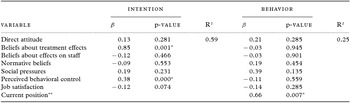
Multiple linear regression to predict intention and behavior with TPB-variables and job-related characteristics

*Significance < 0.05.
**nurse or nursing assistant.
The measures of the direct attitude indicate that the use of antipsychotics in dementia patients was mostly regarded as undesirable. This scale had a moderate and significant positive correlation with intention (r = 0.55, p < 0.05), indicating that a more favorable attitude toward antipsychotics was associated with a higher intention to call for antipsychotics. The items on which the nurses most frequently agreed with, on the scale beliefs about treatment effects, were related to the positive effects of antipsychotics on the patients and his/her environment, such as smaller risk of harm to other patients. For the scale beliefs about effects on staff, the most frequently agreed items were less psychological burden for staff and less staff distress. Both scales were significantly correlated with intention (r = 0.62 and r = 0.39, p < 0.05), indicating that nurses with more positive beliefs about the effects of the treatment on the patient and on the staff were more inclined to call for this treatment. None of these scales had significant correlations with behavior.
The underlying items of the normative beliefs indicate that according to the nurses their colleagues (nurses and nursing assistants) experienced the use of antipsychotics as positive. This scale was significantly correlated with intention as well as behavior (r = 0.36 and r = 0.29, p < 0.05). The measures of the social pressures scale indicated that according to the respondents, other nurses were more likely to call for antipsychotics. However, they disagreed that any of the other healthcare workers, resident, or family would demand antipsychotic use. This scale was not correlated with intention but had a significant correlation with behavior (r = 0.38, p < 0.05).
The most important underlying items of the perceived behavioral control were confidence and capability. Of the nurses, 51% felt confident to ask a physician to prescribe antipsychotics. Moreover, 53% of the respondents were able to call for antipsychotics. The confidence scale had a moderate and significant association with intention to call for antipsychotics (r = 0.55, p < 0.05) but not with behavior.
Intention and behavior to call for antipsychotics
In the multivariate analysis, beliefs about treatment effects (β = 0.85, p < 0.05) and perceived behavioral control (β = 0.38, p < 0.05) were significantly associated with intention (see Table 4). Together, the variables explained 59% of the variance, F (7, 73) = 14.70, p < 0.05, R 2 = 0.59. Regression analyses showed that the association between current position and behavior (β = 0.66, p < 0.05) was positive and statistically significant, indicating that lower educated nurses were more likely to call for antipsychotics. The variables explained 28% of the variance, F (8, 72) = 2.94, p < 0.05, R 2 = 0.25.
Discussion
This study aimed to give an overview of the different factors associated with the request for antipsychotics by nurses based on the TPB. An interesting finding in this study is that the majority of the respondents have actually asked a physician/nurse specialist in the past three months to prescribe antipsychotics. Considering the large amount of residents that already receives antipsychotics (Koponen et al., Reference Koponen2015), this request is remarkable. Although we do not know how the physician/nurse specialist reacted upon their requests, the physician/nurse specialist might be frequently confronted with these requests if he or she is in close contact with several nurses or nursing assistants. However, the number of reported requests seems to be meaningful. Especially, since earlier studies have demonstrated that physicians feel pressured to prescribe by nurses (Cornegé-Blokland et al., Reference Cornegé-Blokland, Kleijer, Hertogh and van Marum2012) and antipsychotics are prescribed to help the nursing staff (Lovheim et al., Reference Lovheim, Sandman, Kallin, Karlsson and Gustafson2006).
Factors associated with the intention to call for antipsychotics were beliefs about treatment effects and perceived behavioral control. A substantial proportion of the nurses and nursing assistants seem to have a positive attitude toward prescription of antipsychotics, i.e. they feel there are positive effects of the medication on the resident. This belief has already been reported in earlier studies (Lemay et al., Reference Lemay2013). The positive effects on the resident are however not supported by scientific studies (Sink et al., Reference Sink, Holden and Yaffe2005). More training and education of nurses and nursing assistants might be needed to change these unrealistic beliefs. Additionally, research is needed to determine if actual knowledge is influencing the beliefs and intention/behavior.
The items of perceived behavioral control, confidence, ability, and ease, were important determinants for the intention. These items were not specifically investigated in previous studies. Remarkably, the opinions of the respondents varied for the item related to the ease to ask for antipsychotics. These varying opinions of nurses and nursing assistants may be due to the different cultures and policies in various nursing homes. The factors of the TPB explained 59% of the variance in intention which is high in comparison with other applications of the TPB. A review of the applications of the TPB indicated an explained variance in intention between 32% and 47% (Godin and Kok, Reference Godin and Kok1996). Therefore, TPB determinants consisted of factors, which have an influence on intention to call for antipsychotics.
We also looked at the correlation between the TPB determinants and behavior. However, no association with any variable of the TPB determinants was found. Only current position of the respondent (nurse or nursing assistant) was related to behavior. In additional analyses, we found that nurses asked more often (74%) for antipsychotics in the past three months than nursing assistants (55%). This could be explained by the difference in tasks between the two groups. Nurses are in the position to discuss the patient with the physician whereas the nursing assistant is not or is less willing to do so. A previous Dutch study showed that better educated nurses were more likely to think that physicians are willing to listen to them (Albers et al., Reference Albers, Francke, de Veer, Bilsen and Onwuteaka-Philipsen2014). It might be the case that nursing assistants feel that the physicians do not listen to them and therefore do not try to discuss patients. However, our data did not allow us to further explain the fact that only current position was related to behavior.
Another interesting finding in this study was that the nurses and nursing assistants seem to feel that there are positive effects of the medication on the staff. Previous research has already shown a correlation between staff workload and behavioral problems in patients with dementia (Black and Almeida, Reference Black and Almeida2004). However, the nurses’ beliefs about positive effects of antipsychotic use on the staff, raises the question of whether the patients should be treated for their own sake, or for that of the staff. Additionally, less satisfied nurses and nursing assistants are more likely to call for antipsychotics. A correlation between staff distress and job satisfaction has been demonstrated earlier (Redfern et al., Reference Redfern, Hannan, Norman and Martin2002), which might be an explanation for our finding. Nurses and nursing assistants, who are dissatisfied with their work, experience their job as more stressful and therefore ask for more drugs for their patients.
Our study has several strengths and limitations. In comparison with previous studies, the current study combined and included all factors found in the literature. Additionally, the basis of this research was a theoretical framework. The framework provided a theoretical underpinned basis for the methodological aspects of this study, which has been proven in other studies, and ensures that the results can be compared with other TPB studies. The quantitative nature of the study has the advantage that the importance of the factors and reasons were identified. In addition, a few limitations should be taken into account. The behavior was measured by self-reporting. The use of self-report measures can create self-selection biases and can increase the chance that participants responded in a socially desirable manner. Besides, respondents were only recruited from one nursing home organization. Therefore, their beliefs might be influenced by the culture and/or habits of this organization. Additionally, the questions related to the work environment of the nurses and nursing assistants were difficult to answer with the consequence that respondents made estimates. A more accurate way of measuring these variables would be by using data systems of the nursing homes. However, then total anonymity could then no longer be guaranteed. Additionally, only 28% of the selected nurses and nursing assistant filled in the questionnaire, therefore our results might not be generalizable and should be interpreted with caution. However, it seems as if our study is representative. The staff/patient ratio of 0.8 as mentioned by the healthcare staff is comparable to the staff/patient ration found in another Dutch study (Zuidema et al., Reference Zuidema, de Jonghe, Verhey and Koopmans2011). Staff characteristics such as gender, age, and work experiences are also comparable to previous research on psychogeriatric wards in Dutch nursing homes (van de Ven et al., Reference van de Ven2013).
Because of the continuous high antipsychotic use in nursing home residents and the assumed importance of the nurses and nursing assistants in the prescribing process, this research focused on the influencing factors and reasons for nurses and nursing assistants to request antipsychotics in residents with dementia. The addition of the theoretical framework of the TPB in this study resulted in a structured and substantiated research, which is useful to determine the influencing factors of the nurses’ and nursing assistants’ request for antipsychotics. Considering all influencing factors observed in this study, we might conclude that educational programs could help nurses and nursing assistants to obtain a more realistic view on the benefits and side effects of antipsychotics. Additionally, these programs should focus on improving the nursing staffs’ understanding of their options to replace antipsychotic use such as reassurance and distraction as well as the use of psychosocial interventions and their efficacy. These programs should also improve their coping with neuropsychiatric symptoms of patients and possible job stressors.
Conflict of interest
None.
Description of authors’ roles
Janus: study concept and design, data analysis, drafting of paper. Drossaert, van Manen: study design, data analysis, and paper revision. Zuidema, IJzerman: paper revision. Bisseling: study concept and design.
Acknowledgments
None.