I. INTRODUCTION
Rare-earth (RE) orthovanadate compounds (where RE is a lanthanide series ion including both Sc and Y ions) have wide applications as catalysts, polarizers, laser host materials, and phosphors.Reference Fang, Hong, Zhou, Dai, Weng and Wan1–Reference Levine and Palilla4 When doped with RE ions such as Nd, Yb, or Tm, this series of crystals have been identified to be excellent laser materials. Nowadays, Nd-doped YVO4, GdVO4, and LuVO4 are three kinds of commercial vanadates, which possess large absorption and emission cross sections, wide absorption and emission spectra, and large thermal properties,Reference Maunier, Doualan and Moncorgé5–Reference Yu, Zhang, Wang, Wang, Shao and Jiang9 attracting attention to study novel vanadate laser materials. Generally, with increasing ionic radius, RE3+ ions show a strong tendency toward monazite-structured orthovanadate due to its higher oxygen coordination number of 9 as compared with 8 of the zircon.Reference Rice and Robinson10 Therefore, lanthanum orthovanadate (LaVO4) possesses monoclinic structure, which is different with the structures of YVO4, GdVO4, and LuVO4. Due to the low symmetry of LaVO4, it is difficult to grow the crystal with fixed orientation and study its anisotropy of properties. Up to now, the Nd- and Yb-doped LaVO4 have been reported including growth, optical properties, and laser performance with a Ti:sapphire as a pump source with unknown directions.Reference Zhang, Hu, Lin and Wang11–Reference Cong, Zhang, Sun, Yu, Yu, Yu, Zhang, Wang and Boughton13 However, for a crystal, its structural anisotropy is an intrinsic characteristic and a determinate factor for its physical properties. As a laser crystal, the anisotropy of refractive indices and spectra including absorption and emission spectra determines its laser performance and application. However, to the best of our knowledge, no investigation on the Nd:LaVO4 has been reported about the anisotropy of refractive indices and spectra. In this paper, we report the growth with fixed direction, structure, and anisotropy of refractive indices and spectra of Nd:LaVO4. All the properties demonstrate that this crystal is a specific low symmetrical laser material different to other familiar vanadates such as Nd:YVO4, Nd:GdVO4, and Nd:LuVO4.
II. EXPERIMENTS
A. Crystal growth
A Nd3+-doped LaVO4 (Nd:LaVO4) crystal was grown by the Czochralski method. The starting materials for Nd:LaVO4 single crystal growth were prepared from a mixture of LaVO4 and NdVO4 raw powder with 99.99% purity in a certain proportion. The starting materials were blended uniformly and pressed into blocks before growth. Nd-doped LaVO4 single crystal was pulled from iridium (Ir) crucible with dimensions of 66 mm in diameter and 40 mm in height, which can contain 310 g starting materials. The Ir crucible was heated by using a 2-kHz intermediate frequency furnace, and the growth atmosphere was N2 + O2 (2% in volume). The temperature control apparatus was EUROTHERM 2604 Controller/Programmer (EUROTHERM, London, UK) with a precision of ±0.1 °C. The crawling distance of pulling apparatus was less than 1 μm. Initially, a platinum–rhodium (Pt–Rh) rod was used as a seed to grow the Nd:LaVO4 crystal. The pulling rate was 1–2 mm/h after crystal diameter reached a certain value, and the crystal was rotated at a rate of 10 rpm during the growth. When the growth was finished, the crystal was cooled down to room temperature at a rate of 30 K/h. Then, a randomly oriented crystal was obtained. After growth, the seeds with orientations perpendicular to the (010), (101), (001), and (00 $\bar 1$) crystal planes have been cut from the grown random orientation crystals. With the different seeds, the crystals were regrown. It has been found that the two latter directions can suppress the bulk spiral growth, and high-quality and large-scale Nd:LaVO4 crystals can be obtained.Reference Cong, Zhang, Sun, Yu, Yu, Yu, Zhang, Wang and Boughton13 The Nd:LaVO4 boules possessed dimensions of Φ28 × 21 mm3 and weight of over 40 g. The crystal quality was detected with 532-nm green laser, and no scattering was observed, which shows that the as-grown Nd:LaVO4 crystal is good for laser experiments. After growth, the as-grown Nd:LaVO4 single-crystal boules were annealed to eliminate some of the O defects and to relieve some of the thermal stress in the crystal. The crystal was placed in constant temperature region of the annealing furnace, slowly heated to 1473 K in air, and then maintained at that temperature for 10 h. It was then cooled to room temperature at a rate of 30 K/h. All the crystals used in this study were grown under similar conditions. The concentration of Nd3+ ions in Nd:LaVO4 was determined to be 0.94 at.% by the method of x-ray fluorescence analysis.
B. X-ray powder diffraction
The x-ray powder diffraction investigation was carried out with Bruker D8 Advance diffractometer (Bruker, Billerica, MA) equipped with Cu Kα radiation (λ = 1.54056 Å) at room temperature in the 2θ range from 15° to 80° with a step size of 0.02°. The measurement time per step was 2 s. Samples for analysis were cut from the as-grown crystals and were ground into powder.
C. Refractive indices determination
The refractive indices were measured by, up to now, the most accurate refractive index measurement system HR SpectroMaster UV–VIS–IR (Trioptics, Wedel, Germany) at 12 different wave lengths over the full transmission range. The sample was cut as two right-angle prisms with short sides 5 × 10.5 mm2 and apex angle about 25.5°, and kept at 21 °C during the measurement.
D. Measurement of absorption spectra
The absorption spectra were measured with JASCO V-570 UV–VIS–NIR spectrophotometer (Jasco, Tokyo, Japan) in the wave length range of 400–950 nm at room temperature. The scanning speed is 200 nm/min. The samples with dimension 6 × 6 × 2.4 mm3 were directed and cut into the disks whose faces are perpendicular to a, b, and c axes, respectively, and the optically polished wafers have high optical quality, which allows the study of optical properties.
E. Measurement of fluorescence spectrum
The fluorescence spectrum of crystal with dimension 6 × 6 × 2.4 mm3, recorded by Edinburgh FS920 Steady State Fluorimeter (Edinburgh, Livingston, UK) from 850 to 1550 nm at room temperature, was excited by 808 nm, using a continuous wavelength xenon lamp as the exciting source.
III. RESULTS AND DISCUSSIONS
A. X-ray powder diffraction
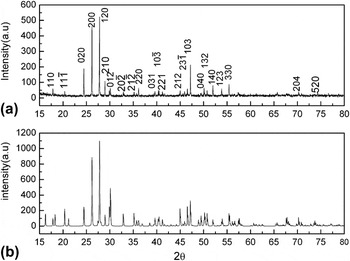
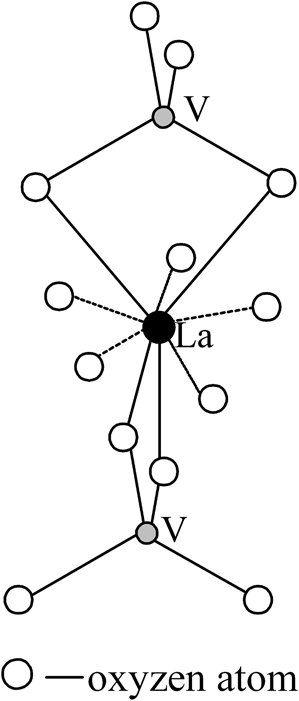
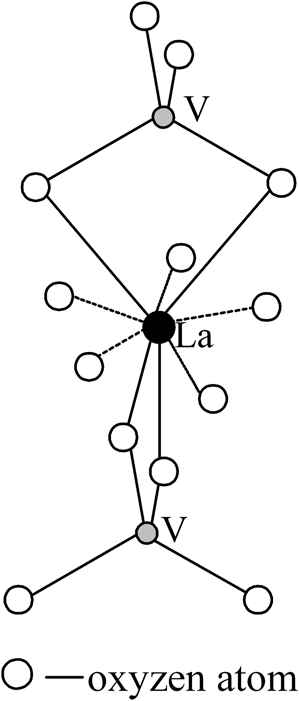
Figure 1 is the x-ray powder diffraction pattern for Nd:LaVO4 and JCPDS (No. 70-2392) pattern for LaVO4. The lattice parameters of the as-grown crystal were calculated to be a = 7.0434 Å, b = 7.2822 Å, c = 6.7213 Å, β = 104.87°, and Z = 4.The results are in good agreement with the values of JCPDS files of LaVO4 (a = 7.038 Å, b = 7.269 Å, c = 6.72 Å, and β = 104.91°) and the earlier findings (a = 7.047 Å, b = 7.286 Å, c = 6.725 Å, β = 104.85° in Ref. Reference Rice and Robinson10 and a = 7.0434 Å, b = 7.2801 Å, c = 6.7224 Å, β = 104.865° in Ref. Reference Bashir and Nasir Khan14). From our x-ray data and Refs. Reference Rice and Robinson10 and Reference Bashir and Nasir Khan14, the crystal possesses monazite structure, which is monoclinic, containing approximately tetrahedral VO4 units and a very irregular coordination polyhedron about La. Each V atom is coordinated to four oxygen atoms in a nearly tetrahedral manner. Each La atom is coordinated to nine oxygen atoms, which can be seen as La atom is linked to two vanadium tetrahedral via edge sharing and to five other tetrahedral through a single bridging oxygen. It can also be seen as an irregular pentagon with two additional oxygen atoms above and with two additional oxygen atoms below the plane of pentagon.Reference Rice and Robinson10Figure 2 shows the schematic diagram of V and La polyhedra in the crystal.
(a) X-ray powder diffraction pattern for Nd:LaVO4 and (b) JCPDS (No. 70-2392) pattern for LaVO4.

The schematic diagram of V and La polyhedra.
B. Refractive indices determination
The minimum deviation angle method was used to measure the refractive indices of the samples.Reference Fan, Huang, Hu, Eckanrdt, Fan, Byer and Feigelson15 They were measured at 12 different wave lengths over the full transmission range of Nd:LaVO4 (due to sample, n 3 was not measured for 0.363 and 0.4047 μm).
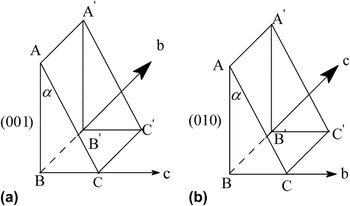
The anisotropic behavior of the crystal allows two beams with orthogonal polarization to propagate in the crystal and the refractive indices in these orthogonal directions to be obtained. Because the crystal belongs to monoclinic crystal, it has three principle refractive indices in different directions and need beam to propagate in the crystal at least in two different directions for gaining its three refractive indices. So we cut two right-angle prisms, as shown in Fig. 3. If we cut the prisms in such a way, with the first prism, n 1* and n 2 refractive indices were measured (n 1* lies in cross section of the ellipse for n 3 and n 1), and with the second prism, n 3 and n 1 refractive indices were measured. The experimental values have a high accuracy of 1 × 10⁻⁵.
Schematic view of two right angle prisms.

The Sellmeier equation is an empirical relationship between refractive index and wave length for a particular transparent medium. The equation is used to determine the dispersion of light in the medium. A different form of the equation is sometimes used for certain types of materials. The equation can often be given in the following form for crystal:
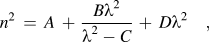 $$n^2 \, = \,A\, + \,{{B{\rm{\lambda }}^2 } \over {{\rm{\lambda }}^2 - C}}\, + \,D{\rm{\lambda }}^2 \quad,$$
where n is the refractive index, λ is the wave length in micrometers, B, C, and D are experimentally determined Sellmeier coefficients. The coefficient A is an approximation of the short wave length (e.g., ultraviolet) absorption contributions to the refractive index. At longer wave lengths, other variants of the Sellmeier equation exist that can account for a material’s refractive index change due to temperature, pressure, and other parameters.
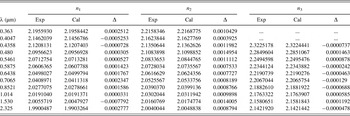
The experimental and calculated values of refractive indices with the Sellmeier’s equations fitted by the least-squares fitting method are compared in Table I. From the results, the Sellmeier coefficients are all precise, and the differences between experimental and calculated values are very small, which reflect the precision of the experiment.
Comparison of the refractive indices between the experimental and calculated values for Nd:LaVO4.

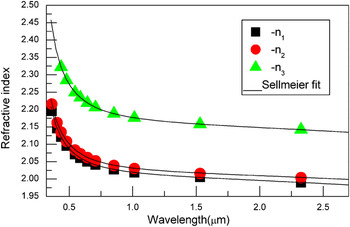
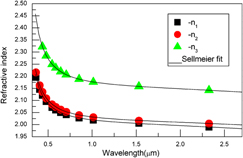
Figure 4 shows the fitted dispersion curves of the Nd:LaVO4 prisms over the full transmission range with the Sellmeier’s equations, and the Sellmeier’s equations fitted by the least-squares fitting method are given as following:
 $$n_1^2 \, = \,4.01992\, + \,{{0.06937} \over {{\rm{\lambda }}^2 - 0.04544}}\, - \,0.01322\, \times \,{\rm{\lambda }}^2\quad ,$$
 $$n_2^2 \, = \,4.06450\, + \,{{0.07084} \over {{\rm{\lambda }}^2 - 0.04857}}\, - \,0.01076\, \times \,{\rm{\lambda }}^2 \quad,$$
 $$n_3^2 \, = \,4.64600\, + \,{{0.10257} \over {{\rm{\lambda }}^2 - 0.05324}}\, - \,0.01413\, \times \,{\rm{\lambda }}^2 \quad.$$
The fitted dispersion curves of the Nd:LaVO4 prism over the full transmission range. (color online)

From the results, its refractive indices are 2.0171246, 2.02921112, and 2.1737241, respectively, at 1064 nm, which show obvious anisotropy and are different with Nd:GdVO4 and Nd:YVO4 (n 0 = 1.97052, n e = 2.19188 at 1064 nm for Nd:GdVO4 and n 0 = 1.95808, n e = 2,16745 at 1064 nm for Nd:YVO4).Reference Studenikin, Zagumennyi, Zavartsev, Popov and Shcherbakov16, Reference Kaminskii, Ueda, Eichler, Kuwano, Kouta, Bagaev, Chyba, Barnes, Gad, Murai and Lu17
C. Absorption spectra
1. Spectra measurement
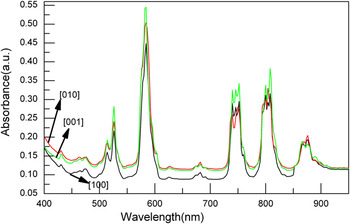
Figure 5 shows the absorption spectra along its [100] [010] [001] orientations at room temperature. Along [010] and [001] directions, the baseline moves away, which may be generated by the large refractive indices along those two directions based on the measurement above. From Fig. 5, the intraconfiguration transitions of the Nd3+ ion and the bands’/states’ Stark split can be analyzed. The initial state of these transitions is all the ground 4I9/2 state of the Nd3+ ion. All the final states are assigned and given in Table II. The absorption peaks are almost in the region of 400–900 nm. The transitions 4I9/2–4F5/2 and 4I9/2–2H9/2 are noteworthy, and all the line widths (full width at half maximum, or FWHM) are more than 17 nm at 808 nm, which are much larger than Nd:YVO4 (2.0 nm).Reference Jensen, Ostroumov, Meyn, Huber, Zagumennyi and Shcherbalov6 The larger width may be generated by the following reasons: in the Nd:LaVO4 crystal, the La possesses oxygen coordination number of 9. However, Nd has oxygen coordination number of 8 in NdVO4 phase. When the Nd ions are doped in LaVO4, a part of La ions are replaced by Nd. Usually, Nd coordinated with 8 oxygen atoms forms octahedron in most orthovanadate compounds, due to La atom is coordinated to 9 oxygen atoms in LaVO4. Therefore, for Nd ions, there is a tendency from oxygen coordination number of 9 to 8, which would induce the variation of crystal field and inhomogeneously broadening in the spectra. Because the wave length of laser diode (LD) would change with its working temperature, it is suggested that a larger FWHM is suitable for pumping by a LD.
Absorption spectra along a, b, and c directions of crystal Nd:LaVO4. (color online)

Spectral parameters of Nd:LaVO4.

2. Judd–Oflet theory analysis
Judd–Oflet (J–O) theoryReference Judd18, Reference Ofelt19 is a very effective method in the analysis of radiative transitions of RE ions. According to J–O theory, only the transitions of ΔS = 0 between 2S+1LJ states are permitted. However, the absorption transitions such as 4I9/2–2H9/2 and 4I9/2–2P1/2 for ΔS ≠ 0 between 2S+1LJ states are also observed, shown in Fig. 5 and Table II. These transitions are relatively weak and were omitted during fitting J–O experimental parameters. At the same time, the background of the absorption spectra was subtracted during the fitting procedure.
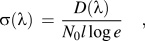
According to J–O theory, the experimental oscillator strength  $P_{\exp }$ can be obtained from the absorption spectra, which is expressed by:
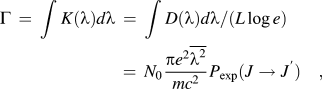 $$<![CDATA[$$\Gamma \, = \,\int {K({\rm{\lambda }})d{\rm{\lambda }}} \, = \,\int {D({\rm{\lambda }})d{\rm{\lambda }}} /(L\log e)\, = \,N_0 {{{\rm{\pi }}e^2 \overline {{\rm{\lambda }}^2 } } \over {mc^2 }}P_{\exp } (J \to J^\prime )\quad,$$
 $$<![CDATA[$${\rm{\sigma }}({\rm{\lambda }})\, = \,{{D({\rm{\lambda }})} \over {N_0 l\log e}}\quad,$$
where N 0 is the concentration of Nd3+ (here, 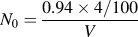 $N_0 = {{0.94 \times 4/100} \over V}$, V = 3.32 × 10⁻²⁸ cm3, so N 0 = 0.11325 × 10²¹/cm3), L is the thickness, m, c, and e are electron mass, light speed, and electron charge, respectively.
 $\overline {\rm{\lambda }} $ is average transition wave length, which can be given by the gravity wave length of the absorption bands.
 $\Gamma $ is the integrated absorbance for each absorption band.
 $D({\rm{\lambda }})$ is the absorbance.
 $K({\rm{\lambda }})$ is the absorbance coefficient.
 ${\rm{\sigma }}_{\rm{\lambda {(k)} }} $ is the absorption cross section. The integrated absorbance
 $\Gamma $ and absorption cross section
 ${\rm{\sigma }}_{\rm{\lambda }} $ with the eight transitions are calculated as shown in Table II.
Based on the J–O theory, the measured line strengths are used to obtain the J–O intensity parameters Ω2, Ω4, and Ω6 by fitting the set of equations from the corresponding transitions between  $J$ and
 $J^′$ manifold in the following equation:
 $$<![CDATA[$$\Gamma \, = \,\int {K({\rm{\lambda }})d{\rm{\lambda }}\, = \,N_0 {{8{\rm{\pi }}^3 e^2 \overline {\rm{\lambda }} } \over {3\hbar c}}{{(n^2 + 2)^2 } \over {9n}}{1 \over {(2J + 1)}}} \times S_{\exp } (J \to J^\prime )} ,$$
 $$<![CDATA[$$S_{{\rm{cal}}} (J \to J^\prime ) = \mathop\sum\limits_{t = 2,4,6} {\Omega _t \left| {\left\langle {4f^n {\rm{\psi }}J\left\|| {U^{(t)} } \right\||4f^n {\rm{\psi }}^\prime J^\prime } \right\rangle } \right|} ^2 ,$$
where n is the refractive index (here, we use the mean refractive index of n 1, n 2, n 3 for different wave lengths), h is the Planck constant, and J is the angular momentum of the ground state. U (t) (t = 2, 4, 6) are the matrix elements of unit tensor that are cited from Refs. Reference Carnal, Fields and Wybourne20 and Reference Carnal, Fields and Rajnak21.
The root-mean-square (rms) deviation between experimental and calculated line strengths is determined by:
 $$<![CDATA[$${\rm{rms}}\, = \,\sqrt {\mathop\sum\limits_{t = 1}^N {(S_{\exp } - S_{{\rm{cal}}} )^2 /(N - 3)} } \quad.$$
So, the rms error is 1.034 × 10⁻²¹ cm2. After a least-square fitting of S exp to S cal, the three J–O intensity parameters were obtained: Ω2 = 2.142 × 10⁻²⁰ cm2, Ω4 = 3.704 × 10⁻²⁰ cm2, and Ω6 = 2.948 × 10⁻²⁰ cm2. The three J–O intensity parameters compared with other Nd-doped crystals are shown in Table III. The spectroscopic quality factor,  $X = {\raise0.5ex\hbox{$\scriptstyle {\Omega _4 }$}\kern-0.1em/\kern-0.15em\lower0.25ex\hbox{$\scriptstyle {\Omega _6 }$}}$, for the crystal Nd:LaVO4 laser material was 1.25. The spectroscopic quality factor, however, has been found to vary from 0.22 to 1.5 for Nd3+ in different host materials.Reference Kaminskii25 The large quality factor indicates that the crystal has a disorder structure, which also identifies that the wide absorption spectra are inhomogeneously broadened.
The J–O intensity parameters and radiative lifetimes of Nd-doped crystals.

From the 4f–4f intensity model, the calculated oscillator strength of a transition between two multiplets is defined asReference Carnall, Crosswhite and Crosswhit26:
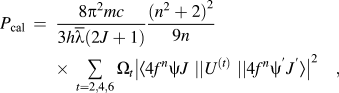 $$<![CDATA[$$P_{{\rm{cal}}} \, = \,\,{{8{\rm{\pi }}^2 mc} \over {3h\overline {\rm{\lambda }} (2J + 1)}}{{(n^2 + 2)^2 } \over {9n}}\, \times \,\mathop\sum\limits_{t = 2,4,6} {\Omega _t \left| {\left\langle {4f^n {\rm{\psi }}J\left\|| {U^{(t)} } \right\||4f^n {\rm{\psi }}^\prime J^\prime } \right\rangle } \right|} ^2 \quad,$$
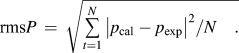 $$<![CDATA[$${\rm{rms}}P\, = \,\sqrt {\mathop\sum\limits_{t = 1}^N {\left| {p_{{\rm{cal}}} - p_{\exp } } \right|^2 /N\quad.} } $$
Then, the experimental oscillator strength P exp and calculated oscillator strength P cal were obtained. The rmsP error is obtained to be 3.302 × 10⁻⁷ cm2. Table II lists the experimental and calculated line strength S exp/S cal and the oscillator P exp/P cal.
3. Fluorescence spectrum
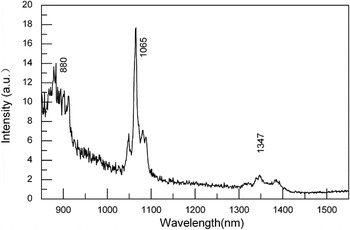
The fluorescence spectrum of the crystal excited by 808 nm recorded at room temperature is shown in Fig. 6. In this spectrum, three intense emission peaks at 880, 1065, and 1347 nm are corresponding to the transitions 4F3/2 → 4F9/2, 4F3/2 → 4F11/2, and 4F3/2 → 4F13/2 of Nd3+ ions, respectively. The most intense line at 1065 nm with FWHM of 10 nm is also much larger than Nd:YVO4 and Nd:YAG,Reference Zhang, Meng, Zhu, Wang, Chow and Lu27, Reference Kaczmarker, Lukasiewicz, Giersz, Jablonski, Jabczynski, Swrkowicz, Galazka, Drozdowski and Kwasny28 which indicates that this crystal is potentially applied for ultrashort pulsed lasers, especially in the femtosecond lasers.
Fluorescence spectrum of Nd:LaVO4 at room temperature.

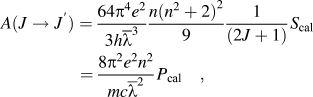
Using the obtained emission line strengths, the radiative decay rates A(J → J′) can be determined by the following equationsReference Krupke29:
 $$<![CDATA[$$A(J \to J^\prime ) = {{64{\rm{\pi }}^4 e^2 } \over {3h\overline {\rm{\lambda }} ^3 }}{{n(n^2 + 2)^2 } \over 9}{1 \over {(2J + 1)}}S_{{\rm{cal}}} = {{8{\rm{\pi }}^2 e^2 n^2 } \over {mc\overline {\rm{\lambda }} ^2 }}P_{{\rm{cal}}} \quad,$$
 $$<![CDATA[$${\rm{\tau }}_{{\rm{rad}}} = {1 \over {\mathop\sum\limits_{J^\prime } {A(J \to J^\prime )} \,}}\quad,$$
 $$<![CDATA[$${\rm{\beta }}_{J^\prime } = {{A(J \to J^\prime )} \over {\mathop\sum\limits_{J^\prime } {A(J \to J^\prime )} }}\quad,$$
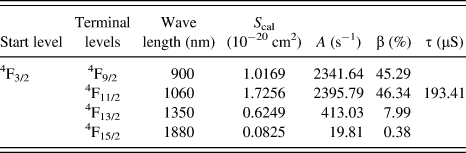
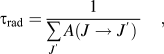
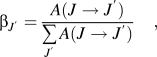
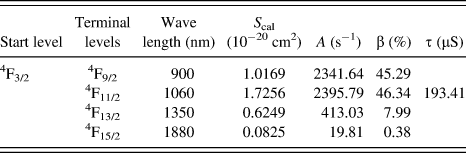
where A(J → J′) is the transition probability for the spontaneous emission per unit time, βJ’ is the fluorescence branching ratios, τrad is the radiative lifetime. The calculated parameters for different transition levels are listed in Table IV. The radiative lifetimes of other crystals are also listed in Table III.
Calculated luminescence parameters of Nd:LaVO4 for the radiation 4I9/2 → 4IJ’ transitions.
The stimulated emission cross section σp related to the radiative transition probability can be defined as:
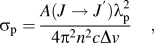 $$<![CDATA[$${\rm{\sigma }}_{\rm{p}} = {{A(J \to J^\prime ){\rm{\lambda }}_{\rm{p}} ^2 } \over {4{\rm{\pi }}^2 n^2 c\Delta v}}\quad,$$
where  $\Delta v$ is the full frequency width at half maximum, λp is the vacuum wave length of the emission peak. The emission cross section σp of emission spectrum at 1065 nm is 6.5 × 10⁻²⁰ cm2 much smaller than that of Nd:YVO4, Nd:GdVO4, and Nd:LuVO4Reference Jiang, Zhang, Wang, Xia, Hu, Teng and Zhang23, Reference Liu, Xia, Gao, Ran, Sun, Ling, Zhao, Zhang, Zhao and Wang24, Reference Kaczmarker, Lukasiewicz, Giersz, Jablonski, Jabczynski, Swrkowicz, Galazka, Drozdowski and Kwasny28 due to the wider inhomgeneously broadened fluorescence spectrum. Combining the long fluorescence lifetime, it can be found that this crystal possesses large energy storage ability, which overcomes the limitation of usual vanadates. It is noteworthy that the emission cross section σp of emission spectrum is 2.9 × 10⁻²⁰ cm2 at 880 nm and it has larger fluorescence luminescence branch ratio (45.29%), which indicates that the crystal has potential application at 880 nm.
IV. CONCLUSIONS
Single-crystal Nd:LaVO4 was grown by the Czochralski technique. X-ray powder diffraction shows that it belongs to monoclinic monazite structure. Refractive indices were determined by minimum deviation angle method with two right angle prisms. Absorption spectra show anisotropic characteristic of the crystal. According to J–O theory, the J–O parameters are calculated: Ω2 = 2.142 × 10⁻²⁰ cm2, Ω4 = 3.704 × 10⁻²⁰ cm2, and Ω6 = 2.948 × 10⁻²⁰ cm2. Room temperature fluorescence spectrum was measured and discussed. The most intense fluorescence line at 1065 nm corresponds to transition 4F3/2 → 4F11/2, whose emission cross section is 6.5 × 10⁻²⁰ cm2, and the calculated radiative lifetime of 4F3/2 is 194.31 μs. It has a large FWHM of 17 nm at 808 nm and longer radiative lifetime in comparison with the other Nd-doped crystals (see Table III), so the crystal is available for LD pumped. The emission cross section σp of emission spectrum is 2.9 × 10⁻²⁰ cm2 at 880 nm and it has larger fluorescence luminescence branch ratio (45.29%), which indicates that the crystal has potential application at 880 nm.
ACKNOWLEDGMENTS
This work was supported by the National Natural Science Foundation of China (Grant Nos. 51025210, 51032004, and 51021062), the China Postdoctoral Science Foundation (Grant Nos. 200904501184 and 201003633), and the National Basic Research Program of China (Grant No. 2010CB630702).