The boreal felt lichen (Erioderma pedicellatum (Hue) P. M. Jørg.) is a species red-listed by the International Union for Conservation of Nature (IUCN; Scheidegger Reference Scheidegger2003) that occurs in three geographically isolated populations within North America (Maass Reference Maass1983; Nelson et al. Reference Nelson, Walton and Roland2009). The population on the island of Newfoundland is listed as being of Special Concern (COSEWIC 2014). Despite its listing in Newfoundland, the boreal felt lichen is quite rare, and only a small number of studies have been carried out looking at habitat and population dynamics of this species in this region (Goudie et al. Reference Goudie, Scheidegger, Hanel, Munier and Conway2011; Wiersma & Skinner Reference Wiersma and Skinner2011; Lauriault & Wiersma Reference Lauriault and Wiersma2020). Little information is available to explain its rarity/sensitivity. Here we propose a conceptual framework that may help explain the rarity of the boreal felt lichen, using the Avalon Forest Ecoregion of Newfoundland as a case study.
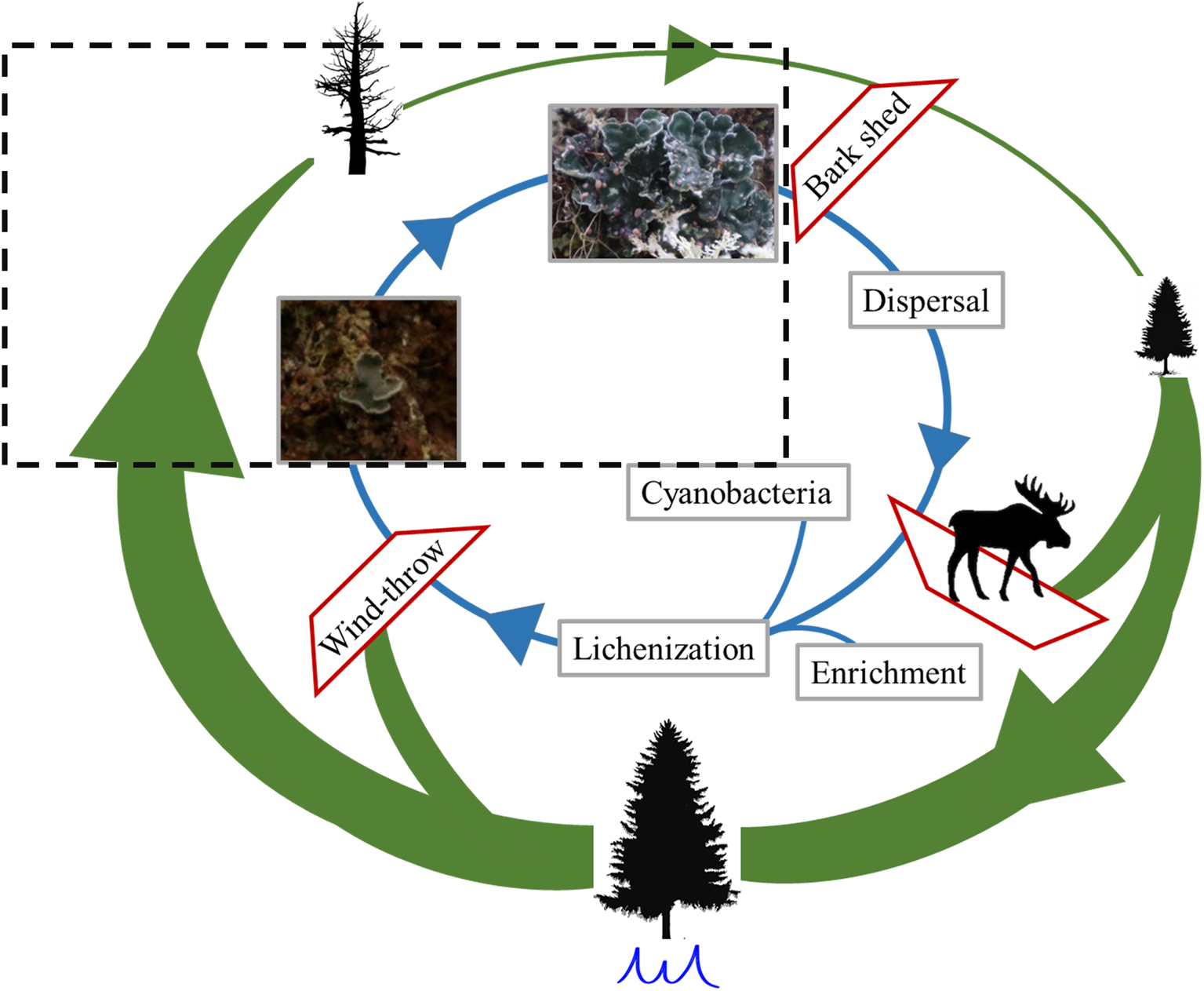
We suggest that the lichen habitat has a temporal aspect which plays a role in restricting the abundance of this species at finer scales (Fig. 1). The life cycle of the boreal felt lichen is intertwined with the life cycle of the balsam fir (Abies balsamea), the main substratum for this lichen in Newfoundland (Maass & Yetman Reference Maass and Yetman2002). The average reproductive age of an adult boreal felt lichen in Newfoundland is estimated at 30 years (Goudie Reference Goudie2009). This is a significant amount of time relative to the 70-year average maximum lifespan of balsam fir in this region (Arsenault et al. Reference Arsenault, LeBlanc, Earle, Brooks, Clarke, Lavigne and Royer2016). This could create a temporal mismatch between the lichen and its host tree.
Lichen-substratum dynamics of the boreal felt lichen Erioderma pedicellatum, along with its host tree species, balsam fir. The inner circle represents the life cycle of the boreal felt lichen, that includes requirements for lichenization (Campbell et al. Reference Campbell, Bradfield, Prescott and Fredeen2010; Cornejo & Scheidegger Reference Cornejo and Scheidegger2016). The outer circle represents the life cycle of balsam fir, the habitat for the lichen. The trapezoids indicate frequent natural disturbance events, which include herbivory and windthrow, that affect the host tree and consequently disrupt the lichen's life cycle (Dale et al. Reference Dale, Joyce, McNulty, Nelson, Ayres, Flannigan, Hanson, Irland, Lugo and Peterson2001; Solomon et al. Reference Solomon, Zhang, Brann and Larrick2003; Gosse et al. Reference Gosse, Hermanutz, McLaren, Deering and Knight2011). The width of the line on the tree life cycle indicates the relative overall substratum quality for the lichen throughout time. The hatched box represents the scope of the present study. In colour online.

Balsam fir trees that boreal felt lichen occupy are often near bogs (Wiersma & Skinner Reference Wiersma and Skinner2011; Power et al. Reference Power, Cameron, Neily and Toms2018). Though balsam fir is somewhat tolerant of hydric soils, it does not grow well when it is rooted in chronically saturated soils (Whitney & MacDonald Reference Whitney and MacDonald1985). However, specific research regarding how chronically water saturated soils affect balsam fir health and/or longevity is scarce. Existing near the edge of its tolerance limit, balsam fir in wet soils appear less healthy and this could either limit the lifespan of the tree, or shrink the window of time it can act as a suitable substratum for the boreal felt lichen. This may suggest that the boreal felt lichen has less opportunity to colonize and grow to reproductive maturity before the substratum is no longer suitable.
Logistical limitations constrained our ability to test the effect of time on the niche dynamics of the boreal felt lichen. Thus, we conceptualize how the boreal felt lichen is temporally constrained and offer an exploratory analysis to illustrate the concept in part. We hypothesize that the water level requirements for a good quality boreal felt lichen habitat are also a stressor for the balsam fir host trees they occupy, thus reducing the chance of the lichen reproducing before its substratum becomes unsuitable. Considering this hypothesis, we explored two questions: 1) is there a pattern between boreal felt lichen thallus size and tree health classes?; 2) is the occupancy of the boreal felt lichen on trees even across the tree health classes?
Methods
We carried out this study in the Central Avalon Forest Ecoregion of Newfoundland, Canada. This ecoregion is found directly in the centre of the Avalon Peninsula, and is characterized by having a post-glacial ribbed moraine landscape structure with intermittent peat bogs. The area immediately surrounding the moraines to the moraine crest is predominantly occupied by balsam fir trees (Meades & Moore Reference Meades and Moore1994). The average annual rainfall here is c. 1500 mm but with the high proportion of area covered by bog, and relatively low annual temperatures (c. 10 °C), this water is retained in the soil for extended periods of time.
New lichen occurrences were documented opportunistically during surveys (carried out between 15 May and 13 September 2018) for plot establishment and occupancy determination (Lauriault & Wiersma Reference Lauriault and Wiersma2019), with some new lichen occurrences being documented outside the plot areas during intelligent meandering (Mueller-Dombois & Ellenberg Reference Mueller-Dombois and Ellenberg1974; Minnesota Department of Natural Resources 2013). We selected areas that appeared to be ideal boreal felt lichen habitat in the ecoregion, which consisted of stunted-growth balsam fir stands that are either near to or within a wetland. In this area, we surveyed the boles of balsam fir trees from the ground to 2 m up the bole.
When we detected a boreal felt lichen, we measured the width of the thallus and categorized tree health. To classify the health of the tree, we adapted the crown health classes of Zemaitis & Zemaite (Reference Zemaitis and Zemaite2018) to include 4 categories with their descriptors to improve repeatability. The four categories were: 1) ‘good’, trees having no crown decay; 2) ‘moderate’, trees having signs of compromised health that include crown decay, but it was not clear that mortality was imminent; 3) ‘poor’, trees having advanced crown decay, sometimes with flaking bark and with tree mortality very likely to occur shortly; 4) ‘dead’, trees no longer having any needles and the bark is either loose or partially shed. During the exploratory phase of fieldwork, we attempted to core trees but even those classified as ‘healthy’ had heart rot (personal observation). Since we could not reliably measure tree age with this method, we did not continue coring trees for this study. Nearly all balsam fir trees found in low-lying areas near wetlands appear much less healthy than upland balsam fir trees, which were not considered in the present study.
In our analyses, we used the largest boreal felt lichen thallus, which we assume represents the earliest colonization on each tree, to test the relative growth of lichens versus tree health decline. We used the Kruskal-Wallis non-parametric test (α = 0.05) to test the thallus width in response to tree health. We tested the number of host trees with at least one mature thallus in each tree health category using a 1-sample chi square test with α = 0.05 (R Core Team 2019).
Results
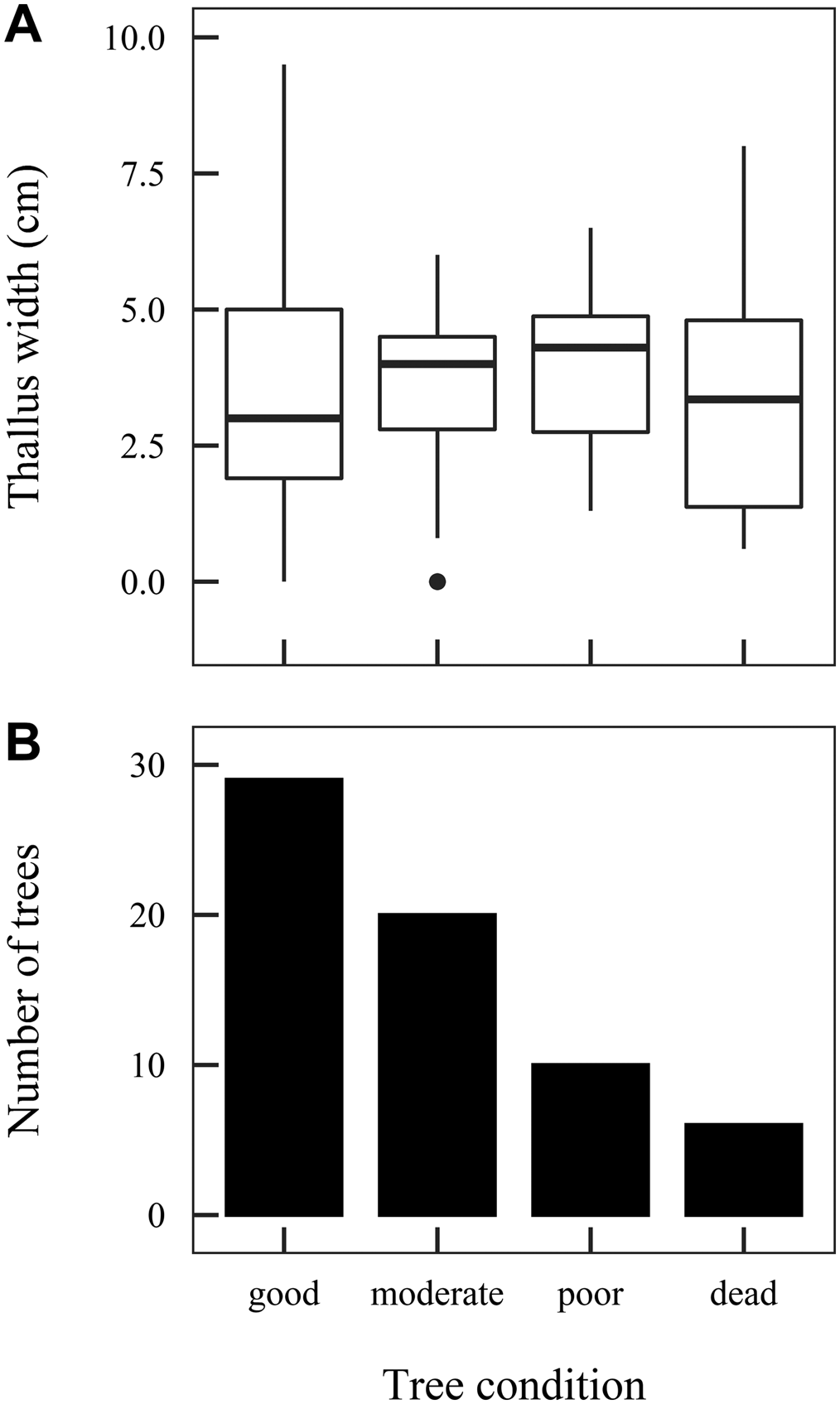
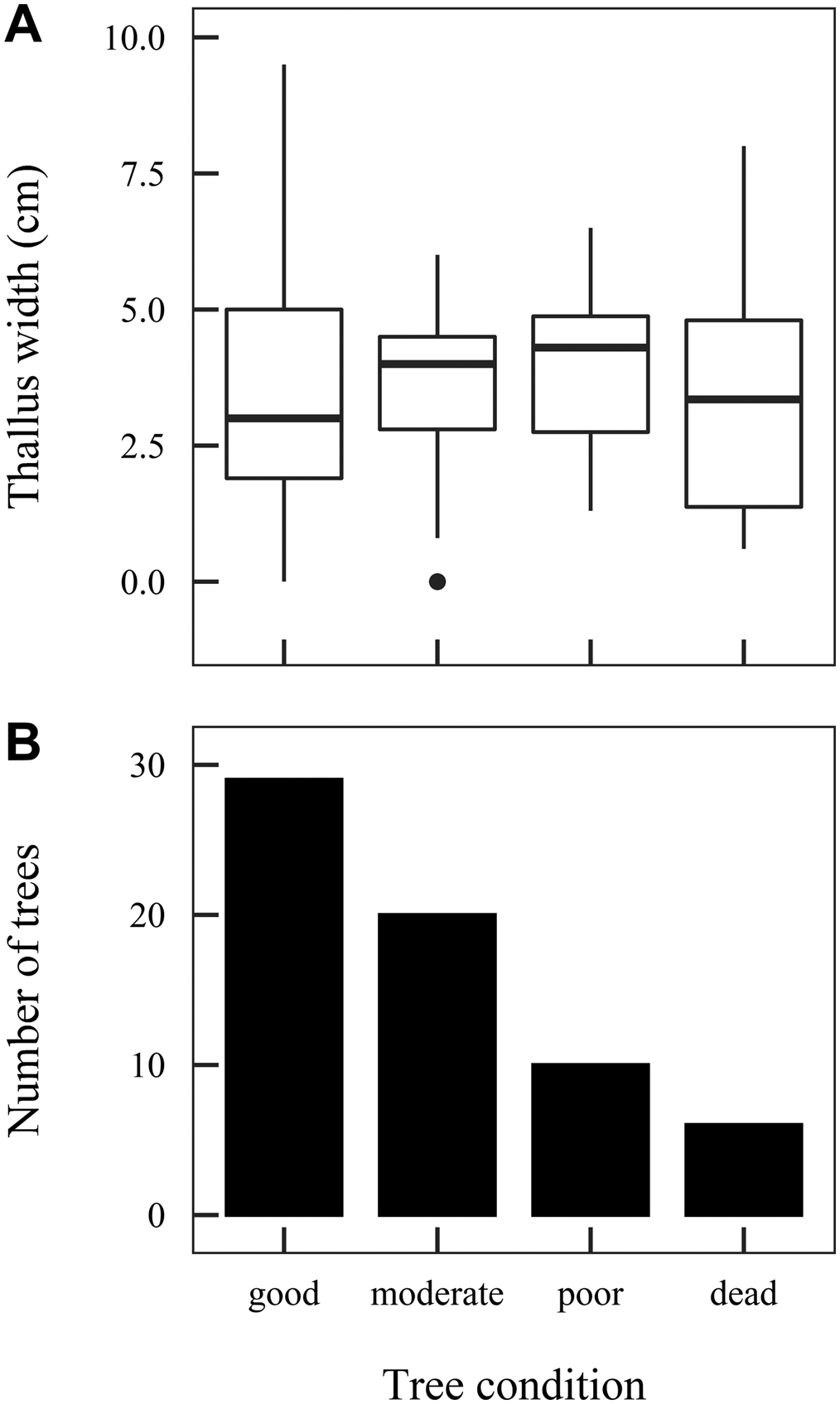
The Kruskal-Wallis rank sum test found no significance for thallus width in response to tree health (Fig. 2A: X2 = 1.09, P = 0.78). The mean thallus width and standard deviations for the largest thallus per tree are as follows: trees in good (mean thallus width = 3.64 cm, SD = 2.64) and moderate (mean thallus width = 3.53 cm, SD = 1.57) health, and poor (mean thallus width = 3.94 cm, SD = 1.75) to dead (mean thallus width = 3.55 cm, SD = 2.78). We did find a significant difference between the number of trees that host at least one mature thallus at each health group using a 1-sample chi square test (Fig. 2B: X2 = 19.74, P < 0.001).
The boreal felt lichen Erioderma pedicellatum and its host tree species, balsam fir. Analysis of the distribution of thallus width of largest lichen only per tree (Kruskal-Wallis rank sum test; X2 = 1.09, P = 0.78) (A) and number of host trees with at least 1 mature thallus (1-sample chi square test; X2 = 19.74, P < 0.001) (B) in response to the health class of the host balsam fir tree.
Discussion
There are challenges in reconciling tree and lichen lifespans with a snapshot study such as this. The time when the lichen colonized the host tree is unknown. Lichen colonization could occur later in the life of the host tree, regardless of condition. The effect of colonization timing is not possible to isolate from the present study and it adds significant noise to the data. Also, the known lifespan of boreal felt lichens in the wild is currently not well understood. If they are shorter-lived than we expect, they might die off before the tree is dead, which would also confound the results. We suggest that using thallus size as a proxy for time spent on the tree is not an adequate alternative for long-term monitoring of lichens.
Our exploratory results may suggest that the substratum quality of balsam fir declines with declining tree health. If we were to use tree health as a proxy for age, and assume that its quality as a substratum remained constant, we could expect that less healthy host trees would be more abundant than healthier host trees. We found a clear pattern that the number of host trees in each health category decreases (Fig. 2B). This might indicate that balsam fir in poorer health are also less suitable as a substratum for the boreal felt lichen, even if less healthy trees existed longer for the lichen to colonize. However, with the current sampling design we cannot verify this hypothesis. A more detailed measure of internal tree health and tree age, with proper representation across all health and age classes, as it relates to the ability to host sensitive lichens, could lead to more informed conclusions.
The detectability of this lichen across tree condition classes is quite similar, and we used a survey method that has been demonstrated to minimize missed detections within the plot boundaries (Lauriault & Wiersma Reference Lauriault and Wiersma2019). Knowing the minimum tree age at which lichens can colonize would be useful but would require careful and frequent monitoring of young trees to detect when a lichen appears. However, we did not find the boreal felt lichen on trees less than 5 cm DBH, suggesting that this lichen cannot colonize trees until they reach a certain age. Another study successfully aged host trees and found that the number of thalli per tree peaked on 80-year-old trees (Tagirdzhanova et al. Reference Tagirdzhanova, Stepanchikova, Himelbrant, Vyatkina, Dyomina, Dirksen and Scheidegger2019), which is beyond the maximum average age of balsam fir in our study region. The patterns between boreal felt lichen host tree age, size and condition in these wetter areas is not well known. We have included data from Wigle et al. (Reference Wigle, Wiersma, Arsenault and McMullin2020) in the Supplementary Material (available online) from upland balsam fir trees (which were not hosts for the boreal felt lichen) in the same region to illustrate the difficulties of relating tree size, age and health.
The boreal felt lichen, as well as some other cyanolichens, has a strong preference for growing in very wet environments (Cameron & Richardson Reference Cameron and Richardson2006; Gauslaa Reference Gauslaa2014). All tree species have a tolerance limit of hydric soils before they exhibit some form of stress response (Rodriguez-Gonzalez et al. Reference Rodriguez-Gonzalez, Stella, Campelo, Ferreira and Albuquerque2010). Our study species is the boreal felt lichen but the results seen here might be pertinent to other rare epiphytic lichens that require wet environments. Trees naturally senesce as they age but health could decrease faster in wetter soils. Our trees were all located on average within c. 15 m of open wetlands, and we noted a general trend of trees closer to wetlands being smaller and in poorer condition than upland trees (personal observation). Considering these multiple dynamics that affect lichen micro-habitats, a multi-factorial analysis might be required.
Understanding the relationship between boreal felt lichens and their substratum may help us better understand why these lichens are rare on local and global scales. The link between the life cycle of the lichen and its host tree (Fig. 1) is a relevant framework for other rare epiphytic lichens (Scheidegger & Werth Reference Scheidegger and Werth2009). This tension between the mutualistic counterparts is present in epiphytic lichen-tree relationships but is greater in those that have more specific habitat requirements and is important to consider in future management practices for endangered lichens.
Acknowledgements
We would like to acknowledge B. Ronayne as the field technician who assisted with data collection in the summer of 2018. Our colleague T. Padgett also contributed to the detection of new boreal felt lichen individuals. We would like to thank Dr Troy McMullin and Dr Luise Hermanutz, Dr Carissa Brown, Dr Sean Haughian as well as two anonymous reviewers for meaningful suggestions for this paper. This research was supported by funding from NSERC and from Environment and Climate Change Canada's Habitat Stewardship Program to YFW. In-kind support was provided by Salmonier Nature Park in Newfoundland.
Author ORCID
Patrick Lauriault, 0000-0002-3363-3635.
Supplementary Material
To view Supplementary Material for this article, please visit https://doi.org/10.1017/S0024282920000493