Acute vasculitis due to Kawasaki disease affects the major coronary arteries. It often causes coronary artery aneurysms in the proximal portion, Reference Tsuda, Tsujii, Kimura and Suzuki1 and coronary artery lesions can remain as long-term sequelae after Kawasaki disease from infancy to adulthood. Reference Tsuda, Tsujii and Hayama2 Coronary artery stenotic lesions can often induce myocardial ischaemia. Whether coronary artery lesions caused by Kawasaki disease affect the coronary artery flow reserve is unknown. On the other hand, coronary arteries without coronary artery lesions show morphological growth within normal ranges after Kawasaki disease. Reference Tsuda and Hashimoto3 However, their endothelial function remains unknown. Therefore, the coronary flow velocity reserve of the left anterior descending artery was examined by transthoracic Doppler echocardiography.
Methods
The coronary flow velocity reserve of the left anterior descending artery was evaluated by transthoracic Doppler echocardiography in patients with a history of Kawasaki disease from 2005 to 2011. The total cholesterol, high-density lipoprotein cholesterol, low-density lipoprotein cholesterol, triglycerides, fasting glucose and haemoglobin A1c were measured at the same time. The ethics committee of our institution approved this retrospective study (R19003-2, M17-041). The patients were classified into nine groups based on their native coronary artery lesions on selective coronary angiography or computed tomographic angiography that had been performed close to the time of the coronary flow velocity reserve examination. The groups were as follows: control (A); no coronary artery lesions (B); no coronary artery lesions in the left anterior descending artery but coronary artery lesions in the right coronary artery (C); regression of an aneurysm of the left anterior descending artery (D); aneurysm at the bifurcation of the left coronary artery (E); aneurysm of the left anterior descending artery (F); localised stenosis <75% (G); localised stenosis ≥75% (H); segmental stenosis (I) and coronary artery bypass grafting to the left anterior descending artery (J). Each mean coronary flow velocity reserve was compared with the other groups and the control group. The no coronary artery lesions group (B group) included patients with transient coronary artery lesions. The coronary artery lesions of the right coronary artery group (C group) included patients who had a coronary artery lesion in the right coronary artery, although they had no coronary artery lesions in the left anterior descending artery. Regression (D group) referred to “apparently angiographically normal coronary arteries” on selective coronary angiography or computed tomographic angiography in the late period, although it was diagnosed as a coronary artery lesion of the left coronary artery in the previous selective coronary angiography or computed tomographic angiography. Segmental stenosis meant that coronary artery recanalisation with multiple small collateral vessels was accidentally found on selective coronary angiography or computed tomographic angiography. The coronary artery bypass grafting group included patients who had a graft in the left anterior descending artery and the graft was patent. All patients gave their informed consent for the coronary flow velocity reserve measurement. Information about the patients in this study was also obtained from their records.
Measurement of the coronary flow velocity reserve by transthoracic Doppler echocardiography
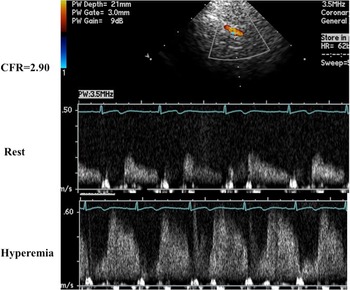
The patients were instructed to avoid taking a meal for 6 hours before the measurements. The coronary flow velocity measurements were carried out with an Acuson Sequoia C 512 mainframe (Acuson, Inc., Mountain View, CA, USA) with a 7.5-MHz transducer. B-mode and colour Doppler mapping were used to identify the distal left anterior descending artery, as previously described. Reference Hozumi, Yoshida and Ogawa4–Reference Cicala, Galderisi, Grieco, Lamberti, Cosimi and Pellegrini6 A cannula was inserted into an antecubital vein for the adenosine infusion. The baseline flow velocity was measured with pulsed wave Doppler, with the mean of at least three cardiac cycles used for the analysis (Fig 1). No angle correction was performed. Hyperaemia was induced by infusion of adenosine at a rate of [0.15mg/kg/minute]. The infusion was continued until the maximal increase in the flow velocity was seen (2–5 minutes). During propagation, the electrocardiogram was monitored continuously, and the blood pressure was recorded with a digital blood pressure monitor at rest and during hyperaemia. The flow velocity waves in the distal left anterior descending artery were recorded using pulse wave Doppler at rest and monitored throughout the adenosine infusion to confirm that the highest flow velocity response during the infusion was recorded. In offline analysis, the mean diastolic velocity was measured at baseline and during the adenosine infusion. The coronary flow velocity reserve was calculated as the hyperaemia-to-baseline ratio. A Bland–Altman analysis was also used to assess the intra-observer, inter-observer agreement (supplemental figure). Excellent intra-observer agreement for coronary flow velocity reserve was shown. A good correlation for the measurements of coronary flow velocity reserve between interobservers was confirmed (r = 0.94, p = 0.0002).
Coronary artery flow recordings at rest and during hyperaemia obtained by transthoracic Doppler echocardiography. This patient is a 17-year-old man with an aneurysm of the right coronary artery. The coronary flow velocity reserve (CFR) was 2.90. He had an aneurysm of the right coronary artery by acute Kawasaki disease at the age of 4 years old.

Statistical Analyses
The statistical analyses were performed using JMP 10 (SAS Institute Inc., Cary, NC, USA). The measurements are expressed as means ± standard deviation. The significance of differences was determined by one-way analysis of variance (ANOVA) with Tukey’s multiple comparisons as a post hoc analysis for the ANOVA. A p value <0.05 was considered significant.
Results
Patients
The coronary flow velocity reserve of the left anterior descending artery was examined by transthoracic Doppler echocardiography in 189 patients (male 125, female 64) with a history of Kawasaki disease and 10 volunteers (control) from 2005 to 2011. Of the 194 patients who underwent coronary flow velocity reserve measurements from 2005 to 2011, 5 were excluded because of difficulty detecting the flow (Table 1). The age at the time of the coronary flow velocity reserve measurement ranged from 6 years to 40 years, with a median of 22 years. The age at the onset of the acute Kawasaki disease episode ranged from 2 months to 14 years, with a median of 23 months. The interval from the onset of Kawasaki disease to the coronary flow velocity reserve measurement ranged from 1 year to 33 years, with a median of 20 years. The diagnosis of coronary artery lesions in each patient was made by selective coronary angiography or computed tomographic angiography, and the median time between the coronary flow velocity reserve measurements and those examinations was 3 years. All patients had no cardiac events between the coronary flow velocity reserve measurements and the evaluation of the coronary artery lesions by selective coronary angiography or computed tomographic angiography. The interval from the onset of acute Kawasaki disease to operation ranged from 2 to 27 years, with a median of 11 years. The interval from the time of the operation to the coronary flow velocity reserve measurements ranged from 1 month to 25 years, with a median of 10 years. Seven patients had a previous myocardial infarction related to the left anterior descending artery.
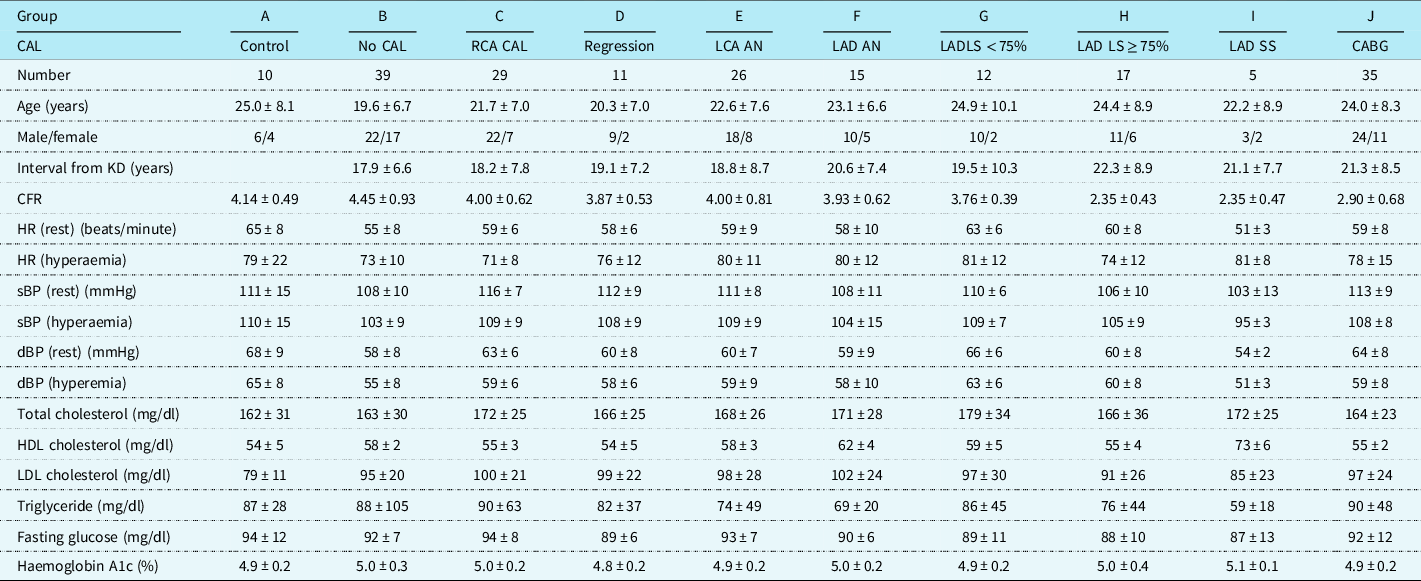
Measurements of the coronary artery flow reserve and other parameters in the respective groups.

AN, aneurysm; BP, blood pressure; CABG, coronary artery bypass grafting; CAL, coronary artery lesion; CFR, coronary flow velocity reserve; HDL, high density lipoprotein; HR, heart rate; KD, Kawasaki disease; LAD, left anterior descending artery; LCA, left coronary artery; LDL, low density lipoprotein; LS, localised stenosis; RCA, right coronary artery; SS, segmental stenosis.
Coronary flow velocity reserve
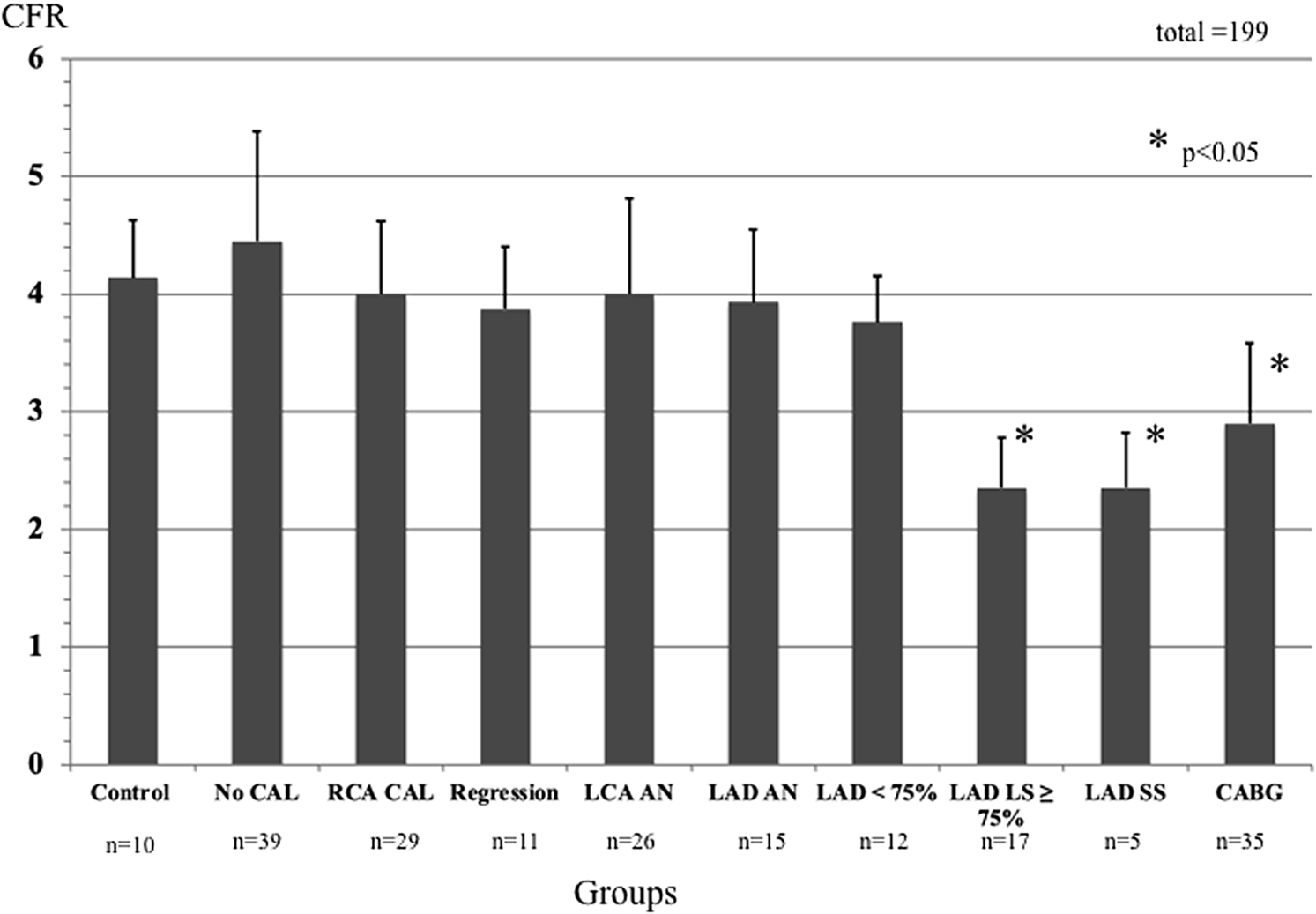
The mean coronary flow velocity reserve in each group is shown in Table 1 and Figure 2. The mean coronary flow velocity reserve ± standard deviation values in the respective groups were control (n = 10) 4.14 ± 0.49; no coronary artery lesions (n = 39) 4.45 ± 0.93; coronary artery lesions in the right coronary artery (n = 29) 4.00 ± 0.62; regression (n = 11) 3.87 ± 0.53; aneurysm of the left coronary artery (n = 26) 4.00 ± 0.81; aneurysm of the left anterior descending artery (n = 15) 3.93 ± 0.62; localised stenosis <75% (n = 12) 3.76 ± 0.39; localised stenosis ≥75% (n = 17) 2.35 ± 0.43; segmental stenosis (n = 5) 2.35 ± 0.47 and coronary artery bypass grafting (n = 35) 2.90 ± 0.68. The mean coronary flow velocity reserve was significantly lower in the localised stenosis ≥75%, segmental stenosis and coronary artery bypass grafting groups than in the other groups (all p < 0.05). The mean coronary flow velocity reserve was preserved in the other groups. There were no significant differences in the age and the respective parameters among the 10 groups.
Coronary artery flow reserve in the respective groups. The mean coronary artery flow reserve in the localised stenosis ≥75%, segmental stenosis and coronary artery grafting groups were significantly lower than in the other groups (p < 0.05). AN, aneurysm; CABG, coronary artery bypass grafting; CAL, coronary artery lesion; CFR, coronary flow velocity reserve; LAD, left anterior descending artery; LCA, left coronary artery; LS, localised stenosis, RCA, right coronary artery; SS, segmental stenosis.

Discussion
This study showed a decreased coronary flow velocity reserve of the left anterior descending artery in patients with localised stenosis ≥75% and segmental stenosis. The coronary flow velocity reserve was significantly decreased in the significant stenotic lesions. These values were very consistent with the previous results. Reference Gould, Lipscomb and Hamilton7 Therefore, the measurement of coronary flow velocity is useful to decide for indication of coronary artery bypass grafting. The competition native flow and graft flow after coronary artery bypass grafting is speculated. The competition native coronary artery flow can induce a string sign of the internal thoracic artery. Reference Tsuda, Fujita, Yagihara, Yamada, Echigo and Kitamura8 We think that the cut-off value for the indication of coronary artery bypass grafting is less than 2.0, which implies significant coronary stenosis. Reference Meimoun, Benali and Sayah9,Reference Fukazawa and Kobayashi10 The coronary flow velocity reserve evaluated by transthoracic Doppler echocardiography is noninvasive, convenient and useful. Reference Montisci, Ruscazio and Marchetti11
The coronary flow velocity reserve is also useful for evaluation after coronary artery bypass grafting. Reference Auriti, Loiaconi and Pristipino12 In this study, it significantly decreased compared with that in the other groups without any significant stenotic lesions. Although the coronary artery flow of the left anterior descending artery at rest was preserved in the patients with coronary artery bypass grafting, the coronary flow velocity reserve did not necessarily improve after coronary artery bypass grafting. Coronary artery bypass grafting does not improve the native coronary artery stenosis. It is another route from the systemic artery to provide myocardial perfusion. There were three factors regulating the coronary flow velocity reserve after coronary artery bypass grafting. One is the factor of limited vessel dilation due to native coronary artery wall thickening, because the remodeling of the coronary artery occurs after coronary artery dilatation. Reference Dionne, Ibrahim and Gebhard13 The second factor is the degree of myocardial involvement after a previous myocardial infarction. The degree of improvement of coronary flow velocity reserve depends on the degree of involvement of the myocardium. The third is the characteristics of the internal thoracic artery and the anastomosis of the graft. The vessel structure of the internal thoracic artery is different from that of the coronary artery. Further, it may also be related to stenosis of the anastomosis between the native artery and the internal thoracic artery. Therefore, the coronary flow velocity reserve after coronary artery bypass grafting may vary in each vessel of each patient with grafting.
On the other hand, the coronary flow velocity reserve was preserved in the other groups, not only in patients without aneurysms in the acute phase, but also in patients with aneurysms. We also reported previously that coronary artery dilatation exceeding 4.0 mm within 100 days after Kawasaki disease predicts a high probability of subsequent late intima-medial thickening more than 10 years after Kawasaki disease on intravascular ultrasound. Reference Tsuda, Kamiya, Kimura, Ono and Echigo14 There was no intimal thickening in the affected coronary arteries without coronary artery dilatation. These findings support the preserved coronary flow velocity reserve in patients with no coronary artery lesions after Kawasaki disease. The coronary flow velocity reserve was related to irreversibility of the coronary artery wall after Kawasaki disease. It is considered that these coronary arteries show morphological growth within normal ranges after Kawasaki disease. Furthermore, this study showed that their endothelial function was preserved. The characteristics of the delayed coronary flow and endothelial involvement of the coronary artery wall in giant aneurysms are well known, especially within 1 year after acute Kawasaki disease. Reference Tsuda, Fujita, Yagihara, Yamada, Echigo and Kitamura8 However, the coronary flow velocity reserve was not decreased in patients with aneurysms in the late period, not only in the left coronary aneurysm group, but also in the left anterior descending artery aneurysm group in the late period. Both a history of Kawasaki disease and dilated coronary artery lesions after Kawasaki disease do not affect the coronary flow velocity reserve significantly. In this study, most patients were young adults. How the coronary arteries, in addition to the atherosclerotic factors, change remains unknown. The endothelial function of coronary arteries is depending on age, and it decreases with ageing. We must continue to observe the changes with ageing in adults. Reference Vacca, Montisci, Garau, Siotto, Piga and Alberto15–Reference Fujiwara, Tamura and Yoshida17
Limitations
Although there was no significant difference among the groups without significant stenotic lesions in this study, the number in each group was small. Therefore, a further prospective study is needed to confirm the results of this study.
Conclusions
The coronary flow velocity reserve was reduced in patients with stenotic lesions, even if they had undergone coronary artery bypass grafting. The coronary flow velocity reserve was preserved in patients without significant stenotic lesions of the left anterior descending artery, even if they had aneurysms. The endothelial function in the epicoronary artery is preserved in the patients with a history of Kawasaki disease and dilated coronary artery lesions.
Supplementary material
To view supplementary material for this article, please visit https://doi.org/10.1017/S104795112100439X
Financial support
This research received no specific grant from any funding agency, commercial or not-for-profit sectors.
Conflicts of interest
None.
Ethical standards
All procedures performed in studies involving human participants were in accordance with the ethical standards of the institutional committee with the 1964 Helsinki declaration and its later amendments or comparable ethical standards.