INTRODUCTION
Climate change has been causing a shift in the geographical range of species (Parmesan & Yohe, Reference Parmesan and Yole2003) but the effect of sea-surface warming is still poorly understood in marine systems (Rivadeneira & Fernández, Reference Rivadeneira and Fernández2005). Nonetheless, some studies have been undertaken on the Portuguese coast to understand the effect of climate change in marine organisms such as rocky shore communities (Boaventura et al., Reference Boaventura, Ré, Fonseca and Hawkins2002) and macroalgae assemblages (Lima et al., Reference Lima, Ribeiro, Queiroz, Hawkins and Santos2007). Intertidal communities are particularly attractive systems to use as models to study changes at community level as they have a shorter life-span associated with their sessile adult stages (Southward et al., Reference Southward, Lanmead, Hardman-Mountford, Aiken, Boalch, Dando, Genner, Joint, Kendall, Halliday, Harris, Leaper, Mieszkowska, Pingree, Richardson, Sims, Smith, Walne and Hawkins2004) and live near their thermal (Helmuth et al., Reference Helmuth, Hartley, Halpin, O'Donell, Hoffmann and Blanchette2002) and haline (Borges, Reference Borges2007) tolerance limits.
An example of such a community is the intertidal wood boring community. This is a heterogeneous group that includes Crustacea of the orders Isopoda and Amphipoda and Bivalvia of the families Teredinidae and Pholadidae, which makes it possible to observe the effects of the same environmental conditions in very different organisms. Wood borers bore into wood not only for shelter but often also for nourishment. The bivalves live confined to their wood galleries and the crustaceans are poor swimmers, so marine borers are generally unable to avoid extremes of temperature and salinity during low tide (Borges, Reference Borges2007).
In Portugal maritime structures made of wood are rare and that is probably one of the reasons why wood borers have not been monitored on the Portuguese coast for the last 40 years. However, in the 1960s and early 1970s, researchers of the Laboratório Nacional de Engenharia Civil (LNEC) in Lisbon carried out long-term trials (15 year period) in the Tagus Estuary, to test several wood species for their resistance to wood boring organisms (e.g. Franco & Farinha, Reference Franco and Farinha1968; Franco, Reference Franco1975). The research aimed mainly at testing more durable wood species in order to find resistant wooden materials, which could be used in maritime construction. In addition, researchers from LNEC were also partners in a cooperative research programme among several European countries of the Organization for Economic Cooperation and Development (OECD), involving experts in wood preservation from 9 countries (Jones et al., Reference Jones, Kuhne, Trussell and Turner1972). The aim of this last programme was the identification and geographical distribution of wood boring and fouling organisms (Franco & Farinha, Reference Franco and Farinha1968). During these trials, important information was gathered concerning wood boring species occurring in the Tagus Estuary. At the time, the only teredinid species reported as occurring in the Tagus was Teredo navalis L. Limnoriids were also found in the Tagus but in very low numbers (Neves, Reference Neves1962; Franco, Reference Franco1968, Reference Franco1975; Franco & Farinha, Reference Franco and Farinha1968).
Recently, researchers at LNEC had access to wooden pillars which supported a platform structure and had been exposed for sixteen years in the Tagus Estuary. The pillars became unserviceable because of the great level of deterioration caused by wood boring organisms and, therefore, were removed and substituted by concrete pillars. The aim of this study was to identify the wood boring species which caused the deterioration of the pillars and of the wooden structure found in the ship wharf to compare with the data on these organisms obtained from the Tagus during the 1960s and 1970s. The comparison made it possible to evaluate the changes in the wood boring community in the area.
MATERIALS AND METHODS
Study area
Measurements at the Tagus over a number of years show that it is a well-mixed estuary where stratification occurs just in specific situations such as neap tides or after heavy rain. At Porto Brandão sea surface temperature ranges from 8 to 26°C while the salinity varies from ~33 to 36 psu.
Pillars from Porto Brandão
Three pillars of Eucalyptus sp. exposed in Porto Brandão (Figure 1) for a period of 16 years were examined at LNEC to assess the species of wood boring organisms present and the severity of their attack in the pillars.
(A) General view of the platform where wooden pillars were taken (low tide); (B) view of pillars showing severe limnoriid attack. a, supratidal; b, intertidal; c, subtidal. Note: in (B) the hourglass shape (top arrows) and pencil point shape (bottom arrow) typical of limnorrid attack.

On their arrival each pillar was divided in three areas according to their exposure—supratidal, intertidal and subtidal—to facilitate the determination of the severity of attack. Each area was inspected externally for signs of damage by limnoriids and internally for attack by teredinids. Limnoriid and teredinid specimens were extracted for identification. However, the lag between removal and examination meant that the soft bodies of teredinids were dried out or were lost, but shells and pallets were retained. Identification was based on the pallets found in the wood using the keys of Turner (Reference Turner, Jones and Eltringham1971) and the illustrations of Turner (Reference Turner1966). All limnoriids found were identified using the keys of Menzies (Reference Menzies1957) and the keys of Cookson (Reference Cookson1991).
Surveys at Porto Brandão
A field survey was conducted at a small ship wharf in Porto Brandão, nearby the platform where the pillars were taken (Figure 2).
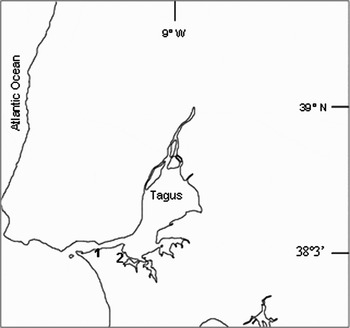
Location of test sites. (1) Porto Brandão; (2) Arsenal do Alfeite.

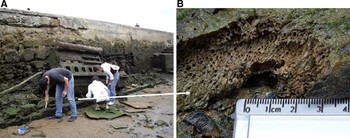
At the ship wharf a wooden structure attacked by wood borers was found and sampled (Figure 3).
Samples collected at Porto Brandão. (A) Wooden structure attacked by wood borers; (B) detail of a wood sample collected showing high severity of attack by limnoriids.

Field trials at Arsenal do Alfeite in the 1960s and 1970s
In 1960 LNEC researchers initiated a study on the attack of marine borers on 74 wood species including several species of Eucalyptus and several species of pine used as non-durable wood species (for details on the wood species see Machado & Nunes, Reference Machado and Nunes1991). Ten replicate test panels were cut per wood species with dimensions 15 × 5 × 5 cm. They were secured to a metal frame attached with cables to a pontoon in Arsenal do Alfeite. The frames were submerged 1 m below low water level, where attack by wood borers was most intense in previous trials. The total duration of these trials was 15 years. The panels were analysed at six-month intervals to determine the severity of attack. At each inspection, panels with their sections reduced to more than half were retrieved. The trial which was part of the cooperation programme was also carried out in Arsenal do Alfeite and involved the exposure of 24 test panels of Pinus sylvestrus L. cut to dimensions 20 × 10 × 2 cm. All test panels were provided by the Norwegian partner to insure homogeneity of test panels. Two panels were submerged every month for a period of 1 year and were retrieved after 8 weeks of exposure. Limnoriids and teredinids extracted from test panels from those trials were identified at LNEC and identifications were confirmed by expert partners in the cooperation programme.
In the present study, test panels of a number of wood species used in the trials in the 1960s and 1970s (e.g. Nesogordonia leplaei (Verm.) R. capuron; Gossweilerodendron balsamiferum Harms) from the LNEC collection were observed under a stereo microscope. Some remaining pallets and shells were found and, when possible, teredinid species were identified. The reports from those trials were also revised to get information on the wood boring species identified at the time.
RESULTS
Pillars from Porto Brandão
The pillars retrieved from Porto Brandão showed severe marine borer attack (Figure 1) on the intertidal and sub-tidal areas. Both areas were rated 4 for limnoriid attack and 3 to 4 for teredinid attack, according to the categories defined in British Standard EN 275 (1992).
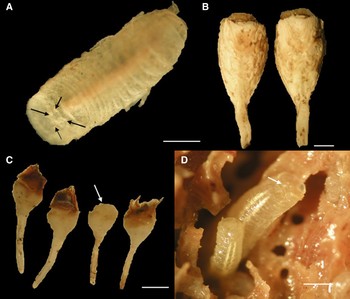
The intertidal area of the pillars, showed an hourglass shape (Figure 4B), while the subtidal area (Figure 4C), exposed above the mud line, had a characteristic pencil-point shape. These shapes are characteristic of Limnoria attack. Indeed, the specimens extracted were all Limnoria quadripunctata Holthuis (Figure 4A).
Wood boring organisms found in Porto Brandão. (A) Limnoria quadripunctata (preserved in ethanol) found in pillars from Porto Brandão. Notice the arrows pointing to the four characteristic punctae on the pleotelson. Scale bar = 0.5 mm; (B) pallets of Nototeredo norvagica found in pillars from Porto Brandão. Scale bar = 2 mm; (C) pallets of Lyrodus pedicellatus. Note that pallets are eroded and one is missing the periostracum (arrow). Scale bar = 1mm; (D) two live specimens of Limnoria tripunctata collected in a wooden structure at Porto Brandão. Note the three punctae in the pleotelson of one of the specimens (arrow). Scale bar = 1mm.

Attack by teredinids was also visible in central areas of the pillars, with some calcareous tubes protruding through the wood surface, due to the high destruction caused by limnoriids in the surface. Some tubes had a larger diameter and, in the majority of cases, were also longer. The smaller tubes were however more numerous. It was not possible to find complete specimens inside the tubes but several pallets were recovered. Pallets found in the larger tubes were identified as belonging to Nototeredo norvagica (Splenger) (Figure 4B) whereas pallets in smaller tubes were of Lyrodus pedicellatus (Quatrefages) (Figure 4B).
Survey at Porto Brandão
Wooden samples taken from the old ship wharf at Porto Brandão showed severe attack by Limnoria tripunctata Menzies (Figure 4D). Specimens of Chelura terebrans Philippi were also found associated with the tunnels of limnoriids.
In some areas there was also attack by teredinids as the calcareous linings were still present in the wood. However, it was not possible to identify the species as neither specimens nor pallets were found.
Wooden test panels from marine trials in the 1960s and 1970s
Most test panels were severely attacked by teredinids but some also showed light attack by limnoriids (e.g. Gossweilerodendron balsamiferum and Pinus sylvestris). There are references in the numerous reports produced, to Limnoria tripunctata and Teredo navalis (Franco, Reference Franco1968, Reference Franco1975; Franco & Farinha, Reference Franco and Farinha1968). In the cooperation study under the OECD, only the two species mentioned above were reported attacking the Scots pine panels.
The observation of the panels under the stereo microscope revealed some remaining pallets and even some dried specimens of Limnoria. Most pallets were of Teredo navalis but a few showed a shape more characteristic of Lyrodus pedicellatus. However the identification of the latter as L. pedicellatus is uncertain as the periostracum—an essential feature used on the identification of this species—had been lost. The intact features of the pleotelson of some dry limnoriids found in the old panels made it possible to identify them as Limnoria tripunctata confirming the identification in reports produced in the 1960s and identification by Neves & Gomes (Reference Neves and Gomes1956) and Neves (Reference Neves1962).
DISCUSSION AND CONCLUSIONS
The high severity of attack by limnoriids in the pillars from Porto Brandão (12 years of exposure), compared to that of teredinids (Figures 1 & 3B) shows a clear change in the activity of wood boring organisms in the Tagus Estuary. In the 1960s and 1970s the activity of limnoriids was not considered a threat to wooden structures exposed in the area (Franco, Reference Franco1962, Reference Franco1975). The severity of attack by Limnoria quadripunctata in the pillars retrieved from Porto Brandão, 4 according to the scale in British Standard EN275 (1992), was comparable to the severity of attack inflicted by L. tripunctata in the wooden structures found in the ship wharf (also 4). This confirms laboratory findings that deterioration by L. quadripunctata, when in optimum conditions of temperature and salinity, is as severe as that by Limnoria tripunctata (Cookson, Reference Cookson1990; Borges et al., Reference Borges, Cragg and Busch2009), which was considered to be the most destructive limnoriid species (Menzies, Reference Menzies1957).
The ship wharf and the platform where the pillars were retrieved are located nearby, so it seems that the two limnoriid species—L. quadripunctata and L. tripunctata—coexist in the area, similarly to what was observed in Southampton waters, UK by Eltringham & Hockley (Reference Eltringham and Hockley1958). Chelura terebrans was found associated with Limnoria tripunctata in the wood collected at the ship wharf and although this species has been established as a wood borer (Barnard, Reference Barnard1955), there is no information reporting it as a threat for wooden structures in marine environments (Cragg & Daniel, Reference Cragg and Daniel1992). From the results of the present study, it is not possible to ascertain whether the deterioration observed was also caused by C. terebrans.
To find Limnoria quadripunctata in the Tagus Estuary was unexpected, as this area is out of the known range of distribution of the species in Europe. Since the species was found on coasts of The Netherlands and described by Holthuis (Reference Holthuis1949), it was only reported in Europe along the coasts of Britain (Hockley & Eltringham, Reference Hockley and Eltringham1958; Jones, Reference Jones1963; Hall & Saunders, Reference Hall and Saunders1967; Borges, Reference Borges2007) and at Trieste, Italy (Menzies & Becker, Reference Menzies and Becker1957). However, the specific status of the L. quadripunctata in the Mediterranean is uncertain (Cookson, Reference Cookson1990; Borges, unpublished data) so it is not clear if there is continuity in the distribution of the species from Northern Europe to the Mediterranean.
The absence of L. quadripunctata in the Tagus in the 1960s might be due to the limited capability of dispersion of these organisms (Cragg et al., Reference Cragg, Pitman and Henderson1999) as they lack a planktonic larval stage and migration takes place mainly by seasonal swimming between pieces of wood located at short distance from one another (Johnson & Menzies, Reference Johnson and Menzies1956). However, it is also possible, that the range of temperature, and salinity in the Tagus in the 1960s were not favourable to the settlement of this species in the area. Indeed both salinity and temperature are key factors in determining geographical distribution (Cragg et al., Reference Cragg, Pitman and Henderson1999) and activity (Borges et al., Reference Borges, Cragg, Bergot, Williams, Shayler and Sawyer2008, Reference Borges, Cragg and Busch2009) of limnoriids. In the last 50 years sea surface temperature in the Tagus has suffered an average increase of 0.016°C per year, which has been attributed to climate change (Lima et al., Reference Lima, Ribeiro, Queiroz, Hawkins and Santos2007). The actual temperatures registered in the study area (8 to 26°C) are probably more favourable both to L. quadripuncta and to L. tripunctata which have their optimum range of temperatures between 15 and 25°C (Borges et al., Reference Borges, Cragg and Busch2009) and 10 to 35°C (Eltringham, Reference Eltringham1965), respectively.
The salinity in the Tagus has also increased. The increase in salinity is probably the result of a combination of factors such as less precipitation in Southern Europe in later years (Eisenreich, Reference Eisenreich2005), higher evaporation due to warmer waters, and increase in human activity in the Tagus Estuary, with an increase in the use of water for a range of activities such as industry and agriculture (Fernandes et al., Reference Fernandes, Elliott and Da Silva1995). The increased salinity in the Tagus (actual range 33 to 36 psu) was probably the most important factor contributing to the establishment of L. quadripunctata and for a higher activity of L. tripunctata at Porto Brandão, as limnoriids appear to be restricted to waters with salinity close to that of seawater (Cragg et al., Reference Cragg, Pitman and Henderson1999).
In the 1960s reports, the only teredinid species reported in the Tagus was Teredo navalis (Franco, Reference Franco1968; Franco & Farinha, Reference Franco and Farinha1968) therefore its complete absence in the area in the present study was unexpected. The actual range of temperature and salinity at the study area are well within the range tolerated by this species, –1.5 to 30.7°C and 10 to 39 psu respectively (Borges, unpublished data), therefore it is not probable that the changes in the temperature and salinity can explain the absence of this species in the area. Competition with other wood boring species such as Lyrodus pedicellatus might be a more probable explanation for the absence of T. navalis. In the European survey carried out by Borges (Reference Borges2007) it was observed that L. pedicellatus was the dominant species in all the sites where it occurred with T. navalis, which might be related with life history strategies of the two species. The larvae of L. pedicellatus settle in the wood 24–48 hours after being released while the larvae of T. navalis remain in the plankton for about a month (Turner, Reference Turner1966). Thus the larvae of T. navalis might be more exposed to adverse environmental conditions and predators.
In a historical review concerning wood borers in European waters, L. pedicellatus was reported to occur in the British Isles (e.g. Lebour, Reference Lebour1946; Morton, Reference Morton1970), Algarve, the south of Portugal (Brown, Reference Brown1998; Praël, Reference Praël2003) and the south of Turkey, Mediterranean Sea (Bobat, Reference Bobat1995) but did not seem to be a very active species in European coastal waters. However, in later years L. pedicellatus is the most destructive teredinid in southernmost waters as far north as the English Channel (Borges, Reference Borges2007). In the Tagus Estuary, the increase in movement of ships might have played an important role in the introduction of larvae of L. pedicellatus in the area, as ballast water has long been recognized as a vector for the introduction of alien species (Carlton, Reference Carlton1999). It is also possible that the increase in sea surface temperature (Lima et al., Reference Lima, Ribeiro, Queiroz, Hawkins and Santos2007) has favoured the establishment of this species in the Tagus Estuary. Adult L. pedicellatus have been observed surviving at temperatures as low as 4.7°C (Borges, unpublished data), however larvae cannot survive below 10°C (Eckelbarger & Reish, Reference Eckelbarger and Reish1972) and do not settle below 13°C (Coe, Reference Coe1941).
Salinity is also a major factor affecting the activity of L. pedicellatus, the minimum salinity registered for this species was 33 psu (Borges, unpublished data) thus it seems that the increase in salinity in the Tagus Estuary might have also benefited the activity of this species. The increase of sea surface temperature and salinity has also been shown to have caused changes in the fish community (Cabral et al., Reference Cabral, Costa and Salgado2001) and algae assemblages (Lima et al., Reference Lima, Ribeiro, Queiroz, Hawkins and Santos2007) in the Tagus.
Specimens of Nototeredo norvagica present in the pillars were outnumbered by specimens of Lyrodus pedicellatus; however, the large dimensions which the first attained were the cause of the extensive teredinid damage observed in the inner layers of the pillars. The relative low number of specimens of N. norvagica found in the pillars might be related to the predominant occurrence of this species at greater depths (Nair, Reference Nair1959). Indeed the species has been found at depths of 700 m (Roch, Reference Roch1940) and even 944 m off the north coast of Scotland (Turner, Reference Turner1966). This species has been reported surviving in temperatures ranging from 2 to 30°C and salinity of 13 to 39 psu (Borges, unpublished data), therefore, it is not probable that the range of temperature and of salinity in the Tagus were limiting factors.
ACKNOWLEDGEMENTS
We would like to thank the International Research Group on Wood Protection for funding the Short Scientific Mission in Lisbon of the senior author. The financial assistance provided by the Project INTERREG IIIB Espaço Atlântico No. 197—MEDACHS is also acknowledged. The senior author wishes also to thank Dr Machado for his help during the period of her visit to LNEC. The manuscript benefited from constructive comments from anonymous referees.