1. Introduction
Contemporary Bayesian confirmation theory is based on the notion of probabilistic relevance. A common way to analyze the concept is to devise a function  $c( h,\,e) $ assuming a positive value iff
 $\mathrm{Pr}\,( h\vert e) > \mathrm{Pr}\,( h) $, value zero iff
 $\mathrm{Pr}\,( h\vert e) =\mathrm{Pr}\,( h) $, and a negative value iff
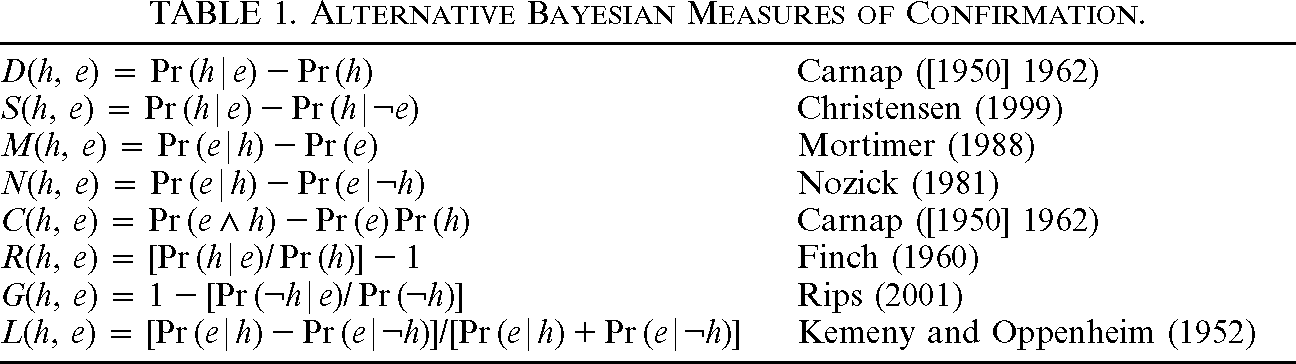
 $\mathrm{Pr}\,( h\vert e) < \mathrm{Pr}\,( h) $.Footnote 1 There are infinite such functions, and quite a few of them have been proposed and seriously discussed as candidate measures of degrees of confirmation (Festa Reference Festa, Galavotti and Pagnini1999; Fitelson Reference Fitelson1999). Consider the list in Table 1. It provides a representative sample, for most of the Bayesian confirmation measures in the literature are ordinally equivalent to some measure appearing in the list.Footnote 2 (As shown in Crupi, Tentori, and Gonzalez Reference Crupi, Tentori and Gonzalez2007, 231, there is also no pair of ordinally equivalent measures within the list.) Indeed, the large majority of contemporary Bayesian philosophers of science seem to have subscribed to the following thesis:
(1) The appropriate formalization  $c( h,\,e) $ of the notion of confirmation (or possibly a set of appropriate formalizations) is included (among measures ordinally equivalent to those) in Table 1.Footnote 3

 $D( h,\,e) =\mathrm{Pr}\,( h\vert e) -\mathrm{Pr}\,( h) $ |
Carnap (Reference Carnap[1950] 1962) |
 $S( h,\,e) =\mathrm{Pr}\,( h\vert e) -\mathrm{Pr}\,( h\vert \neg e) $ |
Christensen (Reference Christensen1999) |
 $M( h,\,e) =\mathrm{Pr}\,( e\vert h) -\mathrm{Pr}\,( e) $ |
Mortimer (Reference Mortimer1988) |
 $N( h,\,e) =\mathrm{Pr}\,( e\vert h) -\mathrm{Pr}\,( e\vert \neg h) $ |
Nozick (Reference Nozick1981) |
 $C( h,\,e) =\mathrm{Pr}\,( e\wedge h) -\mathrm{Pr}\,( e) \mathrm{Pr}\,( h) $ |
Carnap (Reference Carnap[1950] 1962) |
 $R( h,\,e) =[ \mathrm{Pr}\,( h\vert e) /\mathrm{Pr}\,( h) ] -1$ |
Finch (Reference Finch1960) |
 $G( h,\,e) =1-[ \mathrm{Pr}\,( \neg h\vert e) /\mathrm{Pr}\,( \neg h) ] $ |
Rips (Reference Rips2001) |
 $L( h,\,e) =[ \mathrm{Pr}\,( e\vert h) -\mathrm{Pr}\,( e\vert \neg h) ] /[ \mathrm{Pr}\,( e\vert h) +\mathrm{Pr}\,( e\vert \neg h) ] $ |
Kemeny and Oppenheim (Reference Kemeny and Oppenheim1952) |
Bayesian approaches to confirmation instantiating thesis (1) have been said to solve or accommodate a variety of traditional puzzles in epistemology and philosophy of science (see Earman Reference Earman1992, 63–86; Fitelson Reference Fitelson1999) including the so-called problem of irrelevant conjunction, to which we will now turn.
2. Irrelevant Conjunction: The Standard Bayesian Line
The so-called problem of irrelevant conjunction involves the consequences of conjoining irrelevant statements, say x, to a hypothesis h that is confirmed by some piece of evidence e. Fitelson (Reference Fitelson2002) effectively drew attention to the need that the kind of “irrelevance” at issue be clarified in order to properly state and address the problem. Within a Bayesian framework, Fitelson's original proposal was to call statement x a (confirmationally) irrelevant conjunct to hypothesis h with regard to evidence e just in case x is probabilistically independent from both h and e as well as from  $h\wedge e$. Such a treatment has been further refined by Hawthorne and Fitelson (Reference Hawthorne and Fitelson2004) providing a definition based on the weaker clause that x does not add anything to h as to how confidently e is expected to occur, that is,
 $\mathrm{Pr}\,( e\vert h) =\mathrm{Pr}\,( e\vert h\wedge x) $.Footnote 4 In terms of the latter proposal, one might usefully illustrate the problem of irrelevant conjunction by a hypothetical conversation such as the following.
Dr. Cheap: Oh, I heard that your hypothesis h has been significantly confirmed by the successful observation of the empirical prediction e.
Dr. Hardwork: Did you? Well, that has been a very challenging piece of work, of which I’m very proud indeed.
Dr. Cheap: Sure! … By the way, you probably know that in my own field of research I happen to advocate hypothesis x. It turns out that e is expected assuming h as much as assuming the conjunction of h and x.
Dr. Hardwork: I see. Well, yes, I guess that conjoining x to h would hardly make any difference concerning e.
Dr. Cheap: So, apparently, the conjunction of h and x is equally confirmed by your data as h is.
Dr. Hardwork: Wait a minute, I don’t quite agree with that … .
Dr. Cheap: How come?
Dr. Hardwork: It seems to me that, in order to claim the same amount of positive support from e to a more committal theory “h and x” as from e to h alone, well, at the very least adding x should contribute by raising further how strongly e is expected assuming h by itself. Otherwise, what would be the specific relevance of x? Indefinitely many other statements could then be conjoined that don’t make any difference as to the evidence obtained e, and still the confirmatory impact would remain the same across all such nonsense conjunctive hypotheses!
Dr. Cheap: Uh-uh. … Well, indeed, I was about to mention another hypothesis of mine, y. Guess what? I checked out and, look, e is expected assuming h as much as assuming h and x along with y. So, you see, your data confirm them all conjoined together just as much as your h alone. Impressive, isn’t it?
Dr. Hardwork: … .
The fictitious scenario is meant to make vivid the intuitive background of usual discussions of the problem as applied to confirmation theory. Roughly, we would like a satisfactory account of confirmation to line up with Dr. Hardwork and against Dr. Cheap.Footnote 5 That's because Dr. Cheap's hypotheses x and y are irrelevant conjuncts to h (with regard to e): they seem to have been merely “tacked on” to it in the hope of exploiting the confirmatory impact of e on h at no cost whatsoever. The Bayesian problem of irrelevant conjunction is that, for any Bayesian confirmation measure, if e confirms h, then e also confirms  $h\wedge x$, even if x is a confirmationally irrelevant conjunct (to h with regard to e)Footnote 6—which seems to speak in favor of Dr. Cheap's line of argument. According to Hawthorne and Fitelson (Reference Hawthorne and Fitelson2004), the Bayesian strategy to fix things amounts to the following thesis:
(2) If e has a positive confirmatory impact on h and x is a confirmationally irrelevant conjunct to h with regard to e, then e will have the same kind of impact (namely, positive) on  $h\wedge x$ but to a minor extent. Formally, if
 $c( h,\,e) > 0$ and
 $\mathrm{Pr}\,( e\vert h) =\mathrm{Pr}\,( e\vert h\wedge x) $, then
 $c( h,\,e) > c( h\wedge x,\,e) > 0$.
The good news is that (2), which effectively counters Dr. Cheap's tricks, is consistent with the Bayesian core thesis (1) above. Even better, in order to actually have (2) as a theorem of Bayesian confirmation theory, we need to rule out only a couple of candidate measures, as it can be shown that (2) is a consequence of the following modification of (1):Footnote 7
(1*) The appropriate formalization  $c( h,\,e) $ of the notion of confirmation (or possibly a set of appropriate formalizations) is included (among measures ordinally equivalent to those) in Table 1, except for measures
 $R( h,\,e) $ and
 $M( h,\,e) $.
According to a line of thought including Earman (Reference Earman1992, 64–65), Rosenkrantz (Reference Rosenkrantz1994, 470–471), and Fitelson (Reference Fitelson2002) up to Hawthorne and Fitelson (Reference Hawthorne and Fitelson2004) themselves, a result of this kind provides a standard Bayesian solution to the problem of irrelevant conjunction.Footnote 8
3. Troubles with Disconfirmation
The following hypothetical conversation illustrates a further twist of the irrelevant conjunction issue that, oddly enough, seems to have completely escaped attention so far.
Dr. Hardwork: I happened to hear that evidence e has been observed, which significantly disconfirms your hypothesis h. Sorry about that.
Dr. Cheap: Yes, well, that's not so serious after all. Did I tell you about my further hypothesis x?
Dr. Hardwork: Um, no … .
Dr. Cheap: Look, it so happens that evidence e disconfirms the conjunction of h and x less severely than h alone.
Dr. Hardwork: Oh, I see. … Surely this must be because e is less unexpected assuming both h and x than assuming h alone, right?
Dr. Cheap: Actually no. Evidence e is equally unexpected in both cases.
Dr. Hardwork: But wait a minute, that doesn’t quite make sense to me. …
Dr. Cheap: How come?
Dr. Hardwork: It seems to me that, in order to claim a milder negative impact from e to a more committal theory “h and x” than from e to h alone, well, at the very least adding x should contribute by reducing how strongly e is unexpected assuming h by itself. Otherwise, what would be the specific relevance of x? Indefinitely many other statements could then be conjoined that don’t make any difference as to the evidence obtained e, and the disconfirmatory impact would lessen gradually down to negligible levels!
Dr. Cheap: Uh-uh. … Well, that's indeed the case with another hypothesis of mine, y, which I was about to mention. In fact, it turns out that e disconfirms the conjunction of h and x along with y even less than “h and x” itself. Impressive, isn’t it?
Dr. Hardwork: … .
If you find this exchange even more troublesome than the previous one and Dr. Cheap's claims even more outlandish, that presumably is because of the intuitive appeal of the following thesis:
(3) If e has a nonpositive (negative or null) confirmatory impact on h and x is a confirmationally irrelevant conjunct to h with regard to e, then e will have the same kind of impact (namely, negative or null) on  $h\wedge x$ and not to a minor extent. Formally, if
 $c( h,\,e) \leq 0$ and
 $\mathrm{Pr}\,( e\vert h) =\mathrm{Pr}\,( e\vert h\wedge x) $, then
 $c( h\wedge x,\,e) \leq c( h,\,e) \leq 0$.
But then a puzzling situation arises, for the following is demonstrably the case (see the Appendix for a proof):
Theorem 1. The conjunction of (1), (2), and (3) is inconsistent.
Before worrying about Theorem 1, one might want to check out how robust the problem is. So let us point out first that no restriction of the list of candidate measures—such as the shift from (1) to (1*) above—can provide any relief: if (2) and (3) are inconsistent with (1), they will be so with any logically stronger claim indicating whatever subset from Table 1. Second, the inconsistency is notably not sensitive to Hawthorne and Fitelson's (Reference Hawthorne and Fitelson2004) specific definition of irrelevant conjunct as compared to Fitelson's (Reference Fitelson2002) original one. Should the latter be adopted, one would have (2) and (3) modified accordingly, and a statement that strictly parallels Theorem 1 would still hold.
4. A Measure-Sensitive Solution
We see Theorem 1 above as pointing to a novel and genuinely paradoxical twist in the irrelevant conjunction issue. As usual with a philosophical paradox, it can be handled by dropping any of the assumptions that appear individually appealing but are demonstrably incompatible when taken together. Here we will indicate one possible solution, which also happens to be the one we favor. In the following paragraph, consideration of a major alternative approach will prompt further discussion of the issue.
One way to handle the problem posed by Theorem 1 is to drop thesis 1 and opt for the following instead:
(4) The appropriate formalization  $c( h,\,e) $ of the notion of confirmation amounts toFootnote 9

Thesis (4) is not only consistent with the intuitively appealing principles (2) and (3), it actually implies both of them (see the Appendix for a proof):
Theorem 2. (4) implies both (2) and (3).
The consequences of Theorem 2 are easily worked out with regard to our fictitious scenarios above. As for our first dialogue, with evidence e confirming Dr. Hardwork's hypothesis h, it can be shown that measure  $Z( h,\,e) $ counters Dr. Cheap's argument by implying that for irrelevant hypotheses x and y,

so that degrees of confirmation are not exploited for free. As for the second dialogue, moreover, with evidence e disconfirming Dr. Cheap's hypothesis h, measure  $Z( h,\,e) $ again demonstrably counters Dr. Cheap's argument by implying that for irrelevant hypotheses x and y,

so that degrees of disconfirmation are not gotten rid of for free. (Interestingly, each of the measures in Table 1 accomplishes one of these two results, but none of them accomplishes both. See the Appendix, proof of Theorem 1, in this respect.)
Importantly,  $Z( h,\,e) $ has not been construed as a Bayesian confirmation measure in order to yield (2) and (3). Instead, it has been recently advocated on very different grounds (see Crupi et al. Reference Crupi, Tentori and Gonzalez2007). Moreover, despite its twofold algebraic form, it also conveys a unifying core intuition based on the notion of relative reduction of uncertainty (see Crupi, Festa, and Buttasi Reference Crupi, Festa, Buttasi, Suárez, Dorato and Rèdei2010).Footnote 10 In fact, in case of confirmation,
 $Z( h,\,e) $ expresses the relative reduction of the initial distance from certainty that h is true as provided by evidence e; that is, it measures how far upward the posterior
 $\mathrm{Pr}\,( h\vert e) $ has gone in covering the distance between the prior
 $\mathrm{Pr}\,( h) $ and 1. Analogously, in case of disconfirmation,
 $Z( h,\,e) $ reflects the relative reduction of the initial distance from certainty that h is false as provided by evidence e; that is, it measures how far downward the posterior
 $\mathrm{Pr}\,( h\vert e) $ has gone in covering the distance between the prior
 $\mathrm{Pr}\,( h) $ and 0.
It should also be pointed out that  $Z( h,\,e) $ demonstrably shares with more traditional competing confirmation measures a number of independently desirable properties. Here are some major examples (again from Crupi et al. Reference Crupi, Tentori and Gonzalez2007, 234):
(i) If  $p( h\vert e_{1}) > p( h\vert e_{2}) $, then
 $Z( h,\,e_{1}) > Z( h,\,e_{2}) $ (a property involved in the Bayesian solution of the “ravens paradox” provided by Horwich Reference Horwich1982).
(ii) If  $h_{1}\vDash e$,
 $h_{2}\vDash e$, and
 $p( h_{1}) > p( h_{2}) $, then
 $Z( h_{1},\,e) > Z( h_{2},\,e) $ (a property involved in the Bayesian solution of the “grue paradox” provided by Sober Reference Sober and Stalker1994).
(iii) If  $p( e\vert h_{1}) > ( e\vert h_{2}) $ and
 $p( e\vert \neg h_{1}) < ( e\vert \neg h_{2}) $, then
 $Z( h_{1},\,e) > Z( h_{2},\,e) $ (a principle known as “weak law of likelihood” or “weak likelihood principle,” which “must be an integral part of any account of evidential relevance that deserves the title ‘Bayesian’” according to Joyce Reference Joyce2004).
The above remarks show that  $Z( h,\,e) $ represents a credible theoretical option on independent grounds. To this extent, it seems to us of particular interest that it provides a natural solution to our extended version of the irrelevant conjunction problem.
5. Discussing a Major Alternative
As both theses (1) and (2) are deeply entrenched among Bayesian theorists, a second critical look at thesis (3) might be a very tempting alternative to our own proposed solution above. In this connection, the following candidate principle concerning Bayesian confirmation and the irrelevant conjunction problem is likely to come to mind (Branden Fitelson, personal communication):
(5) If x is a confirmationally irrelevant conjunct to h with regard to e, then  $\vert c( h\wedge x,\,e) \vert \leq \vert c( h,\,e) \vert $.
Endorsing (5) as it stands, however, does not provide a solution to the extended paradox of irrelevant conjunction. The reason is that, by allowing equalities, (5) is logically consistent with all theses (1), (2), and (3). Indeed, it amounts to a very weak condition that is demonstrably satisfied by all confirmation measures in Table 1 and by  $Z( h,\,e) $ as well. In order to actually handle the paradox, one has to turn to the following stronger claim:
(5*) If x is a confirmationally irrelevant conjunct to h with regard to e, then  $\vert c( h\wedge x,\,e) \vert < \vert c( h,\,e) \vert $.
Informally, (5*) states that adding more and more irrelevant conjuncts to h has the effect of “diluting the confirmational power” of evidence e regarding h—that is, the absolute value of  $c( h,\,e) $—be it either confirmatory or disconfirmatory evidence. Logically, (5*) implies (2), while being consistent with (1) but not with (3). So, formally, one can handle the extended paradox of irrelevant conjunction by endorsing (5*) and dropping (3) ([2] would then become redundant). As (4) implies both (2) and (3), (5*) is also inconsistent with (4). Indeed, for our present purposes, the crucial point is the choice between the adoption of (4)—that is, our proposed solution of the paradox—and that of (5*).
Of course, if one accepts (5*), then one also has to concede that Dr. Cheap's argument in our second dialogue is actually sound: it becomes perfectly legitimate to indefinitely decrease the disconfirmatory impact of e on h by adding to the latter any sort of irrelevant conjunct x, y, … . As long as (5*) holds, quantitative Bayesian theories of confirmation simply cannot prevent that and must bite the bullet. But there is a further independent reason that we see as pushing the balance of arguments in favor of (4) and against (5*). By presenting this latter point, we will be led to our conclusions.
Consider the following condition:
(6)  $c( h,\,e) $ is maximal (minimal) when e logically implies (refutes) h.
Condition (6) (termed “logicality” in Fitelson Reference Fitelson2006, 502) has a rather long history in confirmation theory and inductive logic (see, e.g., Kemeny and Oppenheim Reference Kemeny and Oppenheim1952, 309), as it naturally stems from the highly influential overarching view of confirmation theory as a quantitative extension and refinement of classical deductive logic. We ourselves find (6) compelling, as its violation is known to give rise to simple unpalatable counterexamples (see, e.g., Fitelson Reference Fitelson2007, 476–477; Tentori et al. Reference Tentori, Crupi, Bonini and Osherson2007, 109). It is then of considerable interest to notice that the acceptance of (6) unequivocally favors (4) against (5*), for it is easy to show that (see the Appendix for a proof)
Theorem 3. (6) is implied by (4) but is inconsistent with (5*).
6. Conclusion
To sum up, our novel (extended) paradox of irrelevant conjunction amounts to a simple and previously unnoticed mathematical fact, that is, Theorem 1. Our second result, Theorem 2, proves that there exists a nontrivial way to handle the paradox, by which the principles that degrees of confirmation are not exploited for free (that is, thesis [2]) and that degrees of disconfirmation are not gotten rid of for free (that is, thesis [3]) are both preserved. The solution of a philosophical paradox, of course, is typically a matter of theoretical desiderata and can seldom be settled by conclusive argument. A further formal result (Theorem 3), however, provides independent support to our proposed solution as compared to a major alternative.
Appendix: Proofs
Recall statements (1)–(4), (5*), and (6):
(1) The appropriate formalization  $c( h,\,e) $ of the notion of confirmation (or possibly a set of appropriate formalizations) is included (among measures ordinally equivalent to those) in Table 1.
(2) If  $c( h,\,e) > 0$ and
 $\mathrm{Pr}\,( e\vert h) =\mathrm{Pr}\,( e\vert h\wedge x) $, then
 $c( h,\,e) > c( h\wedge x,\,e) > 0$.
(3) If  $c( h,\,e) \leq 0$ and
 $\mathrm{Pr}\,( e\vert h) =\mathrm{Pr}\,( e\vert h\wedge x) $, then
 $c( h\wedge x,\,e) \leq c( h,\,e) \leq 0$.
(4) The appropriate formalization  $c( h,\,e) $ of the notion of confirmation amounts to

(5*) If x is a confirmationally irrelevant conjunct to h with regard to e, then  $\vert c( h\wedge x,\,e) \vert < \vert c( h,\,e) \vert $.
(6)  $c( h,\,e) $ is maximal (minimal) when e logically implies (refutes) h.
Theorem 1. The conjunction of (1), (2), and (3) is inconsistent.
Proof. We will prove the theorem by showing that, for any measure in Table 1, it violates either (2) or (3). (Just as Hawthorne and Fitelson Reference Hawthorne and Fitelson2004, we will also need to assume throughout that  $\mathrm{Pr}\,( h) > \mathrm{Pr}\,( h\wedge x) > 0$; see note 7.)
Assume  $\mathrm{Pr}\,( e\vert h) =\mathrm{Pr}\,( e\vert h\wedge x) $. Then, for any e, h, and x,

Hence measures R and M both violate (2).
Now assume  $\mathrm{Pr}\,( e\vert h) =\mathrm{Pr}\,( e\vert h\wedge x) $ and
 $c( h,\,e) < 0$. Then we have

Since both sides are negative, it follows that

Hence measure N violates (3). It also follows that

Hence measure C violates (3). Furthermore,

Hence measure D violates (3). Furthermore,

Hence measure S violates (3). Furthermore,

Hence measure G violates (3).
Finally, we already noticed (see note 2) that measures R, G, and L are ordinally equivalent to, respectively,

It also easy to show that

By ordinal equivalence,  $R( h,\,e) =R( h\wedge x,\,e) $ implies
 $R^{*}( h,\,e) =R^{*}( h\wedge x,\,e) $ and
 $G( h,\,e) < G( h\wedge x,\,e) $ implies
 $G^{*}( h,\,e) < G^{*}( h\wedge x,\,e) $. Then we have
 $L^{*}( h,\,e) < L^{*}( h\wedge x,\,e) $ (except in the case
 $\mathrm{Pr}\,( h\vert e) =0$), and again by ordinal equivalence,

Hence measure L violates (3). This completes the proof of Theorem 1.
Theorem 2. (4) implies both (2) and (3).
Proof. Assume  $\mathrm{Pr}\,( e\vert h) =\mathrm{Pr}\,( e\vert h\wedge x) $ and
 $c( h,\,e) > 0$. Then we have

Hence measure Z fulfills (2).
Then assume  $\mathrm{Pr}\,( e\vert h) =\mathrm{Pr}\,( e\vert h\wedge x) $ and
 $c( h,\,e) \leq 0$, thus having

Hence measure Z fulfills (3).
Theorem 3. (6) is implied by (4) but is inconsistent with (5*).
Proof. Simple algebraic considerations, along with probability theory, show that  $Z( h,\,e) $ ranges in [−1, +1]. If
 $e\vDash h$, then
 $\mathrm{Pr}\,( h\vert e) =1$, so that

Moreover, if  $e\vDash \neg h$, then
 $\mathrm{Pr}\,( h\vert e) =0$, so that

This proves that (4) implies (6).
Then suppose that  $e\vDash \neg h$. If so,
 $\mathrm{Pr}\,( e\vert h) =0=\mathrm{Pr}\,( e\vert h\wedge x) $ for any x, so any x is a confirmationally irrelevant conjunct to h with regard to e. Also, by logic,
 $e\vDash \neg ( h\wedge x) $. Thus, (6) implies
 $c( h,\,e) =c( h\wedge x,\,e) $, whereas (5*) implies
 $c( h,\,e) < c( h\wedge x,\,e) $. This proves that (5*) and (6) are inconsistent.