INTRODUCTION
Bereavement has long been acknowledged as one of life's most stressful experiences (Holmes & Rahe, Reference Holmes and Rahe1967; Stroebe et al., Reference Stroebe, Schut and Stroebe2007), with family caregivers prone to a range of physical and psychological problems and health outcomes (Grov et al., Reference Grov, Dahl and Moum2005; Girgis et al., Reference Girgis, Johnson and Currow2006; Hudson, Reference Hudson2006; Lobb et al., Reference Lobb, Kristjanson and Aoun2010; Hudson et al., Reference Hudson, Thomas and Trauer2011). Studies have shown that bereavement and bereavement-related grief increase the risk of mortality (Stroebe & Stroebe, Reference Stroebe, Stroebe and Stroebe1993; Bowling, Reference Bowling1994; Hart et al., Reference Hart, Hole and Lawlor2007; Buckley et al., Reference Buckley, Sunari and Marshall2012), and they have also been linked to depression, anxiety, insomnia, cognitive function, and work and relationship difficulties (Grov et al., Reference Grov, Dahl and Moum2005; Hardison et. al., Reference Hardison, Neimeyer and Lichstein2005). Bereaved individuals may experience a loss of identity, a change in their roles and responsibilities within the family, and/or social isolation (Aoun et al., Reference Aoun, Kristjanson and Currow2005; Stoltz et al., Reference Stoltz, Uden and Willman2004). Given the links between bereavement, health, and quality of life more broadly (Rebollo et al., Reference Rebollo, Alonso and Ramon2005), the presence of bereavement support services within health settings, particularly palliative care, is unsurprising (Forte et al., Reference Forte, Hill and Pazder2004). Yet, research within and outside of Australia has indicated both a lack of uptake of formal bereavement services among family caregivers and the lack of a sufficient evidence base upon which to develop policy and practice (Hudson, Reference Hudson2006; Abbott et al., Reference Abbott, O'Connor and Payne2008; Mather et al., Reference Mather, Good and Cavenagh2008; Breen, Reference Breen2012). While a range of guidelines for bereavement support services has been developed in Australia (Hall et al., Reference Hall, Hudson and Boughey2012; Hudson et al., Reference Hudson, Remedios and Zordan2010a; Reference Hudson, Remedios and Zordan2012) and internationally (Kerslake et al., Reference Kerslake, Chaplin and Hartley2014; Tol et al., Reference Tol, Barbui and Bisson2014), a growing body of work has highlighted the challenges for bereavement support services in accessing caregivers who have been assessed as being in need of support, including difficulties maintaining contact following the patient's death and subsequent underutilization of support services by the bereaved (Cherlin et al., Reference Cherlin, Barry and Prigerson2007; Lichtenthal et al., Reference Lichtenthal, Nilsson and Kissane2011; Breen et al., Reference Breen, Aoun and O'Connor2014; Aoun et al., Reference Aoun, Breen and Howting2015). Little is known about why bereaved family caregivers choose not to engage with support services (Cherlin et al., Reference Cherlin, Barry and Prigerson2007). At the same time, there have been calls for qualitative studies that explore the kinds of support and types of services desired and valued as helpful by bereaved family caregivers (Jordan & Neimeyer, Reference Jordan and Neimeyer2003; Diamond et al, Reference Diamond, Llewelyn and Relf2012). In this paper, we use the term “family caregiver” to describe any kin or non-kin relative, friend, or person with a significant relationship to the deceased person who provided support or assistance as the patient approached the end of life (Hudson & Payne, Reference Hudson, Payne, Hudson and Payne2009). Our aim was to systematically examine family caregivers' accounts of their bereavement experiences using qualitative interviews, including their views on and interactions (or, alternatively, lack of interaction) with palliative care bereavement support services.
Palliative Care and Bereavement Support
Within palliative care, the family is considered to be the unit of care (World Health Organization, 2002; Aoun et al., Reference Aoun, Kristjanson and Currow2005; Hudson et al., Reference Hudson, Remedios and Zordan2012). Such a focus on improving quality of life for the patient and their family includes preparing for death and postdeath support/follow-up (Steinhauser et al., Reference Steinhauser, Clipp and McNeilly2000; Hudson et al., Reference Hudson, Remedios and Zordan2012). Provision of bereavement support is considered to be standard within palliative care (Abbott et al., Reference Abbott, O'Connor and Payne2008; Mather et al., Reference Mather, Good and Cavenagh2008), yet it is also acknowledged to be the least-developed facet of Australian palliative care services, as indeed it is in comparative contexts internationally (Payne, Reference Payne2001; Agnew et al., Reference Agnew, Manktelow and Taylor2010; Breen et al., Reference Breen, Aoun and O'Connor2014; Sealey et al., Reference Sealey, Breen and O'Connor2015). In addition, the evidence base to guide practice and program development is lacking, arguably resulting, in the Australian context at least, in variability in terms of the support services offered across and between palliative care centers (Mather et al., Reference Mather, Good and Cavenagh2008; Breen et al., Reference Breen, Aoun and O'Connor2014). Bereavement support in palliative care units in Australia is coordinated by a range of health professionals, including nurses, social workers, pastoral care workers, and volunteers (Mather et al., Reference Mather, Good and Cavenagh2008). The types of support vary but commonly include follow-up phone calls, home visits, memorial services, counseling, provision of information/resources, and referral to other support agencies (Mather et al., Reference Mather, Good and Cavenagh2008). Less is known about the extent to which bereavement care engages family caregivers, the forms of support desired or required by family caregivers, or how such care is experienced. Indeed, previous studies have noted the need for further research, especially qualitative studies, in order to further our understanding of family caregivers' experiences of bereavement and to improve service provision for patients and families (Diamond et al., Reference Diamond, Llewelyn and Relf2012, Forte et al., Reference Forte, Hill and Pazder2004; Mather et al., Reference Mather, Good and Cavenagh2008; Breen et al., Reference Breen, Aoun and O'Connor2014; Sealey et al., Reference Sealey, Breen and O'Connor2015).
Family Caregivers and Bereavement
Although bereavement is a stressful life experience, the majority of individuals will manage with the support of family, friends, and their community (Stroebe et al., Reference Stroebe, Schut and Stroebe2007). However, research has revealed that a substantial number of family caregivers require support. One study found that around half of bereaved family members expressed a need for bereavement follow-up (Milberg et al., Reference Milberg, Olsson and Jakobsson2008), and others have estimated that 10–20% of family caregivers experience ongoing and significant psychiatric distress as a result of their loss (Lobb et al., Reference Lobb, Kristjanson and Aoun2010; Prigerson et al., Reference Prigerson, Maciejewski and Reynolds1995; Aoun et al., Reference Aoun, Breen and Howting2015). While some researchers have argued for caution against medicalizing or pathologizing “normal” grief experiences (Friedman, Reference Friedman2012; Bandini, Reference Bandini2015), it is clear that for some proportion of family caregivers bereavement will present complex and variable challenges that call for support or intervention from health and social care professionals (Milberg et al., Reference Milberg, Olsson and Jakobsson2008; Hudson & Breen, Reference Hudson, Payne, Hudson and Payne2009; Breen, Reference Breen2012). In addition, family caregivers may experience a considerable burden of care approaching the end of life (Aoun et al., Reference Aoun, Kristjanson and Currow2005), resulting in emotional suffering (Stoltz et al., Reference Stoltz, Uden and Willman2004) and difficulties associated with identity and role transitions (namely, from caregiver to bereaved). While family caregivers experiencing bereavement-related difficulties are likely to benefit from targeted interventions, they are also less prone to seek out supportive services (Currier et al., Reference Currier, Neimeyer and Berman2008; Lichtenthal et al., Reference Lichtenthal, Nilsson and Kissane2011; Sealey et al., Reference Sealey, Breen and O'Connor2015). Bereavement may be a key time during which to offer support to family caregivers given that two of the barriers to service uptake have now ended: the time-consuming activities of providing care (Colombo et al., Reference Colombo, Llena-Nozal and Mercier2011) and the reticence among family caregivers to discuss their own need for support in front of their relatives (Hudson, Reference Hudson2013). Thus, there is a clear need for potentially vulnerable family caregivers to be identified by bereavement support services.
Assessing Bereavement and Support Needs for Family Caregivers
A key problem for bereavement support services lies in the character of the bereavement experience. Bereavement is often experienced privately, as a personal or individual process that can be shaped by various and ongoing emotions or circumstances (Milberg et al., Reference Milberg, Olsson and Jakobsson2008; Sealey et al., Reference Sealey, Breen and O'Connor2015). Grieving privately, at home, can compound social isolation, and it is difficult for health services to gauge (Hudson, Reference Hudson2006; Agnew et al., Reference Agnew, Manktelow and Haynes2011). In this way, pre-bereavement risk assessment or care planning can be effective when staff have face-to-face contact with family caregivers (Sealey et al., Reference Sealey, Breen and O'Connor2015). While a range of bereavement risk-assessment tools have been developed (Forte et al., Reference Forte, Hill and Pazder2004; Currier et al., Reference Currier, Neimeyer and Berman2008; Sealey et al., Reference Sealey, Breen and O'Connor2015), the implementation of such tools within Australian palliative care settings is uneven (Mather et al., Reference Mather, Good and Cavenagh2008; Aoun et al., Reference Aoun, Breen and Howting2015; Sealey et al., Reference Sealey, Breen and O'Connor2015). Moreover, research has highlighted the challenges involved in measuring or assessing the likelihood of a family caregiver needing (or benefitting) from support services (Milberg et al., Reference Milberg, Olsson and Jakobsson2008; Hudson et al., Reference Hudson, Trauer and Graham2010b; Agnew et al., Reference Agnew, Manktelow and Haynes2011; Aoun et al., Reference Aoun, Breen and Howting2015). It is difficult to predict who will need support services, when or at which point they will need support, or indeed how and when offers of support are most likely to be accepted (Milberg et al., Reference Milberg, Olsson and Jakobsson2008; Hudson et al., Reference Hudson, Trauer and Graham2010b; Agnew et al., Reference Agnew, Manktelow and Haynes2011; Breen et al., Reference Breen, Aoun and O'Connor2014; Aoun et al., Reference Aoun, Breen and Howting2015). The experiences of bereaved caregivers thus need to be systematically examined in order to provide a more comprehensive understanding of the factors that may shape engagement with bereavement support services.
METHODS
In this paper, we report on one aspect of a broader study designed to explore a range of experiences of patients and caregivers to and through palliative care (MacArtney et al., Reference MacArtney, Broom and Kirby2015a; Reference MacArtney, Broom and Kirby2015b; Reference MacArtney, Broom and Kirby2016; Broom et al., Reference Broom, Kirby and Kenny2016). Given the sensitivity of the research, face-to-face interviews were chosen as a feasible and effective method for documenting experiences of care at the end of life (Steinhauser & Barroso, Reference Steinhauser and Barroso2009; Broom & Kirby, Reference Broom and Kirby2013; MacArtney et al., Reference MacArtney, Broom and Kirby2015a; Reference MacArtney, Broom and Kirby2015b; Reference MacArtney, Broom and Kirby2016; Broom et al., Reference Broom, Kirby and Kenny2016). Focusing on experiences of bereavement, we drew on semistructured interviews conducted with 15 bereaved Australian family caregivers of patients (average patient age = 84 years) cared for at a specialist palliative care unit in Queensland, Australia. The unit offers a “patient and family support service,” consisting of social workers, nurses, pastoral care personnel, and counselors, offering the following support: information cards/brochures, follow-up phone calls, individual counseling (within the hospital or at home), group counseling, memorial services, assistance with burial/cremation arrangements (when applications for funding to support costs are needed), and referral to psychological/psychiatric services, both prior to and following the person's death. After we obtained both university and hospital ethics approval, caregivers (pre-bereavement) were approached by their treating clinician, who explained the study aims and methods. The researchers then contacted family caregivers to confirm their participation, arranged an initial interview, and obtained formal written consent. From the original family caregivers interviewed (n = 67), 48 volunteered to be contacted for a follow-up interview 3–9 months later. We were later able to contact 21 of the caregivers, 2 of whom had moved away from the region, and 4 of whom declined to be interviewed. These postdeath interviews were conducted most often in participants' homes and focused on the experiences of the transition from palliative care to the experience of the postdeath/bereavement period and reflections on formal and informal support offered, accepted/declined, and received. These interviews lasted between 20 and 60 minutes, were digitally recorded, and transcribed verbatim in full.
Analysis
Data analysis took place during the qualitative fieldwork from July of 2013 to October of 2014 and was revisited over 5 months in 2016. We employed the framework approach of qualitative data analysis, utilizing NVivo 11 software, which involves the following steps: (1) familiarization—the researchers reviewed the transcripts; (2) identification of framework—key themes were identified around which the data were organized; (3) indexing—application of themes to text; (4) charting—use of headings and subheadings to build up a picture of the data as a whole; and (5) mapping and interpretation–in which associations were clarified and explanations worked toward (Pope et al., Reference Pope, Ziebland, Mays, Pope and Mays2006). Three research team members independently coded the data, and these separate analyses were then crosschecked to uncover related and/or deviant cases/themes, and to develop an overall interpretation of the data. Once a theme was identified in the transcripts, interviews were searched for related comments using constant comparison in order to further develop themes (Ezzy, Reference Ezzy2002). In this way, the richness of the data was retained, while interrelated events could be mapped. Analytical rigor was augmented by constant comparison and searching for negative cases during code and theme development (Fitzpatrick & Boulton, Reference Fitzpatrick and Boulton1996; Pope et al., Reference Pope, Ziebland, Mays, Pope and Mays2006).
RESULTS
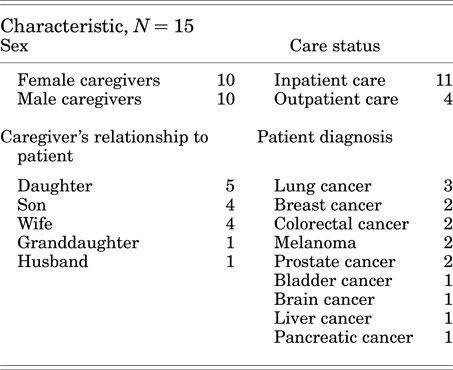
A summary of participants' characteristics is presented in Table 1. Some 13 participants recalled offers of bereavement support, and 11 declined. Here we report on the emergent themes from our systematic analysis of the interviews (see Table 2). It was clear from the interviews that some caregivers felt more “in need” of support than others. Indeed, the meaning and character of support varied across the participant group. Despite these variations, our analysis revealed four predominant themes: (1) sociocultural constructions of the character of bereavement support; (2) the perceived limited scope of bereavement support services; (3) the “personal” experience of bereavement; and (4) timing and approaches to providing support.
Participant characteristics

Summary of emergent themes

“I'm a capable person”: Sociocultural Constructions of Bereavement Support
The caregivers we interviewed provided detailed accounts of their understanding of formalized bereavement support, in terms of both the services offered by the palliative care center and the idea of bereavement support more broadly. That is, such support was understood by the majority of participants as synonymous with counseling or “talking to someone.” Moreover, counseling was associated by the majority of participants with being only for the weak or socially isolated. While all participants acknowledged the potential for postdeath counseling to be useful or therapeutic, it was described predominately as being for people who were not coping and were “falling apart.” This theme was particularly prevalent among the (adult) children of the deceased (as opposed to spousal or other family caregivers). As the indicative quotations in Table 3 show, several participants felt that counseling was unnecessary for them as they were “strong,” “capable,” or “able to cope.” Some participants felt that counseling would be more appropriate for those without family, as the absence of family members with whom to talk and grieve may result in needing to talk to a professional. However, other participants stressed the personal nature of their grief, suggesting that bereavement was something to process “on your own.”
Indicative quotations (“I'm a capable person”) and sociocultural constructions of bereavement support

The (Perceived) Scope of Bereavement Support
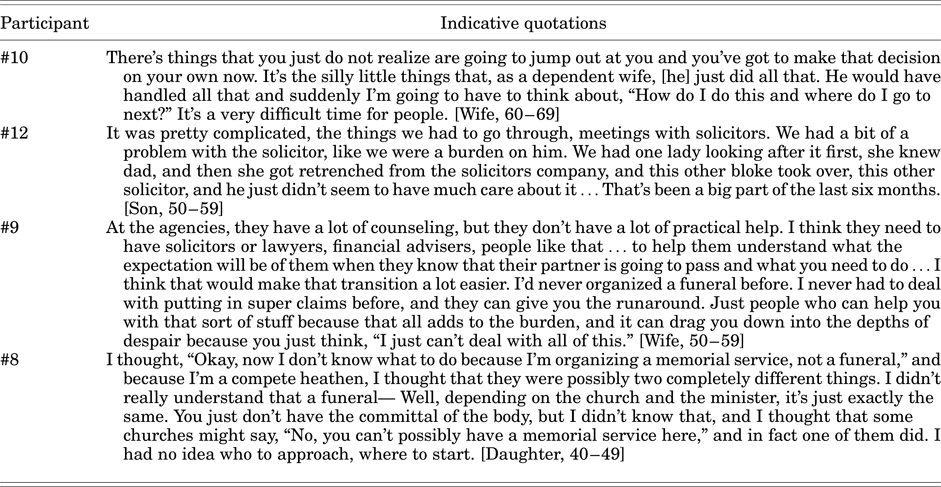
Another predominant theme within the interviews was the perceived limited scope of bereavement support—that is, the notion that bereavement support focuses on the psychosocial aspects of bereavement rather than such practical aspects as organizing funerals or developing new skills/roles formerly handled by the deceased person. Our analysis revealed a clear demand for postdeath assistance with practical tasks, and we heard frequent accounts from participants around “not knowing what to do” or how to complete the various bureaucratic, financial, and organizational tasks associated with death. As the indicative quotations in Table 4 demonstrate, the months immediately following bereavement were usually dominated by a range of decisions and tasks that family caregivers did not necessarily feel prepared to complete. Yet, the majority of participants did not feel that the hospital bereavement support included such assistance. Furthermore, and as shown in Table 4, participants directly linked their ability to cope more broadly with their ability to manage the required practical tasks. Most participants talked about the emotional stress and strain experienced as a result of their unfamiliarity with various practical, legal, or financial processes at such a difficult time. Indeed, we heard frequent accounts of such practical difficulties serving to compound emotional distress, grief, and loss.
Indicative quotations: the (perceived) scope of bereavement support

The “Personal” Experience of Bereavement
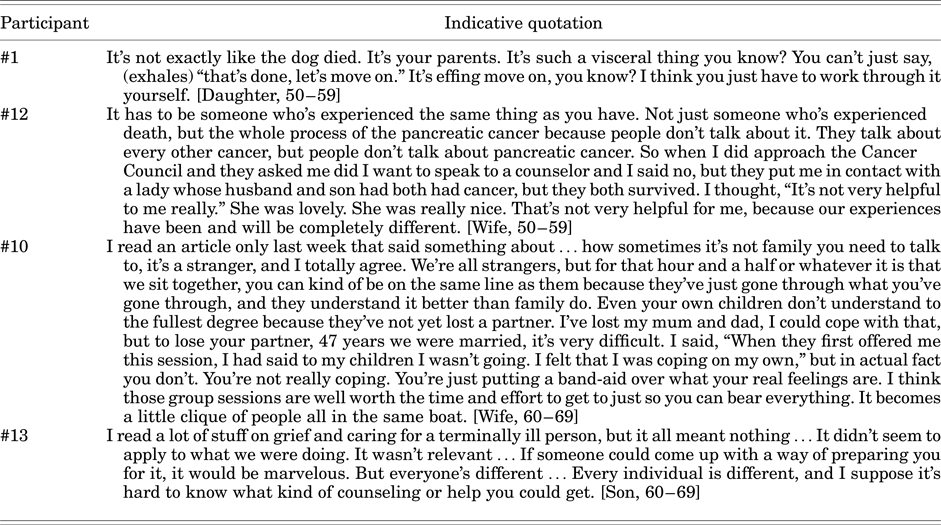
The third theme to emerge from our analysis was the view among participants that the bereavement experience was personal, individual, and unique. For these participants, the specificities of cancer experience, tumor type, and relationship to the deceased served as points of differentiation that mitigated against anyone else being able to “understand what they were going through.” Comments like “everyone is different” and that “it's different for every individual” were frequently expressed (see Table 5). This presumed uniqueness of the bereavement experience was a persistent barrier to bereavement support uptake among participants. That is to say, participants talked about finding it difficult to see the potential benefit of bereavement support, as every circumstance was different. We did hear occasional counternarratives. For example, one participant recounted the benefit of interacting with others she considered to be “in the same boat.” Importantly, though, she too expressed initial hesitance to participate in a group session because she considered her coping to be personal and individual. Overall, the analysis identified a tendency toward understanding bereavement as an individualized experience. Such views were inextricably linked to the ways by which support was offered or approached and the timing of such offers of support, as we discuss below.
Indicative quotations: The personal “experience of bereavement”

Stereotypical Grief, Untimely Help and Delayed Recognition: Timing and Approaches to Providing Support
The question of when a person would be “ready” to talk, think, or begin to process their grief and loss was central to participants' accounts of their bereavement experience. While some participants talked about coping well, others said that they were still struggling months later. Indeed, we saw a continuum of coping relative to time. In other words, at similar durations of weeks or months postdeath there was little to no consistency across participants in terms of coping, managing the deceased's affairs, and associated stresses or strains. This raises questions about when it is best to approach family caregivers with offers of bereavement support services, how best to approach them, and when to avoid approaching them, so as to avoid alienating those in need. Our analysis also revealed how individuals' experiences of bereavement and general hesitance about formal support services is colored by widely shared social assumptions and stereotypes about grieving—namely, that bereavement is private and necessarily entails feelings of sadness and loss. Participants were reluctant to publicly air their feelings and were similarly hesitant to express sentiments that might not resonate with stereotypical grieving. In other words, some participants felt relief or release at the death of a family member but questioned the acceptability of expressing such feelings. The quotations in Table 6 highlight the need for sensitivity in terms of family dynamics and context and a flexibility of approach in offering bereavement support services.
Indicative quotations: Stereotypical grief, untimely help, and delayed recognition; timing and approaches to providing support

DISCUSSION
The findings presented here provide timely insight into the lived experience of bereavement and support. It is important to note here that during the interviews we heard very positive accounts of the quality of bereavement support, both in terms of offers and experiences of support from the palliative care service. It is not our intention in this paper to question the quality or effectiveness of the support offered by formal services. Rather, we hope that our findings will be helpful for health professionals to better understand experiences of support from the perspective of the family caregivers themselves.
Accounts of bereavement as personal, along with ideas of being “strong willed” or (emotionally) “stronger than others,” highlight individualized forms of resistance to, or avoidance of, pathologizing discourses (Bandini, Reference Bandini2015). Acknowledging participants' desires for practical support (other than pscyhotherapeutic interventions), we argue, better locates our finding of the need for support outside of concerns about the pathologization of grief. Bereaved family caregivers face manifold challenges beyond grief and loss. Several participants talked about the financial stress they faced (or were facing) due to care-related costs and, for some, ceasing employment in order to fulfill the caregiver role. Participants often expressed a desire for assistance in areas such as funerals and estate planning and legal/financial matters, as they were particularly burdensome tasks to be performed in the weeks and months following bereavement (Steinhauser et al., Reference Steinhauser, Clipp and McNeilly2000). This insight offers support to Grande et al. (Reference Grande, Farquhar and Barclay2004), whose randomized controlled trial of the impact of a hospice at home program in the United Kingdom on bereavement outcome found poorer early bereavement experiences among caregivers who felt they were offered inadequate practical support. The intensity of these logistical requirements early on in the bereavement period raises the question of when to approach bereaved family caregivers with offers of support. For these participants, the days following bereavement were talked about as being incredibly busy, filled with practical tasks. As such, participants were “too busy” to think about how they were coping and thus not well placed to engage with the idea of accepting psychological or emotional bereavement support.
This study has several highlights that may be relevant for practice. Previous Australian research has shown that bereavement follow-up occurs within 2 weeks in around 70% of centers (Mather et al., Reference Mather, Good and Cavenagh2008). However, our findings support the suggested guidelines for supporting family caregivers (Hudson et al., Reference Hudson, Remedios and Zordan2012) by establishing contact at around 1 month postdeath, and again at about 6 months postdeath. We suggest that family caregivers may be more likely to accept support if follow-up—particularly offers of counseling or group sessions—occurs after these periods. Our findings also highlight the importance of bereavement support as a transitional process (Field et al., Reference Field, Payne and Relf2007), where family caregivers will likely benefit from (1) assistance in preparing for and carrying out practical tasks, (2) ongoing support that begins before bereavement (Roulston et al., Reference Roulston, Campbell and Cairnduff2016) and extends further into the bereavement period, and (3) better communication around the character and scope of bereavement services, including referral to or collaboration with other agencies. Health professionals should also be mindful about the language and tone they employ when offering bereavement support. Family caregivers may be experiencing mixed emotions, particularly in the context of family discord or dysfunction, where terms such as “loved one” may alienate caregivers potentially in need of support.
Finally, our findings highlight a tension between the sociocultural construction of bereavement support, as for the weak or socially isolated, and participants' concurrent desire for practical assistance with the logistical tasks following the death of a relative. Our findings suggest that a productive way out of this tension may be the expanded use of bereavement volunteers in developing a community capacity to provide bereavement “assistance” (see Diamond et al., Reference Diamond, Llewelyn and Relf2012; Field et al., Reference Field, Payne and Relf2007, Breen et al., Reference Breen, Aoun and O'Connor2014). As Breen et al. (Reference Breen, Aoun and Rumbold2017, p. 5) have noted, “while most bereaved people do not require professional counseling, all would benefit from appropriate information and compassion.”
LIMITATIONS AND STRENGTHS OF THE STUDY
Our study has various limitations. Our sample of 15 caregivers, while appropriate in size for a qualitative study, only captures the experiences of family caregivers of people with cancer, at one moment in time, at different points in the months postdeath, and in one hospital palliative care unit. As such, despite providing indications of themes and theoretical insights likely to resonate across other contexts, our findings cannot be generalized to other settings. However, we argue that the significant rapport built with participants' pre-bereavement resulted in highly valuable and rich data in an area of research that is widely acknowledged to be difficult to access (Stroebe & Stroebe, Reference Stroebe and Stroebe1990; Payne & Field, Reference Payne and Field2004). Further research focused on the experiences of bereavement support beyond cancer and among caregivers from culturally and linguistically diverse backgrounds is needed to improve service provision.
The findings presented herein add to the growing body of research focused on improving bereavement support in palliative care (Hudson & Payne, Reference Hudson, Payne, Hudson and Payne2009; Breen, Reference Breen2012; Breen et al., Reference Breen, Aoun and O'Connor2014; Aoun et al., Reference Aoun, Breen and Howting2015). Bereavement support services may be perceived as limited to counseling or group therapy, potentially concealing the various other forms of support and resources offered. In turn, counseling may be deemed as being only for the weak or socially isolated, or only appropriate for those who have lost loved ones, limiting the potential of bereavement support to assist family caregivers in need. In summary, our findings highlight the need for diversity in support services and the importance of continuity of care throughout the bereavement experience. Further qualitative and/or intervention-based research focused on the practice of bereavement support programs run by palliative care services is needed to better understand caregiver needs and to continue to develop and deliver effective supportive services in Australia.
ACKNOWLEDGMENTS
The authors gratefully acknowledge the interviewed participants and the financial support of the Australian Research Council (nos. LP120200268 and DE150100285)