1 Introduction
In much linguistic and phonetic research, intonational meaning is thought of as post-lexical (typically ‘sentence-level’), pragmaticFootnote 1 meaning conveyed through suprasegmental properties of speech, e.g. upholding ‘sentence type’ or speech act distinctions (Ladd Reference Ladd2008). One typical assumption in this type of research is that in any occurrence of a given contour (or ‘tune’), there will be some invariant component of the linguistic ‘message’, however abstract or generic, that is ascribable to the contour. There are different views as to whether contours are composed of smaller meaning-bearing units or not: some researchers treat contours as taking on meaning rather holistically (Delattre Reference Delattre1966, Liberman & Sag Reference Liberman, Sag, La Galy, Fox and Bruck1974, Cruttenden Reference Cruttenden1997, Marandin Reference Marandin2006), whereas others treat them as composed of individual tones which contribute, as meaning-bearing components, to the meaning of the contour (Pierrehumbert & Hirschberg Reference Pierrehumbert, Hirschberg, Cohen, Morgan and Pollack1990, Bartels Reference Bartels1999, Portes & Beyssade Reference Portes and Beyssade2015). Regardless of the view on meaning compositionality, however, the majority of influential phonetic and phonological research appears to be working with the idea that contours convey an invariant layer of meaning that applies across utterances, rather independently of the verbal material and discourse context; as a representative example from French, see Ladd (Reference Ladd2008: 120) on the suspended-fall contour. Ladd (Reference Ladd2008: 147) also notes that arguments concerning intonational meaning are often drawn upon as evidence for arguments about the phonological analysis of intonational forms; while this sort of procedure is relatively straightforward when lexical minimal pairs are contrasted, it is a more intricate task to decide which pragmatic contrasts are demonstrably real and relevant to interactants themselves. Generally, the treatment of intonational meaning as a source of evidence (rather than a domain of inquiry in its own right) suggests that intonational meaning has come to be a less than central concern in phonetic-phonological research (which focusses on forms and their underlying representations). This article considers, on the basis of evidence from detailed analysis of talk-in-interaction, to what extent intonation categories (here exemplified by an intonation contour in French) can be analysed as having invariant meanings, independently of the talk with which they co-occur.
2 Background
2.1 Meaning and context in intonation research
Intonational meaning has been approached from numerous angles. One objective pursued in language descriptions aligned with the tradition of intonational phonology is to define ‘default’ contours for given sentence types (such as declaratives, exclamatives, imperatives, wh-questions, polar questions and vocatives); for recent examples of such work with relevance for Romance languages including French, see Frota & Prieto (Reference Frota and Prieto2015). While the focus in work such as the chapters in Frota & Prieto (Reference Frota and Prieto2015) is primarily on which prosodic form an utterance typically takes, other studies pursue the question of how the choice between available intonation contours distinguishes between potential meanings of an utterance: as indicated further below, different approaches to intonation have dealt with meaning distinctions in different ways, exploring meaning of various kinds (see references below), but recurrently, the intonational meaning is construed as a context-independent contribution, in the form of a basic or core meaning. It is generally acknowledged that these basic meanings take on more specific nuances in particular contexts (Ladd Reference Ladd2008: 41; see also Cruttenden Reference Cruttenden1997: 89–90), but the very concept of a basic meaning implies that there is some degree of common, invariant meaning inherent to the contour, excluding the possibility that the same contour may have entirely unrelated functions in different contexts of use. For instance, Pierrehumbert & Hirschberg (Reference Pierrehumbert, Hirschberg, Cohen, Morgan and Pollack1990: 285) posit that although the interpretation of individual utterances instantiating a given tune will vary (due to differences in paralinguistic prosody and non-prosodic features including context), any instance of a given tune type will convey the same basic intonational meaning, independently of the propositional content (i.e. the verbal material).
A well-known example of research linking an intonation contour and attitudinal meaning is the study by Ward & Hirschberg (Reference Ward and Hirschberg1985) of the fall–rise contour in English, which is found to indicate uncertainty of the speaker as to whether their utterance is relevant to the discourse. Ward & Hirschberg (Reference Ward and Hirschberg1985) make some observations about the distribution of the contour: many instances occur as indirect answers to polar questions. However, there is little discussion of the verbal composition (including the lexico-grammatical design) of the utterance carrying the fall–rise contour, and how that may matter for the pragmatic meaning. Furthermore, the description of the intonational meaning focusses on how the individual utterance is produced and interpreted, and the contextual embeddedness of the meaning is not fully investigated empirically. While based on a corpus of authentic examples, these were noted ‘on the fly’ rather than drawn from recordings, which necessarily restricts the level of detail available for scrutiny, and which may also have introduced both inaccuracies and what might be termed ‘conspicuousness bias’. In addition, discourse contexts are reduced to a single preceding utterance, and some of these contexts (and sometimes also the target utterances) are invented. (In the follow-up perception study (Hirschberg & Ward Reference Hirschberg and Ward1992), only constructed utterances and contexts are used.) These methodological choices seem to reflect expectations of discourse context and verbal properties of the talk as ultimately having a marginal role in the attribution of meaning to intonation, and this is also explicitly stated: intonation is found to make ‘an independent contribution to utterance interpretation, . . . not dependent upon any particular lexical item(s) for its interpretation’ (Ward & Hirschberg Reference Ward and Hirschberg1985: 773). The ongoing interest in intonation as expressing attitudinal or affective meaning is also manifested in more recent studies conducted in various theoretical perspectives (including Grabe et al. Reference Grabe, Gussenhoven, Haan, Marsi and Post1997, Gussenhoven Reference Gussenhoven2004, Kohler Reference Kohler, Fant, Fujisaki, Cao and Xu2004; see also Chen & Boves, this issue). Other studies take a different approach to pragmatic meaning, focussing not on attitudinal or affective meaning but on belief status and attributions of beliefs (Pierrehumbert & Hirschberg Reference Pierrehumbert, Hirschberg, Cohen, Morgan and Pollack1990, Hirschberg & Ward Reference Hirschberg and Ward1995, Grice & Savino Reference Grice and Savino2003, Wichmann Reference Wichmann2005); these also include work with particular reference to French (Beyssade & Marandin Reference Beyssade, Marandin and Denis2006, Portes et al. Reference Portes, Beyssade, Michelas, Marandin and Champagne-Lavau2014). Aspects of this research focus are also taken up in a number of studies (see e.g. Grice & Savino Reference Grice and Savino2003, Armstrong Reference Armstrong, Prieto and Roseano2010, Vanrell et al. Reference Vanrell, Mascaró, Torres-Tamarit and Prieto2013, Armstrong & Prieto Reference Armstrong and Prieto2015) that have related intonation contours, not least in Romance languages, specifically to speakers’ certainty about the propositional content. These studies could also be subsumed under the notion of belief status or attribution. In my view, while these approaches frame intonational meaning in very different terms – variously related to attitudes, affect, (mutual) beliefs, or speakers’ intentions of some kind – they all tend to constrain that meaning to cognitive or emotional attributes of speakers, whereas much of the pragmatic work of intonation could perhaps be more rigorously accounted for in terms of its procedural relevance for the social interaction (between multiple participants) of which it is an integral part.
Quite apart from the abovementioned types of pragmatic meaning of intonation patterns, a whole other strand of research relates intonation to various aspects of information structure (Lambrecht Reference Lambrecht1994), including issues of focus (see e.g. Gussenhoven Reference Gussenhoven1983, Terken & Hirschberg Reference Terken and Hirschberg1994, Swerts, Krahmer & Avesani Reference Swerts, Krahmer and Avesani2002, Beyssade et al. Reference Beyssade, Delais-Roussarie, Doetjes, Marandin, Rialland, Corblin and de Swart2003, Steedman Reference Steedman, Lee, Gordon and Büring2008). Some aspects of intonational meaning have also been accounted for in terms of Gricean pragmatics, as a form of conversational or conventional implicatures (Hirschberg Reference Hirschberg2002). Furthermore, there are also investigations of the potential of intonation contours to convey pragmatic meaning framed as speech act distinctions (e.g. Sag & Liberman Reference Sag, Liberman, Grossman, James and Vance1975, Geluykens Reference Geluykens1987, Haan Reference Haan2001, Torreira & Valtersson Reference Torreira and Valtersson2015). While there are notable difficulties with extending categories of speech act theory to naturally occurring talk-in-interaction (see Levinson Reference Levinson1983: Chapter 6; Schegloff Reference Schegloff1988), there can be little doubt that intonation contours convey meanings that are of a pragmatic rather than semantic nature, which means that a serious engagement with context is called for.
The potential importance of context for intonational meaning is certainly not a novel or even recent idea; for instance, Cutler (Reference Cutler, Beach, Fox and Philosoph1977) explored this possibility by considering a range of intuited utterances and altering their imagined contexts, thus inducing changes in pragmatic meaning. Recently, there have also been experimental studies (e.g. Armstrong & Prieto Reference Armstrong and Prieto2015) where context is operationalised as invented ‘scenarios’ that precede target utterances. These lines of research as well as others (see Prieto Reference Prieto2015) recognise the context-dependence of intonational meaning, but at least from an interactional linguistic point of view, the way in which ‘context’ has been handled leaves something to be desired. The interactional linguistic approach taken in the present paper offers one principled way of handling ‘context’, by moving beyond imagined and invented scenarios, to dealing with naturally occurring talk and its embeddedness in real-world contexts and sequences, where intonation takes on meaning not in isolation, but through the complex interplay of prosodic, verbal and contextual factors. Essentially, the pragmatic import of intonation contours is likely to be conditioned by sequential context, i.e. the immediately preceding talk and other conduct, as well as by the action import of the utterance that carries the intonation (which in turn will hinge on the lexis and grammar, to a great extent). A contextually sensitive treatment of intonation will involve taking all these factors into account. In this perspective, one way to begin to understand the pragmatic meanings of intonation is through detailed investigation of instances of clearly delineated phenomena of talk-in-interaction. (In what follows, pragmatic meaning is thus taken to be the pragmatic ‘work’ that the intonation does, i.e. the intonational contribution to the action conveyed by the turn-at-talk.) Some essential elements of the interactional linguistic method for such investigations are given further below (see Section 3).
2.2 The F_ToBI framework and accentuation in French
The French language is well-known for its obligatory accentuation on the last full syllable of phrases, whether it be called final accent (Mertens Reference Mertens, Blanche-Benveniste, Bilger, Rouget and van den Eynde1990, Di Cristo & Hirst Reference Di Cristo and Hirst1993), primary accent (Di Cristo Reference Di Cristo2000; Jun & Fougeron Reference Jun, Fougeron and Botinis2000, Reference Jun and Fougeron2002), internal accent (Rossi Reference Rossi1999), or lexical accent (Martin Reference Martin2009). Phonetically, the final accent is primarily manifested by lengthening and a pitch excursion, and it is associated with the last full (non-schwa) syllable of the smallest intonation unit, the accentual phrase (AP). APs usually consist of one or several content words preceded by all associated function words (Jun & Fougeron Reference Jun, Fougeron and Botinis2000). APs group into intonational phrases (IPs), which end in boundary tones (H% or L%). While some accounts include only two levels of prosodic hierarchy (e.g. Post Reference Post2000), other accounts (including F_ToBI, see Delais-Roussarie et al. Reference Delais-Roussarie, Post, Avanzi, Buthke, Di Cristo, Feldhausen, Jun, Martin, Meisenburg, Rialland, Sichel-Bazin and Yoo2015) also posit a level between APs and IPs, usually termed intermediate phrases (ips), ending in phrasal edge tones (H- or L-) (Delais-Roussarie et al. Reference Delais-Roussarie, Post, Avanzi, Buthke, Di Cristo, Feldhausen, Jun, Martin, Meisenburg, Rialland, Sichel-Bazin and Yoo2015; see also Jun & Fougeron Reference Jun, Fougeron and Botinis2000, D'Imperio & Michelas Reference D'Imperio and Michelas2014).
French also has an optional initial accent (or secondary accent), whose placement is more variable, but typically it occurs on the first syllable of first content word of the AP; it is notated Hi (Delais-Roussarie et al. Reference Delais-Roussarie, Post, Avanzi, Buthke, Di Cristo, Feldhausen, Jun, Martin, Meisenburg, Rialland, Sichel-Bazin and Yoo2015). It appears that the initial accent may also fall on the second syllable of the first content word, and possibly also on function words and clitics (Delais-Roussarie et al. Reference Delais-Roussarie, Post, Avanzi, Buthke, Di Cristo, Feldhausen, Jun, Martin, Meisenburg, Rialland, Sichel-Bazin and Yoo2015: 65–67). In any case, an initial accent is possible when the AP has at least one accentable non-final syllable (Portes, D'Imperio & Lancia Reference Portes, D'Imperio, Lancia, Ma, Ding and Hirst2012). Finally, the complete tonal makeup of APs according to F_ToBI involves an AP-initial low edge tone (aL), and an AP-medial low tone (L) which is often associated with the penultimate syllable of the AP (Delais-Roussarie et al. Reference Delais-Roussarie, Post, Avanzi, Buthke, Di Cristo, Feldhausen, Jun, Martin, Meisenburg, Rialland, Sichel-Bazin and Yoo2015). With parentheses marking optionality, the general tonal makeup of the AP is thus (aL) (Hi) (L) T*, to which phrasal edge tones or boundary tones may be suffixed (T* stands for either a L* or a H*, that is, either a low or a high pitch accent). F_ToBI conventions (Delais-Roussarie et al. Reference Delais-Roussarie, Post, Avanzi, Buthke, Di Cristo, Feldhausen, Jun, Martin, Meisenburg, Rialland, Sichel-Bazin and Yoo2015) are adopted for the purposes of this article.
Many accounts include more than one type of initial accent, or more than one function of initial accents, where a variant with emphatic functions – often called accent d'insistance, see Mertens Reference Mertens, Blanche-Benveniste, Bilger, Rouget and van den Eynde1990, Di Cristo Reference Di Cristo1999 – is distinguished from e.g. structural, boundary-marking and rhythmic variants (Di Cristo Reference Di Cristo, Hirst and Di Cristo1998, Reference Di Cristo1999, Reference Di Cristo2000; Welby Reference Welby2006; Astésano, Bard & Turk Reference Astésano, Bard and Turk2007). In F_ToBI, the phonological analysis is the same for the different variants of the initial accent (Delais-Roussarie et al. Reference Delais-Roussarie, Post, Avanzi, Buthke, Di Cristo, Feldhausen, Jun, Martin, Meisenburg, Rialland, Sichel-Bazin and Yoo2015: 68). Di Cristo (Reference Di Cristo, Hirst and Di Cristo1998) describes the use of emphatic (focal) initial accents – combined with a fall extending to the final accent – for the two separate purposes of intensification and contrastive focus. German & D'Imperio (Reference German and D'Imperio2016: 168) note that accent d'insistance (hereafter: AI) is ‘typically associated with emphatic or corrective functions’.
As for the phonetic manifestations of emphatic initial accents – although accounts differ somewhat – there is a certain amount of agreement that AI involves a high pitch accent, possibly an increase in loudness, and a syllable onset which is lengthened as well as articulatorily strengthened (Mertens Reference Mertens, Blanche-Benveniste, Bilger, Rouget and van den Eynde1990; Di Cristo & Hirst Reference Di Cristo and Hirst1993; Di Cristo Reference Di Cristo, Hirst and Di Cristo1998; Jankowski, Astésano & Di Cristo Reference Jankowski, Astésano and Cristo1999; Lœvenbruck Reference Lœvenbruck1999, Reference Lœvenbruck2000; Rossi Reference Rossi1999; Astésano Reference Astésano2001; Jun & Fougeron Reference Jun and Fougeron2002; Astésano et al. Reference Astésano, Bard and Turk2007; Martin Reference Martin2009). Perhaps unsurprisingly, emphatic initial accents are held to have a more prominent pitch excursion and greater onset lengthening than non-emphatic initial accents (Astésano Reference Astésano2001, German & D'Imperio Reference German and D'Imperio2016). Astésano (Reference Astésano2001) also notes that emphatic initial accents have some rime lengthening, although the onset lengthening is more considerable (unlike in final accents). Some descriptions include both the initial accent itself and a fall that follows, resulting in a global rising–falling pitch pattern (e.g. Di Cristo Reference Di Cristo, Hirst and Di Cristo1998: 209), and Post (Reference Post2000) analyses the fall after such emphatic accents as deaccentuation of a post-focal stretch. However, many other authors (e.g. Mertens Reference Mertens, Blanche-Benveniste, Bilger, Rouget and van den Eynde1990: 164–165; Rossi Reference Rossi1999; Martin Reference Martin2009: 110) take AI to consist solely of the high initial accent.
While there is a link between emphatic initial accents and focus in French, the relation is not simple. Apart from prosodic resources, syntactic means such as clefts are extensively used for achieving narrow focus (including contrastive focus) in French. However, syntactic means may be combined with prosodic ones, such as emphatic initial accents, or a high final accent with a wide pitch excursion, or both (Delais-Roussarie et al. Reference Delais-Roussarie, Post, Avanzi, Buthke, Di Cristo, Feldhausen, Jun, Martin, Meisenburg, Rialland, Sichel-Bazin and Yoo2015). German & D'Imperio (Reference German and D'Imperio2016) found for wh-interrogatives that the realisation of an initial accent was favoured by contrastive focus being placed on the relevant constituent, but also favoured by increasing length (i.e. number of syllables) of that constituent. German & D'Imperio (Reference German and D'Imperio2016) conclude that although initial accent appears to be somehow associated with focus in French, it is not a straightforward prosodic marker of focus.
What is important to take away from this, is that most research has focussed on the form and phonological analysis of initial accents. To the extent that pragmatic meanings are attributed to AI (or the ‘emphatic initial accent’), these are generally considered to be related to intensification or contrastive focus. In most studies, this is supported with evidence from read or elicited talk, from single utterances, or from other monologue-based data. There have been few (if any) attempts to account for the pragmatic meanings of emphatic initial accents in French as the result of an interplay between prosodic, verbal and contextual aspects of talk-in-interaction. The present paper can be read as a tentative first step towards such an account.
3 Data, method and purpose
The data analysed in this study come from various corpora of audio recordings of naturally occurring social interaction in French, in a variety of everyday and institutional settings, including e.g. calls between acquaintances, radio phone-in talk, and various types of service encounters (see Persson Reference Persson2015). The collection of repetitions is quite diversified with respect to which type of setting the recording is drawn from, but for the selection of instances to present in this article, the data sources with the highest acoustic quality have been prioritised. In the acoustic records presented, the waveforms, spectrograms and logarithmic f 0 traces are aligned with a broad phonetic transcription segmented into syllables, an orthographic transcription, and a tier with a tonal (F_ToBI) analysis.
The first analytic section (Section 4) is based on a previously assembled and analysed collection of next-turn other-repetitions (i.e. when one speaker's talk is repeated by another in the next turn). The complete collection comprises 230 instances, and the collection used here includes 214 instances, of which 110 registering and 104 repair-initiating repetitions (see Section 4 for details on this distinction). The instances on which the second analytic section (Section 5) is based were collected as follows. A portion of the available recordings, which was deemed of suitable acoustic quality, was subjected to an auditory search for clear-cut cases of the intonation contour that specifically were not other-repetitions, and this search yielded 26 cases. The majority of those cases could be loosely grouped into emphasis-related (seven cases) and contrast-related (15 cases); the analyses presented in Section 5 exemplify these groupings (and demonstrate how cases were analytically attributed to these groups), although they cannot give a full sense of their variability on the interactional level.
The interactional linguistic approach to sound patterns taken here (see Couper-Kuhlen & Selting Reference Couper-Kuhlen, Selting, Couper-Kuhlen and Selting1996, Local & Walker Reference Local and Walker2005) is data-driven rather than theory-driven, and the impetus for theorising is naturalistic observation. Seeking to remain accountable in the first instance to observable empirical facts of naturally occurring and context-rich talk-in-interaction, researchers in this line of enquiry insist that any prosodic categories posited should be shown to be procedurally relevant to participants in interaction. This typically means that analyses are derived from, and warranted with, sequential evidence such as relations between, on the one hand, the turn-at-talk exhibiting the prosodic properties in question and, on the other, prior or subsequent talk (Wootton Reference Wootton, Bull and Roger1989). Thus, the interactants’ own treatment of phonetic and prosodic forms, as they emerge in real time, provide the means both for discovery procedures and for proof procedures. In line with this aim of maintaining a participants’ perspective, phonetic or prosodic work on talk-in-interaction usually requires that any acoustic analyses should at least be complemented by auditory analysis, to secure the auditory availability of the phonetic characteristics identified (Local & Walker Reference Local and Walker2005). The instances on which the current analysis is based were collected by the author through auditory identification, and subsequently subjected to acoustic analysis.
The overarching objective of this paper is to reconsider some results from an interactional linguistic study (Persson Reference Persson2015), concerning an exemplary intonation pattern (salient initial accent + low primary accent), in the light of the debate about intonational meaning and its context-(in)dependence. To do this, the intonation contour is first analysed, and contrasted with other prosodic options, in the context of next-turn other-repetition (Section 4). In addition to the fact that repetition is a resource with varied and distinct purposes in interaction (see Persson Reference Persson2015 for more background), the main reason for studying the contour specifically in repetitions is simply that it is one recurrent context in which this intonation pattern is used in naturally occurring interaction. Subsequently, in Section 5, occurrences of the target contour are considered in two other sequential environments. It is argued that the contour takes on different meanings in those contrasting cases, since the turns in which it occurs deal with entirely different interactional issues. The analyses are then discussed (Section 6), before some conclusions are drawn (Section 7).
4 Intonation patterns in next-turn other-repetitions
4.1 The investigated intonation pattern
A study of French talk-in-interaction (Persson Reference Persson2015) found that interactants recurrently produce one type of other-repetitions – so-called registering repeats (see Section 4.2 below) – with a characteristic prosodic format: a salient pitch prominence occurring on the secondary accented syllable, followed by a low tonal target (low or falling pitch) associated with the primary accented syllable. If there are any syllables between the secondary and the primary accented syllables, the high pitch target does not spread to any following pre-nuclear syllable(s), but instead the fall begins during the secondary accented syllable, or at its right boundary. This intonation pattern could be analysed as the accent d'insistance (AI) as described in the literature (see references above), especially where such descriptions refer not only to the initial accent itself, but also to the fall that follows it. (For the present purposes, this notion of AI will be adopted, as a mere heuristic concept, for the intonation pattern at hand, in order to facilitate discussion of some relevant empirical data in relation to earlier work on intonational meaning in French, without definitively and unreservedly subscribing to any specific model of intonation. This paper takes no strong or definitive stance on the phonological structure of the intonation pattern AI and its precise delimitation, nor on the classification of different types of initial accents and their underlying phonological representations. The position taken is merely that the surface forms identified as instantiating the target contour can plausibly be heard – by interactants and analysts alike – as having some significant and recognisable intonational features in common with each other, and with AI as described and illustrated in the literature.) The instances of this contour that are described in Persson (Reference Persson2015) often (but not always) also exhibit noticeably lengthened onsets in the syllables with an initial accent, consistent with the literature on AI. In F_ToBI notation (see Delais-Roussarie et al. Reference Delais-Roussarie, Post, Avanzi, Buthke, Di Cristo, Feldhausen, Jun, Martin, Meisenburg, Rialland, Sichel-Bazin and Yoo2015), a typical realisation of this contour (in a single AP) is analysable as (aL) Hi L* L%, where aL is a low boundary tone associated with the left edge of the AP, Hi is the initial accent, L* is the low final accent, and L% is the low boundary tone associated with the right edge of the intonational phrase.
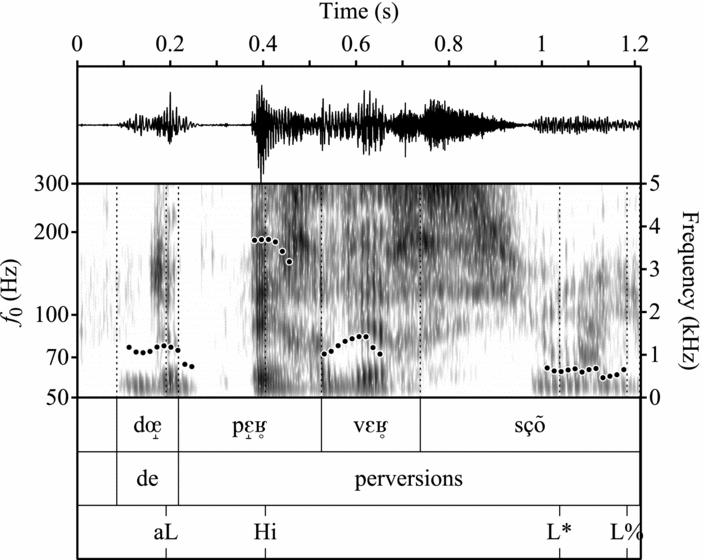
Figure 1, showing a registering repeat, provides a clear illustration of the intonation contour in question: after the phrase-initial preposition de ‘about’, there is a salient initial accent on the first syllable of the first content word ([pɛ̝ʁ̥]), and the primary, final accent on [sçõ] is low. The pitch excursion on the initial accent is wide, and the relevant syllable onset (i.e. the closure phase of the plosive [p]) is noticeably lengthened whereas the rime is not (note the short vowel in particular).
Waveform, spectrogram and pitch track for the other-repetition de perversions ‘about perversions’.

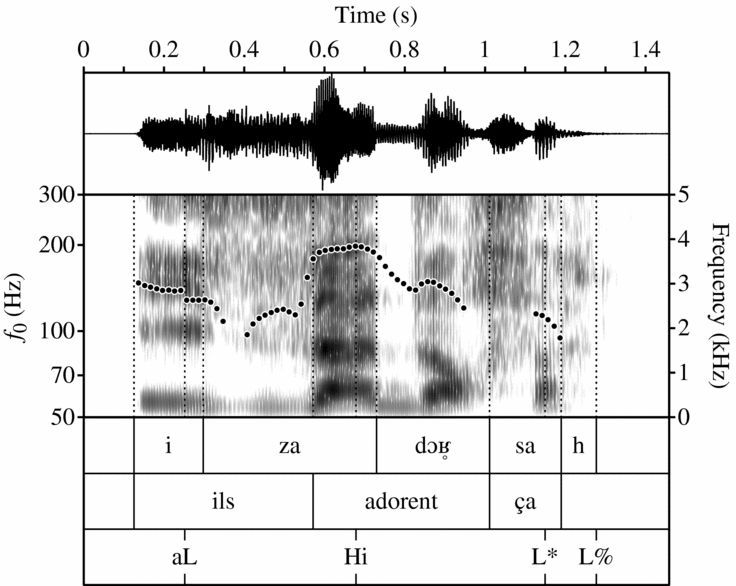
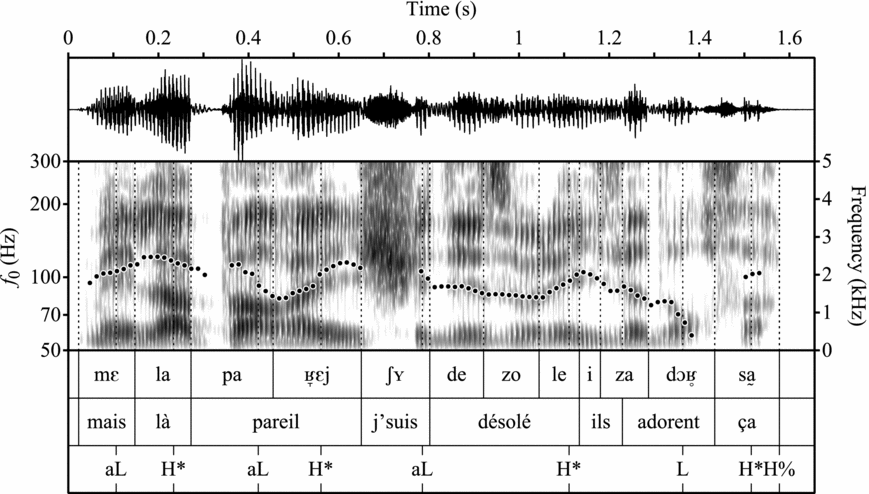
Consider also Figure 2, where there is a salient initial accent on the syllable [za], which spans a (morphosyntactic) word boundary.Footnote 2 While the high pitch target is aligned with the vowel, the syllable onset ([z]) is noticeably lengthened in this case as well. The primary accented syllable [sa], which is noticeably non-prominent, has a low pitch target.
Waveform, spectrogram and pitch track for the utterance ils adorent ça ‘they love that’.

4.2 Doing a registering repetition
In what follows, it will be shown that the investigated intonation pattern has a pragmatic value specific to other-repetitions: it does the interactional work of differentiating registering repeats from other types of repeats. Registering repetitions are other-repetitions that unproblematically register receipt of, or display ‘taking in’, the repeated turn, without necessarily soliciting confirmation from the speaker of the first saying. The investigated contour can be contrasted with other contours that are systematically used for other-repetitions designed for different purposes, such as repair-initiation (see Section 4.3 below), i.e. where repetitions are used for signalling problems with the intelligibility or appropriateness of the turn that gets repeated, and inviting the interlocutor to remedy such problems.
Consider extract 1, where speaker E asks speaker S a question (in line 1) about a year-long journey virtually around the world upon which S is about to embark, together with his partner.

Speaker E follows up his question with two candidate answers in line 2. Speaker S provides the authoritative answer in line 3, and immediately repeats the answer (possibly because the answer was partially overlapped by E's talk in line 2, as indicated by the aligned square brackets). E produces what appears to be the beginning of an other-repetition in line 4 (le v-), but cuts off (again, arguably because of overlap with the recycled answer from S). The other-repetition by E in line 6 (le vingt juillet ‘the twentieth of July’) is done in the clear, and it is sequentially placed in third position (the logic behind the numbering is that the sequence-initiating turn – the question – is in first position, the expectable response – the answer – is in second position, and the receipt of that answer in third position). Thus, the other-repetition allows the questioner to register unproblematic receipt of the answerer's talk. After the receipt, and a short silence, E moves on to the next question (thus treating the prior answer as unproblematic and satisfactory for all practical purposes), which broaches the topic of how the travellers are financing the journey (continued in data not shown).
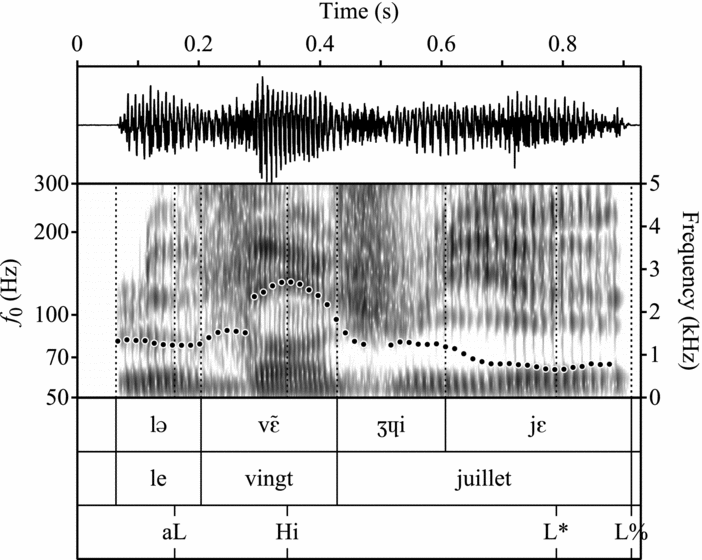
The registering repeat le vingt juillet exhibits the typical prosodic pattern (see Figure 3), with a salient initial (high) accent and a low primary accent.
Waveform, spectrogram and pitch track for the other-repetition le vingt juillet ‘the twentieth of July’.

Another case of a registering repeat is shown in extract 2. Speaker E is organising a conference, and has called R to enquire about catering deliveries. R explains that her company is an organiser of receptions, rather than a caterer, and for this reason R is now referring E to a caterer frequently engaged by R's company.

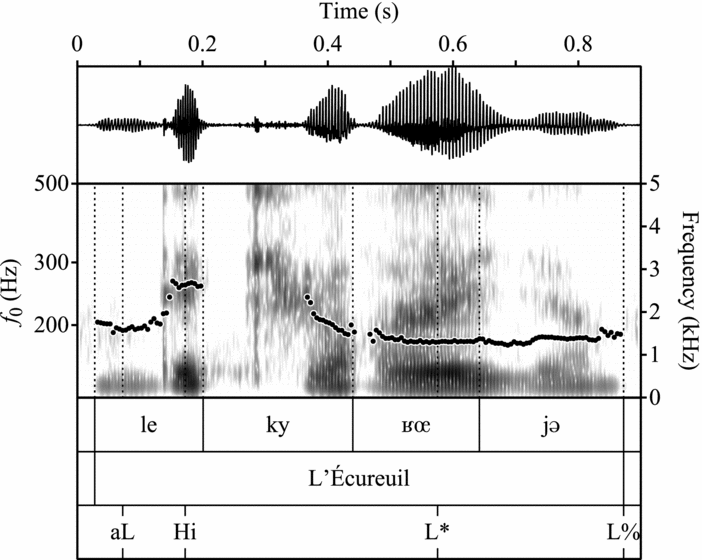
The registering repeat in extract 2 (see Figure 4 for the intonation contour) comes in a slightly different sequential position (with respect to extract 1). Here, R has started to provide E with some directives, telling her who to call (see line 9). However, when E repeats L’Écureuil at line 10, those directives are understandable not to be complete yet (it is not a completed provision of ‘contact details’, as projected in line 1), since the essential information regarding which number to call is still pending at that point. The repeat is thus produced to register unproblematic receipt of a piece of information, within the course of an ongoing sequence (and not at the potential end of a sequence, as in extract 1). By ‘unproblematic receipt’, it should be understood that the repetition is not doing any kind of request for confirmation – which is another common function that other-repetitions accomplish elsewhere in interaction. Having receipted the name at line 10, E immediately goes on to positively assess that name at line 12, further suggesting that there was no issue with taking in the name provided.
Waveform, spectrogram and pitch track for the other-repetition L’Écureuil ‘The Squirrel’.

4.3 Doing a repair-initiating repetition
It is notable that both the salient initial accent and the low primary accent appear to be involved in the target contour as employed in registering repeats. In fact, this contour forms a formal and functional contrast with several different intonation contours that have a prominent high final accent, used when the repeat is designed to elicit confirmation, sometimes followed by elaboration in the form of more substantial repair work such as explanations or justifications of what is being confirmed. Here, it will have to suffice to give one illustration of such repeats (however, see also Persson Reference Persson2015 for additional illustrations; a more focussed investigation of the different sub-types of such repair-initiating repeats is also currently in progress).

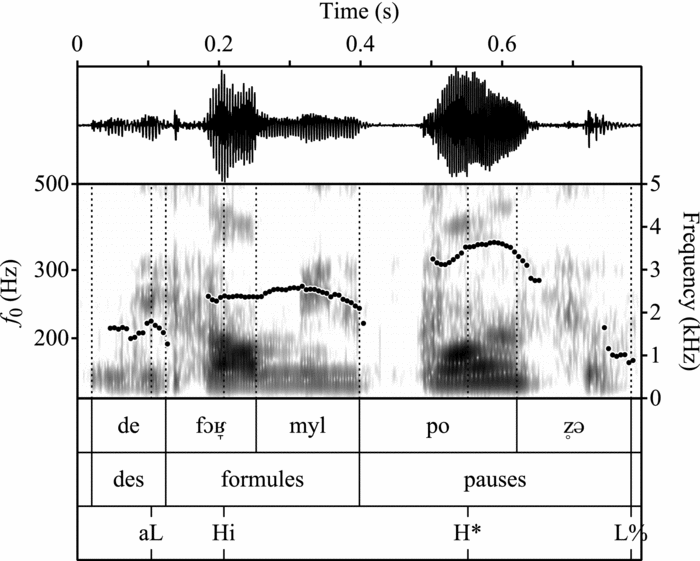
Extract 3 above (taken from another call to a caterer) illustrates a repair-initiating repeat. At line 5, by repeating E's phrase formules pauses ‘break specials’ with an intonation contour that involves a prominent final accent, C treats the repeated part as problematic. E responds to this (at line 6) by merely confirming C's questioning repeat as an accurate uptake of the first saying (in other cases, repair-initiating repeats are met with confirmations accompanied by more explanatory repair work). Subsequently, at line 8, C further insists on the problematic nature of the repeated talk with an expression that specifically diagnoses the trouble as understanding-related. E also provides a solution (at line 9) that is fitted to such trouble (a rephrasing of the problematic lexical item), which C subsequently treats as having solved the problem. The intonation contour for this repetition (see Figure 5) may be analysed as aL Hi H* L%. While there is a discernible initial accent on the first content-word syllable [fɔʁ̞], which has slightly higher pitch than the first syllable (the indefinite plural article des), this initial accent is not salient, nor is it followed by any fall in pitch over the next syllable (unlike in the target contour). Most importantly, as shown in Figure 5, there is a prominent high accent on the primary accented syllable ([po]).
Waveform, spectrogram and pitch track for the repair-initiating other-repetition des formules pauses ‘break specials’.

4.4 Optional relevance of confirmations
The previous subsections (and extracts 1–3) suggest a very simple interactional distinction between registering and repair-initiating repeats, which either elicit confirmation or not. However, as this subsection will show, the sequential organisation of repeats is more complex (and interesting) than has been suggested so far. One thing that has been noted in work on confirmations in talk-in-interaction is that confirmations are produced not only when elicited – e.g. after polar questions – but also sometimes ‘volunteered’ at times when they do not seem to be elicited, strictly speaking (Sorjonen Reference Sorjonen, Ochs, Schegloff and Thompson1996, Svennevig Reference Svennevig2008: 498). One such situation is after registering repeats, where volunteered confirmations are sometimes produced; see extract 4 for a case in point.

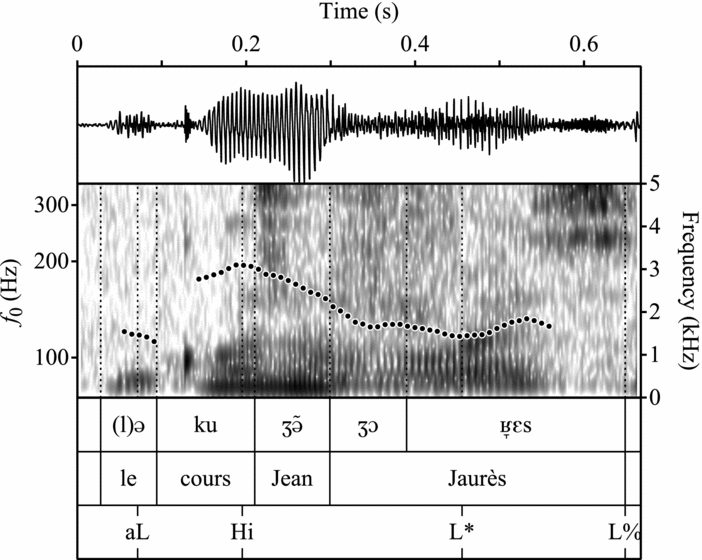
Before beginning to do a response proper to C's enquiry, H repeats the street-name part of the enquiry (le cours Jean Jaurès) at line 4 (see Figure 6), and portrays this enquiry as noteworthy (eh ben dis donc, perhaps roughly translatable as ‘well how about that’) and explains why that is (see lines 7 and 11). Only after that does H begin the response proper (the direction-giving begun at line 13), which continues after the talk shown in this extract. The confirmation from C (mm at line 5) does not appear to be elicited by H's repeat, since H goes on talking immediately after the repetition, without leaving a slot for a reply from C. As a result, C's confirmation ends up in overlap with H's talk.
Waveform, spectrogram and pitch track for the other-repetition le cours Jean Jaurès (the name of a street).

As an aside, note that there are several different pieces of interactional evidence showing that repetitions with salient initial accents make confirmation optionally relevant (as opposed to conditionally relevant, see Schegloff Reference Schegloff1968).Footnote 3 This optional relevance is manifested in at least three ways. First, one can observe that in response to such repetitions, confirmations are sometimes produced and sometimes not, and when not produced, the repeat-speaker does not react as if they ‘should’ have been produced e.g. by pursuing a confirmation. In other words, even when absent, confirmations are not noticeably absent in such contexts (see extracts 1 and 2 above). Second, as illustrated in extract 4 above, ‘volunteered’ confirmations are often produced in overlap with continued talk by the repeat-speaker, again suggesting that in these cases, confirmations are not normatively expectable from the perspective of the repeat-speaker, since no space is left for the respondent's talk (see Persson Reference Persson2015 for several additional illustrations of this pattern). Third, volunteered confirmations are designed to be different from elicited ones. This distinction relies on several types of features, involving lexis, voice quality, prosody and articulatory features (see Persson Reference Persson2014: 218–237 for a more detailed account including acoustic observations). For instance, although the mm token (see extract 4) may be fully functional as a yes/no-type response turn, in the collection of repeats it occurs only after registering repeats. In terms of global prosodic features, volunteered confirmations are neither loud nor high-pitched, arguably so as not to be heard as turn-competitive (French & Local Reference French and Local1983) if they should happen to end up in overlap (Persson Reference Persson2015: 599). Relatedly, these instances of overlap are typically not the site of hitches or perturbations that elsewhere accompany overlapped talk (see Schegloff Reference Schegloff2000). Furthermore, volunteered confirmations are sometimes produced with creaky voice, whereas elicited confirmations are not (but may instead have final devoicing of the high word-final vowel in oui ‘yes’) (Persson Reference Persson2014: 224–232; Reference Persson2015: 601). Finally, volunteered productions of the oui/ouais ‘yes/yeah’ form-continuum typically have laxer articulation (with variable word-initial lip rounding and variable word-final vowel height) while elicited productions typically have tenser articulation (more consistent word-initial lip rounding and a consistently close word-final vowel) (Persson Reference Persson2014: 224–232; Reference Persson2015: 601). Even in merely confirming responses to repetitions, then, participants orient to the distinction between registering and repair-initiating repeats. Thus, in Sections 4.1–4.4, this pragmatic distinction, corresponding to a prosodic contrast, has been warranted with interactional evidence.
4.5 Prosodic form of more complex repetition turns
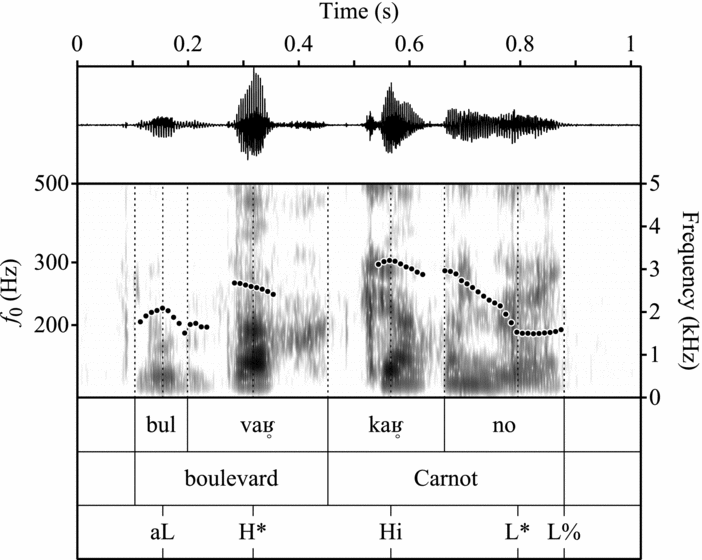
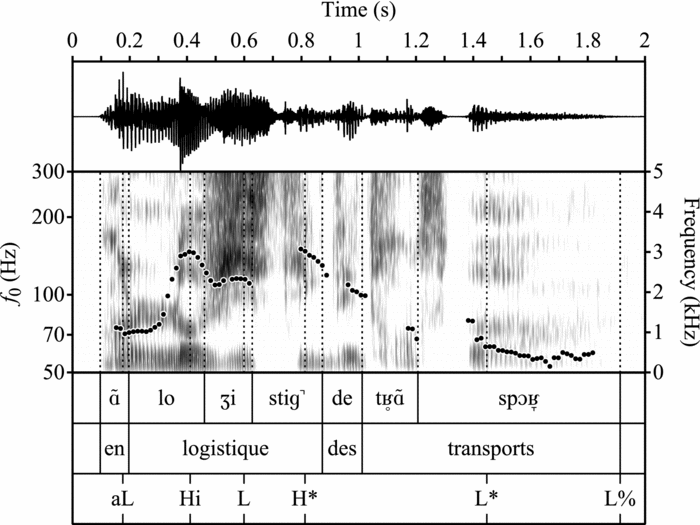
Returning to the intonational analysis of the target intonation pattern, let us briefly consider the forms that it may take in more complex repetition turns. Figure 6 shows a monosyllabic content word, cours (part of a street name), carrying the initial accent of an IP with a single AP, whereas in other realisations, it might have carried a primary accent and marked the final syllable of the first of two APs. Things are more complex when there are several APs in the repetition turn, in terms of the distribution of initial and final accents. Figure 7 (boulevard Carnot) shows one possible way that speakers may design such turns: both the salient initial accent and the low primary accent come in the second, disyllabic AP; this may reflect an information-structural choice – by placing the initial accent on the second AP, the proper name Carnot is arguably treated as the least predictable part of the original utterance, and thus the most relevant thing (for the speaker of the registering repeat) to show that she grasped. Figure 8 (en logistique des transports ‘in transport logistics’) shows a registering repeat with two APs that is formatted differently: the initial accent is carried by the vowel in the first content syllable of the first, non-final AP (which also has a high final accent – possibly the ‘default’ primary accent for non-final APs; see Jun & Fougeron Reference Jun and Fougeron2002), and the low final accent comes in the second and final AP (see Persson Reference Persson2015 for an interactional analysis of this particular repetition in its sequential context). Note also the greatly lengthened syllable onset at the initial accent in Figure 8, especially with respect to the short syllable nucleus.
Waveform, spectrogram and pitch track for the other-repetition boulevard Carnot (the name of a street).

Waveform, spectrogram and pitch track for the other-repetition en logistique des transports ‘in transport logistics’.

4.6 Import of the interactional distinction
The distinction between registering and repair-initiating repeats is analysed in more detail elsewhere (Persson Reference Persson2015), and corroborated with more interactional evidence – the main objective here is to draw out the implications of this distinction for the analysis of intonational meaning. Some sequential-analytic evidence has nevertheless been offered here in support of the claim that the target contour (salient initial accent + low primary accent) and (one of) its alternatives each have distinct, demonstrable consequences for the ensuing development of the talk, when considered in the delimited environment of next-turn other-repetitions. In particular, there is no evidence in the interaction that the prosody serves to accomplish ‘intensification’ or ‘contrastive focus’ here.
5 Comparison with other conversational contexts
5.1 Self-repetition: Upgraded assessments
Let us now examine the target intonation contour as it occurs in other interactional-sequential environments. In extract 5, Y is part of an environmentalist organisation which has put out a pamphlet with suggestions for how to celebrate Christmas in an environmentally friendly way. With regard to one tip (about eschewing children's toys made of plastic that work on batteries, in favour of gifts made of wood), the radio show host E has just objected that children tend to love battery-powered plastic toys. Here, the host is moving on to discussing the next suggestion (which is read aloud in line 1) about being restrictive with flashing Christmas lights.

After E (in line 2) has identified the issue with Y's suggestion – children love such lights, just like they love battery-powered plastic toys – Y first delays his response somewhat (see line 3) before reacting with laughter (line 4). In the face of this, at line 5, E repeats the children's-perspective assessment with its positively valenced lexical content (ils adorent ça ‘they love that’). Figure 9 shows phonetic records for line 5, and see Figure 2 for the self-repetition. The second assessment (Figure 2) is produced with a salient initial accent (followed by a low primary accent) which is readily heard as contributing to a stronger, more emphatic assessment than the first one – portraying the children's positive views as even more intense – although the lexical material is identical. (As an alternative, E could also have produced a weaker, downgraded second assessment, thus backing down to some extent from his first assessment; see Ogden Reference Ogden2006.) This upgraded assessment allows E to pursue a concession from Y that Christmas lights are nice, and Y does indeed agree with this (lines 6–7) before justifying his position of moderation (lines 8–10). Instances such as this make it easy to see how AI has come to be described as having functions such as emphasis and intensification (e.g. Di Cristo Reference Di Cristo, Hirst and Di Cristo1998: 209) – unlike the instances in extracts 1, 2 and 4. In extract 5, there is indeed interactional evidence that the contour serves to do something like intensification, but note that this is not accomplished through prosody alone, but through prosody in concert with the verbal material and the sequential organisation. As others have pointed out, even ‘repetition’ is not a unitary phenomenon in interaction (Curl Reference Curl2005, Curl, Local & Walker Reference Curl, Local and Walker2006) – the self-repetition of an assessment has little in common with the registering other-repetitions described in Section 4 – and it appears difficult to plausibly account for the salient initial accents as somehow doing related things in the two cases, when considering what the interactional issues for the participants seem to be in each case.
Waveform, spectrogram and pitch track for line 2, extract 5.

An interesting cross-linguistic parallel is that one main usage of intensifying emphasis in English is when speakers ‘make a second, stronger and upgraded assessment soon after a first’ (Ogden Reference Ogden2012a: 55), in particular to provide the addressee with a second chance to give a response of the sought kind, much like what is seen in extract 5. Intensifying emphasis in English involves hyperarticulated syllable-initial consonants, untypically long durations, pitch prominence, and a swell in loudness. Crucially, Ogden's (Reference Ogden2012a) analysis of intensifying emphasis and its communicative functions concerns not only (i) the phonetic parameters that are modified, but also (ii) the lexical and (iii) sequential properties of turns in which it occurs; the phonetic modifications do not ‘do’ intensification on their own. Similarly, the intensifying effect in extract 5 results from E's combined deployment of (i) the intonational form and (ii) the lexical properties (e.g. the valenced lexical content that makes it an assessment), (iii) specifically in this sequential environment.
5.2 Self-repetition with modification: Self-repair
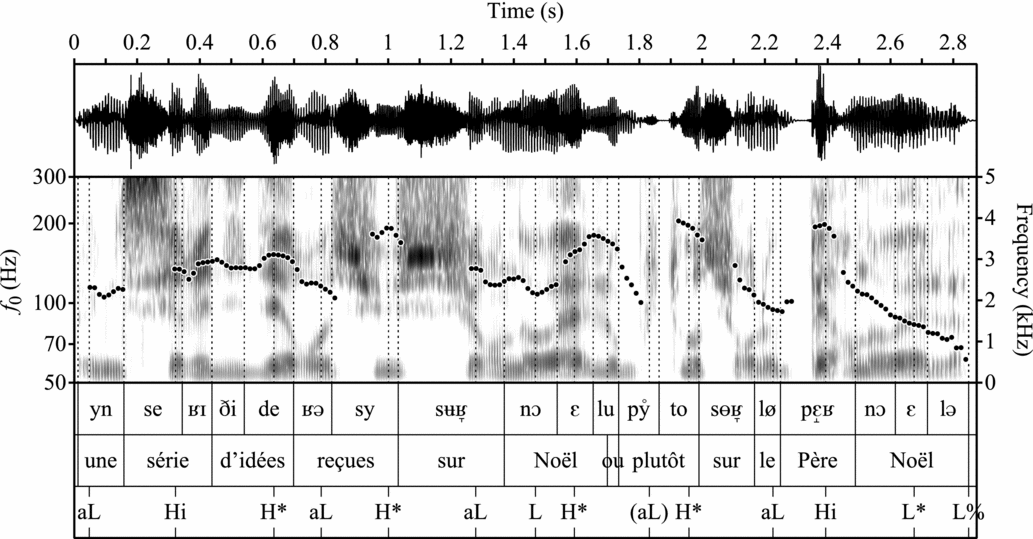
As mentioned earlier, another main pragmatic meaning frequently attributed to AI in French is contrastive focus. In relation to this, consider extract 6, which is from a telephone interview with the author of a book about misconceptions surrounding Christmas (part of a book series entitled Idées Reçues ‘Common Beliefs’).

In line 2 (see Figure 10), E is deploying a salient initial accent and a low primary accent on the AP that ends up being turn-final (whereas the first version sur Noël ‘about Christmas’ had a high primary accent), in order to do something strongly reminiscent of what has been termed contrastive focus: not ‘about Christmas’ but ‘about Father Christmas’. This is a form of self-repair operation (syntactically, replacing one prepositional object with another), but because the first constituent sur Noël is produced in full (and not e.g. cut-off and aborted as in many other self-repairs) and does not project the imminent production of the revised constituent,Footnote 4 it comes off almost like an afterthought or addendum (and not as a definitive rejection of an initial version in favour of a corrected one). However, note once more that the contrast-like operation accomplished in this particular instance depends upon more than the intonation contour; other linguistic-contextual features on which the speaker draws for achieving this ‘self-repair-after-the-fact’ are the editing terms ou ‘or’ and plutôt ‘rather’, the close proximity (within the same turn) of a previous ‘replaceable’ item starting with the same preposition, and the in-context semantic compatibility of the replaceable and the replacement as items ‘of the same kind’ (here, both are treated as possible topics for a book). This instance thus illustrates an environment that differs from other-repetitions not only in terms of immediate context (‘what came before’), but also in terms of the verbal (in this case, lexico-grammatical) design of the utterance that carries the contour.
Waveform, spectrogram and pitch track for line 2, extract 6.

In this extract, the self-repair is picked up on by the interlocutor (in line 4), who thereby treats as relevant the issue of whether the replacement sur le Père Noël ‘about Father Christmas’ should stand as the definitive version of what the book is about, or whether either version – or rather only the two versions together – is adequate. It seems likely that here, the intonation contour helps to foreground a corrective operation, whereas one may also choose to self-repair without foregrounding the contrast between the initial version and the repaired version (and such choices may be strategic, see Drew, Walker & Ogden Reference Drew, Walker, Ogden, Hayashi, Raymond and Sidnell2013). While the interlocutor M could also have let this pass without comment, one could argue (although it would require more elaborate evidence than this single case) that E's exposing of his own self-correction (see Jefferson Reference Jefferson, Button and Lee1987), through the prosody, favours M's reacting specifically to it and reasserting her epistemic authority over the matter.Footnote 5 Whether that is a recurrent pattern or not, the workings of what some traditions consider to be contrastive focus may be well worth exploring in well-defined interactional contexts such as different repair environments.Footnote 6 Phonologists and phoneticians have often noted that AI in French is only part of a pool of prosodic, syntactic and lexical resources for doing contrastive focus, and how these different types of resources work together is not yet well understood – even less so in naturally occurring talk-in-interaction.
Whatever the precise workings and purposes of contrastive focus (and whatever else is at work) in extract 6, it is an interactional accomplishment which draws on a number of linguistic and contextual features, and not only on prosody. As in the case with the upgraded assessment, extract 6 illustrates the target contour as deployed in talk which is essentially repetition. Here, it is a sort of modified self-repetition, where that (corrective) modification is the very motive for doing the second version. But like for extract 5, there is no interactional evidence that the communicative function of the contour in this context is comparable with its function in other-repetitions (see Section 4). In the different sequential environments, there are plainly different issues in play, and it is in relation to those issues that the pragmatic meaning of the intonation pattern is understood. If we started from the assumption that the target contour always signified something like ‘emphasis’ or ‘contrastive focus’ (as the very term accent d'insistance would suggest), we might have reasonably expected e.g. that speakers of registering repeats are understood as insisting on how they are saying the lexical material (as opposed to how the interlocutor first said it). However, this is not the understanding that interactants themselves display through their conduct (see Section 4); registering repeats are neither emphasised nor contrastive.
5.3 Syntagmatic and paradigmatic prosodic contrasts
One upshot of these observations is that intonation may contribute to ‘meaning-making’ both syntagmatically and paradigmatically. Sections 5.1 and 5.2 have shown two contexts in which some talk is emphasised or upgraded in relation to some prior talk, and that calls for syntagmatic perspectives that capture local contrasts between features of subsequent turns. Syntagmatic perspectives may be even more important when the prosodic variation is not categorical, such as contour type, but rather gradient, such as scaling (Szczepek Reed Reference Szczepek Reed2006; see also Ogden Reference Ogden and Niebuhr2012b). But a full account of intonation categories also has to include a paradigmatic perspective (as laid out in Section 4, and to some extent in Section 5.2), explaining how they contribute to meaning-making by forming contrasts with other intonation categories relevant in the same places (e.g. how distinct contours help differentiate registering other-repeats from repair-initiating other-repeats, and exactly how emphasised self-corrections relate to non-emphasised). Consequently, an essential part of accounts of intonation in talk-in-interaction is specifying what the relevant alternatives to intonation contours are, in specific places in sequences of action.
6 Discussion
In relation to the general concern of intonational meaning, the findings presented here are at odds with the argument that an intonation contour makes ‘an independent contribution to utterance interpretation’ (Ward & Hirschberg Reference Ward and Hirschberg1985: 773). Specifically, the investigated contour does not seem to perform its pragmatic work independently of the verbal material accompanying it and the sequential organisation of the talk. On the contrary, it is found that where there is indeed interactional evidence of functions such as intensification or contrastive focus, these effects are achieved through configurations involving resources of several kinds (prosodic, verbal and sequential properties of talk). In relation to research on AI, the present paper departs from prior work, by taking the first steps towards an account that treats the pragmatic meaning of the intonation pattern [salient initial accent + low primary accent] as a combined product of prosodic form, verbal material, and action-sequential context. Such an approach may cast light on numerous issues at the intonation–pragmatics interface.
One reviewer suggested that the interactional approach taken here be understood as a method for pinning down the uses and meanings of prosodic forms as established in intonational phonology. While such a view would seem possible, interactional linguists have usually stressed the need for avoiding reliance on established linguistic categories, since their demonstrable relevance to participants (and not just to linguists) for making sense of talk is (typically) yet to be determined. One formulation of the interactional linguistic research programme stated that interactionally grounded categories for prosodic and intonational analysis may turn out to correspond only loosely – or not at all – to ‘traditional’ linguistic categories (Couper-Kuhlen & Selting Reference Couper-Kuhlen, Selting, Couper-Kuhlen and Selting1996: 17). In fact, the research reported here did not set out to investigate AI, but to investigate next-turn other-repetition, and one of the prosodic formats treated by participants as constitutive of a participants’ category then turned out to fit some descriptions of AI (although, as mentioned, other accounts of AI do not include the low primary accent but only the emphatic initial accent). To some extent, interactional linguistics and intonational phonology may be dealing with different empirical realities simply because of methodological divergences: what is empirically verifiable by the standards of interactional linguists may not be so by the standards of intonational phonologists, and vice versa.
7 Conclusions
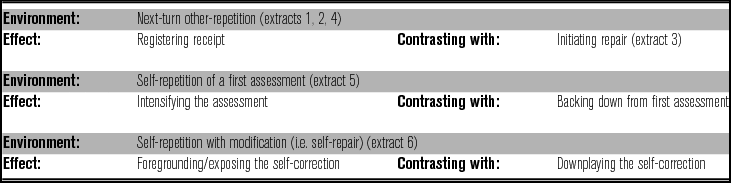
As discussed in Section 2, an important unresolved issue is how intonation takes on pragmatic meaning. The intonation pattern (a salient initial accent + a low primary accent) has been illustrated in three environments which are different verbally and sequentially: (i) other-repetitions, (ii) upgraded assessments, and (iii) contrastive-focus-like self-corrections. In these three different interactional-sequential environments, entirely separate sets of pragmatic issues are relevant, which entails variations in the pragmatic meanings that the contour takes on (see Table 1). This suggests that the investigated contour itself does not have a particular pragmatic meaning (e.g. insisting or doing emphasis) outside of its contexts of use; any pragmatic meaning is only specified for the contour as occurring in interactional-sequential context. At least on the basis of the findings presented here, it does not seem warranted to assume, and attempt to specify, some common, invariant meaning in these three different deployments of an intonation pattern, even though they could be claimed to merely be different ‘flavours’ of repetition. Thus, alterations of the environment entail consequential changes in terms of which pragmatic issues are relevant at a specific moment, and in terms of which pragmatic role an intonational category will have with respect to those issues (for instance, registering receipt is not a potentially relevant task when one is doing a self-repetition). A coarse categorisation of the target utterances – e.g. as ‘repetition’ in the case investigated here – is too superficial, and a fine-grained action-sequential specification is needed in order to identify the precise environments in which the intonation contour may take on stable meanings. This insight is in line with previous interactional linguistic studies concerning specific contours, for example Benjamin & Walker (Reference Benjamin and Walker2013) on the high rise–fall contour in repetitions in English. This is also consistent with Ogden's (Reference Ogden, Barth-Weingarten, Reber and Selting2010) notion of prosodic constructions. Indeed, such constructions are not to be understood as direct mappings of prosodic form and meaning: Ogden argues that sequential environment and verbal (in that case, lexical) material are also specified among the ‘form’ properties of constructions (Ogden Reference Ogden, Barth-Weingarten, Reber and Selting2010: 99). In line with Ogden's argument, the present findings suggest that intonation patterns can have systematic pragmatic meanings, but only in specific action-sequential environments (see also the proposal by Torreira & Grice (this issue) that melodic constructions can include specifications of linguistic and discourse context). Using the notion of constructions, then, this study can be said to deal with a single intonation pattern as employed in three different prosodic constructions.
Overview of effects of the intonation pattern in three distinct action-sequential environments.

Once the locus of some intonational meaning is identified, the next major issue to deal with is how to specify what that intonational meaning is. The most common approach in intonation research is to assume that elements of intonation have inherent meanings, which are very general, but give rise to more specific interpretations in particular contexts. I would argue that this approach tends to yield descriptions that are incomplete with respect to the relevance of intonational categories specifically for talk-in-interaction: if one could come up with a basic meaning that applies across the three analysed sequential environments (see Table 1), that meaning is likely to be so generic and abstract as to lose its empirical bite. Efforts to analytically connect what appears to be disparate intonational meanings, and interpolate these to form more abstract categories, will quite possibly yield meaning-categories that are real only for analysts and not for interactants, and cannot be empirically supported with interactional evidence. If the aim is an account that captures pragmatic meanings which are real and relevant to language users, there is no place in the analysis for abstract levels of representation of meaning that do not correspond to observable conduct in interaction; any postulated meaning needs to be analytically warranted with detailed observations about the understandings that participants themselves display through their behaviour. By way of comparison, Portes & Beyssade (Reference Portes and Beyssade2015) is a recent example of an argument for a compositional approach where the meaning of intonation contours is analysed as a product of abstract and decontextualised semantic primitives associated to specific elements of intonation via intermediate levels of representation. Abstract, invariant meanings expressed in semantic terms are thus attributed not only to intonation contours, but also to their components. Although such analyses have strong appeal in terms of theoretical elegance, if one were to attempt to demonstrate the empirical reality and relevance of such semantic categories to language users, and for their everyday task of making sense of each other's talk (including intonation), one may face substantial challenges – indeed, such semantic primitives are taken to be abstract, and they cannot (and should not) be expected to be directly linked to observable conduct. By contrast, from an interactional linguistic perspective, intonation contours appear to serve a variety of concrete interactional functions that are demonstrably oriented to by interactants – including functions that have to do with action and sequence organisation: registering receipt, upgrading a second assessment, and foregrounding a self-correction – but these intonational contributions to utterance meaning cannot be specified (or warranted) without reference to the verbal and sequential features of talk. Of course, the approach to be taken is ultimately a matter of which type of ‘meaning’ one aims to describe.
In conclusion, the findings presented here encourage us to consider which type of action given intonation categories contribute to, i.e. what the turn-at-talk as a whole – rather than its intonation alone – is designed to achieve. What an interactional perspective on prosody calls for is not simply wariness of one-to-one mappings between form, e.g. intonational elements, and pragmatic meaning, but more fundamentally an awareness of how the pragmatic meaning (or interactional function) of the intonation in any given turn-at-talk cannot be abstracted away from what that turn as a whole is designed to do in its particular context.
Transcription conventions for extracts

Acknowledgements
This article has benefitted from numerous valuable remarks and suggestions made by the special issue editors Nigel Ward and Oliver Niebuhr and the journal editor Amalia Arvaniti, as well as by the anonymous reviewers.