Introduction
Cannabis use is common in patients with first-episode psychosis (e.g. Cantwell et al. Reference Cantwell, Brewin, Glazebrook, Dalin, Fox, Medley and Harrison1999; van Mastrigt et al. Reference van Mastright, Addington and Addington2004) and has been associated with an adverse course of the illness, including increased levels of psychotic symptoms (Baeza et al. Reference Baeza, Graell, Moreno, Castro-Fornieles, Parellada, González-Pinto, Payá, Soutullo, de la Serna and Arango1999; Lambert et al. Reference Lambert, Conus, Lubman, Wade, Yuen, Moritz, Naber, McGorry and Schimmelmann2005), high rates of relapse and more hospitalizations (Linszen et al. Reference Linszen, Dingemans and Lenior1994; Zammit et al. Reference Zammit, Moore, Lingford-Hughes, Barnes, Jones, Burke and Lewis2008). Despite these findings, the evidence for effective interventions for treating cannabis use in patients with psychosis is limited. A review identified four randomized controlled trials (RCTs) that reported cannabis use outcomes from psychological interventions for psychosis (Baker et al. Reference Baker, Thornton, Hides and Dunlop2012). These studies found no evidence to support motivational interviewing (MI) with or without cognitive behavioural therapy (CBT) over standardized interventions in terms of reducing cannabis use. More recent RCTs also found no advantage of MI-CBT in reducing cannabis use in psychosis (Madigan et al. Reference Madigan, Brennan, Lawlor, Turner, Kinsella, O'Connor, Russell, Waddington and O'Callaghan2013; Barrowclough et al. 2014), or in this respect showed only modest benefits of MI-CBT (Barrowclough et al. Reference Barrowclough, Haddock, Wykes, Beardmore, Conrod, Craig, Davies, Dunn, Eisner, Leweis, Moring, Steel and Tarrier2010; Hjorthøj et al. Reference Hjorthøj, Orlovska, Fohlmann and Nordentoft2013) or MI alone (Bonsack et al. Reference Bonsack, Gibellini, Favrod, Montagrin, Besson, Bovet and Conus2011). On the other hand, some RCTs have shown promising results with family interventions in reducing cannabis use and/or improving treatment outcomes among patients with psychosis, either as stand-alone (Mueser et al. Reference Mueser, Glynn, Cather, Xie, Zarate, Smith, Clark, Gottlieb, Wolfe and Feldman2013) or combined with MI-CBT (Barrowclough et al. Reference Barrowclough, Haddock, Tarrier, Lewis, Moring, O'Brien, Schofield and McGovern2001; Haddock et al. Reference Haddock, Barrowclough, Tarrier, Morning, O'Brien, Schofield, Quinn, Palmer, Davies, Lowens, McGovern and Lewis2003).
Given the need to improve treatment for patients with first-episode psychosis and co-occurring cannabis use, the involvement of patients’ caregivers might have special relevance. Because the onset of psychosis usually occurs during young adulthood, many patients are living with, or have close contact with their family (Addington et al. Reference Addington, Jones, Ko and Addington2001). It has been found that family interventions and ongoing family support are associated with an improved early course of psychosis (Norman et al. Reference Norman, Malla, Manchanda, Harricharan, Takhar and Northcott2005; Bird et al, Reference Bird, Premkumar, Kendall, Whittington, Mitchell and Kuipers2010). On the other hand, research has also shown that caregivers tend to be more critical and hostile towards the patient with psychosis if the illness is accompanied by drug use (Lopez et al. Reference Lopez, Nelson, Snyder and Mintz1999; Barrowclough et al. Reference Barrowclough, Ward, Weardon and Gregg2005). Importantly, high levels of criticism and hostility in the family environment have been consistently associated with an increased risk of psychotic relapse (Butzlaff & Hooley, Reference Butzlaff and Hooley1998).
The above-mentioned findings suggest that interventions for first-episode psychosis and co-occurring cannabis use should be aimed at establishing a supportive family environment, as well as at reducing caregivers’ expressions of negative affect towards their offspring. Therefore, we developed a family-based intervention for parents of young adults with recent-onset schizophrenia and co-occurring cannabis use; it involved training parents in interaction and motivational interviewing skills. In a RCT we demonstrated that this training, called Family Motivational Intervention (FMI), was significantly more effective than routine family support (RFS) in reducing quantity and frequency of patients’ cannabis use for at least 3 months after completion of the training (Smeerdijk et al. Reference Smeerdijk, Keet, Dekker, van Raaij, Krikke, Koeter, de Haan, Barrowclough, Schippers and Linszen2012). The current study is an evaluation of the effectiveness of FMI at 15 months after the training had ended. We hypothesized that FMI would continue to show significant greater reductions in patients’ cannabis use compared to RFS. In addition, the following secondary outcomes were examined: (1) patients’ substance use other than cannabis, their craving for cannabis and their quality of life, and (2) parents’ levels of distress and sense of burden.
Method
Participants
Patients were recruited from two psychiatric services for early psychosis in The Netherlands (the Academic Medical Centre, Amsterdam and Mental Health Service North Holland North). Patients were eligible to participate if they fulfilled the following criteria: (1) DSM-IV (APA, 1994) diagnosis for schizophrenia or a related disorder as determined by the Comprehensive Assessment of Symptoms and History (CASH; Andreasen et al. Reference Andreasen, Flaum and Arndt1992), (2) onset of the first psychotic episode within the last 5 years, (3) aged between 16 and 35 years, (4) cannabis use for at least 2 days/week during the past month; and (5) contact with a parent for at least 10 h/week during the past month.
Study-design and procedure
This study was a follow-up of a single-blind RCT, in which the allocation of parents to receive either FMI (experimental condition) or RFS (control condition) was based on random assignment of the child to one of these conditions. Patients were approached about participation when they were receiving either in-patient or outpatient treatment from one of the two above-mentioned psychiatric services. The content of the patients’ treatment programme is described in detail elsewhere (Linszen et al. Reference Linszen, Dingemans, van der Does, Nugter, Scholte, Lenior and Goldstein1996). Parents were approached only after the patient had given consent. Before written informed consent was obtained, patients and parents were fully informed about the content and aims of the study, and they were assured that ongoing family support would continue to be offered regardless of whether or not they decided to participate in the trial. Parents could participate even if their child or partner declined to do so.
Both patients and parents were assessed at three time points: within 4 weeks before FMI or RFS started (baseline) and 3 months and 15 months after FMI and RFS had ended. The assessments were conducted by the first author, who had completed an expert-led training on the use of the patient's measures. Before the start of the study, rater reliability was checked by comparing the assessor's ratings with those of an experienced rater for five randomly selected patients. There was 100% agreement on diagnosis and 90% agreement on substance use ratings, indicating good reliability. The assessor and the other research staff were blind to participants’ assignment to FMI or RFS, and efforts were made to maintain their blindness, included using separate rooms for therapy and the research staff and reminding participants prior to and at the beginning of each assessment not to disclose their allocation. Throughout the trial, the blindness of the assessor was broken in 34 cases (11 patients, 23 parents). To those participants a new ‘blind’ assessor was allocated.
Family interventions
According to the standard mental health care in The Netherlands for recent-onset psychosis, all patients and parents in the trial were invited to participate in two group sessions of family psycho-education during the first month of hospitalization. After the psycho-education, the parents received either FMI or RFS, which was scheduled every other week across a 6-month period. The content of the interventions has been described in detail elsewhere (Smeerdijk et al. Reference Smeerdijk, Linszen, Kuipers, Keet, Lobban and Barrowclough2009, Reference Smeerdijk, Keet, Dekker, van Raaij, Krikke, Koeter, de Haan, Barrowclough, Schippers and Linszen2012). Here we provide a brief synopsis. Two experienced family therapists conducted FMI. They were trained and supervised by experts in interaction skills training (IST) and in MI skills training.
FMI consisted of six group sessions of IST and six group sessions of MI training. Each session lasted 3 h. IST was developed by the training company ‘Bureau de Mat’ (Kuipers, Reference Kuipers2003, Reference Kuipers2008; van Meijel et al. Reference van Meijel, Megens, Koekkoek, de Vogel, Kruitwagen and Grypdonck2009). It teaches parents non-hostile interaction and problem-solving skills for dealing with conflicts and reducing stress related to behaviours and symptoms of psychosis. Parents practised how to set boundaries and learned to make a conscious distinction between behaviours that patients cannot change and the behaviours that they will not change (‘cannot v. will not’). The MI training was based on the underlying spirit of MI (Miller & Rollnick, Reference Miller and Rollnick2002), and its aim was to teach parents how to enhance their child's intrinsic motivation to change his/her cannabis use. Through instruction and role-play interactions parents were taught skills such as posing open-ended questions, reflective listening, and summarizing, in order to evoke self-motivational statements (i.e. ‘change talk’) from the patient about changing cannabis use. When patient's ambivalence was resolved, parents were taught how to assist the patient in carrying out a change plan.
As a standard component of the treatment service, RFS consisted of consultations for parents with an experienced family therapist. The aims of RFS were to provide parents with emotional support and practical help concerning the first-episode psychosis of their child. Parents introduced their own topics; no formal skills training was provided. Differences between FMI and RFS sessions were that RFS lasted 1 h instead of 3 h and RFS was offered individually to single parents or parent couples instead of in a group format.
Patients’ measures
The Timeline Followback (TLFB-90) interview (Sobell & Sobell, Reference Sobell, Sobell, Litten and Allen1992) was administrated to measure data on patients’ cannabis and other substance use during the previous 90 days. With the use of a calendar, the following measures were obtained: (1) days of use of cannabis, alcohol and others substances, (2) quantity of use in grams for cannabis and in standard Dutch units for alcohol (1 unit = 12.5 ml of pure ethanol), and (3) percentage of patients who were abstinent from cannabis at the two follow-up points. The TLFB has been shown to be a reliable and valid method for assessing cannabis use in patients with psychosis (Hjorthøj et al. Reference Hjorthøj, Fohlmann, Larsen, Arendt and Nordentoft2011; Barrowclough et al. 2014). In addition to the TLFB interview, urine samples were taken to validate patients’ self-reported cannabis, cocaine, ecstasy, and amphetamine use.
Because craving might be an important mediator of continued cannabis use and relapse after abstinence, patients’ craving for cannabis was assessed with the Obsessive Compulsive Drug Use Scale (OCDUS; Franken et al. Reference Franken, Hendriks and van den Brink2002; Dekker et al. Reference Dekker, Koeter and van den Brink2012). This self-report instrument measures subjective craving in the past 7 days based on three underlying factors: thoughts and interference, desire and control, and resistance to thoughts and intentions.
Finally, the patients were asked to complete the short form of the World Health Organization Quality of Life questionnaire (WHOQOL-BREF; De Vries & van Heck, Reference De Vries and van Heck1995; WHOQOL Group, 1998).
Parents’ measures
In order to evaluate levels of burden and distress experienced by parents in relation to caring for someone with recent-onset schizophrenia and co-occurring cannabis use, three self-reports measures were administered: Experience of Caregiving Inventory (ECI), Family Questionnaire (FQ), and General Health Questionnaire (GHQ-28). The ECI (Szmukler et al. Reference Szmukler, Burgess, Herrman, Benson, Colusa and Bloch1996) obtains parents’ negative and positive appraisal of caregiving for patients with first-episode psychosis. The FQ (Quinn et al. Reference Quinn, Barrowclough and Tarrier2003) measures three dimensions of parents’ perception of the behaviours and symptoms of the patient: the frequency of symptoms and behaviours and the parents’ concern and their ability to cope with the symptoms and behaviours. The GHQ-28 (Goldberg & Hillier, Reference Goldberg and Hillier1979) screens for parents’ psychological distress by assessing their mental health status during the last 4 weeks.
In a previous report of this trial (Smeerdijk et al. Reference Smeerdijk, Keet, de Haan, Barrowclough, Linszen and Schippers2014), we demonstrated the feasibility of teaching MI skills to parents as part of the FMI training by coding their use of MI in role-play interactions with an actor portraying their child. In this current report we examined whether parents’ performances in MI after FMI had ended were related to changes in patients’ cannabis use from baseline to follow-up. The MI coding instrument was adapted from two coding instruments (CoSIT-MI; De Jonge, Reference De Jonge2005 and MITI; Moyers et al. Reference Moyers, Martin, Manuel, Miller and Ernst2007), and showed satisfactory inter-rater reliability and internal consistency.
Statistical analyses
All data were analysed using SPSS Statistics for Windows version 20 (IBM, USA). The analyses were conducted on an intention-to-treat basis using linear mixed-effect regression models. This approach enables the performance of restricted maximum-likelihood estimates, which uses all available data. This means that patients and parents with at least one outcome measurement contributed to the effect estimates. Assuming that missing values were missing at random, this results in either unbiased or less biased estimates compared to complete-case analyses with either imputed or deleted data (e.g. Beunckens et al. Reference Beunckens, Molenberghs and Kenward2005; Salim et al. Reference Salim, Mackinnon, Christensen and Griffiths2008). Because using baseline scores both as outcome variables and as covariates is not allowed in mixed-effect analyses, change scores from baseline to the 3-month and 15-month follow-ups were entered as the dependent variables. To adjust for possible dependence in data due to repeated measures, period was entered as a repeated effect in the patients’ outcomes analyses. Possible dependence in the data resulting from the fact that in some cases both parents took part in the trial was handled by using an unstructured covariance matrix in the repeated statement of the mixed-effect procedure. When there was no significant condition × period interaction, further analyses were conducted without the interaction terms. For all outcome variables, the baseline scores were entered as covariates.
Patients’ urine values at follow-up were analysed using a generalized estimation equation (GEE) approach that allows longitudinal analyses of binary data and accommodates missing values. The analyses were repeated with the imputation of missing urine samples as positive, assuming that missing could indicate that patients did not want to disclose their drug use. Exploratory analyses were conducted using: (1) direct logistic regression to determine the predictive value of craving for cannabis on cannabis abstinence, and (2) Pearson's correlation coefficients (r) to determine relationships between changes in the outcome variables. All statistical tests were two-tailed, and the threshold for significance was set at p < 0.05.
Results
Patients’ and parents’ progress
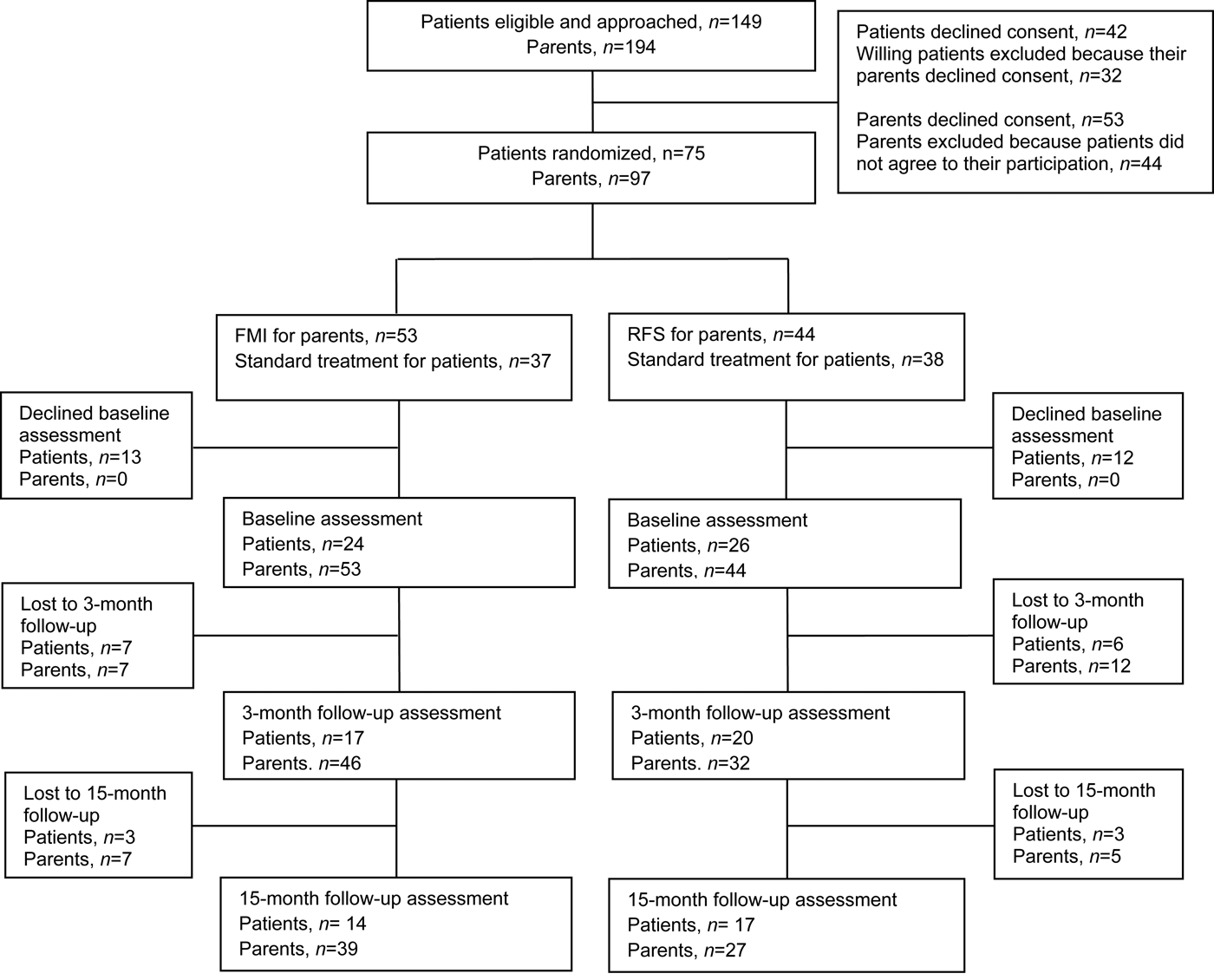
Fig. 1 presents the number of patients and parents in each stage of the trial and the reasons for their dropping out. Of the 149 patients meeting the inclusion criteria, 194 parents were identified as potentially eligible. Of these, 74 patients and 97 parents either declined to participate or were excluded. The main reasons for patients’ declining were: (1) they thought that the intervention was not necessary and (2) they did not want their parents to be involved in the treatment programme. For parents’ the main reasons for declining were: (1) they felt that they were able to deal with patients’ difficulties and (2) they did not have sufficient time to attend the training. Of the remaining 75 patients who were randomized into one of the two groups, 25 (12 FMI, 13 RFS) declined to take the baseline assessment, but they agreed that their parent(s) could participate. From baseline to 15 months after the family intervention had ended, 14 (58%) patients in the FMI group and 17 (65%) patients in the RFS group had completed all assessments. Of the 53 parents, 39 (74%) in the FMI group and 27 (61%) in the RFS group completed all assessments.
CONSORT diagram. FMI, Family Motivational Intervention; RFS, routine family support.

Patients’ and parents’ characteristics
Details of the characteristics of the participating patients and the parents have been reported previously (Smeerdijk et al. Reference Smeerdijk, Keet, Dekker, van Raaij, Krikke, Koeter, de Haan, Barrowclough, Schippers and Linszen2012). Here the findings are briefly summarized. At baseline, there were no significant differences between the conditions on any of the patients’ demographic or clinical characteristics. Patients had a mean age of 23 (±4.53) years and were predominantly male (90%). No significant differences at baseline were also found between the conditions on all patients’ outcome variables, including cannabis and other substance use, levels of craving for cannabis use and quality of life. When seen at the first follow-up, all patients were receiving outpatient care aimed at relapse prevention and rehabilitation. Patients who completed all assessments did not significantly differ from those who were lost to follow-up on any of the measures. Over the 21-month trial period, three (13%) patients in the FMI group and two (8%) patients in the RFS group were readmitted to hospital following a psychotic relapse.
At baseline, there were no significant differences between the conditions on the parents’ demographic characteristics or their scores on the three measures of stress or sense of burden. Parents were predominantly female (70%). A total of 47 single parents and 25 parental couples participated. With regard to parents’ exposure to the 12 sessions of FMI or RFS, the average number of sessions attended was 9.15 (±2.17) in the FMI group and 8.86 (±2.40) in the RFS group. Comparison between the parents who completed all assessments with those who were lost to follow-up indicated only one significant difference; within the RFS group, parents who were born in The Netherlands were more likely to complete the follow-up assessments than parents who were born in another country (72% v. 25%, Fisher's exact test = 7.93, p = 0.01).
Patients’ outcomes
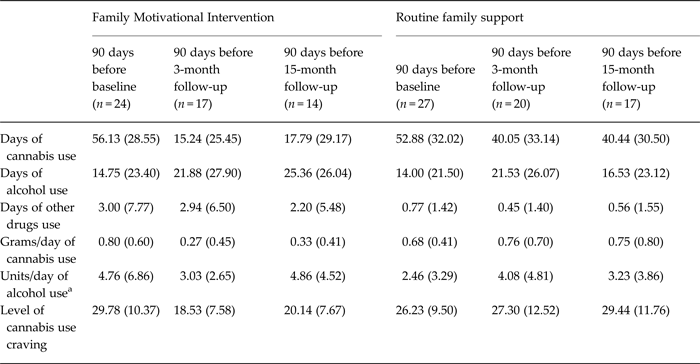
Table 1 shows the unadjusted means and standard deviations for patients’ self-reported use of cannabis, alcohol, and other substances at baseline and at the 3-month and 15-month follow-ups. Regression analyses indicated a significant effect for group in changes from baseline to follow-up on mean days of cannabis use when adjusted for baseline scores (F = 10.58, df = 1,30.2; p < 0.01), but there was not a significant group×assessment interaction. Specifically, the significantly greater reduction in the FMI group compared to the RFS group in patients’ mean days of cannabis use at the 3-month follow-up was sustained at the 15-month follow-up, with an adjusted overall greater reduction across the follow-ups of 25.39 (s.e. = 7.81) days. The significant advantage of the FMI group over the RFS group in the reduction in mean grams of cannabis used was also sustained from the 3-month to the 15-month follow-up, after the baseline scores had been controlled (F = 7.56, df = 1,33.1; p = 0.01), with an adjusted overall greater reduction across the follow-ups of 0.39 (s.e. = 0.13) grams/day of cannabis use. Again, no significant effect was found for group × assessment interaction.
Patients’ mean (s.d.) cannabis, alcohol and other drug use and craving for cannabis use

a One alcoholic unit was considered to contain 12.5 ml pure ethanol.
Although complete abstinence from cannabis use was reported more frequently in the FMI group than in the RFS group at both the 3-month (58.8 v. 25.0%) and 15-month (57.1 v. 18.8%) follow-up, the difference only approached significance (3 months: χ2 = 3.07, p = 0.08; 15 months: χ2 = 3.23, p = 0.07). Among the patients seen at 3-month follow-up, 41% (7/17) in the FMI group and 45% (9/20) in the RFS group declined to give a urine sample. At the 15-month follow-up, the refusal rates were 43% (6/14) in the FMI group and 47% (8/17) in the RFS group. In both conditions there was a 100% agreement at the 3- and 15-month follow-ups between patients’ self-reported abstinence from cannabis use on the TLFB and their urine test results for cannabis use. GEE analyses revealed that there was no significant difference between two conditions in the proportion of patients with a urine sample that was negative for cannabis use at either the 3-month or 15-month follow-ups. After imputing missing urine samples as positive, the difference remained non-significant at both follow-up points.
With regard to quantity and frequency of alcohol consumed, there were no significant changes from baseline to follow-up in either group and no group × assessment interaction after baseline scores had been controlled. Thus, patients’ self-reported alcohol use remained stable across the assessment points in both groups. There were also no significant changes from baseline to follow-up in either group with regard to drugs use other than cannabis.
Table 1 also contains the unadjusted means for patients’ subjective craving for cannabis at baseline. There was a significant benefit for the FMI group over the RFS group in changes in patients’ craving from baseline to follow-up when baseline scores were entered as covariate (F = 9.46, df = 1, 29.7; p < 0.01). The FMI group had an adjusted greater decrease of 8.39 (s.e. = 2.73) points across follow-ups. More specifically, in the FMI group the reduction in craving for cannabis at the 3-month follow-up was maintained at the 15-month follow-up, whereas in the RFS group craving remained fairly stable across the assessment points. Finally, logistic regression analyses revealed that subjective craving for cannabis use at baseline did not predict abstinence from cannabis at the 3-month follow-up. Moreover, craving at either baseline or the 3-month follow-up was not a significant predictor of abstinence at the 15-month follow-up, after controlling for abstinence at the 3-month follow-up.
In both groups there was an overall increase from baseline to follow-up in quality of life, with an unadjusted mean increase of 7.22 points in the FMI group and 2.21 points in the RFS group. In this respect there was no significant difference between the groups.
Parents’ outcomes
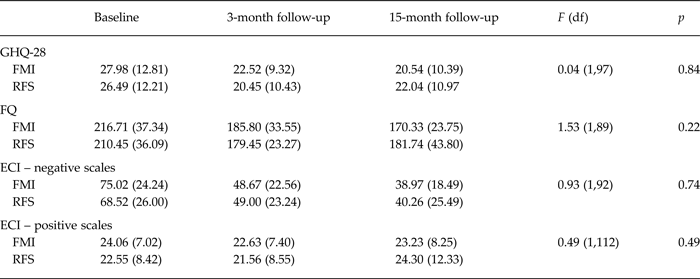
Table 2 presents the parents’ unadjusted means on the three measures of parental stress and sense of burden at baseline and at the 3- and 15-month follow-ups, as well as the results from the mixed-effect regression analyses. From baseline to each follow-up, there was improvement in both groups on all three measures; however, there were no significant main effects for time or for group when baseline scores were included as covariates. On the FQ there was, nevertheless, a significant group×time interaction (F = 4.08, df = 1, 66.07, p < 0.05). Specifically, in the FMI group parental distress further decreased from the 3-month to 15-month follow-ups, whereas in the RFS group, the improvement in parental distress remained stable across the follow-up assessments. The adjusted overall greater decrease in the FMI group across the follow-ups was 8.39 (s.e. = 9.87) points. This group × time interaction was not significant for the GHQ or for the positive or negative or scales of the ECI.
Parents’ baseline and follow-up scores, and linear mixed-effect regressions analyses between FMI and RFS

FMI, Family Motivational Intervention; RFS, routine family support; GHQ-28, General Health Questionnaire; FQ, Family Questionnaire; ECI, Experience of Caregiving Inventory; df, degrees of freedom.
Values are given as mean (s.d.).
Correlations between patients’ and parents’ outcomes
At 3 and 15 months after completion of the family intervention, no significant relationships were found between improvements in parents’ stress and sense of burden and reductions in quantity and frequency of patients’ cannabis use. The increases in parents’ adherence to MI skills at the 3-month follow-up in the FMI group was significantly correlated with reductions in (1) grams of cannabis that patients used at the 3-month follow-up (r = −0.45, p = 0.05) and (2) days that patients used cannabis at the 15-month follow-up (r = −0.42, p = 0.04). Furthermore, improvements in parents’ competence in MI skills was also significantly correlated with reductions of the number of days that patients used cannabis at the 3-month follow-up (r = −0.44, p = 0.05). Nevertheless, none of the other five relationships between MI proficiency of parents and patients’ cannabis use was statistically significant.
Discussion
This study demonstrated that training parents of patients with recent-onset schizophrenia in motivational and interactions skills was superior to RFS in reducing patients’ cannabis use over a 15-month follow-up period after the training had ended. Specifically, the gains that had been obtained in the FMI group at the 3-month follow-up in terms of a significantly greater reduction in quantity and frequency of patients’ self-reported cannabis use were retained at the 15-month follow-up. All of the urine test results that were positive for cannabis use at the 3-month and 15-month follow-ups corresponded to patients’ self-reports; however, the proportion of patients who declined to give a urine sample was high at each follow-up. Given that excessive use of alcohol and other substances than cannabis were hardly present among our patient sample, it was not possible to detect significant effects on these outcomes. The significant reduction in patient's subjective craving for cannabis in the FMI group at the 3-month follow-up was also maintained at the 15-month follow-up. Our prediction that craving would be an important mediator of continued cannabis use or cannabis abstinence was only partially confirmed. Furthermore, because only one patient in each condition relapsed after being abstinent from cannabis use, it was not possible to determine the predictive power of the OCDUS for relapse.
The results were inconsistent regarding the long-term greater effectiveness of FMI than RFS in reducing parents’ sense of burden and distress about their child's psychotic symptoms and cannabis use. In both groups, the improvements in parents’ psychiatric morbidity (as measured with the GHQ) and their appraisal of the impact of caring for their child (as measured with the ECI) seen at the 3-month follow-up were maintained at 15 months. However, the improvement in parents’ appraisal of their child's symptoms and behaviours (FQ) at the 3-month follow-up (as measured with the FQ) had further increased in the FMI group at the 15-month follow-up, but it remained stable in the RFS group across follow-ups. These results suggest that in the long term FMI is an effective approach to improve parents’ perception of their child's illness and their ability to cope with the child's symptoms.
Considering that cannabis use has consistently been associated with an adverse course of schizophrenia (Cleary et al. Reference Cleary, Hunt, Matheson and Walter2008), it is likely that it triggers stress and burden in family members. Accordingly, is it has been found that substance use in schizophrenia is associated with high levels of family stress and burden (Kashner et al. Reference Kashner, Rader, Rodell, Beck, Rodell and Muller1991; Dixon et al. Reference Dixon, McNary and Kegnab1995). It was surprising, therefore, that in the current study the reductions in patients’ cannabis use were not related to the improvements in parents’ distress and sense of burden. However, it should be pointed out that the applied measures of parental distress and burden do not focus exclusively on patients’ substance use, but on a variety of other factors that may be a source of stress in the caring for someone with recent-onset schizophrenia. Further work needs to clarify the precise impact of cannabis use in recent-onset schizophrenia on family distress and sense of burden, particularly in comparison with other illness-related characteristics of the patient.
Our prediction that in the FMI group patients’ reductions in cannabis use would be related to the improvements in parents’ proficiency in MI, was partially supported. This suggests that the IST next to the training in MI skills may be highly relevant in reducing cannabis use among patients in the early stage of schizophrenia. Clearly, research is needed to clarify why FMI works and which factors significantly contributed to its effectiveness.
It was surprising that excessive use of alcohol and other substances than cannabis was rare in our patient sample, given that high rates of use of alcohol and various other drugs have been consistently found in patients with first-episode psychosis (Barnett et al. Reference Barnett, Werners, Secher, Hill, Brazil, Masson, Pernet, Kirkbride, Murray, Bullmore and Jones2007; Wisdom et al. Reference Wisdom, Manual and Drake2011). This raises the question of whether patients in the present study tended not to disclose their alcohol and drug use other than their use of cannabis. However, the 100% concordance between self-reported abstinence and negative urine samples for cocaine, ecstasy and amphetamines suggest that the majority of patients did accurately reported at least their drug use at each assessment time point.
There are a number of limitations of the study that warrant discussion. Two of them concern the relatively small sample size and the high number of patients meeting the inclusion criteria who refused to participate. First, the relatively small sample in combination with the attrition of patients over the follow-up period, may have prevented us from detecting statistically significant differences between the conditions and from identifying relationships between patients’ and parents’ outcomes. Second, the high rate of refusal among patients might indicate that our included sample was not fully representative of the population of patients who use cannabis and receive treatment for first-episode psychosis.
A large portion of parents declined to participate, possibly indicating that FMI is not appropriate for every family. Nevertheless, the interventions were offered to all parents of patients who met the inclusion criteria regardless of their subjective perceived need for support. Considering the high engagement rates of parents in both conditions, it is reasonable to assume that parents in the FMI group were not a biased sample (e.g. more motivated than parents in the RFS group). A related concern with respect to external validity is that the trial included only (1) patients who had contact with a parent for at least 10 h per week, and (2) parents and no other family members or other relatives of the patients. For these reasons, we do not known whether the results can be generalized to patients without substantial contact with their parents or to relatives other than parents.
Because of the large number of patients who declined to give a urine sample, patients’ self-reported substance use could be confirmed for only 57% of the patients seen at the 3-month follow-up and for 55% patients seen at the 15-month follow-up. However, study results on the agreement between self-reported use and blood samples, indicate that the reports of cannabis use by patients with psychosis and co-occurring cannabis use disorders on the TLFB are valid (Hjorthøj et al. Reference Hjorthøj, Fohlmann, Larsen, Arendt and Nordentoft2011). It should also be noted that urine analysis might overestimate abstinence rates because the window during which cannabis in the urine can be detected is only 1–5 days for infrequent users, and up to 6 weeks for frequent users. This might explain why we did not detect cannabis use in the urine samples of three patients who reported that they had used cannabis.
In conclusion, this study demonstrated that adding a family motivational intervention to standard mental care for patients in the early course of schizophrenia is an effective approach to reduce cannabis use over the long term. This finding is important for clinical practice since cannabis use in this group is associated with poor illness outcomes (Cleary et al. Reference Cleary, Hunt, Matheson and Walter2008). However, the study also highlights the need to refine the intervention in order to retain more families in treatment. Clearly, additional research is required to determine the utility of this approach in other samples of patients and families.
Acknowledgements
This study was supported by ZonMw, the Dutch Counseling for Health Research and Development (grant no. 100003014), and by Eli Lilly. The authors thank the patients and parents who participated in the trial and Marijke Krikke for her contribution to the study.
Declaration of Interest
The Academic Medical Centre of the University of Amsterdam invited B. van Raaij to deliver the Interaction Skills Training on behalf of the training company ‘Bureau de Mat’.