1. Introduction
In recent years, the concept of social innovation (SI) has been extensively used in various social policy arenas, including poverty and inequality alleviation (Dearing, Reference Dearing2017), aging (Angelini et al., Reference Angelini, Carrino, Abou Khaled, Riva-Mossman and Mugellini2016), education (Loogma et al., Reference Loogma, Tafel-Viia and Ümarik2013), and healthcare (Mason, Reference Mason2017), among others. SI is seen as the solution to new social risks (Sinclair and Baglioni, Reference Sinclair and Baglioni2014), In East Asia, policy discussions of SI are growing fast (Shen and Li, Reference Shen and Li2017). The Chinese central government has made “promote social system innovation” a major policy priority (Ghys, Reference Ghys2017). The governments in Japan, South Korea, and Singapore, for example, have provided support for social innovation in various forms, such as in social entrepreneurship and social impact investment (Chandra and Wong, Reference Chandra and Wong2016; Mee-Hyoe, Reference Mee-Hyoe2013).
In Hong Kong, policy discussions of the concept of SI emerged in the early 2010s. This article illuminates how the term SI is used in policy discourse, originating with the NPM reform of the social service sector in the early 2000s, as part of the austerity measures in response to the 1997 Asian financial crisis and subsequent economic recession. Specifically, the roles played by an SI policy initiative (the Social Innovation and Entrepreneurship Development [SIE] Fund) in “reshaping” the incumbent social service sector in the post-NPM reform era are discussed. Taking the perspective of historical institutionalism (HI), this article further highlights some path dependencies arising from historical legacies inherited from the incumbent social service environment that continue to constrain policy efforts to enact institutional change.
The rest of the article is organized as follows. First, we elaborate on our conceptual definition of SI and the analytical framework of HI. Then, we outline the emergence of the concept of SI in policy, against the backdrop of social service sector reform in Hong Kong. The third section reports the findings of our empirical study exploring the roles of the SIE Fund as an institutional changemaker in the contemporary social service sector and the barriers arising from its historical legacies. Insights drawn from this case study are discussed in the final section.
2. Social Innovation (SI)
Several reviews have illustrated that the term “SI” arises from multiple academic fields (Choi and Majumdar, Reference Choi and Majumdar2015; Moulaert, Reference Moulaert, Moulaert, Swyngedouw, Martinelli and Gonzalez2010; van der Have and Rubalcaba, Reference van der Have and Rubalcaba2016). Owing to the multiple forms of framing, scholars have argued that it is difficult to understand precisely what SI means (Benneworth et al., Reference Benneworth, Amanatidou, Edwards Schachter and Gulbrandsen2015) and have characterized SI as a contested concept with definitional ambiguity (Ayob et al., Reference Ayob, Teasdale and Fagan2016; van der Have and Rubalcaba, Reference van der Have and Rubalcaba2016).
Within the context of social service reform, the conception of SI can be illuminated from two dimensions. The first dimension relates to the economic efficiency in social service delivery, where SI can be understood as the emergence of more efficient and novel solutions in addressing social problems, whether in the form of new products, process, or service models (Mulgan, Reference Mulgan2007; Phills et al., Reference Phills, Deiglmeier and Miller2008). Another dimension of SI concerns the “social justice” ideology (e.g. equal rights in accessing social service), where SI in this regard is “about the satisfaction of basic needs and changes in social relations within empowering social processes” (Moulaert, Reference Moulaert, Moulaert, Swyngedouw, Martinelli and Gonzalez2010, p. 10) and improvement of human welfare (Pol and Ville, Reference Pol and Ville2009). As illustrated later, this article has placed a greater emphasis on the first dimension by exploring the roles of the SIE Fund in enhancing the economic efficiency of the social service sector, but admittingly it devoted relatively less attention towards the second dimension – the extent to which the policy initiative has (or has not) enhanced the welfare of the underprivileged. This is certainly an important question to explore but however is beyond the scope of the present investigation.
3. Historical Institutionalism (HI)
HI is a major theoretical account in the study of public policy and institutional change. Its central premise emphasizes the role of historical factors in structuring policy and institutional development (Béland, Reference Béland2005; Immergut, Reference Immergut1998; Thelen, Reference Thelen2004), HI stresses that policy progress tends to exhibit path dependency (Mahoney, Reference Mahoney2000), where vested interests created by previously enacted policies and established institutions, formal or informal, are likely to constrain future decision making among political actors and interest groups. This path-dependent characteristic favors the reproduction of established institutional logic, creating a self-reinforcing dynamic (institutional lock-in), even when such approaches result in sub-optimal efficiency (Woerdman, Reference Woerdman2004). Unintended consequences may also arise from tensions between new arrangements and the incumbent institutional structure, constraining efforts in driving institutional change (Schmidt, Reference Schmidt, Landman and Robinson2009).
From the viewpoint of HI, changes in policy and institutional settings are likely to be incremental, and although possible, path-altering institutional changes are rare (Béland, Reference Béland2005; Béland et al., Reference Béland, Rocco and Waddan2016; Hacker, Reference Hacker2004). For institutional change to take place, some HI scholars emphasized the assessment of previously enacted policy measures and their consequences. Two reasons have been highlighted for the need for such assessment. The first draws insights from Kingdon’s agenda-setting theory outlining the role of assessments in drawing political attention to particular sets of “pressing issues” and directing policy makers’ focus to deliberating over potential alternatives (Béland, Reference Béland2005). The second lies in the concept of social learning (King and Hansen, Reference King and Hansen1999). As Hugh Heclo notes, quoted in Béland’s paper (Reference Béland2005, p.4), “policy invariably builds on [established] policy, either in moving forward with what has been inherited, or amending it, or repudiating it”. In this context, “a process of learning may be said to occur when policy makers respond to the failures of a past policy, draw lessons from that experience and incorporate these into the making of new policy.”
A substantial body of literature uses HI as an analytical framework to elucidate the process of social service reform (Béland, Reference Béland2005; Béland et al., Reference Béland, Rocco and Waddan2016; Pierson, Reference Pierson1996). In non-profit studies, social origin theory uses HI as a conceptual framework illustrating the influence of socio-historical factors in non-profit sector development across regions (Salamon and Toepler, Reference Salamon and Toepler2015). Research regarding SI from an HI perspective largely exists in regard to social enterprise (Defourny and Nyssens, Reference Defourny and Nyssens2010; Kerlin, Reference Kerlin2010), This study extends this line of work by using HI as an analytical framework to explore the dynamic interplay between new SI policy and inherited institutional logic in the social service sector of Hong Kong.
4. The rise and evolution of the social service sector in Hong Kong
In Hong Kong, state social welfare provision emerged in the late 1950s, when the colonial government’s minimalist approach toward welfare started changing. Before that, state provision of social welfare was almost non-existent, but some Chinese civic associations and Western non-profits provided education and social services to the underprivileged.
In the early 1970s, after two large-scale social riots, the colonial government started taking a more active role in social welfare provision. During this period, a substantial expansion of social service provision was implemented, including the introductions of nine years of free and compulsory education, a 10-year housing program, the approval of the Labour Ordinance, and the establishment of the first social assistance scheme. The first five-year Plan for Social Welfare Development White Paper was also published during this period, in 1973. During this phase, the state became the major financier of social services, whereas non-profits were used, typically through contracting, as service delivery agents (E. W. Lee, Reference Lee2005; K.-L. Tang, Reference Tang1998). From the 80s to the mid-90s, Hong Kong enjoyed steady economic growth, while social welfare provision increased incrementally, as the demands of social care also increased and economic prosperity allowed the state to secure sufficient fiscal budgets to support social service development. The non-profit sector expanded and its image as a social service provider also became more widely established in society (E. W. Lee, Reference Lee2012).
The New Public Management reform of the social service sector in the early 2000s
Hong Kong’s economic environment was shaken in 1997 by the Asian financial crisis. With declining economic growth and growing social expenditure, the HKSAR government faced increasing challenges in regard to maintaining the sustainability of the social welfare system, which eventually led to major reform. In tandem with the proliferation of neoliberalism as a developmental paradigm, the social service sector underwent “new public management” (NPM) reform. E. W. Lee (Reference Lee2012) describes NPM reform of social services as the “marketization” of the non-profit sector.
During NPM reform, the HKSAR government increasingly cut social services budgets under a subvention scheme. In addition, the government imposed market-based regulations, such as the introduction of the Service Performance Monitoring System and the Lump Sum Grant system on non-profits in order to increase non-profits’ “competitiveness”, “value for money”, and “efficiency”. The five-year Plan for Social Service Provision was also replaced by an annual Resource Allocation Exercise. In essence, the policy strategies implemented during the NPM reform of social services encourage non-profits to develop business-like activities. In order to facilitate the reform, the HKSAR government introduced two major funding schemes to incentivize non-profits to develop self-financed services or social enterprises.Footnote 1 Seizing these opportunities, many well-established non-profits during this period transformed (or “reframed”) their existing services, which had previously been funded under the subvention program, into self-financed services and called them “social enterprises” in order to secure financial resources under the new public funding schemes, to compensate for budget cuts. As the government positioned the two new funding schemes as measures for poverty alleviation, with a focus on enhancing the employability of disadvantaged populations, the social entrepreneurial environment became dominated by work-integration activities (Chan et al., Reference Chan, Kuan and Wang2011; Defourny and Kim, Reference Defourny and Kim2011). These were later criticized for being overly homogeneous and lacking diversity and innovation (J. C. Y. Lee, Reference Lee2016).
The introduction of SI in public policy discourse during the early 2010s
In the early 2010s, some policy experts started questioning the efficacy of NPM reform on the social service sector. While the reform inevitably forced non-profits to explore new avenues to generate income, NPM measures “had done little to alter the high-resource dependency of non-profits on the government” (E.W. Lee, Reference Lee2012, p. 547). Several reports highlighted that a notable proportion of social enterprises were unlikely to achieve financial sustainability without continuous government support (K. L. Tang et al., Reference Tang, Fung, Au, Lee and Ko2008). In the face of this criticism, the HKSAR government was forced to refine its policy in regard to support for the social service sector, including social enterprises.
The discussion of SI in regard to policy in Hong Kong emerged against this backdrop, coinciding with global trends of renewed interest in the concept of SI among policymakers, social service practitioners, and scholars. While the discussion of SI had been used in the local policy field since the early 2010s, the formal introduction of the term came in the 2014 Chief Executive’s Policy Address and was described as “encourag[ing] individuals and organizations who care about social development to help tackle poverty and associated problems by innovative ideas” (p. 62).Footnote 2 To support this political agenda, the government institutionalized the SIE Fund. The stated objective of the Fund is “to establish or support schemes and experiments with a view to attracting, inspiring or nurturing social entrepreneurship to develop innovations that aim at creating social impact and build social capital for supporting poverty relief”.Footnote 3
This article reports the findings of our recent study aiming to explore how the Fund has impacted the social service sector, particularly about enhancing the efficiency of the social service sector. In this study, the social service sector is defined as the collective group of agencies both non-profits and for-profit social enterprises, for which the main organizational purpose is social service delivery.
5. Methods
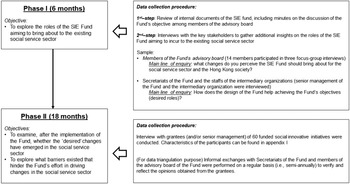
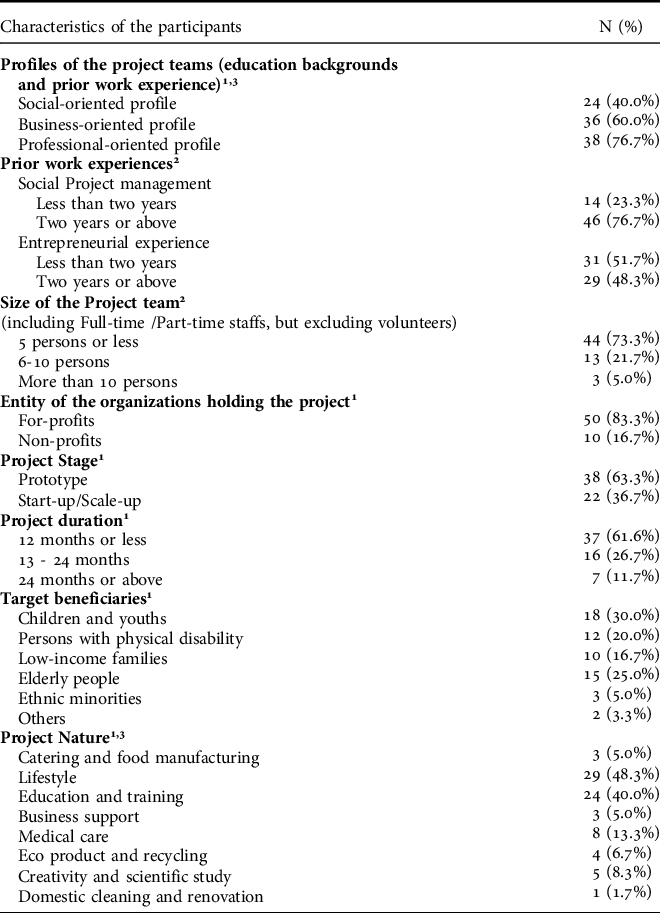
We selected a qualitative method to address this research question because previous research has highlighted the way in which qualitative work is a preferable method of addressing questions pertaining to the dynamics of institutional change (Mahoney and Thelen, Reference Mahoney and Thelen2009). The evaluation study adopted a two-phase design (Appendix I). The objective of the first phase (a six-month period) was to identify the intended impacts (i.e. institutional changes) that the Fund was attempting to achieve in the social service sector. To do so, we (CHC and CC) reviewed the relevant internal documents of the SIE Fund and invited members from the Secretariat (an intermediary organization) and the fund’s advisory board to participate in face-to-face interviews, in order to gain additional insights into the Fund’s objectives and the rationale behind its design. The second phase of the study involved exploring whether the intended changes had emerged in the social service sector since the introduction of the Fund. To address this research objective, we invited all grantees of the funded initiatives for face-to-face interviews. During an 18-month data collection period, grantees of 60 funded initiatives were recruited as participants. This group of participants represented a diverse group with varying backgrounds and experiences in the existing social service sector (the characteristics of these participants are summarized in Appendix II). As a whole, they provided insights into our enquiry from various perspectives. In the semi-structured interviews, the participants were asked to share their views and opinions regarding their experiences of the funded initiatives. Attention was given to their perceptions of: (1) how the SIE Fund enabled their work in the existing institutional landscape of the social service environment; and (2) what barriers they faced during the implementation of their initiatives and how those barriers are related to the status quo of institutional settings. Informed consent was obtained prior to the interviews and confidentiality and anonymization of participants during data analysis were ensured. Ethics approval was obtained from the Human Research Ethics Committee of the University of Hong Kong (reference no. EA160620),
Thematic analysis was employed to analyze the content of the Fund’s documents and the transcriptions of the interviews in the following steps: familiarizing ourselves with the data, generating the initial codes, searching for themes, reviewing the themes, defining and naming the themes, and, finally, producing a report (Braun and Clarke, Reference Braun and Clarke2006). Keywords and responses relevant to the research objectives were identified and highlighted in each interview transcript and were subsequently classified into categories and then by emergent themes. To enhance the reliability of the data, two of the authors (1st and 2nd author) coded the transcripts independently, for comparative purposes. Where there were discrepancies, the research team discussed the issues among themselves until they reached a consensus. The other co-author (3rd author) acted as “devil’s advocate”, to challenge the findings that emerged, and took part in refining them.
6. Findings
As a result of the document reviews and the interviews with the participants, we posit that the SIE Fund acts as an institutional changemaker in the existing social service sector, particularly in the three following areas: (1) facilitating emergence of “new” forms of social entrepreneurial activities to fill unmet gaps that have not been fully addressed by existing social service provisions; (2) empowering new actors in entering the social service sector; and (3) reinforcing the government’s position in regard to the NPM reform of the social service sector in order to manage social spending. However, despite the Fund’s efforts to drive changes in the incumbent social service sector, the data revealed that several historical legacies inherited from the incumbent institutional setting (“lock-ins”) constrained the Fund’s efforts. In the following, our views on the roles of the SIE Fund in the social service sector reform are explained. For each area of institutional change, the historical factors that hinder the Fund’s efforts are then delineated. Quotations presented below are drawn from data collected from the grantees of the 60 funded initiatives.
Facilitating emergence of new forms of social entrepreneurial activities to fill unmet social needs
As highlighted earlier, during NPM reform, the HKSAR government abandoned the five-year planning exercise for social service provision. This decision led to problems of its own, as it failed to account for the new and pluralistic demands for social care resulting from rapid demographic and socioeconomic transformations. The incumbent social entrepreneurial environment was dominated by work-integration projects that lacked the diversity to adequately address the broad range of social needs. We contend that the introduction of the Fund by the government was intended to address this issue by facilitating “new” solutions led by civic society. The resulting social innovation initiatives were funded with intention to fill unmet gaps that had not been fully addressed by existing social service provisions (i.e. services supported under the subvention program and the Lump Sum Grant Scheme). Data collected from the grantees ascertained that the Fund was viewed as being relatively open-minded (compared with other forms of established public funding), allowing them to develop alternative (non-conventional) solutions to “better” address some existing social issues.
“The SIE Fund filled some [funding] holes in the social welfare system. Currently, there is no such education program for ethnic minority groups. Conventional social welfare funding channels [e.g. subvention or lump sum grants] may not support our initiative. Even if they were willing to do so, I believe it will take years to change the existing system to incorporate our work. The Fund gave us an alternative and quicker way to establish our initiative.” (case 19)
“The Fund appeared to be willing to support “unorthodox” social initiatives. With other [social enterprise] funds, the funders were very much confined to a “rigid” concept of what the service models should be like. The SIE Fund seemed different and I thus tried something “new”.” (case 23)
Data also revealed that some historical legacies inherited from the conventional social service setting (“lock-ins”) constrained the Fund’s efforts to develop and diversify service provision. A few participants highlighted that, although they were encouraged by the opportunities granted to them by the SIE Fund to try different forms of social entrepreneurial activities, the normative belief that social enterprises are supposed to address (un)employment was too embedded within the local psyche for them to enact meaningful change in this respect. Participants’ strongly perceived that existing institutional norms situated their work as being equivalent to work-integration social enterprises and that this hindered their ability to experiment with “alternative” services that could address the pluralistic needs of the underprivileged. Grantees reported coercive pressure to include a work-integration component in their initiatives, even if it did not align with their ventures’ social missions, and caused them to incur increased costs.
“[While the organization aims to enhance social inclusion for the elderly, the project grantees] included work-integration in our business operation; otherwise, others [the general public and other stakeholders] would not see us as a social enterprise.” (case 7)
“After discussing the issue with funders and advisers, they suggested integrating the provision of jobs with my project’s targets. Operationally, this was challenging. The kids were generally not motivated and needed us to pay quite a [bit] of attention to them.” (case 24)
Empowering new actors in entering the social service sector
It is evident that the SIE Fund has also played a role in empowering new actors to participate in the social service sector. As outlined earlier, during the period of NPM reform, many well-established non-profits reframed their services as “social enterprises”, as a work-around to obtain resources from the newly established public funding schemes that encourage business-like activities. Given its affiliations with the established non-profits that held a strong track record and had good connections with the government, this group of actors were often situated in a favorable position in funding competitions. Many newly founded social enterprises (e.g. those that were not affiliated with established non-profits) encountered difficulties in winning funding competitions and securing resources to develop their services.
The design of the SIE Fund clearly aimed to address this issue. First, unlike the two previously established public social enterprise funds, which exclusively supported non-profit actors,Footnote 5 the funding eligibility of the SIE Fund is more inclusive, allowing actors from both non-profits and for-profits to apply. Its multi-stage funding design provides opportunities for agencies with relatively little experience to obtain seed money with which to experiment and develop their services.Footnote 6 While this contribution of the SIE Fund was first illustrated by a recent study showing that the Fund enabled a group of new players, typically for-profit actors, to enter the social service field (C. H. Chan et al., Reference Chan, Chui, Chan and Yip2019), data collected from our interviews further add support to Chan et al.’s work. Participants indicated that both the financial support of the Fund and their efforts to help them gain wider public recognition facilitated the development of their work, particularly those working for for-profit entities and lacking a track record in social service delivery.
“I started my company some years ago. A few years ago, I participated in a local campaign in ethical consumption and, since then, I have been trying to embark on some [socially inclined] work. The SIE Fund helped me to realize my goal… It’s not only about the financial support. As I am new to the social service field, only a handful of stakeholders knew me. Since obtaining the funding, there [have been] more stakeholders perceiving my work as doing social good [rather than simply trying to make a profit]. There are more and more people “accepting” our work, as we are funded by the SIE Fund.” (case 42)
However, despite the Fund’s efforts to empower this group of new actors in social service delivery, one commonly reported theme was the tilt in the existing institutional arrangement favoring conventional non-profits in regard to resource acquisition. The participants attributed this tilt to the dominance of non-profits in the social service sector, due to the longstanding state-non-profit partnership. Specifically, a notable number of participants pointed out that some public funding bodies other than the SIE Fund, owing to its original setup, remained exclusive to non-profits. Given that the existing tax deduction system only applies to donations to entities with a non-profit status, participants suggested that some donors were more inclined to sponsor non-profits than new for-profit social agencies. This favoritism toward non-profits was observed in other aspects, such as in reduced rental costs for some public amenities.
“With a commercial company status, there are a lot of restrictions [in applying for funding]. I have approached a number of funders and many are receptive to my work. But, when they asked me if I am a non-profit organization and I told them I am not, they said they could not support [me]. They said they will only support non-profit organizations.” (case 7)
“In the current public system regarding renting facilities, such as concert halls and recreational facilities, non-profit organizations have a higher priority than ventures registered as a business company do. Ventures with a non-profit status enjoy advanced venue bookings and pay less. Even though our mission is the same as the non-profit organizations, we are disadvantaged.” (case 34)
Participants also reported that the inequality between for-profits and non-profits hinders their ability to form cross-sector collaborations for the sake of project development. They claimed that potential collaborators from other sectors harbored a sense of mistrust toward social startups run by business entities and thus refused to collaborate with them. Some agencies were discouraged by these experiences and showed reluctance in continuing in the field.
“We tried to sign a memorandum of understanding with several public estates, allowing us to conduct our business, but many replied that they would only sign with non-profit organizations.” (case 5)
“We contacted some [potential collaborators], but they won’t let us in because they are apprehensive about our intention, since we are a commercial entity. We are not a non-profit organization and they don’t trust us. It would have been very different if we were a non-profit social enterprise, but we are an individual, private company.” (case 33)
“We are not going to continue this project after completing the mandates of the funding requirement. [Given the for-profit entity of our agency], this is very difficult to secure organizations to work with us. I felt the investment of our time was too much.” (case 33)
Reinforcing the government’s position on NPM reform of the social service sector
The third role of the SIE Fund can be recognized as a reinforcer of the government’s position on the NPM tenet of the social service sector, with the aim of reducing public spending. As outlined in an earlier section, policy experts have questioned the efficacy of NPM reform, citing its failure to reduce the high-resource dependency of non-profits on the government. Some attributed the poor financial performance among social enterprises (in the 2000s) to a deficiency in entrepreneurial skills. In this regard, the design of the SIE Fund, allowing for-profit actors to apply, could be seen as a way of enticing individuals with a strong entrepreneurial background to enter the social service field. In addition, the Fund’s aim of enhancing the entrepreneurial spirit of social service agencies can also be embodied by its use of intermediary organizations to deliver business incubation support. During the repeated exchanges with members of the advisory board of the Fund, the author (CHC) recognized that the Fund strongly encourages and expects funded initiatives to eventually become self-sustainable without public funding support. Some participants testified that the incubation support of the intermediaries has had a positive impact on the financial sustainability of their initiatives.
“The courses organized by the intermediary organization were useful. They refreshed my understanding of running a social agency [even though I had been managing the financial matters in my own organization for some years]. The mentor [part of the incubation support provided by the intermediary organization] helped us to improve our business model. Previously, we had mainly depended on funding and donations; now, we have developed another revenue stream.” (case 45)
However, there is notable evidence suggesting that some historical factors would be likely to undermine the Fund’s efforts to enhance the financial viability of their funded initiatives. As highlighted earlier, a number of participants who identified themselves as entities with a for-profit status typically reported that the acquisition of financial resources outside of the SIE Fund itself was difficult. Some experienced isomorphic pressure to convert their ventures from a for-profit to a non-profit status, despite having to incur a transaction cost (i.e. an additional administrative workload) in the process of doing so.
“After considering the pros and cons, we (re)made ourselves as a non-profit [converting from a for-profit venture], despite there being so much administrative work and documentation needed. It was a very lengthy process.” (case 18)
Another theme that emerged from the data was the way in which the participants perceived the incumbent social entrepreneurial environment as disproportionally emphasizing non-profit-making characteristics. Some perceived that this normative perception resulted from a large number of existing social enterprises that are non-profit hybrids (i.e. within the commercial-social continuum) skewed toward a social origin. Among the interviewed grantees, a notable proportion came from strong commercial backgrounds and placed emphasis on entrepreneurial logic. Their deviation from the established cognitive prescription of what constitutes social entrepreneurship apparently created issues regarding project implementation. Facing this institutional difference, some explained that their social entrepreneurial activities were often met with skepticism or were delegitimatized. Participants stated that the distorted societal norms equating social enterprises to charity adversely affected their competitiveness and sustainability because they were forced to lower the pricing of their products and services.
“They see us more as a charity [rather than an enterprise]. Some assume that, since we have a social mission, we must not make a profit. We often get questions [about] why we are operating at market prices. This always concern[s] me when we price our products. I want to educate the public that social entrepreneurship is not equivalent to social services for poverty relief.” (case 26)
“Some of our [business] clients advised us not to tell others that we are a social enterprise, as this will give the perception that our products are [of] low quality, and they don’t want to be seen as doing business with social enterprises.” (case 47)
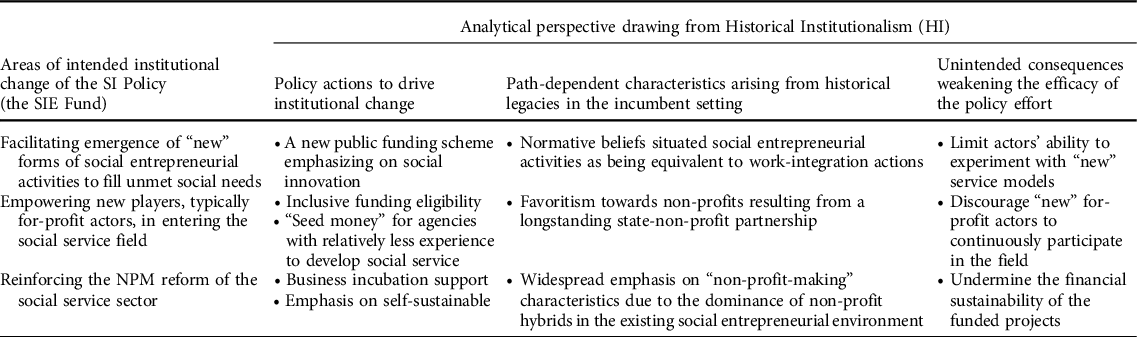
The above illustrates our views on the three major ways in which the SIE Fund functions in terms of contemporary social service reform in Hong Kong. At the same time, it shows how some historical factors have “got in the way”, undermining the Fund’s efforts as an institutional changemaker. A summary is provided in table 1.
A summary of the findings based on the HI framework

7. Conclusion
This article illuminates how the term SI is being used in the policy realm in Hong Kong in relation to NPM reform of the social service sector originating in the early 2000s. The roles of an SI policy initiative, the SIE Fund, as an institutional changemaker in the existing social service system in the post-NPM reform era was explored. Drawing insights from the analytical perspective of HI, path-dependent characteristics arising from the incumbent social service sector constraining policy efforts in regard to bringing about changes were highlighted. Our assessment, pointing toward the historical factors undermining policy efforts, facilitates policy learning to take place (Béland, Reference Béland2005) and would be conducive for future policy refinement.
This article elucidated how a multitude of factors in the course of NPM social service reform in Hong Kong, as well as the international trend, have shaped the emergence and the functions of the SI policy. While the HKSAR government framed the Fund as a policy effort to drive social innovation, we argue that one of its major functions was to fill some of the unmet gaps in the existing social service provision resulting from the abolishment of the five-year planning exercises that have caused the provision system to become increasingly fragmented and less adaptive to the pluralistic demands of social care (E. W. Lee, Reference Lee2012).
Another major aim of the SI policy initiative is to empower new players, many of which are for-profit actors, to enter the social service field. Specifically, the Fund aims to bring about this change by creating a more inclusive funding mechanism that allows actors lacking a track record in social service delivery to develop their innovative social work. While consistent findings were found in a recent study ascertaining the Fund’s role in enabling for-profit actors to develop their social entrepreneurial activities (Chan et al., Reference Chan, Chui, Chan and Yip2019), our data additionally reflect some widespread norms and established institutional logic in the incumbent environment, which serve as a counterbalancing force that constrains the Fund’s efforts. The most notable tension emerges from the established institutional logic that conceives of non-profits as the “only” legitimized entities for social service delivery; agencies with a different legal status (e.g. registered businesses) are less legitimate. This institutional logic results from the long-term state-non-profit partnership developed since the colonial era. Throughout the past several decades, these ideas have been deeply institutionalized in contemporary Hong Kong society. In this light, we argue that, to cultivate a friendly environment that allows for-profit actors to participate in social service delivery, efforts to break through this institutional inertia (i.e. the tension between for-profit and non-profits in social service delivery) are warranted.
The third purpose the SIE Fund serves is to reinforce the government’s position in regard to princples of NPM in social service reform. This adds additional evidence to the international literature on the no-reversal signs of the NPM reform in the non-profit sector (Alexander et al., Reference Alexander, Brudney and Yang2010; E. W. Lee, Reference Lee2012), This political agenda is embodied by the Fund’s strategy to entice actors from for-profit backgrounds (with a strong entrepreneurial spirit) to develop social entrepreneurial activities and use intermediary organizations to incubate funded initiatives, in order to enable them to become more financially self-sustainable, although the data revealed that the incumbent institutional logic involved, such as favoritism toward non-profits and the norm equating social enterprises with charities, created hurdles for the grantees in developing their social entrepreneurial processes. Our data, along with a few studies in the current social innovation literature, highlight some barriers to SI (Chalmers, Reference Chalmers2013; Howaldt et al., Reference Howaldt, Schröder, Kaletka, Rehfeld and Terstriep2016); this work extends prior studies by illustrating the potential causes of those barriers.
Regarding the ongoing social service reform in Hong Kong, an important question that needs to be raised is whether or not the increased use of social entrepreneurial models in social service provision actually enhances the welfare of the deprived. Hong Kong is a society that faces challenges associated with high income inequality (Lau and Gordon, Reference Lau and Gordon2017), There is a danger that increasing marketization may exacerbate the problems of inequality, potentially leading to greater overall societal outcomes whilst at the same time creating an underclass that receive an inferior standard of health and social care due to lacking the financial resources of others.
Some of the threats to social justice have been highlighted in literature examining the Nordic model of social welfare, which follows the principle of universal welfare (i.e. equal access to all, regardless of income or status) yet has been undergoing increasing marketization. These include the danger that marketization leads to services being provided not based on the actual needs of users, but based on ability to make informed choices about which services to use, or ability to pay top-up fees (Moberg, Reference Moberg2017; Anttonen and Karsio, Reference Anttonen and Karsio2017), In light of these risks, it will be important to ask to what extent this policy scheme, as part of the wider process of social service reform, will empower the vulnerable in Hong Kong and protect principles of equal access? Or more precisely, how will the scheme avoid reinforcing a market-based system that can aggravate forms of social exclusion? These are crucial questions to address, although admittingly they go beyond the scope of this investigation and will require examination in a subsequent paper.
On a separate note, despite this study’s inclusion of a substantial number of stakeholders to address our research question, one limitation of this work is related to our primary pool of participants. Participants are associated with the Fund (e.g. grant holders, intermediaries sponsored by the Fund) and were selected on the basis that they were in a position to inform us on the impact that the Fund has had on them and the social service sector. However, this selection meant that other actors not directly involved in this process were not included. Whether or not and how this latter group may be indirectly influenced by this policy initiative is thus unclear. Future study is warranted to solicit wider views.
Nonetheless, this article demonstrates how historical context matters in revealing the emergence and political framing of an SI policy in a particular socioeconomic context. Our case study illustrates the way in which the development of the SI policy in Hong Kong is historically tied to NPM reform. It also highlights how institutionalized state-non-profit partnerships in social service provision hinder SI policies acting as institutional changemakers. This work, one of few empirical policy analyses to date, contributes to the theorization of the role of SI policy in social service sector development in the East Asian context.
The two-phase design of the evaluation study
1The advisory board (in its second term) of the SIE Fund consisted of 19 members from diverse backgrounds, including academics, social entrepreneurs, welfare officers, legislative council members, impact investors, and individuals from the private sector (https://www.sie.gov.hk/sie/en/who-we-are/task-force/index.page?).

Characteristics of the participants, including profile and years of prior work experience of the project holders, characteristics of the entity holding the projects, and the natures and details of the project. (N = 60)