Introduction
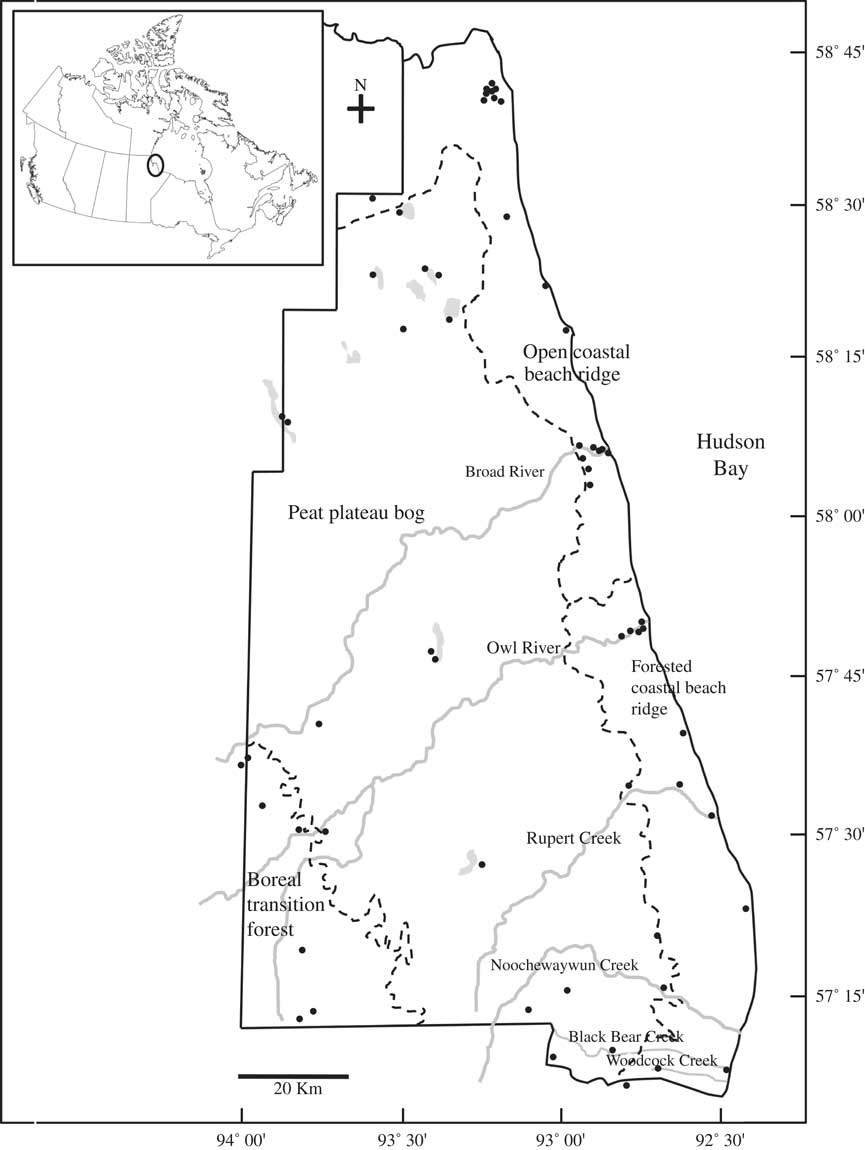
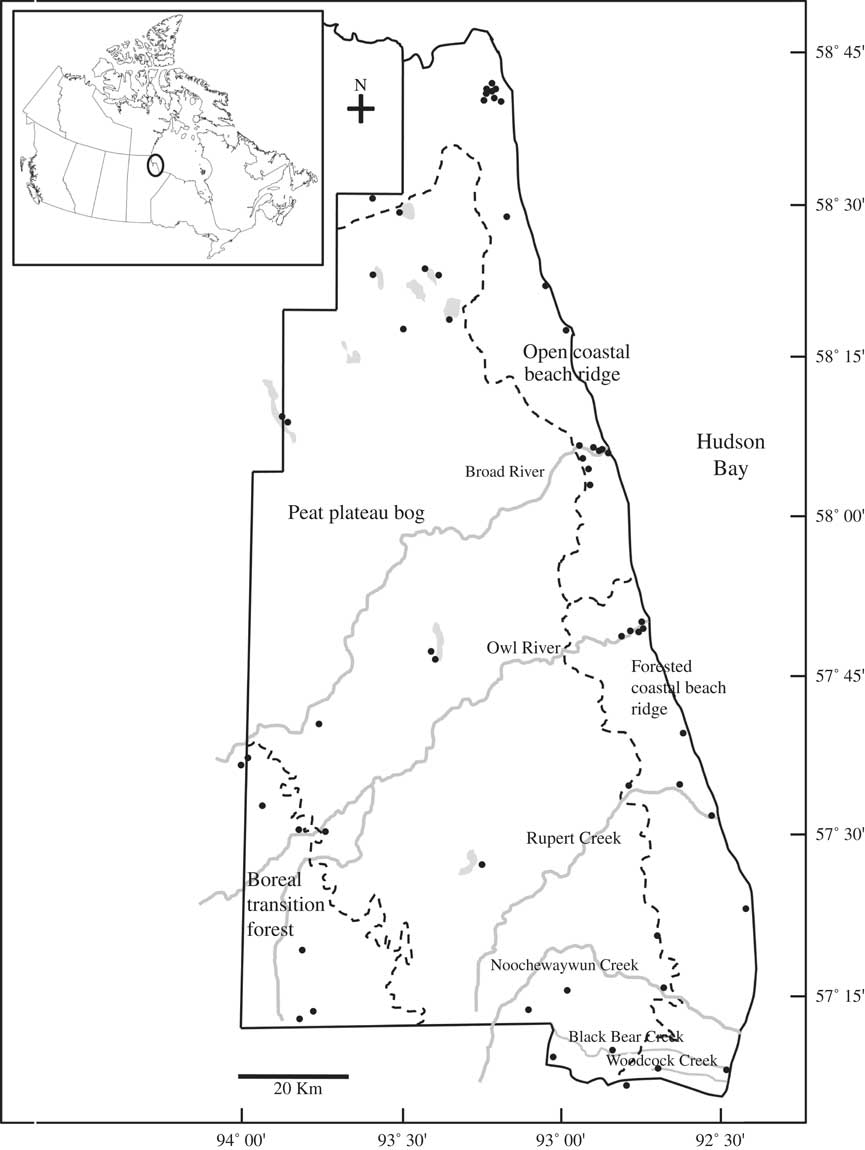
Wapusk National Park covers 11 475 km2 on the west side of the Hudson Bay in Manitoba, Canada (Fig. 1). The terrain is composed of raised calcareous beach ridges and intervening fens that become older with greater vegetation cover further inland because of the slow retreat of the Tyrell Sea over the last 8000 years into the present day Hudson Bay (Dredge Reference Dredge1992). The beach ridge system in Wapusk National Park is important for understanding global environmental change (Scheffers et al. Reference Scheffers, Engel, Scheffers, Squire and Kelletat2011) and provides diverse habitats for lichens and bryophytes, which play significant roles in the ecosystem as winter food for caribou and reindeer (Rominger et al. Reference Rominger, Robbins and Evans1996) and are indicators for polar bear den choice (Richardson et al. Reference Richardson, Stirling and Hik2005). Other roles include nutrient cycling and soil stabilization (Dahlberg & Bültmann Reference Dahlberg and Bültmann2014). The large expanse of lichen and moss ground cover in the interior peat plateau provides a habitat for polar bears to build dens, which are excavated in the sides of lichen-covered peat palsas (Richardson et al. Reference Richardson, Stirling and Hik2005). The National Park was established in 1996 to protect polar bears and their dens, as well as other wildlife such as birds, caribou, and small mammals that are found in the area (http://www.pc.gc.ca/eng/pn-np/mb/wapusk/index.aspx). Previous studies have examined patterns in macrolichen species distribution, method of reproduction, and substratum preference in specific areas of the Park (Piercey-Normore Reference Piercey-Normore2005, Reference Piercey-Normore2006, Reference Piercey-Normore2008, Reference Piercey-Normore2010; Cassie & Piercey-Normore Reference Cassie and Piercey-Normore2008), but no study has reported both the microlichen and macrolichen patterns of occurrence throughout the entire area based on habitat type, which is represented here by physiographic regions.
Map of Wapusk National Park (boundary shown by solid black line) showing the four physiographic regions delimited by dashed black lines. The latitude and longitude are indicated to the right and bottom of the map. The black dots represent the locations visited. The grey lines and patches represent water bodies relevant to this study. Map of Canada produced by J. Doering, using NAD83 Lambert Conformal Conic projection. Source data collected from Natural Resources Canada, 2003, downloaded from www.arcgis.com.
Climate change has already resulted in a decrease in lichen biomass and cover in Arctic regions (Shaver & Jonasson Reference Shaver and Jonasson1999; Jandt et al. Reference Jandt, Joly, Meyers and Racine2008; Joly et al. Reference Joly, Jandt and Klein2009) and this is predicted to continue (Chapin et al. Reference Chapin, Shaver, Giblin, Nadelhoffer and Laundre1995; Cornelissen et al. Reference Cornelissen, Callaghan, Alatalo, Michelsen, Graglia, Hartley, Hik, Hobbie, Press and Robinson2001; Epstein et al. Reference Epstein, Calef, Walker, Chapin and Starfield2004; Walker et al. Reference Walker, Wahren, Hollister, Henry, Ahlquist, Alatalo, Bret-Harte, Calef, Callaghan and Carroll2006). As the Hudson Bay Lowlands, which might be considered a subarctic environment, become climatically milder, lichens could become replaced by vascular plants (Cornelissen et al. Reference Cornelissen, Callaghan, Alatalo, Michelsen, Graglia, Hartley, Hik, Hobbie, Press and Robinson2001). If the moss and lichens of the peatlands in the interior of Wapusk National Park are replaced by either vascular plants or other lichens as a result of climate change, the polar bear dens and other wildlife habitats might also be affected.
The Hudson Bay Lowlands in Ontario have been extensively studied by Kershaw and co-workers (Kershaw & Rouse Reference Kershaw and Rouse1973; Kershaw & Larson Reference Kershaw and Larson1974; Larson & Kershaw Reference Larson and Kershaw1975; Pierce & Kershaw Reference Pierce and Kershaw1976; Kershaw Reference Kershaw1977) and beach ridge systems in other parts of the world have also been investigated (Christensen & Johnsen Reference Christensen and Johnsen2001; Scheffers et al. Reference Scheffers, Engel, Scheffers, Squire and Kelletat2011), but those studies were either non-floristic or the systems have different combinations of environmental and geological conditions to those of Wapusk National Park. The goal of this study was to explore patterns in lichen diversity as related to physiographic regions to better understand species diversity and distribution of lichens throughout the study area. More specifically the objectives were: 1) to determine lichen species diversity including species richness and evenness; 2) to explore the patterns of species distribution; and 3) to compare lichen growth form and substratum relationships among physiographic regions.
Materials and Methods
Field collections
Fieldwork was carried out between 2002 and 2010 for 10–14 days per year in 59 remote locations of Wapusk National Park (Fig. 1; Supplementary Material Table S1, available online). Standardized sampling of a wide range of microhabitats was conducted by one person in each location, which required c. 3–5 hours for collecting lichens and usually two locations per day were visited. Access to some locations required hiking from base camp while others were visited by helicopter. Respect for polar bear habitat and frequent encounters made it impossible to thoroughly sample some locations. Sampling involved collecting at least one specimen for each species that appeared to be new to the location and its presence for the location was recorded. The number of locations per physiographic region in which a species occurred was used as an estimate of abundance. Specimens were collected in paper bags, labelled, and allowed to air dry before further processing. Thin-layer chromatography (Orange et al. Reference Orange, James and White2001) was performed when required. Lichen nomenclature follows Esslinger (Reference Esslinger2015). All voucher specimens were deposited in the University of Manitoba Herbarium (WIN) or the Canadian Museum of Nature (CANL).
Four physiographic regions modified from those outlined by Wapusk National Park (http://www.pc.gc.ca/pn-np/mb/wapusk/visit/carte-map/carte-map-03.aspx) were delimited for this study (Fig. 1). These regions include open coastal beach ridges and fens (open calcareous beach ridges and intervening fens with willow and dwarf birch), forested coastal beach ridges and fens (the same beach ridge system in addition to forests of spruce and larch), peat plateau bogs (inland open peat polygons, plateaus, and lakes with margins of Picea mariana (Mill.) Britton et al., P. glauca (Moench) Voss, and Larix laricina (Du Roi) K. Koch.), and boreal transition forest (includes elements of the boreal forest). A description of the study area was provided by Brook (Reference Brook2001). Specimens collected from three locations that were burned in the past 20–30 years were recorded and separated in the analyses. Descriptions of collection locations, including the major vegetation type, structural features, substrata, and the latitude and longitude, were recorded with each sample. General substratum characteristics were recorded over eight categories: 1) foliose and fruticose lichens growing among loose moss or among mosses and fruticose lichens on the ground (among lichen/moss); 2) all lichens on bark (bark); 3) all lichens on bone (bone); 4) all lichens on decaying wood (decayed wood); 5) all lichens on weathered or driftwood (driftwood); 6) all lichens on rock (rock); 7) all lichens growing directly on the surface of soil or humus (soil/humus); 8) all lichens growing on the surface of compact moss cushions or peat moss, but not humus (on moss surface).
Data analysis
The number of species collected per location for each physiographic region was plotted by jackknife sampling (Colwell & Coddington Reference Colwell and Coddington1994) to visualize the accumulation of species for the nine-year collecting period.
Non-metric multidimensional scaling (NMS) was performed on species presence/absence using PC-ORD (version 6.21; McCune & Mefford Reference McCune and Mefford2011). This method was selected because it assumes monotonicity of data and it neither assumes distribution shapes in the data nor distorts the data, as in other ordinations (McCune & Grace Reference McCune and Grace2002; Peck Reference Peck2010). The NMS determined the optimal number of ordination axes using a minimum stress test and Monte Carlo randomization and it was used to visualize the relationship between location and habitat type based on species presence.
Jaccard’s index of similarity (Mueller-Dombois & Ellenberg Reference Mueller-Dombois and Ellenberg1974) was used to compare species similarity among four physiographic regions. Similarity among locations was also examined by the multi-response permutation procedure (MRPP) (Mielke Reference Mielke1984). MRPP (A) is a non-parametric test for group differences and does not require distributional assumptions of normality and homogeneity of variances. MRPP values range between 0 (heterogeneity expected by chance) and 1 (identical regions; no heterogeneity). A Bonferroni correction was applied where α=0·05/6 comparisons resulting in an alpha of 0·008.
Species diversity incorporates both species richness (the number of species in a physiographic region) and species evenness (relative abundance of species within regions) across physiographic regions. These are common measures of species diversity (Greig-Smith Reference Greig-Smith1983; Wilsey & Potvin Reference Wilsey and Potvin2000). A Shannon’s diversity index (H) was used to calculate the species diversity of the physiographic regions. Higher index scores indicate greater species diversity. Species evenness was calculated by dividing the Shannon’s diversity index score by the natural log of the total number of species (species richness). Evenness assumes a value between 0 and 1, with 1 being perfect species evenness. Finally, the unique species were determined as those species present in only one of the four physiographic regions.
Results
A total of 3549 specimens representing 276 species and subspecies in 97 genera were collected from 59 locations; 56 in the four physiographic regions (Fig. 1) and three at burned locations in Wapusk National Park (see Supplementary Material Table S2, available online). The 276 taxa comprised 110 crustose, 67 foliose, and 95 fruticose lichens, in addition to three basidiomycete lichens (Lichenomphalia hudsoniana (H. S. Jenn.) Redhead et al., L. umbellifera (L.:Fr.) Redhead et al., and Multiclavula vernalis (Schwein.) R. Petersen) and one lichenicolous fungus (Sphinctrina turbinata (Pers.:Fr.) DeNot.). There were 18 cyanobacterial lichens and seven green-algal lichens with a cyanobacterial component (cephalodia).
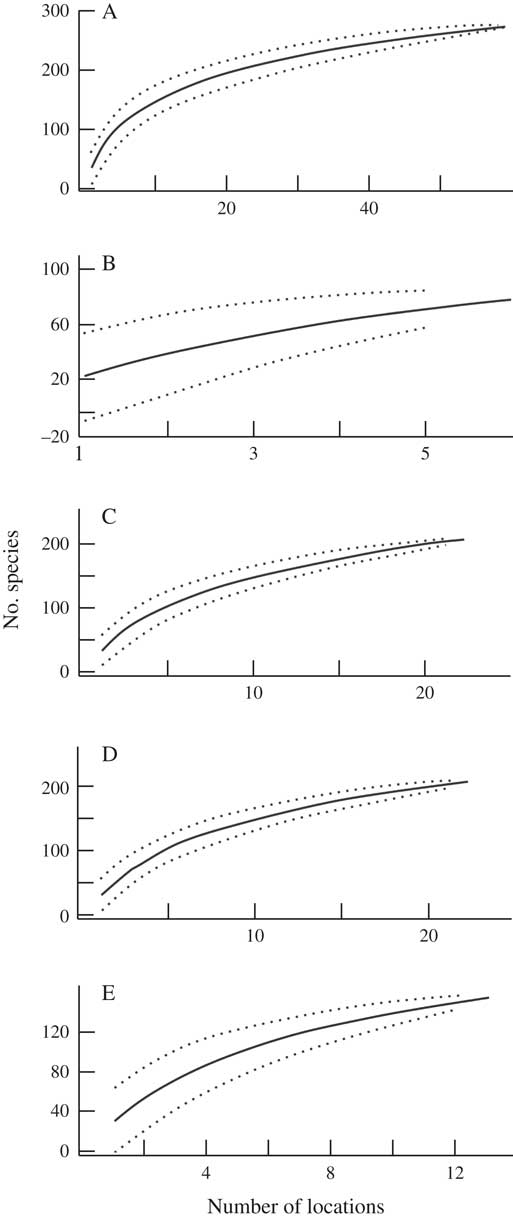
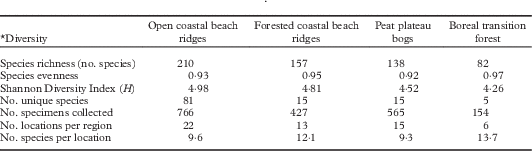
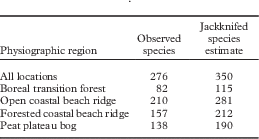
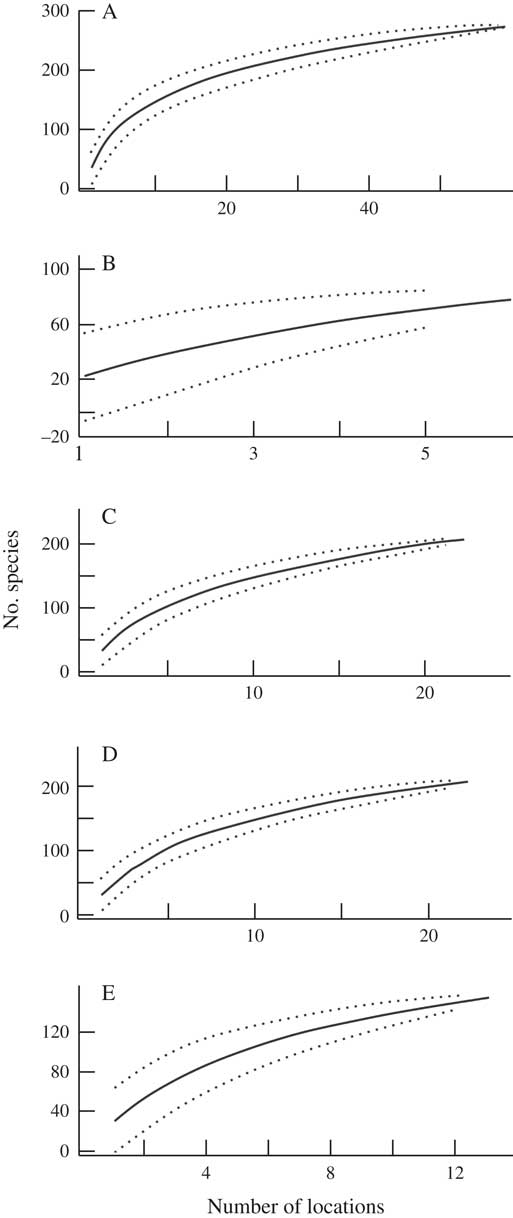
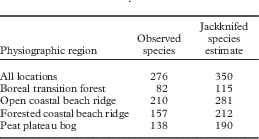
The number of locations for each physiographic region was unequal; therefore, caution should be taken in the interpretation of diversity comparisons. Regions were ranked in order of H values as follows: open coastal beach ridges > forested coastal beach ridges > peat plateau bogs > boreal transition forest (Table 1). The average number of species per location and the species evenness decreased in the order boreal transition forest > forested coastal beach ridges > open coastal beach ridges > peat plateau bogs (Table 1). The number of new species collected after visiting a larger number of similar habitats decreased over the nine years of collecting but the numbers continued to increase for each of the four physiographic regions (Fig. 2; Table 2). Since the nine year project was terminated because the contract with Parks Canada came to an end, no more collections could be made.
Number of species collected from each location for the four physiographic regions within Wapusk National Park on the Hudson Bay Lowlands; A, open coastal beach ridge; B, forested coastal beach ridge; C, peat plateau bog; D, boreal transition forest; E, all locations over the nine years of the study. Dotted lines represent the standard errors.
Diversity indices for lichens collected in four physiographic regions within Wapusk National Park on the Hudson Bay Lowlands
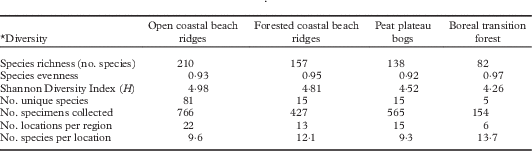
* Collections from the burned locations are not included.
Total number of species observed and estimated by jackknife analysis for all four physiographic regions and all regions combined within Wapusk National Park on the Hudson Bay Lowlands
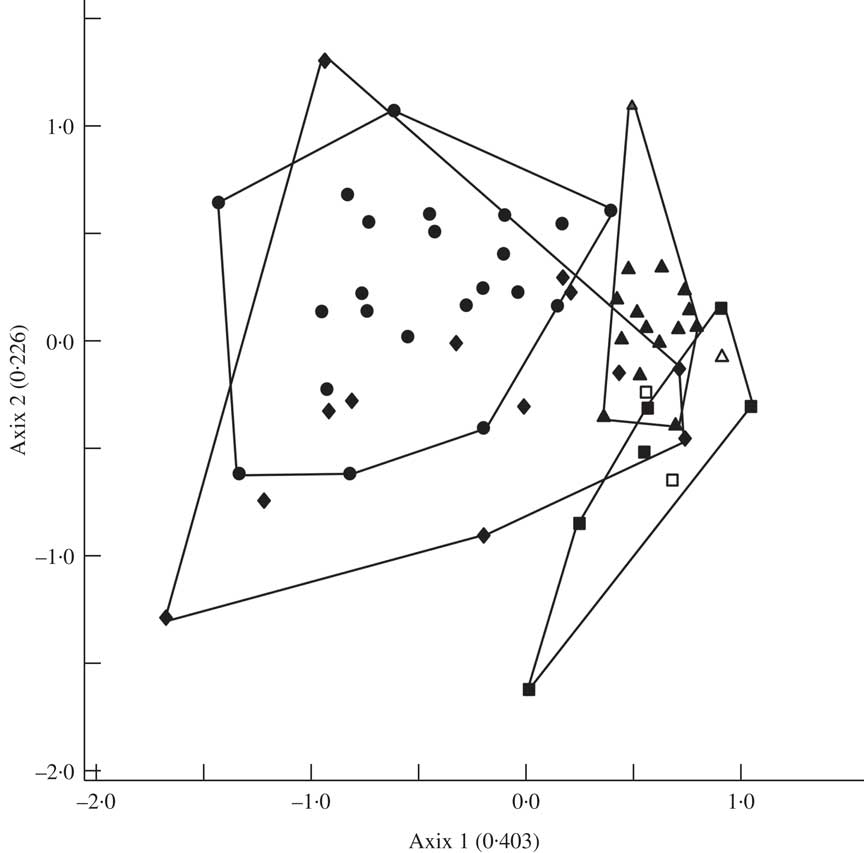
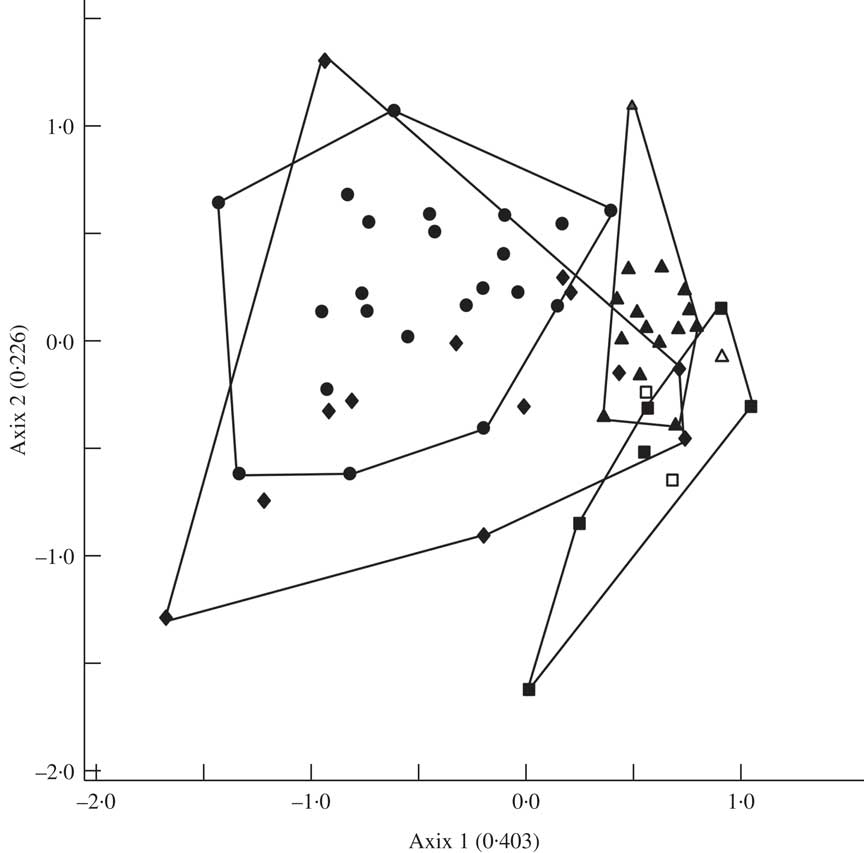
As derived from the NMS, the lichen assemblages in each of the physiographic regions showed some separation based on the presence and absence of species per location (Fig. 3). The lichen assemblages in the forested coastal beach ridges showed a large amount of overlap with the open coastal beach ridge and a small overlap with the other two regions (boreal transition forest and peat plateau bogs). Fifteen species were unique to the forested coastal beach ridges, 81 species were unique to the open coastal beach ridges, five species were unique to the boreal transition forest, and 15 species were unique to the peat plateau bogs (see Supplementary Material Table S2, available online).
Non-metric multidimensional scaling (NMS) based on presence/absence of species in four physiographic regions; open coastal beach ridge (closed circles), forested coastal ridge (closed diamonds), peat plateau bog (closed triangles), and boreal transition forest (closed squares). Two burned locations are also included in the analysis (open triangle for peat plateau bog; open square for boreal transition forest). The first two axes explained 62·9% of the variation in the data (axis 1, 40·3%; axis 2, 22·6%).
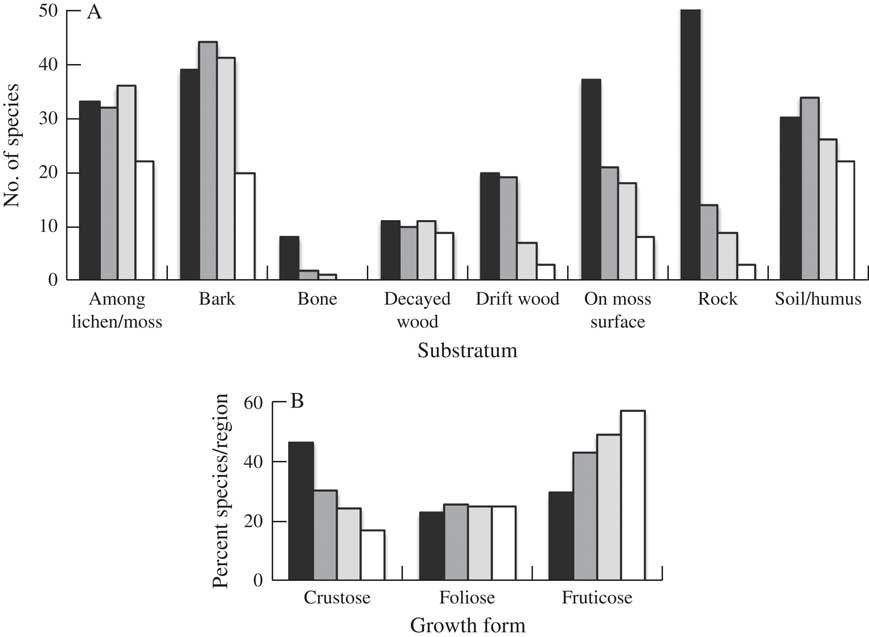
The substrata were divided into eight types (Fig. 4A). For four of these (i.e. among lichen/moss, bark, decayed wood, and soil/humus), the number of colonizing species was similar across the open coastal beach ridges, forested coastal beach ridges, peat plateau bogs, and boreal transition forest regions (Fig. 4A). However, the other substratum types (i.e. bone, on moss surface, and rock) were colonized by species in the open coastal beach ridges where these substrata were common. Lichens growing on weathered wood or driftwood were more common in both the open and forested coastal beach ridges than in the peat plateau bog or the boreal transition forest (Fig. 4A).
Differences in lichen communities among four physiographic regions in Wapusk National Park:, open coastal beach ridge (black), forested coastal beach ridge (dark grey), peat plateau bogs (light grey), and boreal transition forest (white). A, number of species colonizing different types of substrata; B, growth form as a percentage of all collected species per physiographic region.
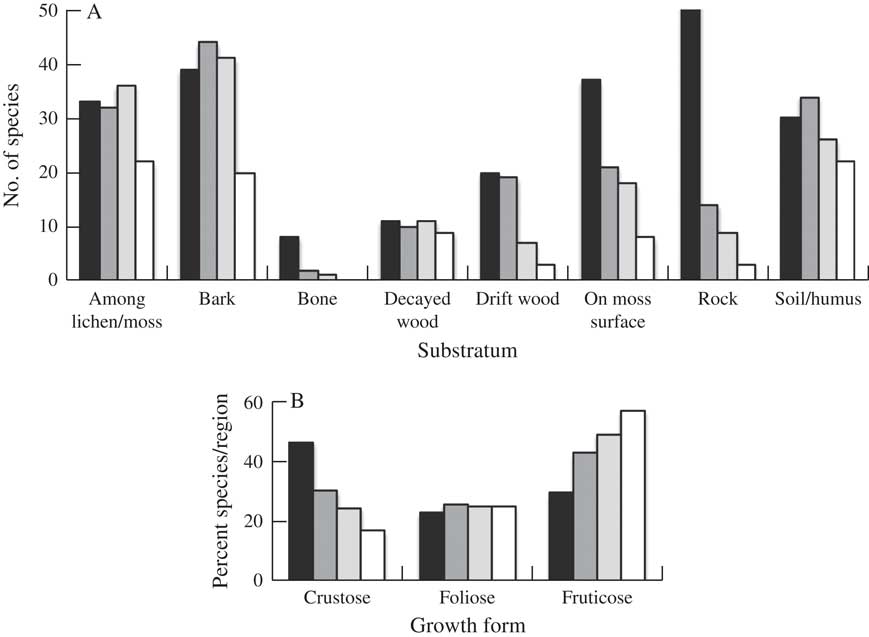
Among growth forms, the proportion of crustose lichens was highest in the open coastal beach ridges and the fruticose lichens were highest in the forested coastal beach ridge regions (Fig. 4B). The occurrence of the foliose lichens was similar across all four physiographic regions (Fig. 4B).
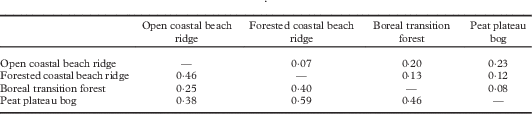
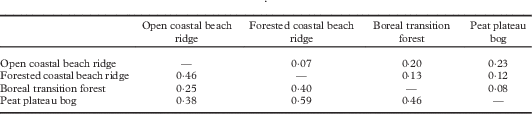
The peat plateau bog and the open coastal beach ridge were most similar based on MRPP, while the forested coastal beach ridge and peat plateau bog were the most similar regions based on Jaccard’s index of similarity (Table 3). The three locations that were burned in a forest fire within the last 20–30 years included one in the peat plateau bog which had 35 species identified from 35 specimens collected, and two in the boreal transition forest which had 42 species identified from 51 specimens collected. Most species present in the burned peat plateau bogs were also found in the unburned locations of the peat plateau bogs, except three species (Cladonia bacilliformis (Nyl.) Sarnth., Scytinium lichinoides (L.) Otálora et al., [≡ Leptogium lichinoides (L.) Zahlbr.] and Usnea glabrata (Ach.) Vain.). Eighty percent of the species in the burned boreal transition forest were also present in the unburned boreal transition forest. The nine species present only in the boreal transition forest were: Bryoplaca jungermanniae (Vahl) Søchting et al. [≡ Caloplaca jungermanniae (Vahl) Th. Fr.], Bryoria lanestris (Ach.) Brodo & D. Hawksw. (sometimes included in B. fuscescens; Velmala et al. Reference Velmala, Myllys, Goward, Holein and Halonen2014, but see Brodo & Hawksworth Reference Brodo and Hawksworth1977), Cladonia borealis S. Stenroos, Melanelia stygia (L.) Essl., Mycobilimbia berengeriana (A. Massal.) Hafellner & V. Wirth., Rhizocarpon polycarpum (Hepp) Th. Fr., Solorina saccata (L.) Ach., Stereocaulon alpinum Laurer ex Funck, and S. grande (H. Magn.) H. Magn.
Pairwise comparison between physiographic regions in Wapusk National Park showing Jaccard’s index of similarity (below the diagonal) and Multi-Response Permutation Procedures (MRPP(A)) (above the diagonal) based on the presence and absence of species. Values of Jaccard’s index range between 0 (dissimilar habitats) and 1 (similar habitats). MRPP values range between 0 (heterogeneity expected by chance) and 1 (identical regions; no heterogeneity). All MRPP values are significant with P<0·002
Three specimens of Buellia uberior Anzi, a new report for Canada, were collected from the open coastal beach ridges on rock. Buellia uberior was almost always accompanied by Miriquidica lulensis (Hellb.) Hertel & Rambold. Aspicilia perradiata (Nyl.) Hue, Bryobilimbia hypnorum (Lib.) Fryday et al., Diplotomma venustum Körb., Farnoldia micropsis (A. Massal.) Hertel, Lecanora xylophila Hue, M. lulensis, Pertusaria octomela (Norman) Erichsen, Polyblastia cupularis A. Massal., Protoblastenia incrustans (DC.) J. Steiner, and Rinodina roscida (Sommerf.) Arnold are reported here for the first time in Manitoba.
Discussion
Species diversity in Wapusk National Park
This study was the first intensive inventory of the lichens of Wapusk National Park. Other ecological studies in the Park include 15 species from Brook (Reference Brook2001) and several species lists of lichens (Piercey-Normore Reference Piercey-Normore2005, Reference Piercey-Normore2006, Reference Piercey-Normore2008, Reference Piercey-Normore2010; Cassie & Piercey-Normore Reference Cassie and Piercey-Normore2008). These previous contributions reported a total of 134 species. Some geographical locations surrounding the Park were previously studied by Ritchie (1960 Reference Ritchiea, Reference Ritchieb ) but those areas comprised different habitats. The total lichen diversity of Wapusk National Park would likely increase with additional collecting effort because the number of species collected after multiple visits to the same physiographic region was still slowly increasing with each visit at the termination of our study (Fig. 2).
With a lichen biota of 276 species, Wapusk National Park (11475 km2) does not appear to be as diverse as other parks in or near Canada. For example, in Ontario, the Bruce Peninsula and Fathom Five National Parks (268 km2) hold 365 species (Brodo et al. Reference Brodo, Harris, Buck, Lendemer and Lewis2013), Klondike Gold Rush National Historic Park (54 km2) on the Alaskan-Yukon border has 766 species (Spribille et al. Reference Spribille, Pérez-Ortega, Tønsberg and Schirokauer2010), and Fundy National Park in New Brunswick (200 km2) has 470 species (Gowan & Brodo Reference Gowan and Brodo1988), noting, however, that the latter two studies include a significant number of lichenicolous species. On the other hand, with regard to other subarctic and arctic areas, the numbers are more comparable. For example, the number of macrolichens in the arctic ecosystem in Noatak National Preserve, Alaska (26000 km2) was 209 species (McCune et al. Reference McCune, Holt, Neitlich, Ahti and Rosentreter2009), which is similar to the number of species reported for Wapusk National Park.
A new report for Canada, Buellia uberior
Buellia uberior, a new report for Canada, was almost always present with Miriquidica lulensis on rock and on the coastal beach ridges. Miriquidica lulensis is a widespread arctic-alpine species that occurs on iron-rich rocks (Hertel & Andreev Reference Hertel and Andreev2003). While M. lulensis is widespread, it is briefly described here because of its consistent presence with B. uberior in the Park. The Wapusk material of M. lulensis has a blue-green epihymenium; a hyaline hypothecium; an exciple which was black externally and hyaline within; hyaline one-celled ascospores, 8·6–9·8×3·7–5·8 µm; paraphyses that are branched to sparsely branched, not capitate; a medulla IKI−, K+ red with crystals (norstictic acid); and an ascus tip K/I+ blue. Buellia uberior is sometimes lichenicolous on Schaereria fuscocinerea (Nyl.) Clauzade & C. Roux and was reported from Europe with two chemotypes (gyrophoric acid alone or gyrophoric and stictic acids) (Scheidegger Reference Scheidegger1987). One specimen of B. uberior in this study was adjacent to S. fuscocinerea on rock but it did not appear to be parasitic. Two specimens contained gyrophoric acid and a trace of lecanoric acid, which is common in lichens that contain gyrophoric acid. It grows on wind-exposed siliceous rocks (Scheidegger Reference Scheidegger1993) and was found in this study on rocks in the wind-exposed coastal beach ridges. The characteristics of B. uberior from Wapusk include predominantly sunken apothecia with a green-brown-black epihymenium; a hyaline to brown hypothecium; an exciple that is green-black at the edge and hyaline cellular within; two-celled brown spores constricted at the septa, ornamented, and small (9·0–12·0×5·0–6·5 µm) compared with other species of Buellia; unbranched paraphyses; and the medulla C+ pink to red, K−, IKI+ blue. The species is similar to B. miriquidica Scheid., which has smooth ascospores and contains miriquidic acid as well as gyrophoric acid, and which was recently discovered in the mountains of Maine (Fryday Reference Fryday2006). Buellia uberior, which typically contains gyrophoric and stictic acids, has previously been reported in North America only from high mountain sites in Arizona (Bungartz et al. Reference Bungartz, Nordin and Grube2007).
Substratum and habitat specificity may determine species presence
Some of the taxa collected represent species found in similar habitats for each of the physiographic regions. For example, Cladonia turgida Ehrh. ex Hoffm., C. verticillata (Hoffm.) Schaer., Stereocaulon tomentosum Fr., and Usnea scabrata Nyl. (see Supplementary Material Table S2, available online), which are common boreal species (Goward Reference Goward1999; Brodo et al. Reference Brodo, Sharnoff and Sharnoff2001), are present in the boreal transition forest and not in subarctic regions of the Park such as the open coastal beach ridges. None of the four Ochrolechia and only five of the nine Pertusaria species were exclusive to any of the physiographic regions, but both genera were more common on the open coastal beach ridges than anywhere else in the Park. By contrast, Icmadophila ericetorum (L.) Zahlbr. was rare in the coastal regions where there was exposed soil but very common on the interior peat plateau bogs where there was no soil but mostly peat. While I. ericetorum was found only on peat in this study, it is reported to occur on soil (Muggia et al. Reference Muggia, Klug, Berg and Grube2013) and over moss, decaying wood, and peat (Brodo et al. Reference Brodo, Sharnoff and Sharnoff2001).
The presence of some species in a given specific physiographic region may have been due to the availability of substrata and environmental conditions (Adamska & Deptula Reference Adamska and Deptula2015; Ardelean et al. Reference Ardelean, Keller and Scheidegger2015). Species unique to the open coastal beach ridges were found on substrata such as wood, rock, or open soil, which were common in these regions, and included Buellia uberior, Evernia divaricata (L.) Ach., Mirquidica lulensis, Psoroma hypnorum (Vahl) Gray, Thamnolia vermicularis (Sw.) Ach. ex Schaer., and Tuckermannopsis chlorophylla (Willd.) Hale. Evernia divaricata was found on the ground on the crest of the beach ridges, which is a habitat very different to the one reported in Estonia where the thallus was found exclusively on twigs (Juriado et al. Reference Juriado, Jaanus and Jaan2003). This species was found in humid mixed conifer forests in Norway (Haugen et al. Reference Haugen, Bratli and Gaarder1994; Rolstad & Rolstad Reference Rolstad and Rolstad2011) but on trees in drier steppe formations in Germany (Lange et al. Reference Lange, Türk and Zimmerman2005). It has also been reported in the North American Arctic on soil (Brodo et al. Reference Brodo, Sharnoff and Sharnoff2001). Thamnolia vermicularis was rare in all four physiographic regions in the Park, but T. subuliformis (Ehrh.) W. L. Culb. was common on the soil of the open beach ridges (e.g. Cassie & Piercey-Normore Reference Cassie and Piercey-Normore2008). Thamnolia vermicularis is common in the Southern Hemisphere (Billings & Mark Reference Billings and Mark1961) but less common in the Northern Hemisphere (Sato Reference Sato1962), which explains the rare findings in this study. Species of Umbilicaria are specific to siliceous rock substrata and if siliceous rocks were rare in a region, Umbilicaria was also rare; this was particularly the case for U. deusta, U. hyperborea, U. lyngei, U. muehlenbergii, U. proboscidea, U. torrefacta, and U. virginis. Similar circumstances pertain to Rhizocarpon spp. (e.g. R. geminatum, R. geographicum, R. grande, and R. polycarpum). Five taxa that occurred on bone (Caloplaca tiroliensis Zahlbr., Lecanora zosterae (Ach.) Nyl. var. beringii (Nyl.) Śliwa, L. zosterae var. palanderi (Vainio) Śliwa, L. zosterae var. zosterae, and Lecidella carpathica Körb.) were present only in the open coastal beach ridges. Change in environmental factors over time, such as light, humidity, and temperature, influences growth of lichens on bones (Prieto et al. Reference Prieto, Rivas, Silva, Carballal and de Silanes1995; Armstrong & Bradwell Reference Armstrong and Bradwell2010). Most species on bone and driftwood were crustose accounting for 99 species in the open coastal beach ridges. Nine of the 25 species reported to occur on driftwood in this study were also reported on driftwood on Svalbard by Wegrzyn et al. (Reference Wegrzyn, Wietrzyk, Adamska and Nicia2015). There was an overlap of 12 species on driftwood reported in this study and that of Osyczka & Wegrzyn (Reference Osyczka and Wegrzyn2008), who reported them on lignin. However, only two species from those studies were found exclusively on driftwood here (Flavoplaca citrina (Hoffm.) Arup et al. [≡ Caloplaca citrina (Hoffm.) Th. Fr.] and Lecanora zosterae), suggesting that many of the species we found on driftwood may be adapted to a wide range of substrata (Smith et al. Reference Smith, Aptroot, Coppins, Fletcher, Gilbert, James and Wolseley2009).
Conclusion
Three regions (open coastal beach ridge, peat plateau bog, boreal transition forest) of the four physiographic regions hosted different lichen assemblages, while the forested coastal beach ridge comprised species that potentially overlap with those in the open coastal beach ridge and peat plateau bog. The open coastal beach ridge hosted many of the crustose species, including the new report for Canada, and it had the highest diversity of lichens as well as substrata. This region has the highest diversity, the rarest species, and is the most likely to be disturbed by people and animals; therefore we assert that it is the region of the Park that should receive the greatest conservation attention. The species in the burned sites did not differ from those in unburned areas suggesting that 20–30 years after a burn would be sufficient to re-establish lichen communities. While species less commonly collected may reflect the collecting effort, this may also reflect the scarcity of substrata available within each region. Species unique to each physiographic region (see Supplementary Material Table S2, available online) might serve as indicator species for these regions and may be useful to monitor long-term climate or human-induced changes to these habitats.
The authors thank J. Sheard for confirmation of species of Rinodina; T. Booth for editorial suggestions on the manuscript; Parks Canada employees who provided field support over nine years, and B. Ford, D. Punter, and E. Punter (University of Manitoba) who accompanied MPN during collection. Collection permits for this study were WAP2002-2010-1670; funding was received from Parks Canada and the National Sciences and Engineering Research Council of Canada (NSERC).
Supplementary material
For supplementary material accompanying this paper visit http://dx.doi.org/10.1017/S002428291600027X