There was once good reason to suspect that the demand for painters in rural England began to diminish after the dissolution of the monasteries in the 1530s and 1540s. Encouraged by the decline of Purgatorial belief and the culture of divine intercession, subsequent rampant iconoclasm, and – at least in some corners – a stricter adherence to the Second Commandment and its essential proscription of portraiture, the painters’ trade faced unaccustomed challenges. These were seen to be magnified on the rural scene by the growing draw of London as a centre for the production and consumption of the visual arts, and by the more sophisticated approach especially of the mostly Protestant continental painters who flocked there. Patrons who could afford their services tended to prefer these more polished and sophisticated strangers, leaving the crude production of the native English vernacular standing by the wayside.
Following the lead of Karl-Josef Holtgen, some few scholars went so far as to see in the years between the late Elizabethan era and the reign of Charles I a Protestant-led rejection of ‘all material images and implying an advanced and radical application of the second Commandment of the Decalogue’, so that ‘by 1600 to be found in possession of a picture (almost any picture) was to be a suspected papist’.Footnote 1 Still, other commentators placed that perceived decline in a geographic context, and thus as particularly severe in the provincial and rural scenes. William Gaunt, in the influential Praeger ‘World of Art’ series of the 1960s, could declare that ‘the local centres of art having vanished after [the Henrician Reformation] the tendency of art to be centred in London and the service of the court was affirmed’.Footnote 2
Subsequent research has shown these assumptions of a sharp decline in rurally-based painting and a wholesale consolidation of ‘art’ in London either to be patently false or too simplistic to be useful.Footnote 3 Post-dissolution England certainly did see the painters’ trade being compelled to adjust to new contextual circumstances. Along with the reception of continental styles and methods that were new to native English figurative painters, the transition from ecclesiastical to secular patronage, each with its characteristic range of subject matter, stand out most clearly.
But discussion on these issues has focused geographically on the urban and metropolitan context,Footnote 4 socially on aristocratic and courtly patronage,Footnote 5 and materially on the genre of portraiture.Footnote 6 In addition, it has at least implied that ‘painters’ equated largely with portrait painters. On all these counts, there is much more to it than that. Portrait painters may well be the most familiar to us of all painters in this era, but they did not by any means represent the whole of the painters’ trade, nor did urban or aristocratic patronage constitute all of the painters’ work. The role of painters as an occupational group, their occupational versatility, and their geographical distribution all remain to be explored if we are to understand their cultural significance in general and their presence and role in the rural scene in particular.
It may seem unnatural to lump portrait painters together with other practitioners of the painters’ trade, but it shouldn't. Save for the small number of very high end specialists providing portraiture for the court and aristocracy – people such as, for example, Hans Eworth, Nicholas Hilliard, Daniel Mytens, Cornelis Johnson, Peter-Paul Rubens, and Anthony van Dyck – very few painters could afford to restrict their undertakings solely to portraiture. The few painters’ companies or guilds whose records survive tell us that the usual apprenticeship, even in provincial areas, included both figurative and non-figurative painting.Footnote 7 The vast majority of painters working in England during these years took on any work they could get and were necessarily versatile in its pursuit. Even within the highly specialised subgenre of arms painters, men such as William Segar,Footnote 8 Edward Norgate,Footnote 9 and Randle Holme the elder,Footnote 10 painted portraits as well as heraldic devices.
And, though one often refers to painters in this era as ‘artists’, we would recognise almost all of them as craftsmen and they were (and continue to be) counted, especially by social and economic historians, amongst the building trades. ‘Artists’ were highly skilled in what they did (as were some of the latter), but they approached their metier with some theoretical or academic understanding thereof and with the more sophisticated techniques inspired by that knowledge. They were set apart from the ranks of the anonymous craftsmen, were sought after for their personal reputation, and were often in this era inspired by and/or trained in the more sophisticated and refined techniques of continental painting. Proud of their individual expertise, they more frequently signed their works.
Craftsmen, by contrast, laboured in the untheorised and less refined traditions passed on through generations of native-English, apprentice-based training. They were not much known by name outside of local circles. Indeed they are often cited in financial accounts merely as ‘the painter’. In this era they almost never signed their names. George Buck, writing in 1615, may have been a little extreme in describing the figure of the painter as ‘base and mechanaicall and a more mesteir [sic] of an artificer and handy craftsmen’,Footnote 11 but his can hardly have been an isolated sentiment at the time.
Still, it would be wrong to think of painters as an entirely monolithic group. Notwithstanding the general versatility of most painters, the painters’ trade included a number of specialties, each with their own employment patterns. The era at hand may have undermined the demand for glass painters, most of whom had worked in parish churches. Yet it saw the blossoming of a widespread and socially inclusive ‘public’ for portraiture,Footnote 12 arms painting, and decorative work in residential premises.Footnote 13
One might well assume that, as has long been established for other non-agricultural rural occupations, the numbers of rural places that hosted painters, and the number of specialised craftsmen such as painters resident in these places, increased in the era at hand. As John Patten noted in his seminal essay on changing occupational structures in the East Anglia of this era:
We can no longer, from the evidence of these findings [for East Anglia], and from studies of rural occupations in other parts of England, state quite so confidently that in the pre-industrial period, ‘the majority of craftsmen lived in towns for the simple reason that urban centres had the greatest concentrations of population and the best links with the villages in the neighbouring countryside’.Footnote 14
Yet such a small and highly specialised occupation as the painters’ trade has never figured in Patten's or other studies of rural occupations. It remains to be seen whether, as he would have it, painters followed the geographic or structural patterns of other occupations that proliferated in the countryside over time, or whether (as Gaunt saw it) painters vacated the rural scene for London, leaving it bereft of their work, over the same duration.
This article explores the presence and activity of painters in post-Reformation rural England to 1640. It seeks to understand the shifting geographic distribution of working painters, to identify the types of painting they undertook, and to come to a more informed appreciation of how they served the rural England of their time. It rests particularly on the evidence collected for the online database entitled ‘Early Modern British Painters, 1500–1640’ (hereafter EMBP) which, at current writing, contains over 2,600 biographical entries of painters of all sorts working in England, Ireland, Scotland, and Wales between the years 1500 and 1640.Footnote 15 (The database itself, updated twice annually, is the fullest and most accurate directory of painters working in the British Isles that could so far be compiled on the basis of available evidence. It provides specific information, including location of work and/or residence, on particular painters. It therefore allows us clearly to identify significant trends in their appearance and distribution over the critical period of religious change, population growth, and economic expansion marked by the years 1500–1640.)
Amongst all the building trades, figure sculptors and painters (the latter broadly construed so as to include such subspecies as decorative painters, portrait painters, glass painters, herald painters, and combinations thereof) seem more likely than other craftsmen to have been affected by religious and social change in this era. Workmen like plumbers, masons and carpenters, for example, found ample employment in the salvaging of materials from former monastic buildings, the conversion of dissolved properties to country houses, or the construction or refurbishing of extant houses after the dissolutions. But neither the kind of work they did nor their geographical distribution were significantly affected by the religious changes of the era: changes so sweeping as to impact upon virtually every parish and community in the realm.
A leaky lead roof required repair whatever the circumstance; Snout's wall, with its ‘crannied hole, or chink’Footnote 16 had just as urgently to be patched! Whether before the Reformation or after, almost any town or even village could count on such expertise in its midst; nearly every set of churchwardens’ or chamberlains’ accounts bear witness to the ubiquity of such trades. Some plumbers, carpenters, and masons in particular were even kept on retainer by towns and the larger churches.Footnote 17
At one time the same ubiquity might perhaps have applied to painters. But a close examination of painters’ whereabouts as indicated on the EMBP database shows that the widespread permanent residence of painters in small rural communities had come pretty much to an end after the mid-sixteenth century. One searches, for example, through such sources as churchwardens’ and chamberlains’ accounts for decades on end to find very few references to painters compared to those regarding, for example, plumbers, carpenters and masons, and fewer still as the century progressed. Such searches also produce the impression that, for example, plumbers, carpenters, and masons were more often referred to by name – Smith the mason, etc. – than were painters, to whom payments were more often in the form of ‘pd. to the painter’. This in turn suggests that craftsmen in the former occupation were resident in the community and known by name to their paymasters, whilst painters were less frequently resident in smaller rural communities, and tended to be known instead by their occupation.
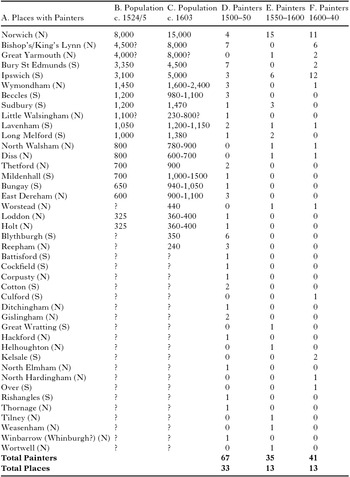
These impressions of the declining residence of painters in rural communities are confirmed in Table 1, extracted from the current EMBP database. Column A takes Patten's reasonably selected sample area of East Anglia and lists all the places where painters have been identified between the years 1500 and 1640. It includes the major centre of Norwich, and secondary centres like King's Lynn, Great Yarmouth, Bury St Edmunds, and Ipswich. But it also includes smaller towns, villages and even hamlets: places like Cotton, Cockfield, North Elmham, or Battisford in Suffolk or Hackford, Weasenham, and Reepham in Norfolk. These places either had populations estimated at 300 or less at a time when painters may be found in them, or were too obscure and small to have been included in the two standard studies of local populations covering this era.Footnote 18 Yet they turn up on the EMBP database as places where resident painters have been identified between 1500 and 1640.
Painters in East Anglia, c. 1500–1640.

Notes: (1) (N) = Norfolk; (S) Suffolk.
The EMBP data, which serve as the basis for Table 1, have not only been drawn from the wills and inventories upon which Patten relied. They also derive from apprenticeship records, freemens’ rolls, and chamberlains’ accounts where they survive in the larger places, and from court records, churchwardens’ and bailiffs’ accounts, leases, and property deeds from much smaller places. Patten's exclusive use of surviving wills will have caused him to miss those many non-testators or those wills have not survived. The additional sources employed in compiling the EMBP database highlight quite a few painters and places that are not identified in wills upon which he relied.Footnote 19 Ironically, people who failed to write a will were likely to be amongst the poorer and more remotely-located part of the population.Footnote 20 Had Patten used these additional sources he would likely have found even more rural painters. Yet on close inspection, as explained later, and even with the use of such additional sources, the identity of additional painters in remote places fails to sustain Patten's larger thesis insofar as it applies to that occupation.
The tri-partite division of chronological periods in Table 1 has been adopted to track changes over time, from pre-Reformation (c. 1500) to pre-Civil War (1640). Thus it includes painters whose careers continued to c. 1550, but who had established themselves at or before the time of the monastic dissolutions. The listings for the subsequent period, 1550–1600, takes in the revival of painters’ ecclesiastical and religious work in the brief reign of the Catholic Mary. But it mostly embraces the era in which Catholicism again became proscribed, and in which much of the visual imagery of pre-Reformation religious practice disappeared. The last era, 1600–40, is meant to represent the ‘new norm’ and subsequent geographic redistribution for the painters’ occupation. Many painters will of course have worked over the chronological boundaries of two of these periods. Where this is known to have occurred they have been counted in each of the two.
Given the greater survival of records of all types from the later decades of the chosen era, the larger national population, and the expanding clientele for portraiture and both decorative and heraldic imagery, one might well anticipate that more painters would appear in the last of the three periods and fewer in the first. Such an expansion in rural England would conform to Patten's conclusions about the expansion and distribution of non-agricultural occupations in general. Yet this does not appear to be the case with painters.
Despite these factors, and even with the generally greater survival of records for the later period, a comparison of the total number of resident painters in Columns D and E of Table 1 shows a sharp decline in their numbers in Norfolk and Suffolk between 1500–50 (67) and 1550–1600 (35), with a modest increase thereafter to forty-one between 1600 and 1640 in Column F. As one would expect, some of the sharpest declines came from former monastic locations like Bury St Edmunds, where (in contrast to the claim of its role as an art centre in the seventeenth century),Footnote 21 the number of painters went from seven to zero by 1600 and back only to two by 1640, and Thetford, whose two painters disappeared after 1550. But beyond the dissolutions of monasteries and chantries, painters will have lost additional ecclesiastical patronage in the decline of the lavish decorative work, which, especially in Norfolk, marked many pre-Reformation parish churches.Footnote 22
The decline is even more starkly evident when observed in the number of places served by resident painters. Thirty-three places in all had resident painters in the first half-century, but only thirteen in each of the two successive periods. The consolidation of the trade from smaller to larger communities is also starkly apparent. Whereas nineteen places with estimated populations of 750 or less had a total of thirty-one painters up to 1550, only seven such places (Weasenham, Helhoughton, Wortwell, Tilney, Diss, and Worstead in Norfolk; Great Wratting in Suffolk) still had resident painters, one in each place, by 1600. That number fell slightly to six places and seven painters by 1640: a precipitous drop in both locations and resident painters in the most rural places. In fact, the number of painters resident working in the smallest places between 1600 and 1640 may even be more meagre than the numbers suggest. They include Sir Nathaniel Bacon of Culford, Suffolk, who painted brilliant still lifes as a hobby but not as an occupation,Footnote 23 and William Barker of Worstead who died only two years after 1600 and probably worked most of his life in Norwich, where he had been admitted as a freeman painter back in 1573.Footnote 24 He has been counted in both time periods. But if resident painters did not proliferate in the countryside as did other occupations, where did they go, and was rural England left without their services?
Many painters, as Gaunt suggested, undoubtedly moved on to London, though not by any means anywhere near all of them. Though it proves impossible to track enough of them to make any statistical conclusions, the ranks of the Painter-Stainers’ Company of London were, as Gaunt suggested, filled by betterment migrants who came to be trained as apprentices, employed as journeymen, or (less frequently) admitted as masters who had moved in mid-career from elsewhere. But Gaunt failed to recognise the substantial number of painters who consolidated in the regional centres of provincial England or who became itinerant. Table 1 shows that in East Anglia the former type grouped themselves especially in three of the most populous five places: Norwich (fifteen in the middle period and eleven in the later); King's Lynn (none in the middle period but six in the later); and Ipswich (six in the middle period, twelve in the later). Such provincial consolidation fits neither the pattern described for painters by Gaunt nor that described for working people in general by Patten.
In this consolidation of locations, it is at least probable, though unprovable, that consolidation of painters’ employment status followed as well. Independent rural painters will have given up, either moving to larger centres as masters, joining expanding urban workshops as journeymen, or taking to the roads and working for themselves. The general increase in the costs of setting up shop, a characteristic that applied to other trades as well, will have encouraged all of these tendencies.Footnote 25 In addition, many towns of over 5,000 inhabitants in 1600 had multi-generational painters’ workshops, some remaining in the hands of a single family over two or more generations. Such painter family dynasties, including the Brameses of Ipswich,Footnote 26 and the IsbornesFootnote 27 and Iveses of Norwich,Footnote 28 endured and prospered in East Anglia, just as other family dynasties, including the Cleys of Shrewsbury,Footnote 29 the Spries of Plymouth,Footnote 30 the Kyrcks (or Kircks) of Lichfield,Footnote 31 the Holmes,Footnote 32 Framways,Footnote 33 or HallwoodsFootnote 34 of Chester, did in other areas of the realm. Those enterprises tended to keep the business in the family, even when masters died before their children were old enough to succeed them. Evidence from Chester presents several cases of widows taking on the business and running it with the help of apprentices and journeymen until their sons could take it over.Footnote 35 Such families relied on interim help when necessary, but were reluctant to take on newcomers on any permanent basis.
Whether the reduction in the number of rural places with resident painters also means the reduction in rural places served by painters is a different and much more difficult question. Whilst rural post-Reformation communities may no longer have had enough work to support a painter's continuous presence, even parish churches required their skills on an occasional basis. In consequence, painters do seem to have continued regularly to take on work in rural areas. They did so either as itinerants or as members of regional, urban-based workshops that took up commissions on demand and perhaps brought parts of such work back for completion in-house. (Some painters, including people like Esther Inglis (d. 1624)Footnote 36 or Henry Peacham (fl. c. 1600–44)Footnote 37 , moved several times during their career but, working from particular locales for substantial durations between moves, cannot be counted as true itinerants.)
The very nature of itinerancy, a work pattern that leaves a scant paper trail, makes it difficult to document their work and movements. A small number of well-known, high end, itinerant painters left more of an archival trail in the surviving record of their commissions or, very occasionally, in the signature of their works or in correspondence with or amongst patrons. Such sought-after itinerants included the Chester natives Thomas Leigh and his son Thomas the younger, both of whom became well known in their time. Thomas the younger in particular accepted myriad commissions throughout western England and Wales before eventually settling in around the Inns of Court, where he skillfully portrayed many leading members of the Inns.Footnote 38
However, many native English itinerants were much more likely either to be journeymen who were finding it more expensive and difficult to gain freemans’ status and eventually to set up their own shops, or former apprentices who had failed to complete their training. As Chris Minns and Patrick Wallis have recently reminded us for a slightly later period, apprenticeship was a much more flexible and varied experience than the Statute of Artificers (5 Eliz., c. 4) would suggest.Footnote 39 Some apprentices in occupations like painting served as many as ten years rather than the obligatory seven, making the temptation to quit even stronger.Footnote 40 Failed apprenticeships were extremely common in these years, amounting to between 60 and 85% in those towns on which research has been done.Footnote 41
In contemporary Chester, whose uniquely full records for the painters’ occupation allow the calculation, only fourteen, or 22%, out of the sixty-three who apprenticed to the painters’ trade between 1571 and 1635 eventually became freemen painters in that city, though some stayed on for a few years in Chester as journeymen. Twenty-three journeymen, mostly locally trained but also including two ‘strangers’ from abroad, served Chester in that capacity in one-year contracts and for but a few years each between 1580 and 1650. Most of them disappeared from the local record thereafter.Footnote 42 They probably anticipated the career of Oliver Goldsmith's ‘limner who travelled the country and took likenesses for fifteen shillings a head’.Footnote 43
In an effort to restrict entry to the ranks of future masters, centres with well-established gilds such as Norfolk, Chester, Newcastle or York strove to limit the admission of apprentices, preferring to have journeymen, usually trained elsewhere, staff their workshops.Footnote 44 Under those circumstances, many journeymen and sundry failed apprentices must have taken to the road and sought painters’ work wherever they could find it. Lacking the sort of archival trail, including wills or inventories, which leads us to the Leighs, these men remain largely unknown to us.
Other painters served the rural scene by working and traveling regionally from fixed bases in urban centres. They include people like John Fenn or Fenner (fl. 1616–24) in Cambridgeshire and East Anglia;Footnote 45 and the Oxford-based Sampson Strong (c. 1550–1611) in Oxford and Abingdon.Footnote 46 The Chester-based portrait painter John Souch (1594–1645) portrayed regional gentry in Cheshire, Flintshire, northern Shropshire and Denbighshire.Footnote 47 John Matthew (fl. 1578–94) worked in both Nottinghamshire and Leicestershire.Footnote 48 Whilst most of the hinterlands served by these men were limited to perhaps two or three contingent shires, some such painters worked even more widely. Between 1621 and 1637/8 Thomas Sprye (b. 1588/9), part of his family's painting dynasty of Plymouth, worked the south coast from Dover in Kent to the Cornish parish of Maker-with-Rame.Footnote 49
Some few itinerants were foreigners. The Frenchman Charles Gage (or Gagné?), came through Dorchester in 1633 and took portrait commissions from the Borough Recorder, William Whiteway and several others.Footnote 50 The Hungarian Johan Prowizer (1627–35) appears to have worked his way through several provincial areas as an unlicensed painter.Footnote 51 These two seem to have been well trained. Gage/Gagné, carried painting manuals with him and gave instructions on that craft to Whiteway and others during his stay. But other foreigners operated at a more modest level. Jacob de Villegrande, who served Randle Holme the elder of Chester as a journeyman for the single year 1598, or the man simply recorded simply as ‘Dutchman’ who served Holme's fellow Cestrian Edward Bellin in 1642, are undoubtedly more typical of the many foreigners who came to England, usually for religious reasons, and found whatever painters’ work they could.Footnote 52 Though many latched on to workshops in London, others will have stuck to rural areas to avoid the restrictions placed upon non-licensed painters and even vagrants in London and many other urban jurisdictions where they were considered intrusive and unwelcome competition.
Given the likelihood of incomplete training, many and perhaps most itinerants, along with small town native Englishmen, seem to have been men of modest skills. Their circumstances required them to take on any painters’ work on offer, and they had to be sufficiently versatile to do so. But when patrons required more highly specialised work, they often travelled to find it, or brought in more skilled craftsmen from further afield. Patrons most often travelled for portraiture, leaving the least affluent or sophisticated rural patrons to rely on local talent, but travel figured in other painting genres as well. Thus, for example, John Turner (fl. 1547–61) was the usual painter of all work over a number of years at St Michael's, Bishop's Stortford. But when the churchwardens required more refined work, they brought in John Laxton and Thomas Wulman from Saffron Walden. Both received room and board for twenty-one days, and the churchwardens even sent Laxton to London so that he could examine other buildings as models to emulate.Footnote 53 In the same manner, John Pullen served as the resident painter at St Mary's, Dover, completing extensive work in and around the rood loft in 1550/1 amongst other tasks. But Pullen appears to have been unskilled in lettering and perhaps even illiterate. When the parish required someone to paint the Ten Commandments, they sent for a skilled Londoner, Charles Willyams, to carry out the work instead.Footnote 54
Dover's experience in bringing in Willyams suggests that not all painters by any means were literate in this era. It also tells us that literacy – the ability to write clearly as well as to read – was in great demand, and not infrequently justified the cost of bringing in a non-resident painter. The painter who could both paint and inscribe had an advantage over his competitors. The painter William Lawe, described as ‘a man of Sir Thomas Stanhope’ in March of 1592/3, could do even better. He was recommended to the earl of Shrewsbury one who could ‘write and rhyme’!Footnote 55
The most familiar type of writing upon paintings remains the portrait inscription, particularly the laconic ‘aetatis suae’ (in the year of age) of myriad portraits. But painters were also asked to write the Ten Commandments and, less often, the Apostles’ Creed and the Lord's Prayer, in churches and private chapels both urban and rural. Such work pertained especially in the more reformed churches throughout the realm, even as early as 1550/1 in, for example, St Mary, Dover. The practice became more widespread after the passage of the Canons of 1604, the second of which required that all three texts be lettered on the east end of every church and chapel.Footnote 56
The canon appears to have been honoured more in the breech than in the performance: Archbishop Abbot's effort in 1641 to license the painter-stainer John Sergent of Hitchen to paint the royal arms, the creed, the Ten Commandments and the Lord's Prayer in all the churches and chapels under his jurisdiction came to naught.Footnote 57 But those efforts nevertheless marked something of a milestone in the prescribed visual imagery of the Anglican tradition, as it required for the first time that such work must be done. It clearly served as a boon to painters up to the task. Carvers and scriveners did some such lettering in rural churches, but painters like Willyams in Dover; ‘Carnocke the painter’ in Stoke Charity, Hampshire;Footnote 58 or Henry (‘Harry’) Overton in Wilmslow, Cheshire, did as well.Footnote 59 Writing was also a very frequent component of wall painting, more of which more will be addressed later.Footnote 60 Other forms of painting in post-Reformation churches included the painting of royal arms, or tombs and other forms of funeral monuments.
More frequent secular painting came principally in the form of vernacular portraiture, wall painting, or decorative painting in the houses of the aristocracy, gentry or even aspiring yeomanry. The fashion for portraits in particular grew so dramatically in the latter half of this era that, at least in one man's opinion ‘ every citizen's wife that wears a taffeta kirtle and a velvet hatt [sic] . . . must have her picture in the parlour’.Footnote 61
Painters of this ilk, those whom George Buck had in mind in his excoriating description of 1615, are not to be confused with the high end, urban-based painters of the day, people like the decorative painter and contractor Rowland Buckett,Footnote 62 or the portraitists Cornelis Johnson,Footnote 63 Matthew Goodricke,Footnote 64 or Gilbert Jackson,Footnote 65 who also travelled frequently throughout their careers from one aristocratic patron to another. But they mostly retained their workshops in London and/or other major centres as they did so.
Patrons for visiting painters on contract often provided bed, board and workshop space for the duration of their project. Such arrangements could endure for months or even a few years at a time amongst the wealthier, country house-building, gentry, or for only a few days or weeks for work in parish churches or lesser homes. In the former case, for example, the French painter Didier Bonayre dwelt at Wolf Hall with Sir Edward Seymour, earl of Hertford, in 1544 and probably for some time thereafter;Footnote 66 Richard (‘Dwarf’) Gibson (c. 1605–90) served in the household of Philip Herbert, fourth earl of Pembroke, for much of the 1630s.Footnote 67 Sir Arnold Braemes of Bridge in Kent hosted the fashionable London painter Cornelis Johnson (1593–61) for several weeks in 1636 so that Johnson could paint portraits of Braemes's family and members of his West Kent gentry circle.Footnote 68 And the Dutch painter Hendrick de Kayser (1613–65) served in the household of Henry Clifford, fifth earl of Cumberland, between 1631 and 1638.Footnote 69
The same practice also pertained at more modest levels of patronage and in small communities. We have already seen that the churchwardens of Bishop's Stortford put up John Laxton and Thomas Wulman for the three weeks it took them to complete their work on site.Footnote 70 And when, in 1633 and 1634, Samuel Kyrck of Lichfield (1594 to the mid-1650s) carried out decorative painting on Sir Richard Leveson's newly acquired house at Trentham Hall, Leveson gave him a locked studio over the coach house to use as a temporary residence and workshop.Footnote 71 Given the necessary logistics of such arrangements, the frequency with which country gentlemen like Leveson employed itinerant or visiting painters suggests such residential provisions as common practice.
Along with residential decoration, arms painting became particularly important in these years. The extraordinarily keen social competition and mobility of sixteenth- and early seventeenth-century England placed enormous emphasis, not only on claims to family lineage and background, but also on the visual display of such claims. The promulgation of armigerous standing via the various objects of arms painting became more important than ever.Footnote 72
The lust for family arms spiked particularly from the 1530s to the 1580s and again from the 1610s.Footnote 73 By the early seventeenth century, heraldic imagery became common in the houses of all the landed classes save for the meanest gentry, even if such images were illegitimately contrived or informally assumed for the purpose.Footnote 74 Patrons not only demanded displays of their own family arms, but (very aware that one would also be known by the company one keeps) some even displayed the arms of relatives, friends and associates.
It should not surprise us that these often massive displays might be found in the homes of the great, like William Cecil, Lord Burghley, at Hatfield.Footnote 75 But they could also be found in more modest venues. The minor gentleman John Kaye of Woodsome, in rural Yorkshire, had sixty-six coats of arms painted on the reverse of his double-sided portrait panel to show the range of his family and friends.Footnote 76 People like Kaye could easily procure a coat of arms, if not legally by a formal grant from the College of Arms, then illegally by the often slapped up work of an unauthorised painter.
Even by the early sixteenth century, aspiring landowners, merchants and professionals often displayed counterfeit arms in order to create widespread resentment and even undermine the very stability of local and regional communities. Corrupt practices continued throughout the era. Books of heraldic examples from which one could quote at random were frequently bought, sold, or inherited so as to be readily available.Footnote 77 Coats of arms could be purchased freely and without pretence of authenticity in many a provincial shop. Painters like Robert Fayebank (or Fayrebank) of York, who was accused in 1609 of painting heraldic devices illicitly for funerals in Nottinghamshire and Yorkshire,Footnote 78 or the Cestrian Robert Frere, who was accused in 1623 of illicitly painting false coats of arms throughout Cheshire,Footnote 79 operated widely and openly.
The situation became so irksome, and so very costly to the Crown in lost revenues, as to prompt a more formal and powerful administrative system for the recognition, regulation and certification of arms. By 1530 a royal commissions authorised the Clarenceux King of Arms to carry out periodic heraldic visitations of those shires, south of the River Trent, which lay in his jurisdiction. In 1555 the College of Arms was reincorporated to give it a permanent home and greater authority.Footnote 80 And by the 1560s and 1570s, the visitation system extended to the rest of the realm and operated in a more regular manner.Footnote 81 But even the reformist efforts, between 1597 and 1623, of William Camden as Clarenceux failed to have lasting effect.Footnote 82
Under such pressures for armigerous standing, the heralds’ presence and authority in rural society grew rapidly. Along with their myriad other duties,Footnote 83 their periodic visitations proceeded at intervals in virtually every shire. Their remit required a close and continuing familiarity with all the armigerous and potentially armigerous families of each shire, and also with the chartered boroughs, schools, charitable institutions, and any other institution with armigerous pretensions.
(Though it is impossible to count the number of the last two types of institutions who received or recorded arms in these years, some seventy-two towns and boroughs had their arms grated, recorded or ‘refreshed’, some of them several times, between 1530 and 1640. As we would expect, they include urban centres like York (1584), Norwich (1562) and Newcastle (1575 and 1615), but also much smaller places like Eye in Suffolk (1552), Calne, Wiltshire (1565) and Lydd in Kent (1574 and 1619).Footnote 84 In the effort to keep up with this burgeoning workload, the role and number especially of deputy heralds and arms painters, but also of unlicensed and amateur arms painters, rapidly increased throughout the realm.Footnote 85 )
In response to the clamour for arms painting, the Painter-Stainers’ Company of London added heraldic painting to its approved apprenticeship curriculum, some of its ‘graduates’ proceeding to find their work far from London.Footnote 86 Deputy heralds, and even some very highly placed heralds and other officers of the College, either painted arms themselves or employed local and regional painters to do it for them.Footnote 87 Deputy heralds who also painted commonly either took on such work as one aspect of a more general painting practice, or became specialists whose livelihood came largely to depend on heraldic custom. Most heraldic painters worked from London, regional centres, or county towns, some of them in large workshops, which turned out all sorts of painted work. But they regularly travelled throughout the countryside wherever their work took them. Some indication of their travels may be found in the workbooks of those eight-at-a-time members of the Company of Painter-Stainers of London who were permitted by the College of Arms to take on heraldic painting wherever required.Footnote 88
In some cases heralds and deputy heralds with little skill in arms painting or little time to take it on used their close ties with regional families to connect them with local painters of their acquaintance. Such recommended painters catered to the need for armigerous display, but they sometimes served their clientele with full portraits or other painted work in which heraldic imagery found a place.
The Chester-based deputy herald and painter Randle Holme the elder and his son and namesake Randle the younger, usefully demonstrate the possibilities. The former had served his own apprenticeship with the deputy herald and herald painter Thomas Chaloner, and so was well qualified in both of these closely related occupations. He came to run one of the largest and most successful family workshops in Chester while serving as deputy herald for a three-county region in England and North Wales. As demonstrated by his signature on myriad death certificates of regional gentry, he was well known to scores of armigerous families over that wide area. Both he and his son certified and produced arms for many of them, and both took on as their apprentices others who would carry on that trade.Footnote 89 As has recently been discovered, the senior Holmes also accepted commissions for portraits: his signature appears, for example, on a portrait of Sir Thomas Mostyn of Mold, in nearby Flintshire.Footnote 90
Yet the combination of his myriad heraldic and civic duties (he also served at various times as Sheriff and Mayor of Chester) left him little time to take on regular portrait work. Instead he seems to have introduced one of his most prominent former apprentices, John Souch, to his clients amongst the regional gentry who required portraits as well as heraldic painting. These connections allowed Souch to develop a widespread and successful practice portraying gentry families in such out of the ways places in Chester's wide rural hinterland as Gwysanay and Trevallyn in Flintshire and Lyme, Trafford Bridge, Aston, and Ulkington in Cheshire.Footnote 91
Ironically, the growth of heraldic painting in rural society also threw a lifeline to some glass painters, who were now more often required to paint arms than of saints. Glass painting had enjoyed its heyday in the decades before the Reformation, with provincial cathedral centres like Exeter, Norwich and York, and regions like East Anglia, being particularly active hives of such activity.Footnote 92 Though glass painting never quite regained its former popularity, the combination of heraldic display, Archbishop Laud's ‘beauty of holiness’ campaign in parish churches and cathedrals, and the increasingly lavish decoration of country houses allowed one form or other of that craft to make something of a recovery under Charles I.
It is additionally ironic that when such demand arose, it was often immigrant glaziers and glass painters who responded: men like Bent (fl. 1533–81) and Martin (fl. c. 1595 to post-1617) van Bentham or Bentheim,Footnote 93 Abraham von Diepenbeck,Footnote 94 or Abraham (fl. 1620 or 1623–42) and Bernard (fl. 1621–8) van Lingen.Footnote 95 Perhaps there had come by then to be a shortage of native English craftsmen to do the work. On the other hand, glass painters had long been associated with painters in general, both occupationally and institutionally. That is to say that they often painted on surfaces other than glass, while in places like Newcastle, Preston and Chester they were members of the same amalgamated gild.Footnote 96 Numerous painters of all work, men like Richard Greenbury (c. 1600–70) and his frequent collaborator Thomas Haypole (fl. 1613–32), included glass painting amongst their skills.
We come at last to wall painting, the least known and least studied, but nevertheless probably the single most widespread form of painting in both rural and urban England at this time.Footnote 97 Wall paintings dating from the era at hand may still be found in parish churches and chapels, where they were common prior to the Reformation, and occasionally in civic buildings. Yet after the 1540s they were most often produced in residences whose inhabitants ran nearly the whole span of the contemporary social pyramid: from the large and elaborate scheme painted by the future Sergeant Painter Leonard Fryer at the royal palace of Oatlands in Surrey for £103 in 1597, to the crudest work done anonymously for less than a shilling in many a country cottage.Footnote 98
The study of post-Reformation wall paintings presents an unfortunate but inescapable irony. Though it was almost certainly the most common form of painted work throughout the era at hand, the fact that the very large proportion of wall paintings were done in private residences makes it exceedingly difficult to learn more about them or their creators. Most patrons for the craft were men of modest status who almost never recorded the commissioning of such works, or who failed to establish families that endured long enough to retain and preserve and such records. Most of their paintings were crudely done in a regional vernacular tradition and – typically for craft production – were left unsigned. Finally, only a small proportion survived for modern scrutiny. Though the analysis of their style, workmanship, design and materials has become something of a cottage industry for art historians, conservationists and post-Medieval archeologists,Footnote 99 social and economic historians who rely on a paper trail have little to go on for working out their authorship or the circumstances of their creation. In view of what we know of painting in rural England as summarised earlier, it can best be said that by c. 1600, most wall paintings were probably done by modestly skilled itinerant painters working in the native English tradition, or by those who worked within the hinterland of a regional urban centre.
The two most important influences on the painters’ trade during the era at hand were: (1) the Reformation, with its ecclesiastical dissolutions and reformed practices of worship and belief; and (2) the growth of population and of social competition. The former event dramatically reduced the visual imagery of the traditional church and chapel, thus sharply diminishing the painters’ role in producing and maintaining it. But as if to balance this out, the social developments of the same era substantially boosted the production of decorative painting, wall painting, arms painting and portraiture. Rural communities may not have supported the actual residence of painters as they once did, but they continued to be served by painters who were often either itinerant or based in accessible regional centres.
The changing geographical structure of the painters’ occupation thus revises Gaunt's bleak assessment of ‘London or nothing’. It also runs counter to the prevalent patterns of non-agricultural workers in general described by Patten. The peculiarities of the painters’ trade may not suffice to overturn his general rule, which has non-agricultural, resident occupations proliferating rather than declining in local communities. Yet painters present an interesting exception to it: one brought about by shifts in patronal requirements, and one that came to be less effectively met by residence in villages and small towns.