Bark and ambrosia beetles (Coleoptera: Curculionidae: Scolytinae) are among the most pernicious pests of forest and shade trees in the Northern Hemisphere (Figs. 1–2), and their cryptic (endophytic) habits have posed obstacles to their management for centuries from the level of individual trees to forested landscapes (Furniss and Carolin Reference Furniss and Carolin1977; Fettig and Hilszczański Reference Fettig, Hilszczański, Vega and Hofstetter2015). They are taxonomically diverse organisms with a wide range of host fidelity (Wood and Bright Reference Wood and Bright1992; Bright Reference Bright2014). Populations of some species can increase rapidly (Bentz et al. Reference Bentz, Allen, Ayres, Berg, Carroll and Hansen2009; Marini et al. Reference Marini, Økland, Jönsson, Bentz, Carroll and Forster2017), and several notable tree-killing species appear to be capitalising on our changing climate (Bentz et al. Reference Bentz, Régnière, Fettig, Hansen, Hayes and Hicke2010; Marini et al. Reference Marini, Ayres, Battisti and Faccoli2012; Jakoby et al. Reference Jakoby, Lischke and Wermelinger2019). During recent decades, substantial basic and applied research has been devoted to the development of effective tools and tactics for mitigating undesirable levels of tree mortality attributed to bark and ambrosia beetles (Bentz et al. Reference Bentz, Bonello, Delb, Fettig, Poland, Pureswaran, Seybold and Stanturf2020).
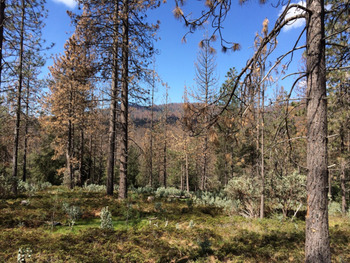
California experienced a severe drought in 2012–2015 inciting a large bark beetle outbreak in the central and southern Sierra Nevada mountain range. At lower elevations, most of the tree mortality was attributed to western pine beetle (Dendroctonus brevicomis), a species that readily colonises drought-stressed ponderosa pine (Pinus ponderosa Douglas ex Lawson; Pinaceae) (Kolb et al. Reference Kolb, Fettig, Ayres, Bentz, Hicke and Mathiasen2016). Photograph by Christopher J. Fettig, United States Department of Agriculture Forest Service.

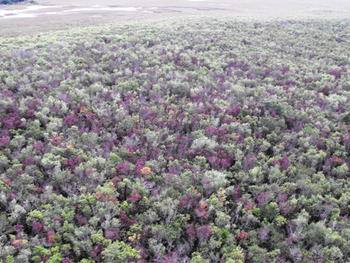
Xyleborus glabratus Eichhoff (redbay ambrosia beetle) is native to Asia but was introduced into coastal forests of Georgia, United States of America, in 2002. This species vectors a wilt fungus (Raffaelea lauricola Harrington et al.; Ophiostomataceae) that has now resulted in mortality of hundreds of millions of redbay (Persea borbonia) with substantial negative consequences to these sensitive ecosystems (Evans et al. Reference Evans, Scheffers and Hess2014). Of further concern, climate change may facilitate the northward spread of redbay ambrosia beetle to sassafras (Sassafras albidum (Nuttall) Nees; Lauraceae) in the central and northeastern United States of America (Nielsen and Rieske Reference Nielsen and Rieske2015). Photograph by Jason A. Smith, University of Florida (Gainesville, Florida, United States of America).

The genesis of the symposium Managing bark and ambrosia beetles with semiochemicals, and this special issue, was a synthesis published in the Annual Review of Entomology developed by a group of United States Department of Agriculture Forest Service research and development scientists from the western United States of America (Seybold et al. Reference Seybold, Bentz, Fettig, Lundquist, Progar and Gillette2018). The synthesis highlighted the progress that has been made concerning the application of semiochemicals for management of conifer bark beetles in western North America. This team received substantial input from several Canadian colleagues, so it seemed appropriate to revisit the content of the synthesis article through a symposium format at an inspiring Canadian venue. Unlike the scope of the synthesis, we chose to expand the symposium programme to include presentations on ambrosia beetles, which are major native, wood-boring pests of conifers in western Canada (Orbay et al. Reference Orbay, McLean, Sauder and Cottell1994) and also prominent invasive species of hardwoods in other parts of North America (Hulcr and Dunn Reference Hulcr and Dunn2011; Hughes et al. Reference Hughes, Smith, Ploetz, Kendra, Mayfield and Hanula2015; Coleman et al. Reference Coleman, Poloni, Chen, Thu, Li and Sun2019). The inclusion of hardwood pests also served to broaden the topic area of threatened habitats from forests to nurseries, ornamental plantings, orchards, urban landscapes, and forests.
Bark beetles and their semiochemicals have played a major role in the origin and development of the science of chemical ecology (Fig. 3). The functional terminology of signals involved in chemical ecology (e.g., pheromone, allomone, kairomone, synomone) (Wood Reference Wood1982; Seybold et al. Reference Seybold, Bentz, Fettig, Lundquist, Progar and Gillette2018) found early illustrations in the primary and collateral behavioural activities of bark beetle aggregation pheromones during field testing in California, United States of America in the 1960s. Isolated or synthetic materials for two pine bark beetles, Ips paraconfusus Lanier and the western pine beetle (Dendroctonus brevicomis LeConte), attracted not only the target pest but also various natural enemies, while repelling competing bark beetles (Wood et al. Reference Wood, Stark, Silverstein and Rodin1967, Reference Wood, Browne, Bedard, Tilden, Silverstein and Rodin1968; Bedard et al. Reference Bedard, Tilden, Wood, Silverstein, Brownlee and Rodin1969). Verbenone [(1 R)-cis-4,6,6-trimethylbicyclo[3.1.1]hept-3-en-2-one], now regarded as a “universal” behavioural repellent (anti-aggregation pheromone) for many bark beetles (Seybold et al. Reference Seybold, Bentz, Fettig, Lundquist, Progar and Gillette2018), was also identified as a pine bark beetle-associated natural product during this era of pioneering investigations (Renwick Reference Renwick1967).
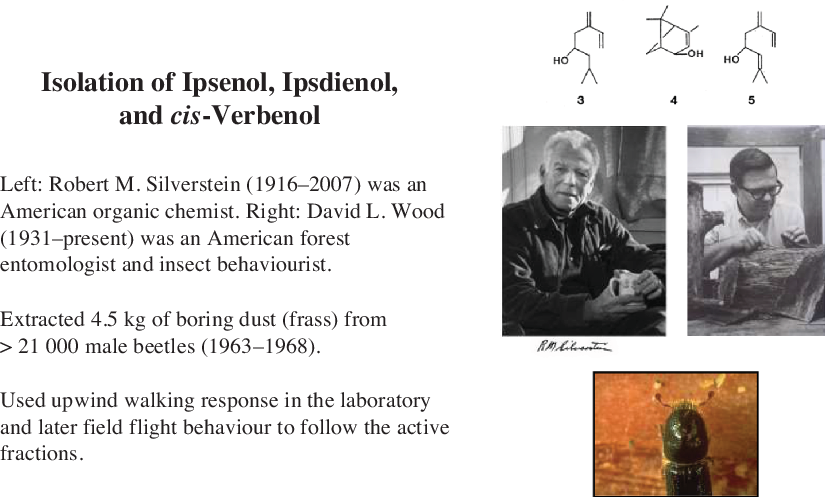
Isolation and identification (1963–1968) of the aggregation pheromone of Ips paraconfusus Lanier (California fivespined ips) was a landmark step in the nascent science of chemical ecology (Silverstein et al. Reference Silverstein, Rodin and Wood1966; Tumlinson and Wood Reference Tumlinson and Wood2011). The three monoterpene alcohols that comprise the aggregation attractant of this pine bark beetle provided the first example of a multicomponent pheromone, whose elements work in synergy to elicit the behavioural response. It was also the first recorded instance of a pheromone that did triple duty as an allomone [repelling the competing Ips latidens (LeConte) and later the western pine beetle (Dendroctonus brevicomis) and red turpentine beetle (Dendroctonus valens LeConte)] and as a kairomone (attracting several bark beetle predators) (Wood et al. Reference Wood, Stark, Silverstein and Rodin1967, Reference Wood, Browne, Bedard, Tilden, Silverstein and Rodin1968; Paine and Hanlon Reference Paine and Hanlon1991; Fettig et al. Reference Fettig, Borys, Dabney, McKelvey, Cluck and Smith2005).

The exquisite behavioural specificity elicited by some of the earliest isolated natural products relied on blends of optical isomers (enantiomers) of the components (Borden et al. Reference Borden, Chong, McLean, Slessor and Mori1976; Wood et al. Reference Wood, Browne, Ewing, Lindahl, Bedard and Tilden1976; Birch et al. Reference Birch, Light, Wood, Browne, Silverstein and Bergot1980). In some instances, substantial amounts of both an enantiomer and its antipode were required to elicit the full behavioural response, whereas in other cases, the opposite isomer was inactive. With western populations of the pine engraver (Ips pini (Say)), the antipode interrupted the flight response to the behaviourally active enantiomer, (R)-(–)-ipsdienol (2-methyl-6-methylene-2,7-octadien-4-ol) (Birch et al. Reference Birch, Light, Wood, Browne, Silverstein and Bergot1980). At the conclusion of this discovery period, it became clear that the semiochemicals that govern the diversity of behavioural interactions among bark and ambrosia beetles and the subcortical community (Fig. 4) may be useful to land managers as tools of integrated pest management and, specifically, in insect control (Silverstein Reference Silverstein1981). Further research demonstrated the complexity of the olfactory environment within forests and that for widely distributed bark beetle species, there can be variability in the production and response to semiochemicals among populations, such that there are in essence olfactory dialects in different parts of the range.
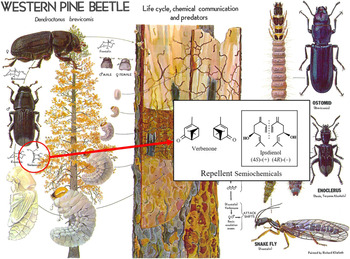
Partial subcortical community of western pine beetle (Dendroctonus brevicomis) in ponderosa pine (Pinus ponderosa) illustrating semiochemical-guided interactions in which attractive pheromone components (e.g., exo-brevicomin and frontalin) elicit aggregation behaviour, mating, and brood production, whereas repellent pheromone components [verbenone and (S)-(+)-ipsdienol] regulate intraspecific competition (Byers et al. Reference Byers, Wood, Craig and Hendry1984; Paine and Hanlon Reference Paine and Hanlon1991). The latter also regulates population densities of competing bark beetles (as allomones), but attracts predators such as Enoclerus lecontei (Wolcott) (Coleoptera: Cleridae) and Temnochila chlorodia (Mannerheim) (Coleoptera: Trogositidae) (as kairomones). Modified from Boyce Thompson Institute of Plant Research.

Modern semiochemical-based tools and tactics for bark and ambrosia beetles range from monitoring and detection of native and invasive species to protection of individual trees and small landscapes. These approaches have been illustrated in depth in a series of case studies of four of the most damaging western North American bark beetles, mountain pine beetle (Dendroctonus ponderosae Hopkins), Douglas-fir beetle (Dendroctonus pseudotsugae Hopkins), spruce beetle (Dendroctonus rufipennis (Kirby)), and D. brevicomis (Seybold et al. Reference Seybold, Bentz, Fettig, Lundquist, Progar and Gillette2018). Application of pheromone-baited multiple funnel traps (Lindgren Reference Lindgren1983) for the detection and evaluation of spread of the invasive Orthotomicus erosus (Wollaston) across urban areas of the southwestern United States of America and detection of the invasive Pityophthorus juglandis Blackman across the black walnut (Juglans nigra Linnaeus; Juglandaceae) “breadbasket” of the eastern United States of America are recent examples of the use of semiochemicals for revealing low-density and newly established populations (Seybold et al. Reference Seybold, Dallara, Nelson, Graves, Hishinuma and Gries2015, Reference Seybold, Bentz, Fettig, Lundquist, Progar and Gillette2018, Reference Seybold, Klingeman, Hishinuma, Coleman and Graves2019; Fig. 5). With the latter invasive species, volatiles from hosts and nonhosts, as well as verbenone, are under investigation to protect relatively high-value English walnut (Juglans regia Linnaeus) orchards in the Central Valley of California (Audley et al. Reference Audley, Dallara, Francke and Seybold2016). In two other hardwood systems, redbay (Persea borbonia (Linnaeus) Sprengel; Lauraceae), a coastal species native to the southeastern United States of America, and in orchards of avocado (Persea americana Miller; Lauraceae), repellency of the invasive Xyleborus glabratus Eichhoff may figure prominently in future management (Martini et al. Reference Martini, Sobel, Conover, Mafra-Neto and Smith2019).
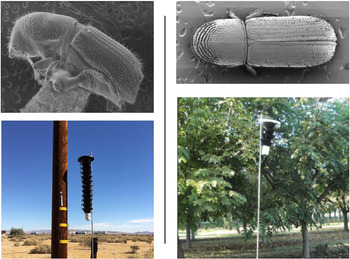
Detection of populations of (left) Orthotomicus erosus and (right) Pityophthorus juglandis with aggregation pheromone-baited, multiple-funnel traps. These are two examples of detection of invasive bark beetle species through application of structurally similar pheromone components, 2-methyl-3-buten-2-ol and 3-methyl-2-buten-1-ol, respectively (both male-produced) (Seybold et al. Reference Seybold, Dallara, Hishinuma and Flint2013, Reference Seybold, Dallara, Nelson, Graves, Hishinuma and Gries2015, Reference Seybold, Penrose, Graves, Paine and Lieutier2016). Photographs by Megan A. Siefker, University of California (Davis, California, United States of America) (left), and Andrew D. Graves and Steven J. Seybold, United States Department of Agriculture Forest Service (right).

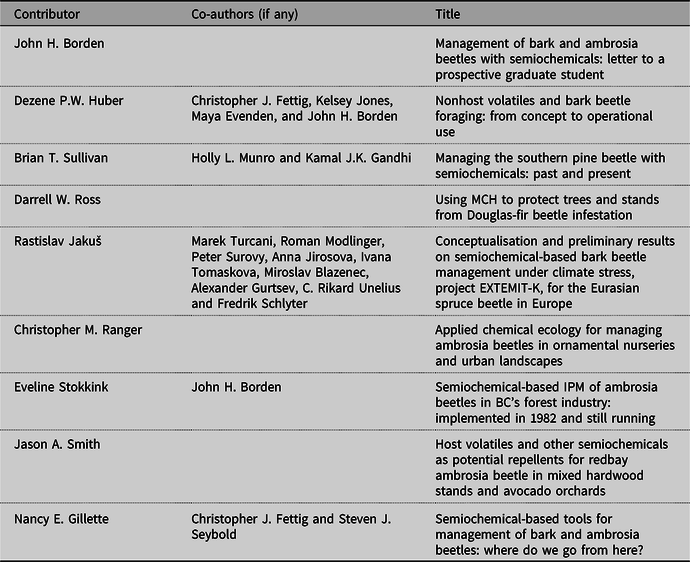
Development of effective semiochemical-based management tools and tactics for bark and ambrosia beetles is a tricky business. It not only requires strong knowledge of chemistry, chemical ecology, insect ecology, and forest ecology but also of the major semiochemical components of the system being studied and eventually the most efficacious blends, ratios, and release rates to impart the desired behavioural effect on the insect in the field. It involves substantial time, risk, and investment in research, development, and application, which are often significant barriers to success for minor use crops, such as pines, where returns on investments can be limited (Progar et al. Reference Progar, Gillette, Fettig and Hrinkevich2014). Despite this, significant advances are being made ranging from increases in understanding of the biochemistry of pheromone production in beetles to commercialisation of novel products for field applications. This symposium highlighted some of these advances through presentations by nine distinguished speakers from three countries (Table 1), as we attempted to exercise deference to the joint meeting theme of Crossing borders. The symposium was bookended by keynote speakers John H. Borden and Nancy E. Gillette. Dr. Borden, who many regard as “the father of semiochemical-based management of bark and ambrosia beetles” took a typically refreshing approach by eschewing a PowerPoint presentation. Rather, he narrated his thoughts through a letter that he composed to a fictitious prospective graduate student. Dr. Gillette, who braved the smoke of wildfires in northern California for a day trip to Vancouver (British Columbia, Canada), shared insights and experiences from her remarkable career focussed on management of multiple forest insect systems with semiochemicals. Dr. Gillette’s and Dr. Borden’s visions of the path forward will likely shape future contributions to the field.
Contributors to the symposium Managing bark and ambrosia beetles with semiochemicals held at the Joint Meeting of the Entomological Society of America, the Entomological Society of Canada, and the Entomological Society of British Columbia, Crossing borders: entomology in a changing world, 14 November 2018, Vancouver, British Columbia, Canada.

Acknowledgements
We acknowledge the contributions of the symposium presenters, as well as members of the United States Department of Agriculture Forest Service Research and Development Western Bark Beetle Research Group whose input led to the development and publication of the synthesis article that underpinned the symposium highlighted herein. We also acknowledge the support of the United States Department of Agriculture Forest Service Pacific Southwest Research Station, and Dr. Dezene P.W. Huber, Editor-in-Chief of The Canadian Entomologist, who encouraged us to move forward with this special issue. Sadly, Dr. Steven J. Seybold (1959–2019) passed away unexpectedly in November as he and I were nearing completion of this article. Dr. Seybold was a giant in our field, and a rare scientist who excelled at all levels. He will be sorely missed. A preceding tribute dedicates this special issue to his memory and highlights some of his enormous contributions to our science.