A central assumption of most models of reading acquisition is that children start out by decoding words on a letter-by-letter basis at first (Ehri, Reference Ehri1995; Grainger & Ziegler, Reference Grainger and Ziegler2011; Seymour, Reference Seymour, Snowling and Hulme2005; Share, Reference Share1995). They learn grapheme–phoneme correspondence (GPC) mappings and sound out words. As their reading skills develop and they gain more experience with written words, it is assumed that they become sensitive to intermediate-sized units until they are finally able to decode whole words directly “on sight.” For example, Seymour's (Reference Seymour, Snowling and Hulme2005) dual-foundation model proposes that reading develops in phases. It is thought to begin with simple alphabetic decoding using phonemes and advances to increasingly more complex structures, first centered around rimes, and in the last stage using syllables and morphemes. Equally, the multiple-route model of orthographic processing (Grainger & Ziegler, Reference Grainger and Ziegler2011) assumes that beginning readers start out by decoding words on a phonology-driven letter-by-letter basis (cf. Share, Reference Share1995) that leads them to two routes of orthographic processing: a fine-grained and a coarse-grained route. The main difference between the fine-grained and coarse-grained routes is the coding of letter positions: the fine-grained route is sensitive to ordered letter sequences, whereas letter coding in the coarse-grained route is position invariant. As a consequence, the coarse-grained route entails direct access from orthography to semantics via whole words, whereas the fine-grained route is tuned to detect frequently co-occurring letter sequences as functional units for word recognition. Both syllables and morphemes feature frequently co-occurring letter sequences and can thus be suspected to function as sensible intermediate-sized units that are detected in the fine-grained route. Albeit being formally very similar in terms of size and features of letter position coding, syllables and morphemes differ from each other in how they are defined and what type of information they encode. Syllables are phonologically defined and encode information about pronunciation. Morphemes are defined through the convergence of form and meaning, encoding lexical–semantic information. Syllables can thus be seen as being more closely associated with a phonological processing route, while morphemes constitute a more direct link between orthography and semantics. A very recent extension of the multiple-route model by Häikiö, Bertram, and Hyönä (Reference Häikiö, Bertram and Hyönä2016) captures this relation by proposing a syllabic assembly mechanism as an intermediate stage between a phonological and a fine-grained route, thus predicting the use of syllables to chronologically precede the use of morphemes in reading development.
In a range of languages, empirical evidence has been put forward separately for the use of syllables and morphemes in reading development. Vast evidence shows that sensitivity to syllables, as a subdomain of phonological awareness, is a strong predictor for later reading ability (e.g., Wagner & Torgesen, Reference Wagner and Torgesen1987), measured, for example, by syllable counting or syllable segmentation tasks. In the process of reading, sensitivity to syllables has also been found early in children of different languages. For example, French Grade 5 readers show effects of syllable frequency (Chetail & Mathey, Reference Chetail and Mathey2008) and syllable compatibility effects, that is, faster responses when a word was preceded by the corresponding syllable, have been found in syllable detection tasks with Grade 1, 3 and 5 children (Colé, Magnan, & Grainger, Reference Colé, Magnan and Grainger1999; Maïonchi-Pino, Magnan, & Écalle, Reference Maïonchi-Pino, Magnan and Écalle2010) and in lexical decision tasks with sixth graders (Chetail & Mathey, Reference Chetail and Mathey2012). The visual segmentation of a word in a position congruent with a syllable boundary (pa/per vs. p/aper) results in fewer word recognition errors for poor second-grade readers of English (Katz & Baldasare, Reference Katz and Baldasare1983) and syllable-congruent coloring similarly speeds up poor second-grade readers of French, while it slows down good age-matched peers (Chetail & Mathey, Reference Chetail and Mathey2009). Moreover, eye-tracking studies indicate that hyphenation at syllable boundaries is less disruptive than hyphenation within syllables for Finnish readers already by the end of first grade (Häikiö, Hyönä, & Bertram, Reference Häikiö, Hyönä and Bertram2015). This indicates that syllables are helpful units very early in reading acquisition and for dysfluent readers (see also Hautala, Aro, Eklund, Lerkkanen, & Lyytinen, Reference Hautala, Aro, Eklund, Lerkkanen and Lyytinen2012) and that in many languages syllables come into play very early in the course of reading acquisition.
There is also vast evidence that children use morphemes in word recognition. In lexical decision and naming tasks in a variety of languages, elementary school children have been found to respond faster and more accurately to multimorphemic compared to matched monomorphemic words (Italian: Marcolini, Traficante, Zocolotti, & Burani, Reference Marcolini, Traficante, Zoccolotti and Burani2011; French: Colé, Bouton, Leuwers, Casalis, & Sprenger-Charolles, Reference Colé, Bouton, Leuwers, Casalis and Sprenger-Charolles2011; Quémart, Casalis, & Duncan, Reference Quémart, Casalis and Duncan2012; English: Carlisle & Stone, Reference Carlisle and Stone2003, Reference Carlisle and Stone2005). Conversely, more false alarms and prolonged response times (RTs) in lexical decision were found in the presence of real morphemes in pseudowords, because they were mistaken as real words and thus harder to reject (Quémart et al., Reference Quémart, Casalis and Duncan2012). Those effects of morphology were found as early as in Grade 2 for French children, and a little later (around Grade 3) in Italian children. Moreover, masked morphological priming effects for suffixed words and nonwords have been reported for children in different languages from around Grade 3 onward (English: Beyersmann, Castles, & Coltheart, Reference Beyersmann, Castles and Coltheart2012; French: Beyersmann, Grainger, Casalis, & Ziegler, Reference Beyersmann, Grainger, Casalis and Ziegler2015; Casalis, Dusautoir, Colé, & Ducrot, Reference Casalis, Dusautoir, Colé and Ducrot2009; Quémart, Casalis, & Colé, Reference Quémart, Casalis and Colé2011). A Finnish eye-tracking study by Häikiö, Bertram, and Hyönä (Reference Häikiö, Bertram and Hyönä2011) reports advantages from hyphenations in compounds only for slow second-grade readers, but not for their faster age-matched peers or Grades 4 and 6 readers. Therefore, as for syllables, there is general consensus that children use morphemes as units at some point in reading development; however, findings on when this happens diverge depending on the language studied.
It is important to note that only a few studies have more directly compared syllables and morphemes in reading (see Prinzmetal, Hoffman, & Vest, Reference Prinzmetal, Hofmann and Vest1991, for a study with adults using an illusory conjunction paradigm). However, in order to refine models of reading acquisition, it is necessary to disentangle the relative importance of syllables and morphemes in word recognition and determine whether there is an order of their utilization in reading development. One study that has addressed the direct comparison between syllables and morphemes in child reading was undertaken by Colé et al. (Reference Colé, Bouton, Leuwers, Casalis and Sprenger-Charolles2011) with French second and third graders. They used multimorphemic words in which the syllable and morpheme boundary do not coincide (e.g., malade). This is the case for multimorphemic words that have a suffix beginning with a vowel. The consonants at the end of the stem in these cases form a syllable unit with the suffix, because syllable division follows the maximal onset principle (Spencer, Reference Spencer1996), which states that the maximally possible number of consonants should be assigned to the onset of a syllable rather than to the end of the preceding syllable. Colé et al. (Reference Colé, Bouton, Leuwers, Casalis and Sprenger-Charolles2011) exploited these cases to more directly compare the impact of syllabic segmentation (e.g., ma lade), morphological segmentation (mal ade) and morphological + 1 grapheme (mala de) to unsegmented low-frequency derivations (malade) in a reading task. Reading times were expected to be shorter if the segmentation is in line with the units that are activated in reading and longer when the segmentation destroys important units. The authors found that both second and third graders read words equally fast when they were segmented by a space into syllables or morphemes or were unsegmented. Readers were only slowed down by the morphological + 1 condition. These results point to flexible use of syllables, morphemes, and even whole words, at least for French Grade 2 and 3 readers in the reading of multimorphemic words.
Ziegler and Goswami (Reference Ziegler and Goswami2005) emphasize in their psycholinguistic grain size theory that language-specific characteristics determine preferences for the use of certain units as linguistic characteristics of a language and its orthography may pose different demands on learners. Cross-linguistic differences in reading development have been attributed to orthographic transparency (Katz & Frost, Reference Katz, Frost, Frost and Katz1992), syllable structure (Seymour, Aro, & Erskine, Reference Seymour, Aro and Erskine2003), and morphological richness (Perfetti & Harris, Reference Perfetti and Harris2013). Learners of opaque orthographies (e.g., English) might need longer to master GPC-based reading, while in transparent orthographies, like German or Finnish, solid reading skills can be achieved quickly by the use of GPC rules only (Wimmer & Goswami, Reference Wimmer and Goswami1994). As a consequence, learners of opaque orthographies can be assumed to profit considerably more from using bigger units, such as syllables or morphemes, because those tend to have more consistency in the way they are spelled and pronounced (Katz & Frost, Reference Katz, Frost, Frost and Katz1992). However, languages also vary in the complexity of their syllable structure: for example, in Finnish and French syllable structure tends to be more simple, while the syllable structure of German and English is rather complex (Seymour et al., Reference Seymour, Aro and Erskine2003). As Seymour et al. (Reference Seymour, Aro and Erskine2003) found, complex syllable structures tend to be more challenging for developing readers. Moreover, as the transparency of an orthography tends to be correlated with the morphological complexity of the language (Perfetti & Harris, Reference Perfetti and Harris2013; Seidenberg, Reference Seidenberg, McCardle, Ren and Tzeng2011), more transparent languages are often equipped with a richer and more productive morphology. For languages in which morphemes are very prominent, like German or Finnish, then, they suggest themselves as units in word recognition, despite the availability of smaller units. Considering the interplay of syllables and morphemes, languages also differ in the degree of convergence and interactions of the two units. In German, syllables and morphemes very often coincide. Moreover, suffixation usually does not affect stress assignment in the word, whereas in French, suffixes often draw the stress. The distinction between syllables and morphemes might therefore be less pronounced in German in comparison to French. Differences between languages in the structure of mappings between phonology, orthography, and meaning can produce differences in the sensitivity to certain sublexical units. Due to the described characteristics, German presents an interesting contrast to the languages in which development of syllables and morphemes as reading units has been studied so far, and different predictions can be made on the basis of its linguistic characteristics. In particular, the orthographic transparency together with complex syllable structure would predict prolonged reliance on graphemes throughout development. However, the morphological richness should act in favor of early advancement to morphemes. Finally, the prevalent convergence of morphemic units with syllabic units can be expected to also enhance reliance on syllables. Consequently, the relative importance of syllables and morphemes in reading development is unclear for this language and needs to be tested empirically.
To address the role of syllables and morphemes as reading units in German reading development, we adopted the methodology from the study by Colé et al. (Reference Colé, Bouton, Leuwers, Casalis and Sprenger-Charolles2011), using a manipulation of the presentation format. Unfortunately, the study by Colé et al. (Reference Colé, Bouton, Leuwers, Casalis and Sprenger-Charolles2011) focuses exclusively on multimorphemic words and does not reveal whether syllables are equally used in reading monomorphemic words. It is possible that a segmentation at the syllable boundary in monomorphemic words leads to even faster responses as it does not simultaneously destroy a morphemic structure. Therefore, we further extended the study design to monomorphemic words and made some slight changes to the paradigm. We included multimorphemic words with a syllabic segmentation (e.g., FAH:RER) and a morphological segmentation condition (FAHR:ER) in our study, just like Colé et al. (Reference Colé, Bouton, Leuwers, Casalis and Sprenger-Charolles2011). In order to examine the use of syllables in multimorphemic words in comparison to that in monomorphemic words, we also included monomorphemic words that were segmented at the same positions as the multimorphemic words, namely, at the syllable boundary (syllable-congruent; e.g., SPI:NAT) or one letter after the syllable boundary (syllable-incongruent; SPIN:AT). Note that the latter parallels the morphological segmentation condition of the multimorphemic words, but in the case of the monomorphemic words cannot coincide with a morpheme boundary by definition (–at is not a German suffix). We hypothesized that word recognition would be easiest for readers in the disruption condition that puts emphasis on the functional unit they actually use, while other disruption positions should make reading harder. That is, if a reader uses only syllables as functional units, the syllable-congruent disruption condition should lead to faster word recognition compared to the incongruent disruption in both monomorphemic and multimorphemic words. However, if a reader uses morphemes as functional units, the syllable-incongruent disruption of multimorphemic words (e.g., FAHR:ER, thus being morpheme-congruent) should be faster than the syllable-congruent one, while this should not be the case for the monomorphemic words (SPIN:AT) as the resulting structure does neither map onto a phonological syllable nor onto a morpheme (but see Taft, Reference Taft1979, Reference Taft1986, for another possible structure called BOSS). Our study thus not only allows investigating the findings of Colé et al. (Reference Colé, Bouton, Leuwers, Casalis and Sprenger-Charolles2011) for another language but also refines them due to the inclusion of monomorphemic words.
Another limitation of the study by Colé et al. (Reference Colé, Bouton, Leuwers, Casalis and Sprenger-Charolles2011) is that no pseudowords were included, although those can also be informative concerning the use of syllables and morphemes in reading new items. Because children, especially those who have just started to read, are often confronted with a given written word for the first time, the use of syllables or morphemes in reading such a newly encountered word is of special interest with regard to the role of different units in reading development. Reading pseudowords most likely parallels the processes involved in reading new words. In the present study, we included pseudowords by employing a lexical decision task. Learners of transparent orthographies achieve basic reading skills with rather high accuracy rates very early in development (Seymour et al., Reference Seymour, Aro and Erskine2003; Wimmer & Goswami, Reference Wimmer and Goswami1994), and silent reading, as required in the lexical decision task, is already natural to them. Therefore, a lexical decision is an adequate task to study processing also in beginning readers of German. The pseudowords included in the study matched the real words: they either did or did not feature an existing suffix (multimorphemic and monomorphemic pseudowords) and were also segmented syllable-congruent (e.g., DOS:TOR, HEL:BER) or syllable-incongruent (DOST:OR, HELB:ER), the latter again corresponding to a morpheme-congruent disruption for pseudowords featuring a suffix (–er). Considering the hypotheses for pseudowords, one has to keep in mind that, opposite of words, those have to be rejected in a lexical decision task. Syllable-congruent segmentation, encouraging the use of syllables, might help to “read through” the pseudoword faster than a segmentation that destroys this unit when readers rely on a phonological decoding strategy. It might thus allow a faster rejection relative to a syllable-incongruent segmentation, as evidence from English and Serbo-Croatian (Katz & Feldman, Reference Katz, Feldman, Lesgold and Perfetti1981; Lima & Pollatsek, Reference Lima and Pollatsek1983) suggests. However, multimorphemic pseudowords have been found to be harder to reject (Burani, Marcolini, & Stella, Reference Burani, Marcolini and Stella2002; Quémart et al., Reference Quémart, Casalis and Duncan2012), because morphemes as lexical–semantic units signal word status. Therefore, the syllable-incongruent segmentation of multimorphemic pseudowords (e.g., HELB:ER), which puts emphasis on the real suffix, might result in prolonged rejection times. Overall, including both mulimorphemic and monomorphemic words and pseudowords in our study provides a more extensive direct comparison of syllables and morphemes as functional units in reading.
To summarize, one of our main aims was to find out how the use of syllables and morphemes changes in the course of reading development in German. In order to investigate developmental differences, children at different stages in reading development were examined. Based on the previously mentioned findings on syllable and morpheme use in children, we decided to conduct the study with second and fourth graders. In accordance with the prediction of the multiple route model (Grainger & Ziegler, Reference Grainger and Ziegler2011) that developing readers use a phonological strategy in the beginning, we expected that younger children would be more inclined to make use of syllables in word recognition, because although those are intermediate-sized units, they are phonologically defined and thus more approximate to the phonological route (see Häikiö et al., Reference Häikiö, Bertram and Hyönä2016). Based on the developmental sequence outlined by Häikiö et al. (Reference Häikiö, Bertram and Hyönä2016), older children, who had gained more reading experience, were expected to have moved away further from a phonological strategy and more toward an orthographic strategy using fine-grained processing with morphemes as functional units. In order to compare the processing strategies of readers that are still in the course of development to those of skilled readers, we also included a group of adults. The adults’ processing thus serves as a reference point for the reading skills that the children should be achieving at some point in the future. Skilled readers should have access to both fine-grained and coarse-grained processing. Consequently, their reading strategy should depend on task demands. As coarse-grained processing, that is position invariant, is more robust to small changes in words that only affect a single sign (i.e., transposed or substituted letters: e.g., Forster, Davis, Schoknecht, & Carter, Reference Forster, Davis, Schoknecht and Carter1987; O'Connor & Forster, Reference O'Connor and Forster1981), this would be a more beneficial strategy for the present task. It is therefore plausible that adults are able to adjust to this, being considerably less affected by the position of the disruption.
METHOD
Participants
Fifty-seven second-grade children were recruited from 10 elementary schools in the Berlin area. At the time of testing, the children were at the beginning of second grade, meaning they had received approximately 1 year of formal reading instruction. Permission for participation from the school administration and the children's parents was acquired prior to the experiment. Moreover, 20 fourth graders were recruited at the after-school care of one Berlin school. Permission from the after-school care and the children's parents was acquired before testing. Every child received a small gift and candy for his or her participation. Finally, 24 university students from the Berlin area participated for monetary reimbursement.
In order to ensure that participants showed age-appropriate reading behavior, each participant's reading fluency was assessed using the 1-min reading test for words and nonwords from the second edition of the Salzburg Reading and Spelling Test (Moll & Landerl, Reference Moll and Landerl2010). We used reading fluency percentile norm values of <3 as an indication that readers belonged to the 3% of the population at the lowest end of the reading fluency scale suffering from dyslexia. This applied to 6 second graders. Furthermore, we excluded one adult who reported having a history of dyslexia and two adults who reported having learned German as a second language later in life. As we aimed at investigating unimpaired reading, we excluded those participants. As a consequence, the study included 51 second graders (24 girls, M age = 6.9 years), 20 fourth graders (10 girls, M age = 9.5 years), and 21 university students (10 women, M age = 26.1 years). All remaining participants reported normal or corrected to normal vision and had German as their native language or second language acquired before the age of 6. As analyses for monolinguals and early bilinguals showed no differences, all children were included in the analyses.
Materials
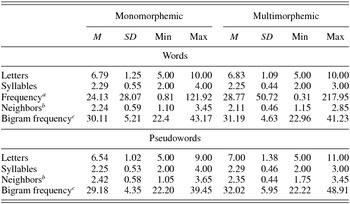
Twenty-four multimorphemic words, consisting of a stem and a suffix, were selected from the childLex corpus (Schroeder, Würzner, Heister, Geyken, & Kliegl, Reference Schroeder, Würzner, Heister, Geyken and Kliegl2015). Crucially, suffixes beginning with a vowel were chosen (–er, –in, –ung), because when they are combined with a stem, the syllable boundary does not correspond to the morpheme boundary, thus creating a special morphophonological case. The words were disrupted by inserting a colon (:) at the syllable boundary (syllable-congruent condition, e.g., FAH:RER) or one letter right of the syllable boundary (syllable-incongruent condition, FAHR:ER), which corresponds to the morpheme boundary in the multimorphemic words, thus being morpheme congruent for those. Moreover, 24 monomorphemic words were selected from the corpus and were also disrupted by a colon at the syllable-congruent (e.g., SPI:NAT) or syllable-incongruent (SPIN:AT) position. Mono- and multimorphemic words were matched on number of letters, number of syllables, frequency, bigram frequency, and neighbors (all t < 1, p > .05, see Table 1 for lexical statistics).
Lexical statistics of the word and pseudoword items

a Normalized type frequency (per million).
b Orthographic Levenshtein Distance 20.
c Summed bigram type frequency.
Moreover, 24 multimorphemic pseudowords were created by selecting multimorphemic words that were not in the stimulus set but had the same suffixes that were used in the word set (–er, –in, –ung). To create pseudowords, one letter in the stem was changed, such that the morphological structure remained due to the presence of the real suffix. Again, the items were disrupted syllable-congruent (e.g., HEL:BER) or syllable-incongruent/morpheme-congruent (HELB:ER). In addition, 24 monomorphemic words were chosen and one letter was changed in order to create monomorphemic pseudowords, which were again segmented at the syllable boundary (e.g., DOS:TOR) or one letter to its right (DOST:OR). Mono- and multimorphemic pseudowords were matched on number of letters, number of syllables, bigram frequency, and neighbors (all t < 1, p > .05, see Table 1 for details). Finally, the pseudoword set and the word set were matched on these characteristics as well (all t < 1, p > .05, see Table 1).
Two lists were created from the final set of 48 words and 48 pseudowords, such that each stimulus appeared both in the syllable-congruent and the syllable-incongruent/morpheme-congruent condition across participants, but each participant only saw each stimulus in one of the conditions.
Procedure
The children were tested individually in a quiet room in their schools or in their after-school care. The adults were tested individually at the test center of the research institution. The experiment was run on a 15-in. laptop monitor with a refresh rate of 60 Hz. The stimuli were always presented in the center of the screen in white 20-point Courier New font on a black background. Each trial started with a 500-ms fixation cross, followed directly by a disrupted word or pseudoword. The word or pseudoword remained on the screen until a response was made by the participant. Participants were instructed to decide as quickly and as accurately as possible whether the presented stimulus was an existing German word or not while ignoring the colon in the stimulus. They were further instructed to indicate their decision by pressing the D or the K key on a standard keyboard, marked red and green. Eight practice trials with feedback (right or wrong answer) were given prior to the 96 experimental items. After half of the items, the participants had a break that was timed by the experimenter.
RESULTS
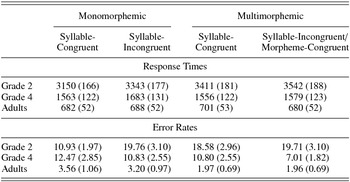
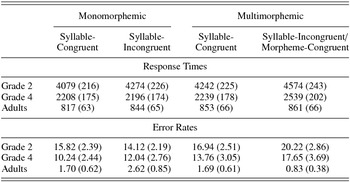
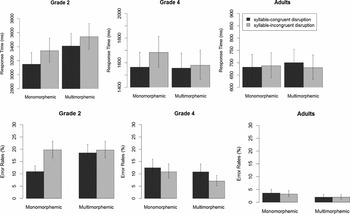
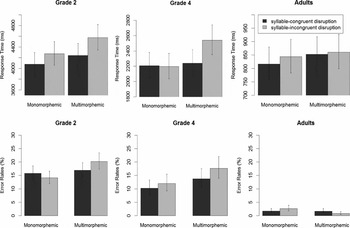
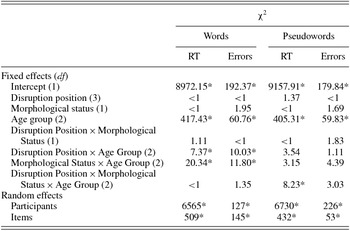
Reaction times and error rates from the experiment were collected and analyzed separately for words and pseudowords. For the RT analysis, incorrect responses were removed from the analysis (15.80% for words, 15.80% for pseudowords), as were RTs below 200 ms or above 10000 ms (0.91% for words, 3.16% for pseudowords). The remaining RTs were then logarithmically transformed. Following Baayen and Milin (Reference Baayen and Milin2010), model criticism based on a simple model including random effects for subject and item was used for further outlier trimming, excluding all data points with residuals exceeding 2.5 SD for the main analyses (2.32% for words, 1.95% for pseudowords). It should be noted that adults made very few errors, limiting the meaningfulness of the error rate analysis for adults. For reasons of completeness and because the children made more errors, we report error analyses too. The means and standard errors for words and pseudowords are presented in Tables 2 and 3 and illustrated in Figures 1 and 2, respectively.
Mean (standard error) response times (ms) and error rates (%) to words

Mean (standard error) response times (ms) and error rates (%) to pseudowords

Mean response times (ms) and error rates (%) to words in the different conditions by age group. Error bars indicate standard errors.

Mean response times (ms) and error rates (%) to pseudowords in the different conditions by age group. Error bars indicate standard errors.

Main data analyses were performed using linear mixed-effects models (Baayen, Reference Baayen2008; Baayen, Davidson, & Bates, Reference Baayen, Davidson and Bates2008). A forward-selection procedure was used for model building, starting with a very simple model only including age group as a fixed effect and only adding predictors when they significantly improved model fit as indicated by comparison of the Bayes information criterion. The final model included morphological status (monomorphemic vs. multimorphemic), disruption position (syllable-congruent vs. syllable-incongruent/morpheme-congruent), age group (second graders vs. fourth graders vs. adults), and their interactions as fixed effects, and participants and items as random factors. The results for the overall effects tests using contrast coding and Type III sum of squares (using the Anova function in the car package) are summarized in Table 4. Post hoc comparisons were carried out using cell means coding, and single df contrasts using the glht function of the multcomp package (Hothorn, Bretz, & Westfall, Reference Hothorn, Bretz and Westfall2008) were evaluated using a normal distribution.
Results from mixed-effect models with morphological status, disruption position, and age group as fixed effects and participant and item as random intercepts

Note: Tests are based on Type III sum of squares and χ2 values with Kenward–Roger df. The numbers in parentheses are degrees of freedom. RT, Response time.
Words
The model fitted to the word data revealed a significant main effect of age group, indicating faster RTs with increasing age. Furthermore, age group interacted with morphological status as well as with disruption position. Decomposing the Age Group × Morphological Status interaction, post hoc contrasts showed that albeit second graders showed a numerical advantage for monomorphemic compared to multimorphemic words, this effect did not reach significance (ΔRT = 230 ms, t = 1.72, p = .08), and neither did the difference between monomorphemic and multimorphemic words in fourth graders and adults (Grade 4: ΔRT = 55 ms, t < 1, p = .42; adults: ΔRT = 5 ms, t < 1, p = .84). The simple main effect of morphological status, however, was significantly different in second graders compared to fourth graders (t = 4.29, p < .01) and compared to adults (t = 2.68, p < .01), while fourth graders and adults did not differ significantly (t = 1.57, p > .05).
Decomposing the Age Group × Disruption Position interaction, it became clear that all children were slowed down significantly by the syllable-incongruent compared to the syllable-congruent condition (Grade 2: ΔRT = 162 ms, t = 3.69, p < .01; Grade 4: ΔRT = 72 ms, t = 2.21, p = .03), while this was not the case for adults (ΔRT = 7 ms, t < 1, p = .56). The simple main effect of disruption position did not differ between second and fourth graders (t < 1, p = .87), but differed significantly between both second graders and adults (t = 2.63, p < .01) and fourth graders and adults (t = 2.02, p = .04).
There was no three-way interaction of morphological status, disruption position, and age group. A similar model was fitted to the error data. This mirrored the outcome of the RT model with a significant main effect of age group, indicating more accurate responses with increasing age. Age group also interacted with morphological status and with disruption position. Regarding the Age Group × Morphological Status interaction, post hoc contrasts showed that the direction of the morphological status effect differed significantly between second graders and fourth graders (t = 2.74, p < .01) and between second graders and adults (t = 2.45, p = .01). All other contrasts were not significant.
When decomposing the Age Group × Disruption Position, it became evident that second graders made fewer errors in the syllable-congruent disruption condition (t = 3.57, p < .01), while this was not the case for fourth graders (t = 1.57, p = .12) and adults (t < 1, p = .86).
Taken together, children's word recognition is impeded when syllables are visually disrupted, while adults are not affected differentially by syllable-congruent and syllable-incongruent/morpheme-congruent visual disruptions.
Pseudowords
RTs to pseudowords were analyzed as described above. A main effect of age group was found, indicating that RTs to pseudowords became faster with increasing age. This main effect was moderated by a three-way interaction of morphological status, disruption position, and age group.
Post hoc contrasts showed that for second-grade children, there was no interaction of morphological status and disruption position (t = 1.09, p = .28), nor a simple main effect of morphological status (t = 1.44, p = .15), but the simple main effect of disruption position was significant (t = 4.62, p < .01). This indicated slower responses to syllable-incongruent compared to syllable-congruent pseudowords (ΔRT = 264 ms).
For fourth-grade children, there was an interaction effect of morphological status and disruption position (t = 3.23, p < .01). The effect of disruption position was only significant for multimorphemic words (t = 4.29, p < .01); that is, RTs to pseudowords disrupted at the syllable-incongruent position were longer when the pseudoword contained an existing morpheme (ΔRT = 298 ms) and the segmentation was therefore morpheme congruent. There were no prolonged RTs to monomorphemic syllable-incongruent pseudowords (t < 1, p = .85).
Adults did not show a significant effect of neither morphological status (t < 1, p = .42) nor disruption position (t = 1.17, p = .24), nor the interaction of those (t < 1, p = .52).
Error rates to pseudowords were analyzed parallel to the RTs. The model yielded a significant main effect of age group only, indicating that error rates decreased with increasing age.
In summary, second graders were slower in rejecting pseudowords when the disruption was syllable incongruent, while fourth graders were only slowed down by syllable-incongruent (i.e., morpheme-congurent) disruptions of multimorphemic pseudowords, which were the morpheme-congruent cases. Adults were again not influenced by disruptions at all.
DISCUSSION
The present study examined second graders’, fourth graders’, and adults’ use of syllables and morphemes as functional units in word recognition by using a lexical decision task with monomorphemic and multimorphemic words and pseudowords that were visually disrupted either in a syllable-congruent or a syllable-incongruent way (being morpheme-congruent in the case of mulitmorphemic words). Beginning and skilled readers were impacted differently by this disruption, implying that different units are preferred depending on the stage of reading development. Moreover, the effect of disruption position also differed for word recognition and pseudoword rejection in the different age groups. Second graders were faster when the disruption was syllable congruent in both word recognition and pseudoword rejection. For fourth graders, syllable-congruent disruptions were also faster in word recognition, but in pseudoword rejection, this was only the case for multimorphemic pseudowords. Together, this indicates that syllables facilitate word recognition for all children, while morphemes selectively impede the rejection of multimorphemic pseudowords in fourth graders. Adults were not affected differently by syllable-congruent and syllable-incongruent disruptions, neither in word recognition nor in pseudoword rejection.
Second-grade children in the present study responded faster when disruptions were congruent with the syllables (SPI:NAT, FAH:RER) than if they were not (SPIN:AT, FAHR:ER), regardless of the morphological status. Moreover, this pattern emerged for both words and pseudowords. In addition, second graders made fewer errors to words with syllable-congruent disruptions. Together, this shows that beginning readers of German can use syllables as units in reading. Moreover, the results indicate that word and pseudoword reading in young children is based on the same sublexical mechanism. This can be best interpreted as some kind of phonological restructuring into syllables prior to lexical access (Katz & Feldman, Reference Katz, Feldman, Lesgold and Perfetti1981) that helps the flow of reading, making it easier for beginning readers to “get through” the word or pseudoword. Taken together, the response pattern to words and pseudowords militates for the syllable as a salient grain size in German second graders’ reading, while morphemic structure is still tedious.
Children in fourth grade in our study also showed facilitation from syllable-congruent compared to syllable-incongruent disruptions, albeit this effect did only emerge in the RTs, but not in the error rates. It is interesting that no facilitation from syllable-congruent disruptions in the monomorphemic pseudowords (DOS:TOR) was evident. The disruption position only made a difference in the multimorphemic pseudowords that featured a suffix, which was accentuated in the syllable-incongruent disruption (HELB:ER). Because pseudowords have to be rejected, the RTs can reflect not only actual reading processes but also rejection difficulty. Thus, the longer RTs to pseudowords that feature a suffix and are disrupted at the morpheme boundary, such that the suffix is highlighted, might point to a role of morphemes in reading. The prominences of syllables as functional units in word reading, but morphemes in pseudoword reading, is very interesting because it suggests that different processing mechanisms can be involved depending on lexicality and/or familiarity. When reading unfamiliar words, such as pseudowords, morphemes might be particularly consulted, as they aid breaking down and understanding unknown words (Bertram, Laine, & Virkkala, Reference Bertram, Laine and Virkkala2000). This draws on the different types of information that syllables and morphemes encode. The accentuation of the existing suffix in a pseudoword might thus result in longer attempts at ascribing meaning to the pseudoword, which finally fails (see Quémart et al., Reference Quémart, Casalis and Duncan2012). It can be assumed that fourth graders have already developed some sensitivity to suffixes as lexical–semantic units, but do not fully capitalize on morphemes as sublexical decoding units in words when they do not coincide with syllables. Together, results from words and pseudowords for fourth-grade readers indicate that in the course of reading development, sensitivity to morphemes emerges, while syllables do not lose their relevance as a grain size in fine-grained reading.
Turning to the results for the skilled adult readers in our study, we failed to find any effects of the disruption, in the case of both words and pseudowords. Certainly, this does not rule out the possibility that adults are sensitive to syllables and morphemes in word recognition, as has been evidenced by many studies with a variety of paradigms (e.g., for syllable effects, Carreiras, Álvarez, & De Vega, Reference Carreiras, Álvarez and De Vega1993; and Conrad & Jacobs, Reference Conrad and Jacobs2004; for a review of morphological effects, see Amenta & Crepaldi, Reference Amenta and Crepaldi2012). Our results should be interpreted with caution in this regard with several considerations in mind. First, the words were very familiar to adults, as we chose them from a child corpus (childLex; Schroeder et al., Reference Schroeder, Würzner, Heister, Geyken and Kliegl2015) with the developmental focus of the study in mind, and syllable and morpheme effects have been shown to diminish or even disappear with increasing word frequency (Colé et al., Reference Colé, Magnan and Grainger1999; Marcolini et al., Reference Marcolini, Traficante, Zoccolotti and Burani2011). Second, the disruption we used (:) was very subtle for skilled readers, whose reading system is robust to some amount of impreciseness (e.g., Forster et al., Reference Forster, Davis, Schoknecht and Carter1987; O'Connor & Forster, Reference O'Connor and Forster1981). Third, as the accentuation of certain units through the disruptions was not always helpful (e.g., SPIN:AT, leaving no sensible subunits, or HELB:ER, drawing the attention to the misleading existing suffix), adults might have ignored the manipulation altogether. Skilled readers thus showed less sensitivity to syllables and morphemes as sublexical units in the present study, which does not exclude their ability to rely on these grain sizes under task demands. However, in the present study, we suggest that they used a coarse-grained strategy that is more tuned to deal with the insertion of a single character at any position, because it uses position-invariant letter coding. After having arrived at a whole-word orthographic representation via the coarse-grained route, of course, morphological processing is possible. This supralexical morphological processing, however, does not assume the use of morphemes as ordered letter sequences, which we believe our manipulations tap into. The interpretation of the adult data in terms of skilled processing mechanisms is surely limited and needs to be investigated separately in future studies. In the present study, the skilled readers nevertheless serve as a control group to illustrate how the same materials should be processed by the end of reading development.
Our developmental results diverge from those of Colé et al. (Reference Colé, Bouton, Leuwers, Casalis and Sprenger-Charolles2011), who reported equal use of syllables and morphemes in multimorphemic words already in second grade, while in our study syllables seemed to be the preferred units in word recognition still in fourth grade. The divergence in findings could possibly be ascribed to differences in the study design: for example, word frequencies might influence the magnitude of syllable and morpheme use (Colé et al., Reference Colé, Magnan and Grainger1999; Marcolini et al., Reference Marcolini, Traficante, Zoccolotti and Burani2011), but are difficult to compare across the two studies. However, cross-linguistic differences affecting reading development (Seymour et al., Reference Seymour, Aro and Erskine2003; Ziegler & Goswami, Reference Ziegler and Goswami2005) seem to present a more crucial factor for children. Particularly, in French, most common suffixes start with a vowel; thus, derivations typically have a morpheme-incongruent syllable structure. In German, in contrast, there are many suffixes starting with a vowel and many suffixes starting with a consonant, such that morpheme-congruent syllable structure is not an exception. Moreover, stress assignment in French is typically changed by suffixation, whereas in German, suffixation virtually never changes stress assignment. As a consequence, the distinction between syllables and morphemes might be less pronounced in German as compared to French, such that there is also less pressure to functionally separate them. The establishment of morphemes as separate functional units might only become urgent later for German children and in the beginning particularly for newly encountered words, when the amount of multimorphemic words that are learned through reading drastically increases between Grades 3 and 5 (Anglin, Reference Anglin1993; Segbers & Schroeder, Reference Segbers and Schroeder2016). Together with arguably less pronounced, but still effective differences in GPC consistency, syllable complexity, and morphological richness between German and French, this bears the possibility of a deviating developmental trajectory in the two languages.
The present study suggests that, at least for German, functional units of word recognition emerge in a sequential order, with syllables preceding morphemes. This is consistent with Häikiö et al.’s (Reference Häikiö, Bertram and Hyönä2016) recent extension of the multiple-route model, which predicts the use of syllables to chronologically precede the use of morphemes in reading development. Nevertheless, comparing our findings to studies in other languages, especially the one by Colé et al. (2001), supports the assumptions of the psycholinguistic grain size theory (Ziegler & Goswami, Reference Ziegler and Goswami2005) that language-specific characteristics pose different demands on learners and determine cross-linguistic differences in the preference for certain reading units across reading development. This strongly suggests that cross-linguistic differences need to be taken into consideration by models of reading development. To base models on findings from a single language severely limits their generalizability across languages. Future studies should therefore aim at comparing the use of different functional units in reading development directly across languages, carefully selecting the languages under investigation with regard to their orthographic transparency, syllable structure, and morphological complexity. In addition, including younger and older children and reading skills as a moderating factor as well as the influence of other linguistic skills, such as phonological and morphological awareness, is highly desirable in order to investigate individual trajectories in future studies and thus advance models of reading development further.
In summary, by examining the use of syllabic and morphemic units in both mono- and multimorphemic words and also pseudowords in German, our results extend previous findings on children's use of ordered letter sequences in a fine-grained processing route. This allowed us, in an important extension to the findings by Colé et al. (Reference Colé, Bouton, Leuwers, Casalis and Sprenger-Charolles2011) for French, to demonstrate developmental changes in the use of different functional units. We were able to show that the syllable comes first in development, and German second graders have a stronger preference for using syllables in word recognition, while morphemic structure is challenging for them. For the fourth graders, we did find use of both units in multimorphemic word recognition, indicating that fine-grained reading is still in practice by the end of elementary school and is flexible in regard to syllable versus morpheme use. While our data suggests that there is an order of acquisition, with syllables coming first and morphemes later, this does not need to be the case in all languages, as the comparison to Colé et al. (Reference Colé, Bouton, Leuwers, Casalis and Sprenger-Charolles2011) demonstrates. Therefore, cross-linguistic developmental studies on that topic are highly desirable in order to further disentangle how language-specific characteristics influence the use of certain grain sizes at different stages in reading development.
APPENDIX A
Stimuli used in the experiment