Introduction
Bullying victimization is a distinct form of aggressive behavior that is ‘intentional, repeated, and involves a power imbalance between the perpetrator and victim’ (Olweus, Reference Olweus1993). The rising number of suicides and violence among young people who have been bullied makes understanding the underlying processes an urgent priority. The Centers for Disease Control recognize childhood bullying as a serious public health concern (Centers for Disease Control, 2015) with one third of school-age children reporting being targets of bullying (Bradshaw et al. Reference Bradshaw, Sawyer and O'Brennan2009) and 10–15% identified as frequent and systematic victims of peers’ aggressive acts (Olweus, Reference Olweus1993). Childhood bullying is associated with a wide range of adverse effects on children's social-emotional, behavioral (Reijntjes et al. Reference Reijntjes, Kamphuis, Prinzie and Telch2010), somatic (Gini & Pozzoli, Reference Gini and Pozzoli2009), and academic (Card & Hodges, Reference Card and Hodges2006) functioning. Those who are bullied in childhood are not only at risk for developing social anxiety and depression, but are at dramatically increased risk of childhood suicidal ideation, suicide attempts, (Holt et al. Reference Holt, Vivolo-Kantor, Polanin, Holland, DeGue, Matjasko, Wolfe and Reid2015) and even psychotic behavior (Catone et al. Reference Catone, Marwaha, Kuipers, Lennox, Freeman, Bebbington and Broome2015; Trotta et al. Reference Trotta, Murray and Fisher2015). The serious mental health problems associated with bullying victimization can continue into adulthood even after the bullying has stopped. A recent review of longitudinal studies provides cogent evidence of the long-term negative outcomes of being bullied in childhood (Klomek et al. Reference Klomek, Sourander and Elonheimo2015).
Copeland and colleagues report significantly elevated rates of anxiety, suicidality, and depression in young adults that have been bullied in childhood, controlling for previous psychopathology and family hardship (Copeland et al. Reference Copeland, Wolke, Angold and Costello2013). Older adults that have been bullied as children report reduced physical, social, and cognitive functioning along with depression, anxiety, and suicidality as far as middle adulthood (Takizawa et al. Reference Takizawa, Maughan and Arseneault2014; Klomek et al. Reference Klomek, Sourander and Elonheimo2015).
The study of discordant MZ twins (or the ‘co-twin control method’) is a powerful approach for disentangling genetic and environmental factors on bullying victimization and psychopathology. Since MZ twins are completely matched for DNA sequence, age, gender, in utero influences, and the family environment (Petronis, Reference Petronis2006; Bell & Spector, Reference Bell and Spector2011), the design provides a natural control not only for shared genetic factors but also for familial environmental risk shared by members of an MZ pair. Differences in the rates of psychopathology in discordant MZ pairs provide evidence that peer victimization and psychiatric disturbance are environmentally, not genetically linked.
Arseneault et al. (Reference Arseneault, Milne, Taylor, Adams, Delgado, Caspi and Moffitt2008) reported an environmentally mediated effect of bullying victimization on internalizing symptoms within childhood among 7- to 9-year-old bullied discordant monozygotic (MZ) twins, even after controlling for prior internalizing symptoms.
The present study was undertaken to elucidate the genetic and environmental influences linking childhood bullying victimization and psychiatric disturbance within childhood and young adulthood. Analyses were based on longitudinal data collected on juvenile twins from the Virginia Twin Study of Adolescent Behavioral Development (VTSABD; Eaves et al. Reference Eaves, Silberg, Meyer, Maes, Simonoff, Pickles, Rutter, Neale, Reynolds, Erikson, Heath, Loeber, Truett and Hewitt1997) and the Young Adult Follow-Up Study (YAFU; Silberg et al. Reference Silberg, Meyer, Pickles, Simonoff, Eaves, Hewitt, Maes and Rutter1996).
The key goals of the study were to: (a) estimate the short- and long-term effects of being bullied on psychopathology in the full twin sample, (b) verify bullying and psychopathology associations that are not confounded by genetic background and/or shared environmental/familial factors using data on the discordant MZ twins, (c) use structural equation twin modeling to obtain estimates of the genetic and environmental correlation between being bullied and psychopathology (using both MZ and DZ twins), (d) analyze the temporal associations between victimization and psychiatric disturbance while controlling for any genetic or shared environmental influence.
The analyses were conducted on victims only. This was based upon the very small number of ‘bully-victim’ discordant MZ pairs (those that are bullied and bully others) and because children who are both victims and perpetrators of bullying behavior show a different profile of psychopathology compared with victims-only (Sourander et al. Reference Sourander, Jensen, Ronning, Niemela, Helenius, Sillanmaki, Kumpulainen, Piha, Tamminen, Moilanen and Almqvist2007).
Method
The VTSABD and YAFU samples
Ascertainment
The VTSABD is a cohort-sequential, multi-wave longitudinal study of 1412 MZ and DZ male and female juvenile twin pairs. A sample of 6837 putative twin pairs born between 1980 and 1985 were ascertained through the state school system and participating private schools in Virginia. Of the 5413 twin families that were considered eligible for the study, 1894 were selected for interview. Families were excluded if they did not meet the age requirement (8–17 years), Virginia residency requirement, or could not be contacted. A total of 1412 families with twins between the ages of 8 and 17 participated in the first wave of data collection, representing 75% of the targeted sample. For the second wave of the study, 1049 out of the 1302 families with twins still between the ages of 8 and 17 and residing in Virginia completed a home interview (80.6% cooperation rate), and 635 (81.7%) of the 777 eligible families participated in a third wave of assessment. Data collection occurred at approximately 2-year increments using the same interview protocol. All twins from the first wave of the VTSABD were considered eligible for follow-up in the young adult study – 2307 individual twins, representing 1079 complete twin pairs participated, an 82% cooperation rate.
Longitudinal data on the 2824 juvenile twins and the 2307 twins that participated in the young adult follow-up were analyzed. There were 145 MZ pairs discordant for being bullied in childhood.
Childhood psychiatric disturbance
Mothers and the twins were interviewed using the Child and Adolescent Psychiatric Assessment (CAPA; Angold & Costello, Reference Angold and Costello2000), a clinically based interview for diagnosing the major disorders of childhood. Major depressive episode, social anxiety, separation anxiety, overanxious disorder, conduct disorder, oppositional defiant disorder, and attention deficit hyperactivity disorder (ADHD) were diagnosed based upon DSM-III-R criteria (APA, 1987). A child-based and parent-based form of the interview was used to evaluate the presence of symptoms comprising each psychiatric disorder. If the child or the mother indicated symptoms in the previous 3 months, the diagnosis was considered to be present. Endorsement of a symptom required that it occurred in at least two activities of the child's life and was at least somewhat uncontrollable.
Suicidal ideation
Suicidal ideation, a strong predictor of suicidal behavior (Linker et al. Reference Linker, Gillespie, Maes, Eaves and Silberg2012) was asked independently of the clinical disorders and was coded a ‘1’ or ‘0’ if the child indicated: (a) thoughts about wanting to die; (b) not being able to go on any longer or; (c) life not being worth living.
Bullying victimization
At each of the three waves of the VTSABD study, the responses from the mother and the twins were used to assess bullying victimization in the previous 3 months. The child was considered bullied if s/he was a preferred object of mockery, physical attacks, or threats by peers. If the mother or the child's responses met these criteria, the bullying victimization item was coded a ‘1’ (or a ‘0’). The CAPA assessment of bullying victimization has been used in several large population studies and is associated with a wide range of child and young adult psychopathology (Copeland et al. Reference Copeland, Wolke, Angold and Costello2013, Reference Copeland, Wolke, Lereya, Shanahan, Worthman and Costello2014). The 1 month test–retest correlation of the CAPA assessment of 0.84 is evidence of its reliability (Hettema & Roberson-Nay, unpublished data).
The young adult follow-up
Twins were re-contacted for the Young Follow-up study if they were aged ⩾18 years. Psychiatric assessments were made via telephone interview for diagnosing major depressive episode, suicidal ideation, generalized anxiety, panic attacks, and antisocial personality disorder using the DSM-III-R based Structured Clinical Interview (SCID; Spitzer et al. Reference Spitzer, Williams and Gibbon1987). In the YAFU protocol, suicidality was assessed as one of the core symptoms for diagnosing major depression.
Statistical analysis
Bullying victimization and psychiatric disturbance
The full twin sample
The associations between bullying victimization and psychopathology in childhood and young adulthood were evaluated in the sample as a whole, calculating the odds ratio, 95% confidence intervals (CIs), and the statistical significance for each binary outcome. The proc genmod logistic routine was used to control for potential bias due to the non-independence of data within the twin pairs (SAS Institute, 2000).
Discordant MZ twins
The odds ratio and two-sided p values from an exact binomial test for bullying victimization and each psychiatric trait was then computed in the subsample of MZ discordant twins. A significantly higher rate of psychiatric disturbance in the bullied v. the non-bullied co-twin of these MZ twin pairs would be evidence of an environmentally mediated effect of being bullied.
Structural equation twin modeling
To estimate the strength of the association between bullying victimization and psychiatric disturbance, the genetic and environmental correlations between were obtained by fitting bivariate genetic models to the data on the MZ and DZ twins using the statistical program Mx (Neale et al. Reference Neale, Baker, Xie and Maes2003). The bivariate model decomposes the association between bullying victimization and each psychiatric trait into common and specific additive genetic, shared environmental, and non-shared environmental factors. The model is shown in Fig. 1. A significant individual specific environmental factor (Ec), a key test of environmental mediation between bully victimization and psychopathology, would result in a non-shared environmental correlation. A common genetic influence (Ac) would be reflected in a significant genetic correlation, and a significant shared environmental correlation (Cc) would arise from an effect of a common shared environment. The fit of reduced bivariate genetic models was evaluated by comparing to all full models based upon likelihood ratio χ2 criteria.
Bivariate Cholesky decomposition model with common genetic and environmental factors influencing both traits, e.g. bully victimization and social anxiety, and specific effects on social anxiety. Ac, Common genetic factor; Cc, common shared environmental factor; Ec, common individual specific environmental factor.

Temporal analysis of discordant MZ twins
The direction of causation between being bullied and psychiatric disturbance was examined in the discordant MZ sample by taking into account the temporal ordering of the bullying event and mental health outcomes across the three waves of the VTSABD sample. Psychiatric status was indicated if it occurred in the same wave or after the bullying event. Endorsement of psychopathology for the non-bullied co-twin followed the same temporal restriction as the bullied twin. The exact binomial test was performed to provide evidence that the bullying event preceded the mental health outcome more often than by chance. Similar to the first case, the designation of the co-twin's bullying event was restricted by the temporal sequence of the specific form of psychopathology in their twin.
Other environmental risk factors
We then tested whether life events subsequent to the bullying event might account for differences in young adult outcomes. We focused on young adulthood when life experiences are less likely to be shared by the twins. Logistic models were fit estimating the model coefficients and associated p values for childhood bullying victimization and each significant past year life event on young adult suicidality.
Results
Bullying victimization and psychiatric disturbance
The full twin sample
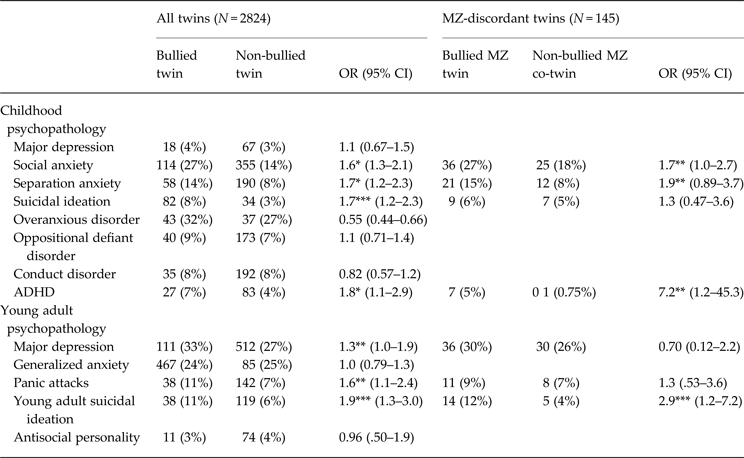
The number of psychiatric disorders in bullied and non-bullied twins based upon the full sample, the associated odds ratios, and 95% CIs are shown in Table 1. Children who have been bullied are at significantly higher risk for psychiatric disturbance in both childhood and young adulthood. Bullied children have greater social anxiety, suicidal ideation, separation anxiety, suicidal ideation, and ADHD in childhood. Young adults that have been the target of bullying in childhood have elevated rates of major depressive episode, panic, and depression-related suicidal ideation and behavior.
Prevalence, odds ratios, and statistical significance for bully victimization and child and young adult psychiatric outcomes in total twin sample and MZ-discordant twin pairs

OR, Odds ratio; CI, confidence interval; MZ, monozygotic; ADHD, attention deficit hyperactivity disorder.
* p < 0.001, ** p < 0.05, *** p < 0.01.
Associations in discordant MZ twins
To test whether these associations are environmental, those disorders that were significantly associated with being bullied in the full twin sample were examined in the discordant MZ twins (also shown in Table 1). For simplicity, only the significant associations are shown. The higher rate of social anxiety, separation anxiety, ADHD, and young adult suicidality in the bullied MZ twins compared to their non-bullied co-twin supports bullying victimization as an environmental risk factor for these traits. Although the rates of child suicidal ideation, panic, and depression in young adulthood were associated with being bullied in the sample as a whole, they were not significantly different in the bullied discordant MZ twins.
Structural equation modeling
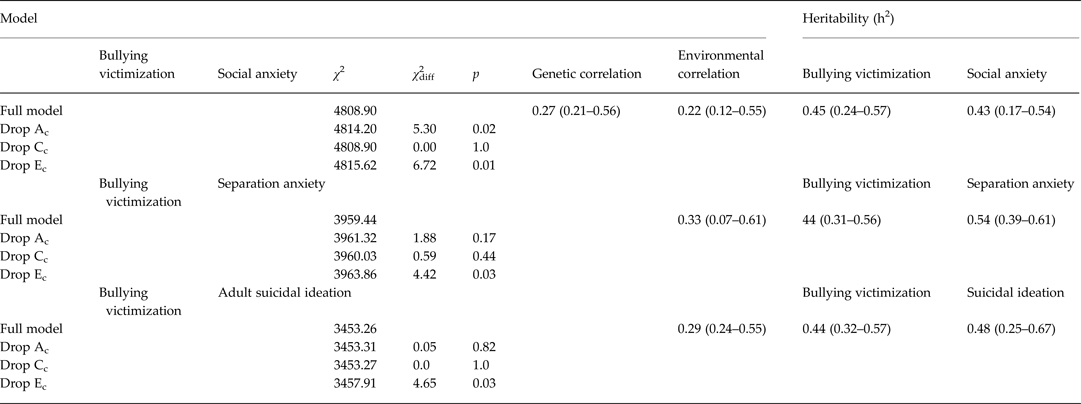
The genetic and environmental correlations (using both the MZ and DZ twin pairs) between being bullied and those mental health outcomes that were significant in the MZ discordant analysis provide a measure of the strength of the associations. The genetic and environmental correlations (and 95% CIs) between being bullied and each form of psychopathology under the best fitting bivariate genetic models are in Table 2. The heritability (h2) of each trait is also shown.
Bivariate genetic models fit to bullying victimization and childhood and young adult psychiatric disturbance

Values in parentheses are 95% confidence intervals.
Ac, Common additive genetic factor; Cc, common shared environmental factor; Ec, common individual-specific environmental factor for bully victimization and psychiatric disturbance.
The individual-specific environment had a significant influence on the association between bullying victimization and social anxiety, separation anxiety, and young adult suicidality. Dropping the environmental factor (Ec) resulted in a significantly poorer fit of the model for all three psychiatric traits, (p < 0.03). The environmental correlation between bullying victimization and social anxiety, separation anxiety, and young adult suicidality was 0.22, 0.33, and 0.29, respectively.
There were shared genetic influences, but they were trait specific. A common additive genetic factor could be eliminated from the models for bullying victimization and separation anxiety and suicidal ideation in adulthood without a significant deterioration in fit of these reduced models (χ2 diff = 1.88, p = 0.17; χ2 diff = 0.05, p = 0.82). In contrast, the common additive genetic factor could not be dropped from the bivariate model for bullying victimization and social anxiety (p < 0.03). The genetic correlation between being bullied and social anxiety was 0.27.
Dropping the shared environmental factor had little impact on the fit of any of the models for bullying victimization and social anxiety, separation anxiety, and young adult suicidality (p > 0.05). A ‘best-fitting’ model could not be identified for ADHD – a genetic or environmental bivariate model provided an equally good fit to the data.
The heritability (h2) of bully victimization was 0.45 (95% CI 0.24–0.57). The heritability of social anxiety was 0.43 (95% CI 0.17–0.54), 0.54 (95% CI 0.39–0.61) for separation anxiety, and 0.48 (95% CI 0.25–0.67) for suicidal ideation in young adulthood.
Temporal analysis of discordant MZ twins
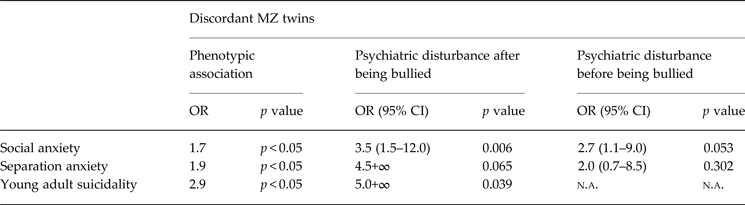
The direction of causation between bullying victimization and social anxiety, separation anxiety, ADHD, and young adult suicidality was then examined using the longitudinal data from the MZ discordant twins. Two models were tested: (a) a model that constrained that bullying preceded these behaviors and (b) a model that constrained that psychopathology preceded peer victimization. The odds ratios and significance of the associations under the two models in Table 3 show a highly significant association between early bullying victimization and later social anxiety (p < 0.001) and bullying victimization and later young adult suicidality (p < 0.05). The temporal association between being bullied and separation anxiety was not significant (p > 0.05). Because of the low number of MZ twin pairs discordant for ADHD, there was insufficient power to determine the temporal pathways between being bullied and ADHD and is not shown in Table 3.
Temporal pathways between bullying victimization and child and young adult psychopathology in discordant MZ twins

OR, Odds ratio; CI, confidence interval; n.a., not applicable.
+∞ value is positive and infinite.
Other environmental risk factors
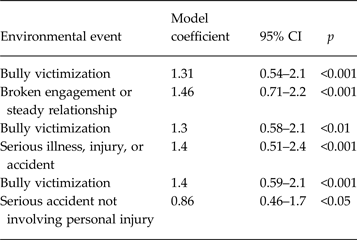
We tested whether other environmental risk factors might account for suicidal ideation in young adulthood beyond a history of being bullied. This was addressed in the sample as a whole. Table 4 shows three negative life events that were significantly associated with young adult suicidal ideation (p < 0.05) and specific to each twin. These included: (a) broken engagement or steady relationship, (b) serious illness, injury, or accident, and (c) serious accident not involving personal injury.
Effect of child bullying victimization on young adult suicidal ideation controlling for adverse life events in young adulthood (N = 2307)

CI, Confidence interval.
The GLM model coefficients for bully victimization and all three life events were significant (p < 0.01). Bullying victimization remained a significant risk factor for suicidal ideation in young adulthood when these other negative life events were included, individually (p < 0.01). Moreover, being bullied in childhood conferred a significant risk for suicidality in adulthood even after including all three stressful life events in the same regression model (p < 0.03).
Discussion
The goal of this study was to examine the genetic and environmental influences on bullying victimization and psychiatric disturbance in childhood and young adulthood. Associations can arise from three different etiological processes: (a) bullying victimization can be a genuine environmental risk factor for psychopathology; (b) psychopathology can increase risk for being bullied; and (c) the two may linked by a common underlying genetic and/or shared environmental liability. The identification of both the environmental and genetic contributions to bullying victimization and psychopathology is an important step towards understanding the processes by which peer victimization increases risk to psychiatric disturbance.
Bullying victimization affects a wide range of psychiatric outcomes. Bullied children are more socially anxious, have greater separation anxiety, ADHD, and report more suicidal ideation. Young adults that have been bullied as children report higher rates of depression, panic attacks, and suicidal thoughts and behaviors. The pervasive effect of being bullied, particularly on internalizing symptoms shown here replicate findings from numerous other large epidemiological studies (Copeland et al. Reference Copeland, Wolke, Angold and Costello2013; Stapinski et al. Reference Stapinski, Bowes, Wolke, Pearson, Mahedy, Button, Lewis and Araya2014; Takizawa et al. Reference Takizawa, Maughan and Arseneault2014; Klomek et al. Reference Klomek, Sourander and Elonheimo2015).
sBased upon the analysis of data from the discordant MZ twins, we demonstrated that bullying victimization is environmentally linked with social anxiety, separation anxiety, ADHD, and young adult suicidality. This is evidenced by a significantly higher rate of these traits in those MZ twins that have been bullied compared to their non-bullied MZ co-twin. As confirmation, the results of model fitting show significant individual-specific environmental correlations between bullying victimization and social anxiety, separation anxiety and young adult suicidality. Genetic factors were also influential in bullying victimization and social anxiety.
The temporal analysis on the MZ-discordant twins showed a direct environmental path from early bullying victimization to later social anxiety and young adult suicidality. These findings replicate previous work (Arseneault et al. Reference Arseneault, Milne, Taylor, Adams, Delgado, Caspi and Moffitt2008) and suggest that the effects of being bullied are not limited to childhood but to adult outcomes which can endure as long as 10 years after the occurrence of the bullying event.
The environmental association between being bullied and psychiatric disturbance may operate through both psychological and biological processes. Psychological processes may reflect reduced self-esteem, decreased connection to school and peers, and increased withdrawal and isolation (Hawker & Boulton, Reference Hawker and Boulton2000). Social anxiety can be a response to threats by bullying peers. Childhood bullying victimization may increase risk to young adult suicidal ideation by the internalization of self-loathing, not deserving to live, or difficulty coping with suffering and social rejection.
Biological mechanisms may also mediate the impact of peer victimization on psychiatric outcomes. As an environmental risk factor, bullying peers may affect children's mental health through changes in behavioral and emotional regulation that underlie many psychiatric disorders. Copeland et al. showed a heightened inflammatory response in those children who were the target of peer victimization (Copeland et al. Reference Copeland, Wolke, Lereya, Shanahan, Worthman and Costello2014). Epigenetic changes, specifically changes in DNA methylation and chromosomal instability, have also been hypothesized as plausible mechanisms in childhood trauma (McEwen et al. Reference McEwen, Eiland, Hunter and Miller2012; York et al. Reference York, Brumelle, Juusola, Kendler, Eaves, Amstadter, Aggen, Jones, Ferreira-Gonzalez and Jackson-Cook2013) and may play a mediating role in bullying victimization.
A secondary feature of the analysis was to test whether individual-specific experiences, other than being bullied in childhood might account for outcomes in young adulthood. We demonstrated a significant independent effect of bullying victimization, even after controlling for a number of concurrent life events.
Evocative genotype–environment correlation (r GE) refers to genetic influences on individual differences in exposure to certain environments (Rutter & Silberg, Reference Rutter and Silberg2002). The significant genetic correlation between being bullied and social anxiety is consistent with r GE and suggests that children with social anxiety may be at high genetic risk for being bullied. They may be perceived as different, evoking abusive behavior from bullies who see them as easy targets. These children may be particularly amenable to intervention to help identify aspects of their behavior that draw negative unwanted attention.
Genetic differences in sensitivity to the environment, or genotype–environment interaction (G×E) was not specifically tested. Variation in the serotonin transporter gene (5-HTT) contributing to increased risk to emotional problems in those children exposed to bullying victimization has been reported (Sugden et al. Reference Sugden, Arseneault, Harrington, Moffitt, Williams and Caspi2010). Because r GE and G×E are confounded G×E interaction was not specifically tested within this analysis, but is an important mechanism to consider in identifying children that are particularly susceptible to the effects of bullying victimization.
In summary, the analysis of psychiatric disturbance in bully-discordant MZ twins shows an environmental impact of bullying victimization on child anxiety disorders and adult suicidal ideation that cannot be accounted for by background genetic or shared environmental factors. Being bullied can no longer be considered a normative part of childhood but a significant environmental trauma on the mental health of children and young adults.
Acknowledgements
This work was supported by NIH grants MH-62368, MH-55557, and the Mid-Atlantic Twin Registry (MATR). Special thanks to Jefferson Lyttle for his editorial assistance.
Declaration of Interest
None.