In the rapidly changing world of work, the possibility of a worker modifying some of his/her working conditions and being proactive can be adaptive both for the worker and for the organization. So, a concept that is growing in importance is job crafting. Job crafting reflects “the physical and cognitive changes individuals make in the task or relational boundaries of their work” (Wrzesniewski & Dutton, Reference Wrzesniewski and Dutton2001, p. 179). Job crafting offers a new perspective compared to work redesign. Whereas work redesign usually has been seen as a top-down process in which supervisors or organizations decide about changes, job crafting is characterized by the employees’ initiative to alter their tasks or other work aspects.
Different researchers have contributed to measuring this phenomenon quantitatively (i.e. Nielsen & Abildgaard, Reference Nielsen and Abildgaard2012; Slemp & Vella-Brodick, Reference Slemp and Vella-Brodrick2013; Tims et al., Reference Tims, Bakker and Derks2012;). One of the most predominant scales in the literature is the Job Crafting Scale (JCS) developed by Tims et al. (Reference Tims, Bakker and Derks2012). The JCS measures four independent job crafting dimensions through 21 items. The four dimensions refer to increasing structural job resources, increasing social job resources, increasing challenging job demands, and decreasing hindering job demands. This scale was validated in a Dutch sample, obtaining a four-factor structure, a good validity and reliability. However, later studies, aimed to validate and adapt it to other cultural contexts, obtained incongruent results about its dimensional structure (e.g. Eguchi et al. Reference Eguchi, Shimazu, Bakker, Tims, Kamiyama, Hara and Kawakami2016). Furthermore, they discovered that different items of the original scale did not seem to work appropriately (i.e. Spain, Bakker, Ficapal-Cusí, Torrent-Sellens, Boada-Grau, & Hontangas Beltrán, 2018; Japan, Eguchi et al. Reference Eguchi, Shimazu, Bakker, Tims, Kamiyama, Hara and Kawakami2016; South Africa, Peral, & Geldenhuys, Reference Peral and Geldenhuys2016).
In addition to this, developing a shorter version of the JCS would be of interest to researchers and practitioners. Shorter versions present some advantages compared to long measures. They are useful for human resources professionals in their practice making it more viable to measure organizational factors such as job crafting or to do so in occupational groups with a low level of education (Nielsen & Abildgaard, Reference Nielsen and Abildgaard2012). A short form of the JCS may be useful for researchers to include an evaluation of Job Crafting in large, multivariate studies without making survey instruments excessively long (see Smith, McCarthy, & Anderson, Reference Smith, McCarthy and Anderson2000).
Thus, the aim of our study is to provide a valid and reliable short version of the JCS in Spanish. In doing so, we extend the current research by Tims et al. (Reference Tims, Bakker and Derks2012) by providing a shorter version of the JCS measure and additional empirical validation in another labor and national context as it is Spain.
Theoretical background
As we said earlier, the work by Wrzesniewski and Dutton (Reference Wrzesniewski and Dutton2001) was one of the first initiatives to understand job crafting. The latter studies also stated that employees could redesign their jobs with or without managers’ involvement (see Oldham & Hackman, Reference Oldham and Hackman2010). These studies suggested that job crafting is about changing certain aspects of the job within the boundaries of the job tasks and not about changing the job as a whole; for example, aspects related to tasks, relationships or cognitions about job (Berg & Dutton, Reference Berg and Dutton2008). In 2010, Tims and Bakker redefined the concept by framing it within the Job Demands-Resources model (JD-R). Job crafting is defined as the self-initiated changes that employees make in their own job demands and job resources in order to attain and/or optimize their personal (work) goals.
According to the Job Demands-Resources model (JD-R) (Demerouti, Bakker, Nachreiner, & Schaufeli, Reference Demerouti, Bakker, Nachreiner and Schaufeli2001), all job characteristics can be classified as demands or resources. Job demands refer to “physical, psychological, social, or organizational aspects of the job that require sustained physical and/or psychological (cognitive and emotional) effort or skills and are therefore associated with certain physiological and/or psychological costs”. Some examples are heavy workload and emotionally demanding interaction with others. However, these job demands do not have to be necessarily negative. They also may be challenging and motivational for employees and their professional development. Job resources refer to “physical, psychological, social or organizational aspects of the job that are either/or: (a) Functional in achieving work goals; (b) reduce job demands and the associated physiological and psychological costs; (c) stimulate personal growth, learning and development” (Bakker & Demerouti, Reference Bakker and Demerouti2007, p. 312). Examples include opportunity for development or performance feedback. So, job resources may play two motivational roles. The intrinsic motivational role aimed to promote employees’ growth, learning and development. It is possible because job resources may help to fulfill basic human needs, such as competence, autonomy or relatedness. The extrinsic motivation role aimed to achieve work goals. Resourceful work contexts foster the willingness to dedicate employees’ efforts and skills to the work task (Bakker & Demerouti, Reference Bakker and Demerouti2008).
Job Crafting Measures
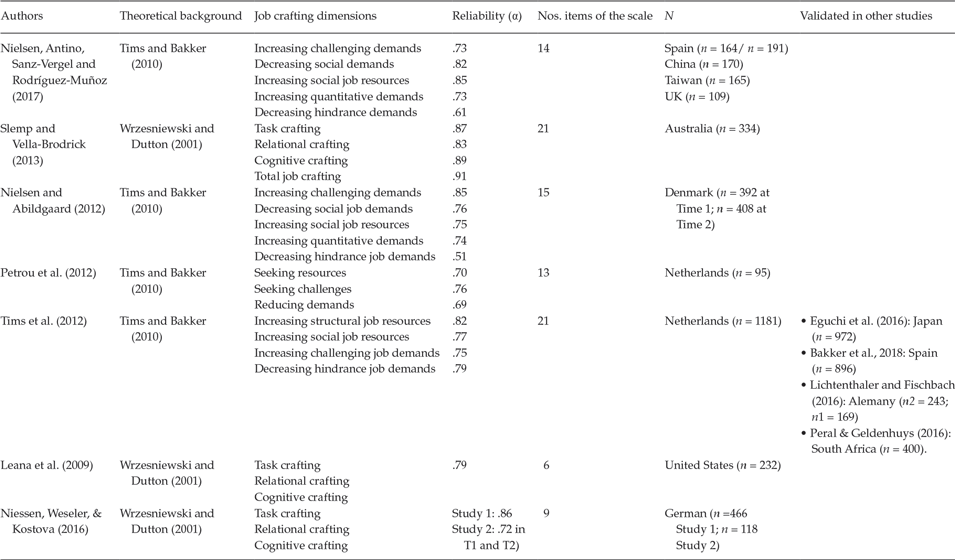
Several efforts have been dedicated to developing a job crafting scale (e.g. Leana, Appelbaum, & Shevchuk, Reference Leana, Appelbaum and Shevchuk2009; Niessen, Weseler, & Kostova, Reference Niessen, Weseler and Kostova2016; Slemp & Vella-Brodrick, Reference Slemp and Vella-Brodrick2013). An overview of these measures is displayed in Table 1. Nevertheless, the use of the scale developed by Tims et al. (Reference Tims, Bakker and Derks2012) seems to predominate in the literature according to their theoretical framework. JCS was originally developed in Dutch and tested in three different studies (N = 1181) by Tims et al. (Reference Tims, Bakker and Derks2012). Their results supported a four-factor solution, with good reliabilities, and criterion validity with peer-ratings of work engagement, employability, and performance. More specifically, four dimensions of job crafting behaviors were considered:
Overview of Validated Job Crafting Scales

Increasing structural job resources dimension reflected employees’ capacity to increase their resources and skills (i.e. autonomy or variety).
Increasing social job resources reflected the opportunities or resources for advice, coach and assistance from others in the job.
Increasing challenging job demands reflected the tasks or projects that could be considered as interesting challenges. Challenging job demands involve personal and professional growth for employees or to attain more difficult goals.
Decreasing hindering job demands reflects the fact that employees may proactively lower their job demands when they perceive that they have become overwhelming.
The job crafting scale (Tims et al., Reference Tims, Bakker and Derks2012) was validated in different contexts. We found only four validations of the full original JCS published in peer-reviewed journals without reduction or adaptation of items. After the Dutch version of JCS (Tims et al. Reference Tims, Bakker and Derks2012), it was translated and validated in Japanese (Eguchi et al., Reference Eguchi, Shimazu, Bakker, Tims, Kamiyama, Hara and Kawakami2016), in German (Lichtenthaler & Fischbach, Reference Lichtenthaler and Fischbach2016), and in Spanish (Bakker et al., Reference Bakker, Ficapal-Cusí, Torrent-Sellens, Boada-Grau and Hontangas Beltrán2018). Further, a study relating job crafting and well-being in South African high school teachers provided a psychometric evaluation of JCS in English (Peral & Geldenhuys, Reference Peral and Geldenhuys2016). However, they presented some problems in their validation of the original scale.
The validation of the Japanese version of the JCS (Eguchi et al. Reference Eguchi, Shimazu, Bakker, Tims, Kamiyama, Hara and Kawakami2016) used a sample in a manufacturing company (N = 972). Results provided an initial five-factor model in which decreasing hindering job demands split into two subdimensions, but the four-factor solution was acceptable. Reliability ranged from .76 to .90; and the four job crafting dimensions correlated significantly with job demands, job resources, work engagement, and job satisfaction. Moreover, some items showed unappropriated low loadings to their dimensions while other items presented error covariances pointing out that some items were rather similar in terms of their content. The validation of the JCS German version (Lichtenthaler & Fischbach, Reference Lichtenthaler and Fischbach2016) supported also the four job crafting dimensions in data obtained from employees working at a large police department (Study 1, N = 243; Study 2, N = 169). It showed good reliabilities (range from .76 to .87), good convergent validity through significant correlations with personal initiative, and good predictive validity with work engagement and emotional exhaustion. Unfortunately, these authors did not present factor loadings in their paper to examine them. Peral and Geldenhuys (Reference Peral and Geldenhuys2016) examined the factor structure and reliability of the JCS in English in a sample of 400 high school teachers in South Africa. They confirmed a three-factor solution and reliability ranged from .83 to .84 for their factors. “Increasing structural job resources” and “increasing challenging job demands” dimensions loaded on one overall factor. Also, the item ‘I decide on my own how I do things’ (from the Increasing structural job resources dimension) presented a loading of .14 and was deleted for further analyses. Finally, the validation of the JCS Spanish version (Bakker et al., Reference Bakker, Ficapal-Cusí, Torrent-Sellens, Boada-Grau and Hontangas Beltrán2018) using a sample of 896 employees of different sectors also supported the four-factor structure and obtained good reliabilities (range .75 to .79). Regarding criterion validity, all job crafting dimensions were significantly correlated with engagement at work and proactivity. However, this study also revealed error covariance among some items.
Furthermore, the job crafting scale (Tims et al., Reference Tims, Bakker and Derks2012) was also adapted and validated in different contexts. For example, Nielsen, Antino, Sanz-Vergel, and Rodríguez-Muñoz (Reference Nielsen, Antino, Sanz-Vergel and Rodríguez-Muñoz2017) reduced the JCS by Tims et al. (Reference Tims, Bakker and Derks2012). It was composed of 14 items, loading in 5 different dimensions. Reliability and validity were appropriate in different samples: Spain, China, Taiwan and UK. Later, Nielsen and Abildgaard (Reference Nielsen and Abildgaard2012) similarly validated an adapted 15 item version of JCS for Danish blue-collar workers finding a 5 factor structure. Petrou, Demerouti, Peeters, Schaufeli, & Hetland (Reference Petrou, Demerouti, Peeters, Schaufeli and Hetland2012) adapted JCS to a 13 item version to evaluate three renamed dimensions (seeking resources, seeking challenges, and reducing demands) both at a general and day-level basis in a diary study in the Netherlands.
In summary, the structure of job crafting scale (Tims et al., Reference Tims, Bakker and Derks2012) has been studied in multiple studies. Some of them supported the original scale structure (i.e. Lichtenthaler & Fischbach, Reference Lichtenthaler and Fischbach2016), but other results do not seem to be congruent, presenting other potential structure solutions (see Eguchi et al. Reference Eguchi, Shimazu, Bakker, Tims, Kamiyama, Hara and Kawakami2016). Furthermore, some items did not work appropriately in some countries (e.g. Bakker et al., Reference Bakker, Ficapal-Cusí, Torrent-Sellens, Boada-Grau and Hontangas Beltrán2018; Peral & Geldenhuys, Reference Peral and Geldenhuys2016). Some items presented unappropriated low loadings or error covariance among them, probably due to specific characteristics of the items such as content redundancy or overlap (see Bakker et al., Reference Bakker, Ficapal-Cusí, Torrent-Sellens, Boada-Grau and Hontangas Beltrán2018). Further research seems to be needed to advance and clarify the structure of JCS. In this respect, we propose to examine the items of the scale throughout different studies in order to identify those that worked more appropriately with the aim to validate a shorter version of the JCS in a Spanish sample. Following Tims et al. (Reference Tims, Bakker and Derks2012), we hypothesized as follows:
Hypothesis 1. The JCS is composed of four dimensions: (a) Increasing structural job resources, (b) Decreasing hindering job challenges, (c) Increasing social job resources, and (d) Increasing challenging job demands.
Correlates of Job Crafting
We examined the convergent validity of the shorter job crafting scale by correlating it with theoretically related constructs. Previous literature suggests that job crafting behaviors may lead to positive outcomes for employees such as job performance and personal growth. These relationships can be explained through different theoretical frameworks.
According to the JD-R model, job crafting behavior can help employees to increase their resources (i.e. skills and knowledge), therefore achieving a better match between their resources, job demands and individual needs (Cheng, Chen, Teng, & Yen, Reference Cheng, Chen, Teng and Yen2016). Similarly, Nielsen and Abildgaard (Reference Nielsen and Abildgaard2012) suggest that minimizing job demands may facilitate this match to employees’ resources. Another theoretical framework, the Conservation of Resources (COR) theory, suggests that the prime human motivation is the maintenance and accumulation of resources. Hence, whereas resource loss is the primary mechanism driving stress reactions, increasing challenging job demands and decreasing hindering job demands may help preserve existing resources (Eguchi et al., Reference Eguchi, Shimazu, Bakker, Tims, Kamiyama, Hara and Kawakami2016).
There is empirical evidence about the positive relationship between job crafting and job performance (Leana et al., Reference Leana, Appelbaum and Shevchuk2009; Lyons, Reference Lyons2008; Tims, Bakker, Derks, & van Rhenen, Reference Tims, Bakker, Derks and van Rhenen2013; Tims et al., Reference Tims, Bakker and Derks2012). Employees make changes to their jobs both to improve performance and to be able to do more interesting or rewarding tasks (Tims, Bakker, & Derks, Reference Tims, Bakker and Derks2012). More specifically, increasing structural and social job resources help employees to meet job demands, which can be invested in different aspects of performance. Increasing challenging demands may also involve performing a higher number of tasks or more complex tasks, consequently improving performance as well. Finally, employees may obtain higher performance by crafting hindering job demands that interfere with the attainment of their goals (Tims et al., Reference Tims, Bakker, Derks and van Rhenen2013).
Regarding personal growth, this concept refers to the need of individuals “to develop one’s potential, to grow and expand as a person” in order to achieve optimal psychological functioning (Ryff, Reference Ryff1989, p. 1071). Although we are not aware of empirical evidence that explicitly support the relationship between job crafting and personal growth, research repeatedly suggests a link between these variables. Demerouti et al. (Reference Demerouti, Bakker, Nachreiner and Schaufeli2001) pointed out that job resources can decrease the impact of job demands, and stimulate personal growth, learning and development. Challenging job demands are demands that may be experienced as stressful or difficult, but, on the other hand, they may stimulate employees to develop their skills and personal growth to cope with them (Crawford, LePine, & Rich, Reference Crawford, LePine and Rich2010). Finally, LePine, Podsakoff, and LePine (Reference LePine, Podsakoff and LePine2005) explained that hindering job demands can unnecessarily thwart personal growth and goal attainment. Hence, decreasing hindering job demands may facilitate personal growth. In summary, through job crafting, employees can optimize their work context by increasing job resources and challenging demands and decreasing hindering job demands. By crafting their jobs employees have all necessary resources to perform well and experience personal growth. According to this reasoning, we propose the following hypotheses:
Hypothesis 2. Job crafting in the form of increasing structural job resources (H2a), decreasing hindering job demands (H2b), increasing social job resources (H2c) and decreasing hindering job demands (H2d) will be positively related to job performance.
Hypothesis 3. Job crafting in the form of increasing structural job resources (H3a), decreasing hindering job demands (H3b), increasing social job resources (H3c) and decreasing hindering job demands (H3d) will be positively related to personal growth.
Method
Sample
The sample was composed of 1,647 Spanish employees. Regarding gender, 43 % employees were men (n = 714) and 52% were women (n = 856). They were classified into three age groups: 26 % younger than 35 years old (n = 432); 55% between 35–50 years old (n = 910); and 16% were over 50 years old (n = 259). In relation to their education level, 1% of the sample reported not to have any official education qualification (n = 20), 13% had finished primary school (n = 211), 37% had accomplished secondary school (n = 607) and 48% had a university degree (n = 753). Mean tenure was 7 years, with a range from 1 to 36 years. Finally, different occupational groups were collected in this sample. 8% were low-qualified job positions (n = 159), 16% were administrative or assistant jobs (n = 268), 30% were medium technic (n = 396), 24% were high-qualified professionals (n = 396), 5% were managers (n = 186) and 11% were classified as others (n = 186). Some percentages may not add up to 100% due to missing values.
Procedure
Researchers contacted human resources departments of several organizations to request their collaboration in the research project. The purpose of the research and the main features of the questionnaire were explained. Anonymous and confidential treatment of the data were also guaranteed. Once organizations decided to collaborate, all their employees who wished to participate were invited to do so. Two different methods were used to distribute the questionnaires according to the participant organizations’ preference: Online questionnaires or by handing them out to employees in the workplace. Having to rely on voluntary participation, the sampling method could not be completely random.
Measures
Job Crafting: Construction of the Short Version of the Job Crafting Scale (JCS)
The original Job Crafting Scale developed by Tims et al. (Reference Tims, Bakker and Derks2012) was composed of 21 items to measure four dimensions. More specifically ‘increasing structural job resources’ (5 items), ‘increasing social job resources’ (5 items), ‘increasing challenging job demands’ (5 items) and ‘decreasing hindering job demands’ (6 items). For all items the introduction statement was “In my job…”, and the response options ranged from 1 (never) to 5 (often).
Our aim was to keep a minimum of three items for each dimension of the JCS, but also to maintain the theoretical meaning of the original scales (Tims et al, Reference Tims, Bakker and Derks2012). To do this, we studied the content of the items and the psychometric properties in the previous validation studies. Our purpose was to retain only those items with loadings over .60. Matsunaga (Reference Matsunaga2010) recommended setting a cutoff of .60 or .70 as appropriate and conservative, and considered a cutoff at .40 as the lowest acceptable threshold. Our cutoff criterion was far more restrictive than the one used by Tims et al. (Reference Tims, Bakker and Derks2012) in their process of scale construction, who retained the items that loaded .35 or higher on the expected factor in their exploratory factor analysis. Thereby, we prioritized the items with loadings above .60 in the statistical review of previous JCS validation studies (Bakker et al., Reference Bakker, Ficapal-Cusí, Torrent-Sellens, Boada-Grau and Hontangas Beltrán2018; Eguchi et al., Reference Eguchi, Shimazu, Bakker, Tims, Kamiyama, Hara and Kawakami2016, Tims et al., Reference Tims, Bakker and Derks2012). We compared the loadings of the different items in each dimension across the studies. Overall, results were very similar showing the same items to yield the highest loadings for JC dimensions. As an exception, we kept the item ‘When there is not much to do at work, I see it as a chance to start new projects’ in the dimension “increasing challenging job demands” (factor loading was .58 in Tims’ el al (2012) around the .60 cutoff value.
In this review process, we also checked that the selected items maintained the meaning of dimensions of the original scale. The dimension Increasing structural job resources had a stronger focus on opportunity for development. However, previous studies demonstrated that the items of autonomy and variety did not load appropriately to this dimension (Bakker et al., Reference Bakker, Ficapal-Cusí, Torrent-Sellens, Boada-Grau and Hontangas Beltrán2018; Eguchi et al., Reference Eguchi, Shimazu, Bakker, Tims, Kamiyama, Hara and Kawakami2016; Tims et al., Reference Tims, Bakker and Derks2012). A possible explanation could be that these items “I decide on my own how I do things” (autonomy) and “I make sure that I use my capabilities to the fullest” (variety) do not reflect an increment of resources, but the use of existing ones. Thus, these items, as they are written, do not reflect appropriately the dimension of increasing structural job resources. In fact, Peral and Geldenhuys (Reference Peral and Geldenhuys2016) already removed the autonomy item due to its undesirably low factor loading (.14) in their study.
The dimension Increasing social job resources scale strengthened its focus on supervisor support. The items that reflected co-workers support (“I ask others for feedback on my job performance” and “I ask colleagues for advice”) presented non-appropriated loadings in previous studies. These items also presented significant error covariance (Bakker et al., Reference Bakker, Ficapal-Cusí, Torrent-Sellens, Boada-Grau and Hontangas Beltrán2018). Furthermore, research showed that performance is more strongly related to supervisor support than co-worker support. Thus, the relationship between co-worker support and performance was not significant when supervisor support was present (e.g. Liaw, Chi, & Chuang, Reference Liaw, Chi and Chuang2010). This could provide certain insight concerning the low loadings of items referred to co-workers support compared to supervisor support. Increasing challenging job demands and decreasing hindering job demands were equivalent to the original scale in terms of content of their items. Increasing challenging job demands reflected employees’ behaviors that involved demands, perceived by the employee as challenging. Decreasing hindering job demands contained items that reflected both emotional and mental demands. After this selection process, we selected 12 items for the short version (see Table 2).
Items, Means, Standard Deviation, and Exploratory and Confirmatory Factor Analysis of the Job Crafting Scale

We used the translation/back-translation method to translate the questionnaire to Spanish (see Brislin, Reference Brislin1986). First, researchers translated the job-crafting questionnaire from English to Spanish. Second, a bilingual professional translator back translated the Spanish version into English. Finally, researchers compared the original questionnaire to the back-translated version. Items were written in a general language to make the scale appropriate for different Spanish varieties and countries (see Table 3). Additionally, the questionnaire was tested in a pilot group composed of 18 workers with different occupational levels. These workers were interviewed in order to identify potential problems with the language expressions or wording.
Confirmatory factor Analysis of Job Crafting Scale

*p < .01
Job Performance was assessed with a 3-item scale (Williams & Anderson, Reference Williams and Anderson1991). An example item is: “I finish appropriately my tasks”. The response scale ranged from 1 (completely disagree) to 7 (completely agree), with an adequate Cronbach’s alpha (α = .77).
Personal Growth was measured through 4 items from Ryff (Reference Ryff1989). The response range was from 1 (completely disagree) to 7 (completely agree). One example of the items is: “For me, life has been a continuous process of learning, changing, and growth”. Cronbach’s alpha for this scale was .66.
Data Analysis
Firstly, the sample was randomly split in two subsamples: subsample 1 (n = 828 employees) and subsample 2 (n = 819 employees). This method allows examining the stability of the structural factors solution across the two halves (see Fabrigar, Wegener, MacCallum, & Strahan, Reference Fabrigar, Wegener, MacCallum and Strahan1999). In examining the factorial structure of JCS, an exploratory factor analysis was computed in subsample 1 using the unweighted least squares method. We extracted factors with eigenvalues greater than one and the factor structures were obtained through promax rotation.
Afterwards, different confirmatory factor analyses (CFA) were computed in subsample 2. CFAs were computed using AMOS 18 program to test the four-factor model (M5) compared to other four alternative solutions: A one-factor model (M1), a two-factor model with increasing versus decreasing strategies (M2), a three-factor model with increasing job resources (structural and social), decreasing hindering job demands, and increasing challenging job demands (M3) and a model according to results of exploratory factor analysis (M4). Multiple fit indices were computed to assess global model fit (Marsh, Balla, & Hau, Reference Marsh, Balla, Hau, Marcoulides and Schumacker1996): Chi-squared index (χ2), chi/df ratio (χ2/df), adjusted goodness-of-fit index (AGFI), Non-Normed Fit Index (NNFI), the Standardized Root Mean Square Residual (SRMR) and the Root Mean Square Error of Approximation (RMSEA). Additionally, we computed measures of parsimony that assess the efficiency of models’ fit to a particular sample such as Aikaike Information Criteria (AIC) and Consistent Aikaike Information Criteria (CAIC), which are appropriate for model comparison (Hao, Wen, & Cheng, Reference Hao, Wen and Cheng2004).
In the second step, we examined internal consistency in subsample 2. Cronbach’s alphas were computed for the job crafting dimensions as well as the total scale (Nunally, 1978). The number of items also needs to be considered to appropriately examine the internal consistency of a scale (Cortina, Reference Cortina1993). In this vein, Clark and Watson (Reference Clark and Watson1995) pointed out to compute inter-item and item-scale correlations to assess the internal consistency of a scale. The values should range from .15 to .50 for a good reliability. Hence, inter-item and item-scale correlations were computed to assess the internal consistency of the scale.
In the third step, convergent and divergent validity were examined. Convergent validity is the degree of confidence about a factor being well measured by its indicators. It was assessed by the Average Variance Extracted (AVE) and Composite Reliability (CR). Furthermore, correlations between the studied construct and other theoretically related variables are commonly used to examine convergent validity. So, correlations between job crafting and related outcomes (i.e. job performance and personal growth) were performed.
Finally, discriminant validity is the extent to which a construct is truly distinct from other constructs. Discriminant validity is examined by comparing the squared root of AVE’s with the squared correlation for each of the constructs. The squared root of AVE’s represents a measure of variance between a construct and its indicators (Fornell & Larcker, Reference Fornell and Larcker1981).
Results
Structure of the Job Crafting scale
Table 2 displays the results of exploratory factor analysis of JCS. Contrary to our expectations, results showed a three-factors structure with eigenvalue higher than 1. The items of increasing structural job resources and increasing challenging job demands loaded on Factor 1. The items of increasing social job resources and decreasing hindering demands showed the greatest factor loadings on Factors 2 and 3, respectively. Interfactor correlations ranged from –.16 to .32.
Four CFA were computed in Subsample 2 (see Table 3). All indexes showed a poor fit for the one-factor model (M1), two-factor model (M2), three-factor model (M3) and three-factor model proposed by AFE (M4) in subsample 2. Hence, our results pointed out that the one, two and three-factor solutions were not appropriate for the dimensionality of job crafting.
Regarding the four-factor model (M5), the Chi-Squared Goodness-of-Fit Index (χ2) did not either indicate a good fit between the observed covariance matrix and the hypothesized model for both solutions. However, this is probably due to the sensitiveness of this index to big sample sizes. In contrast, AGFI = .94 and NNFI = .93 surpassed the cutoff of .90 (Jöreskog & Sörbom, Reference Jöreskog and Sörbom1993) and RMSEA = .06 and RMR = .05 were lower than .08 (Browne & Cudek, Reference Browne, Cudek, Bollen and Long1993) in Subsample 2. So, these indexes indicated a good fit for the proposed four-factor solution. The values of AIC and CAIC were lower for the four-factor solution (AIC = 252.70 and CAIC = 423.94). So, these indexes also supported a better fit for the four-factor model (M5) (Hao et al., Reference Hao, Wen and Cheng2004). In summary, the results supported the dimensionality of job crafting as predicted. The four-factor model (M5) showed a better adjustment compared to the other models.
Internal consistency
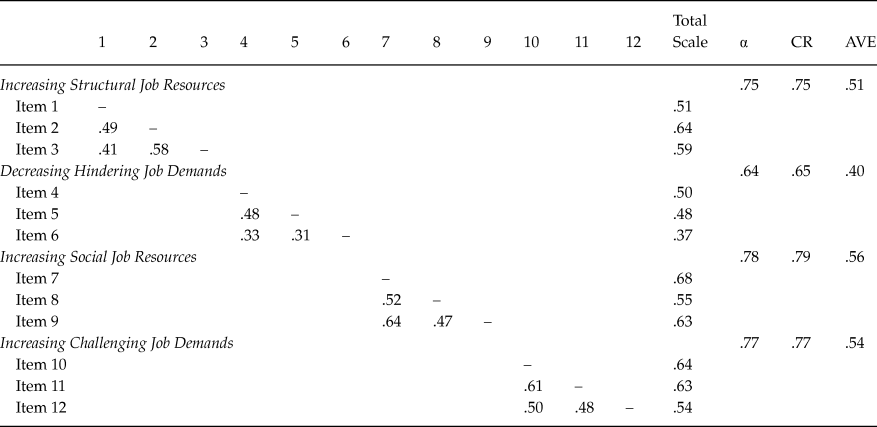
Internal consistency of the short JCS was examined in Subsample 2 (see Table 4). Cronbach’s alphas were computed obtaining values above .70, with the exception of the dimension ‘decreasing hindering job demands’ (α = .64). All inter-item and item-scale correlations were higher than .30 (p < .01), surpassing the minimum .20 cutoff value recommended by Streiner and Norman (Reference Streiner and Norman1995). In fact, our indices ranged from .15 and .50 recommended by Clark and Watson (Reference Clark and Watson1995). Our item-scale correlation values ranged from .31 to .64 (p < .01). Summarizing, internal consistency of the short JCS may be considered as appropriate.
Inter-item and item-scale correlations, Cronbach’s alpha, Composite Reliability and Average Variance Extracted

Note: CR = Composite Reliability; AVE = Average Variance Extracted. All correlations were significant at p < .01
Convergent Validity
Further, we examined convergent validity of the Spanish short JCS. The values obtained for AVE were above .50 and for Composite Reliability were larger than .70 for three dimensions of the JCS. The dimension ‘decreasing hindering job demands’ obtained lower values, around the cutoff criteria (AVE = .40; CR = .65) (see Table 4) (Fornell-Larcker, 1981). We can conclude that factors were clearly defined; the items measured just one construct; and convergent validity of the model may be considered satisfactory, even though convergent validity of ‘decreasing hindering job demands’ was just acceptable.
Additionally, the different dimensions of job crafting were correlated to other theoretically related outcomes (i.e. job performance and personal growth). Our Hypothesis 2 and 3, stating that job crafting behaviors would be significantly related to job performance and personal growth, were confirmed. All correlations between job crafting dimensions and outcomes were significant at p < .05 (see Table 5). As expected the three dimensions related to ‘increasing resources’ were positively and significantly related to job performance and personal growth. Our results show that ‘increasing structural job resources’ presents the strongest correlation both with job performance and personal growth. However, ‘decreasing hindering job demands’ was significantly and negatively related to employees’ job performance and personal growth (r = –.09, p < .01).
Descriptive Statistics (Means and Standard Deviations) and Correlations (95% Confidence Intervals in Parentheses)

*p < .05. **p < .01, two–tailed.
Discriminant validity
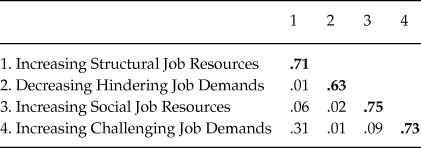
Table 6 shows the square root of AVE’s in the diagonal, which is a measure of variance between a construct and its indicators, and the off diagonal figures represent squared correlation between constructs. The lowest AVE value was 0.63 for ‘decreasing hindering job demands’, which exceeded the largest squared correlation between any pair of constructs (.31, between ‘increasing structural job resources’ and ‘increasing challenging job demands’). Thus, shared variance between factors was lower than the AVE’s of the individual factors, which confirmed discriminant validity.
Squared Root of AVE (diagonal) and others Squared Correlations

Discussion
This study aimed to develop a shorter version of the JCS (Tims et al., Reference Tims, Bakker and Derks2012) and provide additional empirical support to this questionnaire in another national context, i.e. Spain. Data obtained from 1,647 Spanish employees across different occupations revealed adequate psychometric properties of the items and the scales. The analysis supported the four-factor dimensionality proposed in the original Job Crafting Scale (Tims et al., Reference Tims, Bakker and Derks2012) and all job-crafting items loaded on the expected dimensions. Thus, Hypothesis 1 was confirmed. Furthermore, the scale had good internal consistency, as reflected by alpha coefficients and inter- and intra-items correlations, and an appropriate discriminant validity according to squared root of AVE. Although our results overall support the four-factor model, it is noteworthy the three-factor solution of the exploratory factor analysis. As Peral and Geldenhuys (Reference Peral and Geldenhuys2016) explained, the dimensions of “increasing structural job resources” and “increasing challenging job demands” are defined to obtaining similar beneficial outcomes. Both were directed to personal development and personal growth. Hence, their items may be overlap and their distinction become blurred. Further research may be interested in examining these dimensions and their items.
The Job Crafting scale also presented an acceptable convergent validity according to AVE and composite reliability. More specifically, a good convergent validity was showed for three dimensions (increasing structural job resources, increasing social job resources and increasing challenging job demands), and just acceptable for the dimension ‘decreasing hindering job demands’.
Correlational analysis provided additional support to convergent validity for the four dimensions of job crafting scale. Job crafting was significantly related to employees’ job performance and personal growth (Hypothesis 2 and 3 confirmed). The increment of structural and social job resources, and challenging job demands was associated to higher levels of employees’ outcomes. Thus, when employees craft their jobs by increasing structural and social job resources and challenging demands, they obtain the necessary resources that allow them a better performance and personal growth. These results support previous empirical evidence (i.e. Nielsen & Abildgaard, Reference Nielsen and Abildgaard2012; Tims et al., Reference Tims, Bakker and Derks2012, Reference Tims, Bakker, Derks and van Rhenen2013).
Contrary to our expectations, decreasing hindering job demands was related to lower job performance and personal growth. In this respect, the association of “decreasing hindering demands” dimension to employees’ outcomes seems to be unclear in the literature. Some studies found a positive relationship (Leana et al., Reference Leana, Appelbaum and Shevchuk2009; Lyons, Reference Lyons2008; Tims et al., Reference Tims, Bakker and Derks2012, Reference Tims, Bakker, Derks and van Rhenen2013), some a negative relationship (Gordon, Demerouti, Le Blanc, & Bipp, Reference Gordon, Demerouti, Le Blanc and Bipp2015; Petrou, Demerouti, & Schaufeli, Reference Petrou, Demerouti and Schaufeli2015; Tims, et al., Reference Tims, Bakker and Derks2012) and others a non-significant association (Tims, et al., Reference Tims, Bakker, Derks and van Rhenen2013) between decreasing hindering demands and employees’ outcomes.
Our results are congruent with some recent research directed to explain the variability in employees’ outcomes depending on particular job crafting dimensions (Bruning & Campion, Reference Bruning and Campion2018; Lichtenthaler & Fischbach, Reference Lichtenthaler and Fischbach2016; Mäkikangas, Reference Mäkikangas2018). According to an extended JD-R job crafting model, job crafting is understood on the basis of a self-regulatory process and two types of job crafting are differentiated. First, promotion-focused job crafting refers to employee-driven job redesign behaviors, which is oriented to increasing structural and social job resources and challenging job demands. It is motivated by the desire to broaden one’s existing resources and to take on new tasks. Second, prevention-focused job crafting referred to employee-driven job redesign behaviors, which are oriented to decreasing hindering job demands. It represented an avoidance behavior to minimizing energy consumption in a stressful situation.
Overall, the developed short form provides a valid and reliable alternative to the original scale.
Our results should be interpreted in light of some limitations. Since all measures were self-reported we adopted several measures to control for common method variance (i.e. participation was voluntary; participants were told that there were not correct or incorrect answers). Furthermore, in an attempt to assess the potential common method variance, we computed Harman’s one-factor test. This technique aims to examine the number of necessary factors to account for the variance in the variables (Podsakoff, MacKenzie, Lee, & Podsakoff, Reference Podsakoff, MacKenzie and Podsakoff2012; Podsakoff & Organ, Reference Podsakoff and Organ1986). Thus, we computed two confirmatory factor analyses: A single factor model and a six-factor model (i.e. increasing structural job resources, decreasing hindering job demands, increasing social job resources, increasing challenging job demands, job performance and personal growth). The goodness of fit indexes showed a better adjustment for the six-factor model than the one-factor model: global model, χ2(152) = 2,346.10, p < .01; RMR= .12; AGFI=.67; NNFI = .47; RMSEA = .13; AIC = 2,422.10; CAIC = 2,639.01, and six-factor model, χ2(137) = 468.91, p < .01; RMR= .05; AGFI=.92; NNFI = .91; RMSEA = .05; AIC = 574.91; CAIC = 877.44. In any case, we would like to note that additional methods would be useful to avoid this possible problem in future research. We recommend the use of multiple sources to measure variables in future.
There are several important practical implications. Mainly, a reliable, valid shorter version of the Job Crafting scale is available in Spanish. This shorter measure may be especially useful for practitioners to assess the extent to which employees craft their jobs, and encourage researchers to include job crafting in multiple-variable surveys.
To conclude, this short version of job crafting scale by Tims et al (Reference Tims, Bakker and Derks2012) presented adequate validity and reliability in a Spanish context. A careful revision of previous validations of the full scale in different languages and national contexts provided arguments for a refinement of the scale and a reduction in the number of items. The psychometric results obtained for this short version provides a valid reliable 12 – item short form in Spanish. Future research should validate this shorter version of job crafting scale in other languages and contexts, i.e. in English.