Introduction
In 1667, at the opening session of the town court of Ljubljana, the Carniolan capital, Johann Anton Kunstl, doctor of both laws,Footnote 1 emphasized that “the supreme bliss of the commonweal lies in the harmony and agreement among [its] burghers,”Footnote 2 underpinning this maxim with a quote by Sallust from Bellum Iugurthinum: “with harmony even the smallest things grow, while discord brings down the greatest” (concordia paruae res crescunt, discordia uero maximae dilabuntur). The jurist echoed ancient values, according to which concord and peace in a community were predicated on nonviolent dispute settlement.Footnote 3 In the urban setting of the Middle Ages, this required relinquishing one’s right to feud. It was in keeping with the same “old commendable custom” that, in 1537, the Ljubljana town councilors reprimanded the distinguished burghers Severin Hoff and Zuanmaria Bonicelli, who had fallen out with each other. After their neighbors failed to reconcile them, the council stepped in and called upon them to hand over the settling of their dispute to the councilors, as “it is becoming that such matters are to be resolved among burghers with good will and unity.” They were cautioned that the council “will not suffer if they wished to turn neighborliness into enmity and outrage,”Footnote 4 as it knew well that their enmity (veindtschafft) could result in reciprocal violence if left unchecked.
Similar discourse was used in the countryside. In Carniola in 1648, the provincial court, or Landgericht,Footnote 5 of the Lordship of Bled, an extraterritorial enclave of the Tyrolean Prince-Bishopric of Bressanone/Brixen, mediated between its subject peasants Hans Triplat and Jurij Avsenik. The two already had a long history of enmity, which once again boiled over into violence when Avsenik accused Triplat of theft. Or, as was recorded by the court, “because of the injustice a fight had erupted between the parties due to their hot-headedness and anger, predicated on their longstanding evil unneighborliness.”Footnote 6 Such notions of neighborliness, or the lack thereof, were likewise prominent in the settling of homicides, such as in the 1654 killing of Peter Jakopič, who was beaten to death in a brawl with the four sons of Hanže Svetina. To make “true and full peace” with the victim’s kin and be granted safe conduct by the Bled court, Hanže requested a settlement with Peter’s kin. The Jakopič family accepted and pledged not to pursue his sons, who had fled the enclave or Carniola, and upon their return home to “forgo all enmity” and live with them “in good neighborliness as is becoming.” In exchange, Hanže pledged for himself and his family to give Peter’s kin no cause for “anger or ill-will” and to “always act peacefully and neighborly toward them.”Footnote 7
These cases demonstrate the duality of the concepts of “enmity” and “neighborliness,” a cognate of “friendship,” enmity’s antonym.Footnote 8 This article investigates the rich lexicon of dispute settlement to identify the legal, social, and emotional dimensions of the concept of “enmity” in early modern Central Europe. It focuses this analysis specifically on Habsburg Inner Austria,Footnote 9 an underexplored region in regard to interpersonal violence, despite its importance for the House of Austria. In particular, the article examines how litigants and courts understood and used “enmity” and its cognates, and how changes in criminal law impacted its usage. It focuses on interpersonal conflicts and violence among nonnobles, who constituted the vast majority of Inner Austria’s population.
Throughout the Middle Ages and well into the early modern period, “enmity” designated not so much an emotion, but a state of interpersonal conflict. Consequently, as a state of social relations, it was closely tied to the use of retaliatory violence, both physical and verbal, and the word itself was commonly used to denote feuds. It is generally accepted among researchers that whether caused by spilled blood, injured honor, or violated property rights, the purpose of a feud as the formalized enmity between individuals or kin groups was to communicate a grievance and invite mediation. This made it an integral part of medieval dispute settlement for all classes. With the notable exception of Italy, there is much less agreement on whether this was still true in the early modern period.Footnote 10 Despite this, an increasing number of studies propose that feuding and much of its language survived well into the early modern period.Footnote 11 The rich research on Italy, where the urban populace was exposed to levels of social and economic interdependence that were far more advanced than elsewhere in coeval Europe, demonstrates that the feud or vendetta was a complex social practice that did not disappear after 1500, and that in addressing grievances litigation was corollary to violence—they proliferated at the same time.Footnote 12
In contrast, for the early modern Holy Roman Empire, the investigation of the feud or Fehde remains almost completely separate from the social history of dispute settlement.Footnote 13 This is due to the dominant belief that Fehde was a medieval and elite phenomenon abandoned following its 1495 ban, the adoption of the inquisitorial judicial process with Emperor Charles V’s penal code of 1532, the Constitutio Criminalis Carolina (Carolina), and the establishment of more sound imperial legal institutions following the Peace of Augsburg in 1555.Footnote 14 This view remains entrenched in German historiography despite the discovery of widespread feuding among peasantsFootnote 15 and growing evidence that feud as social practice continued among all classes well into the early modern period.Footnote 16 Both Austrian and Slovene historiography largely share the view of feud as an essentially medieval custom of the nobility. This is further predicated on a general disinterest in the social history of interpersonal violence, especially notable in the Slovene scholarship focused on peasant revolts as the only form of plebeian violence worth researching. This has only very recently begun to change as Slovene scholars have conducted several investigations into the role of feud in post-1500 dispute settlement.Footnote 17 Austrian historiography, on the other hand, has seen no acknowledgment of the recent research on early modern and plebeian feuds, and studies of nonnoble conflicts have centered primarily on Tyrol, Upper Austria, and Lower Austria.Footnote 18
Going beyond, but not rejecting, the concept of Fehde to encompass a wider set of closely related customary practices of retaliation and peacemaking, this article contributes to the recent studies on feud as social practice and interpersonal conflict in general. It explores the vocabulary of “enmity” among commoners in early modern Inner Austria to better understand the nature of dispute settlement in coeval Central Europe.
However, as very few Inner Austrian records on major crimes (causae maiores), such as feud or homicide, survive from the period, any analysis of plebeian enmities in the region must focus on records of minor crimes (causae minores), such as insults and brawls, recorded in registers of provincial and town courts. While this source limitation obfuscates a strict analysis of the local transformations of Fehde, these records of more everyday conflicts nonetheless contain a rich language of dispute settlement, enabling a study of the broadest notions of “enmity” and adding nuance to our understanding of early modern social relations. To investigate the Inner Austrian lexicon, registers and other records of several courts with jurisdiction over nonnobles are discussed, covering the region’s two main linguistic groupsFootnote 19 and its three central provinces: the provincial courts of Kapfenberg and Rothenfels from Styria, Arnoldstein/Podklošter, Wolfsberg/Volšperk, and Landskron/Vajškra and Velden/Vrba from Carinthia, Bled from Carniola, and the town court of Ljubljana. Drawing from these accounts, this article begins by exploring the interrelations between feud and enmity before then analyzing the latter’s legal, social, and emotional dimensions.
Enmity and Feud
In 1306, the statutes of the Diocese of Tournai, to the northwest of the Holy Roman Empire, stipulated that priests had to help amicably settle all “controversies and disagreements … anger, quarrels, hatreds … and injustices” (controversies et discordias … irae, rixae, odia … et injuriae) among their parishioners.Footnote 20 Across medieval Europe, these and similar words, but particularly enmity (inimicitia), were used to denote both more quotidian conflicts and full-blown feuds. The English word “feud” and its German counterpart, Fehde, derive from the Old Germanic words fǣhþ or gifēhida, meaning “enmity.”Footnote 21 This was most succinctly put as “faida, hoc est inimicitia” in the Edictum Rothari, a seventh-century collection of Lombard law.Footnote 22 Eight centuries later, in 1440, the nobleman Sigmund von Weispriach declared a feud to the prominent Benedictine abbey of Sankt Paul in Carinthia, formally stating that in order to keep his honor, he had to be its enemy (veint), and later designated their conflict as war (or quarrel; see below), ill-will, and defiance (kriegs, vnwillen vnd absag).Footnote 23 As elsewhere in the empire, medieval statutes in the region also warned that a killer should “beware of his enemies,” thereby advising him to make peace with his victim’s kin to avoid retaliation in kind.Footnote 24 This wording still echoed in a Slovene folk ballad first recorded in the late 1800s, in which the protagonist declares his father’s and brother’s killer as his enemy (sovražnik).Footnote 25 In the Middle Ages and the early modern period, blood feudFootnote 26 was commonly referred to as “capital” or “mortal enmity” (hauptveintschaft or totveintschaft),Footnote 27 although not every enmity designated as such involved the threat of reciprocal killings. In fact, at least among urbanites, already by medieval times “mortal enmities” were often largely carried out in law courts or were the result of litigation, as lawsuits were a common expression of hostility, much like public insults, threats, and acts of physical violence.Footnote 28 Resorting to the courts did not necessarily preclude violence and extra-curial settlement, rather, they all remained correlate means of (re)establishing one’s honor or rights well into the early modern period. All of this demonstrates two things.
First, in the medieval and early modern periods, enmity (Feindschaft) designated not so much the emotion—and sin—of anger (Zorn) or hatred (Hass), but a state or feeling of mutual opposition or hostility between individuals or kin groups. Nonetheless, as enmity had been inseparable from emotion at least since classical antiquity,Footnote 29 it was frequently recorded with terms that primarily expressed emotion, that is, emotion-terms.Footnote 30 For instance, longstanding disputes among peasants in early modern Styria were sometimes recorded as “old resentment” (alter grollen) or “delayed hatred” (verzogte haas).Footnote 31
Second, the concept of “enmity” encompassed a much broader spectrum of (formalized) hostile relations than the legal institution of Fehde. Due to its centrality in interpersonal conflicts across medieval and early modern Europe, Stuart Carroll has recently proposed “enmity” as a better analytical concept for the study of social relations than “feud,” which is often burdened with anthropological, legalist, and “national” interpretations,Footnote 32 such as the German Fehde, the Italian vendetta, the Albanian gjakmarrja, or the Montenegrin osveta. A cross-cultural examination has lately also propounded that, in its broadest sense, feud should be understood everywhere as a social practice of dispute settlement. That is, as a formalized enmity that followed the ritualized pattern of publicized grievance-retribution-mediation-truce-peace, regardless of legal or semantic definitions.Footnote 33 Both proposals advocate for a broadening of investigations into dispute settlement by expanding the terms through which it is understood. This is especially useful for the Holy Roman Empire in the period following the criminalization of feuding, as it remedies the overreliance on the term Fehde by tracing its transformations and survival as a social practice, particularly among plebeians.
Unlike England, where feud as an institution was obsolete well before the end of the Middle Ages,Footnote 34 and the modern word was revived by twentieth-century anthropology to describe a system of social relations,Footnote 35 in the Holy Roman Empire the term Fehde had a narrower legal meaning. In those territories, it was formalized by medieval imperial and provincial peace codes (Reichsfriede, Landfriede) and lower-level legislation and also underpinned by custom.Footnote 36 As a legal institution for the enforcement of rights through the use of violence within acceptable boundaries, normatively the destruction or seizure of property,Footnote 37 Fehde was not unparalleled, as it is commonly claimed, as similar practices and rites were recorded in statutory law and other sources elsewhere in medieval Europe.Footnote 38 For instance, typically a formal declaration of enmity was required by law or custom as a public airing of grievances, the last call for mediation before a legal, or at least legitimate, recourse to violence could be taken. The German term for this was Absage, a formal defiance (diffidatio) or renunciation of peace that often included the threat of harm (schaden) if the demands were not met. Still, in the empire, the legal limitations on the use of violence in feuds were by far the most detailed in Europe, as elsewhere generally only the rites of peacemakingFootnote 39 were extensively codified, another factor that has led historians to overemphasize the uniqueness of Fehde in relation to other forms of feud.
While medieval towns had early success prohibiting or restricting feuding among their burghersFootnote 40 (though feuding still remained between towns and cities and the nobilityFootnote 41), a legislative crackdown on peasant feuds started late in the period, following a growing number of peasant revolts, and the Swiss and Hussite wars.Footnote 42 Article 1 of future Emperor Maximilian I’s Perpetual Peace of 1495 explicitly banned feuding for everyone, regardless of their social standing. One of his main reasons for banning Fehde “in perpetuity,” predicated on his father Emperor Frederick III’s temporary ban of 1467, was to unite the empire against the Ottomans, who were in the process of becoming not only Christendom’s, but especially the (Austrian) Habsburgs’ “hereditary enemy,” or Erbfeind. Footnote 43
Article 1 of the 1495 Peace also correlated feuding (bevechden) with waging war (bekriegen). This was grounded in medieval usage, both discursively and in practice. Most recorded Fehden (plural) were waged by the nobility, who had the most means to enforce rights or exact vengeance by force of arms, with the most (in)famous feuds often involving great houses capable of mobilizing hundreds or even thousands of men. In practice, it was also hard to delineate between wars and feuds among the many lords and princes in the empire, because medieval and, to an extent, early modern warfare resembled Fehde with its widespread use of destruction and seizure of enemy property, including the ransoming of enemy castles, knights, soldiers, and subjects, while large battles and prolonged sieges were comparatively rare.Footnote 44 In contrast, Fehden among peasants typically involved small kinship networks, with (threats of) arson as their main weapon.Footnote 45 Maximilian I’s ban stimulated the already ongoing clarification of the boundaries of war as legal and feud as illegal, “private” violence, but the process took more than a century.Footnote 46 Moreover, the etymological origin of the modern German word for war, Krieg, is broader and somewhat more benign, as it generally meant quarrel or dispute, much like the Frankish root of the English “war” and French guerre. Footnote 47 In fact, in the medieval and early modern periods, Krieg and guerre often designated disputes in general, not just feuds and wars. The modern Slovene word for quarrel, kreg, likewise derives from the original German meaning of Krieg. Footnote 48
With the criminalization of feuding in the empire, its vocabulary changed, rather than its rites and social role, not only because feuds could still be legally framed as self-defense but particularly because their rites of reconciliation (Sühne) and peace (Friede) long remained integral to judicial and extrajudicial dispute settlement. However, the hitherto general lack of research on feuding after the mid-1500s, especially notable in the Austrian and related historiographies, also appears to be a consequence of the changes to how disputes were formally expressed.
As disputants had a rich language to describe their conflicts, once Fehde was prohibited and the word was increasingly restricted to criminal law, all social classes were able to abandon it for a plethora of less illicit cognates that already articulated the same state of social relations—most notably “enmity.” Regional variations in this terminology are in part predicated on the state of local archives. Thus, sources from Brandenburg demonstrate that local peasants continued to use the terms Fehde and Absage in their conflicts at least until the early seventeenth century.Footnote 49 The lack of records on such crimes in contemporary Inner Austria, however, precludes any definite claims and necessitates a look beyond Fehde.
The Letter of the Law
In the Holy Roman Empire, the vocabulary of dispute settlement changed in accordance with the framework of the new law courts and penal codes introduced after 1495. These institutions criminalized the use of Fehde and its formal declaration, Absage, thenceforth punishable by death, though with certain exceptions and mitigating circumstances. As late as 1768 Empress Maria Theresa’s penal code, the Constitutio Criminalis Theresiana (Theresiana), stipulated exceptions for instances of retaliation against defiance or grave injustice in its Article 73.Footnote 50
In sixteenth-century Inner Austria, the new criminal legislation was first rooted in Maximilian I’s codes for the Further Austrian County of Tyrol from 1496 and 1499, and the Provincial-Court Ordinance, or Landgerichtsordnung, for the Archduchy of Austria below the Enns (Lower Austria) from 1514, which were part of his general attempts to criminalize feuding. Regarding major crimes, the Criminal Privileges of the Burghers of Ljubljana (Deren von Laibach Malefitzfreyhaittn) from 1514 followed the Tyrolean codes, while the Provincial-Court Ordinance for Carniola from 1535 was based on the Lower Austrian ordinance. In contrast, the Provincial-Court Ordinance for Styria from 1574 largely followed Charles V’s criminal code from 1532, which was also used for sanctioning major crimes in Carinthia. There, the sanctioning of major crimes was not included in its ordinance from 1577, as the Provincial Estates had long rejected the Carolina’s adoption. Revised several times, although not on the matters of feud, provincial-court ordinances remained in effect until the Theresiana, which itself was largely a compilation of older legislation.Footnote 51
As elsewhere in the empire, following established late medieval use and early modern imperial codes, feuding was generally designated as Fehde or Absage in the Inner Austrian penal codes. The Criminal Privileges penalized “defiers” (absager),Footnote 52 the Carniolan ordinance pertained to those who were feuding (befechd) and those who “declared themselves enemies” (abgesagt veind),Footnote 53 and the Styrian ordinance was aimed against “public, malicious enemies or peace-breakers” (offenlicher, můtwilliger Feind oder Fridprecher).Footnote 54 Later, Article 73 of the Theresiana labeled feuding as a criminal pursuit of “alleged justice,” while the article’s diction makes it clear that “Absagerey, oder Befehdung,” or “Crimen diffidationis,” pertained particularly to plebeians. The Theresiana also used more cognates for enmity than any Inner Austrian penal code: when it sanctioned those who would not provide sureties when making peace due to “conscious vengefulness, audacity, or malice” (verspuͤrenden Rachgier, Verwegen- und Bosheit) in Article 73; in Article 84, which stipulated that in killings in self-defense it was an aggravating circumstance if the killer and the victim had previously been in dispute (zerkriegt); and in Article 99, which penalized setting fire in enmity, including if the feud was declared in writing (mit schriftlicher Befehdung).
Aside from provincial codes, from the Middle Ages, dispute settlement was also regulated according to local statutes, or Weistümer, which were legal customs recorded in cooperation between a lordship or a town and experts in customary law, either by the authorities’ order or per request of the community.Footnote 55 In the early modern period, the local statutes’ regulation of violence in conflicts was replaced by the adoption of new penal codes,Footnote 56 although there were exceptions, such as in the Upper Styrian Kleinsölk, a free valley (Freithal), in an area largely supposed to have been allodial property of the Styrian Provincial Estates. Its Weistum from the second half of the sixteenth century stipulated that when an enmity arose between neighbors, with or without justifiable cause, the bailiff and four peasant trustees first had to make every effort to amicably settle their dispute.Footnote 57 Likewise, the statutes of the Carinthian market town of Weitensfeld/Prečpolje ob Krki from 1582 stipulated that “all selfishness, including hatred, envy, and discord, which are against God and charity, should stop and be prevented as much as possible, and instead the commonweal and all good neighborly concord should be sown and promoted.”Footnote 58 Statutes of the Styrian market town of Aussee from 1568 were even more direct, specifying that the judge and council were not to suffer any public or “known enmity” (wissentliche veindschaft).Footnote 59 Most likely, this meant that they had to do their best to settle it amicably, not outright or severely sanction it, as was also the practice in contemporary Ljubljana.
In fact, local judiciaries everywhere in Inner Austria continued to adhere to old practices of dispute settlement until they lost the remaining vestiges of their autonomy following Emperor Joseph II’s judicial reforms in the 1780s. Until then, and despite the criminalization of feuding, local courts largely continued to successfully control violence in enmities of all social classes by traditional rites of dispute settlement, with community mediation, apologies, forgiveness, and compensation payments for affronts and damages, including homicide, when it could be presented as unpremeditated. Customary peacemaking was integrated into court proceedings and instrumentally underpinned by local law courts, which regarded it as an indispensable element of social cohesion and peace, conceptualized as “good neighborliness.” This applied when the courts were able to assert control over settlements, largely through sureties, whereas corporal punishment, death sentences, and banishment were generally reserved for recidivists or the gravest breaches of social order.Footnote 60
An indispensable element in the control of violence and enmity in the early modern period were securities and oaths not to offend. These oaths were sworn in court both to the court itself and to the offended party and financially tied a culprit’s family into supporting the peace. Securities and oaths were closely related and are sometimes conflated in the sources.Footnote 61 In German, such oaths were called Urfehde, literally meaning “not feud,” and were sworn to renounce revenge or otherwise break the peace, including with a lawsuit. These Urfehden (plural) were sworn in three cases: among former enemies when making truce or peace; by released captives in a feud to their enemies; and by defendants or suspects to the court, plaintiff, and anyone else who had aided in their arrest. The oath was closely related to the idea of accommodation, having both the function of submission and an agreement to compromise. As a legal institution, the Urfehde originated in peace treaties, when it was publicly sworn as a temporary (in truce) or lasting renouncement of enmity. In peace treaties, renouncement was descriptive and rarely used the word Urfehde. In the Middle Ages, it was similar in oaths pledged to law courts, whereas in the early modern period Urfehden sworn to the courts became standardized legal forms and could be sworn for any offense punishable by imprisonment. In the seventeenth and eighteenth centuries, Urfehden generally became a convict’s formal acceptance of the judgment and had the function of maintaining the moral and social order. As a rule, Urfehden included banishment or a fine in place of corporal or capital punishment, which was to be exacted if the oath was violated.Footnote 62
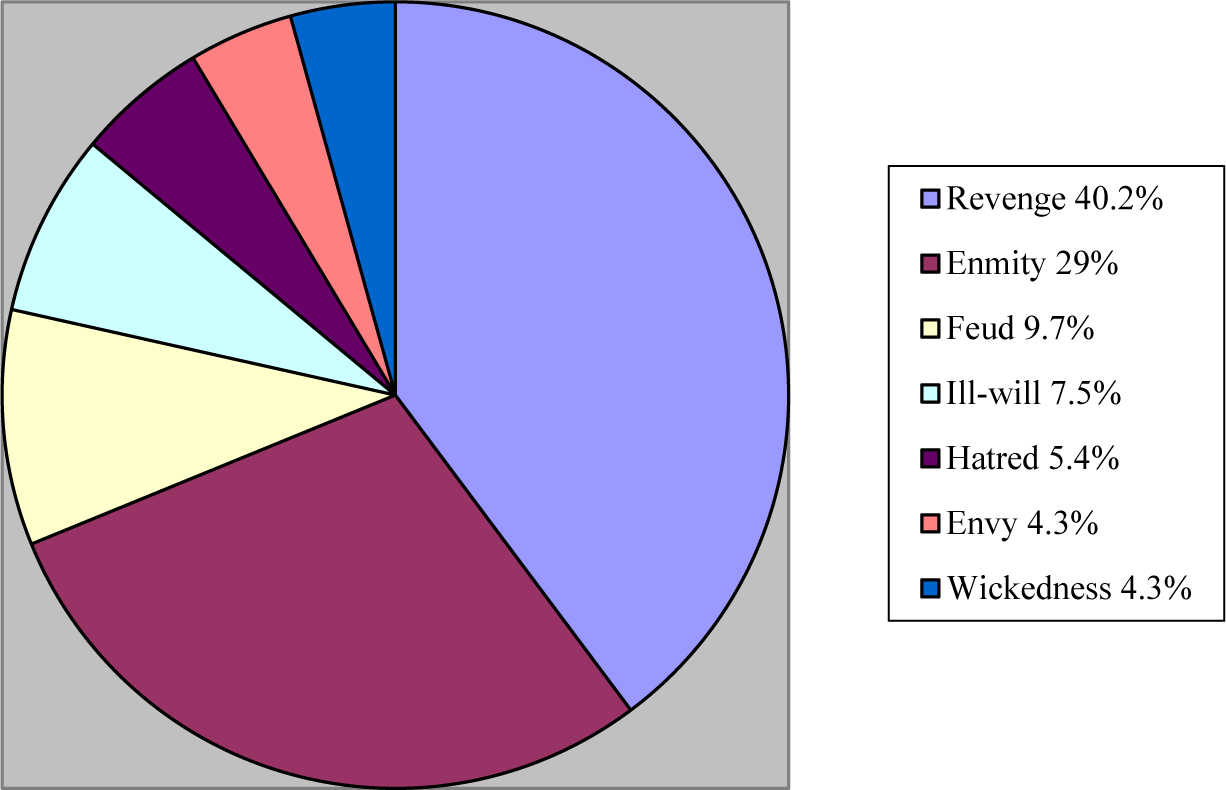
As oaths renouncing retribution, Urfehden also contained established legal or judicial terms for enmity. Perhaps the largest collection from early modern Inner Austria is from the Upper Styrian provincial court of Kapfenberg, owned by the mighty Lords of Stubenberg. Altogether 51 examples survive from the 1513–1633 period, with another from 1484, of which 27 Urfehden (51.9 percent) were sworn for moral offenses. Of the 52 total oaths, a cognate for feud was recorded 35 times (67.3 percent), but only 9 times (33.3 percent) in oaths sworn upon release from jail for adultery or other similar moral offenses. Of the total, 19 (36.5 percent) Urfehden are from the early 1600s, but only 1 was then sworn for fornication. The predominant term used in Kapfenberg was revenge, or Rache, with 32 uses (91.4 percent), followed by enmity, or Feindschaft, with 20 (57.1 percent), and feud, or Fehde, with 5 (14 percent). It was also usual that several terms were used simultaneously: revenge and enmity were recorded together 17 times (48 percent), and all three words (revenge, enmity, feud) 5 times (14.3 percent). For instance, in 1555, Mathes Khämpl, who had been jailed for theft, upon release renounced all “revenge, feud, enmity, and everything else, wicked or evil” (rach, vech, veindtschafft noch ichtes anders, args oder peses).Footnote 63 At least in Kapfenberg, the change from using enmity and feud to using only revenge seems to have happened in the early 1580s. However, in the seventeenth century, only 5 Urfehden (26.3 percent) out of 19 used a word for enmity, namely “revenge.” The earlier vocabulary was richer, as up until 1575, ill-will or Unwille, was also used six times (17.1 percent), wickedness or Arg, thrice (8.6 percent) and envy or Neid, twice (5.7 percent)—all in combination with either enmity, feud, or revenge.Footnote 64
In 6 surviving Urfehden from 1523 to 1538 from the provincial court of the Benedictine abbey of Arnoldstein in Southern Carinthia the phrasing is similar: 6 used enmity (100 percent), 4 feud and hatred (66.6 percent), 2 revenge (33.3 percent), and 1 envy (16.7 percent). Of them, 2 were sworn upon release from jail for moral offenses with no differences in their wording.Footnote 65 On the contrary, cognates for feuding were barely recorded in the copy register of 27 fifteenth- (from 1404) and sixteenth-century (1517–97) Urfehden for capital offenses from the provincial court of the Southern Carinthian Lordship of Wolfsberg, under the Franconian Prince-Bishopric of Bamberg. Of the 20 Urfehden from the 1500s, only 4 oaths (20 percent) used cognates for feuding: revenge thrice and once enmity, hatred, wickedness, envy, and ill-will—several of these were used in combination. The last use of “enmity” was in 1597.Footnote 66
Overall, the sample of 76 Urfehden (see Figure 1) is quite small and chronologically limited, as three-quarters of the oaths are from the sixteenth century. However, judging from the Kapfenberg cases, it seems that in Inner Austria by the 1600s, at least in the learned language of law, “revenge”—increasingly related to crime and sinFootnote 67—had largely replaced other words. Nonetheless, as feuding practices in the territory retained broad legitimacy well into the seventeenth century and beyond, litigants continued to use enmity and a variety of its cognates to designate their disputes. So too did clerks of local law courts, who were rarely university-trained legal professionals, as even few judges and lawyers were trained in Roman law until well into the eighteenth century.Footnote 68
Enmity and Its Cognates in Inner Austrian Urfehden From a Sample of Ninety-three Words
Note that often more than one word for the state of enmity was used in an Urfehde.

Legal Culture
At the time of Emperor Maximilian I’s death in 1519, a quarter-century after his declaration of the Perpetual Peace, the Carniolan Provincial Estates still complained about ongoing “open feuds, discords, and altercations” (offene Fehden, Irrungen und Späne) among nobles, and called on the Provincial Governor and his councilors to settle them amicably.Footnote 69 This was one of the last uses of the word Fehde in Inner Austria in its medieval legal context. By the seventeenth century, the local nobility denounced the violence of their enemies in noble law courts chiefly as breaches of provincial or imperial peace, or they used “enmity” and “disorder” to designate their feuds. Feuding was by then transformed into a combination of litigation and carefully measured small-scale violence, which could be both explained as reasonable and leave open the possibility for extra-curial settlement.Footnote 70 One example is the enmity between the gentlemen Fermo Qualandro and Simon Moscon, from the Lower Styrian town of Ptuj, which turned into open feud over a contentious Freihaus in 1654. When Qualandro occupied the Freihaus with a few servants, his nephew Moscon marched 40 of his armed subjects into Ptuj and tried to take the house by force, thereby breaking town peace; the assault stopped only after Qualandro fatally shot one of the attackers. The town authorities immediately stepped in, brokering a truce and fining Moscon for the attack. In 1655, Qualandro successfully pleaded self-defense and was ordered by the court to pay restitution for the homicide to his victim’s family (blood money), the town (fine), and a local chapel (atonement), much as would have occurred in the Middle Ages. While this enmity was conducted according to the pattern of feud, the words Absage, Fehde, Urfehde, and Sühne were not used—the conflict was recorded merely as a disorder (vnordnung).Footnote 71 Presumably, settlement would have been severely hampered if an enemy’s use of violence had been outright decried as Fehde, potentially—if unlikely in actual practiceFootnote 72—resulting in a death sentence or, much more likely, in heavy fines or long-term banishment, ultimately exacerbating the conflict.
Similar reasoning might have also been at work among nonnobles, who had less protection from the law. Only three times in over 300 surveyed Inner Austrian cases of largely physical altercations, many of which were the result of longstanding disputes, did plaintiffs accuse their adversaries of declaring a formal enmity. First, in 1548, the Ljubljana town court recorded that Leonhard Kache and Anton Tischler formally defied each other (ain einander abgesagt) over a debt.Footnote 73 While criminal law stipulated death by the sword, they seem to have been only briefly jailed and forced to settle. Second, in 1610, Matej Rojko, leader, or župan, of the Lower Styrian village of Negova, complained that his kinsman Jurij Rojko had been committing robberies in the surrounding countryside for several years, often “declaring himself the enemy” (durch des feindts eingebung) of his victims as well as threatening Matej with robbery, arson, and murder. The accusations against Jurij as a common highwayman should be met with caution, since the relatives were clearly enemies, as were perhaps Jurij’s other alleged victims.Footnote 74 How Absage among plebeians might have transformed is evidenced by the third case, from Upper Carniolan Bled. In 1634, when the millers Christoph Scheull and Adam Paßler or Hörman fell out, the offended Scheull swore in front of a handful of witnesses: “Mark my words, Hörman, if I haven’t caused you harm yet, I still will!” (mörkh du Hörman ob ich dier bißhero nit schaden gethan, also will ichs noch thuen). At the same time, Scheull tapped himself on the nose, gesturing that it should be cut if he did not deliver on the threat, thereby implying that failure to do so would cause him great dishonor.Footnote 75 While all this might seem like a lesser threat than Absage, Scheull’s public threat of harm, inviting mediation—successfully in his case—before resorting to violence, was consistent with medieval usage.
The Bled provincial court registers also contain several homicide settlements from the mid-seventeenth century. In 1657, when Gregor Knaflič finally made peace with the kin of Mihael Stojan, whom he had killed 12 years earlier, the court declared the “adversity” (widerwertigkheit)Footnote 76 among the parties to be over.Footnote 77 Similar terms were used in settling more quotidian disputes. In 1647, the court held that Matija Arl and Jakob Prešelj deserved punishment for their “repeated and adverse quarrels, insulting and dishonorable words” (offtmalige vnd widerwertige zanckh, schelt, vnd ehr wirige worth), wherewith they continuously pestered the court, but ruled that settling their “enmities” (feindtschafftigkheiten) was preferable.Footnote 78 In a case of enmity not directly recorded as such, from 1646, Jakob Finžgar claimed that he became “embittered” due to a contentious sale of a farm and “as a sign of this struck” Peter Glazer with a heavy club the next day because he refused to revoke his insults. At the church fair, this had been a very public show of enmity, displaying its exacerbation in the most direct manner. While it is more likely that Finžgar struck Glazer in the heat of the moment, his argument in court was in accordance with the social pattern of feud: namely, that they were already in conflict, his attitude toward Glazer was well known to the latter, and that he had previously tried to settle their dispute through mediation.Footnote 79
Cases from the jurisdiction of the Rothenfels provincial court in Upper Styria convey a similar choice of words. In 1660, the court had to settle all “impropriety and enmity” (vngelegenheit vnd feindtselliges) that erupted among four peasants after one of them had thrown a skittle at the other, which was taken as a “suspicious sign” (argwoniges zaichen) and a brawl ensued.Footnote 80 As suspicion and mistrust were opposites to neighborliness and friendship, they were closely related to enmity. Two years later, Adam Wuelz beat up Matheus Schäffer and his wife after ambushing them on a public road and asking why they “despised” (verachte) his father-in-law; the court ordered the parties to settle to “increase their unity.”Footnote 81 Likewise, in 1668, the dairy farmer Adam Ebmer ambushed his colleague Merthen Pechl on a public road and asked why he did not greet him anymore and “held an enmity against him” (feindtschafft nachtriege); Ebmer then hit him in the teeth. Their conflict was over pasture rights, and while they had already often publicly insulted each other,Footnote 82 not greeting one’s adversary demonstrated the exacerbation of a quarrel. Similarly, in 1677, Matheus Steiner or Grueber “very angrily” (ganz zorniger) threatened his neighbor Georg Lähner with an axe because Lähner would not greet him anymore, despite their settlement 2 years earlier.Footnote 83 Being one’s enemy entailed the use of violence. In Southern Carinthia in 1665, at the church fair in Lind/Lipa near Arnoldstein, Jurij or Georg Pinter’s younger son attacked “an enemy of his,” with whom he had already had an altercation a year before. The man defended himself with a stiletto, but Georg’s older son intervened before matters escalated further.Footnote 84 There were also other, nonviolent, expressions of unneighborliness. The “longstanding dispute” (langwüriger strittsach) between the Rothenfels subject peasants Andrä Dietmaÿr and Georg Lähner, which had often erupted into grave insults and physical violence between their families, was supposed to have come to an end in late 1673, when Dietmaÿr was on his deathbed. The dying man called for his neighbor to apologize to him and make peace, but Lähner, being “hard and unchristian,” rejected the offer and later also refused to help bury his neighbor, as was customary; he was reprimanded and fined by the court.Footnote 85
By the early eighteenth century, the semantics of enmity had changed little in Rothenfels. For instance, in 1721, the provincial court ordered Georg Bischow to settle with Georg Schattner for his blows and that both parties should forever forget all “enmities” between them.Footnote 86 A year later, the court had to intervene in the “quarreling and hot-headedness” (stritt: vnd hüzigkheiten) between Mathias Pez and his neighbor Georg Schäffer, who fell out over their pigs; let loose to forage, pigs were commonly used as offensive weapons in disputes.Footnote 87 To prevent “worse” from happening, the court ordered the peasants to shake hands and forever forget about the matter.Footnote 88 Most likely, this also entailed the payment of settlement wine (vergleich wein) to be drunk by both parties,Footnote 89 as was customary in Rothenfels and elsewhere in Inner Austria.
As late as the late nineteenth century, at least in parts of the countryside along the Upper Carniolan-Lower Styrian border, neighbors still used handshakes and mutual toasts to demonstrate the settlement of their enmities (sovraštvo). Enmity remained a synonym for unneighborliness, while going to court over brawls and grave insults was seen as dishonorable.Footnote 90 This attitude was likely similar in the early modern period, and only enmities that could not be settled among the neighbors themselves or were seen as a threat to the community or the social order likely reached the courts.
Furthermore, enmities were rarely recorded as such in the registers of early modern Inner Austrian law courts. In the surveyed Rothenfels registers, enmity or one of its cognates are used 30 times (16.8 percent) in 178 surveyed settlements for beatings and brawls, generally unarmed; 83 cases from 1656 to 1688 and 95 from 1706 to 1743.Footnote 91 Enmity is directly recorded 6 out of 30 times (20 percent), whereas terms such as hot anger or hot-headedness, Hitzigkeit, 9 times (30 percent), and discord, with 8 uses (26.7 percent), prevail. Other cognates for enmity are recorded once (3.3 percent) each: the more typical anger, revenge, resentment, and bitterness, and the less common suspicion, hardness, and contempt. There are a further six mentions of anger as a mitigating circumstance by defendants and one denoting the adversary’s attack with this emotion-term.
The usage was similar in the united provincial courts of Landskron and Velden in Southern Carinthia, belonging to the powerful House of Dietrichstein, with the prominent exception being that “enmity” was not recorded once in the 77 surveyed settlements for largely unarmed physical altercations; 53 cases from 1651 to 1657 and 24 from 1752 to 1760.Footnote 92 Instead, enmity’s most common analogs were used a total of 13 times (16.9 percent): discord (once as zwistigkeit), hot-headedness, and ill-will thrice (23.1 percent) each, followed by anger, resentment, envy, and bitterness once each (7.7 percent). As in Rothenfels, anger was invoked 4 times as a mitigating circumstance. In the eighteenth century, between the two courts, cognates for a state of enmity are recorded 14 times: discord 7 times (50 percent), enmity (only in Rothenfels) and hot-headedness 3 times each (21.4 percent), and bitterness once (7.1 percent).
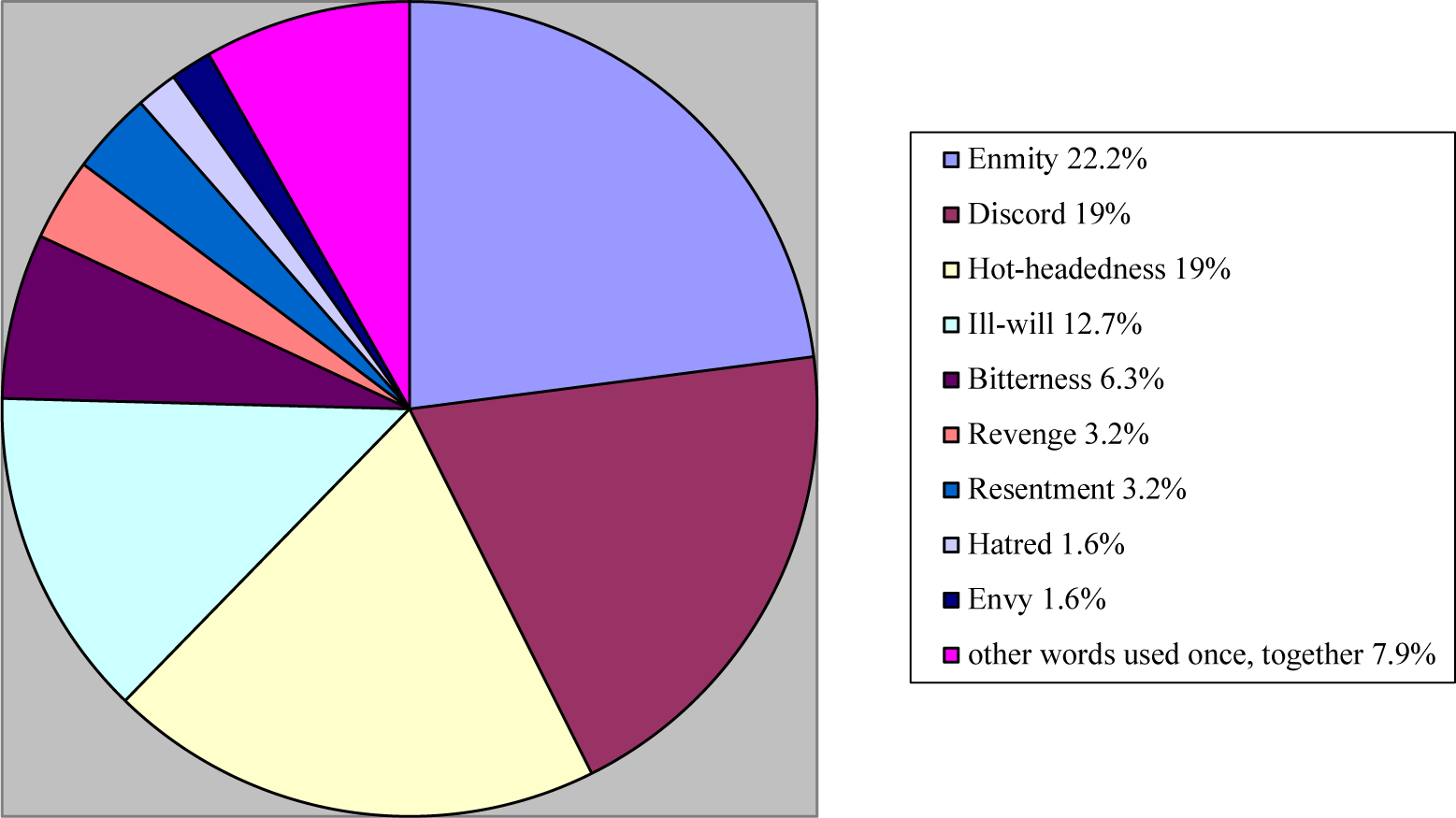
Much like in the provincial courts, in the surveyed Ljubljana town court registers from 1521–1671,Footnote 93 one of the most extensive to survive from coeval urban Habsburg Austria, enmity and its key cognates were only recorded in 15 cases and were used 21 times altogether. This is less than 10 percent of cases corresponding to contemporary notions and expressions of enmity: 131 public insults, 42 beatings and brawls, 13 threats with arms drawn, 8 armed assaults, and 27 homicides—these numbers should not be seen as accurate totals, as no registers of the Ljubljana criminal court (Malefizrecht) survive. Of the 21 uses, enmity was most common, being recorded 8 times (38.1 percent), followed by ill-will 5 times (23.8 percent), once as vnguette, bitterness twice (9.5 percent), and once each (4.8 percent) discord, hatred, resentment, revenge, quarrel, and defiance. Revenge, resentment, and defiance were only used in the sixteenth-century registers. Enmity was directly recorded thrice (37.5 percent) in the sixteenth century and 5 times (62.5 percent) in the seventeenth century, with the last recorded use in the surveyed registers in 1659. Apart from these cases, anger was claimed as a mitigating circumstance for affronts three times, only once in the seventeenth century.
The figures from Ljubljana show that the urban language of enmity was similar to that in the countryside (Figure 2). In 1549, a dispute over honor between the councilors Georg Tiffrer and Johann Baptist Posch was recorded as ill-will (both as vnguette and vnwillen), and the men were briefly jailed and forced to make peace, likely because Tiffrer had a history of violence.Footnote 94 In 1651, yet another such dispute turned into “great enmity” and, upon settling, the councilors Luka Krabat and Dionysius Neüriser were declared “good friends and neighbors,” ending all “ill-will and discord” between them.Footnote 95 In 1659, the long running inheritance dispute between the Mazoll and Wibmer families was recorded as “mutual bitterness” and demands for payment as “inimical attacks” (feundtsalliger anlauf).Footnote 96 In 1616, the widow Marusch Ugga stated that the lawyer Daniel Schwizer was her “known enemy” to successfully get him removed as a witness in a property dispute,Footnote 97 an effective practice since the Middle Ages.Footnote 98 That same year, Schwizer and his wife were in an alimony dispute with the widow Mohorčič, allegedly threatening her with arms and “quarrelsome” (hadersichtig) words.Footnote 99 As already noted in a few Bled cases, another cognate for enemy was adversary, or Widersacher. In the Lower Styrian town of Ptuj in 1642, Matej Sirc had Hans Sigmund Khockerl arrested over a debt, whereupon Sirc was alternately recorded as Khockerl’s feindt and widersacher, while violent altercations between them are not attested.Footnote 100 This digression aside, in Ljubljana in 1594, Marco Vidalbo demanded the full payment of damages from Josef Knoblauch who beat his wife to death, but stressed that he was still acting in a “neighborly” manner, not “displaying any enmity” (khein feindtschafft tragen wellen), thereby attempting to avoid the resumption of their quarrel, as settlement had already been reached.Footnote 101 Likewise, when the merchant Blasius Rottheüser was killed in 1634 by the nobleman Georg Andreas Apfaltrer zu Roj/Jablaniški, or someone in his employ, the town court confirmed the settlement, stating that this was done to “keep the peace and unity and prevent all enmity and ill-will” (zu erhaltung fridt: vnd einigkheit, auch vermeidung aller feindthättigkheit vnd widerwillen).Footnote 102 These were not simply formalities, as killings by enemies remained a plausible threat. For instance, in 1602, in the dispute between the gentleman Hieronymus Görzer and burgher Jurko Nadal, whom Görzer “attacked with an inimical hand” (mit feindtlicher hant angriffen) and later looked for with men armed with crossbows and pistols, thereby also breaking the town peace. Their enmity erupted or was exacerbated because Görzer had sex with Nadal’s wife and stole a substantial sum of money from him. Nadal sought protection from the town, which demanded that Görzer provide appropriate security, essentially an Urfehde, although it was not recorded as such.Footnote 103 His concerns continued to be shared by many for at least another century, as in 1724, the Carniolan provincial authorities still complained about the allegedly ubiquitous extra-curial payment of blood money to homicide victims’ kin.Footnote 104
Enmity and Its Cognates, Including Emotion-Terms, in Surveyed Inner Austrian Court Registers From a Sample of Sixty-three Words

Emotions
No matter how formalized or ritualized they were, enmities, like all social relations, were inseparable from their emotional dimension. Therefore, it is unsurprising that the state of enmity was often designated by various emotion-terms or their equivalent physical expressions in the sources, regardless of whether feelings opposite to friendliness and neighborliness were dissimulated or not.Footnote 105 Consequently, it is impossible to clearly delineate between “pure” emotion-terms and terms describing only social relations, so the distinction between them used here is, as often,Footnote 106 somewhat arbitrary. Thus, this section excludes the more legal terms like enmity and discord (including revenge and ill-will) but covers the more emotional ones like hatred and envy. However, in the surveyed Inner Austrian sources, the latter two are generally found only in Urfehden, so they also had a secular legal character. Moreover, as cardinal sins, envy and anger had religious and ecclesiastic legal qualities, although, as in Urfehden, hatred (odium) rather than wrath (ira) was used in the surveyed Church sources.
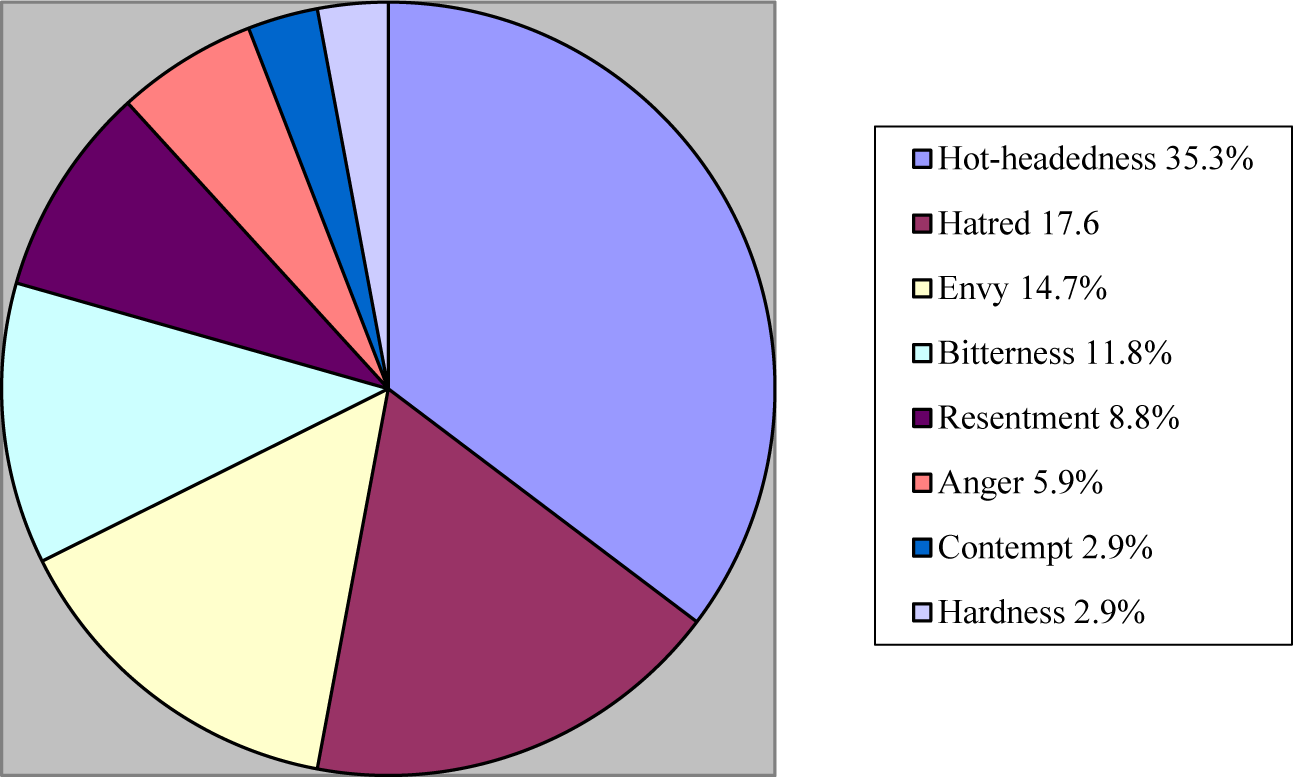
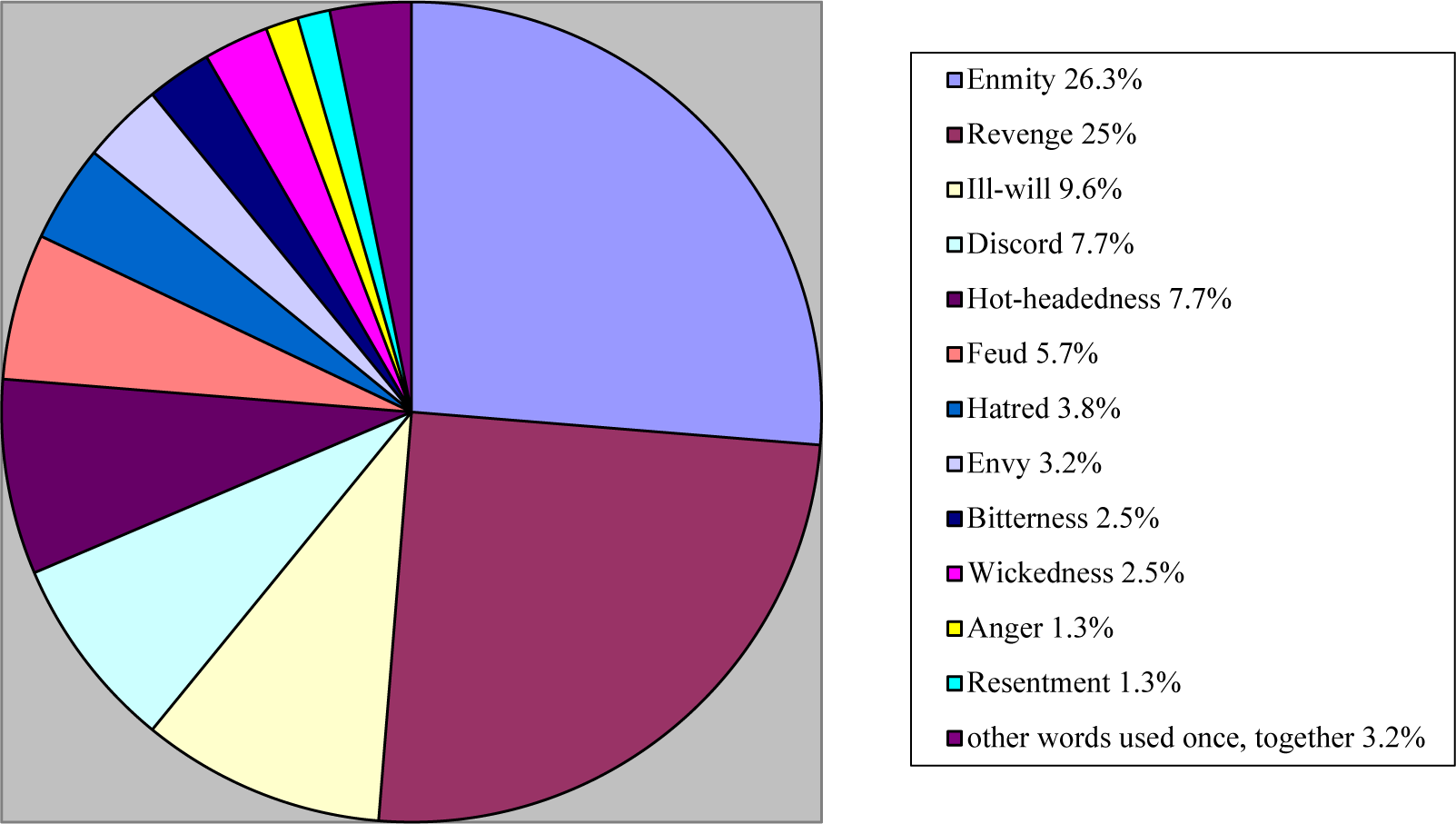
Of the total 34 emotion-terms used in the surveyed court registers and Urfehden, hot-headedness was most common, altogether used 12 times (35.3 percent), followed by hatred with 6 mentions (17.6 percent)—5 times in Urfehden—and envy with 5 (14.7 percent)—4 times in Urfehden. Bitterness was also used 4 times (11.8 percent), resentment thrice (8.8 percent), anger twice (5.9 percent) and hardness and contempt once each (2.9 percent) (Figure 3).
Emotion-Terms Used to Signify the State of Enmity in Surveyed Inner Austrian Sources From a Sample of 156 Words
Percentages shown are only for the thirty-four emotion-terms used.

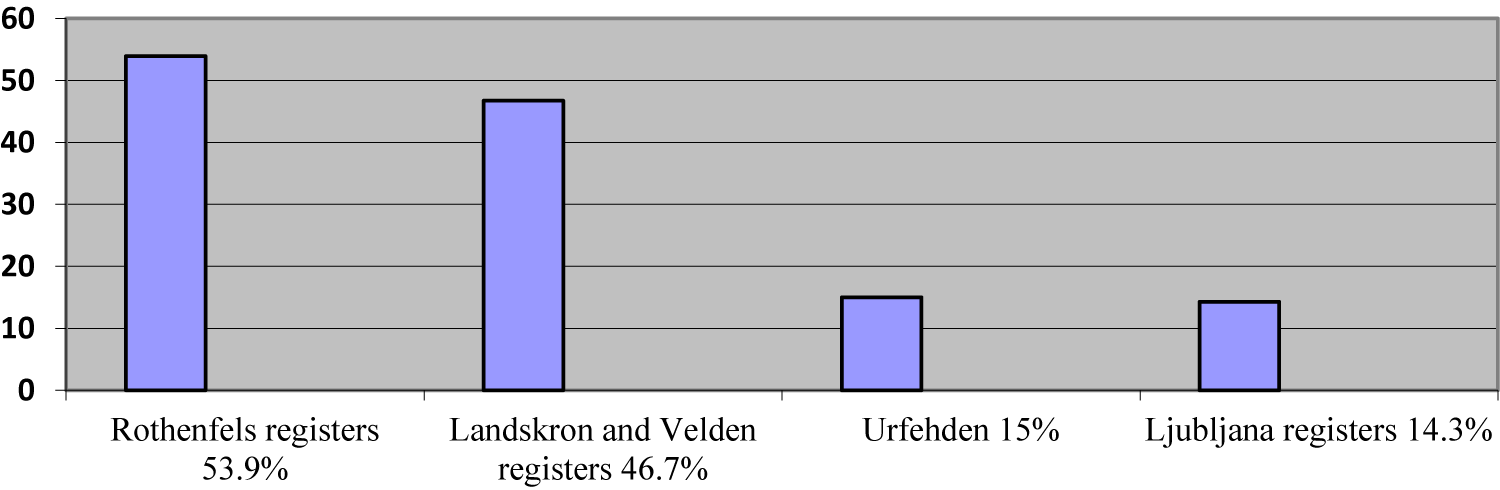
Emotion-terms were mostly used to denote enmities in the countryside: 7 out of 13 used more emotionally charged cognates (53.8 percent) in Landskron and Velden and 14 out of 30 (46.7 percent) in Rothenfels, compared to 4 out of 21 (14.3 percent) in Ljubljana, and the likewise rather emotionless language of Urfehden, with 9 out of 60 using such cognates (15 percent). Likely, this difference (Figure 4) was less the result of a richer countryside vocabulary, but rather because in the rural courts, especially in minor cases, the litigants’ words were probably less mediated upon recording by local clerks and other judicial officials, who were rarely trained lawyers. Nonetheless, this richness of emotion-terms used in the social and legal contexts demonstrates that the investigation of emotions in dispute settlement should be expanded beyond the more typical terms such as anger or hatred.
Percentage of Emotion-Terms Used to Denote a State of Enmity in Surveyed Inner Austrian Sources
Note that “enmity” was not recorded once in the Landskron and Velden provincial court registers.

Hot-headedness was the most common emotion-term in the surveyed registers, but it was rarely used as a cognate for enmity (11.6 percent), while anger was hardly used in this way at all (1.9 percent). Although the two terms are closely related, there seems to have been a clear legal distinction between them, perhaps owing to early modern changes in attitudes toward anger. At least up until the early sixteenth century, ira in general signified a formal state of mutual hostility, rather than the cardinal sin, which was principally understood as blind rage.Footnote 107 The dichotomy between uncontrollable wrath due to injustice and just anger, or ira iusta, as an emotionally balanced and honorable expression of grievances had been known since at least classical antiquity.Footnote 108 During the early modern period, due to the changing attitudes of secular authorities and the learned toward feud and the control of passions, the delineation between rage and just anger slowly blurred.Footnote 109 In the empire, Article 137 of the Carolina sanctioned homicide committed in anger (Gechheit und Zorn) with the death penalty, but Article 142 allowed judges to use their discretion in ascertaining the limits of self-defense. Consequently, they frequently used arbitrary punishment rather than execution if the anger was seen as warranted due to physical attack or grave insult that threatened the defendant’s honor or even life, a practice predicated on the writings of Italian jurists. When a sudden bout of rage or a temporary loss of sense was successfully claimed by defendants or their lawyers, this in the very least resulted in a lighter sentence, especially if the defendant was otherwise known as honorable.Footnote 110 Even in less bloody conflicts, arguing that one was overtaken by anger could minimize the enmity, allowing for swifter settlement.Footnote 111
Things were similar in Inner Austria. In the analyzed sources, one’s state of anger was mostly claimed as an attenuating circumstance for physical and serious verbal affronts: eight times in the registers of Rothenfels, four in Landskron and Velden, and thrice in Ljubljana. Only twice was “anger” used to express a state of enmity, without defendants pleading to having been overtaken by rage. In 1656, in the jurisdiction of the Landskron and Velden provincial court, the longstanding enmity between Bärtl Kaufman and Sebastian Lippitsch, both of whom were peasant sons and Jesuit students, once again erupted into violence and Kaufman’s friend, Lipp, stabbed Lippitsch almost to death with his sword outside a tavern in Köstenberg/Kostanje. This was not the result of inebriation, as a witness opined that Kaufman and his two companions, including his uncle, the parish priest of Köstenberg, arrived at the tavern looking as if “brimming with anger” (voller zorn),Footnote 112 thus alluding to premeditation and an ongoing enmity, not trying to establish mitigating circumstances. Similarly, in 1738, the Rothenfels court designated the brawl between Joseph Hochprugger and Andre Maÿr as “anger,” which “shattered the common tranquility” (gemeinsambe ruhe zerstöret)—the two Oberwölz burghers came to blows following unsuccessful negotiations over the sale of a farm.Footnote 113 Sometimes, anger was recorded as having been expressed nonverbally. In 1681, the Žalec market-town councilor Johann Christoph Pilpach raided the nearby Plumberk manor in Lower Styria that belonged to his enemy Ferdinand baron Miglio. Seizing the manor with the help of soldiers he acquired from the Counts of Strassoldo from Krško in Lower Carniola, Pilpach reportedly threatened Miglio’s servants by gnashing his teeth (gerinnt) and presenting a handful of bullets, saying that these “cherries” will be served to the baron.Footnote 114
Apart from five uses in Urfehden, “hatred” was used only once for enmity in the surveyed registers; rather surprising, considering its widespread use in coeval Europe. In 1601, the Ljubljana town court had the town hospice master Ulrik Robida and the influential town councilor Michael Taller amicably settle their “hateful quarrel” (gehäßige handel), rooted in their rivalry for town offices and further exacerbated by Taller publicly calling Robida a thief.Footnote 115 Ecclesiastic authorities also frequently used “hatred” to designate enmities, perhaps to condemn them as sinful too. For instance, in the Prince-Bishopric of Ljubljana in 1709, when the prospective newlyweds Andrej Maranšek and Marija Avguštin from the Lower Styrian market-town of Gornji Grad expected that their marriage would end the odium between their families, who were in dispute over the delineation of their fields.Footnote 116 The 1761–71 visitation questionnaires for the Carniolan archdeaconries of the Archbishopric of Gorizia/Gorica likewise inquired if, among other “public scandals,” there were any “hatreds among persons or families” (odia inter personas, aut familias).Footnote 117 While none were reported, presumably this was because it would have reflected badly on the priests, as feuds with neighbors long remained one of the main reasons for non-attendance at church, since to receive communion one first had to be at peace with one’s neighbors.Footnote 118 The honesty of parish priests in this matter is questionable in the first place, as, save for small numbers of concubinage, almost no “public scandals” were reported, which also included superstition, witchcraft, usury, and prostitution.
Long recognized as a common cause of enmity, “envy” was likewise mostly recorded in Urfehden in the analyzed registers. The sole exception is from 1652, when the Landskron and Velden court noted that the quarrel between the miller Ruep Trinkher and ironsmith Mathes Hochenberger, who depended on the use of the same watercourse, was due to their “hot-headedness and envy.” It seems that both had been rallying their kin and allies to demolish each other’s dams. These gatherings of peasants, who were armed at least with tools, made the lordship nervous, and the court demanded that its subjects refrain from their “quarreling, envy, and bitter adversities” (strüttigkheit, neidt, vnd härbliche aufstossungen).Footnote 119 Finally, unlike “hatred” and “envy,” “bitterness” only denoted enmities in court registers. For instance, in 1710, the Rothenfels court recorded the longstanding hostilities of Georg Merl with Georg Neuman and Hans Pez as the men being “embittered.”Footnote 120
Conclusion
Much like its rites of violence and peace, the words and emotions of enmity were part of a rich legal and social vocabulary of dispute settlement that was inextricably bound to status and property and, in the words of Stephen D. White, “provided scripts or schemas for representing, interpreting, and experiencing competition for honor and other kinds of conflict.”Footnote 121 As the analyzed cases demonstrate, this lexicon was broadly known and allowed disputants from all social classes’ room to maneuver in the narration of their enmities. This maneuverability also allows historians to read between the silences and holes in judicial sources and to see past emotion-terms, such as anger or hate, when they communicated a state of social relations rather than unrestrained feeling, as well as to recognize patterns of formalized enmity when no explicit “fighting words” were recorded. Thus, broadening our knowledge of the language of enmity enables us to expand our investigations on the nature of early modern dispute settlement beyond legalist interpretations.
The surveyed cases demonstrate that among Inner Austrian townspeople and peasants, “enmity” and its key synonyms expressing ill-will, discord, or hatred—as opposites of love, concord, and friendship—long signified a social state of mutual hostility rather than unrestrained feeling. In particular, the analysis establishes the richness of the lexicon of enmity within the broader legal culture, as opposed to the more taciturn normative usage (see Figure 5).
Enmity and Its Cognates in Surveyed Inner Austrian Sources From a Sample of 156 Words

Besides “enmity” itself, the surveyed Urfehden, as more formalized legal sources, used only 5 cognates to denote it as a social relation, in stark contrast to court registers, which used 14 synonyms in the selected documents alone. In Urfehden, the use of “revenge” and “enmity” greatly predominated, while the change to using only “revenge” by the late sixteenth century was most likely the result of the ongoing criminalization of feuding. This is already indicated by the earlier use of “wickedness” and, notably, “feud,” neither of which are recorded in the surveyed court registers. As their vocabulary was much more diverse, “enmity” was therein used only marginally more often than the likewise common terms “discord” and “hot-headedness,” whereas in the countryside, more emotion-laden terms prevailed in designating longstanding disputes. It is particularly striking that “enmity” was never used in the surveyed Landskron and Velden provincial-court registers.
While in Inner Austria, Feindschaft seems to have been largely replaced by Rache in Urfehden by the seventeenth century, in the broader legal culture “enmity” remained closely related to violent retribution well into the 1700s—or even a century longer, at least locally. Moreover, the term “enmity” was primarily understood as the opposite of good neighborliness by the majority of the population. Unlike feud and perhaps even peace, enmity and neighborliness, underpinned by Christian teaching,Footnote 122 might have been more tangible everyday concepts, albeit definitive conclusions for the region are hard to make due to few surviving sources on major crimes. However, judging from how conflicts were narrated in cases like those from 1634 Bled and 1654 Ptuj, it can be surmised that by the seventeenth century, Fehde and Absage were substituted with a less illicit vocabulary that conveyed the same state of social relations.
The long survival of the concept of “enmity” in dispute settlement, including much of its vocabulary whereby it can be traced, was predicated on the longue durée of social traditions that upheld neighborliness and concord in both urban and rural communities. These social traditions were essentially underpinned by local courts of law striving to control interpersonal violence and uphold the peace. In Inner Austria, this lasted until they lost the last remnants of their autonomy to absolutist reforms at the end of the eighteenth century. While the consequent ejection of customary rites of dispute settlement from criminal justice accelerated their abandonment in the broader society, this process took time. In settling more everyday violence and conflicts, remnants of the ancient rites and lexicon of enmity and neighborliness were still recorded in parts of the former Inner Austrian countryside in the 1870s. Like “neighborliness,” “enmity” was contingent on traditional rites of sociability, which in the countryside, barely a generation after the abolition of serfdom in the region, had only just begun to be slowly dismantled by modernization processes. This demonstrates that, regarding interpersonal violence and its (social) control, the transition to modernity took much longer than is generally assumed.
Acknowledgements
This article is the result of research carried out in the post-doctoral project Z6-3223 (B) Plebeian Dispute Settlement in Baroque Inner Austria: Between Feud and Criminal Law, funded by the Slovenian Research and Innovation Agency (ARIS) in 2021–23, and the research program P6-0435 (A) Practices of Conflict Resolution Between Customary and Statutory Law in the Area of Today’s Slovenia and Its Neighbouring Lands, co-funded by ARIS in 2022–27. My thanks to Stuart Carroll and the two anonymous reviewers for their comments on this paper.