Introduction
Maintenance of adequate soil cover, increased organic matter return, and reduction in tillage can improve soil health (Hartwig and Ammon Reference Hartwig and Ammon2002). Living mulches can provide rapid soil cover, enhance resource-use efficiency, and deter interrow tillage (Masiunas Reference Masiunas1998). Greater water infiltration occurs in living mulch systems relative to systems lacking a living mulch; while soil erosion, water and pesticide runoff, puddling, and nitrate leaching are reduced in living mulch systems (Hall et al. Reference Hall, Hartwig and Hoffman1984; Kemper and Derpsch Reference Kemper and Derpsch1981; Meisinger et al. Reference Meisinger, Hargrove, Mikkelsen, Williams, Benson and Hargrove1991).
In some cases, living mulches compete only with weeds and do not negatively impact crop growth and yield (Brainard and Bellinder Reference Brainard and Bellinder2004). Vrabel et al. (Reference Vrabel, Minotti and Sweet1981) reported that sweet corn (Zea mays L.) planted into a white clover (Trifolium repens L.) living mulch had 75% higher yield and 50% higher leaf nitrogen content compared with corn not planted into living mulch. Despite reported yield benefits of living mulches in some crops, competition with the cash crop for resources and unreliable weed control are major challenges in living mulch systems (Masiunas Reference Masiunas1998). For example, early planting (0 to 10 d after crop planting) of intercrops was reported to increase weed suppression and residue levels in cabbage (Brassica oleracea L. var. capitata) and broccoli (Brassica oleracea L. var. italica), but decreased crop yields (Brainard and Bellinder Reference Brainard and Bellinder2004; Brainard et al. Reference Brainard, Bellinder and Miller2004). Whereas, for late-planted (20 to 30 d after crop planting) intercrops, multiple interrow cultivations (before their seeding) were required for adequate weed control. The reduced soil cover in case of late-planted living mulches also potentially curtails their contributions toward weed suppression and soil conservation. Vrabel et al. (Reference Vrabel, Minotti and Sweet1980) found that planting sweet corn and living mulch at the same time resulted in maximum benefits for both. In the same study, drilling living mulch seeds into the crop interrows did not decrease crop yields, whereas broadcasting the seeds did, likely because of increased competition from living mulch plants growing in close proximity to the crop rows.
Living mulch research has focused largely on perennial living mulch systems in no-till corn and soybean [Glycine max (L.) Merr.] (Echtenkamp and Moomaw Reference Echtenkamp and Moomaw1989; Elkins et al. Reference Elkins, Vandeventer, Kapusta and Anderson1979, Reference Elkins, George and Birchett1982; Hall et al. Reference Hall, Hartwig and Hoffman1984; Moomaw and Martin Reference Moomaw and Martin1976). Annual living mulches, especially in vegetables, have been less well studied. Because soil conservation is the primary objective in most perennial living mulch systems, additional fertilizers and herbicides are used to maintain crop yield (Cardina and Hartwig Reference Cardina and Hartwig1980; Moomaw and Martin Reference Moomaw and Martin1976; Peters and Currey Reference Peters and Currey1970; Robertson et al. Reference Robertson, Lundy, Prine and Currey1976; Vrabel et al. Reference Vrabel, Minotti and Sweet1981). However, negative environmental impacts of increased fertilizer and herbicide use, as well as excessive living mulch injury, can be major disadvantages in realizing the full benefits of living mulch systems. Moreover, increased nitrogen inputs may favor weeds over crops (Brainard et al. Reference Brainard, Bellinder and Miller2004; Little et al. Reference Little, Mohler, Ketterings and DiTommaso2015).
Severe herbicide injury to living mulches can lead to high weed pressure, whereas living mulches may suppress weeds more effectively when injury is not too severe (Hartwig Reference Hartwig1977; Hughes and Sweet Reference Hughes and Sweet1979). For adequate recovery of living mulches and to increase stand duration, herbicide rates can be reduced (Elkins et al. Reference Elkins, George and Birchett1982). Adequate weed suppression is also possible using low herbicide rates (Akobundu et al. Reference Akobundu, Sweet, Duke and Minotti1975; Hamill and Zhang Reference Hamill and Zhang1995). POST applications of predominantly PRE herbicides, along with surfactants to boost their activity, could simultaneously suppress living mulch and weeds. Mowing is a nonchemical option for living mulch control in some crops; however, living mulches can recover quickly and negatively impact crop performance (Hartwig Reference Hartwig1976).
Living mulches could become volunteer weeds in subsequent seasons if they produce seeds. In temperate regions like the northeastern United States, susceptibility of tropical/subtropical species such as sesbania and sunn hemp to late-summer/early-fall temperatures may prevent seed set without additional chemical use or mechanical operations. Besides increasing input costs, such operations typically occur close to crop harvest, when time can be a limiting factor. Use of novel/exotic species can also reduce the possibility of the living mulches serving as alternate hosts for regional pests.
Despite previous research on the feasibility of integrating living mulches into cropping systems, several research gaps remain. These include: (1) their use in reduced-tillage systems or where no-tillage is difficult (such as in vegetable cropping systems); (2) use of annual living mulches rather than perennial sods; (3) reducing herbicide inputs; (4) use of novel living mulch species; and (5) influence of application timing and herbicide type on crop yield, weed control, and living mulch performance. The main objectives of this study were to determine the effects of: (1) living mulch–herbicide combinations on fresh market tomato yield; (2) herbicide treatments on living mulch growth; and (3) living mulch–herbicide combinations on efficacy of weed control.
Materials and Methods
Field trials were conducted at the Homer C. Thompson Vegetable Research Farm in Freeville, NY, USA (42°30′45″N, 76°20′45″W) during 2014 (preliminary trial), 2015, and 2016, on Howard gravel loam soils (Loamy-skeletal, mixed, active, mesic Glossic Hapludalf) with a pH range of 6.0 to 6.6. The trials were located in different fields each year. The tropical/subtropical legumes sesbania and sunn hemp were used as living mulches. Tomato was selected as the vegetable crop for two main reasons: (1) it can be planted in relatively wide rows, enabling easier establishment of living mulches; and (2) it has a relatively greater number of herbicides registered for use, thus increasing options for herbicide treatments.
Field Preparation and Planting
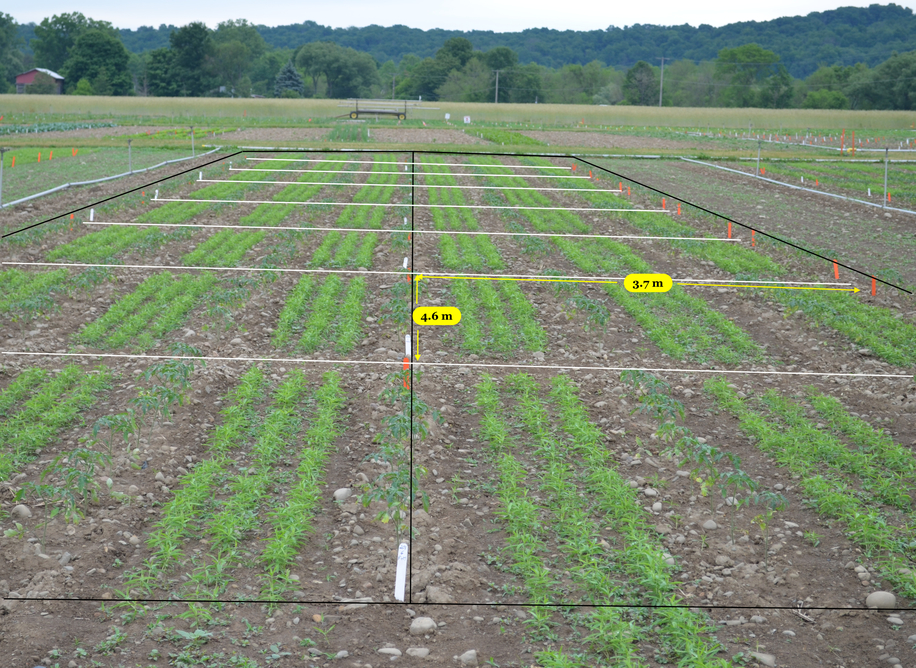
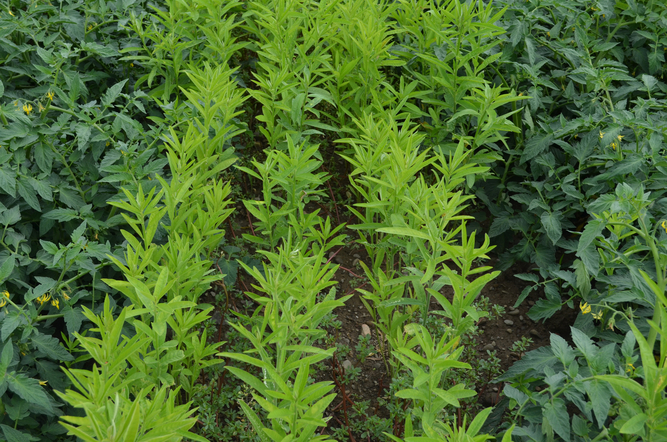
Field preparation consisted of moldboard plowing, followed by disking and harrowing, and fertilization at the standard rate of 100 kg ha−1 each of N, P, and K used at the research farm. No additional fertilizers were applied to compensate for the living mulch. During the last week of May, living mulches were seeded at a row spacing of 23 cm using a grain drill (Model KED-72, Eco-Drill, Kasco, Shelbyville, IN). Sesbania was planted at 40 kg ha−1. The grain drill lacked a suitable setting for sunn hemp seeds, so sunn hemp was seeded at approximately 55, 50, and 90 kg ha−1 in 2014, 2015, and 2016, respectively. In 2015, a push-behind seeder was employed after this initial seeding to increase seeding rate to approximately 60 kg ha−1. Due to unavailability of a smaller drill seeder capable of planting within tomato rows, living mulches were planted in 3.7-m-wide strips. Immediately after emergence, living mulch rows were removed with a hand hoe to accommodate the tomato crop. Because tomato was planted at 122-cm row spacing, living mulch rows were removed and left in sets of three. Therefore, adjacent tomato rows had three living mulch rows between them, with 46-cm spacing between tomato rows and the closest living mulch row on either side (Figure 1). Due to poor emergence and establishment of sesbania during 2014 and 2015, sesbania was not used in the 2016 trial.
Photograph of two (out of a total of four) replications during 2016 (June to September) at Freeville, NY, USA, illustrating the planting pattern of living mulch (sunn hemp) in fresh market field tomato (‘Mountain Fresh’). Three rows of living mulch (23-cm row spacing) were planted within tomato rows (122-cm row spacing and 46-cm plant-to-plant spacing), such that the distance between a tomato row and the nearest living mulch row on either side was 46 cm. Tomato (4-wk-old seedlings) was transplanted approximately 5 d after living mulch emergence. Individual treatment plots measured 4.6 by 3.7 m.

Four- to five-week-old fresh market tomato ‘Mountain Fresh’ transplants were hand transplanted into the field during the 1st to 2nd week of June at a plant-to-plant spacing of 46 cm. To facilitate deeper planting in the stony soil, a tractor-driven two-tine attachment was used in 2016 to make approximately 25-cm-deep furrows where tomato would be transplanted. Care was taken to prevent tractor wheels from injuring the living mulch.
Treatments and Data Collection
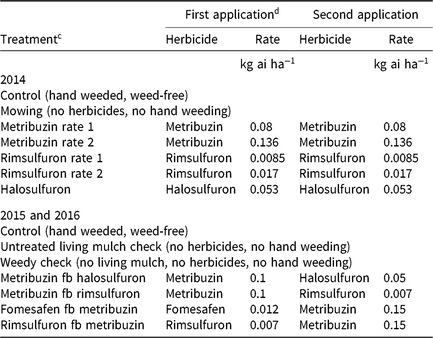
Herbicide treatments and reference plots for 2015 and 2016 were designed based on greenhouse testing and observations from the 2014 preliminary field trial (Table 1). The reference plots used were: (1) control, kept weed-free by hand weeding; (2) untreated living mulch check, with no herbicide treatments or other forms of weed control; and (3) weedy check, with no living mulch or herbicide treatments or other forms of weed control. All herbicide applications were made post tomato transplanting and living mulch emergence, and included a nonionic surfactant at 0.25% of the spray volume. Herbicide treatments comprised two temporally spaced applications, with each application consisting of a different single herbicide. Herbicide treatments are referred to as “(first herbicide) fb (second herbicide),” where “fb” refers to “followed by” in a sequential application. The only other herbicide used in this study was sethoxydim, used at 0.27 kg ai ha−1 over the entire field. Sethoxydim was applied at approximately the same time as the first set of herbicide treatments in order to suppress grass weeds, as the primarily broadleaf herbicides used in the treatments were not expected to adequately control grass weeds at low rates. The grass herbicides did not cause any visible injury to the broadleaf living mulches. Experimental plots were set up in a randomized complete block design with four replicates. Each 3.7-m-wide strip of living mulch was a replicate, and the treatments were randomly assigned to plots within these strips. Individual plots measured 3.7 by 4.6 m and consisted of four tomato rows, of which the two central rows were hand harvested to estimate tomato yield. Irrigation was provided using overhead sprinklers. Due to above-average rainfall in 2015, irrigation was not needed/done that year. In contrast, irrigation (total of approximately 60 mm) was required multiple times in the much drier 2016 growing season.
Living mulch (sunn hemp)–herbicide treatments used during 2014, 2015, and 2016 (June to September) in fresh market field tomato at Freeville, NY, USA.a, b

a Abbreviation: fb, followed by (in a sequential application).
b Three rows of living mulch (23-cm row spacing) were planted in the middle of adjacent tomato rows (122-cm row spacing and 46-cm plant-to-plant spacing).
c All herbicide applications included nonionic surfactant at 0.25% of the spray volume. Reference plots are also listed.
d First applications were made approximately 25 d after living mulch emergence (at about 75% soil cover), which was approximately 20 d after tomato (4-wk-old seedlings) transplanting; second applications were made approximately 15 d later.
Herbicide applications were made using a pressurized carbon dioxide backpack sprayer fitted with a two-nozzle (8003 EVS flat-fan; TeeJet® Technologies, Spraying Systems, Wheaton, IL) boom of 1-m swath, operating between 200 and 240 kPa and delivering approximately 320 L ha−1. The first set of herbicide applications was made in late June/early July, 20 to 25 d after living mulch emergence/15 to 20 d after tomato transplanting, when living mulch cover was approximately 75%. The second set of herbicide applications was made approximately 15 d later. Choice of herbicides and application timings considered the preharvest intervals, which can be long in vegetable crops (60, 30, 7, and 45 d for fomesafen, halosulfuron, metribuzin, and rimsulfuron, respectively, in NY field tomato). Tomato harvests started in early September and were completed by late September. Five harvests were required in 2014, and three in 2015 and 2016. No living mulch termination operations were carried out.
Percent living mulch and weed cover and living mulch height were measured four times each season, at 10- to 15-d intervals. Percent cover was visually estimated by the same observer in both years from either end of the length of each plot and was measured in absolute and not relative terms; therefore, percent cover of living mulch and weeds may not add up to 100%. Biomass and density of living mulch and weeds were measured a few days before the start of tomato harvest. Living mulch biomass and density were determined from two randomly selected 50-cm-long segments of living mulch rows, at least 60 cm away from plot edges. Weed biomass and density were determined from two randomly selected 0.25-m2 (50 by 50 cm) areas, at least 60 cm away from plot edges. Living mulch and weeds were cut at ground level and weighed to estimate fresh aboveground biomass; dry biomass was determined by weighing the plant materials after they were oven-dried for 2 wk at 75 C.
Data Analyses
Living mulch (cover, height, density, and biomass), weed (cover, density, and biomass), and tomato (yield) parameters were subjected to ANOVA and regression analyses at 5% level of significance. Treatment differences were compared using Tukey’s HSD test. Herbicide treatments were considered as fixed effects. Data were not transformed and were not combined among years for analyses due to very different climatic conditions in 2015 and 2016. Statistical analyses were performed using JMP Pro v. 12.0.1 (2013 SAS Institute, Cary, NC) software.
Results and Discussion
Weather Conditions
The 30-yr average rainfall from May to August at the trial site was 404 mm (CLIMOD 2, Northeast Regional Climate Center). With 467 and 451 mm of rainfall during this period in 2014 and 2015, respectively, water was not deemed to be limiting during these 2 yr. This was in contrast to 2016, which received only 239 mm of rainfall during these months; and just 120 mm from May to July, compared with 339 and 395 mm in 2014 and 2015, respectively. Although irrigation was provided, it did not fully compensate for this severe extended drought that occurred in 2016 in central New York State.
Summer temperatures were below average in 2014, so emergence of the warm-season living mulches was delayed, as were their initial growth and establishment. Sunn hemp grew with adequate vigor as the season progressed. Sesbania did not establish very well in 2014 or 2015. Therefore, data were not collected from sesbania plots, and sesbania was not planted in 2016. The following discussion is therefore based only on 2015 and 2016 sunn hemp data. Tomato was hand harvested, and these operations caused severe destruction of living mulch stands; this, along with the drop in temperatures, was enough to arrest the growth of these warm-season species by late September. As such, seed set of the living mulches was not observed in any year.
Treatment effects were more pronounced in 2016 relative to 2015, and significant relationships were observed between living mulch, weed, and crop parameters. In 2015, the above-average rainfall may have moderated the effects of living mulch–weed–crop competition. Major weeds in the experimental plots included Powell amaranth (Amaranthus powellii S. Watson), shepherd’s purse [Capsella bursa-pastoris (L.) Medik.], common lambsquarters (Chenopodium album L.), hairy galinsoga (Galinsoga quadriradiata Cav.), common purslane (Portulaca oleracea L.), and eastern black nightshade (Solanum ptychanthum Dunal).
Tomato Yield
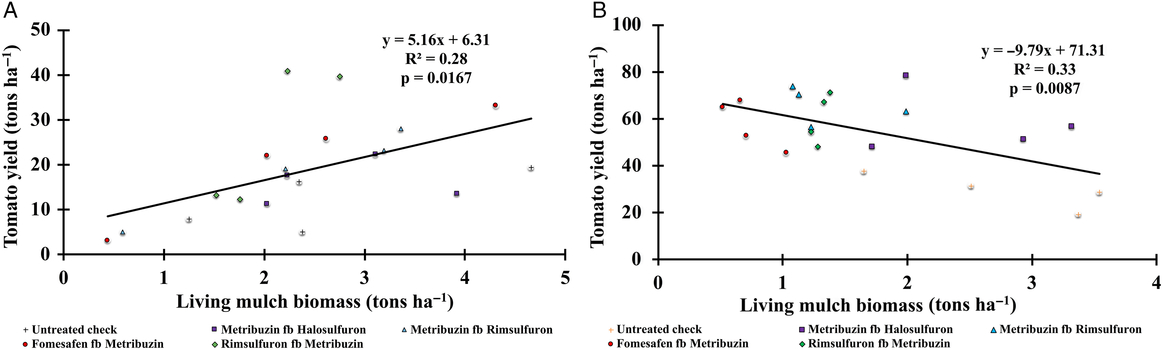
In 2015, the incidence of early blight [Alternaria solani (Ell. and Mart.) Jones and Grout] in tomato was high, likely because of the very wet and cloudy conditions that season. Under such conditions, presence of the living mulch could have adversely affected tomato yields by reducing air circulation and increasing leaf wetness period, thereby increasing the susceptibility of tomato plants to disease. However, there was a positive correlation between tomato yield and living mulch biomass (P = 0.0167) (Figure 2A). This is a desirable outcome, because the sustainability benefits of living mulches can potentially be maximized without adversely affecting crop yield.
Relationship (linear regression, α = 0.05) between tomato yield and living mulch (sunn hemp) biomass (oven-dried for 2 wk at 75 C) in fresh market field tomato (‘Mountain Fresh’) during 2015 (Figure 2A) and 2016 (Figure 2B) (June to September) at Freeville, NY, USA. Three rows of living mulch (23-cm row spacing) were planted in the middle of adjacent tomato rows (122-cm row spacing and 46-cm plant-to-plant spacing). Herbicides treatments and the untreated living mulch check (no hand-weeding, no herbicide treatments) are represented here. First herbicide applications were made approximately 25 d after living mulch emergence (at about 75% soil cover), which was approximately 20 d after tomato (4-wk-old seedlings) transplanting; second applications were made approximately 15 d later. Herbicide rates: metribuzin fb halosulfuron (0.1 and 0.05 kg ai ha−1, respectively); metribuzin fb rimsulfuron (0.1 and 0.007 kg ai ha−1, respectively); fomesafen fb metribuzin (0.012 and 0.15 kg ai ha−1, respectively); rimsulfuron fb metribuzin (0.007 and 0.15 kg ai ha−1, respectively). Abbreviation: fb, followed by (in a sequential application).

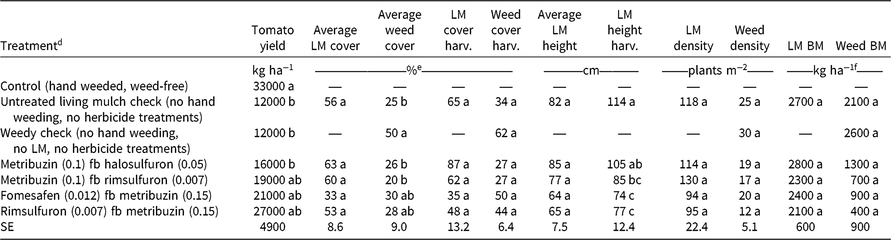
Living mulch biomass in the herbicide treatment plots in 2015 ranged from 2100 to 2800 kg ha−1 (Table 2). This level of biomass production by the living mulch and the positive relationship between tomato yield and living mulch biomass contrast with the negative relationships that have been typically reported from living mulch studies. For example, Hiltbrunner et al. (Reference Hiltbrunner, Liedgens, Bloch, Stamp and Streit2007) reported a negative correlation between the dry weight of several legume living mulches and wheat (Triticum aestivum L.) yield. Similarly, Brainard et al. (Reference Brainard, Bellinder and Miller2004) reported that higher cabbage yields were more consistently associated with later planting of annual living mulches (and lower mulch biomass) than earlier planting.
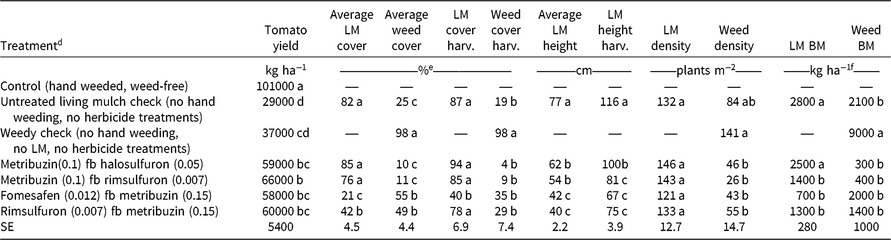
Tomato yield, living mulch (sunn hemp) cover, height, stand density, and biomass, and weed cover, density, and biomass in fresh market field tomato during 2015 (June to September) at Freeville, NY, USA. a , b , c

a Abbreviations: BM, biomass; fb, followed by (in a sequential application); harv., at beginning of tomato harvest; LM, living mulch.
b Three rows of living mulch (23-cm row spacing) were planted in the middle of adjacent tomato rows (122-cm row spacing and 46-cm plant-to-plant spacing).
c Values within a column followed by a same letter are not significantly different according to Tukey’s test (α = 0.05).
d All herbicide applications included nonionic surfactant at 0.25% spray volume. First applications were made approximately 25 d after living mulch emergence (at about 75% soil cover), which was approximately 20 d after tomato (4-wk-old seedlings) transplanting; second applications were made approximately 15 d later. Herbicide rates in kg ai ha−1 are given within parentheses.
e Visual estimations (percentages) are in absolute terms, so living mulch and weed cover may not add to 100%.
f Oven-dried (2 wk at 75 C) dry matter.
In 2015, tomato yield from only one herbicide treatment was lower than from the control (Table 2). In 2016, however, tomato yield from the control was considerably higher than from all herbicide treatments (Table 3). While an important contributor to this outcome may have been the excessive competition for soil moisture between the living mulch and the tomato crop in 2016 due to drought conditions, competition for nutrients and sunlight, as well as physical resistance to expansion of tomato foliage, may also have been causative factors. In our trials, no nodulation was observed in sunn hemp roots, indicating that sunn hemp derived all its nitrogen from nitrogen already in the soil and supplied through fertilizers. So, it is possible that the sunn hemp living mulch competed with the tomato crop for nitrogen, and other nutrients as well. Therefore, during adoption of such herbicide-managed living mulch systems for herbicide reduction/weed control, mitigating soil erosion, enhancing organic matter return, or any of their numerous other sustainability functions, it may be prudent to expect compromises in crop yield. If the potential gains toward sustainability are considered to be worth the potential losses in crop yields, then such living mulch systems may be practicable.
Tomato yield, living mulch (sunn hemp) cover, height, stand density, and biomass, and weed cover, density, and biomass in fresh market field tomato during 2016 (June to September) at Freeville, NY, USA. a , b , c

a Abbreviations: BM, biomass; fb, followed by; harv., at beginning of tomato harvest; LM, living mulch.
b Three rows of living mulch (23-cm row spacing) were planted in the middle of adjacent tomato rows (122-cm row spacing and 46-cm plant-to-plant spacing).
c Values within a column followed by a same letter are not significantly different according to Tukey’s test (α = 0.05).
d All herbicide applications included nonionic surfactant at 0.25% spray volume. First applications were made approximately 25 d after living mulch emergence (at about 75% soil cover), which was approximately 20 d after tomato (4-wk-old seedlings) transplanting; second applications were made approximately 15 d later. Herbicide rates in kg ai ha−1 are given within parentheses.
e Visual estimations (percentages) are in absolute terms, so living mulch and weed cover may not add to 100%.
f Oven-dried (2 wk at 75 C) dry matter.
In 2016, although weed biomass in the weedy check was approximately 9000 kg ha−1, both living mulch and weed biomass from the herbicide treatments were within the range recorded in 2015 (Tables 2 and 3). However, unlike in 2015, tomato yield in 2016 was negatively correlated with biomass of both living mulch (Figure 2B) (P = 0.0463) and weeds (P = 0.003). Although, overall yields in 2016 were higher than in 2015 because of a healthy crop stand and sunny conditions, drought conditions were prolonged, and despite irrigating experimental plots to mitigate the lack of rainfall, competition for water could have reduced tomato yields. Hence, the positive relationship between tomato yield and living mulch biomass observed in 2015 (Figure 2A) may have been due to ample water availability from the above-average rainfall received that year. The influence of soil moisture availability on competitive interactions in living mulch systems has also been observed in cotton (Gossypium hirsutum L.) (Bhaskar et al. Reference Bhaskar, Bellinder, DiTommaso and Walter2018). In a series of six field trials at four locations in semiarid central India, nonchemical management of living mulch systems was evaluated using five different living mulch species. In a dry year, there was an overall negative relationship between cotton yield and living mulch biomass, but in a wet year, there was a positive relationship.
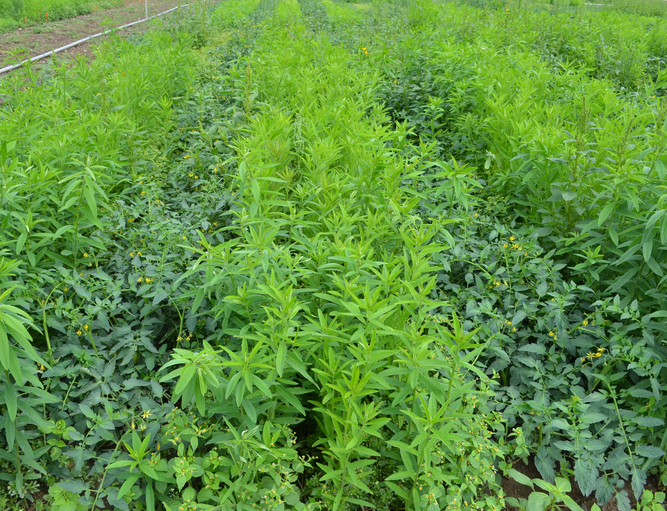
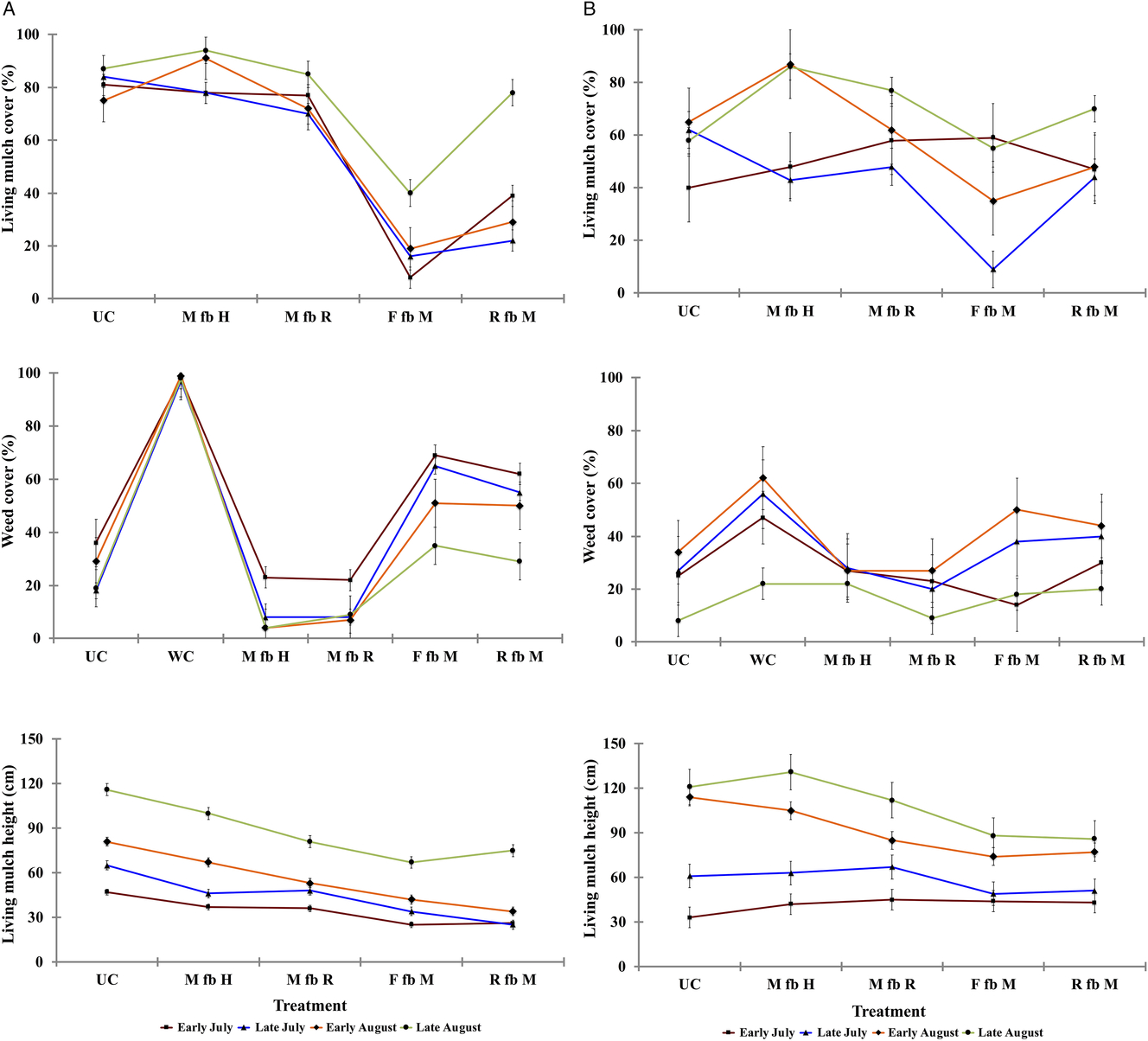
In 2016, the lowest tomato yield (29000 kg ha−1) occurred in the untreated living mulch check (Table 3), a yield even lower than from the weedy check (37000 kg ha−1). Given that weed biomass in the untreated check (2100 kg ha−1) was considerably lower than in the weedy check (9000 kg ha−1), it is unlikely that weeds caused the reduction in tomato yield. Moreover, weed biomass in the untreated check was comparable to weed biomass from other treatments (300 to 2000 kg ha−1), where tomato yields were higher. Living mulch biomass in the untreated check (2800 kg ha−1) also did not differ from that in metribuzin fb halosulfuron treatment (2500 kg ha−1), which had a tomato yield of 59000 kg ha−1. Therefore, low tomato yield in the untreated check was unlikely to be a result of increased weed pressure or increased removal of soil moisture by the living mulch, but was likely due to shading of the tomato crop by the significantly taller living mulch in the untreated living mulch check (Figures 3 and 4A; Table 3), a conclusion also reported by Echtenkamp and Moomaw (Reference Echtenkamp and Moomaw1989) in corn. Compared with the untreated check, herbicide treatments reduced living mulch height by 16 to 49 cm. When 2016 tomato yields were adjusted for differences in weed biomass and living mulch biomass between treatments, the projected tomato yields were not much different from actual tomato yields. However, when tomato yields were adjusted for living mulch height, a 44% yield increase was projected for the untreated check. Therefore, reducing living mulch height is an important impact of herbicide treatments.
Photograph of an untreated living mulch (sunn hemp) check (no hand-weeding, no herbicide treatments) plot in fresh market field tomato (‘Mountain Fresh’) during 2016 (June to September) at Freeville, NY, USA. Three rows of living mulch (23-cm row spacing) were planted in the middle of adjacent tomato rows (122-cm row spacing and 46-cm plant-to-plant spacing). Tomato (4-wk-old seedlings) was transplanted approximately 5 d after living mulch emergence.

Living mulch (sunn hemp) cover (top), weed cover (center), and living mulch height (bottom) (± SE) at different times in fresh market field tomato (‘Mountain Fresh’) during 2015 (Figure 4B) and 2016 (Figure 4A) (June to September) at Freeville, NY, USA. Three rows of living mulch (23-cm row spacing) were planted in the middle of adjacent tomato rows (122-cm row spacing and 46-cm plant-to-plant spacing). Abbreviations: fb, followed by (in a sequential application); UC, untreated living mulch check (no hand weeding, no herbicide treatments); WC, weedy check (no hand weeding, no living mulch, no herbicide treatments); M fb H, metribuzin fb halosulfuron (0.1 and 0.05 kg ai ha−1, respectively); M fb R, metribuzin fb rimsulfuron (0.1 and 0.007 kg ai ha−1, respectively); F fb M, fomesafen fb metribuzin (0.012 and 0.15 kg ai ha−1, respectively); R fb M, rimsulfuron fb metribuzin (0.007 and 0.15 kg ai ha−1, respectively). First herbicide applications were made approximately 25 d after living mulch emergence (at about 75% soil cover), which was approximately 20 d after tomato (4-wk-old seedlings) transplanting; second applications were made approximately 15 d later.

Herbicide Effects on Living Mulch
Among the four herbicides and rates used in the treatments, fomesafen and rimsulfuron had greater POST activity on the living mulches than halosulfuron and metribuzin. The four herbicides caused approximately 90%, 50%, 5%, and 5% reductions in living mulch foliage cover, respectively. The herbicide applications were not severe enough to kill the living mulches, which recovered from herbicide injury. The speed and extent of recovery were usually inversely proportional to the degree of injury.
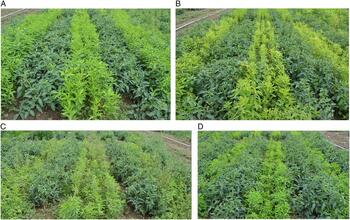
The herbicide treatments produced different living mulch–weed–crop interactions (Figure 5A–D). Despite herbicide applications, living mulch growth in some treatments was similar to that in the untreated check. At the end of the 2015 season, living mulch in metribuzin fb halosulfuron plots was 131-cm tall, while the living mulch in the untreated check was 121-cm tall (Figure 4B). In this herbicide treatment, living mulch biomass was 2800 kg ha−1 compared with 2700 kg ha−1 in the untreated check. In metribuzin fb halosulfuron plots, these two herbicides had only weak POST activity on sunn hemp and likely more severely affected the weeds, which were generally smaller than the living mulch at the time of both applications.
Photographs of one plot each of the four herbicide treatments used in the living mulch (sunn hemp) trial in fresh market field tomato (‘Mountain Fresh’) during 2016 (June to September) at Freeville, NY, USA. Three rows of living mulch (23-cm row spacing) were planted in the middle of adjacent tomato rows (122-cm row spacing and 46-cm plant-to-plant spacing). First herbicide application was made approximately 25 d after living mulch emergence (at about 75% soil cover), which was approximately 20 d after tomato (4-wk-old seedlings) transplanting; second application was made approximately 15 d later. Herbicide treatments and rates: metribuzin fb halosulfuron (Figure 5A) (0.1 and 0.05 kg ai ha−1, respectively); metribuzin fb rimsulfuron (Figure 5B) (0.1 and 0.007 kg ai ha−1, respectively); fomesafen fb metribuzin (Figure 5C) (0.012 and 0.15 kg ai ha−1, respectively); rimsulfuron fb metribuzin (Figure 5D) (0.007 and 0.15 kg ai ha−1, respectively). Abbreviation: fb, followed by (in a sequential application).

In living mulch systems, the ability of management techniques to maintain living mulch cover and stand density (as in the case of metribuzin fb rimsulfuron in 2016) is vital for achieving acceptable yields as well as providing valuable ecosystem services. Living mulch height in metribuzin fb rimsulfuron plots at the start of tomato harvest was reduced to 85 and 81 cm in 2015 and 2016, respectively, compared with 114- and 116-cm-tall living mulch in corresponding untreated checks (Tables 2 and 3; Figure 4A and B). However, stand density of the living mulch in this treatment and the soil cover it provided were comparable to those in the untreated living mulch in both 2015 and 2016 (Tables 2 and 3). In contrast, greater reduction in living mulch height by the fomesafen fb metribuzin and rimsulfuron fb metribuzin treatments was associated with considerable reduction in soil cover and living mulch density, leading to poor weed suppression. Previous living mulch studies have also reported that excessive damage from herbicides and low living mulch stand density generally result in high weed pressure (Brainard and Bellinder Reference Brainard and Bellinder2004; Hartwig Reference Hartwig1977; Hughes and Sweet Reference Hughes and Sweet1979).
Herbicide combinations have been previously used to suppress living mulches (Cardina and Hartwig Reference Cardina and Hartwig1980; Hartwig Reference Hartwig1976, Reference Hartwig1977; Linscott and Hagin Reference Linscott and Hagin1975). However, these were usually applied in mixture through a single application. When designing our herbicide treatments, it was expected that an early/first application of a herbicide with greater POST activity would reduce living mulch–cash crop competition. The reason is that these herbicides would not only cause greater injury to the (young) living mulch (and emerged weeds), but would also result in a longer recovery time, thereby reducing competition with the crop, especially during early growth stages. However, weed suppression may be compromised due to the severe and extended loss in living mulch vigor and poor soil residual activity.
Alternatively, first application of a primarily PRE herbicide like metribuzin, with its POST activity enhanced by the surfactant, would affect the living mulch, but not too severely, prompting faster recovery from herbicide injury. The difference in size between the living mulch and the weeds at the time of the first set of herbicide applications may influence these outcomes. In our trials, the living mulch emerged earlier than the weeds and was approximately 20-cm tall at the time of weed emergence. So the first herbicide application likely injured the weeds more than the living mulches. Because living mulch cover, especially in the area near the tomato row, was not complete at this time, enough herbicide must have made its way in gaps in the living mulch canopy to injure the weeds below. Moreover, metribuzin would have the additional benefit of residual soil activity, thereby negatively impacting weed emergence and establishment. Following an application of metribuzin, a second application of a herbicide with primarily POST activity is also likely to affect the living mulch less than the weeds due to the larger size of the living mulch at the time of the second application. However, one disadvantage of this herbicide sequence is that competition between the living mulch and cash crop is likely to be more intense, possibly decreasing crop yield. These differences were especially pronounced in 2016, when treatments with a first application of metribuzin provided more consistent soil cover by the living mulch as well as lower average weed cover (Table 3; Figures 4A, 5A, and 6). The disparity between these two sets of treatments in 2016 may be due to increased stress on the entire system from drought conditions, while in 2015, differences were likely mitigated by abundant rainfall, which also allowed faster recovery from herbicide injury.
Photograph of a metribuzin fb halosulfuron (0.1 and 0.05 kg ai ha−1, respectively) treatment plot in the living mulch (sunn hemp) trial in fresh market field tomato (‘Mountain Fresh’) during 2016 (June to September) at Freeville, NY, USA, illustrating the soil surface below the living mulch canopy. Three rows of living mulch (23-cm row spacing) were planted in the middle of adjacent tomato rows (122-cm row spacing and 46-cm plant-to-plant spacing). First herbicide application was made approximately 25 d after living mulch emergence (at about 75% soil cover), which was approximately 20 d after tomato (4-wk-old seedlings) transplanting; second application was made approximately 15 d later. Abbreviation: fb, followed by (in a sequential application).

In 2016, all herbicide treatments had lower weed density (P = 0.0016) and lower weed biomass (P = 0.0001) than the weedy check (Table 3). However, for the untreated check, while weed density was similar to that of both the weedy check and the herbicide treatments, weed biomass was similar only to that of the herbicide treatments and lower than in the weedy check. This suggests that living mulches may require herbicides to reduce weed density but are capable of directly reducing weed biomass in a dry year. Because living mulch biomass and density during both years were similar, the dry conditions experienced in 2016 compared with the wet conditions in 2015, likely enhanced the competitive effects of the living mulch on weeds. The absence of a correlation between weed biomass and living mulch biomass in both 2015 (P = 0.36) and 2016 (P = 0.75) may appear to contradict these results. However, a possible explanation is that, although living mulches may have an inherent capacity to suppress weeds, in a living mulch system where living mulch vigor has to be reduced to a level that precludes any adverse effects on crop growth, herbicides may be required to adequately control weeds.
In 2016, the untreated living mulch check (2100 kg ha−1) reduced weed biomass by 76% compared with the weedy check (Table 3). Overall, herbicide treatments reduced weed biomass by 78% to 97%. Therefore, the addition of herbicides to the living mulch decreased weed biomass by up to 21%. During the same year, metribuzin fb rimsulfuron (9%) and metribuzin fb halosulfuron (4%) treatments reduced weed cover by 91% to 96% compared with the weedy check (98%). The untreated check reduced weed cover by 81%. This increase in weed suppression with the addition of herbicide applications may be important for reducing weed seed production.
Our study demonstrates that living mulch–herbicide systems in temperate regions such as the northeastern United States can be a promising approach to diverse and sustainable systems for wide-row crops such as fresh market field tomato and may provide accompanying soil health benefits. Tillage was reduced, as no interrow tillage was performed after living mulch species and tomatoes were planted. PRE herbicides were not used in our trials, nor were additional fertilizers to compensate for the presence of the living mulch. The economics of such a system is one area that requires further investigation. However, the goals behind adoption of such living mulch systems may have to go beyond the desire to attain a given crop yield to encompass accepting compromises in yield in the interest of long-term sustainability.
Through this study, a more in-depth understanding was gained of how several important factors may impact living mulch–cropping systems. These include (1) adequate soil moisture may be necessary to prevent living mulches from decreasing crop yield; (2) herbicides may be required for adequate weed control; (3) herbicide treatments must adequately reduce living mulch height; and (4) herbicide type, rate, and application timing are key factors that may be manipulated to favor crop yield and weed control. Thus, in any living mulch–cropping system, there are factors that can be manipulated so that herbicide inputs are reduced and weeds are disproportionately more negatively affected than the living mulch. Once these factors are determined, it is important that the herbicide rates used are based on achieving adequate weed control and not on attaining a target living mulch biomass, because even vigorous living mulch stands can be unreliable in weed control and are therefore poor predictors of crop yield. However, wider adoption of tropical and subtropical annual species as living mulches in temperate vegetable cropping systems requires further study to establish broader guidelines for use. Additional research is needed to assess how factors such as crop type, planting pattern, living mulch species, and herbicides, rates, and application timings affect crop yield and ecosystem benefits.
Acknowledgments
We thank Peter Putriment, Rebecca Wilk, Steve McKay, Rick Randolph, and Ethan Tilebein for their assistance in the experiment. We acknowledge the helpful suggestions from Robert Nurse and two anonymous reviewers for improving earlier versions of this article. This project was supported in part by a grant from the Northeastern Sustainable Agriculture Research and Education (NE-SARE, award no. GNE15-095). No conflicts of interest have been declared.