

INTRODUCTION
Sparse data on local radiocarbon (14C) reservoir offsets hampers paleo-studies around the North Pacific Rim (Dumond and Griffin Reference Dumond and Griffin2002; Fitzhugh et al. Reference Fitzhugh, Shubin, Tezuka, Ishizuka and Mandryk2002; Corbett et al. Reference Corbett, West and Lefèvre2010). For many records, marine samples are the most readily available organics for chronological estimation. Here we provide estimates of the late Holocene reservoir offset (Delta R; ΔR) for two locations in the northern and central Kuril Islands (Rasshua and Makanrushi Islands), based on paired marine and terrestrial samples from archaeological sites in these areas. These estimates quantify the systematic difference between the 14C ages observed for locally collected marine samples and those expected if the global average marine reservoir prevailed locally (Stuiver and Braziunas 1993; Bronk Ramsey Reference Bronk Ramsey2009b:1023–1024, 1038–1039). We also compare the new Kuril ΔR estimates to published estimates from around the North Pacific Rim to evaluate the hypothesis that shared oceanographic conditions result in comparable reservoir offsets in this broader region.
SAMPLES
Archaeological surveys of the Kuril Islands were conducted as part of the interdisciplinary Kuril Biocomplexity Project (KBP) (Fitzhugh Reference Fitzhugh2012; Fitzhugh et al. Reference Fitzhugh, Gjesfjeld, Brown, Hudson and Shaw2016). Each summer from 2006 to 2008 and again in 2010, participants traveled to the remote Kurils by ship from Karsakov, Sakhalin Island to sample archaeological deposits and collect other data on Kuril paleoenvironments. By the end of the project, 69 archaeological sites were documented from the 16 largest islands. In the course of the project, fauna, charcoal, and artifacts were collected from stratified deposits for subsequent analysis.
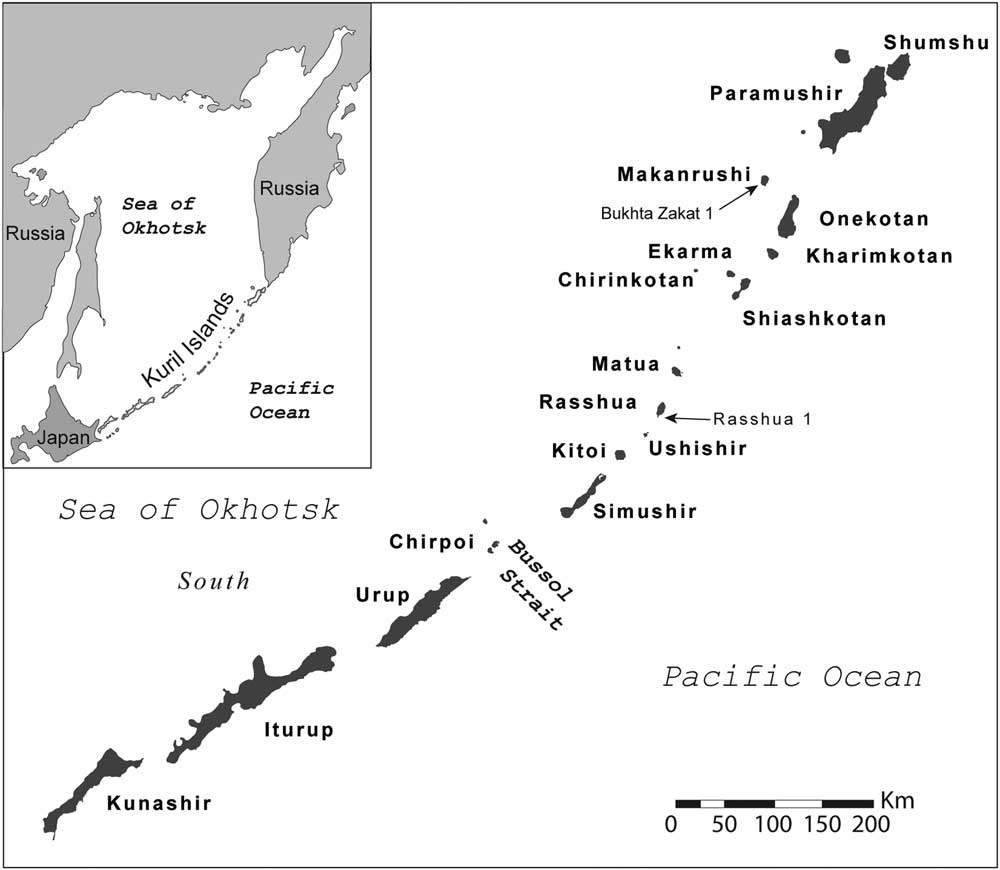
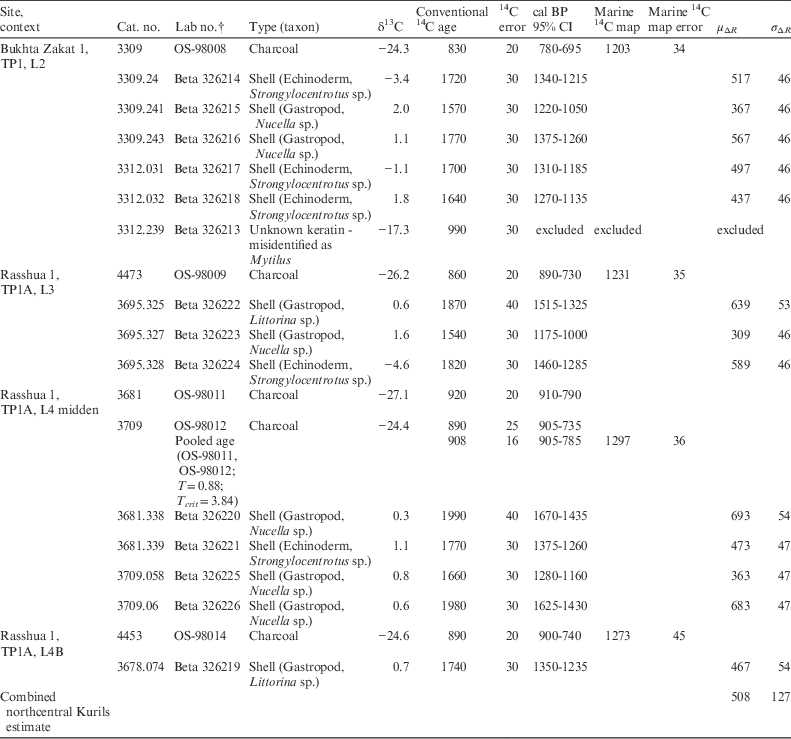
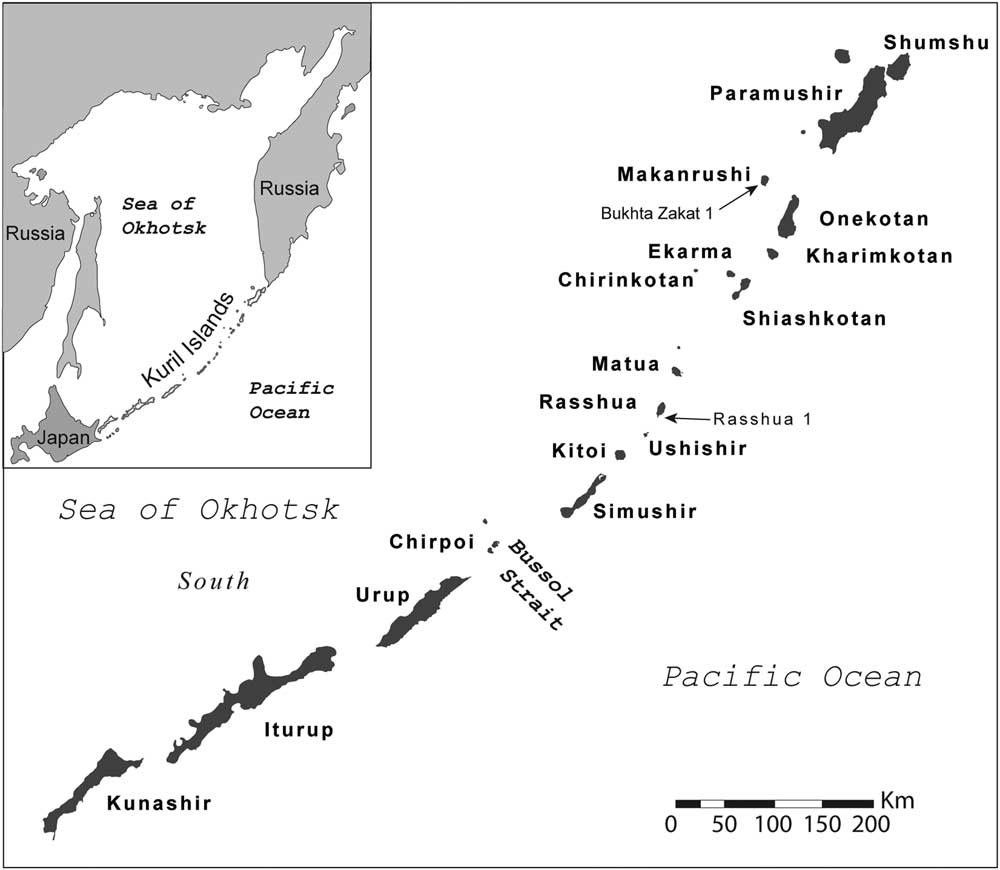
The team collected the samples used for this reservoir study in 2008 from isolated stratigraphic units in test excavations at the sites of Bukhta Zakat 1 (Makanrushi Island) and Rasshua 1 (Rasshua Island) (Figure 1). The relevant layers were deposited by people of the Okhotsk Culture, a group that colonized the Kuril chain in about the 8th century CE (Fitzhugh et al. Reference Fitzhugh, Gjesfjeld, Brown, Hudson and Shaw2016). Our samples come from a single midden layer at Bukhta Zakat 1 with a charcoal date of 830±20 BP (OS-98008), and three successive stratigraphic layers at Rasshua 1 with charcoal 14C ages of 860±20 BP (L3: OS-98009), 920±20 and 890±25 BP (L4: OS-98011 and OS-98012), and 890±20 (L4B: OS-98014) (Table 1). To derive local reservoir estimates, we dated marine shell samples derived from subtidal, near-shore gastropods (periwinkle and whelks) and echinoderms (urchins) that were collected from the same archaeological contexts as these charcoal samples (Table 1).
Map of the Kuril Islands showing the locations of archaeological sites Rasshua 1 and Bukhta Zakat 1.
Radiocarbon dates of and ΔR estimates from marine and terrestrial samples obtained from archaeological sites in the north-central Kuril Islands. Calibrated ages are uncorrected to local reservoir and are provided to show the differences between the terrestrial and uncorrected marine calendar ages.

† Following physical pre-cleaning of dirt and visible roots in Fitzhugh’s University of Washington archaeology lab, all charcoal samples for the KBP project were processed at the NOSAMS facility at Woods Hole under the federal government rate. After cleaning, marine samples reported here were submitted to Beta Analytic, Inc., which offered a higher level of preprocessing and assistance in sample evaluation.
Ideally, 14C reservoir estimation is calculated using marine samples of known calendric age (Stuiver and Braziunas Reference Stuiver and Braziunas1993). In the case of prehistoric archaeological samples, calendric age must be estimated independently of the marine sample, typically through the dating of associated non-marine samples (Ulm Reference Ulm2006; Khasanov et al. Reference Khasanov, Nakamura, Okuno, Gorlova, Krylovitch, West, Hatfield and Savinetsky2015). In the absence of more precise calendric age estimators (e.g., based on dendrochronology), 14C dates from terrestrial organics provide the best available calendric timestamps. Materials from local and short-lived plant components (seeds, twigs, etc.) or animals with terrestrial diets are preferred when available. Lacking such short-lived plant specimens and with only samples of terrestrial animals of uncertain proportions of marine foods in their diets, here we use archaeological wood charcoal to provide terrestrial/atmospheric timestamps.
Wood charcoal dates from coastal archaeological samples are subject to two complications potentially affecting their use for marine reservoir calibration. Both relate to the “old wood” problem (Schiffer Reference Schiffer1986). In the case discussed here, the lesser source of bias derives from the common use of driftwood for fueling fires in the tree-deprived islands of the subarctic North Pacific. In places like the remote Kurils, with few indigenous trees, preindustrial occupants relied on driftwood for much of their wood and fuel (Shaw Reference Shaw2008). Identification of charcoal samples from archaeological sites on three Kuril islands (Rasshua, Simushir, and Urup Islands) found that the majority of wood fuels derived from non-local taxa (especially Larix, Picea), while a smaller proportion could have come from local sources (Pinus, Salix, Alnus) (Reference ShawShaw, online report; Fitzhugh et al. Reference Fitzhugh, Gjesfjeld, Brown, Hudson and Shaw2016). Driftwood is unlikely to float in the North Pacific for more than a year and a half (Häggblom Reference Häggblom1982: Table 1; Shaw Reference Shaw2008:80–81), and degradation of wood is rapid in the wet North Pacific—rendering beached drift logs ineffective fuel sources in only a few years (Shaw Reference Shaw2008). We take this to be sufficient evidence to rule out a significant driftwood bias (Fitzhugh et al. Reference Fitzhugh, Gjesfjeld, Brown, Hudson and Shaw2016).
An additional concern is the potential for dating old wood from the inner rings of long-lived trees. This is a standard problem for 14C analysis of fragmentary wood-derived carbon that is recognized but frequently ignored in archaeological dating of anthropogenic charcoal. Reference ShawShaw (online report) estimates that the taxa forming the charcoal assemblages in the Kurils had lifespans averaging 100–150 yr. Given that the volume of wood added to a typical tree every year increases geometrically with age (as height and girth increase through life), we suspect that a random sample of charcoal from a burned tree would tend to result in a preponderance of dates close to the death age of the tree with diminishing frequency of older dated samples as sampling moves towards the core wood. Additional factors, such as the way wood may have been burned (as whole logs, or split) are complicating factors. Here, we simply acknowledge the uncontrolled—but we propose limited—uncertainty associated with our use of archaeological charcoal to anchor the terrestrial component of the marine reservoir estimation to the calendric timeline. We note that old-wood dates should have the effect of reducing the apparent reservoir/ΔR estimate. This might lead one to consider larger ΔR estimates within sets of such estimates for a given study area as the more likely representatives of the local reservoir offsets compared to smaller ones calculated for the same atmospheric age and location.
We acknowledge one additional source of uncertainty. Archaeological samples are inherently vulnerable to imprecision or outright errors of association, arising from the nature of deposition and “mixing” of archaeological deposits. Thus, while the samples selected for this study come from seemingly intact deposits and were collected in proximity to each other within these deposits, nevertheless, even intact archaeological deposits accumulate over some time interval, and even rapidly accumulated deposits can be subjected to anthropogenic and natural disturbances. We take heart from the general consistency in the charcoal dates, suggesting rapid accumulation of the three targeted layers of the Rasshua 1 site. Even so, some of the scatter in shell dates reported below is likely due to deposit mixing. Our methods explicitly address this problem.
METHODS
The charcoal dates reported in Table 1 are part of an archipelago-wide analysis of archaeological settlement and an effort to derive a paleodemographic proxy model for human occupation (Fitzhugh et al. Reference Fitzhugh, Gjesfjeld, Brown, Hudson and Shaw2016). For the purposes of this study, we dated 13 marine shells including echninoderms or sea urchins of the Strongylocentrotus genus, gastropods in the Nucella and Littorina genera. We also dated an unknown tissue sample originally identified as a Mytilis (mussel) periostracum. Samples were chosen based on their archaeological association with previously dated terrestrial (charcoal) samples. 14C dates from the paired terrestrial and marine samples are reported in Table 1, with the exception of the keratin sample that was a clear outlier and eliminated from subsequent analysis.
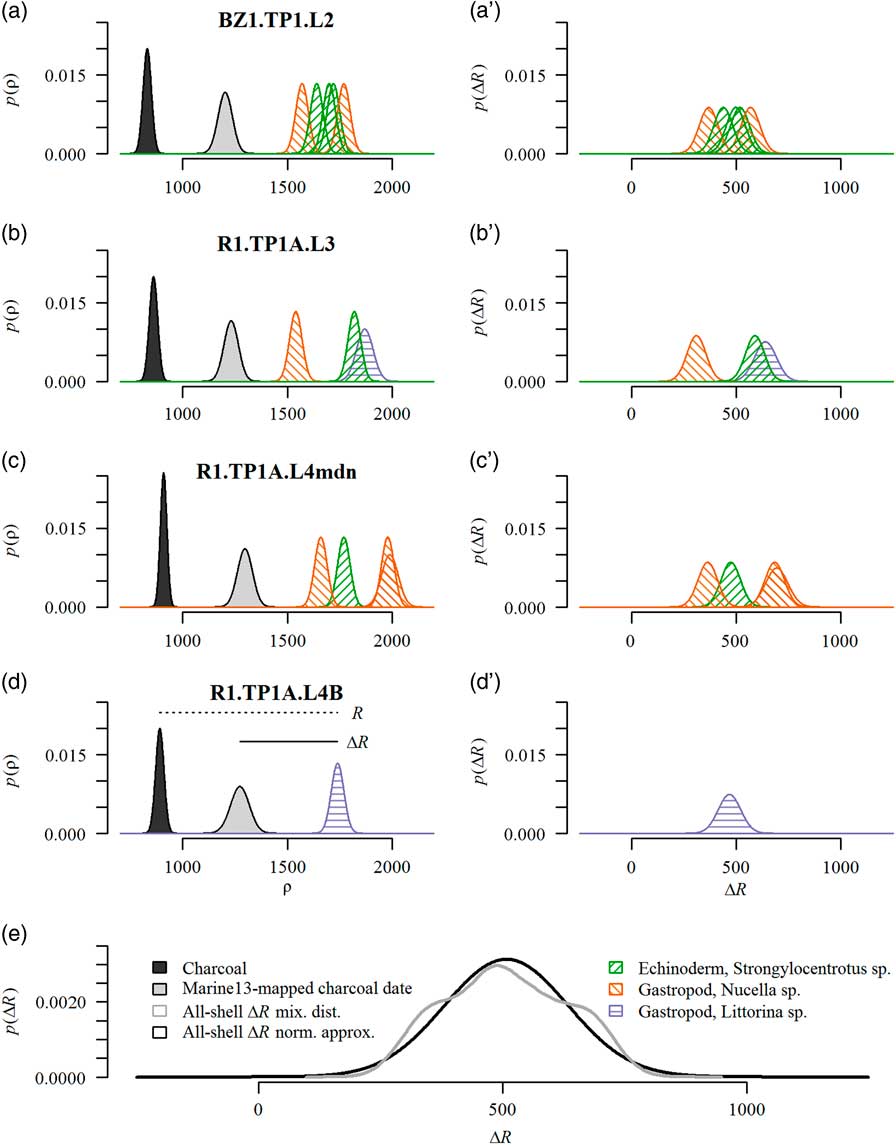
To estimate ΔR from our assemblage of shell specimens, we paired each shell (n=13) with a 14C-dated charcoal specimen recovered from the same stratigraphic context (Table 1, Figure 2a–d: black and striped polygons). The charcoal date used for the Rasshua 1, TP1A, L4 midden assemblage is a pooled date comprising two dated specimens, combined following the Ward-Wilson Case I test and pooling protocol (Ward and Wilson Reference Ward and Wilson1978).
Stratum-specific assemblages of probability distributions describing (left column: a–d) estimated 14C ages (ρ) and (right column: a’–d’) derived ∆R, based on conventional or pooled 14C ages for charcoal and shell specimens (black-filled and texture-filled curves, respectively) for north-central Kuril archaeological contexts. (a, a’) Bukhta Zakat Test Pit 1 Level 2; (b, b’) Rasshua 1 Test Pit 1A Level 3; (c, c’) Rasshua 1 Test Pit 1A Level 4midden; and (d, d’) Rasshua 1 Test Pit 1A Level 4B. Left column (a–d): gray filled curves describe predictive distributions of marine 14C ages derived by mapping calibrated charcoal age estimates back onto the 14C age axis through the Marine13 curve. Dashed and solid lines in panel (d) visually illustrate the calculation of reservoir offsets (R and ∆R) as the difference between the conventional 14C age of a single shell and conventional or pooled 14C age for the charcoal (dashed line) or between the conventional 14C age of the shell and the charcoal-based predictive distribution (dotted line). Right columns (panels a’–d’) describe the individual-shell ∆R estimates (x-axis is ∆R, with midden strata divided across panels). The bottom panel (e) provides an overlay plot of the combined probabilities for each stratigraphic context, illustrating the aggregate estimate of ∆R, based on the mixture distribution (gray line) and its normal approximation (black line) described in the “Methods” section.

To generate a probabilistic estimate of ΔR for each individual charcoal-shell pair, we used a Monte Carlo (MC) simulation approach, which allowed us to identify the mean and standard deviation (
 $\hat{\mu }_{{\Delta R,i}} $
and
 $\hat{\sigma }_{{\Delta R,i}} $
) of a normal distribution over the domain of the estimand ΔR (Table 1 and Figure 2a′–d′). This simulation involved (a) calibrating the charcoal date using the IntCal13 calibration curve (Reimer et al. Reference Reimer, Bard, Bayliss, Beck, Blackwell, Bronk Ramsey, Buck, Cheng, Edwards, Friedrich, Grootes, Guilderson, Haflidason, Hajdas, Hatté, Heaton, Hoffmann, Hogg, Hughen, Kaiser, Kromer, Manning, Niu, Reimer, Richards, Scott, Southon, Staff, Turney and van der Plicht2013), assuming a uniform prior distribution (Bronk Ramsey Reference Bronk Ramsey2009a: 342); (b) stochastically mapping the calibrated date back onto the 14C domain through the Marine13 model (Reimer et al. Reference Reimer, Bard, Bayliss, Beck, Blackwell, Bronk Ramsey, Buck, Cheng, Edwards, Friedrich, Grootes, Guilderson, Haflidason, Hajdas, Hatté, Heaton, Hoffmann, Hogg, Hughen, Kaiser, Kromer, Manning, Niu, Reimer, Richards, Scott, Southon, Staff, Turney and van der Plicht2013; Figure 2a–d, gray polygons); and (c) comparing this map to the paired shell age (e.g., solid line in Figure 2d). Comparison between individual-shell estimates (Table 1 and Figure 2a′–d′) give conflicting estimates of ΔR (i.e., minimal overlap between some shells’ ΔR distributions), suggesting that some of the charcoal-shell pairings are spurious. Identifying or otherwise managing the potential presence of outliers in this case is neither theoretically nor computationally trivial (cf. Bronk Ramsey Reference Bronk Ramsey2009b:1024–1028), and given our modest sample size and lack of independent information about the calendric ages of the shell specimens, we did not attempt to fit an outlier model to the data. Instead, we simply assumed that (1) the densest concentration of individual-shell ΔR
i
estimates approximates the true value of ΔR and (2) the inclusion of outliers has not significantly biased the aggregate result. In this case, the mean and standard deviation of the distribution of all ΔR
i
estimates should provide a useful and reliable estimate of ΔR. To calculate these parameters, we approximated a mixture distribution comprising all individual-shell ΔR
i
estimates through MC estimation (gray curve in Figure 2, bottom panel), then calculated the mean and standard deviation of this mixture distribution to derive a normal approximation (black curve in Figure 2, bottom panel).
Finally, to compare our estimate of ΔR for the northcentral Kuril archipelago against those estimated for other locales spanning the North Pacific Rim, we collated published ΔR i estimates from across this region. A pan-North Pacific estimate was calculated in the same manner as the aggregate Kuril estimate, as well as ΔR estimates stratified by tropical/temperate versus subarctic waters.
All computation was performed using the R programming language (R Core Team 2017). Greater technical detail regarding our MC simulation procedures are provided in the Supplement Appendix I.
RESULTS
ΔR estimates from individual charcoal-shell pairs collected on Rasshua and Makanrushi Islands vary between 309 and 693 yr, with standard deviations between 46 and 54 yr (Table 1). Both islands are situated in the same oceanographic province, hundreds of km from mainland hydrological inputs and at the confluence of the Kamchatka-Oyashio current and the Okhotsk Gyre. While regional 14C reservoirs can vary through time in response to changes in supply of 14C-depleted or “old” carbon relative to 14C-enriched, “new” carbon (Ingram and Southon Reference Ingram and Southon1996; Deo et al. Reference Deo, Stone and Stein2004), we believe temporal consistency in reservoir (a strong but standard assumption underlying the ΔR correction strategy; Stuiver and Braziunas Reference Stuiver and Braziunas1993; Jones and Nicholls Reference Jones and Nicholls2001; Bronk Ramsey Reference Bronk Ramsey2009b) is supported at least for the narrow range of ages we are working within (within 200 years) but cannot be extrapolated more generally from these data alone. In any case, accepting the general consistency between whole-assemblage and whole-site ΔR estimates (Figure 2e) we propose that the pooled inter-site ΔR estimate of 508±127 yr provides a reasonable correction term for the calibration of marine 14C dates throughout the central and northern Kuril Islands.
DISCUSSION
Differences in marine reservoirs from the atmospheric 14C curve (R; see Figure 2d, dotted line; Stuiver and Braziunas Reference Stuiver and Braziunas1993) are driven by variability in the supply of waters with different carbon residence times. Active-layer carbon geochemistry is influenced by freshwater inputs and the relative supply of long-residence abyssal waters through upwelling/deep mixing. North Pacific sources of marine bicarbonate derive from freshwater input (e.g., around the margins of the Gulf of Alaska, Yukon-Kuskokwim Delta, and the eastern Bering Sea and the Amur River), upwelling of nutrient-rich abyssal water (in the North Pacific Subarctic Gyre: Broecker Reference Broecker1991; Kiefer et al. 2001:86) and strong tidal mixing (especially in the shallower passes of the Aleutian and Kuril Islands: Nakamura et al. Reference Nakamura, Awaji, Hatayama, Akitomo and Takizawa2000; Hunt and Stabeno Reference Hunt and Stabeno2005). High freshwater inputs in the interior passes of the Eastern Gulf of Alaska and Straits of Georgia appear to have relatively high inputs of “old carbon,” perhaps from the erosion of carbon sinks upstream. This water enters the Alaska Current and mixes with abyssal waters through upwelling, tidal flux, and the action of mesoscale eddies over a relatively shallow halocline. These different sources and processes should lead to spatial variability in reservoir offsets (Mangerud Reference Mangerud1972). Until recently, ΔR estimations were of insufficient coverage to begin mapping North Pacific marine reservoir variability. With the analyses reported here and published data from around the North Pacific, we can begin to consider reservoir variability synoptically in relation to North Pacific geography and oceanography.
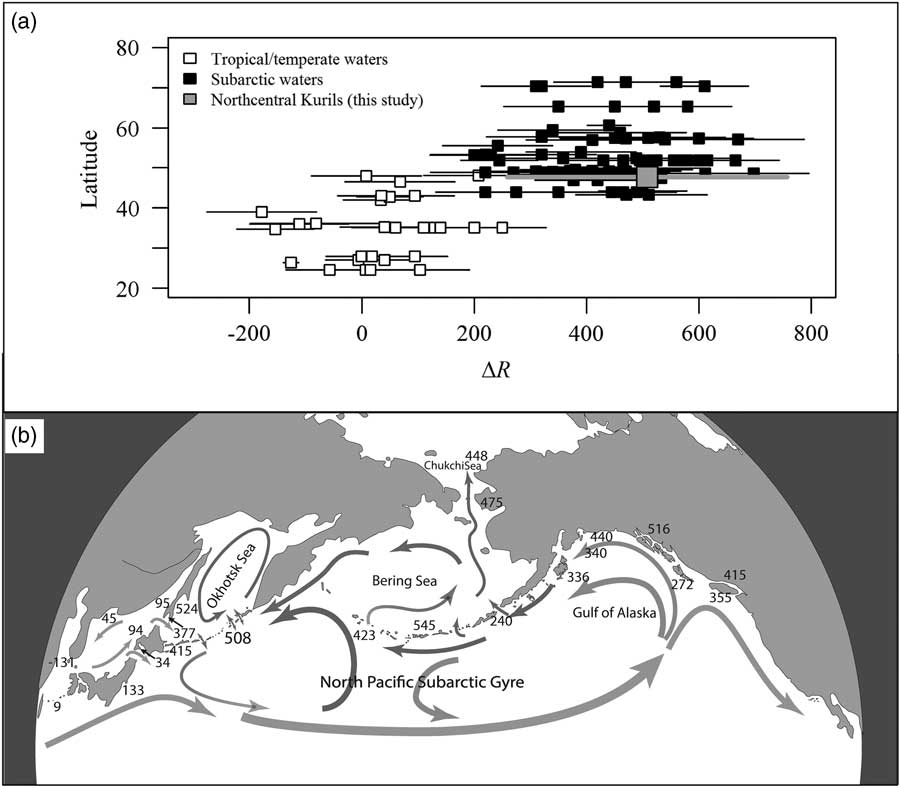
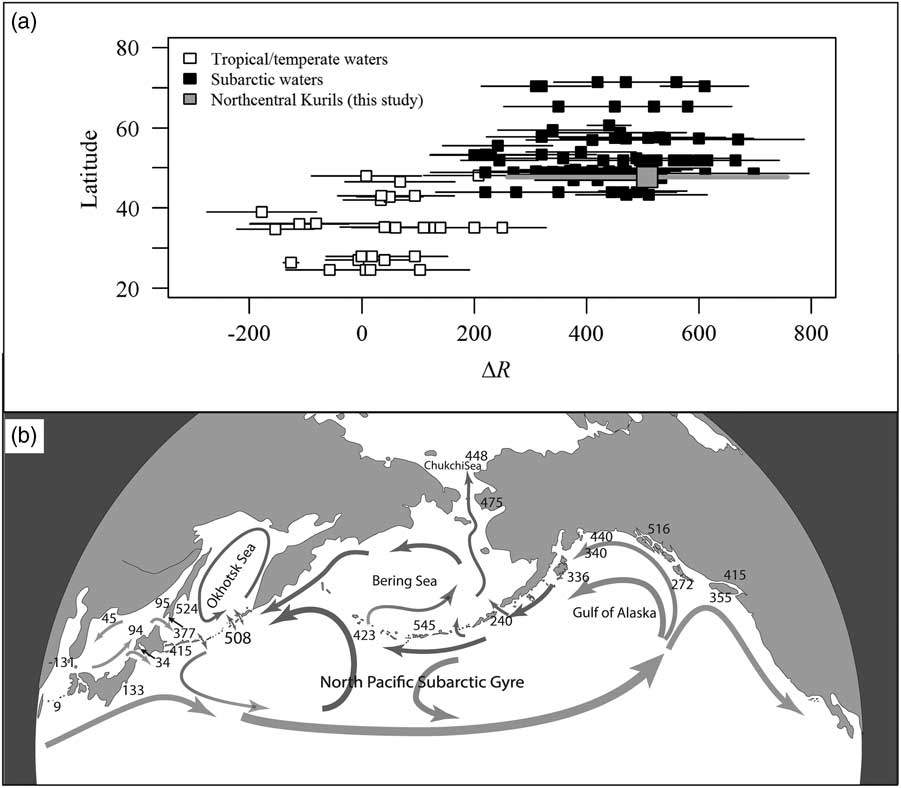
Figure 3 and Supplement Appendix II summarize available ΔR estimates from around the North Pacific Subarctic Gyre and along the mid-latitude Western Pacific based on data from the global marine database in Calib (Reimer et al. Reference Reimer, Bard, Bayliss, Beck, Blackwell, Bronk Ramsey, Buck, Cheng, Edwards, Friedrich, Grootes, Guilderson, Haflidason, Hajdas, Hatté, Heaton, Hoffmann, Hogg, Hughen, Kaiser, Kromer, Manning, Niu, Reimer, Richards, Scott, Southon, Staff, Turney and van der Plicht2013). While data remain sparse across the central North Pacific basin, ΔR estimates are consistently large (440±127 yr; +191 to +689 yr at the 1.96σ range) from British Columbia to the Sea of Okhotsk relative to those along the East Asian continental margin (35±111 yr; or –183 to + 253 yr at the 1.96σ range). As demonstrated in Figure 3, the subarctic samples have significantly larger ΔR values compared to those influenced by the tropical Kuroshio Current and freshwater influx from tropical-temperate East Asia. The break between these reservoirs falls at the oceanographic confluence of tropical and subarctic gyre waters around Hokkaido and southern Sakhalin. We note that the apparent latitudinal gradient in ΔR appears to dissolve when these ΔR estimates are disaggregated into oceanographically distinct clusters, though estimates from interior passes of the E. Gulf of Alaska tend to be older than adjacent outer regions, as noted above and as is seen in Figure 3b. The oceanic waters of the deep North Pacific, around the Aleutians and Kurils also appear somewhat older (larger ΔRs) than more continental areas, though this could still reflect the small sample size of oceanic estimates.
(a) Plot of ∆R estimates for locations spanning the North Pacific Rim, plotted against latitude. Distinction between tropical/temperate (open) and subarctic-water (solid black) sites are described in the text. The pooled north-central Kurils estimate reported in this study (in gray) falls clearly in the subarctic set. (b) Map of the subarctic North Pacific showing surface currents and mean ΔR values from this and previously published reservoir analyses (see Supplement Appendix II for dates summarized here and their source references).
Most of the reported North Pacific ΔR estimates summarized here are derived from marine shells, although two of the western Aleutian ΔR estimates (Buldir Island) are based on grass-pinniped bone pairs (Corbett et al. Reference Corbett, West and Lefèvre2010:199). While sea mammal bone can be unreliable due to the wide roaming patterns of some taxa (Dumond and Griffin Reference Dumond and Griffin2002), Buldir (and the Aleutians more generally) is centrally located in the 14C-depleted North Pacific Subarctic Gyre region. The similarity of the Buldir ΔRs with those derived from shell-charcoal pairs on Adak (central Aleutians; Khasanov et al. Reference Khasanov, Nakamura, Okuno, Gorlova, Krylovitch, West, Hatfield and Savinetsky2015) and Kurils (and across the Okhotsk Sea), Gulf of Alaska, Bering, and Chukchi Seas suggest that these animals likely remained within this pool of “old water” through their lives and may be considered reliable representatives of the regional reservoir.
Based on currently available evidence, we posit that the bicarbonate concentration of the North Pacific subarctic system—including waters of the North Pacific Subarctic Gyre and derivative waters of the Bering, Chukchi, and Okhotsk seas (with exception of inner waterways and estuaries)—are characterized by a well-mixed, high-ΔR active layer. Presumably the supply of “old carbon” comes from freshwater runoff in the E. Gulf of Alaska and the upwelling of abyssal currents terminating in the subarctic gyre, and the large ΔR values reported imply relatively low atmospheric/terrestrial carbon inputs from surface exchange. The large range of individual estimates suggests some combination of meso- to micro-scale spatial variability, possibly over short time-scales, and imprecision in the temporal association of dated terrestrial and marine samples used to estimate those offsets (especially for those derived from prehistoric samples). Taking this uncontrolled variability into consideration in our pooled estimates, we suggest that marine calibration correction for shell (and perhaps annually resident marine mammal) samples from around the North Pacific Subarctic Gyre can apply ΔR corrections of 440±127 yr. This estimate can be improved in the future with new marine-terrestrial paired date comparisons covering a greater temporal range and at more locations throughout the region, but especially the Aleutians and western Bering Sea.
Some of the scatter in ΔR estimates of individual charcoal-shell pairs in the larger North Pacific data may reflect short-term (sub-centennial to sub-annual) variability in the concentration of 14C concentrations incorporated into shells. We expect seasonal and inter-annual variability in more continental/estuarine settings, where local, high-amplitude fluctuations in precipitation and upwelling should more often diverge from better mixed open ocean regions. Given the oceanic setting of the Kuril sampling locations, variability in carbon sources—if underlying the observed variability at all—should more plausibly relate to decadal scale climatically forced shifts in the upwelling of North Pacific deep water and the supply of freshwater at the basin scale. Decadal-scale oscillations are reported in the 20th–21st century Aleutian Low pressure system that are believed to drive physical and biological regimes in sea surface temperature, velocity of the North Pacific gyre, associated upwelling, ecological productivity, and the structure of marine ecosystems (Beamish and Bouillon Reference Beamish and Bouillon1993; Beamish et al. Reference Beamish, Neville and Cass1997; Mantua et al. Reference Mantua, Hare, Zhang, Wallace and Francis1997; Hare et al. Reference Hare, Mantua and Francis1999; Stabeno et al. Reference Stabeno, Bond, Hermann, Kachel, Mordy and Overland2004; Di Lorenzo et al. Reference Di Lorenzo, Schneider, Cobb, Franks, Chhak, Miller and Rivière2008; Linkin and Nigam Reference Linkin and Nigam2008; Overland et al. Reference Overland, Alheit, Bakun, Hurrell, Mackas and Miller2010). Associated changes in precipitation on the continental margins of the North Pacific would additionally alter the proportion of “fresh” to “reservoir” carbon available to shell growth (see Rodionov et al. Reference Rodionov, Bond and Overland2007; Tachibana et al. Reference Tachibana, Oshima and Ogi2008; Nishioka et al. Reference Nishioka, Mitsudera, Yasuda, Liu, Nakatsuka and Volkov2014). Resolution is not possible from the study presented here and indeed would require higher-precision dating methods. Nevertheless, this topic would make an interesting future study in coupled atmosphere-ocean variability, possibly combining paleo-proxy data and dynamic modeling.
CONCLUSION
ΔR estimates from the central and northern Kuril Islands are derived from 14C dated archaeological charcoal and marine (shell) pairs. A pooled ΔR estimate, incorporating information from both a central and a northern site in the Kurils, suggests a north-central Kuril offset of approximately 508±127 yr.
This estimate is shown to be comparable to similar estimates from other regions of the North Pacific Subarctic Gyre and oceanographically derivative regions of the Bering, Chukchi and Okhotsk seas. This suggests that subarctic waters of the North Pacific are disproportionately influenced by waters deplete in 14C, presumably from abyssal sources entering the mixed layer after residence of nearly 1000 years at depth. Overall similarity in averaged ΔRs throughout this region, compared to much lower ΔRs in more temperate and tropical areas along the East Asian margin (see Figure 3), suggests that marine calibrations across the subarctic North Pacific could reasonably adopt ΔR corrections for marine calibrations on the order of 440±127 years. With the possible exception of the interior waterways of the North American Northwest Coast, there appears little reason to use more localized corrections given uncertain reliability of estimates from small samples.
ACKNOWLEDGMENTS
The research reported here was financially supported by the U.S. National Science Foundation (0508109; 1202879). Project administrative support came from the UW Center for Studies in Demography and Ecology (CSDE), with funding from a Eunice Kennedy Shriver National Institute of Child Health and Human Development (NICHD) research infrastructure grant, R24 HD042828. Mike Etnier conducted taxonomic identification of KBP faunas, helped select the shell samples for this analysis and consulted about the anomalous keratin data and δ13C variability. John Southon provided early clarification on procedures for ΔR estimation. John Stone gave useful advice on methods for ΔR error derivation. The manuscript was revised significantly—we hope for the better—as a result of insightful feedback from three anonymous reviewers and the editor. Naturally, we take full responsibility for any remaining flaws in the paper.
SUPPLEMENTARY MATERIAL
For supplementary material/s referred to in this article, please visit https://doi.org/10.1017/RDC.2017.125