Introduction
Hyperacusis has been defined as ‘unusual tolerance to ordinary environmental sounds’ and, more pejoratively, as ‘consistently exaggerated or inappropriate responses to sounds that are neither threatening nor uncomfortably loud to a typical person’.Reference Baguley1 Hyperacusis is generally characterised by decreased sound tolerance and difficulty adjusting to sudden shifts in volume which may not evoke any such reaction in a normal listener. Hyperacusis can create a high level of discomfort, and may have a profound impact on a patient's life. Patients may try to avoid sounds by avoiding social interaction and noisy environments.
Tsschlassny coined the term ‘phonophobia’ to describe hypersensitivity to auditory stimuli. The term was defined as an abnormal discomfort for suprathreshold sounds that do not annoy healthy individuals.Reference Carmen2 At the time, the terms phonophobia and hyperacusis were used interchangeably. However, they are now used to designate different phenomena. Phonophobia (fear of sound) and misophonia (dislike of sound) may also accompany hyperacusis in extreme cases. Hyperacusis differs from the phenomenon of recruitment, in which the patient does not hear up to a certain level due to a cochlear hearing loss (caused by destruction of outer hair cells); after that level is reached, there is a rapid growth of perceived loudness in comparison to normal. In hyperacusis, low intensity sounds may also be uncomfortably loud, and there may be variation depending on the patient's mood.
Marriage and Barnes have distinguished between peripheral and central hyperacusis. They have stated that peripheral hyperacusis may be associated with abolition of the stapedial reflex following Bell's palsy, Ramsay Hunt syndrome, myasthenia gravis, perilymphatic fistula or Ménière's disease. In contrast, central hyperacusis is associated with migraine, depression, pyridoxine deficiency, benzodiazepine dependence, musicogenic epilepsy, Tay–Sachs disease, gangliosidosis type two, post-traumatic stress disorder, or chronic or post-viral fatigue syndrome. Furthermore, these authors have stated that the primary cause of central hyperacusis is related to 5-hydroxytryptamine (Serotonin-A hormone, also called 5-hydroxytryptamine, in the pineal gland blood platelets, the digestive tract, and the brain. Serotonin acts both as a chemical messenger that transmits nerve signals between nerve cells and that causes blood cells to narrow. Changes in serotonin levels in brain can alter the mood eg. medications that affect the action of serotonin are used to treat depression.) function.Reference Marriage and Barnes3
Hyperacusis is also seen in patients with tinnitus with or without hearing loss; however, it has been neglected and has not been properly addressed as a significant health issue.Reference Jasterboff and Jasterboff4 We attempted to address this issue in the case of a patient with hyperacusis and depression, with encouraging results.
Case report
A 22-year-old woman presented to the speech and hearing unit of our department of otolaryngology-head and neck surgery with the chief complaint of ‘increased sensitivity to sound and inability to tolerate sounds’.
The ENT examination was normal.
A detailed history was taken. There was no relevant history for hyperacusis, such as migraine, head injury or exposure to noise.
The patient did not report any recurrent episodes of otitis media with effusion. She was asked to fill in a hyperacusis test (a self-reporting, 12-item questionnaire) in order to subjectively score her hyperacusis.5 This questionnaire had a total possible score of 36 (and a maximum score per item of 3), with greater scores indicating greater difficulty; the cut-off value for hyperacusis diagnosis was 12. The patient obtained a score of 23, indicating that a moderate degree of hyperacusis could be suspected. The major findings of the hyperacusis test were difficulty with sudden loud noises and high-pitched sounds. The patient had been using ear protection (in the form of cotton balls) to muffle loud sounds, and attempted to avoid social gatherings.
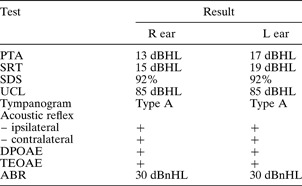
Detailed audiological testing was undertaken (Table I). Pure tone audiometry and speech audiometry revealed normal hearing, although the patient did show discomfort during suprathreshold speech discrimination score testing. Tympanometry and acoustic reflex testing showed a type A tympanogram with ipsilateral and contralateral reflexes present. Distortion product otoacoustic emissions and transient evoked otoacoustic emissions were present. Brainstem evoked response audiometry revealed waves present until 30 dBnHL.
Audiological findings

R = right; L = left; PTA = pure tone average for 0.5, 1 and 2 kHz; SRT = speech reception threshold; SDS = speech discrimination score; UCL = uncomfortable loudness level; += present; DPOAE = distortion product otoacoustic emissions; TEOAE = transient evoked otoacoustic emissions; ABR = auditory brainstem response
The patient had previously been diagnosed with depression by her general practitioner, and had complained of hyperacusis since the onset of her depression. Hence, she was also referred to our psychiatry department for detailed psychological assessment. A case history was obtained and the Hamilton psychiatric rating scale for depression administered. The patient was diagnosed with moderate depression. She was prescribed lithium, an antidepressant medication, as well as counselling.
Directive counselling was undertaken, with a focus on hyperacusis. The patient underwent four sessions of counselling over a two-week period. She was educated about the auditory system and the mechanism of hyperacusis. In addition, she was advised to avoid silence and overprotection of her ears, and to work in environments with low intensity background sounds so that she could be desensitised to her hyperacusis.
The patient reported back after three months. She reported suffering less depression and having less difficulty with sounds. The Hamilton psychiatric rating scale for depression was again administered, and the patient's scores were within normal limits. The patient also completed the hyperacusis test again; the score was 15, very close to normal. Testing of the patient's uncomfortable loudness level revealed a level of 100 dBHL for both ears. At this stage, the patient reported difficulty with sounds only during depressive episodes; at other times, she was thriving. She was asked to return for follow-up three months later, to monitor her hyperacusis (or earlier if she had any difficulty).
Discussion
Studies of platelet 5-HT transporter binding (serving as a model for 5-HT activity in the brain) have demonstrated that such binding is decreased in patients with depression. Research also suggests that virtually every known antidepressant drug functionally increases serotoninergic neurotransmission during long term treatment.Reference Owens and Nemeroff6
Thompson et al. have shown that 5-HT innervation of the neural system is capable of modulating primary sensory pathways.Reference Thompson, Thompson, Garrett and Britton7 Further research has shown that 5-HT has an inhibitory role in sensory modulation at a central level.Reference Marriage and Barnes3 In addition, a reduction in forebrain 5-HT activity is the most likely underlying pathology causing central hyperacusis.
Prince et al. suggested that lithium enhances 5-HT function. It has also been found to augment the efficacy of other antidepressants.Reference Prince, Charney, Delgado and Heninger8
• Hyperacusis may be described as a decreased threshold for discomfort from sound
• A case of hyperacusis associated with depression, with no other audiological abnormalities, is presented. The patient reported greater difficulty during the depressive episode
• Both depression and hyperacusis can be caused by 5-hydroxytryptamine (5-HT; also known as serotonin) hypoactivity in the brain
• Enhancement of 5-HT activity, due to lithium prescribed for depression, may also play a role in alleviating hyperacusis symptoms
These studies point towards a similar mechanism for both depression and hyperacusis, i.e. reduction in 5-HT activity in the brain, and indicate the effectiveness of lithium in enhancing 5-HT activity. We therefore speculate that a depression treatment regimen enhancing 5-HT activity (in our patient's case, lithium administration) may also help alleviate hyperacusis symptoms in individuals suffering from both depression and hyperacusis. This could explain the observed outcome in our patient. Directive counselling alone (without any tinnitus or hyperacusis retraining therapy) cannot account for the improvement reported by our patient, since desensitisation for hyperacusis could not have occurred on the basis of counselling alone.
We therefore suggest that further research on this topic should be pursued, with the aim of enhancing the management of central hyperacusis associated with disorders such as depression and migraine.