In a recent point-prevalence survey of healthcare-associated infections (HAIs) in the United States, HAI events fulfilling then-current National Healthcare Safety Network (NHSN) pneumonia (PNEU) and other lower respiratory infection (LRI) surveillance definitions comprised the most common group of HAIs identified.Reference Magill, Edwards and Bamberg 1 Although many HAI surveillance and prevention efforts for respiratory events have focused on device-associated infections, ie, ventilator-associated pneumonia (VAP), recent data show that only 30%–40% of NHSN-defined PNEU in adults are ventilator associated.Reference Magill, Edwards and Bamberg 1 – Reference Weber, Sickbert-Bennett, Brown and Rutala 3
In 2013, the NHSN transitioned from surveillance for VAP to surveillance for ventilator-associated events because of limitations of the traditional surveillance paradigm. Notably, some of the signs and symptoms used for VAP surveillance have been argued to be both non-specific and subjective in a mechanically ventilated patient population, thereby potentially including a significant proportion of patients who have noninfectious or even nonspecific pulmonary conditions.Reference Klompas and Platt 4 , Reference Klompas, Kulldroff and Platt 5 Moreover, the clinical diagnosis of VAP itself is subject to significant uncertainty.Reference Klompas and Platt 4 , Reference Meduri, Wunderink and Leeper 6 , Reference Klompas 7 Decisions to move away from VAP surveillance were due in part to the following limitations: lack of specificity (and hence correlation with clinical diagnosis) with the surveillance definition and difficulties with clinical diagnosis of VAP.Reference Magill, Klompas and Balk 8 , Reference Klompas 9
In contrast, comparable data, particularly regarding correlation between the surveillance definition and clinical conditions, are not available for the following: (1) NHSN surveillance definitions for PNEU in adults not receiving mechanical ventilation; (2) NHSN surveillance definitions for PNEU in pediatric patients (whether mechanically ventilated or not); or (3) NHSN LRI definitions (for which information regarding receipt of mechanical ventilation is not collected by NHSNReference Horan, Andrus and Dudeck 10 ). The fact that NHSN-defined PNEU in adults not receiving mechanical ventilation is one of the most common HAI types occurring nationally raises the question of whether it should be a priority for prevention and surveillance efforts. However, the known limitations of surveillance for VAP in adults suggest that the events captured by surveillance definitions for other respiratory events might not represent the intended target and that an entirely new approach is needed.
We sought to determine whether these other NHSN-defined respiratory events correlated well with serious clinical infections or other adverse events, with a particular focus on assessing the extent to which events identified by NHSN PNEU and LRI surveillance definitions correspond to clinician-diagnosed pneumonia and lower respiratory infections.
METHODS
Throughout this paper, the abbreviation “PNEU” refers to healthcare-associated infections as identified by NHSN surveillance definitions, whereas “pneumonia” (unabbreviated) refers to the clinical condition or a clinical diagnosis.
Inclusion Criteria
All acute-care hospitals in Pennsylvania conduct surveillance for each type of NHSN-defined HAI from all inpatient locations and report data to the Pennsylvania Department of Health through the NHSN. 11 Data for this project were obtained from 8 short-stay acute-care hospitals in 4 different counties in Pennsylvania, including children’s hospitals (n=2) and general hospitals (n=6). From each hospital, all patients reported to have PNEU or LRI during 2011 and 2012 were identified. Adult patients reported to have ventilator-associated PNEU were excluded from this project because other literature has described these NHSN events in detail.Reference Klompas and Platt 4 , Reference Klompas, Kulldroff and Platt 5 , Reference Klompas 7 Of the remaining NHSN events (ie, LRI events in all patients, PNEU events in pediatric patients, and non–ventilator-associated PNEU events in adults), a subset was selected at random for review. It was not known from data reported to the NHSN or from other sources what proportion of LRI events occurred in patients receiving mechanical ventilation.
Data Collection and Definitions
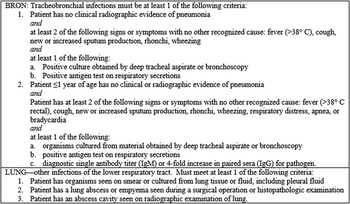
Medical records were reviewed by a team that included medical epidemiologists from the CDC with experience in HAI surveillance and infection preventionists from the CDC and the Pennsylvania Department of Health. The review encompassed all sources within the medical record including physician and/or provider notes, nursing notes, and nursing and/or respiratory therapy flowcharts. Additional assistance locating data elements in the medical records was provided by local hospital staff. Each patient record was first reviewed to confirm the presence of PNEU or LRI during the hospital admission, based on NHSN definitions in place during 2011–2012.Reference Horan, Andrus and Dudeck 10 In brief, PNEU was defined by the presence of new or worsening opacities on chest imaging accompanied by a combination of specific signs, symptoms, and laboratory findings. The reader may refer to Horan et alReference Horan, Andrus and Dudeck 10 for more details. NHSN-defined LRI in 2011–2012 consisted of 2 specific infection types: BRON (“bronchitis, tracheobronchitis, bronchiolitis, tracheitis, without evidence of pneumonia”) and LUNG (“other infections of the lower respiratory tract”). The specific criteria used to identify BRON and LUNG are listed in Figure 1. When necessary, the medical record abstraction team reviewed decisions regarding NHSN classification with an additional CDC subject-matter expert on surveillance for PNEU.
National Healthcare Safety Network surveillance flow diagram for lower respiratory infections (LRI) in place during 2011–2012.

For each NHSN PNEU or LRI event, the following information was recorded: selected underlying medical conditions (as noted by physicians), procedures performed during the week before onset of the NHSN PNEU/LRI event, findings from chest imaging (as summarized by radiology reports), results of microbiologic testing, and outcomes of hospitalization.
The clinical diagnoses recorded in the patient record that corresponded temporally with the NHSN event were also collected by the abstraction team verbatim. Both infectious and non-infectious diagnoses were recorded if the treating clinicians correlated these conditions with signs or symptoms used to fulfill the NHSN criteria (eg, a patient with volume overload developing shortness of breath). These were considered to be the clinical diagnosis/diagnoses likely represented by the NHSN event.
Statistical Analysis
Data were collected on standardized abstraction forms and entered into a Microsoft Access 2007 database (Microsoft, Redmond, WA). The specific clinical diagnoses recorded during chart abstraction were grouped into clinical categories. Analysis was performed using SAS 9.3 (SAS Institute, Cary, NC). Categorical variables were compared using χ2 tests and continuous with a Wilcoxon rank-sum test. Comparisons were considered significant if P>.05. In addition, ventilator-associated LRI events in adults were evaluated to determine whether they met 2013 criteria for NHSN ventilator-associated events. 12
Human Subjects
This project was designated as a non-research quality improvement activity after human subject review at the CDC and the Pennsylvania Department of Health. Participating institutions obtained approvals as IRB-exempt research studies (2 institutions) or non-research projects (6 institutions).
RESULTS
Overall Description
During 2011–2012, the 8 participating hospitals reported 838 NSHN events eligible for inclusion in this project: 589 in adult patients and 249 in pediatric patients. Of these events, 250 (29.8%) were reviewed; 149 (25%) of the reported adult events and 101 (41%) of the reported pediatric events.
Description of Adult PNEU and LRI Events
In adult patients, 96 NHSN PNEU events in patients not receiving mechanical ventilation and 53 LRI events underwent initial review. After chart review, 81 were confirmed to be NHSN PNEU (excluding ventilator-associated PNEU) and 43 were confirmed to be LRIs; thus, a total of 124 adult events were reviewed in more detail. Most differences in classification related to the interpretation of radiology reports.
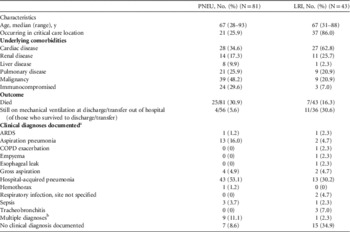
The median age of adult patients was 67 years for both patients with LRI and patients with PNEU (Table 1). LRI events occurred more often in critical care locations (25.9% of PNEU events vs 86.0% of LRI events; P<.0001). Most of the LRI events (38 of 43; 88.4%) occurred in patients receiving mechanical ventilation at the time of the NHSN event. Underlying comorbidities were common among both patients with PNEU and those with LRI. However, patients with PNEU were more likely to have malignancy (48.2% of PNEU patients vs 20.9% of LRI patients; P=.003) and to be immunocompromised (29.6% of PNEU patients vs 7.0% of LRI patients; P≤.0001). In-hospital mortality of PNEU patients (30.9%) was higher than for LRI patients (16.3%); however, this does not reach statistical significance (P=.08).
Baseline Characteristics, Outcomes, and Clinical Diagnoses of Adult Patients Reported to the National Healthcare Safety Network to Have Pneumonia (PNEU), Excluding Ventilator-Associated Pneumonia, or Lower Respiratory Infection (LRI) in Selected Hospitals in Pennsylvania, 2011–2012

NOTE. ARDS: acute respiratory distress syndrome; COPD: chronic obstructive pulmonary disease.
a Diagnoses for LUNG events were esophageal leak, empyema, and sepsis.
b Multiple diagnoses included: both hospital-acquired pneumonia (HAP) and volume overloadReference Klompas and Platt 4 ; both ARDS and HAP; HAP and diffuse alveolar hemorrhage; sepsis and volume overload; gross aspiration and ARDS; HAP and COPD exacerbation; HAP and atelectasis.
The most common clinical diagnoses associated with NHSN PNEU, including events with multiple diagnoses, were healthcare-associated pneumonia and aspiration-related events (69 of 81 PNEU events; 85.2%). Aspiration was specifically documented as the cause in 18 of 69 of the PNEU events (26.1%) designated as healthcare-associated pneumonia or aspiration. In contrast, no single type of clinical diagnosis accounted for a majority of LRI events. For LRI events, healthcare-associated pneumonia or aspiration was the most commonly documented clinical diagnosis (41.9% of LRI events). In addition, 40 of 43 LRI events (93.0%) fulfilled the NHSN BRON definition (as opposed to the LUNG definition). However, clinical diagnoses of bronchitis, tracheitis, or tracheobronchitis were uncommonly reported in these patients (7.0% of LRI patients).
In 34.9% of LRI events and 8.6% of PNEU events (P=.0001), no clinical diagnosis could be found to correspond with the NHSN PNEU or LRI event. In other words, at the time the patient fulfilled the NHSN criteria for one of these definitions, the treating physicians did not document any clinical diagnosis related to changes in clinical status. None of the LRI events in patients on mechanical ventilation fulfilled the 2013 NHSN criteria for ventilator-associated events.
Description of Pediatric PNEU and LRI Events
In pediatric patients, 35 PNEU events and 66 LRI events were reviewed. After chart review, 36 of these events were confirmed to be PNEU (due to reclassification of reported LRI events) and 61 were confirmed to be LRI events by NHSN criteria.
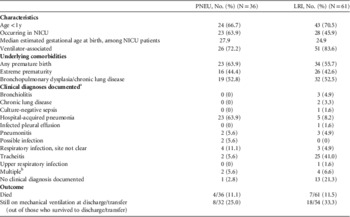
In total, 43 of 61 LRI events (70.5%) and 24 of 36 PNEU events (66.7%) were infants (Table 2). Moreover, a large proportion of both PNEU and LRI events were reported from neonatal intensive care units (63.9% and 45.9% of events, respectively). Among patients from neonatal intensive care units, the median estimated gestational age at birth was 27.9 weeks for PNEU events and 24.9 weeks for LRI events (P=.02). Most events were ventilator associated (72.2% of PNEU events and 83.6% of LRI events) and occurred in patients with bronchopulmonary dysplasia or underlying chronic lung disease (52.8% of PNEU events and 52.5% of LRI events). The in-hospital mortality rates were similar for PNEU events (11.1%) and LRI events (11.5%).
Baseline Characteristics, Outcomes, and Clinical Diagnoses of Pediatric Patients Reported to the National Healthcare Safety Network to Have Pneumonia (PNEU) or Lower Respiratory Infection (LRI) at Selected Hospitals in Pennsylvania, 2011–2012

NOTE. NICU, neonatal intensive care unit.
a LUNG events carried diagnoses of “infected pleural effusion” and “respiratory failure and pleural effusion.”
b Multiple diagnoses included “respiratory failure and pleural effusion”; “tracheitis and atelectasis”; “tracheitis and pneumonia”; “RSV bronchiolitis and culture-negative sepsis.”
Among the pediatric records reviewed, the most common clinical diagnosis associated with PNEU was healthcare-associated pneumonia/pneumonitis (75.6% of events, including those with multiple diagnoses). Clinical diagnoses of other respiratory infections accounted for an additional 16.7% of events. For LRI events, the most common clinical diagnosis was tracheitis (41.0%), followed by healthcare-associated pneumonia/pneumonitis (13.1%), and bronchiolitis (4.9%). As in adult patients, the proportion of NHSN-defined PNEU without any relevant clinical diagnosis was small among pediatric cases (2.8%), whereas a higher percentage of LRI (21.3%) had no clinical diagnosis documented to explain the signs/symptoms fulfilling the LRI surveillance definition (P=.01). Most LRI events (59 of 61; 96.7%) fulfilled the NHSN BRON definition rather than the LUNG definition.
DISCUSSION
In this sample of hospitalized patients, NHSN PNEU surveillance definitions often corresponded with a clinical diagnosis of pneumonia. However, the LRI definitions performed relatively poorly, with >30% of events in adult patients and 21% of events in pediatric patients having no documented clinical diagnosis associated with the NHSN LRI event.
The correlation between NHSN PNEU surveillance definitions and clinical diagnosis of pneumonia in adults not receiving mechanical ventilation appears to be better than has been previously reported for VAP.Reference Klompas and Platt 4 , Reference Klompas, Kulldroff and Platt 5 , Reference Klompas 7 This finding might be because patients receiving mechanical ventilation are more likely to have additional medical conditions (eg, those leading to intubation) that confound determination of healthcare-associated pneumonia by traditional surveillance definitions. Together, these findings indicate that NHSN PNEU definitions do capture clinically significant events in adults who are not receiving mechanical ventilation.
Healthcare-associated PNEU is one of the most common HAIs occurring in hospitals in the United States,Reference Magill, Edwards and Bamberg 1 and most of these events are not ventilator-associated.Reference Magill, Edwards and Bamberg 1 – Reference Weber, Sickbert-Bennett, Brown and Rutala 3 Thus, a high burden of clinically diagnosed healthcare-associated pneumonia occurs among adult patients not receiving mechanical ventilation. Developing approaches to reliably identify and effectively prevent these infections could result in large reductions in HAIs in acute-care hospitals. However, the use of information from radiology reports in surveillance criteria carries inherent subjectivity. Therefore, although this project did not evaluate the agreement of PNEU determinations among different hospital staff; the inter-rater reliability of the existing NHSN PNEU definition may be limited.
The existing NHSN PNEU definitions might be suitable for use by facilities tracking their own progress toward prevention of healthcare-associated pneumonia in patients not receiving mechanical ventilation. Because of the concerns outlined above regarding subjectivity, implementation of non–ventilator-associated PNEU surveillance on a national level would likely require modification to surveillance definitions to remove dependence on radiographic evidence of pneumonia and to enhance the objectivity of other elements of the definitions. Moving forward, at least 3 potential approaches should be considered for surveillance of non–ventilator-associated PNEU. A conservative approach to definition modification would maintain the focus on pneumonia and involve limited modifications, with a goal of maintaining the face validity of the PNEU definitions. Another option, similar to the approach taken with ventilator-associated events, would be to identify a combination of objective signs and laboratory results to identify healthcare-associated respiratory events of interest, which would likely not be limited to pneumonia as a result of these changes. Yet another option could be to focus on healthcare-associated respiratory events that lead to an objective end point, such as intubation. Both of the latter approaches, implementing ventilator-associated event-like definitions in non-ventilated patients or conducting surveillance for unplanned, healthcare-associated intubations, are likely to decrease the correlation between surveillance definitions and specific clinical diagnoses. Further study is needed to determine the optimal approach.
In contrast, most NHSN-defined LRI events occurred in patients receiving mechanical ventilation, and LRI events often had no corresponding clinical diagnosis. Because >70% of patients receiving mechanical ventilation have airway colonization by microorganisms,Reference De Latorre, Pont, Ferrer, Rossello, Palomar and Planas 13 – Reference Durairaj, Mohamad and Launspach 15 the signs, symptoms, and testing results leading to the identification of an NHSN LRI might not indicate the presence of an active infection but instead reflect colonization of the airways in a patient with other clinical conditions. The primary function of the NHSN LRI definition in most hospitals reporting to NHSN was to aid in determining the primary site of infection for a bloodstream infection in central-line–associated bloodstream infection (CLABSI) surveillance. 16 Given the results of our project, which indicated poor correspondence between NHSN LRI and documented presence of clinical infection, attributing bloodstream infections to NHSN BRON might not be appropriate and might cause underestimation of the true burden of CLABSI. For this reason, the NHSN BRON infection type was removed from surveillance protocols starting in January 2015. Because NHSN-defined LUNG infections require isolation of microorganisms from a normally sterile body site or from an invasive procedure, these were considered more likely to represent true infection and were retained.
These data also suggest potential targets for prevention activities that merit further exploration. For example, in adult patients, 26% of the PNEU events were specifically described in the medical record as attributable to aspiration. Because PNEU in non–mechanically ventilated adults is a common HAI nationally, aspiration-related PNEU may contribute significantly to the HAI burden.Reference Magill, Edwards and Bamberg 1 Activities directed toward preventing aspiration (and perhaps targeting populations at high risk for aspiration) might be effective in reducing PNEU cases. 17
In pediatric patients, we included ventilator-associated PNEU events reported to the NHSN in our medical record review because, to our knowledge, the performance of the NHSN PNEU definitions had not been described in this population previously. Most PNEU and LRI events were identified from NICUs. In addition, unlike findings in adult patients, we found that most pediatric PNEU events were ventilator associated. Therefore, focusing on improving definitions for ventilator-associated PNEU might be the highest priority for surveillance of respiratory infections in pediatric patients. Efforts are ongoing to develop and test a ventilator-associated event definition for use in pediatric inpatient locations.
Clinical documentation of diagnoses might be limited as a proxy for severity because syndromes with similarly documented diagnoses could have markedly different clinical impacts. However we found a high in-hospital case fatality rate in adult PNEU cases (particularly considering few of these patients were initially in intensive care units), which supports our conclusion that adult PNEU events represent severe clinical conditions.
We are aware of several limitations in this report. First, this was a retrospective review, and we lacked a true reference standard to establish the presence of pneumonia; we relied on clinical diagnoses as documented in the medical record. Second, because patient records were acquired from a convenience sample of hospitals within a single state, it is possible that PNEU and LRI events described here are not representative of those occurring elsewhere in the United States. Third, we did not attempt to identify whether there were PNEU or LRI events that met NHSN criteria but were not reported to the NHSN. Therefore, we could not include such events in our evaluation of NHSN respiratory definitions.
In summary, surveillance definitions for PNEU correspond favorably with clinical diagnosis of pneumonia in children and in adults not receiving mechanical ventilation, and LRI surveillance definitions did not perform well. Before implementing NHSN PNEU surveillance on a large scale, further work to reduce subjectivity of PNEU definitions could guide efforts to identify and prevent these events and accelerate progress toward elimination of these healthcare-associated infections.
ACKNOWLEDGMENTS
The authors would like to thank Karen Ruscoe (Pennsylvania Presbyterian Medical Center), Deb Runyan (Pennsylvania Hospital), Wendy Fitts (Lancaster General Hospital), Kim Rivera (Pinnacle Health System), and Kate Rosatti (Excela Health) for assistance coordinating chart reviews. We thank Marshall Ma (Pennsylvania Department of Health) for assistance with chart reviews. The findings and conclusions in this report are those of the authors and do not necessarily represent the official position of the Centers for Disease Control and Prevention.
Financial support: This work was supported by the Centers for Disease Control and Prevention.
Potential conflicts of interest: All authors report no conflicts of interest relevant to this article.