INTRODUCTION
It has been estimated that 75% of emerging human diseases are zoonotic in origin (Taylor et al. Reference Taylor, Latham and Woolhouse2001). Unsurprisingly, substantial efforts have been made to identify those species acting as reservoirs for these infections, and while much remains unknown, the importance of rodent hosts has been recognized worldwide. In Europe, bank voles (Clethrionomys glareolus), field voles (Microtus agrestis) and wood mice (Apodemus sylvaticus) have been found to harbour a number of endemic microparasites, including Anaplasma phagocytophilum, Bartonella spp., Trypanosoma spp. and Borrelia burgdorferi, some of which have been established as pathogens of humans and domesticated animals (Healing and Nowell, Reference Healing and Nowell1985; Birtles et al. Reference Birtles, Harrison and Molyneux1994; Noyes et al. Reference Noyes, Ambrose, Barker, Begon, Bennett, Bown and Kemp2002; Bown et al. Reference Bown, Begon, Bennett, Woldehiwet and Ogden2003). Few studies, however, have considered the potential role of the common shrew (Sorex araneus) as a host, even though this small insectivore occupies the same habitat as many European rodents (Middleton, Reference Middleton1931; Shillito, Reference Shillito1963) and shares a similar ectoparasite fauna (Smit, Reference Smit1957; Randolph, Reference Randolph1975; Churchfield, Reference Churchfield1990). While there have been occasional reports of haemoparasites from S. araneus in mainland Europe (Hoyte, Reference Hoyte1956; Laakkonen et al. Reference Laakkonen, Haukisalmi and Merritt1998; Laakkonen, Reference Laakkonen2000; Liz et al. Reference Liz, Anderes, Sumner, Massung, Gern, Rutti and Brossard2000; Holmberg et al. Reference Holmberg, Mills, McGill, Benjamin and Ellis2003), almost nothing is known of their ecology, and there have been no examinations of common shrews from the UK. Haemoparasite DNA has been isolated from S. araneus on only 2 occasions (Liz et al. Reference Liz, Anderes, Sumner, Massung, Gern, Rutti and Brossard2000; Holmberg et al. Reference Holmberg, Mills, McGill, Benjamin and Ellis2003), and comparisons based on sequence data would aid in determining the evolutionary relationships between haemoparasites of common shrews and those of other host species, including sympatric rodents.
In this preliminary investigation, molecular and bacterial culturing techniques were used to determine presence or absence of Anaplasma phagocytophilum, trypanosome and Bartonella infections in common shrews live-caught from Northwest England. All 3 haemoparasites have previously been reported from woodland rodents in the same study area (Ogden et al. Reference Ogden, Bown, Horrocks, Woldehiwet and Bennett1998; Birtles et al. Reference Birtles, Hazel, Bennett, Bown, Raoult and Begon2001; Noyes et al. Reference Noyes, Ambrose, Barker, Begon, Bennett, Bown and Kemp2002). Anaplasma phagocytophilum (formerly Ehrlichia phagocytophilum, Ehrlichia equi and the agent of human granulocytic ehrlichiosis (HGE); Dumler et al. Reference Dumler, Barbet, Bekker, Dasch, Palmer, Ray, Rikihisa and Rurangirwa2001) is a tick-transmitted, obligate intracellular bacterium associated with both human and veterinary diseases, including tick-borne fever in ruminants (Massung et al. Reference Massung, Slater, Owens, Nicholson, Mather, Solberg and Olson1998; Ogden et al. Reference Ogden, Bown, Horrocks, Woldehiwet and Bennett1998). Trypanosomes are unicellular flagellated protozoa found in all classes of vertebrates, and include the agents of human sleeping sickness and Chagas disease (Stevens et al. Reference Stevens, Noyes, Dover and Gibson1999a). Members of the genus Bartonella (including the reclassified genus Grahamella) are Gram-negative cocco-bacillary proteobacteria and obligate parasites of erythrocytes (Birtles et al. Reference Birtles, Harrison, Saunders and Molyneux1995), several species of which are associated with human disease (Breitschwerdt and Kordick, Reference Breitschwerdt and Kordick2000). Both A. phagocytophilum and Bartonella species have been reported in common shrews in mainland Europe (Hoyte, Reference Hoyte1956; Laakkonen et al. Reference Laakkonen, Haukisalmi and Merritt1998; Laakkonen, Reference Laakkonen2000; Liz et al. Reference Liz, Anderes, Sumner, Massung, Gern, Rutti and Brossard2000; Holmberg et al. Reference Holmberg, Mills, McGill, Benjamin and Ellis2003), and trypanosome infections have been described from several species of shrew, but not S. araneus (Laakkonen et al. Reference Laakkonen, Haukisalmi and Merritt1998).
As a first step to exploring the ecology of haemoparasite infections in common shrews in the UK, we investigated effects of host age, sex and year of collection on parasite prevalence through statistical analysis. DNA sequences obtained from haemoparasites infecting UK common shrews were compared with those reported from other host species, and phylogenies inferred from these comparisons.
MATERIALS AND METHODS
Shrew blood sampling
Common shrews were captured from grassy wasteland in the vicinity of Leahurst field station, Cheshire, England (OS grid reference SJ 315 774) between February 2001 and July 2003. Shrews were caught using Longworth traps baited with fly pupae (previously frozen to prevent eclosion) and furnished with bedding material. Traps were checked every 3–4 h, with those containing shrews (or other small mammals) washed thoroughly prior to reuse. Captured shrews were sexed by the presence/absence of nipple patches and testes development in adults (Searle, Reference Searle1985) and classified as either subadults, showing no sign of sexual development, or sexually mature adults caught during or after the breeding season. All animals appeared healthy when captured, and were killed humanely by overdose of inhalation anaesthetic (Fluothane, Schering-Plough Animal Health).
Cardiac blood samples were taken from freshly killed animals using a different sterile syringe for each shrew. Samples were transferred to separate microcentrifuge tubes and subjected to centrifugation for 10 min at 10 000 g to separate serum from pellet. Sera were removed using a micropipette, and the remaining blood pellets stored at −18°C until use.
DNA extraction
DNA was extracted from blood pellets by alkaline digest (Bown et al. Reference Bown, Begon, Bennett, Woldehiwet and Ogden2003) and used as template for detection of A. phagocytophilum and trypanosomes by PCR. Each pellet was dissolved in 500 μl of 1·25% NH3 solution, transferred to a sure-lock microcentrifuge tube and spun briefly at high speed in a centrifuge. Tubes were heated with lids closed at 100°C for 20 min in a heating block, centrifuged again and returned to the heating block with lids open for approximately 25 min, or until half the liquid in each tube had evaporated. The remaining solution was diluted 1:5 and used as template in subsequent PCR reactions.
Cultivation of bartonellae
Isolation of bartonellae from shrews was attempted by inoculating 5 μl of each blood pellet onto 10% horse blood agar plates then incubating inoculated plates at 35°C in a moist, carbon dioxide-rich (5%) atmosphere for up to 30 days. Putative Bartonella colonies were picked and passaged onto new plates. Growth on these plates was harvested into brain heart infusion broth containing 10% glycerol for frozen storage or into sterile distilled water for use as templates in molecular characterizations.
Detection and comparative analysis of haemoparasite DNA
Infection with A. phagocytophilum was detected using a nested PCR targeting a 16S rRNA encoding gene fragment (Massung et al. Reference Massung, Slater, Owens, Nicholson, Mather, Solberg and Olson1998). Amplification of trypanosome DNA was carried out using a nested PCR that targets the 18S rRNA encoding gene fragment (Noyes et al. Reference Noyes, Ambrose, Barker, Begon, Bennett, Bown and Kemp2002). Bartonella DNA was amplified using 2 previously described assays, targeting fragments of the citrate synthase gene (gltA) and the 16S–23S rRNA intergenic spacer region (ISR) (Telfer et al. Reference Telfer, Bown, Sekules, Begon, Hayden and Birtles2005). Amplification products from all the above assays were purified using a Qiaquick PCR purification kit (Qiagen). The base sequence of each product was determined on both strands using the same primers as used for their amplification by a commercial sequencing service (Advanced Biotechnology Service (ABC), Imperial College, London).
Raw sequence data were entered into a DNA handling and analysis programme (SciEd Central, Scientific and Educational Software). For each amplification product, sequence data obtained for forward and reverse DNA strands were aligned and combined. For unambiguous, combined sequences, primer sequences at either extremity were removed and the remaining sequence was used for comparative analysis. For each haemoparasite/gene fragment targeted, sequences obtained from different shrews were compared with one another and with data available in GenBank using BLASTn. Sequence variants for each haemoparasite/gene fragment targeted were aligned with one another and with relevant sequences drawn from the GenBank database using CLUSTALX (Thompson et al. Reference Thompson, Gibson, Plewniak, Jeanmougin and Higgins1997). Trypanosome sequences isolated from shrews were compared with those reported from sympatric rodents (Noyes et al. Reference Noyes, Ambrose, Barker, Begon, Bennett, Bown and Kemp2002) and a wider range of other hosts, including a subset of those used by Stevens et al. (Reference Stevens, Teixeira, Bingle and Gibson1999b) to construct phylogenetic trees. Recovered Bartonella gltA sequences were aligned with those from previously validated Bartonella species.
Phylogenetic relationships between shrew-associated haemoparasites and other members of the relevant taxa were inferred using a maximum likelihood (DNAML) algorithm within the PHYLIP software suite (J. Felsenstein, University of Washington, USA; http://evolution.gs.washington.edu/phylip.html). Results of these analyses were expressed as phylogenetic trees using the program TREEVIEW (Page, Reference Page1996). To test the robustness of proposed branching orders within these trees, bootstrapping was performed using dendrograms constructed from 100 randomly selected samples of the aligned sequence data (SEQBOOT).
Analysis of demographic data
Potential effects of shrew sex, age class (subadult or adult) and year of collection (2001, 2002 or 2003) on prevalence of haemoparasites were investigated using generalized linear models with binomial errors and logit link functions (Crawley, Reference Crawley1993). A separate model was constructed for each parasite genus investigated, with parasite prevalence entered as the dependent variable. To arrive at a minimal model, terms were removed from the maximal model by stepwise deletion, and their significance assessed by comparing the residual deviance of models with and without those terms using χ2 tests (Wilson and Grenfell, Reference Wilson and Grenfell1997a and erratum Wilson and Grenfell, Reference Wilson and Grenfell1997b) in Genstat 5 (Genstat 5 Committee, 1987). Terms not included in the minimal model were added and deleted individually, with changes in deviance again assessed by χ2 tests.
RESULTS
A. phagocytophilum
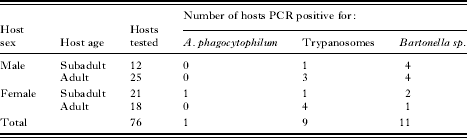
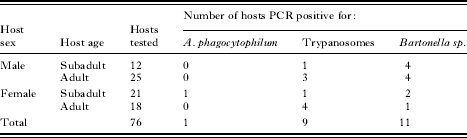
One subadult female of 76 common shrews tested (1·3%) was PCR positive for A. phagocytophilum (Table 1). As only 1 shrew was infected, further analysis of parasite prevalence could not be carried out.
Number of common shrews PCR positive for haemoparasite infections
The 550 bp 16S rDNA fragment obtained from this assay was identical to that previously obtained from a bank vole (C. glareolus) in Northwest England (Bown et al. Reference Bown, Begon, Bennett, Woldehiwet and Ogden2003; GenBank Accession number, AY082656). The sequence differed by 1 base pair from A. phagocytophilum 16S rRNA encoding sequences isolated worldwide (e.g. AF241532, isolated from a llama (Lama glama) in California (Barlough et al. Reference Barlough, Madigan, Turoff, Clover, Shelly and Dumler1997)).
Trypanosomes
Trypanosome DNA was detected in 9 of 76 shrew blood samples tested (11·8%, Table 1). No significant effect of host age (change in deviance when deleted from minimal model: χ2=2·00, d.f.=1, not significant (N.S.)) or host sex (χ2=0·07, d.f.=1, NS) was found on trypanosome prevalence. There was a suggestion of an effect of year of collection, with 0/18 (0%) of shrews sampled in 2001 being PCR positive, compared to 2/15 (13·3%) in 2002 and 7/43 (16·3%) in 2003, though this was not statistically significant (χ2=5·30, d.f.=2, P=0·07).
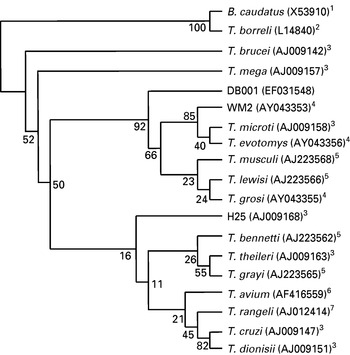
Sequence data were obtained for amplification products obtained from 3 shrews. Comparison of these 503 base pair partial 18S rDNA data demonstrated them to be indistinguishable from one another. Inquisition of GenBank revealed this sequence was novel, sharing greatest similarity with the 18S rDNA of Trypanosoma lewisi (Genbank Accession number: AJ223566, 95% similarity). Alignment with 499 bp 18S rDNA fragments from validated Trypanosoma species resulted in a phylogenetic reconstruction in which the shrew-associated trypanosome specifically clustered with a number of rodent-associated Trypanosoma species, including T. microti, T. evotomys, T. musculi, T. lewisi and T. grosi (Fig. 1). However, within this cluster the shrew-associated trypanosome formed an outgroup, lying on a deeply diverging branch close to the cluster's root. The evolutionary distance separating the S. araneus-associated trypanosome from other trypanosomes was akin to, and often considerably greater than, that observed among the validated Trypanosoma species (Fig. 1).
Phylogenetic tree constructed using maximum likelihood showing relationships between Trypanosoma 18S rRNA sequences, including ‘DB001’ isolated from Sorex araneus in Cheshire. Bootstrap values (percentages) are shown at nodes, GenBank Accession numbers in parentheses. Bodo caudatus and Trypanoplasma borreli are included as an outgroup for tree rooting (Stevens and Gibson, Reference Stevens and Gibson1999). ‘WM2’ isolated from Apodemus sylvaticus (Noyes et al. Reference Noyes, Ambrose, Barker, Begon, Bennett, Bown and Kemp2002), ‘H25’ isolated from Macropus giganteus (Stevens et al. Reference Stevens, Noyes, Dover and Gibson1999a). (1) Fernandes et al. Reference Fernandes, Nelson and Beverley1993; (2) Maslov et al. Reference Maslov, Avila, Lake and Simpson1994; (3) Stevens and Gibson, Reference Stevens and Gibson1999; (4) Noyes et al. Reference Noyes, Ambrose, Barker, Begon, Bennett, Bown and Kemp2002; (5) Haag et al. Reference Haag, O'Huigin and Overath1998; (6) Votypka et al. Reference Votypka, Obornik, Volf, Svobodova and Lukes2002; (7) Stevens et al. Reference Stevens, Teixeira, Bingle and Gibson1999b.

Bartonella sp.
Eleven of 76 shrews (14·5%) were culture positive for Bartonella spp., with the presence of parasite DNA confirmed by PCR (Table 1). No effect of host age (χ2=0·64, d.f.=1, NS), sex (χ2=3·06, d.f.=1, NS) or year of collection (shrews PCR positive: 2001: 2/18 (11·1%), 2002: 4/15 (26·7%), 2003: 5/43 (11·6%); χ2=1·98, d.f.=2, NS) was found on Bartonella sp. prevalence.
Partial gltA sequences were obtained from Bartonella isolates recovered from 5 shrews. Comparisons revealed there were 2 distinct, but very similar, gltA sequence types that shared >99% similarity (differing at 6 positions in a 667 bp alignment). One sequence occurred 3 times, the other twice. Two 16S–23S ISR sequences (‘F’ GenBank Accession number EF031550; ‘WHF018’ GenBank Accession number EF031551) were also recovered from 1 shrew each, sharing 94% similarity with one another (differing at 16 positions in a 307 bp alignment). The isolates from which different 16S–23S rRNA ISRs were recovered also differed in their corresponding gltA sequences.
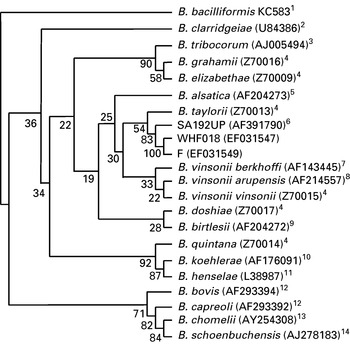
Inference of the phylogenetic positions of the shrew-associated bartonellae using a maximum likelihood algorithm following alignment of 294 bp partial gltA sequences from the shrew-associated bartonellae and other validated Bartonella species indicated that both UK S. araneus-associated gltA sequence types formed a well-supported cluster with one obtained for a Swedish S. araneus-associated Bartonella strain (SA192UP, Accession number AF391790; Holmberg et al. Reference Holmberg, Mills, McGill, Benjamin and Ellis2003) and no other Bartonella species (Fig. 2). This cluster appeared to share specific common evolutionary descent with Bartonella taylorii, but bootstrap support for this topology was only moderate (54%). The evolutionary distances between the cluster of S. araneus-associated bartonellae and other Bartonella species was akin to that observed between Bartonella species.
Phylogenetic tree constructed using maximum likelihood, showing relationships between Bartonella gltA fragment sequences, including ‘WHF018’ and ‘F’, isolated from Sorex araneus in Cheshire. Bootstrap values (percentages) are shown at nodes, GenBank Accession numbers in parentheses. SA192UP isolated from S. araneus in Sweden (Holmberg et al. Reference Holmberg, Mills, McGill, Benjamin and Ellis2003). (1) Sequence provided by R. Birtles; (2) Clarridge et al. Reference Clarridge, Raich, Pirwani, Simon, Tsai, Rodriguez-Barradas, Regnery, Zollo, Jones and Rambo1995; (3) Heller et al. Reference Heller, Riegel, Hansmann, Delacour, Bermond, Dehio, Lamarque, Monteil, Chomel and Piemont1998; (4) Birtles and Raoult, Reference Birtles and Raoult1996; (5) Heller et al. Reference Heller, Kubina, Mariet, Riegel, Delacour, Dehio, Lamarque, Kasten, Boulouis, Monteil, Chomel and Piemont1999; (6) Holmberg et al. Reference Holmberg, Mills, McGill, Benjamin and Ellis2003 (7) Roux et al. Reference Roux, Eykyn, Wyllie and Raoult2000; (8) Houpikian et al. Reference Houpikian, Fournier and Raoult2001; (9) Bermond et al. Reference Bermond, Heller, Barrat, Delacour, Dehio, Alliot, Monteil, Chomel, Boulouis and Piemont2000; (10) Droz et al. Reference Droz, Chi, Horn, Steigerwalt, Whitney and Brenner1999; (11) Norman et al. Reference Norman, Regnery, Jameson, Greene and Krause1995; (12) Bermond et al. Reference Bermond, Boulouis, Heller, Van Laere, Monteil, Chomel, Sander, Dehio and Piemont2002; (13) Maillard et al. Reference Maillard, Riegel, Barrat, Bouillin, Thibault, Gandoin, Halos, Demanche, Alliot, Guillot, Piemont, Boulouis and Vayssier-Taussat2004; (14) Dehio et al. Reference Dehio, Lanz, Pohl, Behrens, Bermond, Piemont, Pelz and Sander2001.

DISCUSSION
Of the 76 shrews tested, 1 was PCR positive for A. phagocytophilum. This is only the second report of A. phagocytophilum from S. araneus, having previously been recovered from a common shrew in Western Switzerland (Liz et al. Reference Liz, Anderes, Sumner, Massung, Gern, Rutti and Brossard2000). Similar figures for A. phagocytophilum prevalence have been reported from other small mammals in the UK. Ogden et al. (Reference Ogden, Bown, Horrocks, Woldehiwet and Bennett1998) recovered the infection from 1 of 26 C. glareolus and zero of 27 A. sylvaticus, while Bown et al. (Reference Bown, Begon, Bennett, Woldehiwet and Ogden2003) found A. phagocytophilum in 11% of C. glareolus and 1·8% of A. sylvaticus. Prevalence of A. phagocytophilum in woodland rodents is seasonal, with the majority of infections occurring over summer and autumn, when nymph and adult Ixodes trianguliceps ticks, thought to be the most important inter-rodent vector of the infection, are at their greatest abundances (Bown et al. Reference Bown, Begon, Bennett, Woldehiwet and Ogden2003). Whether A. phagocytophilum prevalence in S. araneus undergoes similar fluctuations remains to be determined, but infestations of I. trianguliceps nymphs on shrews have been reported to peak between May and August (Randolph, Reference Randolph1975).
The recovered A. phagocytophilum partial 16S rRNA sequence differed by 1 base pair to A. phagocytophilum sequences isolated worldwide, but was identical to one previously reported only from C. glareolus in Northwest England (AY082656, Bown et al. Reference Bown, Begon, Bennett, Woldehiwet and Ogden2003). Although A. phagocytophilum isolates generally exhibit considerable similarity in their 16S rRNA sequences, limited genetic diversity has been reported across both Europe and mainland Britain (Anderson et al. Reference Anderson, Dawson, Jones and Wilson1991; Engvall et al. Reference Engvall, Pettersson, Persson, Artursson and Johansson1996; Ogden et al. Reference Ogden, Bown, Horrocks, Woldehiwet and Bennett1998), which may arise through coevolution with reservoir hosts and tick vectors (Ogden et al. Reference Ogden, Bown, Horrocks, Woldehiwet and Bennett1998). The A. phagocytophilum genotype isolated here may represent a strain occurring in both bank voles and S. araneus in Northwest England, perhaps transmitted between host species by I. trianguliceps. Whether the strain isolated here is identical to that recovered from S. araneus in Switzerland is unknown, as sequence data for the latter have not been published.
Our study is the first to report trypanosome infections in S. araneus, with evidence of infection in 12% of animals tested. Comparative analysis of partial 18S rDNA sequences indicated that all animals were probably infected with the same Trypanosoma species and that this species has not previously been recorded. Trypanosomes described from blood smears of other shrew species have usually been referred to as ‘Trypanosoma soricis’ or ‘T. lewisi-like’ (Laakkonen et al. Reference Laakkonen, Haukisalmi and Merritt1998). As no sequence data exist for these parasites, morphometric comparisons may be required to determine if the sequence isolated from S. araneus represents a previously undescribed species, or the genotype of T. soricis.
Phylogenetic inference indicated that the likely novel Trypanosoma species reported from S. araneus shared specific evolutionary homology with a number of UK (and wider European) rodent-associated trypanosomes, suggesting a small mammal-associated common ancestor for all these species. As the sequence isolated here has not previously been reported from either sympatric rodents or their ectoparasites, it may be transmitted by Doratopsylla dasycnema or Palaeopsylla soricis, two species of flea commonly only found on shrews (Smit, Reference Smit1957). No effect of host age or sex was found on trypanosome prevalence in S. araneus, suggesting both males and females are equally at risk of infection (presumably through contact with fleas), and that acquired immunity (associated with some trypanosome infections (Maraghi and Molyneux, Reference Maraghi and Molyneux1989; Albright and Albright, Reference Albright and Albright1991)) did not reduce prevalence in older animals. Analysis of greater numbers of shrews may reveal differences not found in the limited sample investigated here.
Two different sequence types of Bartonella sp. were isolated from common shrews during this study, exhibiting polymorphisms in both gltA and ISR sequences. The 2 partial gltA sequences differed by <1%, whereas the 2 partial ISR sequences differed by <5%, suggesting the 2 strains were likely representatives of the same species (LaScola and Raoult, Reference LaScola and Raoult1997). Both gltA sequences formed a well-supported cluster with a partially characterized Bartonella strain isolated from S. araneus in Sweden (Holmberg et al. Reference Holmberg, Mills, McGill, Benjamin and Ellis2003), although gltA sequence data from this Swedish strain were limited to a short fragment. As none of the gltA sequences isolated from S. araneus in the UK or Sweden have been reported previously from sympatric rodents, they may represent Bartonella strains specific to common shrews (Holmberg et al. Reference Holmberg, Mills, McGill, Benjamin and Ellis2003). Bartonella are considered to be transmitted by arthropod vectors, and fleas have been shown to transmit at least 2 species between bank voles in the laboratory (Bown et al. Reference Bown, Bennett and Begon2004). As suggested for trypanosomes, Bartonella sp. in S. araneus may be transmitted by flea species feeding almost exclusively on shrews, such that the strains isolated here and in Sweden may be restricted by the host range of their ectoparasite vectors.
The prevalence of Bartonella infections reported here was similar to that reported in Sweden (15%, Holmberg et al. Reference Holmberg, Mills, McGill, Benjamin and Ellis2003), Czechoslovakia (10·4%, Sebek, Reference Sebek1975) and Finnish Lapland (10–15%, Laakkonen, Reference Laakkonen2000), although early observations suggest prevalence may be higher in common shrews in Norway (27%, Hoyte, Reference Hoyte1956). No effect of host sex or age was found here on Bartonella prevalence, concurring with results from previous studies of shrews (Hoyte, Reference Hoyte1956; Laakkonen, Reference Laakkonen2000), although larger studies may reveal trends not found here.
Common shrews have previously been neglected in most ecological studies of haemoparasites, most likely because they are caught in relatively small numbers in studies designed to trap rodents, and do not survive long once captured without provision of suitable food (Shillito, Reference Shillito1963; Pernetta, Reference Pernetta1976). The results of this survey indicate that common shrews in the UK are host to haemoparasitic infections, at prevalence levels similar to those reported from sympatric rodents. It is hoped that a greater proportion of future surveys will include common shrews in studies of wildlife diseases: many rodent traps can be adapted to be triggered by the smaller body mass of S. araneus, and trap mortality can be substantially decreased by provisioning fly pupae as food (previously frozen to prevent eclosion), and reducing the interval between trap visits (Crowcroft, Reference Crowcroft1957; Shillito, Reference Shillito1963). Such methods are also suitable for capturing Sorex minutus and Neomys fodiens, species of shrew occurring sympatrically with small rodents and S. araneus (Churchfield, Reference Churchfield1984), which may also harbour haemoparasitic infections.
This work was funded by the Biotechnology and Biological Sciences Research Council. All shrews were trapped under license from English Nature. The authors wish to thank S. Paterson and I. Montgomery for comments on a previous version of this manuscript.