Introduction
para1The genus Rotala L. (Lythraceae) is distributed mainly in tropical and subtropical regions of the world. The total number of accepted species is currently 53, including the nine species and two varieties described since the genus was last revised (Cook, Reference Cook1979). Twenty species have been reported for Peninsular India (Joseph & Sivarajan, Reference Joseph and Sivarajan1989; Mathew & Lakshminarasimhan, Reference Mathew and Lakshminarasimhan1990; Pradeep et al., Reference Pradeep, Joseph and Sivarajan1990; Yadav et al., Reference Yadav, Malpure and Chandore2010; Prasad et al., Reference Prasad, Biju, Raveendran and Bhat2012). During recent floristic explorations in northern Kerala, the first author collected an interesting specimen of Rotala, closely allied with R. occultiflora Koehne from Mugu in Kasaragod District. Professor C. D. K. Cook, Meilen, Switzerland, who confirmed the novelty of the plant, pointed out that he also collected this plant from Dakshina Kannada District, Karnataka in 1986 and identified it as Rotala occultiflora Koehne on seeing the characteristic bracteoles but without examining floral details (pers. comm.). On critical examination, the two collections are quite different from known taxa and are described here as the new species Rotala kasaragodensis.
Species Description
plantnameRotala kasaragodensis K.S.Prasad & Raveendran, sp. nov.Fig. 1.
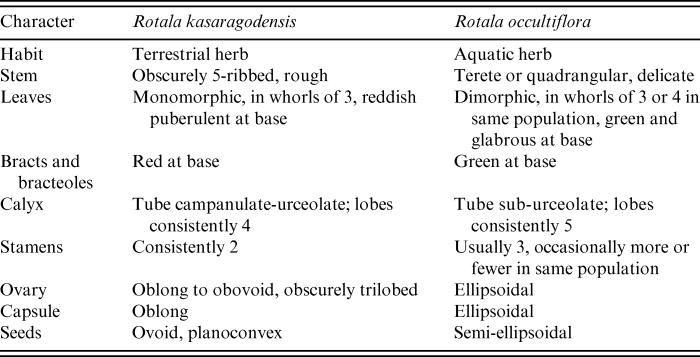
diagnosisSimilar to Rotala occultiflora Koehne but differing in the obscurely five-ribbed stem, monomorphic leaves arranged in whorls of three, consistently having four calyx lobes, consistently having two stamens and the obscurely trilobed ovary. − Type: India, Kerala, Kasaragod District, Mugu, 12°36′56″N, 75°1′40″E, 150 m, on wet soil, 6 ix 2012, K.S. Prasad 03120 (holo CAL; iso BSI, MBGS, MH).
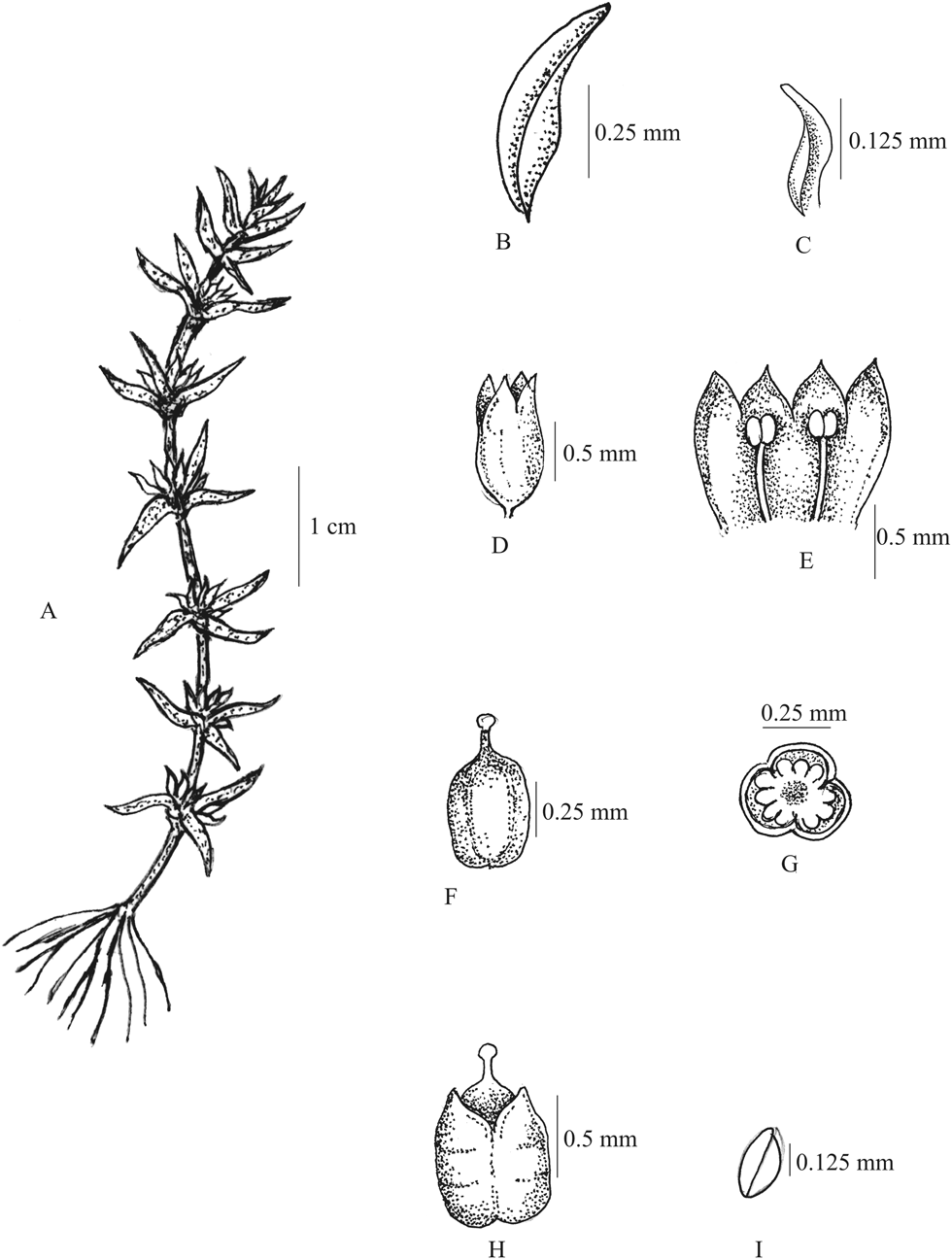
Fig.1.Rotala kasaragodensis K.S.Prasad & Raveendran. A, habit; B, leaf; C, bracteole; D, flower; E, calyx, opened; F, gynoecium; G, ovary, cross-section; H, fruit; I, seed.

para1Terrestrial annual herbs. Stems creeping and branching below, erect above, obscurely 5-ribbed, green, glabrous, 24–64 mm long. Leaves simple, monomorphic, in whorls of 3, 4–6 × 0.5–0.7 mm, ovate-lanceolate, base boat-shaped, reddish and slightly puberulent, green distally, tip sub-acute, margins entire. Flowers monomorphic, sessile, axillary, solitary. Bracts leaf-like, 4–6 × 0.5–0.7 mm, reddish at the point of attachment with the stem, at base boat-shaped and partly enclosing the flower. Bracteoles 2, leaf-like, reddish at extreme base, 0.5–2 × 0.2–0.6 mm, boat-shaped at base, partly enclosing the flower. Floral tubes thin, translucent, campanulate-urceolate, 0.9–1 × 0.4–0.5 mm; lobes 4, triangular, not spreading, pinkish, 0.2–0.3 × 0.1–0.15 mm. Petals absent. Stamens 2, included; filaments 0.5–0.6 mm long, white, attached at the base of the floral tube; anthers dorsifixed, c.0.1 mm across, yellowish. Ovary oblong to obovoid, 0.4–0.6 × 0.3–0.4 mm, obscurely trilobed; style up to 0.1 mm long, simple; stigma capitate. Capsule oblong, 0.9–1.1 × 0.4–0.6 mm, somewhat longer than the calyx, 3-valved. Seeds ovoid to elliptic, planoconvex, 0.2–0.3 mm long, fewer than 10 per fruit, black.
cheadDistribution. Known only from Kasaragod District in Kerala and Dakshina Kannada District in Karnataka.
cheadHabitat and ecology. The material was collected from waterlogged soil on lateritic plains, growing in association with Chrysopogon aciculatus (Retz.) Trim., Desmodium triflorum (L.) DC., Lindernia crustacea (L.) F.Muell., L. ciliata (Colsm.) Pennell, L. rotundifolia (L.) Mukherjee, Justicia nagpurensis Graham, Lobelia alsinoides Lam., Murdannia nudiflora (L.) Brenan, Mecardonia procumbens (Mill.) Small, Selaginella delicatula (Desv. ex Poiret) Alston and Anthoceros sp.
cheadPhenology. Flowers August–October.
cheadEtymology. The new species is named after the District ‘Kasaragod’ which includes the type locality, Mugu.
cheadTaxonomic note. Rotala kasaragodensis K.S.Prasad & Raveendran is allied to R. occultiflora Koehne but differs in the characters given in Table 1.
Comparison between Rotala kasaragodensis and R. occultiflora

specimens1Additional specimens studied. India. Kerala, Kasaragod District, Manya lateritic plateau, 12°33′54″N, 75°2′51″E, 150 m, 16 ix 2012, in wet areas, K.S. Prasad 03131 (Sir Syed College Herbarium); Karnataka, Dakshina Kannada District, Ullal, 12°48′50.31″N, 74°50′24.42″E, 10 m, 26 x 1986, in brackish pool, C.D.K. Cook & R. Frey 4676 (Z n.v.).
Acknowledgements
The authors are indebted to Dr C. D. K. Cook, Meilen, Switzerland for his opinion on the identity of the specimen; to the Principal and Management of Sir Syed College, Taliparamba for providing the necessary facilities; to Mr P. Biju, Department of Botany, Government College, Kasaragod for help in the field, and to Mr Sukumaran for the illustration. The first author is grateful to Kerala State Council for Science Technology and Environment (KSCSTE) for financial assistance.