Introduction
Scholars have tended to ignore the phenomenon of immobility. I stumbled upon it myself while researching its obverse—migration—and then only by accident. Some years ago, I came across a police report on a ‘fracas’ at a Muslim graveyard in Calcutta, where, soon after partition, Hindu refugees had seized the land and put a stop to burials. Out of curiosity, I tried to find the graveyard, but this proved challenging. The people of the now-affluent Hindu neighbourhood that had sprung up in the area stared blankly at me when I asked them how to get there. A few protested that no such burial ground had ever existed. Finally, I found an elderly Muslim rickshaw puller who knew where it was, and he offered to take me there. There was no pucca road leading to it, just a sodden dirt track, barely wide enough for two persons to pass. When we reached the cemetery, it was like a place time had passed by. Only a dozen or so people still remained in what had been, just a few decades before, a bustling Muslim locality. They included the mutawwali, or custodian of the shrines, and a few members of his family, who lived in the most abject poverty I had ever seen. Their crumbling huts were dark and airless. They wore rags that barely hid their skeletal bodies. The women gazed at me in silence, too listless even to brush the flies off the faces of children who neither laughed nor played.Footnote 1
At the time, I perceived only dimly a connection between this family's immobility and their poverty, but it grew more evident in the decade that followed, as I worked on migrants in the Bengal Delta. During this research project,Footnote 2 I kept encountering their counterparts—people whom I called ‘stayers-on’. They were quiet people like the mutawwali, people who had gone nowhere, people whose stories haunted me. These were not folk who had stayed on in peaceful places, in times of plenty. Rather, they had remained where they were despite violence, impoverishment, and social boycott, which had left them culturally and politically marginalized. They had stayed on while most others around them had fled, in contexts of mass migration, when the ‘push factors’ could hardly have been more compelling.
Immobility raises awkward questions for theorists of migration. Every dominant theory (whether of the neo-classical, new economic, world systems, institutions, network, or cumulative causation variety)Footnote 3 seeks to account for why individuals (or households) develop migration strategies, how streams of migration arise, and how these are sustained over time. From the standpoint of these theories, migration is unusual behaviour that requires explanation.Footnote 4 Its obverse, staying in place, is seen as the norm, an ‘obvious’ state of affairs that calls for no accounting.
Yet, as historians are coming to recognize, assumptions about the ordinariness of immobility are insecure. For one thing, we know a great deal more about the mobile societies of early modern Asia.Footnote 5 Between 1722 and 1776, over half of Sichuan's ‘polyglot society’ were migrants, perhaps 3.4 million in number,Footnote 6 while in South Asia, until 1800 perhaps half of the population was mobile for much of their adult lives.Footnote 7 For another, Asian mobility in the era of high imperialism is much better understood.Footnote 8 Washbrook and others have shown that, by the mid-nineteenth century, the colonial state had destroyed the last vestiges of the mobile South Asia of earlier times, forcing its habitually peripatetic communities into a sedentary mode of life rooted in village communities;Footnote 9 but by the late nineteenth century new economic conditions stimulated huge new migrations to cities, plantations, mines, and factories within India and beyond its shores. Amrith suggests that between 1834 and 1940, over 28 million people left India's shores.Footnote 10 From 1926 to 1930, when overseas emigration peaked, according to Kingsley Davis some 3.2 million Indians travelled abroad.Footnote 11 Within India, in 1921 alone, the Indian census recorded more than 15 million internal migrants,Footnote 12 a figure that underestimated the true extent of local and intra-regional movement.Footnote 13 After 1921, spurred on by unprecedented growth in population, internal migration increased still faster, and from the 1970s, these rates of growth achieved dizzying heights. By 2013, perhaps one in five of India's 1.2 billion people was an internal migrant.Footnote 14 In China, between 1979 and 2009, some 340 million people moved from villages to towns.Footnote 15 In Vietnam, 4.3 million people migrated internally in the half-decade before 1999.Footnote 16 In Bangladesh, after a war that created 10 million refugees, constant migration from the countryside to towns, at a rate of over 3 per cent a year between 1975–2009, has led to one of the highest rates of urbanization in the world.Footnote 17 These are staggering figures. But the broad brush of migration on the big canvas conceals higher rates still of local micro-mobility. Even in ‘sedentary’ agricultural societies, as geographers now concur, people do not remain still: they are habitually engaged, to varying degrees, in various complex forms of spatial mobility.Footnote 18
Yet despite these cumulative gains in our understanding of the scale of mobility in early modern and modern Asia, and its dramatic acceleration in ‘the age of migration’,Footnote 19 immobility continues to be seen as the ‘obvious’ state of affairs, and few have asked questions about its causes, conditions, and histories. Where, unusually, such questions have been raised, the emphasis has been upon the barriers built by the states of the West against South-North migration. Jorgen Carling, for instance, describes the daunting ‘immigration interface’ that migrants who go West have to negotiate. He suggests that this acts not so much a wall as a dense ‘jungle in which various paths are each associated with specific obstacles, costs and risks’.Footnote 20 As these costs and risks have escalated in recent times, he argues, ‘involuntary immobility’ has grown.
Yet Carling's valuable study, as well as the handful of others who have looked at this phenomenon, examines exclusively migration from the developing world to Western industrial societies.Footnote 21 This focus is problematic, however. Most of the world's migrants, and over 95 per cent of its refugees since the Second World War, have not moved to the West. They have remained within the Global South, in, or close to, their regions of origin.Footnote 22 ‘The South is not just a “source” of migration, but its preeminent destination.’Footnote 23 Once this overweening fact is recognized, the ‘immobility paradox’ takes on a quite different complexion. In the Global South, the capacity of states to seal their borders is notoriously weak.Footnote 24 The costs of migration across these borders—whether material or psychological—are much lower those of emigration to the West. The risks of travel are relatively low, linguistic and cultural skills are easier to acquire, and networks enabling migration are often already in place. In post-colonial times, in the turbulent contexts of nation-building and minority-formation, the pressures to migrate have been intense, particularly upon those classed as ‘national minorities’. The mutawwali and his family, and others whose stories are discussed below, stayed on, but often were in fear of their very lives. They represent extreme cases, who, according to every existing theory of migration, should have left. And yet they remained.
Why did they remain? And why did this choice (if indeed it was a choice) drive them into poverty? This article suggests some preliminary answers to these questions. Its conclusions come out of a multidisciplinary study of the greater BengalFootnote 25 region in the twentieth century, and the patterns of mobility and immobility that have arisen within it. In that study, the methods deployed were those of a historian and a historical ethnographer: in addition to archival research, 160 interviews were conducted among both Muslim migrants and stayers-on in the Bengal Delta, on both sides of the border, in India and in Bangladesh. Access to interviewees was achieved by a combination of ‘snowballing’ through community ‘gatekeepers’, personal networks, and serendipitous meetings. We interviewed stayers-on both in urban settings (Urdu-speakers in Town Hall Camp in Dhaka, in the former railway township of Syedpur, and well as in Kolkata's Muslim neighbourhoods) and in rural areas (Bengali-speakers in villages in 24 Parganas South in West Bengal). Our intention was to develop a historically sophisticated and ethnographically rich understanding of the processes and relationshipsFootnote 26 underpinning mobility in contexts of mass migration and violent nation creation. We did not go out looking for immobility, but we kept encountering it.
This article seeks to account for that fact. It begins by analysing the impact of the intensifying links, in the late colonial era, between Bengal and the global economy. That impact varied widely on different groups of its people, in ways that had a profound bearing on their capacity to move. The article develops the notion of ‘deficits’—at macro, micro, and cumulative levels—each of which worked to inhibit the mobility of particular groups and individuals. Physical frailty and obligations of care, it shows, were crucial factors in shaping immobility. Relations of gender and generation, and the inequalities embedded in these relations, produced ‘overabundances’—of obligations to people and places—that tied certain people down. Through a series of oral testimonies, the article seeks to bring to life these analytical categories and insights. Finally, it hints at the reasons why, and the ways in which, stayers-on have grown poorer.
Grids, bottlenecks, and the development of ‘network poverty’
In the late nineteenth and early twentieth centuries, eastern India was knitted into a new imperial system of trade and commerce, with Bengal at its centre. In the region, the interplay of private capital and the imperatives of empire—for profit, security, and cheap but safe governance—played out in specific ways. One crucial result was the creation of a particular transport grid, designed to serve a distinctive labour market; and, as this section will show, their particularities made the gulf between the mobile and the immobile ever greater. Features of the transport grid, the labour market, and recruitment systems all combined to produce various (and often overlapping) forms of what might be called ‘network poverty’. Even as the scale and pace of movement accelerated in the region, access to mobility among the people of the region became profoundly uneven.
The discovery in the region of tea, jute, and coal—three commodities that would become crucial for the imperial commerce of India—was a key factor in these processes. This, of course, is well known, but a brief recapitulation will set the context. Native varieties of tea had been ‘discovered’ in Assam and Sylhet as early as 1824, with commercial production beginning in the 1850s. By 1859, the region had 59 ‘tea gardens’, chiefly state-run enterprises, soon transferred to private (mainly European) hands on liberal terms. By 1903, the tea plantations had engrossed 820 square miles of land, producing over 200 million pounds of tea each year,Footnote 27 with Indian tea now ‘oust[ing] the produce of China’ from British markets.Footnote 28 Jute, a natural fibre long cultivated locally for its robustness, came into its own after the Crimean War interrupted the supply of hessian. Jute's commercial manufacture as a packaging material grew with the expansion of world trade, with British-owned mills around Calcutta exploiting the region's competitive advantages. By 1903–1904, India's annual jute export was valued at about 12 crore (a hundred million) rupees, and Bengal emerged not only as the world's sole supplier of raw jute, but, along with Dundee, as one of two centres where it was processed. Neither jute nor tea would have flourished without coal. As steam replaced sail in the 1870s and 1880s, ships also needed coal in huge quantities. As luck would have it, a long strip of ‘black country’ was discovered, initially in Raniganj, and southwest Bengal and eastern Bihar became India's largest suppliers of coal. One of the first stretches of railway line in India was built to connect Calcutta to the coalfields of Raniganj. Soon afterwards, in 1894, mines in neighbouring Jharia began an intensive process of opening up and were connected ‘to a branch line of the East India Railway’, followed in quick succession by new fields at Giridih and Bokaro, west of Raniganj.
This concatenation of developments created a voracious appetite for labour, and eastern India's transport systems were developed chiefly to carry labour, coal, and other commodities swiftly and cheaply to the points where they were in demand. By the early twentieth century, rail, road, and steamer had linked eastern India together in a transport grid, where railways connected (albeit unevenly) the region to upper, central, and western India. Among the main railroads was the 1,468-mile long Bengal and North Western Railway that linked Bengal to the populous, labour-exporting districts of Oudh, Rohilkhand, Benaras, Jaunpur, and Shahbad, carrying 13 million passengers a year by 1904.Footnote 29 The Bengal-Nagpur Railway, which connected Calcutta in the east to Bombay in the west, transporting almost eight million passengers each year, was another key link in this chain, as was the East Indian Railway from Howrah to Kalka and Simla, the distant summer capital of India, on which more than 25 million passengers each year jostled for standing room only. The Assam-Bengal Railway, 740 miles long, ran from ChittagongFootnote 30 on the southeastern seaboard of Bengal, through the Surma river valley and Sylhet, and across Cachar into North Assam, and transported over two million passengers a year (as well as jute and tea) by the turn of the century.Footnote 31 Numerous smaller gauge railways criss-crossed Bengal itself, carrying local traffic over shorter distances.Footnote 32
By the 1910s, in addition to rail, a ‘very complete steamer system’ had begun to ply the region's waterways. The heaviest investment in the steamer system was in eastern Bengal and Assam, where topography rendered railways prohibitively expensive to build, and where connections by water were vital for the development of the (chiefly British-owned) jute and tea industries. By 1909, no fewer than 13 stations in the eastern region each had at least 34 steamer services a month,Footnote 33 and rivers such as the mighty Brahmaputra, previously too treacherous to navigate during the monsoons, were regularly served by ‘small feeder-steamers’ throughout the year.Footnote 34 The road network, admittedly the Cinderella of Bengal's transport system, and chronically starved of funds, was also improved, although ‘trunk’ roads, which connected the centres of British power and trade had priority: by 1930 over a thousand miles of trunk roads had been built (or repaired) in Bengal. Some ‘feeder roads’ were also constructed, usually as auxiliaries to the railways.
Thus, by the early twentieth century, a vast swathe of territory, stretching beyond the Chota Nagpur plateau into parts of northern Madras, the Central Provinces, Orissa, eastern United Provinces, and Bihar had come to be linked closely with central, eastern, and North Bengal, with Assam and Burma to the east, and Nepal to the north, by a transport network built to support the new industries. The whole region had become a vast, interconnected, zonal labour market serving these different, and often competing, sectors. By 1907, Assam contained ‘three-quarters of a million immigrants, or one eighth of its total population. . . The drain from Bengal to Assam [was] almost counterbalanced by an influx of nearly half a million natives of the United Provinces, who come to seek employment in the mills of Calcutta and Howrah and the coal mines of Burdwan, and as earth workers, palanquin-bearers, and field labourers all over Bengal proper.’ By 1901, there were nearly half a million migrants in Burma.Footnote 35 In addition, a quarter of a million people had migrated from Nepal into this region, more than half settling in contiguous British districts.Footnote 36 Between 1911 and 1931, the eastern zone consistently recorded the highest numbers of internal migrants (both immigrants and emigrants) in British India. By 1931, six million persons had moved within and from the greater Bengal region,Footnote 37 a number already twice as large as the entire Indian diaspora worldwide in 1947Footnote 38 (and almost twice the size of the Chinese diaspora in the United States in 2010).
But—and this is a crucial point—access to mobility was profoundly unevenly distributed within the region, with distinct (though sometimes intertwined) kinds of ‘network poverty’ emerging in consequence. The first arose from uneven access to the new modes of mass travel. An important factor were the conditions in the so-called ‘coolie’ class of wagons. They were so dangerously overcrowded and unsanitaryFootnote 39 that only the strong and fit could face the grim prospect of travel in such conditions. Railway staff all-too-frequently manhandled and abused the poor, ‘especially ignorant villagers’,Footnote 40 and treated them ‘worse than brute beasts’.Footnote 41 Lower class carriages, into which passengers were stuffed like sardines into a tin, still had no lighting or toilet facilities 50 years after rail travel began and many carriages still had no seats.Footnote 42 For the elderly, the frail, and the disabled, travelling by train was not a real option. Unaccompanied women and girls entrained at their peril. Even if the labour market had not increasingly denied access to women (about which more below), conditions on the transport grid made it a huge challenge for them even to reach it.
Another crucial axis of stratification was spatial. As Ravi Ahuja has noted, the new transport infrastructure of empire was built only in areas of commercial reward, political sensitivity, and religious significance (major pilgrimage sites increasingly were given rail and road access).Footnote 43 By the 1920s, three exceptionally well-connected clusters of transport infrastructure had emerged in the greater Bengal region. One was southwestern Bengal ‘proper’, centred around Calcutta, the jute mills townships of Hooghly and Howrah, the coalmine districts of western Bengal and Bihar, and the railway hub at Asansol. The second was in eastern Bengal, with its hub at Narayanganj and Dacca, which had excellent steamer facilities. The third was the long ribbon of territory extending south to north from the port at Chittagong, through the Surma Valley in present-day Sylhet, into the tea garden districts of Assam, linked from end to end by the Assam-Bengal Railway.
However, these three ‘hotspots’ of transport infrastructure were not well linked to each other. Beyond them, modern transport facilities penetrated unevenly, tentatively, or not at all. In theory, roads were intended to connect the ‘interior’ to the ‘railheads’, but well into the 1930s, the little money that was spent on them mainly went on roads to towns that served as district or sub-divisional headquarters. In 1938, of a total of 91,936 miles of road in Bengal, 86,541 (94 per cent) were maintained by local authorities, about half of which were tracks and footpaths.Footnote 44 The King Report of that year concluded that ‘except from the system comprising the Grand Trunk Road . . . the province of Bengal has no “Road System” in the proper sense of the term’.Footnote 45 Later, during the Second World War, the government threw vast resources at new airports and roads built to serve the war effort—Assam was finally connected to Bengal ‘proper’ and Burma by a great new arc of metalled road, thousands of miles long.Footnote 46 In the same period, labourers built ‘a fine network of . . . feeder roads’ to the region's 145 new aerodromes, from which South East Asia Command took the fight to the Japanese.Footnote 47 The scale of mobilization was such that the budget of the Engineering Department increased twenty-fivefold, from Rs 40 million in 1939–1940 to Rs 1,000 million by 1944.Footnote 48 Just as the logic of capital had driven the provision of infrastructure in times of peace, the geo-strategic imperatives of empire drove it forward in times of war.
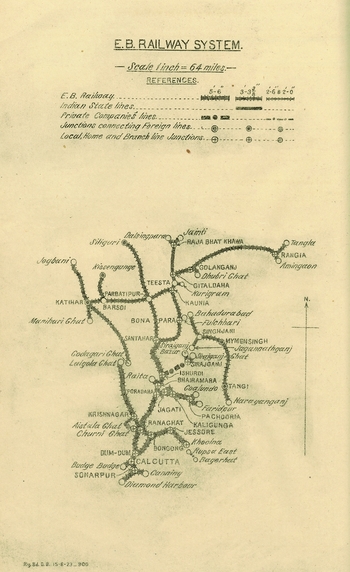
Hand-drawn image of the East Bengal Railway System. Source: History of Indian Railways Constructed and in Progress, corrected up to 31 March 1923, Simla: Government of India Press, 1924.

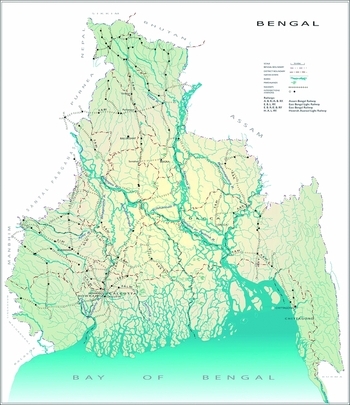
Bengal Railway grid, 1923. Source: Courtesy of Tina Bone. Based on maps in the History of Indian Railways Constructed and in Progress, corrected up to 31 March 1923, Simla: Government of India Press, 1924.

But places without claims to such ‘importance’ languished: providing cheap transport to every Indian was no part of the agenda of the Raj. Comparing three districts before the First World War—the first, 24 Parganas, central to the empire's commercial and political purposes, and the two others, Birbhum and Palamau, more marginal to them—reveals how stark these differences were. By 1914, 24 Parganas already had 324 miles of canals, 53 ferries, over 160 miles of railways, almost 600 miles of metalled roads, and over 1,000 miles of village roads.Footnote 49 Birbhum, by contrast, had no canals and no ferries, only 65 miles of ‘loop line’ narrow railway, 180-odd miles of metalled roads, and 300 miles of unmetalled roads.Footnote 50 At the turn of the century, Palamau, probably Bengal's most isolated district, was compared by one officer ‘to a ship at sea running short of provisions’. Even after the railway reached Daltonganj (in the coal belt) in 1902, ‘the interior [had] not been opened fully’. Roads in the district were so few and so bad that ‘only a small portion of the trade [was] carried by bullock carts, and in most parts pack bullocks form[ed] the only means of transport’. Inaccessibility was ‘particularly marked in the south, a large roadless tract mostly covered by hill, rock and jungle’.Footnote 51
Between 1942 and 1971, this grid, such as it was, suffered a series of seismic shocks. In 1942, with the Japanese threatening India's borders, the government slapped a ‘Boat Denial’ policy onto a swathe of territory on Bengal's southern seaboard, from Chandpur in the east to Kharagpur in the west. All boats capable of carrying more than ten people were either requisitioned for military use, sunk, destroyed, or taken to reception stations where they quickly fell into disrepair. As a result, by the end of the war, only 20,417 boats remained of an original total of 66,563, and this in an area ‘in which communications [were] almost entirely by river’.Footnote 52
In 1947, the new boundary lines of partition wreaked yet more havoc. Radcliffe tried, as far he could, to preserve the integrity of major highways and railroads while drawing the lines carving Bengal into two, but lesser roads and feeder lines were torn apart. The most serious disruption for West Bengal was caused by North Bengal in effect being cut off from the rest of the state. To get from Malda (up north) due south to Calcutta where work was available, people now had to take a circuitous route via Rajmahal in Bihar, often involving numerous changes of trains and interminable waits.Footnote 53 The tea trade, with millions at stake, was hit hard, and only months after partition, the Indian Tea Planters’ Association put in a detailed plan that would connect Jalpaiguri, Darjeeling, Malda, and West Dinajpur with Assam and with the rest of West Bengal. The West Bengal government took note, and gave the reinstatement of this link urgent priority. But the challenge of reconnecting smaller roads and lines markets was never addressed, producing new islands—large and small—of isolation.Footnote 54
As for East Bengal (East Pakistan), after partition it was left with only 300 miles of paved roads in the entire province.Footnote 55 In 1971, the Liberation War devastated an already woefully inadequate transport system: besides the destruction of railway workshops, signals and locomotives, ‘299 railway bridges (including the vital Hardinge and Meghna bridges) and 274 road bridges were either destroyed or damaged. Seaports and several important inland channels were blocked by sunken vessels and war debris.’Footnote 56 On the achievement of independence, ‘Bangladesh was left with no aircraft and no ocean-going vessels’.Footnote 57
Between 1942 and 1971, therefore, a transport grid that in the best of times had provided only the patchiest coverage, was partly destroyed or disintegrated; so badly damaged that many new dark spots appeared off the grid, creating localities marooned and unconnected to vibrant centres of economic activity. New bottlenecks impeded, or severed, old connections.
Colonial sources do not tell us what the ‘catchment area’ for a road or railway station was, or list the towns or villages around the facility which used it. How close was sufficiently close? How far was too far, putting the grid beyond people's reach?
However, two studies conducted in the 1970s give some hint of the answers. The first compared three villages in Bangladesh soon after the Liberation War. The first village was on a metalled road. The second was one-and-a-half miles away from such a road, and the third was six miles away from an all-weather road. In the first village, half the respondents had seen a government official in the preceding three months. In the third village only one in seven (or 14 per cent) had had that dubious privilege.Footnote 58 If officers, with the resources of government at hand, still struggled to get to parts of their jurisdictions which were off the beaten track, the challenge to ordinary people in isolated villages to reach market towns or railheads, or to places even further away where labour was in demand, can be easily imagined.
The second study, conducted in India, draws on data gathered by the National Sample Survey in 1977–78. Its conclusions are even more startling. In the late 1970s, three of every four (72.3 per cent) journeys of over one kilometre in rural India were made on foot. (This compared with only 34.8 per cent of such journeys in urban areas, where, of course, there was much more public transport.)Footnote 59 Village dwellers used bicycles for only one in ten of their journeys, and railways even more rarely. For most of rural India, motorized travel by road was either not available or not affordable. Most people had to walk, most of the time, because they had no other option.
In consequence, they could not travel far. Inevitably, the shortest distances travelled overall (in the whole of India) were by those who lived in ‘backward’ areas (from the perspective of infrastructure provision) such as Arunachal, Tripura, and Manipur.Footnote 60 In Assam and Bihar on average, ‘it took three households, each with more than five persons, to find one person who took a trip of more than one kilometre in the reference week’.Footnote 61
Compare these findings with the millions of travellers who, for the past century, had journeyed to work, sometimes going many hundreds of miles because the grid linked their homes by rail to distant workplaces, and the stunning differences between living on the grid and living off it begin to be clear. People who lived off the grid had little or no experience of the dramatic effects of ‘space-time compression’ of modern modes of travel. As Ahuja has argued, late-colonial development opened up new lines of inequality within regions,Footnote 62 and, as these studies suggest, post-colonial states did relatively little to redress them. The inequities, unevenness (and eccentricities) of the grid have not merely compounded and reshaped older differences of wealth and status, they have created an altogether new type of inequality—measured by access (or lack of access) to mobility.
These problems of asymmetrical access to mobility were compounded by the idiosyncrasies of the labour market, which, for all its size, evolved in ways that allowed only certain kinds of people entry. For one, opportunities for work increasingly came to be restricted by region of origin, with a marked tendency towards an ethnicization of the labour force. To begin with, this pattern emerged organically as employers (in every sector) concluded that migrant ‘pardesis’ (foreigners) were more ‘reliable’ and ‘amenable to discipline’. As Kerr has noted, long-distance migrants who had travelled too far from their villages and fields to be drawn back into the annual cycle of sowing and harvesting, or were not trapped by forms of servitude to local agrarian elites, soon emerged as the ‘modern’ employee of choice.Footnote 63
In time, however, recruiting practices which had evolved in response to irregular labour supply hardened—in tune with the mood music of the times—into racial stereotypes. Local people everywhere, or so it seems, were deemed to be ‘lazy’, whereas certain immigrant ‘races’ and ‘peoples’ were considered good workers by contrast. The tea gardens in Darjeeling thus recruited ‘Gurkha’ workers from the hill populations of Nepal, and also relied on Santal labour from Champaran to the west. The Assam tea gardens soon became notorious for their unscrupulous recruiting of workers from Chotanagpur, Bihar, and the United Provinces, who were then forced to stay on, despite the brutal conditions of work and life in the plantations.Footnote 64 Most mill hands in the jute industry were also migrants from upper India, particularly from Bihar and the United Provinces, and also from famine-prone parts of northern Orissa and the Madras Presidency.Footnote 65
As decades passed, these stereotypes became more elaborate, so that particular forms of labour within each industry came to be deemed appropriate only for people from a particular place, and supposedly of a specific ‘type’. Santals were favoured by tea planters for their ‘hardiness’ in withstanding the humid climate and harsh conditions of the Assam gardens; allegedly they were immune to malaria, willing to work long hours, and, above all, docile. Santal women and children were deemed to have the build best suited to the plucking of tea. Assamese workers, by contrast, were irredeemably lazy in the planters’ eyes, and as a result, by 1884 only five per cent of all workers in Assam's plantations were local people.Footnote 66 ‘Poorbeas’ (men from eastern United Provinces and Bihar) were preferred in the jute mills. In the coalfields, the ‘bulk of the colliers belong[ed] to the Kamia class of landless labourer’, although some were ‘agriculturists holding land at a distance from the coalfields’.Footnote 67 (Both groups, for reasons that of course had nothing to do with ‘race’, were unlikely to ‘abscond’ back to the fields in the harvesting season.) Poorbeas soon came to dominate the regular staff on the railways, and as Partha Shil's work shows, Bengal's constabulary as well.Footnote 68 Men from Noakhali and Sandwip in East Bengal were ubiquitous on Calcutta's docks. Sylhetis soon came to monopolize the boiler rooms of steamships. And so on.
This process of ethnicization was also consolidated by systems of labour recruitment, which (as is well known) relied heavily on sirdars or jobbers of various kinds. Sirdars enlisted men from their own caste, community, kinship group, and village, and this strengthened the links between particular areas of recruitment and specific sectors of the economy. Even within these recruitment hotspots, opportunities for movement came to be restricted to particular networks, access to which sirdars sought tightly to control. In time, therefore, the ‘segmentary’Footnote 69 labour market in these ‘modern’ sectors of the economy became less open to the population at large, even when recruitment swelled to record levels.
As Chandavarkar has shown for Bombay, the power of jobbers waned in the latter half of the twentieth century.Footnote 70 But access to employment is still, in the twenty-first century, dominated by networks. Those historically excluded from such networks continue to find it hard to break into these jobs. Anirudh Krishna's study of poverty in 35 villages in North India, conducted in 2002, bears this out. In 309 cases where young men had successfully diversified household income by migrating to the city, he discovered, 198 had relied upon a contact, ‘a friend, or more often a relative, already established in the city’.Footnote 71 But others, ‘equally well qualified in most other respects have not been equally able to take advantage of these opportunities’. Krishna cites one respondent, Pratap Singh:
I am educated [to high school level] and eager to get a job in the city, but I have no way of knowing what jobs exist. I have no one in the city who can find out and tell me. It is very expensive for me to live there waiting for a job, and my family cannot afford these expenses. Some day, I hope, I will get a job and help my family. I wish I had an uncle or cousin in . . . [the nearest city] who could help me, just as Gopi Singh's brother-in-law helped him to find a job.
Note: everyone in this vignette is male. Pratap Singh is a man, as is Gopi Singh and his helpful brother-in-law. He bemoans his lack of uncles and (male) cousins who might have been able to help him. Women do not enter his narrative of work and the routes to mobility at all.
This is because gender was, and remains, another crucially important axis of differentiation, which cuts across regions and even networks, in ways that the next section will discuss more fully. But here the historical backcloth is relevant. In every industry, as historians have shown single, able-bodied men dominated the migrant working population from the start, and that dominance grew with every passing decade. Even if women had been able easily, say, to hop onto a train, which they could not, employers grew ever more reluctant to hire them as the perceived costs of doing so rose with increasing regulation, as Samita Sen has shown for the jute industry.Footnote 72 The coal industry hired some women and children well into the twentieth century, but paid them lower wages for carrying coal to the tubs and the mineshafts. The industry became increasingly reluctant to hire them from the 1930s, when the prohibition on employing women for underground work came into force, leaving 60 per cent of women in mining centres unemployed.Footnote 73 Tea plantations were an exception—women and children continued to be employed—but this was chiefly in plucking and hand-weeding, tasks that were deemed ‘unskilled’ and were poorly paid. Colonial legal regimes made matters worse. In 1901, the Assam Labour Emigration Act denied married women the legal capacity to enter into labour contracts without their husbands’ consent, and such consent was rarely given.Footnote 74 Of course, historians of labour know all of this. But the point here is that women's ability to move to seek work was curtailed in numerous, intertwined ways. ‘Network poverty’ had profoundly gendered characteristics.
Admittedly, labour conditions in these sectors of the economy were exploitative in the extreme. Employers paid as little as they could and workers endured appalling hardship. Yet scholars of migration cannot ignore the fact that the mobility afforded by these new technologies and industries—mobility that in times of famine, epidemic or riot, made the difference between life and death—was tilted heavily in favour of men and was asymmetrically distributed.
With the end of empire and partition, the implications of being stuck, always grave, became even more profound. As I have shown elsewhere, the mass migrations after partition followed in grooves of mobility carved out in colonial times.Footnote 75 People who previously had access to mobility now used prefigured routes and connections to escape violence. As the economic migrants in the labour markets of empire became the refugees of independent South Asia, the predicament of the immobile presented itself in ever more stark relief.
‘Deficits’ and ‘over-abundances’
In an important study, three economists recently tried to get to the heart of why people in Rangpur district in Bangladesh, notoriously prone to annual famines called monga, did not migrate during these famines, despite knowing the potential benefits of getting away and the dire consequences of staying in place. Fears of failed migration, insufficient savings, and poor information about the opportunities on offer, they discovered, did not adequately explain this reluctance to migrate. The authors described the behaviour of respondents as ‘something of a puzzle’, admitting that ‘there is some element [here] that we do not understand’.Footnote 76
This section suggests some answers to this conundrum, using oral history interviews with stayers-on. The interviews took place in three locations where stayers-on had clustered. Two of the sites were in urban Bangladesh, in Dhaka and Syedpur respectively, where our interviewees were Urdu- or Bhojpuri-speakers of the so-called ‘Bihari’ community who stayed on in Bangladesh after 1971, despite the virulent climate there of hostility and violence against them.Footnote 77 The third location was a rural settlement in the southwest corner of West Bengal, close to the Bangladesh border to the east and the Bay of Bengal to the south. Here we interviewed Bengali-speaking rural Muslim families who had stayed on in West Bengal in India despite intense pressures on them to leave after partition. The first two sites were on the grid, albeit in different ways. Dhaka was intensively connected by road, rail and steamer, and air, while Syedpur—a major railway junction—was otherwise a small, rather sleepy, provincial town. The third site, a small village, was far off the grid, in a pocket of isolation, where people travelled by foot, and crossed deep rivers by small boat. This choice of sites was driven by the project's focus on migrants and refugees rather than stayers-on. But comparing the life stories of people at these sites enabled us to tease out the complex interwoven histories, capabilities, networks, and obligations (or their lack) that tied some people to place.
These interviews suggest some conclusions about patterns of staying on that are best expressed in terms of ‘overabundances’ and ‘deficits’ of certain attributes, albeit in different combinations. Strikingly, the main ‘deficit’ proved not to be a lack of education, cash, or even access to networks (although these were significant) but physical frailty. The ‘over-abundances’—‘sticky’ qualities that lead to inertia—are perhaps less surprising, but nonetheless profoundly revealing: they have to do with deeply internalized, albeit socially constituted, obligations of care.
Salima is a widow, now in her fifties, who has lived in one tiny room in Town Hall Camp in Dhaka for over 30 years. A thin, bespectacled woman, she shares the room with her adult son and his wife, her daughter, and grandchildren—of whom one, Taukir, about 14 years old, is disabled. Salima's husband used to work in the railways, but during the troubles of 1971, he was tortured, and eventually died from his injuries. For several months, Salima nursed him and tended their children. After he died, she went to Dhaka, as she had relatives in the city. She became a squatter in what would eventually become the Camp:
This was then a market place. It was empty. We put jute curtains up and started to live here. Things were very difficult. There were no fans—only lights bulbs tied to bamboo poles, one providing light to a few families together.
This room is now one of hundreds of similar rooms in Town Hall Camp, itself one of several ‘Bihari’ camps in Dhaka. Salima's room is completely without ventilation—when we interviewed her, the stale air smelled strongly of kerosene. None of her children has had any education. She works as a cleaner for a local NGO, and supplements her meagre income doing piecework for garment manufacturers.
One by one, most of Salima's male relatives, including her father and brother, left for Pakistan, where the family had kin and connections. Interestingly, Salima is still in contact with her father. But he was unable (or unwilling) to take his widowed daughter and grandchildren over to Pakistan to live with him, and she seems equally unable to consider moving.
Why did Salima stay on? In the first instance, to care for her badly wounded husband. After his death soon after the war ended, as a single woman with very small children, one of whom was disabled, she calculated that she (and her vulnerable dependents) would be better able to survive in Dhaka where she had some networks of (mainly female) familial and neighbourly support. (Indeed, even as the interview was being conducted, one of her female neighbours dropped in to help Salima—whose eyesight is beginning to fail—complete her quota of piecework on time.) As a squatter in Town Hall Camp, with 36 square feet which she occupies but does not own, she is tied to place. She is also pinned down by her responsibilities for her daughter (who was abandoned by her own husband) and for her disabled grandson, Taukir. With most male others who might have shared these responsibilities with her having emigrated long ago, they weigh heavily on her shoulders. But, together with these fellow stayers-on in the Camp, she has created new bonds of intimacy and familiarity that help them all survive and make their way in the world.Footnote 78
Also in Town Hall Camp lives Sairun, a 45-year-old widow. She occupies a small room with her nephew, his wife, and their two-year-old child. She was born in Old Dhaka and, as with Salima, her family had links with the railways. But in March 1971, her husband died.
‘What happened to him?’ we asked.
‘He left for his business as usual one morning and never returned. He must have been killed.’
During or after the 1971 War, every single one of Sairun's male relatives—her son, her brother (and his wife and children)—left for Pakistan, where they now live in Orangi township in Karachi. But Sairun stayed on in Dhaka. This was because one of her sisters fell sick and eventually died, leaving behind two small children. Sairun, who had nursed her bedridden sister, brought these two orphans up along with her own two children. She never travels anywhere, so she tells us. Even though she is in touch with her Pakistani family, she has not seen her son, now an adult, since 1971. None of the four children she raised is educated, even though Sairun herself is literate—she occasionally supplements her insubstantial income as a maid by giving tuition in Arabic.
Or take the story of Mehrunissa Khatun, a stayer-on who lives in Chamra Godown Camp in Syedpur, where we interviewed her. Syedpur was once the site of the largest railway workshop of the Assam-Bengal Railway, which previously employed thousands of ‘Urdu-speaking’ up-country migrants, who were so numerous that they once made up three out of four of the town's population. But both Syedpur, as well as neighbouring Parbartipur and Santahar, came under attack during and after the Liberation War, and thousands fled for their lives. Mehrunissa's family was one of hundreds which, during the troubles (gondogol is the Bengali word our informants use to describe these events), fled from Parbatipur—a small railway colony—to the larger railway township of Syedpur, seeking safety in numbers.
Just as Salima and Sairun, Mehrunissa had two very young children—two daughters (aged three years and five months respectively). She says:
Here I had three more children. One baby died at the age of ten months. Then I had another daughter and she is now in Pakistan . . . My eldest daughter is called Shah Jahan and is married to a man who works in the trucks as a coolie . . . He is parentless so he lives here with us in Syedpur. They [her daughter and son-in-law] have five children.
In 1978, Mehrunissa's own husband, who was ‘bed-ridden’ for years—‘he used to cough up blood’—died. Mehrunissa continued to care for all her surviving children, and, when her oldest daughter married, her son-in-law as well, and her many grandchildren. Times were so hard that they often had nothing to eat. But somehow they struggled on. In 1985, one of Mehrunissa's sisters was able to migrate with her own husband and children to Pakistan. She took Mehrunissa's younger daughter, Sabra, with her to Pakistan, marrying her off to her own son, to relieve her sister of the burden of one more mouth to feed.
Since then, Mehrunissa has managed to support her family by working as a maid in the house of a Canadian aid-worker. Like Salima, Mehrunissa had kinsfolk in Pakistan (her sister and daughter). She longs to see Sabra, but she will not herself migrate, because she has responsibilities to her other children and grandchildren. She still lives in the same place in Chamra Godown Camp, in extremely reduced circumstances.
Maryam also lives in in Syedpur. She is perhaps 60 years old, and the head of a household of nine people, whom she supports also by working as a maid, and occasionally sewing garments. She has lived here since the 1971 War began, when she moved with her husband from the neighbouring railway colony at Parbatipur. Her husband, a mechanic in the railways, was ailing ‘with some stomach-related illness’, and she looked after him (as well as her children) until his death in 1975.
The details of Hanifa's story are distressing, but not unusual in this milieu. She lived in the railway township of Santahar in Bogra before the war, where ‘Urdu-speakers’ experienced some of the worst violence. ‘When the war started,’ she said,
I was picked up and beaten up. I had two ribs and my skull broken. My husband, two sons, three daughters and grandchild were killed that night . . .Then, taking us all for dead, they left . . . When I regained consciousness I realized that my young son Habib was still alive, and that my baby Zafar, despite the deep gash he had on his stomach, was alive. So I rushed them both to the doctor . . . A kindly [person] treated the children and saved them. After that we survived by eating frogs and grass and mud and wearing coarse cloth made of jute.
These stories all have a common narrative thread. The stayers-on who hung on despite threats to life and limb did not always, in the first instance, lack access to networks that might have helped them migrate. On the contrary, everyone we interviewed in this context belonged to the Bhojpuri-speaking labour diaspora connected with the railways, and they all had rich and far-flung networks across India, Pakistan, and Bangladesh, and indeed, further afield.Footnote 79 Nor did they lack skills—many were literate, and some were moderately well off before 1971. But they lacked other elements of what I have elsewhere defined as ‘mobility capital’, the bundle of assets and competences that makes moving possible.Footnote 80 Above all, they lacked health. Or if they were able-bodied themselves, they had powerful countervailing obligations to care for the vulnerable and infirm, whether infants, the ill, the aged or the disabled, for whom they felt responsible. Most in this category were women.
This suggests—somewhat counterintuitively—that while networks, cash, ‘know-how’, and skills are important elements of mobility, good health is vital. So also is the freedom to leave others behind, to abandon (socially constructed) duties of care. The women we interviewed seemed to practise what Sara Ruddick describes as ‘maternal thinking’, responding to the ‘prolonged physical fragility and therefore prolonged dependence’, not only of children,Footnote 81 but of fragile others, by taking responsibility for their care. Even at times of grave danger to themselves (graphically demonstrated by Hanifa's story), many women chose not to flee, but to stay where they were to try to ensure that their children survived. Those who were already carers of children took on the responsibility first to care for sick and disabled relatives, and then (as with Sairun and her sister) to look after those orphaned by the death of these relatives. They tended the fragile, the sick, and the vulnerable among their kin, even if this put them in danger. If this held them back, and meant they had to pass over opportunities to migrate in the bargain, they did this with a sense of resignation. None, other than Hanifa, expressed bitterness or regret. Indeed, few described it as a decision at all.
Sickness and frailty stalk these narratives. Husbands, children, sisters, and sons-in-law fell ill and died of diseases our informants could not name. They merely described their most graphic symptoms—‘he used to cough up blood’, or ‘he had some stomach ailment’, or ‘she was bedridden’, or ‘his mind went wrong’.
These life stories, and others of their ilk, suggest that sickness, disease, and disability are surely part of the answer to the ‘puzzle’ of the ‘immobility paradox’. Further, given the strong co-relation between poverty and illness, and the dynamic relationship between illness, dependency, and care, they point to a vicious circle that traps the ill, the dependent, and their carers in lives of immobility and poverty.
However, while most examples of staying on can be explained by this cycle of dependency, not all can. There are those who had obligations produced by deeply held religious beliefs, by responsibilities to graves and to ancestors. They were usually eldest sons. My final story throws light on the description of the graveyard with which I began.
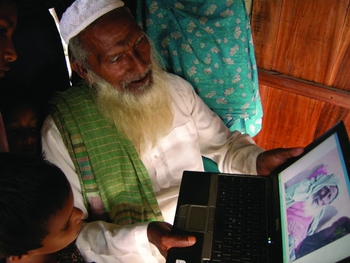
Shahid Gazi views photographs of his long-lost brother, Jalal. Source: Courtesy, Annu Jalais, Bengal Diaspora Project.

Shahid and Jalal Gazi are brothers, originally from the village of Kalitola in the southeast corner of present-day West Bengal. The village was in a remote spot ‘off the grid’—it was served neither by rail nor steamer. But it happened to be just a few miles away from the Radcliffe line that now divided West Bengal in India from eastern Pakistan. After partition, faced with violence and intimidation, Shahid, the younger brother, together with many other members of the family, migrated just across the border. Carrying small bundles of possessions over their shoulders, they trekked on foot to Khupdipur in East Pakistan. But his eldest brother Jalal did not leave. Today Jalal (aged about 95) is too ill and confused to be able to say much. His son, Fakhruddin, fills in the gaps in his story:
We are originally from Kalitola. The Hindus kicked us away from there so we came here [Dokkhin Parghumte] where we had family. Our whole place in Kalitola used to be Muslim. Then one day [around 1950] some refugees who had come from the other side announced that Muslims wouldn't be allowed to live there, that they would have to leave . . . They went from house to house, sometimes raped and looted, at other times burned down our homes and our granaries . . . My elder brother . . . felt he wouldn't be able to keep his honour and left for Khupdipur [across the border] . . . At that time all the Muslims of Jogeshganj, Parghumte, Kalitola, Samshernagar, Gobindokati left this place . . . Our family's land used to stretch all the way to the river, now it ends with the field which surrounds our homestead . . . One by one all of my uncles left. But my father Jalal Gazi, being the eldest, stayed back to look after the mosque and the graves of our ancestors.
Today their community of Muslims is reduced to about 50 people, cramped into only four homesteads. The Gazi family had clearly once been modestly prosperous. After riots broke out in 1950, many members of the clan went to Pakistan. Those who were left behind did not lack contacts in Pakistan—indeed, they had many close relatives and contacts who had made good on ‘the other side’. But Jalal stayed on in India because he felt bound, as the eldest son, by responsibilities to the graves of his ancestors. After he himself grew old and frail, his son, Fakhruddin, and nephew, Hamidullah, stayed even though there are very few opportunities for them in the locality, and despite the fact that the former was ‘kicked out’ of his job at the local school, after being passed over for promotion by a less qualified Hindu. They felt obliged to look after the old man, who is sick, disoriented, and infirm.
‘Previously,’ Fakhruddin continued, ‘we all wanted to leave as our leaders all left, but it is not so now. We can't go and neither do we want to go.’
Their decision to stay has resulted in a catastrophic downward spiral in wealth and status. The landholdings of this clan have shrunk to one small field. The younger men in the family are either unemployed or inappropriately employed, and they are deeply pessimistic about their prospects. Interestingly, they have lost contact with their kin across the border. National borders—even ones as relatively porous as those between India and Bangladesh—and attempts to control movement across them have undoubtedly played a part in this. Since the Enemy Property Act came on the statute book in 1967, maintaining contact with ‘enemy’ aliens across the border has been fraught with danger,Footnote 82 and this may explain why two brothers, separated by partition, had neither seen nor heard from each other for several decades. It was only when we took news and photographs of Jalal over to Shahid in Bangladesh that contact between them was re-established.
Their story reveals a critically important point overlooked by much of the literature on networks: namely, that networks atrophy and rupture in adverse circumstances. After the blood brothers lost touch with each other at a time of upheaval and chaos, the ties between them withered. For the family members who had stayed behind, this meant a cumulative decline in their capacity to move, with assets stripped and familial networks that might once have facilitated their movement gradually disintegrating. In the simple statement—‘We can't go and neither do we want to go’—we see both the inability to leave and the impossibility of abandoning obligations that underlie long-term immobility. Among the less mobile, then, it seems that an initial reluctance to move could foreclose their options for migration at a later date, keeping people like Fakhruddin and Hamidullah Gazi stuck in their unenviable situations.
Conclusion
In his study of North Indian villages, Anirudh Krishna concludes that most of those who escaped poverty did so by ‘building a bridge to the city’. Very few of those who remained where they were in rural areas were able to break free of the destitution in which they lived.Footnote 83 Similarly, the study of villages in famine-prone Rangpur shows that those who migrated (to areas where wages were higher) significantly improved the lives of their families back in the village (as measured by consumption of calories and expenditure on children's education).Footnote 84 Migration, the authors show, is a ‘profitable technology’.Footnote 85 It also, as we know, provides a means of escape from violence in times of upheaval.Footnote 86
This article has drawn attention to the phenomenon of immobility, insisting that it demands greater attention in an age of ever-increasing migration. It suggests that for many people this immobility has arisen historically, as a result of being ‘left out’, or left off, the grid, rendering them unable (for reasons of age, health or gender) to use it safely. Spatial differences were very significant—for many people who lived off the grid, the costs and risks of movement were simply too great, with these inhibiting factors having remained essentially unchanged since early-modern times. Even within regions that were connected to the grid, access to mobility tended to be restricted to healthy male members of the ‘right’ ethnic group, caste or kinship network. The ethnic segmentation of the labour market—itself a commonly attested fact—was a causal factor in its own right in shaping immobility. Deficits of these enabling qualities led to different forms of ‘network poverty’, which, for some unfortunate people, overlapped, with one factor reinforcing others to leave them stuck in their localities.
And even among members of the ‘right’ ethnic group, caste or kinship network, some individuals were far more ‘stuck’ than others. As the second part of the article shows, the most inert are sometimes people who, at least on the face of it, are not ‘network deprived’ in these ways. Among them, however, were the most vulnerable—the sick and the disabled, the very old and very young—and those who looked after them. The women whose stories we heard were all from richly networked railway families, but they were held back by the fragility of those for whom they felt responsible. As Livingston has observed in her study of disability in Botswana, ‘debility . . . troubles, mobilizes and intensifies social relations’, and indeed, ‘the moral imagination’.Footnote 87 Sickness and dependency generated ‘over-abundant’ obligations, responsibilities from which some people—mainly women—could not, and would not, walk away.
Furthermore, having made the initial choice to stay, many of these people found their capacity to move eroded as the years passed by. Address books were lost (many women wept as they told us this), the emigrants among their kin got on with their new lives, and the ties that once bound those who left to those who stayed behind weakened as time went by. Thus networks that might have enabled migrations at a later date withered and died, and any notion of moving grew more and more unrealistic. So stayers-on remained where they were, while the world around them moved on, moved more, and moved more rapidly.
This choice (as well as the conditions that led to it in the first place) appear to have combined to propel these households into a downward spiral into poverty. While the interviews cited here were mainly conducted in Bangladesh, Muslim stayers-on in West Bengal appear to have fared little better. Decades of Communist government notwithstanding, they are among the most impoverished communities in the region. Statistics show them to be disproportionately likely—compared to the rest of the population—to be uneducated, unemployed or under-employed. Despite constituting about 28 per cent of West Bengal's total population, Muslims hold less than 2 per cent of government jobs, and less than 1 per cent of all ‘service-level’ jobs in the private sector.Footnote 88 They tend to live in desperately overcrowded spaces, with little or no institutional support. Their children are more likely than those of other communities to remain illiterate and have shorter lives. Their daughters are more likely to marry young and to die in childbirth. Their sons, in disproportionately large numbers, fall foul of the law and spend years in prison.Footnote 89 A recent study of Muslims stayers-on in contemporary Calcutta showed that four out of every five now live in overcrowded slums, where entire households (an average size of 6.65 persons)Footnote 90 sleep, eat, and work in tiny one-room shacks, the average size of which is less than 120 square feet.Footnote 91 Their literacy is exceptionally low. More than nine out of ten have no ‘chance of getting admitted to any kind of educational institution [whether] recognized or unrecognized, or unaffiliated or public’. Drop-out rates among the few lucky children who are admitted to schools are estimated to be as high as 80 per cent. These urban communities survive mainly by embroidering, for pitifully low returns, gold thread onto cloth, making paper goods like kites, binding books, and making cheap leather goods.Footnote 92
The history of immobility in South Asia, and its intricate relationship with poverty, is complex and, as yet, little understood. Much remains to be done. These stories, it is hoped, will help stimulate more research, while giving us some insight into why, and in what ways, mobility has become ‘a scarce and unequally distributed commodity’, and one of the ‘main stratifying factors of our late modern or post modern times’.Footnote 93