Introduction
Ecosystem services, defined as the benefits provided by biodiversity to both human activities and welfare (Millennium Ecosystem Assessment, 2005; Fisher et al., Reference Fisher, Turner and Morling2009), are especially considered in agriculture (Mace et al., Reference Mace, Norris and Fitter2012). The Millennium Ecosystem Assessment (2005) and numerous studies (e.g., Daily et al., Reference Daily, Alexander, Ehrlich, Goulder, Lubchenco, Matson, Mooney, Postel, Schneider, Tilman and Woodwell1997; Connelly et al., Reference Connelly, Poveda and Loeb2015) evidence a declining biodiversity in agro-ecosystems, which leads to a decrease of ecosystem services provision. Modern agricultural practices have been identified as a major factor for this decline, in particular because of the excessive use of tillage (Pelosi et al., Reference Pelosi, Pey, Hedde, Caro, Capowiez, Guernion, Peigné, Piron, Bertrand and Cluzeau2014), chemical fertilizers, pesticides (McLaughlin and Mineau, Reference McLaughlin and Mineau1995) and landscape simplification (Landis, Reference Landis2016).
Viticulture has a specific ecological and socio-economic profile at a regional scale compared with crop systems. Vine is planted as a perennial monoculture and often locally processed to the final product and sold by the producer. Therefore, wine quality is usually associated to local terroir, i.e., both local environmental conditions and know-how (Castellucci, 2010). Local environmental conditions included in the terroir concept are topography, climate, biodiversity and landscape. Complex landscapes, characterized by diversity and richness of natural and semi-natural elements, including vineyard management promoting vegetation in the inter-row or peripheral grass strips, have been shown to favor biota beneficial for the viticultural agro-ecosystem (Altieri and Schmidt, Reference Altieri and Schmidt1985; Agnelli et al., Reference Agnelli, Bol, Trumbore, Dixon, Cocco and Corti2014). However, despite the fact that viticulture encompasses only 2.5% of agricultural land in France, it uses 20% of the total annually consumed pesticides (Ginon et al., Reference Ginon, Ares, Laboissière, Brouard, Issanchou and Deliza2014). Through intensifying viticulture and increasing landscape simplification, several ecosystem services, such as biological pest control (Begum et al., Reference Begum, Gurr, Wratten, Hedberg and Nicol2006), soil and water retention (Biddoccu et al., Reference Biddoccu, Opsi and Cavallo2014), water contamination mitigation (Dousset et al., Reference Dousset, Thévenot, Schrack, Gouy and Carluer2010) or wine quality (Bahar and Yasasin, Reference Bahar and Yasasin2010), are impaired.
Complex landscapes might also provide cultural ecosystem services (Haines-Young and Potschin, Reference Haines-Young and Potschin2013) that could increase the attractiveness of the wine region. These cultural ecosystem services are less studied than other categories of ecosystem services in any ecosystem (Daniel et al., Reference Daniel, Muhar, Arnberger, Aznar, Boyd, Chan, Costanza, Elmqvist, Flint, Gobster, Gret-Regamey, Lave, Muhar, Penker, Ribe, Schauppenlehner, Sikor, Soloviy, Spierenburg, Taczanowska, Tam and von der Dunk2012), including viticulture (Hernández-Morcillo et al., Reference Hernández-Morcillo, Plieninger and Bieling2013). However, the ‘cultural wine-growing landscapes’ (Luginbühl, Reference Luginbühl2005) may provide aesthetic (Tempesta, Reference Tempesta2010) and recreational services (Tompkins, Reference Tompkins2010). Aesthetic services can be defined as landscape features and functions providing or facilitating landscape aesthetics experience (Millennium Ecosystem Assessment, 2005), i.e., the aesthetic benefits people receive through their senses and their interaction with landscape.
The aesthetic response to a landscape is pleasure felt when a human viewer perceives the properties of an environmental stimulus (Gobster et al., Reference Gobster, Nassauer, Daniel and Fry2007) through all senses (Zaleskienė and Gražulevičiūtė-Vileniškė, Reference Zaleskienė and Gražulevičiūtė-Vileniškė2014). This perspective is larger than a theory of beauty or art only (Bourassa, Reference Bourassa1988; Zaleskienė and Gražulevičiūtė-Vileniškė, Reference Zaleskienė and Gražulevičiūtė-Vileniškė2014). Landscape aesthetics can be addressed by focusing (i) on human perception and judgment (Daniel, Reference Daniel2001), (ii) on landscape features (Swaffield and McWilliam, Reference Swaffield, McWilliam and Dymond2013) or (iii) on their interaction (Zube et al., Reference Zube, Sell and Taylor1982). The wide range of theories used to study landscape aesthetics (Fry et al., Reference Fry, Tveit, Ode and Velarde2009; Swanwick, Reference Swanwick2009) explains landscape perceptions by biological and evolutionary (Kaplan, Reference Kaplan1987), cultural (Lothian, Reference Lothian1999) or mixed theories, as stated by Bourassa (Reference Bourassa1990) who also introduced the importance of personal knowledge. Ecosystem elements and biophysical characteristics, such as shapes, colors and textures, may also influence aesthetics (Swaffield and McWilliam, Reference Swaffield, McWilliam and Dymond2013). Hence, among a wide variety of available indicators for landscape characterization, the most accurate ones have to be chosen (Ode et al., Reference Ode, Tveit and Fry2008), according to the investigated research question. Many studies on landscape experience and aesthetics take the interaction of personal background (biological, social and cultural) and landscape characteristics into account (Abello and Bernaldez, Reference Abello and Bernaldez1986; Nassauer, Reference Nassauer1988a; Gobster et al., Reference Gobster, Nassauer, Daniel and Fry2007; Milcu et al., Reference Milcu, Sherren, Hanspach, Abson and Fischer2014; van Zanten et al., Reference van Zanten, Verburg, Koetse and van Beukering2014).
Thus, numerous comparative studies have ascertained differences in landscape perception between people according to their socio-demographic characteristics (Swanwick, Reference Swanwick2009; Lindemann-Matthies et al., Reference Lindemann-Matthies, Briegel, Schüpbach and Junge2010) or their experience of the landscape, driven by their interests, practices or expertise (Buijs et al., Reference Buijs, Pedroli and Luginbühl2006; Benjamin et al., Reference Benjamin, Bouchard and Domon2007; Ode Sang and Tveit, Reference Ode Sang and Tveit2013; Tempesta and Vecchiato, Reference Tempesta and Vecchiato2015). In particular, farmers can be expected to have a different perception of rural landscapes from other local residents (Winkler and Nicholas, Reference Winkler and Nicholas2016), from naturalists (Natori and Chenoweth, Reference Natori and Chenoweth2008) or from tourists (Quétier et al., Reference Quétier, Rivoal, Marty, de Chazal, Thuiller and Lavorel2010) as they tend to evaluate landscape on the visibility and potential yield of cultural land management (Gobster et al., Reference Gobster, Nassauer, Daniel and Fry2007) which also reflects their own ability to ‘take care’ of their land (Nassauer, Reference Nassauer1988a). Nassauer and Westmacott (Reference Nassauer, Westmacott and Turner1987) introduced the theory of ‘neatness’ understood as a form of ‘care’ for the landscape, which is mostly perceived as increasing its aesthetics (Nassauer, Reference Nassauer1988b). This ‘care taking’ can be related to some soil management practices, the limitation of ‘messy looking vegetation’ (Nassauer, Reference Nassauer1995) or the presence of horticultural rather than spontaneous local plants (Nassauer, Reference Nassauer1988b). Environmental measures could be facilitated by addressing farmer's sense of ‘care taking’ (Nassauer, Reference Nassauer1989).
Viticulture benefits from a good reputation (Christ and Burritt, Reference Christ and Burritt2013) and wine regions seem to be attractive tourist destinations (Mitchell et al., Reference Mitchell, Charters and Albrecht2012; Boatto et al., Reference Boatto, Galletto, Barisan and Bianchin2013). Consumers’ interest for environmentally sustainable agriculture is increasing (Forbes et al., Reference Forbes, Cohen, Cullen, Wratten and Fountain2009) and with that their willingness to purchase wines produced by environment-friendly methods (Barber et al., Reference Barber, Taylor and Strick2009). There is also a growing interest for ‘eco-eno tourism’ and sustainable wine production (Rochard, Reference Rochard2015) that may rely on cultural ecosystem services. Their provision at a landscape scale depends partly on vineyard management practices chosen by farmers, whose increased awareness of ecosystem services could lead to change their practices to preserve these services (Lamarque et al., Reference Lamarque, Meyfroidt, Nettier and Lavorel2014). Thus, we questioned in this study if landscape complexity and extensive vineyard management could increase aesthetic quality of landscapes perceived by visitors, thereby benefiting local wine promotion.
The case study is a wine-growing region of the Loire Valley in France with the designation of geographical origin (DGO) ‘Coteaux du Layon’. Cultural ecosystem services are neither considered by (i) DGO rules (Consumption code, art. L431-1; Rural and maritim fishing code, art. L. 641-5), by (ii) local terroir description (INAO 2014), (iii) touristic labels (Interloire, 2010; AtoutFrance, 2016), nor by (iv) winegrowers themselves. During preliminary interviews, several winegrowers mentioned that ‘Local landscapes are quite trivial and visitors might need certain knowledge about biodiversity and vineyard management to understand and to appreciate them’. Only professionals from the tourism sector described the local landscapes as an asset for the region's attractiveness and mentioned an increasing interest of visitors about more ‘environment-friendly practices’ in vineyards. National recommendations for DGO regions (Gauttier, Reference Gauttier2006), researchers (Maby, Reference Maby2002) and professionals of the wine-growing sector (Fourny et al., Reference Fourny, Cormier, Rochard, Ambroise, Stevez and Denizot2002) highlight landscape as a potential promotion tool for DGO products.
To understand if complex landscapes and vineyard management practices favoring biodiversity might be a cultural ecosystem service to promote a wine-growing region, we investigated how winegrowers and tourist information offices represent and how visitors appreciate complex viticultural landscapes and vineyard management practices favoring biodiversity (e.g., inter-row vegetation) in the DGO ‘Coteaux du Layon’. Our hypotheses were:
(1) Complex landscape and vineyard management practices favoring biodiversity might positively influence visitors’ willingness to visit vineyards and buy wine.
(2) Visitors perceive landscape complexity and know about the benefits of biodiversity.
(3) Winegrowers rarely make use of these beneficial dispositions of visitors for the promotion of their products, while tourist information offices do for the promotion of the DGO region.
Methods
Study area
The ‘Coteaux du Layon’ wine-growing region is situated in the department Maine-et-Loire within the Loire valley in the northwest of France (Fig. 1) and corresponds to the area of DGO of a sweet white wine produced from the local vine variety ‘Chenin blanc’. A cartographical analysis based on the data from the French National Geography Institute (data base ‘BD Topo’) using the land use classification Corine LandCover 2006 completed by field observations revealed that 16% of the DGO area is used for viticulture, 44% is cultivated with other crops and 30% is semi-natural land (forests, woods, permanent meadows) besides urban areas and water bodies.
Location of the wine-growing region with the designation of geographical origin ‘Coteaux du Layon’ (dark gray area) along the Layon river, in the west of France (a) and in the department Maine-et-Loire (b). Surrounding departments are indicated.

The local terroir is characterized by important slopes along the river Layon, granite and sediment bedrocks, and mild climate (INAO, 2014). DGO rules impose grass strips surrounding vineyards, limited yields and late hand-harvesting (Consumption code, art. L431-1; Rural and maritime fishing code, art. L. 641-5). While landscape is clearly mentioned as a component of a terroir (Castellucci, 2010), none of those legal texts explicitly mentions neither landscape nor landscape management.
About 150 winegrowers of the trade union ‘Independent Winegrowers’ process grapes and sell wine directly in the cellar (Vignerons Indépendants des Pays de la Loire, pers. comm. 2016). They are the focus of this study because (i) their vineyard management (within-field and between-field) shapes the wine-growing landscape and influences cultural ecosystem services provision, and (ii) they can be in direct relation with visitors.
Winegrowers’ and tourist information offices’ websites’ photograph sampling
In order to determine whether local winegrowers and tourist information offices used complex landscape and management practices favoring biodiversity to represent either their wine production or the region, we compared their public websites. In summer 2016, we selected the first 50 websites from winegrowers of the DGO ‘Coteaux du Layon’ using the search string ‘vigneron Coteaux du Layon’ on Google search engine. Additionally, we selected the websites of the four existing tourist information offices of the study area.
We defined a typology of the representation of the wine-growing region on each website and the composition of landscape photographs based on a quantification of observed photograph characteristics and landscape elements, respectively. This method allowed objectively analyzing a large number of websites and photographs. We visited the first page of each website and, if extant, the photograph gallery and the page presenting the region or the terroir. To define a typology of the photograph content of the websites, each picture was assigned to a category based on its content (Appendix 1).
The composition of the landscape in each photograph was analyzed using a range of landscape parameters (sky, vineyards, semi-natural elements, water and non-flowering crops) and their estimated proportion of occupied surface as well as the presence/absence of inter-row vegetation and grass strips (Appendix 2). Moreover, we noted if historical heritage was shown and a range of other aesthetic parameters, such as light effects, distance of elements (depth of photograph) and elements in the foreground (Dramstad et al., Reference Dramstad, Tveit, Fjellstad and Fry2006; Appendix 2).
Questionnaire based on photographs for visitors
In order to analyze the perception of landscape complexity among many visitors of the DGO ‘Coteaux du Layon’, we chose to use a questionnaire. Because visitors usually stay for short periods of time in the DGO region and were not available for long interviews with appointment, the questionnaire was the most attractive method for street-use. Moreover, data from the questionnaire could be easily used in a quantitative analysis and interpreted using complementary qualitative answers.
The questionnaire was divided into two parts. The first part contained three questions to be answered with a photograph choice to capture different points of view of landscape perception. Hypothesis 1, about local landscape serving as an element of promotion for wine purchasing and for visiting the region of the DGO ‘Coteaux du Layon’, was tested with questions 1 and 2, while hypothesis 2, about knowledge on biodiversity beneficial for viticulture at a landscape scale, was tested with question 3:
Question 1: ‘Which photograph is most inviting to buy wine?’
Question 2: ‘Which photograph could illustrate a postcard of the region to send to relatives or friends?’
Question 3: ‘Which photograph represents biodiversity that could be beneficial for vineyards?’
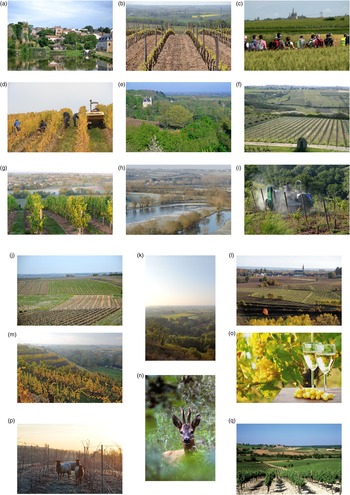
These questions had to be answered with one choice out of 17 photographs (8 × 12 cm, Fig. 2) from a corpus that was composed using different criteria as follows: five photographs representing a landscape complexity gradient (an increase of semi-natural elements proportion combined with a decrease in vineyard proportion in the landscape): J, L, F, E, K. Two pictures displayed contrasting wine-growing practices with a complex landscape as background: bare soil vs vegetation cover in the inter-row (B and G, respectively). Soil management with vegetation cover can be considered as semi-natural element thereby increasing landscape complexity. Other practices related to winegrowing, that are not influencing the landscape but may shape the experience of visitors, are craftwork in photograph D (traditional hand-harvesting as part of DGO rules), the use of machinery and pesticides in photograph I (state-of-the-art technology) and agro-pastoralism as an example for low-input viticulture in photograph P (agroecological techniques are still unusual in the ‘Coteaux du Layon’ area). We also showed pictures of other cultures than viticulture, such as cereals in photograph C and rapeseed in photograph K. Some pictures were included in the questionnaire because they show different recreational activities that can influence landscape perception (Barroso et al., Reference Barroso, Pinto-Correia, Ramos, Surová and Menezes2012; van Zanten et al., Reference van Zanten, Zasada, Koetse, Ungar, Häfner and Verburg2016): historical heritage in photographs A, L, C, E and F; sports or outdoors activities, such as hiking in photograph C, fishing or swimming in photograph H, naturalism or hunting in photograph N; and eno-tourism in photograph O (wine tasting or purchase, cellar and vineyard visit). Finally, we also presented some characteristic abiotic elements from the region that define the local terroir: typical slope in photographs B, D, H and M; the river in photographs G, H and M; and the fog in photograph G. We introduced a photograph from another wine-growing region in France: DGO ‘Gaillac’ in the South-West of France in photograph Q to review if visitors recognize the landscape in the DGO ‘Coteaux du Layon’. In this photograph, the soil and the trees species in hedges are representative of the French Southern viticulture. We arranged the photographs on a board (Fig. 2) to have a balanced view of colors and shapes as well as a good mix of photographs showing landscape, wine-growing practices and touristic activities.
Selection of photographs shown to the visitors in the questionnaire and arranged as on the board presented to respondents during sampling.

Each photograph choice was followed by an open-ended question to explain the choice (Barroso et al., Reference Barroso, Pinto-Correia, Ramos, Surová and Menezes2012; Othman et al., Reference Othman, Mohamed and Ariffin2015). The given reasons were coded and assigned to different categories to understand which element in the picture was the main driver of preference (Appendix 3). While only one photograph could be chosen to answer a question, a specific photograph could be selected several times to answer different questions.
The second part in the questionnaire, the socio-demographic part, was used to investigate factors that could influence responses in the first part, such as age, education level, region of origin, type of social connections in and touristic interest for the wine-growing region (Appendix 4). During spring/summer 2016, the questionnaire was mostly presented in person to 192 visitors in the wine-growing region of the DGO ‘Coteaux du Layon’ and to habitants of the capital town of the department, Angers (Fig. 1), who had visited the region at least once. Sampling occurred in different parts of the DGO ‘Coteaux du Layon’ during touristic events, such as vineyard visits, open cellars, hike and taste days, and regional festivals, as well as on camps sites and in tourist information offices. Additionally, an electronic version of the questionnaire was published by tourist information offices and ‘Independent Winegrowers’ trade union.
Data analysis
Statistical analyses were performed on R version 3.1.2 (R Core Team, 2014). For the analysis of the website content, a Correspondence Analysis was performed on a table containing the number of photographs per category (Appendix 1) in each website (Ménadier, Reference Ménadier2012). As we only considered websites with more than five photographs for this analysis, 38 out of 50 were kept in the Correspondence Analysis. The significance level for absolute contribution was defined as:
 $$\displaystyle{1 \over {\rm Number\; of\; variables}\; \left(N = 11 \right)} \times 10\; 000.$$
A Hierarchical Cluster Analysis (agglomerative type) was performed on the coordinates of the Correspondence Analysis using Ward distance (Rousseau, Reference Rousseau1991) with 11 factors to identify the different website profiles of winegrowers. Tourist information offices’ websites were added according to their respective iconographic composition as illustrative elements to check if they fit into winegrower's website profiles.
To analyze landscape photographs in all winegrowers’ and tourist information offices’ websites, we performed a Multiple Correspondence Analysis on the landscape composition parameters (Appendix 2). We decided to retain landscape composition parameters for the interpretation if their correlation ratio on one axis was ⩾30%. Parameter values were then described on the axis if their absolute contribution was higher than:
 $$\displaystyle{1 \over {\rm Number\; of\; parameters\;} (N = 36)} \times 10\; 000.$$
A Hierarchical Cluster Analysis (agglomerative type) was performed using Ward distance on the χ2 projection of the data. The distribution of landscape photographs in different clusters was compared between winegrowers’ and tourist information offices’ websites with χ2 test (Crawley, Reference Crawley2007).
For the analysis of the questionnaire, the final number of considered answers per question varied as some respondents did not fill in the whole questionnaire. For each question, we performed Fisher's exact tests with simulated P-value (1000 repetitions) on the distribution of the answers among the socio-demographic groups (Crawley, Reference Crawley2007) for each socio-demographic parameter (Appendix 4). When the test result was significant, we used two-by-two post-hoc Fisher's exact tests with Bonferroni correction (McDonald, Reference McDonald2013) to identify the differences between socio-demographic groups.
Thereafter, we associated website photographic profiles from the Correspondence Analysis with the answers to the questions 1 and 2 to find out if websites’ photograph compositions target the preferences of wine consumers and tourists (hypothesis 1). Landscape photograph typology defined by the Multiple Correspondence Analysis was also associated with answers to question 3 to identify if winegrowers and tourist information offices include landscape photographs in their websites that show biodiversity perceived as favorable to vineyards by visitors (hypothesis 2).
Results
Role of landscape in winegrowers’ representations and drivers of motivation to purchase wine or visit the DGO region
The Correspondence Analysis identified six winegrowers’ website profiles in the DGO ‘Coteaux du Layon’ (Fig. 3a) according to the significant contributions of photograph categories to each axis (Fig. 3b). The profile ‘wine’ corresponds to a group of winegrowers that showed wine bottles in 90% of the pictures on their website, while the profile ‘tourism–wine’ emphasizes tourism activities, such as wine tastings or vineyard hikes, besides wine bottles. Profile ‘craftwork–portrait’ comprises websites where either harvesters or workers in the cellar or the winegrowers themselves in front of the vineyards were shown. In the profiles ‘vine’, vineyards or vine plants/grapes were shown on most photographs, in the profile ‘vine–landscape’ also the surrounding landscape. However, no websites showed more landscape photographs than vine photographs. There is also an ‘undefined’ cluster of six websites that showed a large range of different photographs capturing elements of all profiles. The tourist information offices seemed to be characterized by photographs representing historical heritage, especially for the two southernmost tourist information offices Doué-La-Fontaine and Vihiers, while the two other tourist information offices showed also some landscape photographs (Fig. 3, Appendix 5).
Correspondence Analysis (CA) of the photographic composition of winegrower's websites in the wine-growing region ‘AOC Coteaux du Layon’ (N = 38 websites). The inertia of each axis is indicated beside the axes. (a) Each cluster of winegrowers’ websites (gray dots) represents a website profile defined by the cluster's position relative to the two axes (Hierarchical Cluster Analysis). As such the website profile for each cluster is defined by the position of the photograph categories (see Appendix 1 for definition of photograph categories) relative to the axis they contribute to (b). Significant contributions for axes 1 and 2 are mentioned in brackets, first axis contributions are underlined and second axis contributions are not.

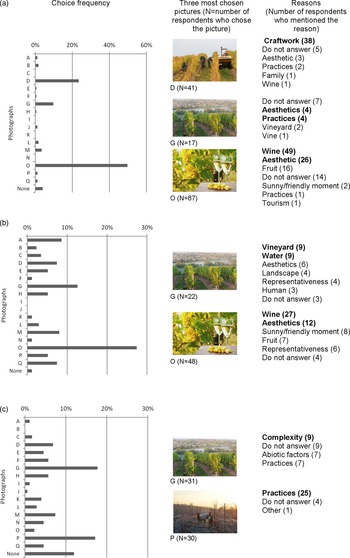
The most inviting photograph to buy wine differed significantly between categories of touristic interests (no differences found between categories of age, education level, region of origin or social connections, Table 1), while socio-demographic categories had no influence on question 2 about the photograph selected as a postcard (Table 1). The most chosen photograph for these two questions was O with a glass of wine (Figs. 4a and b). Visitors interested in the terroir mainly chose the photograph O as the most inviting one to buy wine in the DGO ‘Coteaux du Layon’ (Appendix 6).
Choices frequency (%) for each photograph to (A) Question 1: ‘Which photograph is most inviting to buy wine?’, (B) Question 2: ‘Which photograph could illustrate a postcard of the region to send to relatives or friends?’, (C) Question 3: ‘Which photograph represents biodiversity that could be beneficial for vineyards?’ (N = 175 for each question). See Appendices 1, 2, 3 for differences between two socio-demographic groups. For photographs, see Figure 2. Reasons are not exclusive as each respondent could mention several of them (see Appendix 3 for reasons definition).

Fisher exact tests’ probabilities P of photographs chosen as answers to questions 1–3 between different socio-demographic groups (see Appendix 4 for grouping criteria)

*Points out significant differences of distribution between socio-demographic groups if P < 0.05. N, total number of answers, in brackets. N is lower than the total number of respondents, because some questionnaires were incomplete. Only photograph choices of >10% per socio-demographic group were considered in the analysis.
Although this choice of the glass of wine could correspond to the winegrowers’ website profile ‘wine’ (see Fig. 3), photograph O was not only chosen for showing the wine, but also for the aesthetic of the photograph itself and for sunny/friendly moments associated by the respondents to this picture (Figs. 4a and b).
The second most chosen photograph to answer question 1 was D showing the hand-harvest (Fig. 4a). Particularly, visitors interested in eno-tourism or historical heritage and non-touristic visitors answered with photograph D (Appendix 6), which could correspond to the winegrowers’ website profile ‘craftwork–portrait’ (see Fig. 3), because 93% of the respondents mainly mentioned hand-harvest as a reason for their choice (Fig. 4a).
Photograph G, combining extensive soil management practices in vineyards (vegetation cover in the inter-row) with complex and diverse landscape in the background, was the second most chosen photograph to answer question 2 (Fig. 4b). Except pure wine purchasers, some individuals of all other socio-demographic groups also chose photograph G to answer question 1 (Appendix 6), so it was the third most chosen photograph for this question (Fig. 4b). Aesthetic aspects of the elements, vine and landscape presence, and human-managed vine plants were the main reasons for choosing photograph G to answer both questions (Figs. 4a and b). This choice could correspond to the winegrower's website profiles ‘vine’ and ‘vine–landscape’ (see Fig. 3).
Role of landscape complexity in the photographs of winegrowers’ websites and visitors’ perception of biodiversity benefits for viticulture
Landscape (i.e., large portion of space) was shown on 145 out of the total 1008 sampled photographs. Semi-natural elements, river, vineyards, grass strips and non-flowering crops were the main components of viticultural landscape photographs on winegrowers’ and tourist information office's websites (Fig. 5). Landscape photographs could be grouped into intensive viticultural landscapes under human influence (group 1 in Fig. 5, >50% vineyards with human presence), semi-natural landscapes (group 2 in Fig. 5, no vineyards, >50% semi-natural elements and >50% water bodies) and diverse viticultural landscapes (group 3 in Fig. 5, <50% vineyards with grass strips, <50% semi-natural elements and other crops).
Multiple Correspondence Analysis (MCA) of the composition of landscape photographs from winegrowers’ websites (circles, N = 118 landscape photographs) and Touristic Information Offices’ websites (squares, N = 27 landscape photographs) in the wine-growing region DGO ‘Coteaux du Layon’. The inertia of each axis is indicated besides the axes (see Appendix 2 for parameter definitions and values). Parameters values are indicated only for parameters with a correlation ratio ⩾30%. Significant contributions for axes 1 and 2 are mentioned in brackets, first axis contributions are underlined and second axis contributions are not.

The contribution of landscape photographs to these three groups differed between winegrowers’ and tourist information office's websites (χ2 test, χ2 = 26.36; df = 2; P < 0.0001). Winegrowers in general showed rather intensive viticultural landscapes (73% of all landscape photographs from winegrower's websites are in group 1) than semi-natural landscapes (7% in group 2), whereas tourist information offices show both intensive viticultural (48% of all landscape photographs from tourist information office's websites are in group 1) and semi-natural landscapes without viticulture (45% in group 2). The presence of the river Layon seemed to be an important communication element for tourist information offices (in group 2 photographs show mainly water bodies), but not for winegrowers. Some winegrowers might be aware of the benefits of a complex and diverse viticultural landscape as they show it in some photographs on their websites (20% in group 3), while tourist information offices might not see the touristic potential (7% in group 3).
There were differences between the categories of age and touristic interests in the choice of photographs regarding beneficial biodiversity for viticulture (Table 1). Photograph G, combining extensive soil management practices of vineyards with a complex landscape in the background, and photograph P, showing grazing sheep in the vineyard, were the most chosen ones (Fig. 4c). Reasons to choose photograph G were landscape complexity, abiotic factors visible in the photograph (e.g., slope, humidity) and extensive practices of soil management in the vineyards (i.e., vegetation in the inter-row of the vineyard, Fig. 4c). Such a complex landscape was only reflected by landscape photographs in group 3 of tourist information offices’ and winegrowers’ websites (Fig. 5).
Moreover, within the clusters ‘vine’ and ‘vine–landscape’ in the analysis of the winegrowers’ website profile (Fig. 3), 102 photographs represented landscapes or vineyards; 66 of them showed vegetation cover in the inter-rows and 13 bare soil, while the others did not allow to see soil management practices. However, for 30–44 yr old visitors, photograph P showed more biodiversity than photograph G, because of the alternative soil management practices involving more fauna (78% of answers, Appendix 7). Elder people (>60 yr) mainly answered ‘none of the photographs’, because they do not know or useful fauna is not visible on any of the photographs (80% for both answers combined, Appendix 7), and historical heritage visitors chose photograph N, evoking landscape complexity associated to game fauna (100% of answers, Appendix 8).
Discussion
Importance of wine and traditional production representations for wine purchasing in the DGO
Ménadier (Reference Ménadier2012), who studied several cheese DGOs in Auvergne and Franche-Comté (France), identified two themes for regional representation used in communication: (1) abiotic characteristics (can be related to the ‘terroir’ concept), which is similar to ‘vine’ and ‘vine–landscape’ website profiles in our study, and (2) know-how and consumption of the products (associated with friendliness and quality) similar to ‘craftwork’ and ‘wine’ profiles in our study.
The aesthetics of photograph O is the most important driver for it being selected for encouraging buying wine. Mood lighting and bright colors create important contrasts that could influence perception (Arriaza et al., Reference Arriaza, Cañas-Ortega, Cañas-Madueño, Cañas-Madueño and Ruiz-Aviles2004). This photograph also evokes wine taste and quality as well as conviviality of a wine consuming moment (see also Ménadier, Reference Ménadier2012).
Traditional practices and familial characteristics of a vineyard, as shown on the second most chosen photograph D, are often highlighted on winegrowers’ websites (especially the profile ‘craftwork–portrait’, but also other websites outside this profile) and described as attractive elements that can translate into wine and vineyard quality (Boisvert, Reference Boisvert2006) like in Saint-Emilion vineyard classified as UNESCO World Heritage Site (Briffaud and Davasse, Reference Briffaud, Davasse, Luginbühl and Terrasson2012). These traditional practices have socio-economic consequences (Boisvert, Reference Boisvert2006) and know-how transfer and employment of local people for hand-harvesting can play a role in the perception of viticulture (Luginbühl, Reference Luginbühl2007). Hence, social and technical heritage became associated with the idea of quality and authenticity, which is not always justified, and known as folklore. Laferté (Reference Laferté2003) has described folklore development in Burgundy's vineyards at the beginning of our century by the progressive association of wine quality with a local craftwork. In consequence, touristic iconography for wine-growing regions had been dominated in the past by winegrowers and workers in relation with wine products (Williams, Reference Williams2001).
Influence of visitors’ knowledge about biodiversity beneficial for viticulture on their perception of landscape aesthetics
It seems visitors have certain knowledge about biodiversity favoring practices and landscape complexity beneficial for viticulture, as photograph G and semi-natural elements it shows were mainly chosen to illustrate beneficial biodiversity for viticulture. If it is in contradiction with some winegrowers’ statements, such a result follows what can be found in the literature (e.g., Naveh, Reference Naveh2001).
By choosing photograph P, because they think it represents alternative management practices, visitors show an underlying knowledge in the perception of the ecological state of the vineyard can also shape their experience of landscape aesthetics (Arriaza et al., Reference Arriaza, Cañas-Ortega, Cañas-Madueño, Cañas-Madueño and Ruiz-Aviles2004). Likewise, photograph G was also the second most chosen photograph for aesthetics because it shows a complex landscape and vegetation in the inter-rows. Similar results were obtained by Nassauer and Westmacott (Reference Nassauer, Westmacott and Turner1987) and Nassauer (Reference Nassauer1995), where knowledge-oriented landscape are preferred.
Several authors revealed that complex landscapes providing most ecosystem services are usually preferred by inhabitants, local workers as well as tourists over simplified agricultural landscapes (García-Llorente et al., Reference García-Llorente, Martín-López, Iniesta-Arandia, López-Santiago, Aguilera and Montes2012; van Zanten et al., Reference van Zanten, Zasada, Koetse, Ungar, Häfner and Verburg2016). Vegetation without ecological relevance (e.g., ornamental exotic species), however, could also increase landscapes aesthetic (Tempesta, Reference Tempesta2010). Since respondents pointed out complexity as a driver of their choice, they confirmed to have a certain ecological knowledge, but the explanations were not sufficient to detect comprehension of specific ecological functions.
Most of the elder respondents answered they do not know about beneficial biodiversity for viticulture, which could be explained by a lack of information about biodiversity itself. Lindemann-Matthies and Bose (Reference Lindemann-Matthies and Bose2008) described an influence of age on respondents’ familiarity with the concept of biodiversity, elder people being less likely to have already heard about this concept. The photo of the grazing sheep (P) was mainly chosen in the age class from 30 to 44 yr, because it implies the use of alternative practices such as promoted by recent agroecology models (Altieri, Reference Altieri1983). Visitors interested in historical heritage choose the portrait of the deer (N), because it can represent to them more historical agricultural landscapes. Hence, in both cases, the perception could lead to a romantic vision of this type of agriculture (Gobster et al., Reference Gobster, Nassauer, Daniel and Fry2007) rather than to a real knowledge about the effects it has on agro-ecosystems.
Although Lamarque et al. (Reference Lamarque, Tappeiner, Turner, Steinbacher, Bardgett, Szukics, Schermer and Lavorel2011) showed that farmers are aware of ecosystem services such as landscape aesthetics, winegrowers’ websites showed mostly vine: the plant, fruit or plot, but less landscape complexity or soil management practices. Some winegrowers recognized the importance to show their practices as they noted an increasing demand from consumers and merchants to get more information about the production conditions (preliminary interviews, see also Ménadier, Reference Ménadier2012). Visitors’ preference for complex landscapes including more extensive practices could thus (i) make winegrowers more sensitive to landscape preservation and to extensive management practices (Candau and Deuffic, Reference Candau, Deuffic, Auclair, Aspe and Baudot2006), (ii) lead to the use of landscape management as part of the regional image and touristic development (Falcade et al., Reference Falcade, Medeiros and Pérard2012), and (iii) influence landscape planning and agricultural policies favoring agroecological measures (Gobster et al., Reference Gobster, Nassauer, Daniel and Fry2007), such as incentives for planting hedges and flowering grass strips in the DGO Champagne (CIVC, 2014).
Role of landscape features in the DGO promotion by winegrowers and tourist information offices
In his report about landscape in DGO promotion for the French Ministry of Agriculture and the National Institute of DGOs, Gauttier (Reference Gauttier2006) defines different types of landscape representations. The first one is the landscape as background, whereas the product is presented in the foreground, sometimes with other related objects, such as a glass for liquids or a knife for cheese. In our study, association of the product ‘wine’ with landscape remained extremely unusual. Instead, on winegrowers’ websites, the focus was on bottles with the label highlighted and rarely on wine in glasses. Ménadier (Reference Ménadier2012) also shows for cheese DGOs that landscape observation and product consumption are two separate activities, hence landscape is generally less presented on producers’ websites. It is hence a strong contrast that the most chosen photograph in our study represents a glass of wine in front of a vine plant and grapes. Wine bottles presentations on the websites might therefore not correspond to what consumers associate with the wine glass presentation they chose: aesthetics of the picture itself, sunny moments of wine tasting and conviviality. Mora and Moscarola (Reference Mora and Moscarola2010) evidenced that photographs evoking the emotion experienced during wine tasting or purchasing are the best advertising strategy.
The second type of landscape presentation defined by Gauttier (Reference Gauttier2006) is the landscape shaped by agricultural activities. This definition could correspond to the profile ‘vine’ of winegrowers’ websites and to the vineyard-dominated landscapes they mainly show. The third type of landscape presentation defined by Gauttier (Reference Gauttier2006) is the scenic landscape including some specific animals, famous villages or historical heritage, the latter being a major element of rural landscape aesthetics (Tempesta, Reference Tempesta2010). As such, the tourist information offices’ communication strategy analyzed in our study focused on historical heritage or a natural landscape, mainly composed of semi-natural elements and water in the photographs. Water's influences on the landscape attractiveness are now widely admitted [see, e.g., Parsons and Daniel (Reference Parsons and Daniel2002) in the USA, Arriaza et al. (Reference Arriaza, Cañas-Ortega, Cañas-Madueño, Cañas-Madueño and Ruiz-Aviles2004) in Spain or Dramstad et al. (Reference Dramstad, Tveit, Fjellstad and Fry2006) in Norway]. The objective of these touristic websites is to provide an attractive image of the region, with very typical subjects or elements usually considered as ‘beautiful’ (preliminary interview with tourist information office employees). Only the fourth type of landscape representation, the ‘stylized landscapes’ as a graphic representation of ‘emblematic’ characteristics allowing an abstract interpretation (Gauttier, Reference Gauttier2006), was absent from the winegrowers’ and tourist information offices’ websites, maybe because they are more often used for bottle labels and flyers, that we had not included in our study.
In governmental or other specialized publications, landscape aesthetic is described as a tool for product promotion (e.g., Ambroise and Brochot, Reference Ambroise and Brochot2009) potentially strengthening DGO regions (Candau and Ginelli, Reference Candau and Ginelli2011), especially when the link between landscape complexity and product quality is anchored in the DGO definition (Gauttier, Reference Gauttier2006).
In general, environment-friendly production methods do not seem to be the major decision criteria to buy a product (Forbes et al., Reference Forbes, Cohen, Cullen, Wratten and Fountain2009), especially when this product is more expensive than others from conventional production methods (Fassier-Boulanger, Reference Fassier-Boulanger2006). Therefore, consumers need to understand the benefits provided by complex landscapes and traditional practices in general, but also for viticulture, in an agronomic, socio-economic and ecological context and that could shape their perception of landscape aesthetic (Gauttier, Reference Gauttier2006). Landscape aesthetic as cultural ecosystem service could then increase the touristic attractiveness of a rural wine-growing region and might even become part of territory planning for sustainable regional development (Benvenuti et al., Reference Benvenuti, Giannace and Ciacci2012) with winegrowers being directly involved (Herbin and Rochard, Reference Herbin and Rochard2012).
Conclusion
Winegrowers from the DGO ‘Coteaux du Layon’ have different communication strategies to illustrate and promote their production on their website. Most of them show simple, viticulture-dominated landscape or only the vineyard. The tourist information offices’ strategy is different from that of winegrowers by mainly showing natural and historical heritage. Nevertheless, complex viticultural landscape is appreciated by visitors, and they seem to know ecological benefits of complex landscapes and extensive vineyard management practices. Recent literature and also local winegrowers highlight the increasing interest of consumers for an environment-friendly viticulture. Our results emphasize that landscape can be a relevant element to promote DGOs, as French national professional organizations tend to consider, as (i) visitors have enough knowledge about environment-friendly practices, (ii) extensive practices increase landscape complexity and (iii) landscape aesthetic is associated to socio-economic aspects of traditional production methods, such as hand-harvesting.
Landscape planning should then become a process of regional sustainable development involving winegrowers’ engagement in shaping a local identity through vineyard management and wine production. Policy recommendations for agroecological measures could build on cultural ecosystem services provided by the wine-growing landscape. Wine itself or the wine experience, evoked by the aesthetic of the photograph, remain the most attractive elements to motivate visitors to buy wine. However, wine on winegrowers’ website was presented as bottles and our methodological approach did not allow to confirm if wine bottles on photographs have the same impact on consumers as our wine-in-the-glass photograph with a vine plant in the background. Therefore, future analysis should investigate how the motivation to buy DGO products evolves with increasing ecological education of consumers and developing policy or DGO rules toward agroecological practices in the viticultural landscape. Moreover, the willingness to pay for cultural ecosystem services could be estimated through the purchase of environment-friendly produced wine.
Supplementary material
The supplementary material for this article can be found at https://doi.org/10.1017/S1742170518000273.
Acknowledgements
The authors would like to thank persons who provided their photographs: the tourist information office of the Vihiersois-Haut-Layon (photograph A), Jean-Paul GISLARD (photographs B, D, E, G, H, I, L, M and N), the organizers of Translayon (photograph C), Albin Fertil (photograph J), Château Pierre Bise (photographs M and P), LG Traiteur (photograph O) and Petit Futé (photograph Q). Maps were realized from BD CARTHAGE® (OpenLicence) and ©OpenStreetMap contributors data (free license ODbL). Thanks to Valérie Briand for literature survey. The authors also acknowledge the constructive comments on the manuscript by Alain Bellido from the University of Rennes 1, Martin Potthoff and Holger Bergmann from the Georg-August-University Göttingen, the support by Rebekka Schütte (through the possibility asking landscape-related questions during her focus group) and the great help of Claudia Wiegand for the language and the revisions. This study was funded by the French ANR through the ERAnet BiodivERsA project ‘VineDivers’ (2015–2018). The authors thank the two anonymous reviewers for their helpful comments.