INTRODUCTION
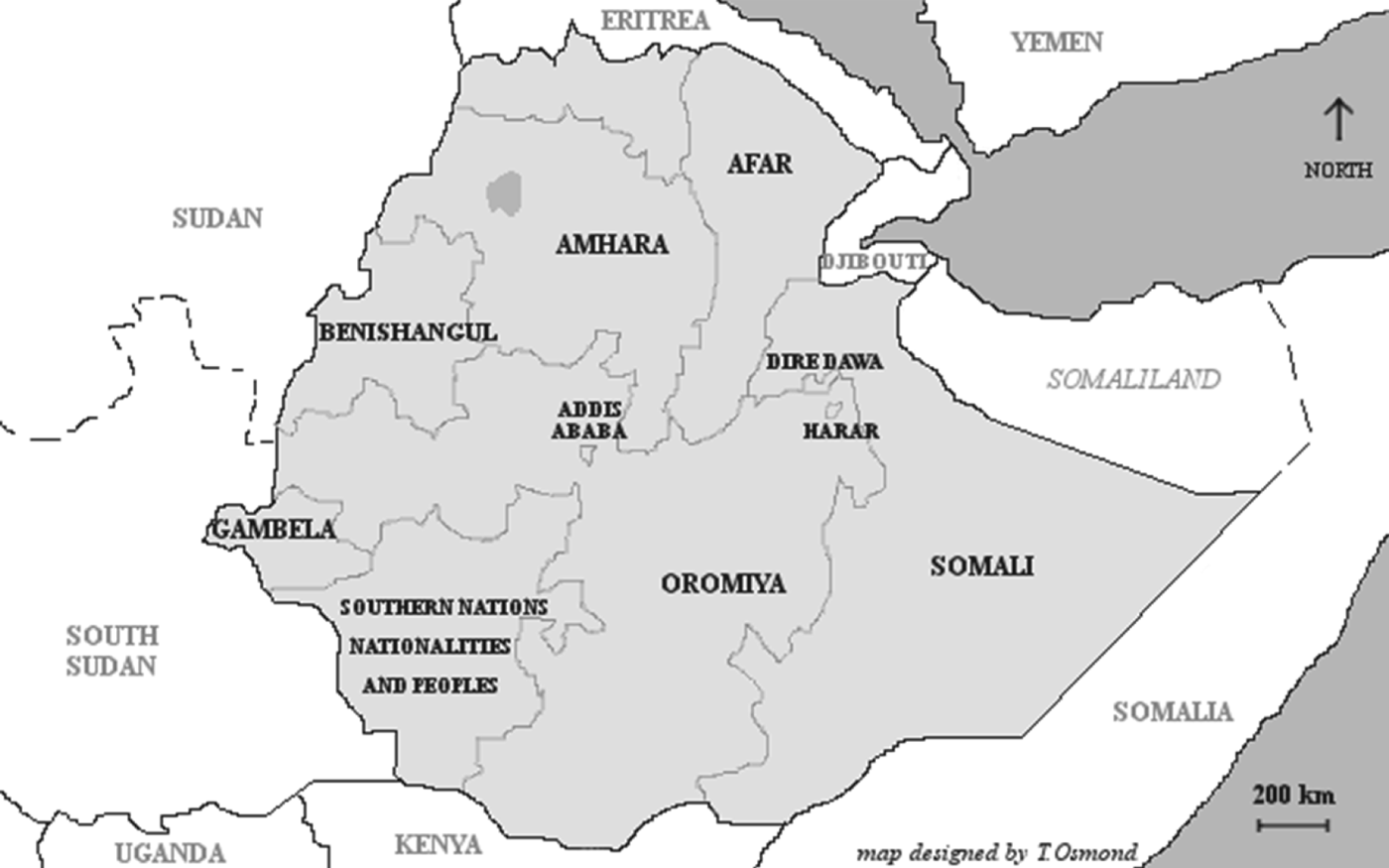
This paper explores some of the historical divergences and interrelations between the Muslim orders in the city of Harar and its rural vicinity. It is still commonly assumed that the regional history is mainly rooted in the developments of the Harari civilisation. The Muslim urban elites of Harar are often opposed to the traditionalist Oromo peasants inhabiting the territories that surround the town. Until recently, these Oromo populations have been generally depicted as the ‘foreign’ and ‘pagan tribes’ that recurrently threatened the existence of the Muslim city since the 16th century (Barker Reference Barker1842; Burton Reference Burton1856; Caulk Reference Caulk1977). In the middle of the 1990s, the Constitution founding the Federal Democratic Republic of Ethiopia formally banned these pejorative discourses on the Oromo inherited from the imperial regime. Indeed, the new Constitution provides all the other ‘nations, nationalities and peoples’ of the country with the same institutional rights and statuses within the Ethiopian multinational federation. To break the centre/periphery hierarchy of the previous regimes, the territories of each ‘nationality’ are now administered by almost autonomous regional governments (Assefa Fiseha Reference Assefa and Turton2006). Centred on Harar town, the Harari Regional State constitutes an enclave within the mainly agricultural and pastoral eastern territories of the Oromiya Regional State.
The Ethiopian Federation in the Horn of Africa today.

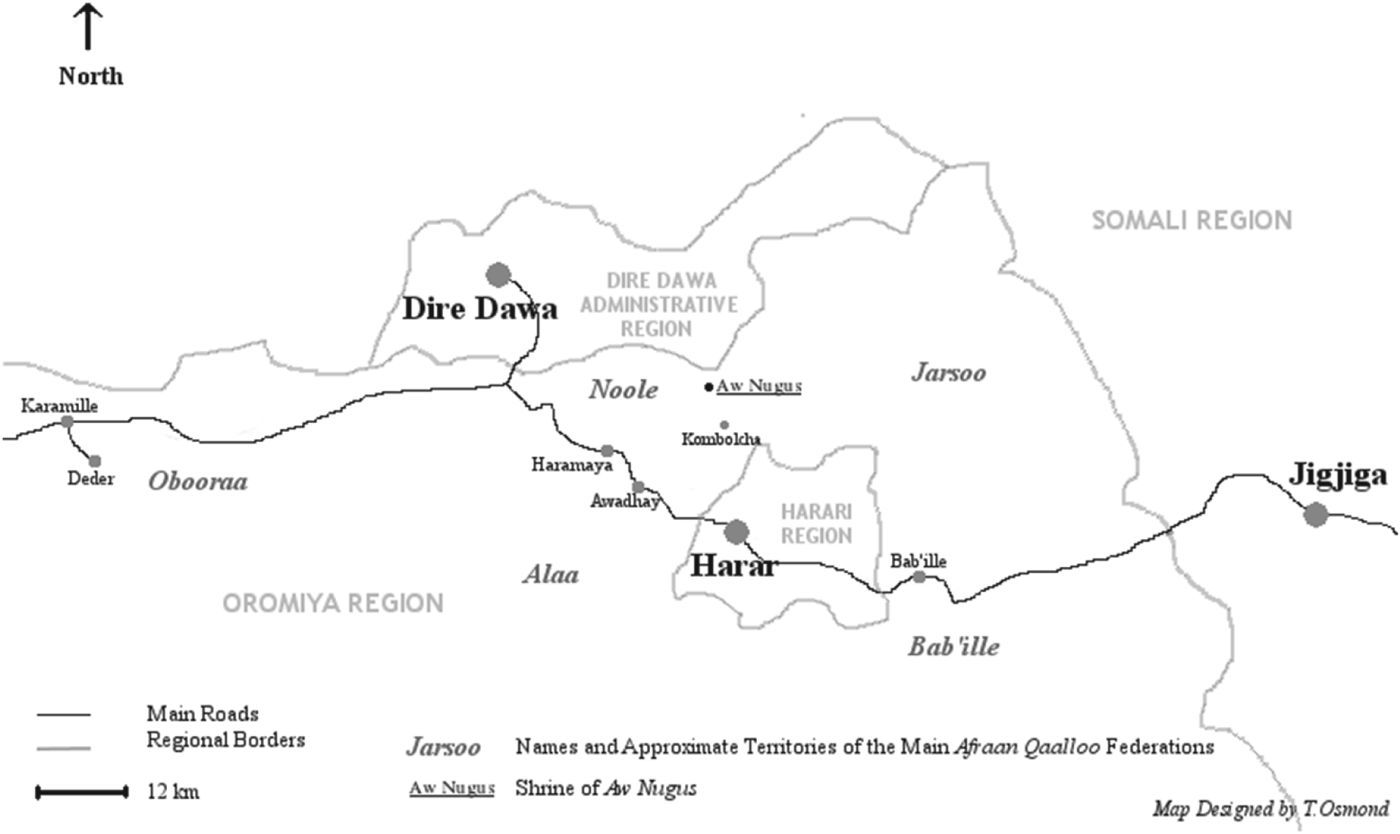
Harar and its vicinity in the present Ethiopian Federation.
Contrary to the formal objectives of the 1995 Federal Constitution, the official recognition of the Harari and Oromo ethnolinguistic ‘nationalities’ has not moderated the historical tensions between the famous Muslim city of Eastern Ethiopia and its close neighbours. For two decades, the identity discourses produced within the Ethiopian multinational regime have rather fostered and remodelled the former cultural discriminations, by opposing the ‘Harari Muslim civilization’, historically rooted in the Middle East, to the current ‘Oromo indigenous civilization’, embedded in the African traditions (Dirribi Demissie Reference Dirribi2011). These dominant discourses tend to elude the ancient and plural relationships that bind the Muslim city of Harar to the complex political orders of its present Oromo vicinity. Last but not the least, by reviving the local historical oppositions inherited from the Ethiopian imperial regime, the current competing (re)definitions of the Harari and Oromo identities could generate important conflicts in a near future (Osmond Reference Osmond2013b).
This article attempts to provide another interpretation on the local political history of Eastern Ethiopia. Far from the static classifications produced by the classical ethnicist readings, this article proposes to explore the historical dynamics of the local polity.Footnote 1 It privileges the diachronic study of its conflicting trends along the moving relationships between Harar and its regional vicinity. This work challenges the current Harari/Oromo distinction by arguing that Harar has never been an immutable hegemonic centre, exercising a permanent and total control over its rural Oromo neighbours. In the historical longue durée, the urban elites of Harar and the Oromo farmers and cattle herders of Eastern Hararghe have rather been the two competing and complementary sides of the same coin. The conflicting history of Harar and its close neighbours involves various and changing Muslim networks, economic partnerships and political coalitions. Behind the current solidarities around the Harari and Oromo ‘nationalities’, this urban/rural configuration seems to reflect the historical developments of the Muslim city models that shape the local trajectories of Islam in Eastern Ethiopia.
REINTERPRETING THE HARARI/OROMO IDENTITIES THROUGHOUT THE POLITICAL DYNAMICS OF THE HORN OF AFRICA
The Harari, Oromo, Somali and Afar languages spoken in Eastern Ethiopia present several words and expressions related to the city. Most of them directly originate from Arabic, though their local pronunciations are sometimes modified in the local languages. In the case of Harar, these different words tend to define the several religious, political and economic devices, associating the urban populations with those living in its rural vicinity. The local market areas, residences and Muslim shrines constitute the privileged locations of the local polity. From the old medina of Harar to the rural territories of Eastern Hararghe, these locations of power mobilise the different social statuses performing the diachronic face-off between the city and its ambivalent hinterland.
The farmers, the pastoralists and the markets of Harar
Until recently, the Oromo populations of Eastern Hararghe were often called Qottuu that literally means ‘those who plough the land’ in Oromo language. However, the Qottuu were not only the farming populations living in the vicinity of the town. Contrary to the ‘civilised’ urban dwellers of Harar, their status of peasants was often associated with their brutal manners, lack of education and almost ‘pagan’ practices. The Qottuu were also closely related to the ‘Galla’ – or Gaala Footnote 2 – populations. According to the elites of the local sultanates and Christian kingdoms that emerged throughout the history of the territories of present Ethiopia, the ‘Galla’ designated the mostly rural, illiterate and almost ‘pagan’ populations who inhabited their hinterlands (Hultin Reference Hultin, Baxter, Hultin and Triulzi1996). These groups generally had a lower social status than the Christian and the Muslim nobles living in the regional political centres. However, they were also their powerful military allies and key economic clients. Last but not the least, whether the ‘Galla’ labelled groups were outside or within the Christian/Muslim political orders, they represented the majority of the inhabitants of these two dominant political centres in the long history of the territories of present Ethiopia. The Qottuu, the ‘Galla’, the Christian and the Muslim elites were not culturally different by essence, but rather culturally differentiated through the moving religious, economic and political statuses developed throughout the regional history (Osmond Reference Osmond, Epple and Girke2013a).
Very few studies have attempted to consider ‘Galla’ as a social stereotype, expressing social statuses related to the rural and urban orders of the Ethiopian history. Among them, the work of Zitelmann (Reference Zitelmann, Baxter, Hultin and Triulzi1996) reveals the plural regimes of historicity of the ‘Galla’/Gaala category and its close relations with the urban/rural duality that shapes the history of the Muslim city of Harar. Zitelmann formulates the hypothesis that Gaala originates from the Arabic term designating the long-distance merchants and the camel herders, carrying the pejorative Muslim connotation of ‘wanderers’.Footnote 3 Indeed, the Muslim elites are generally associated with the city, whereas the populations living outside of urban settlements are more considered as less acknowledgeable in Islam. In addition, the Arabic sources and the local oral narratives indicate that Gaala was ascribed to the rural Muslim notables who claimed their customary rights against the religious elites of Harar since the 16th century.Footnote 4
Today, the word Gaala is still used in most of the local languages in Hararghe and signifies ‘camel, dromedary’. From the same Arabic root, the term magaala means ‘town’ in Oromo, Afar and Somali languages.Footnote 5 In the local vocabulary related to the city, magaala designates the main market areas in Harar and the regional towns in general. These magaala define the urban markets where the Gaala peasants, herders and caravan traders converge to sell their products. From the city of Harar to the surrounding territories of Eastern Hararghe, the local space is generally separated into three social domains: (1) the old fenced medina, the Jeggol, concentrating different well-known regional markets (magaala) controlled by the Harari urban dwellers, where different outsiders or partners converge, inhabiting different types of neighbouring areas; (2) the rural hinterland or the fertile rural vicinity of Harar, where populations labelled today as Oromo handle agro-pastoral production; (3) the trade routes of the farland, located beyond the farming hinterland. These wide territories are mostly inhabited by the nomadic populations of camel or goat herders, like the Somali groups. They were also crossed by the Afar and Gurgura caravans, transporting goods to Harar from other cities such as Zeyla, the ancient regional port on the Indian Ocean.
The people of the city and the people of the countryside
Nowadays, the inhabitants of Harar are still often called the Hadharee or the Hadhariy.Footnote 6 In Arabic, hadhariy is both the noun and the adjective designating an urban dweller and all that relates to a sedentary settlement. In the opposite, the Arabic word baddawiy is used to name the ‘nomad’ and the world of the countryside (bâdiya). In Harar and in all the regional – Oromo, Somali and Afar – languages, the term baadiya also means ‘countryside’. The local use of these Arabic terms expressing the same urban/rural duality reminds of the cleavages described by Ibn Khaldûn (Rosenthal Reference Rosenthal1958), between the ‘people of the countryside’ (‘umrân al-baddawiy in Arabic) and the ‘people of the city’ (‘umrân al-hadhariy). In the Muslim world, he argues that the city-dwellers and the Bedouins often share the same local origin. However, they are socially differentiated along their positions within these urban/rural political orders and their respective modes of solidarity:
Evidence for the fact that Bedouins are the basis of, and prior to, sedentary people is furnished by investigating the inhabitants of any given city. We shall find that most of its inhabitants originated among Bedouins dwelling in the country and villages of the vicinity. (Ibn Khaldûn in Rosenthal Reference Rosenthal1958 (first version 1379), vol. 1; 352).
While the ‘umrân al-baddawiy privileged the local kinship solidarities, farming and cattle breeding production, the ‘umrân al-hadhariy was rather based on the networks of Muslim urban elites and transregional traders.Footnote 7 In the same perspective, this political duality seems to cleave the hadhariy inhabitants of Harar and the Oromo populations living in the baddawiy territories of Eastern Hararghe.
In this dynamic perspective, the city of Harar is not defined from a series of immutable attributes, but rather as a social location crystallizing several political projects and ideological statuses (Lefebvre Reference Lefebvre1968–1972; Holder Reference Holder2004). From the rural hinterland to the centre(s) of the town, these plural political constructions federate and distinguish individuals and social groups along the different parts of the urban and rural spaces they are associated with (Pearson Reference Pearson1998). These categories and their hierarchy are neither immutable nor defined along the ‘static frontier’ separating two monolithic urban/rural orders (Gellner Reference Gellner1969). Like in Northern Africa, the Muslim city and its hinterland rather present different regimes of historicity and political programmes, through the diverse practices of urbanity and the multiple social networks bridging the two urban and rural orders (Grangaud Reference Grangaud and Arnaud2006). They are updated throughout the several regional historical contingencies that frequently redefine the settings of the local polity (Halbwachs Reference Halbwachs1996).
In this dynamic bipolar framework, Harar tends to be generally considered as the main regional market (magaala) and economic centre. Through their hadhariy status, the city-dwellers claim their religious hegemony over their rural neighbours.Footnote 8 Above all, their Muslim seniority and excellence is legitimated by the figure of Abadir, the Patron Saint of Harar, whose shrine is located inside the old medina. However, his controversial identity recalls that the hadhariy hegemony is not an immutable historical reality, but rather a moving political project, challenged by the claims of the baddawiy orders.
THE CONTROVERSIAL LOCAL HEIRS OF PROPHET MOHAMMED'S COMPANIONS
The identity of the Muslim Sharîf missionary who founded Harar around the 11–13th centuries still constitutes a major controversial issue in Harar and among its neighbours. Though the local narratives on the foundation of the city are all embedded in Muslim legacies, they stage two urban and rural competing religious legacies. By claiming their religious legitimacy from the salâf al-madîna,Footnote 9 the dwellers of Harar promote the Qurashi origin of its founder. In the rural vicinity of Harar, it is said that the city was founded by a Husayni and Qadîri missionary, descending from ‘Alî and originating from present Iraq. The controversies about the local urban and rural heirs of Prophet Mohammed's Companions perform the regional adaptations of the Alid dramas and the historical cleavages they generated among the Community of the Believers (Umma).
The Sharîf descendants of Abu Bakr or ‘Alî?
Who was Abadir or rather Abu ad-Dâira, the ‘founding father of Harar’?Footnote 10 The local historical memories clearly diverge on this question. Inside the city, it is generally assumed that his name was ‘Umar ar-Ridha as-Sadîq. Originating from what is now Saudi Arabia (or sometimes Yemen), he belongs to the Banu Taym clan of the Quraish. Sheikh ‘Umar is also presented as a relative of Prophet Mohammad in the eighth degree through their common ancestor, Murra ibn Ka'b. He is also presented as the patrilineal descendant of Abu Bakr as-Sadîq, the first Caliph of Islam. Thus, Sheikh ‘Umar shares this Siddiqi legacy, designating the heirs of Prophet Mohammad's ‘truthful’ Companions (sahâba). In the beginning of the 11th or 13th century, he founded Harar which became the famous Muslim missionary centre from where he initiated the Islamisation of the present Hararghe zone.Footnote 11 He is then considered as the eponym ancestor of the urban dynasty of the Muslim Harari elites, whose descendants still perpetuate both his Qurashi and Siddiqi heritage.
In the rural vicinities of the city, the local historical narratives argue that Harar was founded by the Qadîri missionaries coming from Baghdad to spread Islam in the Horn of Africa since the 11–13th centuries. Their Sharîf ascendance passes by Fatîma, the Prophet's daughter and ‘Alî's wife, through the descendants of their two sons, Hassan and Husayn. According to the local narratives, these Qadîri missionaries implemented the political pact inaugurating the peaceful relationship between both the Muslim dwellers of Harar and the rural populations of Eastern Hararghe. When these missionaries left to conduct their religious activities in other places, one of them was assigned to the protection of the city. He and his descendants were given the title of Abu ad-Dâira, ‘father of the town’. Today, his local heirs mostly dwell in the rural Sufi shrines around Harar and still follow the Husayni legacies of his original Islamic teaching.Footnote 12
The identity of the Harar founder opposes two distinct Qurashi/Husayni Sharîf claims, legitimating two historical interpretations of the local Islamisation process. Within the old fenced medina of Harar, ‘Umar ar-Ridha's heirs would descend from the Arab elites who initiated the teaching of Islam in the city since the 11th or 13th century. The rural populations inhabiting the vicinity of Harar would remain ‘pagan’ until the end of the 19th century (Caulk Reference Caulk1977). However, according to other historical traditions outside the city, the Qadîri missionaries who founded Harar also established mosques and Quranic schools in its rural vicinity. Since the 11–13th centuries, they trained rural Islamic elites whose present heirs are often presented as the local descendants of Husayn and ‘Alî.
Today, when one discusses these contradictory local memories with the Harari elders, they generally answer that the Islamisation process among the rural populations was very slow and partial until recent times.Footnote 13 The forms of Islam in the countryside would be pale, polytheist and superstitious attempts to copy the ‘authentic’ Harari version of Islam, legitimised by the prestigious literate knowledge of the Qu'rân attributed to the urban Harari elites. However, these contemporary discourses seem to perform more ideological statements embedded in the local city/countryside dichotomies, than neutral historical facts.
The vestiges of ancient mosques built in the countryside suggest that several Muslim Sufi communities have indeed been established in the vicinity of Harar for several centuries.Footnote 14 Far from being linear, the history of Islam in Africa rather follows the diachronic fluxes and refluxes of Islam (Goerg & Pondoupoulo Reference Goerg and Pondoupoulo2012). In the case of Harar and Eastern Hararghe, several historical sources quote the competing superposition of numerous Qadîri, Hanâfi and Shâfi'i missionary movements and doctrinal shifts since the 12th century at least (Aklilu Asfaw Reference Aklilu2000; Desplat Reference Desplat2005; Bardey Reference Bardey2010; Husayn Ahmed Reference Husayn2010). Among them, the local historical narratives (Bardey Reference Bardey2010) stress the role of Qadîri missionaries originating from Baghdad. They are often associated with the pact that founded Harar around the shrines of Abu ad-Dâira and Sheikh Gatur, respectively located inside and right outside the medina of the city. It is said that these two Qadîri shrines would represent the two urban and rural sides of the founding pact that bound Harar to the populations of its rural vicinity some eight hundred years ago.Footnote 15 Indeed, inside and close to the medina, two similar graves (qubba) dedicated to ‘Abd al-Qadîr al-Jilâni are found in the shrines of Abu ad-Dâira and Sheikh Gatur. Until today, the yearly celebrations of ‘Abd al-Qadîr al-Jilâni's birthday – locally called Juma'aberk'elle Footnote 16– still commemorate the urban/rural Qadîri pact in Harar and the whole territories of Eastern Hararghe. Beyond the competing Qurashi and Husayni legacies, the celebrations of Juma'aberk'elle express the historical existence of one (or several) pact(s) under the Qadîri patronage that federated the newborn city of Harar and its rural vicinity (Osmond Reference Osmond2013c).
Shifting Muslim legacies and fratricide conflicts
Nowadays, there is no final answer to the controversy about the founders of Harar and the historical spread of Islam in its vicinity. However, it seems clear that the competing narratives on the identity of the city founders and the Islamisation of the region are not immutable, but rather express the political contingencies of the local history of Islam. Since the foundation of Harar, the urban/rural confrontation of shifting Sharîf legacies and Muslim doctrines reveals the dynamic dimensions of the ‘umrân al-hadhariy/'umrân al-baddawiy dichotomies.
Throughout the centuries, the religious leaders of the city and the rural orders of Eastern Hararghe have promoted or dissimulated the several doctrinal legacies of Islam in the region. Meanwhile, the competing Sharîf versions promoted by the Muslim elites of Harar and its rural surroundings tend to perform the local adaptations of the major oppositions cleaving the early history of the Muslim world. The confrontation of the urban Qurashi and rural Husayni legacies around Harar reflects the singular trajectories of the local history. In addition, the Qurashi/Husayni duality of this confrontation seems to mirror the fratricidal competition among the local descendants of Mu’âwiya and ‘Alî for the Caliph position.
Both the local and pan-Muslim dimensions carried by these competing Qurashi and Husayni legacies are recurrent in the narratives on the history of Harar and its rural neighbours. According to those collected in Harar by Bardey (Reference Bardey2010) in the beginning of the 1880s, the founder of the city was a certain Sheikh Husayn. He originated from Iraq and was the king of the Argobba, the senior regional city-dwellers and descendants of the Arab Muslim missionaries (Aklilu Asfaw Reference Aklilu2000). In the beginning of the 16th century, the Turkish–Ottoman authorities became a close ally of Harar and supported the coalition of the regional sultanates federated by Emir Ahmad Gragn. The Arabic sources report the tensions that emerged from the decision of the urban elites of Harar to centralise their religious control over their rural neighbours (Zitelmann Reference Zitelmann, Baxter, Hultin and Triulzi1996).
Around the city, the local narratives generally state that the apex of this long series of tensions between Harar and its neighbours occurred when the Egyptian-Ottoman authorities started to occupy the city and administer the region of Eastern Hararghe in 1875 (Paulitschke Reference Paulitschke1887). The new administrator of Harar, Rauf Pasha, convoked the main rural military leaders in the city and ordered their massacre with the complicity of the Harari elites. Nowadays, the Oromo elders of Eastern Hararghe still consider this drama as the major clash that deeply modified the relations between the local ‘umrân al-hadhariy and the ‘umrân al-baddawiy. The assassination of the local military leaders by the Egyptian authorities entailed the dismantlement of the Afraan Qaalloo defence system that preserved the political autonomy of Harar and the populations of Eastern Hararghe.Footnote 17 The elders inhabiting the vicinity of Harar often stress that after these assassinations, the notables of the city decided to dissimulate their Husayni legacies. To fit with their new prestigious Egyptian-Ottoman partners, the urban elites of the city promoted their putative Qurashi legacies, through their descent from ‘Umar ar-Ridha al-Sadîq. In the same perspective, they stopped privileging their matrimonial alliances with the rural leaders of Harar's surroundings and rather favoured kinship solidarities with Yemeni and Egyptian networks.Footnote 18
The veracity of these local narratives is of course hard to evaluate. Nevertheless, the historical memories they stage are frequently worded through the opposition between the Qurashi model promoted by the urban elites of Harar and the Husayni claims of their rural – and mostly Oromo – neighbours. Around the city, the historical narratives often associate the assassination of the local military leaders by the Egyptian administration with the murder of Husayn in Karbala. In the early history of the Caliphate, ‘Alî was constrained to concede the Caliph title to Mu’âwiya, the founder of the Umayyad dynasty. After his death, his son, Yazîd, replaced him and assassinated Husayn who intended to re-conquer the Caliph position held by his father, ‘Alî. In Eastern Hararghe, the betrayal of the Umayyads is then closely related to the collaboration of the notables of Harar in the assassination of the local – and mostly Oromo – military leaders by the Egyptian-Ottoman administration.
The ceremonies of ‘Ashûrâ performed in the rural Sufi shrines around Harar illustrates these trends to associate the local fratricidal conflicts between the – Qottuu or Gaala – Oromo orders of the bâdiya and the Hadhariy elites of Harar, with the Muslim fratricide conflicts opposing the Alids to the Umayyads. In Eastern Hararghe, ‘Ashûrâ is mainly interpreted according to the Qadîri traditions. The 10th of Muharram closes the celebrations of the Muslim New Year by the test of the Salvation Day (yum al-falâh in Arabic), whose main stake consists in achieving the local reconciliation of the Muslim Community (al-Umma).Footnote 19 This test of reconciliation for the New Year is also closely related to the interpretations of ‘Ashûrâ commemorating the assassination of Husayn and the usurpation of the Caliphate by the descendants of Mu’âwiya. In most of the local celebrations of ‘Ashûrâ performed around Harar, the inhabitants of the countryside stand for the Alids, while ‘Umar ar-Ridha and the Qurashi dwellers of the city represent Mu’âwiya and his heirs. Embedded in ancient Husayni and Qadîri legacies, these rural celebrations of ‘Ashûrâ seem to reiterate the reconciliation between ‘the people of the city’ (‘umrân al-hadhariy) and ‘the people of the countryside’ (‘umrân al-baddawiy).Footnote 20
These plural celebrations of ‘Ashûrâ constitute one of the major yearly ceremonies (re-)proclaiming the religious unity of the regional Umma. The competing Sharîf legacies only constitute one declension of the city/countryside dichotomies that cleave and federate the inhabitants of Harar and its rural vicinity. Like the local religious networks, the plural socio-economic dimensions of the Afraan Qaalloo coalitions reveal the conflicting partnerships that historically bind Harar to its ambivalent Oromo partners.
ECONOMIC NETWORKS AND POLITICAL ALLIANCES: THE AFRAAN QAALLOO COALITIONS
The local genealogical discourses on the Afraan Qaalloo report the existence of several economic federations and political coalitions. Throughout the contingencies of the regional history, these multiple social networks have both distinguished and federated the urban dwellers of Harar and the populations inhabiting its rural vicinity.
From ethnic interpretations to Muslim seniority
Today, many schoolbooks and academic papers commonly assume that Afraan Qaalloo designates the subgroup of the Oromo ‘nationality’ inhabiting the eastern territories of the Oromiya Regional State that surround the Regional City-State of Harar. Qaalloo is generally presented as the leader of the Oromo populations who migrated from the current southern Ethiopian region of Bale to settle around the Muslim city of Harar during the 16th century. In addition, Qaalloo would be the father of the four children – Alaa, Dagaa, Bab'ille and Obooraa – who would represent the local descendants of the Humbana-Bartuma branch of the Oromo genealogical tree (Mohammed Hassan Reference Mohammed1990).
However, this genealogical discourse is neither the only version in Eastern Hararghe, nor the dominant one in many cases. The local elders also promote other genealogical discourses, establishing that the Afraan Qaalloo are the descendants of Prophet Noah (Nabii Nuuh in Oromo), through several ancestral figures related to the Sufi Persian traditions.Footnote 21 The prestigious religious descent valued through these local narratives points out that Muslim seniority represents a general trend among the genealogical discourses on the Afraan Qalloo coalitions. The name Afraan Qaalloo by itself might stage the local Islamic tradition claimed by the members of these coalitions around Harar. Indeed, Qaalloo is probably related to the Arabic root qâl, ‘the written and proclaimed parole’. In the vicinity of the city, the local historical narratives often report that the word Qaalloo – or Qaalluu – used to label the first regional inhabitants who quoted the verses of the Qu'rân.Footnote 22 These local groups actively promoted the message of the Sharîf and mainly Qadîri missionaries of Islam who entered the region around the 11–13th centuries.
As a political project, the Afraan Qaalloo coalitions claim to be the local heirs of these ancient Sufi, Husayni and Qadîri legacies in Eastern Hararghe. At the regional level, the Afraan Qaalloo project tends to promote the Muslim seniority of its four main federations among the other Oromo groups living in the western and southern parts of present Ethiopia.Footnote 23 However, the local historical discourses on the Afraan Qaalloo coalitions do not attribute the same status to Harar. Some of them consider that the city was built by the four federations of the coalitions. Harar is then presented as the urban symbol of the Muslim seniority of these rural political orders surrounding the town. Others rather position the notables inhabiting the fenced medina of the city outside the Afraan Qaalloo networks. In these local narratives, the urban elites of Harar are perceived as the promoters of the foreign Arabic doctrines – associated with the Umayyad heirs – who usurped the Muslim heritage originally held by the Alaa, Dagaa, Bab'ille and Obooraa federations of the Baddawiy orders. These two different readings of the local history perform plural political imaginaries, related to the competing Qurashi/Husayni legacies that both federate and cleave the urban dwellers of Harar and their rural partners among the Afraan Qaalloo coalitions.
Economic federations and kinship policies
Though there is not only one way to name, define and order them, the local narratives often report that Alaa, Dagaa, Bab'ille and Obooraa are the four entities involved in the Afraan Qaalloo coalitions. Contrary to what almost all the academic studies commonly assume (Caulk Reference Caulk1977), Qaalloo and the four ‘sub-clans’ are not the names of the then living persons who founded these descent groups (Afraan Qaalloo literally means ‘the four of Qaalloo’ in Oromo language). Though these terms are frequently found in the different parts of the Oromiya Regional State, they are never used to name individuals, but rather socio-economic federations based on occupational features. Indeed, the four – Alaa, Dagaa, Bab'ille and Obooraa – federations tend to value their respective economic specialities, ranging from military forces, farming and animal production, conflict resolution and regional trade. Thus, the several federations of the Afraan Qaalloo seem to represent the several economic spaces binding Harar to its hinterland and farland. Through various moving partnerships and frequent conflicts, the Alaa, Dagaa, Bab'ille and Obooraa federations have involved the main rural actors (Qottuu and Gaala) of Eastern Hararghe who converged to the markets (magaala) of the Harari urban enclave.
The Alaa are a wide federation gathering numerous populations and groups without centralised organisations. They mostly inhabit the western vicinity of Harar around Garaa Mullaata and Chercher. They are involved in farming and cattle herding activities. Above all, they used to be well-known for their powerful cavalries. In the southeast, the territory of the Bab'ille is located on the top of the hills where the main trade roads coming from Zeyla converged before entering the close vicinity of Harar. The Bab'ille federations comprise groups of camel and horse herders. Due to their privileged geographical location, they controlled the trade routes coming from the Red Sea through the Somali territories, right before the first escarpments of Harar.Footnote 24 The Dagaa groups correspond to the two well-delimited territories of the Noole and the Jarsoo in the northern surroundings of the city. The Noole federations constitute the strongest farming unions of the region.Footnote 25 Their Jarsoo neighbours are rather known for their capacity to solve conflicts and reconcile the different local orders.Footnote 26 Centred in the rural vicinity of Deder town, the Obooraa are the fourth set of the Afraan Qaalloo coalitions. The local historical memories generally associate them with the regional commercial networks and Muslim elites controlling the western gate of the Afraan Qaalloo territories on the road leading to the Arsi and the Bale territories.
Far from being harmonious, the historical relations between the federations composing these coalitions reflect conflicting trends and moving solidarities. According to the local narratives collected around Harar, internal conflicts were recurrent among the Afraan Qaalloo coalitions and even institutionalised within the history of the local kinship categories. For at least five centuries, the federations and their local subdivisions have opposed each other by claiming competing Muslim seniorities and autochthonous legacies.Footnote 27 In addition, the affiliations to one of these federations were neither exclusive nor immutable, but rather fluctuated along the changing policies of kinship.
In Eastern Hararghe, the identification of an individual – and even a group like the Gurgura – to one of these four Afraan Qaalloo federations is not exclusive. Many individuals can claim to belong to several of them. Through adoption, matrilineal legacies and matrimonial bonds, one can often use the multiple facets of kinship to value variable identity constructions, along the changing social contexts. It is also not rare that the local discourses on the patrilineal ascendants of the local populations shift from one federation of the Afraan Qaalloo to another belonging to the Somali Issaa or Darood coalitions. The local populations seem to mobilise these networks of multiple identities according to the social circumstances and the social projects they promote. Far from the classical ethnicist interpretations defining them in terms of ‘sub-tribes’ endowed with their own authority structures, these federations are rather decentralised networks of kinship, economic and political solidarities.
Each individual can concretely join one or several federations of the Afraan Qaalloo coalitions, mainly through filiation and alliance. This new member can then obtain the support of their respective socio-economic networks. They can facilitate his/her access to the land and the water points, obtain a financial support to start a business or benefit from the solidarity of the federations. Such dynamic approaches seem more relevant to reveal the moving and ambivalent dimensions of identity issues in the configuration of Harar and its Oromo neighbours. The following example illustrates this aspect:
AminaFootnote 28 is a famous merchant working in the markets of Dire Dawa, a town located some 50 kilometres from Harar. At her workplace, she often defines herself as an Oromo, belonging to the local Noole farmer federations, whose lands stretch from the northwestern vicinities of Harar to Dire Dawa. Amina married a rich merchant originating from the Amhara Regional State in the northeastern part of present Ethiopia. Though her father is Oromo Noole and her husband Amhara, Amina can also present herself as a Harari lady because she and her husband live in Harar where they are both considered as respectable local traders.
As Waldron (Reference Waldron, Gmelch and Zenner1988) already noticed, the case of Amina suggests that the members of the Afraan Qaalloo coalitions can belong to both the urban and rural orders by mobilizing several kinship policies and economic solidarities. In practice, the inhabitants of Harar and their Oromo neighbours are involved in common religious and economic networks that often bypass the theoretical opposition between the city-dwellers and the populations inhabiting its rural vicinity. However, the Harari and the – Qottuu or Gaala – Oromo identities also perform two distinct social projects cleaving the city-dwellers and their rural partners. Indeed, the urban elites of Harar privilege the political programmes based on the Qurashi hadhariy civilization claimed by ‘the People of the city’. The Oromo farmers and cattle herders living in the countryside rather promote the baddawiy ‘imagined community’ (Anderson Reference Anderson1983; Osmond Reference Osmond, Epple and Girke2013a), valuing the agro-pastoral orders ruled by the indigenous heirs of ‘Ali.
Being Harari implies specific statuses that one can also reach by owning a residence in the old medina and/or belonging to the economic class of the local wealthy traders. Descent and alliance are not the only – and necessary – markers of the Harari identity. Several Harari families inhabiting the city can produce a long list of genealogical ascendants leading to famous Muslim figures in the Middle East. But many others just mention the names of their four or five patrilineal ancestors, because their farther ascendants were Oromo, Somali or even Amhara. Nevertheless, their Harari identity is not denied if, like Amina, they live in the medina of Harar, run a lucrative business of traders and are – in most cases – Muslim.
Maintaining the political autonomy of Harar and its rural partners
These shifting Harari/Oromo identities along the city/countryside dichotomies illustrate the dynamic nature of the Afraan Qaalloo coalitions that both federate and divide the populations of Harar and Eastern Hararghe. Apart from the recurrent internal oppositions and the moving partnerships with the city-dwellers, the four Alaa, Dagaa, Bab'ille and Obooraa federations also provided their members with common legal regulations and judiciary devices. They followed the same systems of penalties for the cases related to killing and cattle stealing. In this perspective, the four federations constituted some of the major social lobbies mobilised to solve the both internal and external conflicts that threatened the political autonomy of Harar and its rural neighbours. From the rural to the urban partnerships, the defence system of the Afraan Qaalloo coalitions bypassed the plural religious and socio-economic networks cleaving the political orders of the countryside and those privileged in the city.
Among the diverse legal devices involved in the resolution of the local conflicts within the Afraan Qaalloo coalitions, the city of Harar and its rural neighbours developed a strong network of military cooperation called the Raaba Doorii system. Until the 1870s, the Raaba Doorii was one of the most important institutions of the political regulation shared by the four Alaa, Dagaa, Bab'ille and Obooraa federations. In spite of the lack of studies on this subject, the Raaba Doorii is probably closely related to the local forms of the Gadaa system in Eastern Hararghe. This complex political system dispatches the local populations into five generation-sets. From childhood to retirement, the members of these generation-sets successively pass through different grades – or mandates of eight years – and handle different military, kinship, political and religious responsibilities. In the southern and western rural parts of the present Oromiya Regional State, the Raaba Doorii is the name of the sixth grade of the local Gadaa regimes (Asmarom Legesse Reference Asmarom1973; Blackhurst Reference Blackhurst, Baxter and Almagor1978). The generation-sets that reach this grade constitute the elites of the military troops. Their main duty consists in defending all the assemblies involved in the same local Gadaa system. According to the elders living in the rural vicinity of Harar, the Raaba Doorii designated the same generation-sets of top warriors. Among the territories of the Afraan Qaalloo coalitions in Eastern Hararghe, the Raaba Doorii comprised numerous local assemblies of co-opted leaders. Their organisation was not based on the socio-economic federations of the Afraan Qaalloo coalitions, but on the generation-sets distributed in four constituencies.Footnote 29
Each of these four Raaba Doorii constituencies was represented by a leader, locally called Sultaan in Oromo (from the Arabic word sultân), who was designated for a mandate of eight years. From the local units gathering a few villages to the numerous troops led by the largest Afraan Qaalloo assemblies – that used to gather in Odaa Bultum near Gara Mullaata (Mohammad Hassan Reference Mohammed (or Muhammad)1973), these four Sultaan were the four heads of the Raaba Doorii pyramidal organisation. Whereas three of these Sultaan emanated from the rural territories of Eastern Hararghe, the fourth supreme commander of the Afraan Qaalloo military forces was always the Emir of Harar. Therefore, the efficiency of the Raaba Doorii depended on the ability of the Emir and the three Sultaan to mobilise and federate their respective troops in order to ensure the political autonomy of the city and its rural hinterland of Eastern Hararghe. Throughout the history of Harar and its close neighbours, the multiple renegotiations of the Raaba Doorii military partnerships among the rural and the urban orders always constituted a decisive issue.
In 1543, the Christian armies killed Ahmad Ibrahim Gragn, the then Emir of Harar, and defeated the Muslim coalition he led. The war waged by Emir Ahmad with the Christian kingdoms of Northern Ethiopia, strongly weakened the two Muslim and Christian coalitions. Until today, it is commonly assumed that the Oromo took advantage of this situation by conquering the territories of the present Oromiya Regional State. In Eastern Hararghe, these controversial Oromo conquests would entail the sack of Harar and the exile of the Emir's heirs (Caulk Reference Caulk1977). However, this common historical interpretation neither fits with the written sources, nor the local narratives. Indeed, after Emir Ahmad's death, Nur Mujahîd ‘Alî became the new ruler of Harar. He attempted to re-federate the city with the Afraan Qaalloo federations of Eastern Hararghe. By successfully renegotiating the pact binding Harar to its Oromo rural allies, Emir Nur was able to efficiently mobilise the Raaba Doori military system and defeat the army of the Christian King Galawdewos in 1559 (Osmond Reference Osmond2013c, Reference Osmond2013d).
In the opposite, the failure of Emir Nur's successors to gather the military forces of the rural Afraan Qaalloo orders within the Raaba Doorii coalitions seriously threatened the political autonomy of Harar and Eastern Hararghe. After the death of Emir Nur in 1567, the persisting disagreements between the successive Harari rulers and their Oromo neighbours led to the sack of the city by the rural Afraan Qaallo coalitions in the late 1570s. Similarly, the divisions among the elites of Harar regarding their relations with their Qottuu partners facilitated the conquest of the city and its vicinity by the Egyptian-Ottoman authorities in 1875 (Caulk Reference Caulk1977: 375–6) and the Christian troops of King Menelik in 1885 (Waldron Reference Waldron1978).Footnote 30
Many academic studies have perhaps underestimated the fictional nature of the highly ideological distinction between the Sharîf rulers of Harar and the recurrent threat of the Oromo ‘pagan tribes’. In a more dynamic perspective, the economic networks linking the city to its rural hinterland and the local memories related to the Raaba Doori system reveal that the urban elites of Harar were active historical members of the Afraan Qaalloo coalitions. Until the 1974 Socialist Revolution, the emirs of the city had to negotiate their authority by developing matrimonial alliances and adoption relationships with their economic and military rural partners of the Afraan Qaalloo coalitions.
CONCLUSION
Far from the persisting cliché of the ‘Harari civilization’ versus ‘the pagan hordes of Gaala or Qottuu’, the history of Harar and its ambivalent Oromo partners rather stages the dynamic confrontation of the two urban and rural Muslim civitates that shaped the local polity for centuries. Since the foundation of Harar, the political history of the city and its rural hinterland is embedded in the trajectories of Islam in the Horn of Africa. The local versions of the ‘umrân al-hadhariy/'umrân al-baddawiy dichotomies have both federated and cleaved the urban/rural orders, promoted by the elites of Harar and their close Oromo neighbours. Between the Middle East and the Eastern African region, the history of Harar and the rural territories of Eastern Hararghe mobilises a complex series of competing Muslim doctrines, economic networks and political coalitions. These moving coalitions confront each other along the controversial Husayni, Qadîri and Qurashi legacies that both oppose and bind the elites of Harar to their Oromo rural partners.
Until the 1974 Socialist Revolution, the numerous local institutions and Sufi communities established in Harar and its vicinity moderated the internal conflicts among the rural and urban components of the Afraan Qaalloo coalitions (Osmond Reference Osmond2013d). The promulgation of the Ethiopian Federal Constitution in 1995 inaugurated a new regional deal. With the creation of the two Harari and Oromiya Regional States, the relations between the city and its historical hinterland are now ruled by the principle of the ‘ethnolinguistic nationalities’. Through the current bricolage of the ‘Harari nationality’, Harar is becoming the worldwide touristic vitrine of Islam in Ethiopia. As for the former Qottuu and Gaala rural partners of the city, they are now the official representatives of the ‘Oromo nationality’ in the Eastern Hararghe Zone of the Oromiya Regional State.
The institutional cleavage between the Harari and the Oromo nationalities tends to excessively fix the cultural oppositions among the local populations and hide the several historical partnerships associating the inhabitants of Harar with those of Eastern Hararghe. In addition, through the recent state promotion of the Al-Ahbash doctrine, the Harari elites are formally presented as the official holders of the Muslim legacies in Ethiopia (Dereje Feyissa Reference Dereje, Desplat and Østebø2013). By reproducing the old cliché on the supremacy of the Harari civilization over its Afro-traditionalist neighbours, this intervention of the Ethiopian authorities in the religious field tends to foster local frustration (Osmond Reference Osmond2013b). Different Oromo, Somali and Afar actors have always partaken to the historical production of this currently Harari-labelled heritage of Islam in Ethiopia. Thus, by fairly representing their intermingled Husayni, Qadîri and Shâfi'i registers, these plural Muslim legacies could be mobilised to moderate the ethno-national divisions emerging within the Ethiopian federation for the last twenty years.
In a more epistemological perspective, this dynamic history of Harar and its ambivalent Oromo partners underlines the necessity to get rid of the theoretical prejudices inherited from the classical Orientalist and Africanist academic traditions on the Muslim studies in this region. Whereas the Persian world and its eastern fringes are formally considered as major historical centres of the non-Arab Muslim civilization, the ancient developments of Islam in African societies are too often considered as recent and superficial influences, integrated within the local corpuses of the ‘African traditional religion’. This study of the historical relations between Harar and its Oromo hinterland suggests that such common assumptions hinder the understanding of the complex Muslim history in north-eastern Africa. Far from being foreign or superficial influences, these non-Arab heritages of Islam in Eastern Ethiopia rather constitute major parts of the Oromo historical legacies.
 ) is often not pronounced ‘dj’ but rather ‘gue’. Nowadays, Somali speakers still use the word ‘gaal’ to designate ‘bastards’ and the white Westerners, considered as non-Muslims and generally Christians (or rather atheists).