

1 Introduction
A copula is a joint distribution function with all Uniform [0, 1] marginal distributions. Due to Sklar’s Theorem (Sklar, Reference Sklar1959), it is possible to decompose every n-dimensional distribution function F into a copula C and its univariate marginal distributions
 $F_{i},\,i=1,\cdots,n$
, that is,
 \begin{equation*}F(x_{1},\ldots,x_{n})=C(F_{1}(x_{1}),\ldots,F_{n}(x_{n})),\ \ x_{i}\in \textbf{R},\ \ i=1,\ldots,n.\end{equation*}
If the marginal distributions
 $F_{i},\, i=1,\ldots,n$
are continuous, then the copula C is unique. Sklar’s Theorem allows us to construct an n-dimensional distribution function conveniently by plugging suitable marginals into a copula. For detailed introduction of copulas and their properties, we refer to Nelsen (Reference Nelsen2006), Joe (Reference Joe2014), and Durante and Sempi (Reference Durante and Sempi2016). Nowadays, copula-based models are widely applied in a variety of areas, see Frees and Valdez (Reference Frees and Valdez1998) and Albrecher et al. (Reference Albrecher, Constantinescu and Loisel2011) in actuarial science and insurance, Cherubini et al. (Reference Cherubini, Gobbi, Mulinacci and Romagnoli2012) and Embrechts et al. (Reference Embrechts, Klüppelberg and Mikosch1997) in finance, and McNeil et al. (Reference McNeil, Frey and Embrechts2015) in risk management.
Constructing new copulas based on existing ones has become an important research direction for the past few years. In the literature, constructing new copulas by applying functions to existing ones is a fundamental method. For example, Genest and Rivest (Reference Genest and Rivest2001), Klement et al. (Reference Klement, Mesiar and Pap2005), Morillas (Reference Morillas2005), Alvoni et al. (Reference Alvoni, Papini and Spizzichino2009), Durante et al. (Reference Durante, Foschi and Sarkoci2010), and Valdez and Xiao (Reference Valdez and Xiao2011) applied a distortion function to copulas for constructing new copulas. Xie et al. (Reference Xie, Yang and Zhu2019) transformed a given copula C with two distortion functions, Liebscher (Reference Liebscher2008) and Mazo et al. (Reference Mazo, Girard and Forbes2015) applied a series of distortion functions to multiple initial copulas for constructing a family of asymmetric copulas, and Lin et al. (Reference Lin, Peng, Xie and Yang2018) applied the stochastic distortion to obtain new copulas with financial background. Based on a straightforward “pairwise max” rule, Zhao and Zhang (Reference Zhao and Zhang2018) utilized power functions to two existing copulas and presented the max-copula. By looking at the Bernstein copula (Sancetta and Satchell, Reference Sancetta and Satchell2004) from another perspective, Yang et al. (Reference Yang, Chen, Wang and Wang2015) employed a series of binomial cumulative distribution functions to two given copulas C and D, and then the composite Bernstein copula was presented. These works focus on the constructions of new copulas from given ones.
Inspired by these works described above and the composite technique, given two n-dimensional copulas B and C, we define an n-dimensional function
 $B\overset{\textbf{f}}{\circ} C:[0,1]^n\rightarrow [0,1]$
via a series of bivariate functions
 $f_i(x,y):[0,1]^2\rightarrow [0,1],\, i=1,\ldots,n$
as follows
 \begin{equation}B\overset{\textbf{f}}{\circ} C(u_1,\ldots,u_n)=\mathbb{E}[B(\,f_1(u_1,U_1),\ldots,f_n(u_n,U_n))],\ \ (u_{1},\ldots,u_{n})\in[0,1]^n,\end{equation}
where
 $\textbf{f}(x,y)=(\,f_1(x,y),\ldots,f_n(x,y))$
and the random vector
 $(U_1,\ldots,U_n)$
obeys the distribution C. For arbitrary copulas B and C, we provide a necessary and sufficient condition on
 $\textbf{f}$
for the n-dimensional function
 $B\overset{\textbf{f}}{\circ} C$
to be a copula. We also present a general approach to construct function vector
 $\textbf{f}$
via bivariate copulas.
The constructed copula
 $B\overset{\textbf{f}}{\circ} C$
is a unified version of compound operation of two n-dimensional copulas B and C. We name the constructed copula
 $B\overset{\textbf{f}}{\circ} C$
as the multivariate composite copula, and the copulas B and C are called the component copulas in this paper. Our method presents a copula construction framework by applying the composite technique, and it can generate a wide variety of dependence structures. It is shown that the multivariate composite copula has the following characteristics:
-
The multivariate composite copula provides versatile dependence structures. The multivariate composite copula
 $B\overset{\textbf{f}}{\circ} C$
inherits some merits from its component copulas B and C, such as keeping various types of orders and symmetries, and it has a clear probability mechanism and strong interpretability.
-
The multivariate composite copula has some properties, including marginality, monotonicity, linearity, symmetry, and exchangeability. The empirical example on financial data also shows that the multivariate composite copula is able to capture tail dependence.
-
The multivariate composite copula has the characteristics of uniform convergence, and it also has a reproduction characteristic for its component copulas B,C and the survival copula
$\bar{C}$
. -
The family of multivariate composite copulas includes many known copulas, such as the Bernstein copula (Sancetta and Satchell, Reference Sancetta and Satchell2004), the composite Bernstein copula (Yang et al., Reference Yang, Chen, Wang and Wang2015), the family of Archimedean copulas (Nelsen, Reference Nelsen2006), the max-copula (Zhao and Zhang, Reference Zhao and Zhang2018), and the copulas presented in Liebscher (Reference Liebscher2008).


The remainder of the paper is structured as follows. Section 2 defines the multivariate composite copula and discusses its theoretical properties, including marginality, monotonicity, linearity, symmetry, and exchangeability. The reproduction characteristic and the convergence of the multivariate composite copulas are also presented in Section 2. Several special classes of multivariate composite copulas are provided in Section 3. In Section 4, simulation studies and an empirical example on financial data are carried out. Conclusions are drawn in Section 5. Some proofs are put in the Appendix.
2 General theory of multivariate composite copulas
2.1 Preliminary
Consider the bivariate function
 $f(x,y):[0,1]^2\rightarrow [0,1]$
. Let
 $\mathcal{F}_{1,R-I}$
be the family of the bivariate function f satisfying that for each fixed
 $y\in [0,1]$
, the function
 $f(x,y),\ x\in [0,1]$
is right-continuous and increasingFootnote 1, and
 $\mathcal{F}_{1,L-D}$
be the family of the bivariate function f satisfying that for each fixed
 $y\in [0,1]$
, the function
 $f(x,y),\ x\in [0,1]$
is left-continuous and decreasing. Similarly, let
 $\mathcal{F}_{2,R-I}$
be the family of the bivariate function f satisfying that for each fixed
 $x\in [0,1]$
, the function
 $f(x,y),\ y\in [0,1]$
is right-continuous and increasing, and
 $\mathcal{F}_{2,L-D}$
be the family of the bivariate function f satisfying that for each fixed
 $x\in [0,1]$
, the function
 $f(x,y),\ y\in [0,1]$
is left-continuous and decreasing.
In the next, we introduce the general inverse functions of the above bivariate functions, where the infimum of the empty set is defined to be 1. When
 $f\in \mathcal{F}_{1,R-I}$
, for fixed
 $y\in[0,1]$
we define
 \begin{equation*}f^{[\!-1]}(u|\cdot,y)=\inf\{x\in[0,1]:\ f(x,y)\geq u\}.\end{equation*}
Similarly, when
 $f\in \mathcal{F}_{2,R-I}$
, for fixed
 $x\in[0,1]$
we define
 \begin{equation*}f^{[\!-1]}(u|x,\cdot)=\inf\{y\in[0,1]:\ f(x,y)\geq u\}.\end{equation*}
When
 $f\in \mathcal{F}_{1,L-D}$
, for fixed
 $y\in[0,1]$
we define
 \begin{equation*}f^{(\!-1)}(u|\cdot,y)=\inf\{x\in[0,1]:\ f(x,y) < u\}.\end{equation*}
And when
 $f\in \mathcal{F}_{2,L-D}$
, for fixed
 $x\in[0,1]$
we define
 \begin{equation*}f^{(\!-1)}(u|x,\cdot)=\inf\{y\in[0,1]:\ f(x,y)< u\}.\end{equation*}
In the following lemma, we give the properties of the four general inverse functions defined above. Note that some similar results on the right-continuous univariate functions have been proposed by Durrett (Reference Durrett2010). Our results focus on the bivariate functions. For the integrity of the content, the properties of all the four general inverse functions are discussed in the following, and their proofs are given in Appendix A.1.
Lemma 2.1
-
(1) When
$f\in \mathcal{F}_{1,R-I}$
, we have
\begin{equation*} f^{[\!-1]}(u|\cdot,y)\leq x \Leftrightarrow u \leq f(x,y),\ u,x\in[0,1]. \end{equation*}
-
(2) When
$f\in \mathcal{F}_{2,R-I}$
, we have
\begin{equation*} f^{[\!-1]}(u|x,\cdot)\leq y \Leftrightarrow u \leq f(x,y),\ u,y\in[0,1]. \end{equation*}
-
(3) When
$f\in \mathcal{F}_{1,L-D}$
, we have
\begin{equation*} x\leq f^{(\!-1)}(u|\cdot,y) \Leftrightarrow u \leq f(x,y),\ u,x\in[0,1]. \end{equation*}
-
(4) When
$f\in \mathcal{F}_{2,L-D}$
, we have
\begin{equation*} y\leq f^{(\!-1)}(u|x,\cdot) \Leftrightarrow u \leq f(x,y),\ u,y\in[0,1]. \end{equation*}


2.2 Definition of the multivariate composite copula
An n-dimensional copula is an n-dimensional distribution function with all Uniform [0, 1] marginal distributions. There are three fundamental functions: the product copula
 $\Pi(u_1,\ldots,u_n)=u_1 \cdots u_n$
,
 $(u_1,\ldots,u_n)\in [0,1]^n$
, the Fréchet–Hoeffding upper bound
 $M(u_1,\ldots,u_n)=\min\{u_1,\ldots,$
 $u_n\}$
,
 $(u_1,\ldots,$
 $u_n)\in [0,1]^n$
, and the Fréchet–Hoeffding lower bound
 $W(u_1,\ldots,u_n)=\max\{u_1+ \cdots+ u_n-n+1, 0\}$
,
 $(u_1,\ldots,u_n)\in [0,1]^n$
. For any
 $n\ge 2$
, the Fréchet–Hoeffding upper bound
 $M(u_1,\ldots,u_n)$
is a copula, and the Fréchet–Hoeffding lower bound
 $W(u_1,\ldots,u_n)$
is a copula only when
 $n = 2$
. It is also known that for each n-dimensional copula C,
 \begin{equation*}W(u_1,\ldots,u_n) \leq C(u_1,\ldots,u_n)\leq M(u_1,\ldots,u_n),\ (u_1,\ldots,u_n)\in [0,1]^{n}.\end{equation*}
Note that any n-dimensional copula B satisfies the Lipschitz condition
 \begin{equation} |B(u_1,\ldots,u_n)- B(v_1,\ldots,v_n)|\le |u_1-v_1|+\cdots+|u_n-v_n|, \end{equation}
where
 $(u_{1},\ldots,u_{n}), (v_{1},\ldots,v_{n})\in[0,1]^n.$
In this paper, for two n-dimensional copulas B and C, let
 $(V_1,\ldots,$
 $V_n)$
and
 $(U_1,\ldots,U_n)$
be two independent random vectors with joint distribution functions B and C, respectively. The survival copulas of B and C are denoted as
 $\bar{B}$
and
 $\bar{C}$
, respectively, that is,
 \begin{align*}\bar{B}(x_1,\ldots,x_n)&=\mathbb{P}(1-V_i\leq x_i,\ i=1,\ldots,n)\\ \ & \textrm{and}\ \ \\ \bar{C}(x_1,\ldots,x_n) &=\mathbb{P}(1-U_i\leq x_i,\ i=1,\ldots,n).\end{align*}
For more details about copulas, please refer to Nelsen (Reference Nelsen2006).
In the rest of this paper, some assumptions will be employed:
-
(1) The function f(x,y) is a bivariate function from
$[0,1]^2$
to [0,1], and for fixed
$y\in[0,1]$
, the function
$f(x,y), \,x\in[0,1]$
is increasing. -
(2) For each
$x\in[0,1]$
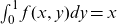
,
$\int_{0}^{1}f(x,y)dy=x$
.




Let
 $\textbf{f}(x,y)=(\,f_1(x,y),\ldots,f_n(x,y))$
and denote
 $\textbf{f}=(\,f_1,\ldots,f_n)\in \mathcal{F}$
if for each
 $i=1,\ldots,n$
, the function
 $f_i$
satisfies Assumption A.1 and Assumption A.2.
Given two n-dimensional copulas B, C and the vector
 $\textbf{f}(x,y)=(\,f_1(x,y),\ldots,$
 $f_n(x,y))$
,
 $(x,y)\in[0,1]^2$
, an n-dimensional function
 $B\overset{\textbf{f}}{\circ} C:$
 $[0,1]^{n}\rightarrow$
[0,1] is defined by (1). In the following theorem, a necessary and sufficient condition on the vector
 $\textbf{f}$
guaranteeing the function
 $B\overset{\textbf{f}}{\circ} C$
to be a copula is given, and a clear probability structure of the copula
 $B\overset{\textbf{f}}{\circ} C$
is also provided.
Theorem 2.1 Suppose that B and C are two n-dimensional copulas. Let
 $(V_1,\ldots,$
 $V_n)$
and
 $(U_1,\ldots,U_n)$
be two independent random vectors with joint distribution functions B and C, respectively.
-
(1) If
$\textbf{f}=(\,f_1,\ldots,f_n)\in \mathcal{F}$
, then the function
$B\overset{\textbf{f}}{\circ} C$
in (1) is a copula. -
(2) If
$\textbf{f}=(\,f_1,\ldots,f_n)\in \mathcal{F}$
and
$f_i\in \mathcal{F}_{1,R-I}$
,
$i=1,\ldots,n$
, then
$f_i^{[\!-1]}(V_i|\cdot,U_i)$
is a Uniform [0,1] random variable, and the random vectorfollows the distribution
\begin{equation*}(\,f_1^{[\!-1]}(V_1|\cdot,U_1),\ldots,f_n^{[\!-1]}(V_n|\cdot,U_n)),\end{equation*}
$B\overset{\textbf{f}}{\circ} C$
.
-
(3) Suppose that
$\textbf{f}=(\,f_1,\ldots,f_n)$
satisfies Assumption A.1, then the function
$B\overset{\textbf{f}}{\circ} C$
is a copula if and only if
$f_1,\ldots,f_n$
satisfy Assumption A.2.








Proof.
-
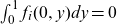
(1) From Assumption A.2, we know that
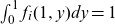
$\int_0^1f_i(1,y)dy=1$
and
$\int_0^1f_i(0,y)dy=0$
,
$i=1,\ldots,n$
. Since for each
$i=1,\ldots,n$
,
$0\le f_i(x,y) \le 1$
, then
$f_i(0,y)=0$
and
$ f_i(1,y)=1$
for almost all
$y\in[0,1]$
. For any
$i =1,...,n$
and
$u_j\in[0,1]$
,
$j=1,\ldots,n$
, and
\begin{align*} &\quad B\overset{\textbf{f}}{\circ} C (u_1,..,u_{i-1},0,u_{i+1},..,u_n)\notag\\[2pt] &=\mathbb{E}[B(\,f_1(u_1,U_1),...,f_{i-1}(u_{i-1},U_{i-1}),f_i(0,U_i),f_{i+1}(u_{i+1},U_{i+1}),...,\notag\\[3pt] &\quad f_n(u_n,U_n))]\notag \\[2pt] &=\mathbb{E}[B(\,f_1(u_1,U_1),...,f_{i-1}(u_{i-1},U_{i-1}),0,f_{i+1}(u_{i+1},U_{i+1}),...,f_n(u_n,U_n))]\notag \\[2pt] &= 0 \end{align*}
Now, it suffices to prove that
\begin{align*} &\quad B\overset{\textbf{f}}{\circ} C (1,..,1,u_i,1,..,1)\notag\\[2pt] &=\mathbb{E}[B(\,f_1(1,U_1),...,f_{i-1}(1,U_{i-1}),f_i(u_i,U_i),f_{i+1}(1,U_{i+1}),...,f_n(1,U_n))]\notag \\[2pt] &=\mathbb{E}(B(1,...,1,f_i(u_i,U_i),1,...,1))\notag \\[2pt] &=\mathbb{E}[f_i(u_i,U_i)] \notag \\[2pt] &=u_i. \end{align*}
$B\overset{\textbf{f}}{\circ} C$
is n-increasing. Let
$1\ge u_i^1\ge u_i^0\ge 0, \ i=1,...,n$
. Then from Assumption A.2, we have Summarizing the above results, we conclude that the function
\begin{align} &\quad \sum_{l_1=0}^{1}\cdots\sum_{l_n=0}^{1}(\!-1)^{\sum_{k=1}^{n} l_k}B\overset{\textbf{f}}{\circ} C(u_1^{l_1},...,u_{n}^{l_n})\notag\\[2pt] &=\mathbb{E}\left[\sum_{l_1=0}^{1}\cdots\sum_{l_n=0}^{1}(\!-1)^{\sum_{k=1}^{n} l_k}B(\,f_1(u_1^{l_1},U_1),...,f_n(u_{n}^{l_n},U_n))\right]\notag\\[2pt] &=\mathbb{P}(\,f_1(u_1^{0},U_1)\le V_1\le f_1(u_1^{1},U_1),...,f_n(u_n^{0},U_n)\le V_n\le f_n(u_n^{1},U_n)) \notag \\[2pt] &\ge 0. \notag \end{align}
$B\overset{\textbf{f}}{\circ} C$
is a copula.
-
(2) If
$f_i\in \mathcal{F}_{1,R-I}$
,
$i=1,\ldots,n$
, then from Lemma 2.1 we have that for any
$u\in[0,1]$
and
$i=1,\ldots,n$
, where the last equality follows from Assumption A.2. Hence for each
\begin{eqnarray*} &&\ \ \ \ \mathbb{P}(\,f^{[\!-1]}_i(V_i|\cdot,U_i)\leq u)=\mathbb{E}[\mathbb{P}(\,f^{[\!-1]}_i(V_i|\cdot,U_i)\leq u|U_i)]\\[3pt] &&=\mathbb{E}[\mathbb{P}(V_i\leq f_i(u,U_i)|U_i)]=\mathbb{E}[f_i(u,U_i)]=\int_{0}^{1}f_i(u,y)dy=u,\end{eqnarray*}
$i=1,\ldots,n$
,
$f^{[\!-1]}_i(V_i|\cdot,U_i)$
is a Uniform [0,1] random variable, and for
$\ (u_1,\ldots,u_n)\in[0,1]^n$
, which implies that
\begin{eqnarray*} &&\mathbb{P}(\,f^{[\!-1]}_1(V_1|\cdot,U_1)\leq u_1,\ldots,f^{[\!-1]}_n(V_n|\cdot,U_n)\leq u_n)\nonumber\\[3pt] &=&\mathbb{E}\left[\mathbb{P}(\,f^{[\!-1]}_1(V_1|\cdot,U_1)\leq u_1,\ldots,f^{[\!-1]}_n(V_n|\cdot,U_n)\leq u_n|U_1,\ldots,U_n)\right]\nonumber\\[3pt] &=&\mathbb{E}[\mathbb{P}(V_1\leq f_1(u_1,U_1),\ldots,V_n\leq f_n(u_n,U_n)|U_1,\ldots,U_n)]\nonumber\\[3pt] &=&\mathbb{E}[B(\,f_1(u_1,U_1),\ldots,f_n(u_n,U_n))]\nonumber\\[3pt] &=&B\overset{\textbf{f}}{\circ} C(u_1,\ldots,u_n),\end{eqnarray*}
$(\,f_1^{[\!-1]}(V_1|\cdot,U_1),\ldots,f_n^{[\!-1]}(V_n|\cdot,U_n))$
follows the distribution
$B\overset{\textbf{f}}{\circ} C$
.
-
(3) The sufficiency is proved in the part (1). Now, we prove the necessity. Assume that the function
$B\overset{\textbf{f}}{\circ} C$
is a copula. For each
$i=1,\ldots,n$
, we have Letting
\begin{align*}u_i&=B\overset{\textbf{f}}{\circ} C(1,\ldots,u_i,\ldots,1)=\mathbb{E}[B(\,f_1(1,U_1),\ldots,f_i(u_i,U_i),\ldots,f_n(1,U_n))]\\[3pt] &\quad \le \mathbb{E}[f_i(u_i,U_i)],\ u_i\in [0,1].\end{align*}
$u_i =1$
in the above inequality, we know that
$f_i(1,y)=1,\,y\in [0,1]$
almost surely. Then for
$u_i\in[0,1]$
, we have Thus, Assumption A.2 holds.
\begin{eqnarray*} &u_i&= B\overset{\textbf{f}}{\circ} C(1,\ldots,u_i,\ldots,1)\nonumber\\[3pt] &&= \mathbb{E}[B(\,f_1(1,U_1),\ldots,f_i(u_i,U_i),\ldots,f_n(1,U_n))] \nonumber\\[3pt] &&=\mathbb{E}[B(1,\ldots,f_i(u_i,U_i),\ldots,1)]=\int_{0}^{1}f_i(u_i,y)dy.\end{eqnarray*}
















In the following, some examples about the multivariate composite copulas are provided.
Example 2.1 Let
 $f_i(x,y)=x$
,
 $(x,y)\in[0,1]^2$
,
 $i=1,\ldots,n$
. It is easy to see that
 $f_i(x,y)$
satisfies Assumption A.1 and Assumption A.2 such that
 $\textbf{f}=(\,f_1,\ldots,f_n)\in \mathcal{F}$
. In this case, for any component copulas B and C,
 \begin{equation*} B\overset{\textbf{f}}{\circ} C(u_1,\ldots,u_n)=\mathbb{E}[B(u_1,\ldots,u_n)]=B(u_1,\ldots,u_n),\ (u_{1},\ldots,u_{n})\in[0,1]^n. \end{equation*}
Example 2.2 Considering the bivariate case and choosing
 $f_i(x,y)=x(1+\theta_i(1-x)(1-2y))$
,
 $(x,y)\in[0,1]^2$
,
 $-1\le \theta_i\le 1$
,
 $i=1,2$
, we have that for each
 $x\in[0,1]$
,
 \begin{equation*}\int_0^1f_i(x,y)dy=x+\theta_i x(1-x)(y-y^2)|_{y=0}^{y=1}=x,\end{equation*}
and for any
 $(x,y)\in[0,1]^2$
,
 $0\le f_i(x,y)=x(1+\theta_i(1-x)(1-2y))\le 1$
. Moreover, for any fixed
 $y\in[0,1]$
,
 \begin{align*}\frac{\partial}{\partial x}f_i(x,y)&=1+\theta_i(1-x)(1-2y)-x\theta_i(1-2y)\\[3pt]&=1+\theta_i(1-2x)(1-2y)\le 1-\theta_i\le 0,\end{align*}
then for any fixed
 $y\in[0,1]$
,
 $f_i(x,y)$
,
 $x\in[0,1]$
is increasing. Thus, in this example,
 $f_i(x,y)$
satisfies Assumption A.1 and Assumption A.2 such that
 $\textbf{f}=(\,f_1,f_2)\in \mathcal{F}$
.
Let
 $C(u_1,u_2)=M(u_1,u_2)$
and
 $B(u_1,u_2)=\Pi(u_1,u_2)$
,
 $(u_{1},u_{2})\in[0,1]^2$
. In this case,
 \begin{equation*}B\overset{\textbf{f}}{\circ} C(u_1,u_2)=\mathbb{E}[f_1(u_1,U)\times f_2(u_2,U)\}]=\mathbb{E}\left [\prod_{i=1}^{2}u_i(1+\theta_i(1-u_i)(1-2U))\right]\ \ \ \ \end{equation*}
 \begin{equation*}=u_1u_2\left(1+\frac{\theta_1\theta_2}{3}(1-u_1)(1-u_2)\right),\ (u_{1},u_{2})\in[0,1]^2.\end{equation*}
The resulting bivariate composite copula has a polynomial form, and it is a bivariate Farlie–Gumbel–Morgenstern (FGM) copula with the parameter
 $\frac{\theta_1\theta_2}{3}$
. If
 $\theta_1=0$
or
 $\theta_2=0$
, then
 $B\overset{\textbf{f}}{\circ} C(u_1,u_2)=\Pi(u_2,u_2)$
.
The family of multivariate composite copulas also includes many known copulas, such as the Bernstein copula (Sancetta and Satchell, Reference Sancetta and Satchell2004) and the family of Archimedean copulas (Nelsen, Reference Nelsen2006), which will be shown in Section 3.
We can see that for a given
 $\textbf{f}=(\,f_1,\ldots,f_n)\in \mathcal{F}$
, the function
 $B\overset{\textbf{f}}{\circ} C$
defined in (1) is a mapping from
 $\textrm{C}_n \times\textrm{C}_n$
to
 $\textrm{C}_n$
, where
 $\textrm{C}_n$
is the space of n-dimensional copulas. Thus, the copula
 $B\overset{\textbf{f}}{\circ} C$
is a composition of the two copulas B and C. In this paper, we call
 $B\overset{\textbf{f}}{\circ} C$
the multivariate composite copula, and the corresponding copulas B and C are named as the component copulas. In the remainder of this paper, we assume
 $\textbf{f}=(\,f_1,\ldots,f_n)\in \mathcal{F}$
.
Theorem 2.1 provides a clear probabilistic structure of the multivariate composite copula. When
 $\textbf{f}=(\,f_1,\ldots,f_n)\in \mathcal{F}$
and
 $f_i\in \mathcal{F}_{1,R-I}$
,
 $i=1,\ldots,n$
, this probabilistic structure leads to a straightforward simulation method for generating random numbers from the multivariate composite copula
 $B\overset{\textbf{f}}{\circ} C$
. The simulation method is described in the following procedure:
-
(1) Generate a random vector
$(V_1,\ldots,V_n)$
from the copula B and a random vector
$(U_1,\ldots,U_n)$
from the copula C, where
$(V_1,\ldots,V_n)$
and
$(U_1,\ldots,U_n)$
are independent. -
(2) Calculate
$(\,f_1^{[\!-1]}(V_1|\cdot,U_1),\ldots,f_n^{[\!-1]}(V_n|\cdot,U_n))$
to get a random vector that follows the multivariate composite copula
$B\overset{\textbf{f}}{\circ} C$
.




From Theorem 2.1, we can get the explicit expression of the multivariate composite copula
 $B\overset{\textbf{f}}{\circ} C$
by focusing on the copula B. The following proposition shows that if for each fixed
 $i=1,\ldots,n$
, the function
 $f_i(x,y)$
is right-continuous and monotonic with respect to (w.r.t.) y when x is fixed, then the multivariate composite copula
 $B\overset{\textbf{f}}{\circ} C$
has other two explicit expressions by using copulas C and
 $\bar{C}$
, respectively.
Proposition 2.1 Suppose that
 $\textbf{f}=(\,f_1,\ldots,f_n)\in \mathcal{F}$
, and B and C are two n-dimensional copulas.
-
(1) If
$f_i(x,y)\in \mathcal{F}_{2,R-I}, \,i=1,\ldots,n$
, then for
$(u_{1},\ldots,u_{n})\in[0,1]^n$
, (3)
\begin{equation} B\overset{\textbf{f}}{\circ} C(u_1,\ldots,u_n)=\mathbb{E}[\bar{C}(1-f^{[\!-1]}_1(V_1|u_1,\cdot),\ldots,1-f^{[\!-1]}_n(V_n|u_n,\cdot))]. \end{equation}
-
(2) If
$f_i(x,y)\in \mathcal{F}_{2,L-D}, \,i=1,\ldots,n$
, then for
$(u_{1},\ldots,u_{n})\in[0,1]^n$
, (4)
\begin{equation} B\overset{\textbf{f}}{\circ} C(u_1,\ldots,u_n)=\mathbb{E}[C(\,f^{(\!-1)}_1(V_1|u_1,\cdot),\ldots,f^{(\!-1)}_n(V_n|u_n,\cdot))]. \end{equation}






Proof.
-
(1) For
$(u_1,\ldots,u_n)\in[0,1]^n$
, from Lemma 2.1 we have Then, the part (1) of the proposition is proved.
\begin{eqnarray*}&&\mathbb{E}[\bar{C}(1-f^{[\!-1]}_1(V_1|u_1,\cdot),\ldots,1-f^{[\!-1]}_n(V_n|u_n,\cdot))]\nonumber\\[3pt] &=&\mathbb{E}[\mathbb{P}(1-U_1\leq 1- f_1^{[\!-1]}(V_1|u_1,\cdot),\ldots,1-U_n\nonumber\\[3pt] &\quad& \leq 1- f_n^{[\!-1]}(V_n|u_n,\cdot)|V_1,\ldots,V_n)]\nonumber\\[3pt] &=&\mathbb{E}[\mathbb{P}(U_1\geq f_1^{[\!-1]}(V_1|u_1,\cdot),\ldots,U_n\geq f_n^{[\!-1]}(V_n|u_n,\cdot)|V_1,\ldots,V_n)]\nonumber\\[3pt] &=&\mathbb{E}[\mathbb{P}(V_1\leq f_1(u_1,U_1),\ldots,V_n\leq f_n(u_n,U_n)|V_1,\ldots,V_n)]\nonumber\\[3pt] &=&\mathbb{E}[\mathbb{P}(V_1\leq f_1(u_1,U_1),\ldots,V_n\leq f_n(u_n,U_n)|U_1,\ldots,U_n)]\nonumber\\[3pt] &=&B\overset{\textbf{f}}{\circ} C(u_1,\ldots,u_n).\end{eqnarray*}
-
(2) The proof is similar to that of the part (1), so we omit the proof.


In the following proposition, we consider the density of the multivariate composite copula
 $B{\overset{\textbf{f}}{\circ}} C$
. The proof will be given in Appendix A.2.
Proposition 2.2 Suppose that
 $\textbf{f}=(\,f_1,\ldots,f_n)\in \mathcal{F}$
, and B and C are two n-dimensional copulas. The multivariate composite copula
 $B\overset{\textbf{f}}{\circ} C$
admits a bounded density if one of the following three conditions holds:
-
a) The component copula B admits a bounded density on
$[0, 1]^n$
and for each fixed
$y\in [0,1]$
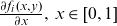
, the partial derivatives
$\frac{\partial f_i(x,y)}{\partial x},\,x\in [0,1]$
,
$i=1,\ldots,n$
exist and are bounded. -
b) The component copula C admits a density on
$[0, 1]^n$
,
$f_i(x,y)\in \mathcal{F}_{2,R-I}, \,i=1,\ldots,n$
, and for each fixed
$x\in [0,1]$
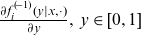
the partial derivatives
$\frac{\partial f_i^{[\!-1]}(y|x,\cdot)}{\partial y},\,y\in [0,1]$
,
$i=1,\ldots,n$
exist and are bounded. -
c) The component copula C admits a density on
$[0, 1]^n$
,
$f_i(x,y)\in \mathcal{F}_{2,L-D}, \,i=1,\ldots,n$
, and for each fixed
$x\in [0,1]$
the partial derivatives
$\frac{\partial f_i^{(\!-1)}(y|x,\cdot)}{\partial y},\,y\in [0,1]$
,
$i=1,\ldots,n$
exist and are bounded.










Remark 2.1. Proposition 2.2 implies that even if one of the component copulas does not admit a density, the multivariate composite copula can admit a density.
2.3 The function f satisfying Assumption A.1 and Assumption A.2
From Theorem 2.1, it is known that functions
 $f_i(x,y)$
,
 $i=1,\ldots,n$
satisfying Assumption A.1 and Assumption A.2 play an important role in constructing the multivariate composite copula
 $B\overset{\textbf{f}}{\circ} C$
. In this subsection, we show how to construct the function f satisfying Assumption A.1 and Assumption A.2. The relationship between the function f and the modified partial Dini derivative of the bivariate copula (Fang et al., Reference Fang, Jiang, Liu and Yang2020) is established, and then a general approach for constructing the function f satisfying Assumption A.1 and Assumption A.2 via an arbitrary bivariate copula is provided.
Following the notation of Fang et al. (Reference Fang, Jiang, Liu and Yang2020), we denote
 $\mathcal{D}_1C(x,y)$
and
 $\mathcal{D}_2C(x,y) $
as the modified partial Dini derivatives of the bivariate copula C at x and y, respectively, that is,
 \begin{equation}\mathcal{D}_1 C(x,y) =\left\{\begin{array}{lr}\underset{v>y}{\inf}D_1^{+}C(x,v), & 0\leq x<1, \,0\le y \le 1, \\ \\[-7pt] \notag\underset{v>y}{\inf}D_1^{-}C(1,v), & x=1, \,0\le y \le 1,\end{array}\right.\end{equation}
and
 \begin{equation}\mathcal{D}_2 {C}(x,y) =\left\{\begin{array}{lr}\underset{u>x}{\inf}D_2^{+}C(u,y), & 0\leq y<1, \,0\le x \le 1 , \notag\\ \\[-7pt] \underset{u>x}{\inf}D_2^{-}C(u,1), & y=1, \,0\le x \le 1,\end{array}\right.\end{equation}
where
 $D_1^{+}C, D_1^{-}C,D_2^{+}C$
and
 $D_2^{-}C$
are defined as
 \begin{align*}D_1^{+}C(x,y) &= \underset{h\downarrow 0}{\lim \sup} \frac{C(x+h,y)-C(x,y)}{h},\\[3pt] D_1^{-}C(x,y) &= \underset{h\downarrow 0}{\lim \sup} \frac{C(x,y)-C(x-h,y)}{h}, \notag \\[3pt] D_2^{+}C(x,y) &= \underset{h\downarrow 0}{\lim \sup} \frac{C(x,y+h)-C(x,y)}{h},\\[3pt] D_2^{-}C(x,y) &= \underset{h\downarrow 0}{\lim \sup} \frac{C(x,y)-C(x,y-h)}{h}. \notag\end{align*}
For example,
 $\mathcal{D}_1 M(x,y) = \mathbb{I}_{\{x\le y\}}$
,
 $\mathcal{D}_2 M(x,y) = \mathbb{I}_{\{y\le x\}}$
and
 $\mathcal{D}_1W(x,y)=\mathcal{D}_2W(x,y)=\mathbb{I}_{\{1-x\leq y\}}$
, where
 $\mathbb{I}_A$
is an indicator function of the set A, that is,
 $\mathbb{I}_A$
equals 1 when A is true and equals zero otherwise.
The following lemma gives the property of the modified partial Dini derivative of the bivariate copula C.
Lemma 2.2. (Fang et al., Reference Fang, Jiang, Liu and Yang2020, Theorem 2.1) For fixed
 $x \in [0,1]$
,
 $\mathcal{D}_1C(x,y),\,y\in [0,1]$
is a cumulative distribution function. And for fixed
 $y \in [0,1]$
,
 $\mathcal{D}_2C(x,y),\,x\in [0,1]$
is a cumulative distribution function. Moreover, for fixed
 $(x,y)\in [0,1]^2$
,
 $\mathcal{D}_1C(x,y)$
and
 $\mathcal{D}_2C(x,y)$
satisfy that
 \begin{equation*} C(x,y) =\int_{0}^x \mathcal{D}_1C(u,y) du,\quad C(x,y) =\int_{0}^y \mathcal{D}_2C(x,v) dv. \end{equation*}
The relationship between the function f and the modified partial Dini derivatives of bivariate copulas is obtained in the following theorem.
Theorem 2.2 The following two statements hold.
-
(1) For any bivariate copula D, let
$f(x,y) = \mathcal{D}_2 D(x,y)$
,
$(x,y)\in [0,1]^2$
, then f(x,y) satisfies Assumption A.1 and Assumption A.2. Moreover, for given
$y\in[0,1]$
, f(x,y),
$x\in[0,1]$
is right-continuous w.r.t. x. -
(2) If f(x,y) satisfies Assumption A.1 and Assumption A.2, then
$D(x,y)=\int_{0}^y f(x,u)du,\ (x,y)\in [0,1]^2$
is a bivariate copula.




Proof.
-
(1) For any bivariate copula D, according to Lemma 2.2, we know that for given y,
$f(x,y)=\mathcal{D}_2D(x,y)$
,
$x\in[0,1]$
is a cumulative distribution function, and thus it is right-continuous w.r.t.
$\,x$
and satisfies Assumption A.1. Moreover,Hence,
\begin{equation*}\int_{0}^1f(x,y) dy=\int_{0}^1\mathcal{D}_2D(x,y) dy=D(x,1)-D(x,0)=x, \ x\in [0,1].\end{equation*}
$f(x,y)=\mathcal{D}_2D(x,y)$
,
$(x,y)\in[0,1]^2$
also satisfies Assumption A.2.
-
(2) Suppose that f(x,y) satisfies Assumption A.1 and Assumption A.2, we define
$D(x,y)=\int_{0}^y f(x,u)du$
,
$(x,y)\in[0,1]^2$
.






From Assumption A.2, we have
 \begin{equation*}D(x,1)=\int_{0}^1 f(x,u)du=x,\ \ D(x,0)=\int_{0}^0 f(x,u)du=0,\ \ x\in [0,1].\end{equation*}
Specially,
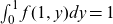 $\int_0^1f(1,y)dy=1$
, and
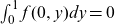 $\int_0^1f(0,y)dy=0$
. Since
 $0\le f(x,y) \le 1$
, then
 $f(0,y)=0$
and
 $ f(1,y)=1$
for almost all
 $y\in[0,1]$
. Thus, for each
 $y\in[0,1]$
, we have that
 \begin{equation*}D(1,y)=\int_0^y f(1,u) du =y,\ \ D(0,y)=\int_0^y f(0,u) du =0,\ \ y\in [0,1].\end{equation*}
Now, it suffices to prove that D(x,y) is 2-increasing, that is, for every subset
 $R=[x_{1},x_{2}]\times[y_{1},y_{2}]$
,
 $ x_1\le x_2,\,y_1\le y_2$
contained in the unit square,
 \begin{equation*}V_{D}(R)=D(x_2,y_2)-D(x_1,y_2)-D(x_2,y_1)+D(x_1,y_1)\geq 0.\end{equation*}
In fact, we have
 \begin{equation*} V_{D}(R)=\int_{y_1}^{y_2}(\,f(x_2,u)-f(x_1,u))du \geq 0,\end{equation*}
where the inequality holds because for fixed
 $y\in[0,1]$
, the function
 $f(x,y),\,x\in [0,1]$
is increasing.
In summary,
 $D(x,y)=\int_{0}^y f(x,u)du$
,
 $(x,y)\in[0,1]^2$
is a copula.
From Theorems 2.1 and 2.2, we can rewrite the multivariate composite copula
 $B\overset{\textbf{f}}{\circ} C$
as
 $B\overset{\textbf{D}}{\diamond} C$
, that is
 \begin{align}B\overset{\textbf{f}}{\circ} C & \equiv B\overset{\textbf{D}}{\diamond} C (u_1,\ldots,u_n)\nonumber\\[3pt] &=\mathbb{E}[B(\mathcal{D}_2D_1(u_1,U_1),...,\mathcal{D}_2D_n(u_n,U_n))],\ \ \ (u_{1},\ldots,u_{n})\in[0,1]^n,\end{align}
here
 $\textbf{D}(u,v)=(D_1(u,v),\ldots,D_n(u,v))$
and
 $\mathcal{D}_2 D_i(u,v)$
,
 $i=1,...,n$
are the modified partial Dini derivatives of bivariate copulas
 $D_i(u,v),\, i=1,\ldots,n$
w.r.t. v.
Note that for a bivariate copula D,
 $\frac{\partial D(x,y)}{\partial y}$
exists for almost all
 $y\in[0, 1]$
and it is almost surely equal to the conditional cumulative distribution function
 $\mathbb{P}(X\le x|Y=y),\,(x,y)\in [0,1]^2$
, here (X,Y) is a bivariate random vector with the joint distribution function D. In the expression of
 $B\overset{\textbf{D}}{\diamond} C$
defined in (5), we need a pointwisely defined function on [0,1], where
 $\frac{\partial D(x,y)}{\partial y}$
may fail to be defined on some points. Thus, we use
 $\mathcal{D}_2 D(x,y)$
instead of
 $\frac{\partial D(x,y)}{\partial y}$
.
If the conditional cumulative distribution function
 $\mathbb{P}(X\le x|Y=y)$
is continuous with respect to y, then the modified partial Dini derivative
 $\mathcal{D}_2 D(x,y)$
equals
 $\mathbb{P}(X\le x|Y=y)$
, and thus the function f can be chosen as the conditional distribution function extracted from a bivariate copula. Such a characteristic of f would provide a more intuitive approach for constructing the function satisfying Assumptions A.1 and A.2. In detail, assume that for each
 $i=1,\ldots,n$
, the conditional cumulative distribution function
 $\mathbb{P}(X_i\le x|Y_i=y)$
is continuous with respect to y, where the joint distribution function of
 $(X_i,Y_i)$
is a bivariate copula
 $D_i$
, and then let
 $f_i(x,y)=\mathbb{P}(X_i\le x|Y_i=y)$
,
 $(x,y)\in [0,1]^2$
,
 $i=1,\ldots,n$
. Since
 $f_i$
is chosen as a conditional distribution function, then it is right-continuous and increasing, that is,
 $f_i\in \mathcal{F}_{1,R-I}$
. It is also easy to see that for each
 $i=1,\ldots,n$
,
 $f_i^{[\!-1]}(V_i|\cdot,U_i)$
is a Uniform [0,1] random variable and the random vector
 $(\,f_1^{[\!-1]}(V_1|\cdot,U_1),\ldots,f_n^{[\!-1]}(V_n|\cdot,U_n))$
follows the distribution
 $B\overset{\textbf{f}}{\circ} C$
. Hence, in this case, the intuitive explanation for the function
 $f_i$
is provided, and then all proofs can be made much simper.
2.4 Properties of the multivariate composite copulas
This section aims at investigating some properties of multivariate composite copulas, including marginality, monotonicity, linearity, symmetry, and exchangeability.
In the following proposition, we show that for a multivariate composite copula
 $B\overset{\textbf{f}}{\circ} C $
, every marginal distribution of the multivariate composite copula can also be expressed as a multivariate composite copula, where its two corresponding component copulas are the marginal distributions of the copulas B and C, respectively.
Proposition 2.3. Suppose that
 $\textbf{f}=(\,f_1,\ldots,f_n)\in \mathcal{F}$
, and B as well as C are n-dimensional copulas. For each
 $i=1,\ldots,n$
, we denote
 $\textbf{f}_{-i}=(\,f_1,\ldots,$
 $f_{i-1},f_{i+1},\ldots,f_n).$
Then
 \begin{equation*}B\overset{\textbf{f}}{\circ} C(u_1,\ldots,u_{i-1},1,u_{i+1},\ldots,u_n)=B_{-i}\overset{\textbf{f}_{-i}}{\circ} C_{-i}(u_1,\ldots,u_{i-1},u_{i+1},\ldots,u_n),\end{equation*}
where
 \begin{equation*}B_{-i}(u_1,\ldots,u_{i-1},u_{i+1},\ldots,u_n):=B(u_1,\ldots,u_{i-1},1,u_{i+1},\ldots,u_n),\end{equation*}
and
 \begin{equation*}C_{-i}(u_1,\ldots,u_{i-1},u_{i+1},\ldots,u_n):=C(u_1,\ldots,u_{i-1},1,u_{i+1},\ldots,u_n),\end{equation*}
are the
 $(n-1)$
-marginal copulas of B and C, respectively.
Proof. Applying (1) we know that
 \begin{eqnarray} &&B\overset{\textbf{f}}{\circ} C(u_1,\ldots,u_{i-1},1,u_{i+1},\ldots,u_n)\nonumber\\[2pt] &=& \mathbb{E}[B(\,f_1(u_1,U_1),\ldots,f_{i-1}(u_{i-1},U_{i-1}),f_{i}(1,U_{i}),f_{i+1}(u_{i+1},U_{i+1}),\nonumber\\ &&\quad \ldots,f_n(u_n,U_n))]\nonumber\\[2pt] &=& \mathbb{E}[B(\,f_1(u_1,U_1),\ldots,f_{i-1}(u_{i-1},U_{i-1}),1,f_{i+1}(u_{i+1},U_{i+1}),\ldots,f_n(u_n,U_n))]\nonumber\\[2pt] &=&\mathbb{E}[B_{-i}(\,f_1(u_1,U_1),\ldots,f_{i-1}(u_{i-1},U_{i-1}),f_{i+1}(u_{i+1},U_{i+1}),\ldots,f_n(u_n,U_n))],\quad \end{eqnarray}
where the second equality holds since for
 $y\in [0,1]$
and
 $i=1,\ldots,n$
,
 $f_i(1,y)=1$
almost surely. Note that the random vector
 $(U_1,\ldots,U_{i-1},U_{i+1},\ldots,U_n)$
obeys the distribution
 $C_{-i}$
. Then (6) gives us the desired result.
The above proposition presents the relationship between the marginal copulas of a multivariate composite copula
 $B\overset{\textbf{f}}{\circ}C$
and the marginal distributions of two corresponding component copulas B and C.
Let
 $C_1$
and
 $C_2$
be n-dimensional copulas, and
 $\bar{C}_1$
and
 $\bar{C}_2$
denote the corresponding n-dimensional survival copulas. We first give the definition of order between the copulas
 $C_1$
and
 $C_2$
. The copula
 $C_2$
is said to be more positively lower orthant dependent (PLOD) than
 $C_1$
, if
 \begin{equation*}C_1(u_1,\ldots,u_n)\leq C_2(u_1,\ldots,u_n), \,\forall (u_1,\ldots,u_n)\in[0,1]^n.\end{equation*}
Similarly, the copula
 $C_2$
is said to be more positively upper orthant dependent (PUOD) than
 $C_1$
, if
 \begin{equation*}\bar{C}_1(u_1,\ldots,u_n)\leq \bar{C}_2(u_1,\ldots,u_n), \,\forall (u_1,\ldots,u_n)\in[0,1]^n.\end{equation*}
See Nelsen (Reference Nelsen2006) for more details. In the following proposition, we discuss the order of multivariate composite copulas.
Proposition 2.4. Suppose that
 $\textbf{f}=(\,f_1,\ldots,f_n)\in \mathcal{F}$
.
-
(1) If
$B_2$
is more PLOD than
$B_1$
, then
$B_2\overset{\textbf{f}}{\circ} C$
is more PLOD than
$B_1\overset{\textbf{f}}{\circ} C$
. -
(2) If
$f_i(x,y)\in \mathcal{F}_{2,R-I}, \,i=1,\ldots,n$
and
$C_2$
is more PUOD than
$C_1$
, then
$B\overset{\textbf{f}}{\circ} C_2$
is more PLOD than
$B\overset{\textbf{f}}{\circ} C_1$
. -
(3) If
$f_i(x,y)\in \mathcal{F}_{2,L-D}, \,i=1,\ldots,n$
and
$C_2$
is more PLOD than
$C_1$
, then
$B\overset{\textbf{f}}{\circ} C_2$
is more PLOD than
$B\overset{\textbf{f}}{\circ} C_1$
.








Proof.
-
(1) For any two n-dimensional copulas
$B_1$
and
$B_2$
, using (1) we have (7)where the random vector
\begin{eqnarray} &&B_1\overset{\textbf{f}}{\circ} C(u_1,\ldots,u_n)-B_2\overset{\textbf{f}}{\circ}C(u_1,\ldots,u_n)\nonumber\\[3pt] &=&\mathbb{E}[B_1(\,f_1(u_1,U_1),\ldots,f_n(u_n,U_n))-B_2(\,f_1(u_1,U_1),\ldots,f_n(u_n,U_n))],\quad \end{eqnarray}
$(U_1,\ldots,U_n)$
obeys the distribution C. Then we can prove that the statement (1) holds from the above equality.
-
(2) For any two n-dimensional copulas
$C_1$
and
$C_2$
, by (3) we have (8)where
\begin{eqnarray} &&B\overset{\textbf{f}}{\circ} C_1(u_1,\ldots,u_n)-B\overset{\textbf{f}}{\circ} C_2(u_1,\ldots,u_n)\nonumber\\[3pt] &=&\mathbb{E}[\bar{C}_1(1-f^{[\!-1]}_1(V_1|u_1,\cdot),\ldots,1-f^{[\!-1]}_n(V_n|u_n,\cdot))\nonumber\\[3pt] &&-\bar{C}_2(1-f^{[\!-1]}_1(V_1|u_1,\cdot),\ldots,1-f^{[\!-1]}_n(V_n|u_n,\cdot))],\end{eqnarray}
$(V_1,\ldots,V_n)$
is a random vector with the joint distribution function B. Then we can prove that the statement (2) holds by applying the above equality.
-
(3) Applying (4), similarly we can prove that the statement (3) holds.


The following proposition shows that a linear combination of component copulas can be chosen to further adjust the value of the multivariate composite copula conveniently. Since this result is a straightforward consequence of (1), we omit the proof here.
Proposition 2.5 Let
 $\lambda\in[0,1]$
be a constant and
 $\textbf{f}=(\,f_1,\ldots,f_n)\in \mathcal{F}$
.
-
(1) Let
$B_1$
and
$B_2$
be two n-dimensional copulas. For any n-dimensional copula C, it holds that
\begin{align*}& (\lambda B_1+(1-\lambda)B_2)\overset{\textbf{f}}{\circ} C(u_1,\ldots,u_n)\\[3pt] &\quad =\lambda B_1\overset{\textbf{f}}{\circ} C(u_1,\ldots,u_n)+(1-\lambda)B_2\overset{\textbf{f}}{\circ} C(u_1,\ldots,u_n).\end{align*}
-
(2) Let
$C_1$
and
$C_2$
be two n-dimensional copulas. For any n-dimensional copula B, it holds that
\begin{align*}&B\overset{\textbf{f}}{\circ} (\lambda C_1+(1-\lambda)C_2)(u_1,\ldots,u_n)\\[3pt] &\quad =\lambda B\overset{\textbf{f}}{\circ} C_1(u_1,\ldots,u_n)+(1-\lambda)B\overset{\textbf{f}}{\circ} C_2(u_1,\ldots,u_n).\end{align*}


In the next proposition, we discuss the symmetry of the multivariate composite copula. An n-dimensional copula C is said to be radially symmetric, if
 $C(u_1,\ldots,u_n) = \bar{C}(u_1,\ldots,u_n)$
for all
 $(u_1,\ldots,$
 $u_n)\in[0, 1]^n$
, where
 $\bar{C}$
is the survival copula of C. More generally, an n-dimensional copula C is said to be symmetric, if
 $C(u_1,\ldots,u_n) = C(\sigma(u_1,\ldots,u_n))$
for all
 $(u_1,\ldots,u_n)\in[0, 1]^n$
, where
 $\sigma$
is any n-permutation of the sequence
 $\{u_i\}_{1\le i\le n}$
. See Nelsen (Reference Nelsen2006) for more details.
Proposition 2.6 Suppose that
 $\textbf{f}=(\,f_1,\ldots,f_n)\in \mathcal{F}$
.
-
(1) Let B and C be two n-dimensional copulas. If for each
$i=1,\ldots, n$
, the function
$f_i\in \mathcal{F}_{1,R-I}$
and (9)then it holds that
\begin{equation} f_i(x,y)=1-f_i(1-x,1-y),\ (x,y)\in[0,1]^2, \end{equation}
In particular, if n-dimensional copulas B and C are both radially symmetric, then the multivariate composite copula
\begin{equation*}\overline{B\overset{\textbf{f}}{\circ} C}(u_1,\ldots,u_n)=\bar{B}\overset{\textbf{f}}{\circ} \bar{C}(u_1,\ldots,u_n),\ (u_1,\ldots,u_n)\in[0,1]^n.\end{equation*}
$B\overset{\textbf{f}}{\circ} C$
is also radially symmetric.
-
(2) If n-dimensional copulas B and C are both symmetric and functions
$f_i(x,y)$
,
$i=1,\ldots,n$
are the same, then the multivariate composite copula
$B\overset{\textbf{f}}{\circ} C$
is also symmetric.


Proof.
-
(1) If the condition (9) holds, from the definition of the survival copula and the probability structure of the multivariate composite copula
$B\overset{\textbf{f}}{\circ} C$
presented in Theorem 2.1, we have that (10)Recall that when
\begin{eqnarray} &&\overline{B\overset{\textbf{f}}{\circ} C}(u_1,\ldots,u_n)\nonumber\\[2pt] &=&\mathbb{P}(1-f_1^{[\!-1]}(V_1|\cdot,U_1)\leq u_1,\ldots,1-f_n^{[\!-1]}(V_n|\cdot,U_n)\leq u_n)\nonumber\\[2pt] &=&\mathbb{P}(\,f_1^{[\!-1]}(V_1|\cdot,U_1)\geq 1-u_1,\ldots,f_n^{[\!-1]}(V_n|\cdot,U_n)\geq 1-u_n)\nonumber\\[2pt] &=&\mathbb{P}(\,f_1(\,f_1^{[\!-1]}(V_1|\cdot,U_1),U_1)\geq f_1(1-u_1,U_1),\ldots,f_n(\,f_n^{[\!-1]}(V_n|\cdot,U_n),U_n) \nonumber\\[2pt] &&\quad \geq f_n(1-u_n,U_n))\nonumber\\[2pt] &=&\mathbb{P}(V_1\geq f_1(1-u_1,U_1),\ldots,V_n\geq f_n(1-u_n,U_n))\nonumber\\[2pt] &=&\mathbb{P}(V_1\geq 1-f_1(u_1,1-U_1),\ldots,V_n\geq 1-f_n(u_n,1-U_n)). \end{eqnarray}
$f_i\in \mathcal{F}_{1,R-I}$
,
$i=1,\ldots,n$
,
$f^{[\!-1]}(u|\cdot,y)=\inf\{x\in[0,1]: f(x,y)\geq u\}$
and
$f^{[\!-1]}(u|\cdot,y)\leq x \Leftrightarrow u \leq f(x,y),\ u,x\in[0,1]$
. From the probability structure of the multivariate composite copula
$\bar{B}\overset{\textbf{f}}{\circ} \bar{C}$
, we also have that Hence, from (10) and the above equation, we get
\begin{eqnarray*} &&\bar{B}\overset{\textbf{f}}{\circ} \bar{C}(u_1,\ldots,u_n)\nonumber\\[2pt] &=&\mathbb{E}[\bar{B}(\,f_1(u_1,1-U_1),\ldots, f_n(u_n,1-U_n))]\nonumber\\[2pt] &=&\mathbb{P}(\,f_1^{[\!-1]}(1-V_1|\cdot,1-U_1)\leq u_1,\ldots,f_n^{[\!-1]}(1-V_n|\cdot,1-U_n)\leq u_n)\nonumber\\[2pt] &=&\mathbb{P}(1-V_1\leq f_1(u_1,1-U_1),\ldots,1-V_n\leq f_n(u_n,1-U_n)). \end{eqnarray*}
$\overline{B\overset{\textbf{f}}{\circ} C}(u_1,\ldots,u_n)=\bar{B}\overset{\textbf{f}}{\circ} \bar{C}(u_1,\ldots,u_n),\ (u_1,\ldots,u_n)\in[0,1]^n.$
-
(2) We only show the case
$n = 2$
, since the proof of
$n \geq 3$
is similar. From the definition of the multivariate composite copula
$B\overset{\textbf{f}}{\circ} C$
given in (1), we know that if the n-dimensional copulas B and C are both symmetric and functions
$f_1(x,y)=f_2(x,y)=f(x,y)$
,
$(x,y)\in[0,1]^2$
, then Hence, the multivariate composite copula
\begin{eqnarray*} B\overset{\textbf{f}}{\circ} C(u_1,u_2)&&=\mathbb{E}[B(\,f(u_1,U_1), f(u_2,U_2))]=\mathbb{E}[B(\,f(u_2,U_2), f(u_1,U_1))]\nonumber\\ &&=\mathbb{E}[B(\,f(u_2,U_1), f(u_1,U_2))]=B\overset{\textbf{f}}{\circ} C(u_2,u_1).\end{eqnarray*}
$B\overset{\textbf{f}}{\circ} C$
is symmetric.












Applying Proposition 2.6, by choosing different functions
 $f_i(x,y)$
,
 $i=1,\ldots,n$
, the multivariate composite copula
 $B\overset{\textbf{f}}{\circ} C$
can have the same symmetry as the component copulas B and C.
Remark 2.2 In the following, we show how to construct functions
 $f_i(x,y)$
,
 $i=1,\ldots,n$
that satisfy the condition (9).
Assume that
 $D_i(x,y)$
,
 $i=1,\ldots,n$
are bivariate copulas. From Theorem 2.2, we know that
 $\mathcal{D}_2D_i(x,y),\ i=1,\ldots,n$
satisfy Assumption A.1 and Assumption A.2. If
 $D_i(x,y)$
,
 $i=1,\ldots,n$
are radially symmetric, then
 \begin{equation*} D_i(x,y)=\bar{D}_i(x,y)=-1+x+y+D_i(1-x,1-y),\ i=1,\ldots,n. \end{equation*}
Differentiating the above equation w.r.t. y, we get
 \begin{equation*}\mathcal{D}_2D_i(x,y)=1-\mathcal{D}_2D_i(1-x,1-y),\ i=1,\ldots,n,\end{equation*}
then (9) holds. Thus the functions
 $f_i(x,y)=\mathcal{D}_2D_i(x,y),\ i=1,\ldots,n$
satisfy the condition (9). Many classes of copulas are radially symmetric (or symmetric), such as the family of Archimedean copulas, the Fréchet and Mardia family of copulas, and the Cuadras–Augé family of copulas (Nelsen, Reference Nelsen2006).
In general, the compositional operation of copulas defined in (1) is not exchangeable, that is,
 \begin{equation*}B\overset{\textbf{f}}{\circ} C(u_1,\ldots,u_n)\not\equiv C\overset{\textbf{f}}{\circ} B(u_1,\ldots,u_n),\ (u_1,\ldots,u_n)\in[0,1]^n.\end{equation*}
For example, letting
 $B\not\equiv C$
and
 $f_i(x,y)=x$
,
 $i=1,\ldots,n$
, then
 $B\overset{\textbf{f}}{\circ} C(u_1,\ldots,$
 $u_n)=B(u_1,\ldots,u_n),\, C\overset{\textbf{f}}{\circ} B(u_1,\ldots,u_n) = C(u_1,\ldots,u_n).$
Thus, we have
 \begin{equation*}B\overset{\textbf{f}}{\circ} C(u_1,\ldots,u_n) \not\equiv C\overset{\textbf{f}}{\circ} B(u_1,\ldots,u_n).\end{equation*}
It is also interesting to see whether the compositional operation of copulas defined in (1) satisfies the law of association.
Proposition 2.7 Let A, B, and C be n-dimensional copulas. If functions
 $f_i\in \mathcal{F}_{1,R-I}$
,
 $i=1,\ldots,n$
satisfy that
 \begin{equation} f_i(\,f_i(x,z),y)=f_i(x,f^{[\!-1]}_i(y|\cdot,z)),\ (x,y,z)\in[0,1]^3,\ i=1,\ldots, n, \end{equation}
then
 \begin{equation} (A\overset{\textbf{f}}{\circ} B)\overset{\textbf{f}}{\circ} C(u_1,\ldots,u_n)=A\overset{\textbf{f}}{\circ} (B\overset{\textbf{f}}{\circ} C)(u_1,\ldots,u_n),\ (u_1,\ldots,u_n)\in[0,1]^n. \end{equation}
Proof. From the definition of the multivariate composite copula given in (1), we have
 \begin{eqnarray*} &(A\overset{\textbf{f}}{\circ} B)\overset{\textbf{f}}{\circ} C(u_1,\ldots,u_n)&=\mathbb{E}[A\overset{\textbf{f}}{\circ} B(\,f_1(u_1,U_1),\ldots, f_n(u_n,U_n))]\nonumber\\[3pt] &&=\mathbb{E}[\mathbb{E}[A(\,f_1(\,f_1(u_1,U_1),V_1),\ldots, f_n(\,f_n(u_n,U_n),V_n))]]\nonumber\\ \end{eqnarray*}
 \begin{eqnarray*} &&=\mathbb{E}[\mathbb{E}[A(\,f_1(u_1,f^{[\!-1]}_1(V_1|\cdot,U_1)),\ldots, f_n(u_n,f^{[\!-1]}_n(V_n|\cdot,U_n)))]]\nonumber\\[3pt] &&=A\overset{\textbf{f}}{\circ} (B\overset{\textbf{f}}{\circ} C)(u_1,\ldots,u_n),\end{eqnarray*}
where the third equality follows from (11) and the fourth equality follows from the probability structure of the multivariate composite copula presented in Theorem 2.1.
In the following, we give two examples of functions
 $f_i(x,y)$
,
 $i=1,\ldots,n$
satisfying (11).
Example 2.3
-
(a) Let
$f_i(x,y)= \mathcal{D}_2\Pi(x,y)=x$
,
$i=1,\ldots,n$
. In this case, we have
\begin{equation*}f_i(\,f_i(x,z),y)= x=f_i(x,f_i^{[\!-1]}(y|\cdot,z)),\ (x,y,z)\in[0,1]^3,\ i=1,\ldots, n.\end{equation*}
-
(b) Let
$ f_i(x,y)= \mathcal{D}_2M(x,y)=\mathbb{I}_{\{x\ge y\}}$
,
$i=1,\ldots,n$
. Then we have that for
$i=1,\ldots,n$
,
\begin{align*}f_i(\,f_i(x,z),y)&=\mathbb{I}_{\{\mathbb{I}_{\{x\ge z\}}\ge y\}}= \mathbb{I}_{\{y=0\}}+ \mathbb{I}_{\{1\ge y>0,\ x\ge z\}}\\[3pt] & =f_i(x,f_i^{[\!-1]}(y|\cdot,z)),\ (x,y,z)\in[0,1]^3. \end{align*}






2.5 Reproduction characteristics of multivariate composite copulas
For the component copulas B and C, an interesting question is whether there exist functions
 $f_i(x,y)$
,
 $i=1,\ldots,n$
such that the corresponding multivariate composite copula defined in (1) can reproduce the component copulas B or C, that is,
 $B\overset{\textbf{f}}{\circ} C=B$
or
 $B\overset{\textbf{f}}{\circ} C=C$
.
Proposition 2.8. Let B and C be two n-dimensional copulas.
-
(a)
$ B\overset{\textbf{f}}{\circ} C(u_1,\ldots,u_n)=B(u_1,\ldots,u_n)$
if functions
$ f_i(x,y)= \mathcal{D}_2\Pi(x,y)=x$
,
$i=1,\ldots,n$
; -
(b)
$ B\overset{\textbf{f}}{\circ} C(u_1,\ldots,u_n)=C(u_1,\ldots,u_n)$
if functions
$ f_i(x,y)= \mathcal{D}_2M(x,y)=\mathbb{I}_{\{y\leq x\}}$
,
$i=1,\ldots,n$
; -
(c)
$ B\overset{\textbf{f}}{\circ} C(u_1,\ldots,u_n)=\bar{C}(u_1,\ldots,u_n)$
if functions
$f_i(x,y)= \mathcal{D}_2W(x,y)=\mathbb{I}_{\{1-x\leq y\}}$
,
$i=1,\ldots,n$
.









Proof.
-
(a) It can be verified directly from the definition of the multivariate composite copula given in the Equation (1).
-
(b) Since functions
$ f_i(x,y)=\mathbb{I}_{\{y\leq x\}}$
,
$i=1,\ldots,n$
are decreasing w.r.t. y, then Thus from (4), we have that
\begin{equation*}f_{i}^{(\!-1)}(y|x,\cdot)=\inf\{u\in[0,1]\,{:}\, f(x,u)< y\}=\begin{cases}x, &y\in(0,1],\\1, & y=0.\end{cases}\end{equation*}
\begin{eqnarray*} & B\overset{\textbf{f}}{\circ} C(u_1,\ldots,u_n)&=\mathbb{E}[C(\,f^{(\!-1)}_1(V_1|u_1,\cdot),\ldots,f^{(\!-1)}_n(V_n|u_n,\cdot))]\nonumber\\[3pt] &&=C(u_1,\ldots,u_n).\end{eqnarray*}
-
(c) Since the functions
$ f_i(x,y)=\mathbb{I}_{\{1-x\leq y\}}$
,
$i=1,\ldots,n$
are increasing w.r.t. y, then Thus by the Equation (3), we have that
\begin{equation*}f_{i}^{[\!-1]}(y|x,\cdot)=\inf\{u\in[0,1]\,{:}\, f(x,u)\geq y\}= \begin{cases} 1-x, &y\in(0,1],\\[3pt] 0, & y=0. \end{cases}\end{equation*}
\begin{align*} B\overset{\textbf{f}}{\circ} C(u_1,\ldots,u_n)&=\mathbb{E}[\bar{C}(1-f^{[\!-1]}_1(V_1|u_1,\cdot),\ldots,1-f^{[\!-1]}_n(V_n|u_n,\cdot))]\nonumber\\ &=\bar{C}(u_1,\ldots,u_n).\\[-35pt]\end{align*}






Remark 2.3 Proposition 2.8 states that the multivariate composite copula
 $B\overset{\textbf{f}}{\circ} C$
has the reproduction characteristic, in the sense that it can reproduce copulas B, C and
 $\bar{C}$
, respectively. The corresponding functions
 $f_i(x,y)$
,
 $i=1,\ldots,n$
are derived from the independent copula
 $\Pi$
, the bivariate Fréchet–Hoeffding upper bound M and the bivariate Fréchet–Hoeffding lower bound W, respectively. Note that the three copulas correspond to the three important dependency structures in insurance and finance: independence, comonotonicity and countermonotonicity (Dhaena et al. 2002a,b).
The following proposition shows that when both B and C are chosen as the independent copula
 $\Pi$
, the Fréchet–Hoeffding upper bound M or the bivariate Fréchet–Hoeffding lower bound W, and
 $\textbf{f}$
is chosen freely under some conditions, the multivariate composite copulas are equal to the corresponding component copulas.
Proposition 2.9 Let
 $\textbf{f}=(\,f_1,\ldots,f_n)\in \mathcal{F}$
.
-
(1)
$ \Pi\overset{\textbf{f}}{\circ} \Pi (u_1,\ldots,u_n)=\Pi(u_1,\ldots,u_n)$
for any
$\textbf{f}\in \mathcal{F}$
. -
(2)
$ M\overset{\textbf{f}}{\circ} M(u_1,\ldots,u_n)=M(u_1,\ldots,u_n)$
provided that functions
$f_i(x,y)=f_1(x,y)$
,
$(x,y)\in[0,1]^2$
,
$i=1,...,n$
. -
(3)
$ W\overset{\textbf{f}}{\circ} W(u_1,u_2)=W(u_1,u_2)$
provided that
$n=2$
and functions
$f_i(x,y)$
,
$(x,y)\in[0,1]^2$
,
$i=1,2$
satisfy the condition (9).









Proof.
-
(1) From the definition (1) of the multivariate composite copula, we have
\begin{align*}\Pi\overset{\textbf{f}}{\circ} \Pi(u_1,...,u_n)&=\mathbb{E}\big[\prod_{i=1}^n f_i(u_i,U_i) \big]\\[2pt] &=\prod_{i=1}^n u_i=\Pi(u_1,...,u_n),\ (u_1,\ldots,u_n)\in[0,1]^n. \end{align*}
-
(2) If
$f_i(x,y)=f(x,y)$
,
$(x,y)\in[0,1]^2$
,
$i=1,...,n$
, then for a Uniform [0,1] random variable U, where the third equation holds from the Assumption A.2.
\begin{align*}&M\overset{\textbf{f}}{\circ} M(u_1,...,u_n) \notag \\[2pt] &\quad = \mathbb{E}[\min\{f(u_1,U),\ldots,f(u_n,U)\}] \notag \\[2pt] &\quad = \mathbb{E}\big[f(\min\{u_1,\ldots,u_n\}, U)\big] \notag\\[2pt] &\quad = \min\{u_1,\ldots,u_n\}=M(u_1,...,u_n),\ (u_1,\ldots,u_n)\in[0,1]^n,\end{align*}
-
(3) In the case
$n=2$
, we have where the second equality follows from condition (9).
\begin{align*}&W\overset{\textbf{f}}{\circ} W(u_1,u_2) \notag \\[2pt] &\quad = \mathbb{E}[\max\{f_1(u_1,U)+f_2(u_2,1-U)-1,0\}] \notag \\[2pt] &\quad = \mathbb{E}[\max\{f_1(u_1,U)-f_2(1-u_2,U),0\}(\mathbb{I}_{\{u_1\geq 1-u_2\}}+\mathbb{I}_{\{u_1< 1-u_2\}})] \notag\\[2pt] &\quad = \mathbb{E}[f_1(u_1,U)-f_2(1-u_2,U)]\mathbb{I}_{\{u_1\geq 1-u_2\}} \notag\\[2pt] &\quad = (u_1+u_2-1)\mathbb{I}_{\{u_1+u_2-1\geq 0\}}=\max\{u_1+u_2-1,0\}\\[2pt] &\quad =W(u_1,u_2),\ (u_1,u_2)\in[0,1]^2,\end{align*}




Remark 2.4. Propositions 2.8 and 2.9 state the reproduction property from different viewpoints. Proposition 2.8 shows that for any bivariate copulas B and C, by choosing suitable
 $\textbf{f}\in \mathcal{F}$
, the multivariate composite copula
 $B\overset{\textbf{f}}{\circ} C$
can reproduce the component copulas B and C, respectively. Proposition 2.9 shows the when both B and C are chosen as
 $\Pi$
, M or W, and
 $\textbf{f}$
is chosen freely under some conditions, the composite copula
 $B\overset{\textbf{f}}{\circ} C$
is equal to the corresponding component copula.
2.6 Convergence of the sequence of multivariate composite copulas
In this section, some results about the uniform convergence of multivariate composite copulas are presented.
We first discuss the convergence of the sequences of multivariate composite copulas
 $\{B_k\overset{\textbf{f}}{\circ} C\}_{k\geq 1}$
and
 $\{B\overset{\textbf{f}}{\circ} C_k\}_{k\geq 1}$
in the following theorem. It is a straightforward consequence of (7) and (8), so we omit the proof here.
Theorem 2.3. Suppose that
 $\textbf{f}=(\,f_1,\ldots,f_n)\in \mathcal{F}$
.
-
(1) If the sequence of copulas
$\{B_k\}_{k\geq 1}$
converges to a copula B uniformly as k goes to infinity, then the sequence of the multivariate composite copulas
$\{B_k\overset{\textbf{f}}{\circ} C\}_{k\geq 1}$
converges to
$B\overset{\textbf{f}}{\circ} C$
uniformly. -
(2) If the sequence of copulas
$\{C_k\}_{k\geq 1}$
converges to a copula C uniformly as k goes to infinity, then the sequence of the multivariate composite copulas
$\{B\overset{\textbf{f}}{\circ} C_k\}_{k\geq 1}$
converges to
$B\overset{\textbf{f}}{\circ} C$
uniformly.


In the following, we provide an example to illustrate the convergence of the multivariate composite copulas by assuming that the component copulas are bivariate Frank copulas, which belong to the Archimedean family (Nelsen, Reference Nelsen2006).
Example 2.4
-
(1) Let the component copula
$B_k$
be a bivariate Frank copula expressed aswhere
\begin{align} B_k(u,v)&=B(u,v;\gamma_k)\nonumber\\ &= -\frac{1}{\gamma_k}\ln(1+\frac{(\exp(\!-\gamma_k u)-1)(\exp(\!-\gamma_k v)-1)}{\exp(\!-\gamma_k)-1}),\ k{=}1,2,\ldots, \notag \end{align}
$\gamma_k\in\textbf{R}/ \{0\}$
. The Frank copula has an interesting property that
$B(u,v;\gamma_k)\rightarrow M(u,v)$
as
$\gamma_k\rightarrow \infty$
,
$B(u,v;\gamma_k)$
$\rightarrow W(u,v)$
as
$\gamma_k\rightarrow -\infty$
and
$B(u,v;\gamma_k)\rightarrow \Pi(u,v)$
as
$\gamma_k\rightarrow 0$
. Then from Theorem 2.3, we know that for an arbitrary bivariate copula C, it holds that
$B_k\overset{\textbf{f}}{\circ}C(u,v)\rightarrow M\overset{\textbf{f}}{\circ}C(u,v)$
as
$\gamma_k\rightarrow \infty$
,
$B_k\overset{\textbf{f}}{\circ}C(u,v)\rightarrow W\overset{\textbf{f}}{\circ}C(u,v)$
as
$\gamma_k\rightarrow -\infty$
and
$B_k\overset{\textbf{f}}{\circ}C(u,v)\rightarrow \Pi\overset{\textbf{f}}{\circ}C(u,v)$
as
$\gamma_k\rightarrow 0$
.
-
(2) Let the component copula
$C_k$
be a bivariate Frank copula with parameter
$\gamma_k$
. Then from Theorem 2.3, we have that for an arbitrary bivariate copula B, it holds that
$B\overset{\textbf{f}}{\circ}C_k(u,v)\rightarrow B\overset{\textbf{f}}{\circ}\Pi(u,v)$
as
$\gamma_k\rightarrow 0$
,
$B\overset{\textbf{f}}{\circ}C_k(u,v)\rightarrow B\overset{\textbf{f}}{\circ}W(u,v)$
as
$\gamma_k\rightarrow -\infty$
and
$B\overset{\textbf{f}}{\circ}C_k(u,v)\rightarrow B\overset{\textbf{f}}{\circ}M(u,v)$
as
$\gamma_k\rightarrow \infty$
.




















Next, we denote
 \begin{equation*}\textbf{f}_k(x,y)=(\,f_{1,k}(x,y),\ldots,f_{n,k}(x,y)),\ (x,y)\in[0,1]^2,\ k=1,2,\ldots.\end{equation*}
Suppose that for each
 $k=1,2,\ldots$
,
 $\textbf{f}_k\in \mathcal{F}$
. Given two n-dimensional copulas B and C, we define the multivariate composite copula
 $B\overset{\textbf{f}_k}{\circ} C$
as
 \begin{align}B\overset{\textbf{f}_k}{\circ} C(u_1,\ldots,u_n)& =\mathbb{E}[B(\,f_{1,k}(u_1,U_1),\ldots,f_{n,k}(u_n,U_n))],\nonumber\\[3pt] &\quad (u_{1},\ldots,u_{n})\in[0,1]^n,\ \ k=1,2,\ldots,\end{align}
where
 $(U_1,\ldots,U_n)$
is a random vector with the joint distribution function C.
The following theorem discusses the convergence of the sequence of multivariate composite copulas
 $\{B\overset{\textbf{f}_k}{\circ} C\}_{k\geq 1}$
.
Theorem 2.4 Let
 $\{\textbf{f}_k(x,y),\ (x,y)\in[0,1]^2\}_{k\geq 1}$
be a sequence of function vectors. Suppose that
 $\textbf{f}_k\in \mathcal{F}$
,
 $k\ge 1$
and
 $\textbf{f}=(\,f_1,\ldots,f_n)\in \mathcal{F}$
. If for each
 $i=1,...,n$
, the sequence of functions
 \begin{equation*}\left\{\int_0^1|f_{i,k}(x,y)-f_i(x,y)|dy,\ x\in[0,1]\right\}_{k\geq 1},\end{equation*}
converges uniformly to zero as k goes to infinity, then the sequence of multivariate composite copulas
 $\{B\overset{\textbf{f}_k}{\circ} C\}_{k\geq 1}$
of type (13) converges uniformly to the multivariate composite copula
 $B\overset{\textbf{f}}{\circ} C$
.
Proof. From the definitions of multivariate composite copulas given in (1) and (13), we know that
 \begin{align*}&\underset{(u_1,\ldots,u_n)\in[0,1]^n}{\max}|B\overset{\textbf{f}_k}{\circ} C(u_1,...,u_n)-B\overset{\textbf{f}}{\circ} C(u_1,...,u_n)| \\[2pt] \notag\le&\underset{(u_1,\ldots,u_n)\in[0,1]^n}{\max}\mathbb{E}[|B(\,f_{1,k}(u_1,U_1),\ldots,f_{n,k}(u_n,U_n))\\[2pt] &\quad -B(\,f_1(u_1,U_1),\ldots,f_n(u_n,U_n))|] \\[2pt] \notag\le&\sum_{i=1}^{n}\underset{(u_1,\ldots,u_n)\in[0,1]^n}{\max} \mathbb{E}|f_{i,k}(u_i,U_i)-f_i(u_i,U_i)| \\[2pt] \notag=& \sum_{i=1}^{n}\underset{(u_1,\ldots,u_n)\in[0,1]^n}{\max}\int_{0}^1 |f_{i,k}(u_i,y)-f_i(u_i,y)|dy,\end{align*}
where the second inequality follows from the Lipschitz condition (2).
Since for each
 $i=1,...,n$
, the sequence of functions
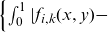 $\left\{\int_0^1|f_{i,k}(x,y)-\right.$
 $\left. f_i(x,y)|dy,\ x\in[0,1]\right\}_{k\geq 1}$
converges uniformly to zero as k goes to infinity, then from the above inequality, we can easily see that the sequence of multivariate composite copulas
 $\{B\overset{\textbf{f}_k}{\circ} C\}_{k\geq 1}$
converges uniformly to the multivariate composite copula
 $B\overset{\textbf{f}}{\circ} C$
.
From Theorem 2.4, we can easily get the following corollary.
Corollary 2.1. Suppose that
 $\{\textbf{f}_k(x,y),\ (x,y)\in[0,1]^2\}_{k\geq 1}$
is a sequence of function vectors and
 ${\textbf{f}}_k\in \mathcal{F}$
,
 $k\ge 1$
. If for each
 $i=1,...,n$
, the sequence of functions
 $\{f_{i,k}(x,y),\ (x,y)\in[0,1]^2\}_{k\geq 1}$
converges uniformly to
 $f_i(x,y)$
,
 $(x,y)\in[0,1]^2$
as k goes to infinity, then functions
 $f_i(x,y)$
,
 $(x,y)\in[0,1]^2$
,
 $i=1,...,n$
satisfy Assumption A.1 and Assumption A.2. Moreover, the sequence of multivariate composite copulas
 $\{B\overset{\textbf{f}_k}{\circ} C\}_{k\geq 1}$
converges uniformly to the multivariate composite copula
 $B\overset{\textbf{f}}{\circ} C$
as
 $k\rightarrow\infty$
, where
 $\textbf{f}(x,y)=(\,f_1(x,y),\ldots,f_n(x,y)). $
Proof. Since functions
 $f_{i,k}(x,y)$
,
 $k=1,2,\ldots$
,
 $i=1,\ldots,n$
are increasing w.r.t. x and bounded, then we know that the limits
 $f_i(x,y)=\lim_{k\rightarrow\infty}f_{i,k}(x,y)$
,
 $i=1,\ldots,n$
are increasing w.r.t. x and
 \begin{equation*}\int_{0}^{1}f_i(x,y)dy=\int_{0}^{1}\lim_{k\rightarrow\infty}f_{i,k}(x,y)dy=\lim_{k\rightarrow\infty}\int_{0}^{1}f_{i,k}(x,y)dy=x ,\end{equation*}
for any
 $x\in[0,1]$
and
 $i=1,\ldots,n$
. Thus, functions
 $f_i(x,y)$
,
 $(x,y)\in[0,1]^2$
,
 $i=1,...,n$
satisfy Assumption A.1 and Assumption A.2. Furthermore, since the sequence of functions
 $\{f_{i,k}(x,y),\ (x,y)\in[0,1]^2 \}_{k\geq 1}$
converges uniformly to
 $f_i(x,y)$
,
 $(x,y)\in[0,1]^2$
as k goes to infinity, then we can easily see that the sequence of functions
 $\left\{\int_0^1|f_{i,k}(x,y)-f_i(x,y)|dy,\ x\in[0,1]\right\}_{k\geq 1} $
converges uniformly to zero as
 $k\rightarrow\infty$
. Hence, from Theorem 2.4, we get the desired results.
The following proposition is easily derived from Theorem 2.4 and Proposition 2.8.
Proposition 2.10 Let B and C be n-dimensional copulas and
 $\{\textbf{f}_k(x,y),\ (x,y)\in[0,1]^2\}_{k\geq 1}$
be a sequence of function vectors, where for each
 $ k\ge 1$
,
 $\textbf{f}_k\in \mathcal{F}$
.
-
(1) If for each
$i=1,...,n$
, the sequence of functions
$\left\{\int_0^1|f_{i,k}(x,y)-x|dy,\ x\in[0,1]\right\}_{k\geq 1}$
converges uniformly to zero as
$k\rightarrow\infty$
, then the sequence of multivariate composite copulas
$\{B\overset{\textbf{f}_k}{\circ} C\}_{k\geq 1}$
converges uniformly to the copula B as
$k\rightarrow\infty$
. -
(2) If for each
$i=1,...,n$
, the sequence of functions
$\left\{\ \int_0^1|f_{i,k}(x,y)-\mathbb{I}_{\{y\leq x\}}|dy,\ \ x\in[0,1]\right\}_{k\geq 1}\ $
converges uniformly to zero as
$k\rightarrow\infty$
, then the sequence of multivariate composite copulas
$\{B\overset{\textbf{f}_k}{\circ} C\}_{k\geq 1}$
converges uniformly to the copula C as
$k\rightarrow\infty$
. -
(3) If for each
$i=1,...,n$
, the sequence of functions
$\left\{\int_0^1|f_{i,k}(x,y)-\mathbb{I}_{\{1-x\leq y\}}|dy,\ x\in[0,1]\right\}_{k\geq 1}$
converges uniformly to zero as
$k\rightarrow\infty$
, then the sequence of multivariate composite copulas
$\{B\overset{\textbf{f}_k}{\circ} C\}_{k\geq 1}$
converges uniformly to the copula
$\bar{C}$
as
$k\rightarrow\infty$
.










In the following, we provide an example to illustrate the convergence of the sequence of multivariate composite copulas
 $\{B\overset{\textbf{f}_k}{\circ} C\}_{k\geq 1}$
.
Example 2.5. Let functions
 $f_{i,k}(x,y)=\mathcal{D}_2D(x,y;\gamma_k)$
,
 $k=1,2,\ldots$
and
 $i=1,\ldots,n$
, where
 $D(x,y;\gamma_k)$
is a Frank copula with the parameter
 $\gamma_k$
,
 \begin{equation*}\mathcal{D}_2D(x,y;\gamma_k) = \frac{\exp(\!-\gamma_k y)(\exp(\!-\gamma_k x)-1)}{(\exp(\!-\gamma_k )-1)+(\exp(\!-\gamma_k x)-1)(\exp(\!-\gamma_k y)-1)}.\end{equation*}
Noting that for fixed
 $x\in[0,1]$
,
 $\mathcal{D}_2D(x,y;\gamma_k)$
is decreasing w.r.t. y, we have
 \begin{align*}&\int_0^1|\mathcal{D}_2D(x,y;\gamma_k)-x|dy\\[3pt] &\quad \le \max\{|\mathcal{D}_2D(x,0;\gamma_k)-x|,|\mathcal{D}_2D(x,1;\gamma_k)-x|\} \notag\\[3pt] & \quad = \max \bigg\{ \bigg|\frac{\exp(\!-\gamma_k x)-1}{\exp(\!-\gamma_k)-1}-x\bigg|, \\[3pt] &\qquad \bigg|\frac{\exp(\!-\gamma_k )(\exp(\!-\gamma_k x)-1)}{(\exp(\!-\gamma_k )-1)\exp(\!-\gamma_k x)}-x\bigg| \bigg\}, \,x\in[0,1]. \notag\end{align*}
Since
 $\lim_{\gamma_k\rightarrow 0} \frac{\exp(\!-\gamma_k x)-1}{\exp(\!-\gamma_k)-1} =x$
and
 $\exp(\!-\gamma_k x)$
is equicontinuous, then from the above inequality, we know that
 $\int_0^1|\mathcal{D}_2D(x,y;\gamma_k)-x|dy $
converges uniformly to zero as
 $\gamma_k \rightarrow 0$
.
Note that
 \begin{align} &\lim_{\gamma_k\rightarrow \infty}\max_{x\in[0,1]}\int_0^1|\mathcal{D}_2D(x,y;\gamma_k)-\mathbb{I}_{\{y\leq x\}}|dy \notag \\[3pt] &= \lim_{\gamma_k\rightarrow \infty}\max_{x\in[0,1]}\int_0^x (1-\mathcal{D}_2D(x,y;\gamma_k))dy+\lim_{\gamma_k\rightarrow \infty}\max_{x\in[0,1]}\int_x^1\mathcal{D}_2D(x,y;\gamma_k)dy \notag\\[3pt] &\le\lim_{\gamma_k\rightarrow \infty}\int_0^1 \max_{x\in[0,1]}(1-\mathcal{D}_2D(x,y;\gamma_k))\mathbb{I}_{\{y< x\}}dy\notag \\[3pt] &\qquad+\lim_{\gamma_k\rightarrow \infty}\int_0^1\max_{x\in[0,1]}\mathcal{D}_2D(x,y;\gamma_k)\mathbb{I}_{\{y> x\}}dy \notag \\[3pt] &=\int_0^1 \lim_{\gamma_k\rightarrow \infty}\max_{x\in[0,1]}(1-\mathcal{D}_2D(x,y;\gamma_k))\mathbb{I}_{\{y<x\}}dy \nonumber\\ &\qquad +\int_0^1\lim_{\gamma_k\rightarrow \infty}\max_{x\in[0,1]}\mathcal{D}_2D(x,y;\gamma_k)\mathbb{I}_{\{y>x\}}dy \notag \\[3pt] &=0, \notag\end{align}
here the last equality holds due to the fact that
 \begin{equation*}\lim_{\gamma_k\rightarrow \infty}\mathcal{D}_2D(x,y;\gamma_k) =\left\{\begin{array}{lr}1, &x>y, \\ \\[-7pt] \notag0, & x<y.\end{array}\right.\end{equation*}
Thus
 $ \int_0^1|\mathcal{D}_2D(x,y;\gamma_k)-\mathbb{I}_{\{y\leq x\}}|dy,\ x\in[0,1] $
converges uniformly to zero as
 $\gamma_k \rightarrow \infty$
. Similarly,
 $\int_0^1|\mathcal{D}_2D(x,y;\gamma_k)$
 $-\mathbb{I}_{\{1-x\leq y\}}|dy,\ x\in[0,1] $
converges to zero uniformly as
 $\gamma_k \rightarrow -\infty$
. From Proposition 2.10, we know that for arbitrary component copulas B and C, it holds that
 \begin{equation*}\lim_{k\rightarrow \infty}B\overset{\textbf{f}_k}{\circ} C =\left\{\begin{array}{ll}B, &\textrm{if}\ \gamma_k\rightarrow 0\ \textrm{as}\ k\rightarrow \infty, \\ \\[-7pt] \notag C, &\textrm{if}\ \gamma_k\rightarrow \infty\ \textrm{as}\ k\rightarrow \infty, \\ \\[-7pt] \notag\bar{C}, &\textrm{if}\ \gamma_k\rightarrow -\infty\ \textrm{as}\ k\rightarrow \infty.\end{array}\right.\end{equation*}
3 Some classes of multivariate composite copulas
In this section, we show that as a unified composition of two copulas B and C, the family of multivariate composite copulas includes many known copulas, such as the Bernstein copula (Sancetta and Satchell, Reference Sancetta and Satchell2004), the composite Bernstein copula (Yang et al., Reference Yang, Chen, Wang and Wang2015), the family of Archimedean copulas (Nelsen, Reference Nelsen2006), the max-copula (Zhao and Zhang, Reference Zhao and Zhang2018) and the copulas presented in Liebscher (Reference Liebscher2008). This implies that the multivariate composite copulas of type (1) can generate a wide variety of dependence structures.
3.1 Bernstein copula and composite Bernstein copula
In the rest of this paper, for a cumulative distribution function F, denote
 $F^{-1}(y)=\inf\{x: F(x)\ge y\},\ y\in[0,1]$
as its inverse function. Let
 $F_{Bin(m,u)}$
,
 $m \in \mathbb{N}$
,
 $u\in [0, 1]$
be the binomial cumulative distribution function and define
 \begin{equation*}f_i(x,y)=\frac{F^{-1}_{Bin(m_i,x)}(y)}{m_i},\ m_i \in \mathbb{N},\ (x,y)\in[0,1]^2, \ i=1,\ldots,n.\end{equation*}
Note that
 $F^{-1}_{Bin(m_i,x)}(y)$
,
 $i=1,\ldots,n$
are increasing w.r.t.
 $\,x$
and
 \begin{align*}\int_{0}^1 f_{i}(x,y) dy=\int_{0}^1 \frac{F^{-1}_{Bin(m_i,x)}(y)}{m_i} dy=\int_{0}^{m_i}\frac{t}{m_i}dF_{Bin(m_i,x)}(t)=x,\ i=1,\ldots,n.\end{align*}
Then functions
 $f_i(x,y)$
,
 $(x,y)\in[0,1]^2$
,
 $i=1,...,n$
satisfy Assumptions A.1 and A.2. In this case, the multivariate composite copula
 \begin{align*}B\overset{\textbf{f}}{\circ} C(u_1,...,u_n)&=\mathbb{E}\left[B\left( \frac{F^{-1}_{Bin(m_1,u_1)}(U_1)}{m_1},\ldots,\frac{F^{-1}_{Bin(m_n,u_n)}(U_n)}{m_n}\right)\right]\\[3pt] &=C_{m_1,\ldots,m_n}(u_1,\ldots,u_n|B,C),\end{align*}
which is the composite Bernstein copula
 $C_{m_1,\ldots,m_n}(u_1,\ldots,u_n|B,C)$
introduced by Yang et al. (Reference Yang, Chen, Wang and Wang2015), where the random vector
 $(U_1,\ldots,U_n)$
obeys the distribution
 $\bar C$
. The composite Bernstein copula can incorporate both prior information and data into the statistical estimation. If
 $C=\Pi$
, then
 $U_1, \ldots, U_n$
are independent. Hence,
 \begin{align*} &B\overset{\textbf{f}}{\circ} C(u_1,...,u_n) \notag \\ =& \mathbb{E}\left[B\left( \frac{F^{-1}_{Bin(m_1,u_1)}(U_1)}{m_1},\ldots,\frac{F^{-1}_{Bin(m_n,u_n)}(U_n)}{m_n}\right)\right] \notag \\ =& \sum_{v_1=0}^{m_1}\cdots\sum_{v_n=0}^{m_n}B\left(\frac{v_1}{m_1},\ldots,\frac{v_n}{m_n}\right)\left(\begin{array}{c} m_1\\ v_1 \end{array} \right)u_1^{v_1}(1-u_1)^{m_1-v_1}\cdots\\[3pt] &\quad \times\left(\begin{array}{c} m_n\\ v_n \end{array} \right)u_n^{v_n}(1-u_n)^{m_n-v_n}. \end{align*}
It belongs to the Bernstein copulas put forward by Sancetta and Satchell (Reference Sancetta and Satchell2004). Note that the Bernstein copula can approximate each copula. Among many recent research papers on the Bernstein copula, please refer to Sancetta (Reference Sancetta2007), Baker (Reference Baker2008), Janssen et al. (Reference Janssen, Swanepoel and Veraverbeke2012), Dou et al. (Reference Dou, Kuriki, Lin and Richards2016), and Scheffer and Weiß (Reference Scheffer and Weiÿ2017).
From the above results, we know that both the Bernstein copula and the composite Bernstein copula belong to the family of multivariate composite copulas.
Note that for each
 $i=1,\ldots,n$
,
 $\mathbb{E}[F^{-1}_{B(m_i,x)}(U)]=m_i x$
and Var
 $(F^{-1}_{B(m_i,x)}(U))=m_ix(1-x)$
, then we have
 \begin{equation*}\int_0^1\left|\frac{F^{-1}_{B(m_i,x)}(y)}{m_i}-x\right|dy=\mathbb{E}\left[\left|\frac{F^{-1}_{B(m_i,x)}(U)}{m_i}-x\right|\right]\le\sqrt{\mathbb{E}\left[\left(\frac{F^{-1}_{B(m_i,x)}(U)}{m_i}-x\right)^2\right]}\end{equation*}
 \begin{equation*}\ \ \ \ \ \ \ \ \ \ \ \ \ \ \ \ \ \ \ \ \ \ \ \ \ =\frac{\sqrt{\textrm{Var}(F^{-1}_{B(m_i,x)}(U))}}{m_i}= \sqrt{\frac{x(1-x)}{m_i}},\ x\in[0,1].\end{equation*}
Then for each
 $i=1,\ldots,n$
, the sequence of functions
 $\{\int_0^1|F^{-1}_{B(m_i,x)}(y)/m_i-x|dy,\ x\in[0,1]\}_{m_i\geq 1}$
converges uniformly to zero as
 $m_i$
goes to infinity. From Proposition 2.10, we know that both the Bernstein copula and the composite Bernstein copula converge uniformly to the copula B as
 $m_i\rightarrow \infty, \,i=1,...,n$
. This result is also obtained by Yang et al. (Reference Yang, Chen, Wang and Wang2015).
3.2 The family of Archimedean copulas
The family of Archimedean copulas is an important copula family widely applied in quantitative finance (Schönbucher, Reference Schönbucher2003), actuarial science (Albrecher et al., Reference Albrecher, Constantinescu and Loisel2011), and biostatistics (Lakhal et al., Reference Lakhal, Rivest and Abdous2008), due to its analytically tractable form and good properties.
Consider an Archimedean copula C with the strict generator
 $\psi$
, where
 $\psi:$
 $[0,+\infty]\rightarrow$
[0,1] is the Laplace transform of a cumulative distribution function F(x) with
 $F(0)=0$
, that is,
 \begin{align}\psi(t) = \int_{0}^{\infty} e^{-x t} dF(x),\ t\ge 0.\end{align}
Then the Archimedean copula C is expressed as
 \begin{equation*}C(u_1,\ldots,u_n)=\psi\left(\sum_{i=1}^{n}\psi^{-1}(u_i)\right),\ (u_1,\ldots,u_n)\in[0,1]^n,\end{equation*}
where
 $\psi^{-1}$
is the inverse function of the generator
 $\psi$
. See Nelsen (Reference Nelsen2006), McNeil and Nešlehová (Reference McNeil and Nešlehová2009) and Xie et al. (Reference Xie, Lin and Yang2017) for more details.
In the following, we show that an Archimedean copula with the generator (14) is a special multivariate composite copula. Rewrite (14) as
 $\psi(t) = \mathbb{E}[e^{-F^{-1}(U)\cdot t}]$
,
 $t\ge 0$
, where U is a Uniform [0,1] random variable We define
 $f_i(x,y)=\exp(\!-\psi^{-1}(x)F^{-1}(y))$
,
 $(x,y)\in[0,1]^2$
,
 $i=1,\ldots,n$
.
From (14), we know that
 $\psi(t)$
,
 $t\ge 0$
is decreasing. Then
 $\psi^{-1}(x)$
,
 $x\in[0,1]$
is decreasing. Thus,
 $f_i(x,y)=\exp(\!-\psi^{-1}(x)F^{-1}(y))$
,
 $(x,y)\in[0,1]^2$
,
 $i=1,...,n$
are increasing functions w.r.t. x. Furthermore, for any
 $x\in[0,1]$
and
 $i=1,...,n$
, it holds that
 \begin{equation*}\int_{0}^1 f_{i}(x,y) dy=\int_0^1 \exp(\!-\psi^{-1}(x)F^{-1}(y))dy=\psi(\psi^{-1}(x))=x.\end{equation*}
Hence, we conclude that functions
 $f_i(x,y)=\exp(\!-\psi^{-1}(x)F^{-1}(y))$
,
 $(x,y)\in[0,1]^2$
,
 $i=1,...,n$
satisfy Assumptions A.1 and A.2.
Let the component copulas
 $B=\Pi$
and
 $C=M$
, that is,
 $U_1=\cdots=U_n=U$
, where U is a Uniform [0,1] random variable. Then
 \begin{align*} &\quad B\overset{\textbf{f}}{\circ} C(u_1,...,u_n) \notag \\ &= \mathbb{E}[B(\exp(\!-\psi^{-1}(u_1)F^{-1}(U)),\ldots,\exp(\!-\psi^{-1}(u_n)F^{-1}(U)))] \notag \\ &= \mathbb{E}\left[\exp\left(\!-\sum_{i=1}^{n}\psi^{-1}(u_i)F_X^{-1}(U)\right)\right] \notag\\ &= \psi\big(\sum_{i=1}^{n}\psi^{-1}(u_i)\big),\ (u_1,\ldots,u_n)\in[0,1]^n. \end{align*}
It is an Archimedean copula with the generator
 $\psi$
.
In summary, if the generator of an Archimedean copula can be written as an inverse of Laplace transform of a cumulative distribution function, then this Archimedean copula is also a special multivariate composite copula
 $B\overset{\textbf{f}}{\circ} C$
with the component copulas
 $B=\Pi$
and
 $C=M$
.
3.3 Asymmetric copulas in Liebscher (Reference Liebscher2008) and max-copula in Zhao and Zhang (Reference Zhao and Zhang2018)
A function
 $D\,{:}\,[0,1]\rightarrow [0,1]$
is called a distortion function if D is increasing, continuous and satisfies
 $D(0) = 0, \,D(1) = 1$
. Let
 $g_{1i}$
,
 $g_{2i}$
,
 $i=1,\ldots,n$
be distortion functions satisfying
 $g_{1i}(x)g_{2i}(x)=x$
,
 $x\in[0,1]$
and
 \begin{equation*}f_{i}(x,y)=\begin{cases}0, &0\leq x< g^{-1}_{2i}(y),\\ \\[-7pt]g_{1i}(x), & g^{-1}_{2i}(y)\le x\leq 1,\end{cases}\end{equation*}
where
 $g^{-1}_{2i}(y)=\inf\{x\,{:}\, g_{2i}(x)\ge y\},\ y\in[0,1].$
Since distortion functions
 $g_{1i}(x)$
and
 $g_{2i}(x)$
,
 $x\in[0,1]$
are increasing and continuous, the functions
 $f_i(x,y)$
,
 $(x,y)\in[0,1]^2$
,
 $i=1,...,n$
are increasing and right-continuous w.r.t. x when y is fixed. Moreover, for any
 $x\in[0,1]$
and
 $i=1,...,n$
, it holds that
 \begin{equation*}\int_{0}^1 f_{i}(x,y) dy=\int_0^1(0 \mathbb{I}_{\{0\leq x< g^{-1}_{2i}(y)\}} +g_{1i}(x) \mathbb{I}_{\{g^{-1}_{2i}(y)\le x\leq 1\}}) dy=g_{1i}(x)g_{2i}(x)=x.\end{equation*}
Thus functions
 $f_i(x,y)$
,
 $(x,y)\in[0,1]^2$
,
 $i=1,...,n$
satisfy Assumptions A.1 and A.2. Noting that for each
 $i=1,\ldots,n$
,
 \begin{equation*}f_i^{[\!-1]}(x|\cdot,y)= \begin{cases} 0, &x=0,\\ \\[-7pt]\max\{g^{-1}_{1i}(x), g^{-1}_{2i}(y)\}, & x \in(0,1], \end{cases}\end{equation*}
where
 $g^{-1}_{1i}(x)=\inf\{u: g_{1i}(u)\ge x\},\ x\in[0,1]$
, and
 $(\,f_1^{[\!-1]}(V_1|\cdot,U_1),\ldots,f_n^{[\!-1]}$
 $(V_n|\cdot,U_n))$
has the distribution
 $B\overset{\textbf{f}}{\circ} C$
, it yields that
 \begin{align*} &B\overset{\textbf{f}}{\circ} C(u_1,...,u_n) \notag \\[2pt] &= \mathbb{P}(\,f_1^{[\!-1]}(V_1|\cdot,U_1)\leq u_1,\ldots,f_n^{[\!-1]}(V_n|\cdot,U_n)\leq u_n) \notag \\[2pt] &= \mathbb{P}(\!\max\{g^{-1}_{11}(V_1), g^{-1}_{21}(U_1)\}\leq u_1,\ldots,\max\{g^{-1}_{1n}(V_n), g^{-1}_{2n}(U_n)\}\leq u_n) \notag\\[2pt] &= \mathbb{P}(g^{-1}_{11}(V_1)\leq u_1,\ldots,g^{-1}_{1n}(V_n)\leq u_n)\mathbb{P}(g^{-1}_{21}(U_1)\leq u_1,\ldots,g^{-1}_{2n}(U_n)\leq u_n)\notag\\[2pt] &= B(g_{11}(u_1),\ldots,g_{1n}(u_n))C(g_{21}(u_1),\ldots,g_{2n}(u_n)),\ (u_1,\ldots,u_n)\in[0,1]^n. \end{align*}
It is an asymmetric copula presented by Liebscher (Reference Liebscher2008),0988 and it is also considered by Mazo et al. (Reference Mazo, Girard and Forbes2015) and Durante and Sempi (Reference Durante and Sempi2016) recently. Furthermore, for each
 $i=1,\ldots,n$
, letting
 $g_{1i}(x)=x^c$
and
 $g_{2i}(x)=x^{1-c}$
with a constant
 $c\in(0, 1)$
, it yields
 \begin{equation*}B\overset{\textbf{f}}{\circ} C(u_1,...,u_n)=B(u_1^c,...,u_n^c)C(u_1^{1-c},...,u_n^{1-c}),\ (u_1,\ldots,u_n)\in[0,1]^n.\end{equation*}
It is a max-copula introduced by Zhao and Zhang (Reference Zhao and Zhang2018). The max-copula is capable of modeling asymmetric dependence as well as joint tail behavior.
In conclusion, the asymmetric multivariate copulas in Liebscher (Reference Liebscher2008) and the max-copula in Zhao and Zhang (Reference Zhao and Zhang2018) are also special multivariate composite copulas of type (1).
4 Numerical illustration and empirical analysis
4.1 Numerical results
For understanding the characteristics of multivariate composite copulas, some numerical results are provided in the following. First, we explain the convergence characteristic of multivariate composite copulas through scatter plots, Kendall’s
 $\tau$
and Spearman’s
 $\rho$
, then we illustrate the reproduction characteristics and continuity characteristics of multivariate composite copulas.
4.1.1 Convergence of multivariate composite copulas
The Clayton copula, the Gumbel copula, and the Frank copula are three important classes of Archimedean family (Nelsen, Reference Nelsen2006; McNeil and Nešlehová, Reference McNeil and Nešlehová2009). First, we choose these three classes of copulas as the component copulas B, C, and the copula D, respectively. To be more specific, let bivariate copulas B and C be the Gumbel copula and the Clayton copula, respectively, that is, for the parameters
 $\alpha\in[1,\infty)$
and
 $\beta\in[\!-1,\infty]\backslash \{0\}$
,
 \begin{eqnarray*} &&B(u,v;\alpha) = \exp[\!-((\!-\ln(u))^{\alpha}+(\!-\ln(v))^\alpha)^{1/\alpha}],\,(u,v)\in [0,1]^2,\\[3pt] &&C(u,v;\beta) = (\!\max\{u^{-\beta}+v^{-\beta}-1,0\})^{-1/\beta}, \,(u,v)\in [0,1]^2 \, .\notag\end{eqnarray*}
Choose functions
 $f_1(x,y)=f_2(x,y)=\mathcal{D}_2D(x,y;\gamma)$
, where
 $D(x,y;\gamma)$
is a Frank copula with parameter
 $\gamma$
. Setting
 $\alpha=3$
and
 $\beta=1$
, we give the scatter plots of bivariate composite copula
 $B\overset{\textbf{f}}{\circ} C$
to illustrate the convergence of the multivariate composite copulas. From the stochastic mechanism of the multivariate composite copula given in Theorem 2.1 and the simulation method presented in Subsection 2.2, we generate 8000 samples of the bivariate composite copula
 $B\overset{\textbf{f}}{\circ} C$
for different
 $\gamma$
and compare them with samples of component copulas B, C, and
 $\bar{C}$
. The scatter plots are present in Figure 1.
The scatter plots of the composite copula
 $B\overset{\textbf{f}}{\circ} C$
for different
 $\gamma$
, where B is a Gumbel copula with parameter
 $\alpha=3$
, C is a Clayton copula with parameter
 $\beta=1$
and
 $f_1(x,y)=f_2(x,y)=\mathcal{D}_2D(x,y;\gamma)$
, D is a Frank copula with parameter
 $\gamma$
.

The most widely known scale-invariant measures of association are Kendall’s
 $\tau$
and Spearman’s
 $\rho$
, both of which “measure” a form of dependence known as concordance (Nelsen, Reference Nelsen2006). For a bivariate copula A, the Kendall’s
 $\tau$
and Spearman’s
 $\rho$
are defined as
 $\tau=4\mathbb{E}[A(U,V)]-1$
and
 $\rho=12\mathbb{E}[UV]-3$
, respectively, where U and V are Uniform [0,1] random variables whose joint distribution function is A. In Table 1, we present the values of Kendall’s
 $\tau$
and Spearman’s
 $\rho$
of the bivariate composite copula
 $B\overset{\textbf{f}}{\circ} C$
for different
 $\gamma$
.
Measures of association for the different parameter
 $\gamma$
, where B is a Gumbel copula with
 $\alpha=3$
, C is a Glayton copula with
 $\beta=1$
, and functions
 $f_1(x,y)=f_2(x,y)=\mathcal{D}_2D(x,y;\gamma)$
, where D is a Frank copula with parameter
 $\gamma$
.

The values of Kendall’s
 $\tau$
and Spearman’s
 $\rho$
presented in Table 1 as well as the scatter plots illustrated in Figure 1 show the convergence of the bivariate composite copula
 $B\overset{\textbf{f}}{\circ} C$
presented in Theorem 2.4 and Proposition 2.10.
Table 1 shows that both Kendall’s
 $\tau$
and Spearman’s
 $\rho$
of the bivariate composite copula
 $B\overset{\textbf{f}}{\circ} C$
increase as
 $\gamma$
increases if
 $\gamma<0$
, and decrease as
 $\gamma$
increases if
 $\gamma >0$
. From Table 1, we can also see that both Kendall’s
 $\tau$
and Spearman’s
 $\rho$
of the bivariate composite copula
 $B\overset{\textbf{f}}{\circ} C$
tend to the corresponding values of the Gumbel copula B, the Clayton copula C, or the survival Clayton copula
 $\bar{C}$
as
 $\gamma$
approaches zero,
 $\infty$
or
 $-\infty$
.
Measures of association for the Gumbel copula with
 $\alpha=3$
, the Clayton copula with
 $\beta=1$
, and the survival Clayton copula with
 $\beta=1$
.

The convergence characteristic is also presented in the scatter plots of the bivariate composite copula
 $B\overset{\textbf{f}}{\circ} C$
. The scatter plots presented in Figure 1(a)–(c) are very similar. When
 $\gamma$
is big enough, the scatter plots of the bivariate composite copula
 $B\overset{\textbf{f}}{\circ} C$
presented in Figure 1(d)–(e) are similar to that of the component copula C presented in Figure 1(f) ; when
 $\gamma$
is small enough, the scatter plots of the bivariate composite copula
 $B\overset{\textbf{f}}{\circ} C$
presented in Figure 1(g)–(h) are similar to that of the survival copula
 $\bar{C}$
presented in Figure 1(i).
4.1.2 Reproduction and continuity of multivariate composite copulas
We choose functions
 $f_1(x,y)=f_2(x,y)=\mathcal{D}_2D(x,y;\theta)$
, where D is a FGM copula with the parameter
 $\theta$
, that is,
 $ D(x,y;\theta)=xy(1+\theta (1-x)(1-y)),\ \theta\in[\!-1,1]$
. In this case, the functions
 $f_i(x,y)$
,
 $(x,y)\in[0,1]^2$
,
 $i=1,2$
satisfy the condition (9). Let the component copula B be a bivariate Frank copula with parameter
 $\gamma$
. Choosing the copula C to be
 $\Pi$
, M and W, respectively, we present the scatter plots of the bivariate composite copula
 $B\overset{\textbf{f}}{\circ} C$
in Figure 2 to illustrate the continuity given in Theorem 2.3 and the reproduction characteristics given in Proposition 2.9
The scatter plots of the composite copula
 $B\overset{\textbf{f}}{\circ} C$
for different
 $\gamma$
, where B is a Frank copula with parameter
 $\gamma$
, C is the product copula
 $\Pi$
, the Fréchet–Hoeffding upper bound M and Fréchet–Hoeffding lower bound W, respectively, and
 $f_1(x,y)=f_2(x,y)=\mathcal{D}_2D(x,y;\theta)$
, where D is a FGM copula with parameter
 $\theta=0.5$
.

From Figure 2(a)–(c), we can see that the scatter plots of the bivariate composite copula
 $B\overset{\textbf{f}}{\circ} \Pi$
are very similar to that of the product copula
 $\Pi$
when
 $\gamma$
is close to zero. When
 $\gamma$
is big enough, the scatter plots of the bivariate composite copula
 $B\overset{\textbf{f}}{\circ} M$
presented in Figure 2(d)–(e) are similar to that of the Fréchet–Hoeffding upper bound M presented in Figure 2(f), and when
 $\gamma$
is small enough, the scatter plots of the bivariate composite copula
 $B\overset{\textbf{f}}{\circ} W$
presented in Figure 2(g)–(h) are similar to that of Fréchet–Hoeffding lower bound W presented in Figure 2(i).
4.2 Empirical example
In this subsection, we analyze the Yield to Maturity data of one-year Chinese treasury bond and five-year Chinese treasury bond. The multivariate composite copula is applied to model the empirical data, and its goodness of fit is compared with that of the component copula. The Yield to Maturity data of one-year Chinese treasury bond and five-year Chinese treasury bond are chosen from 2020/4/20 to 2021/6/30Footnote 2. There are 300 trading days in this period.
We first estimate the marginal distributions empirically and then estimate the parameters of the copulas by the Maximum Likelihood Estimation (MLE) method. To be specific, based on the method introduced by Chen and Fan (Reference Chen and Fan2006), the Yield to Maturity of one-year Chinese treasury bond
 $R^{1Y}_t$
and five-year Chinese treasury bond
 $R^{5Y}_t$
can be converted into pseudo-samples
 $\widehat U_t$
and
 $\widehat V_t$
, where
 \begin{equation}\widehat U_t = \frac{1}{n+1}\sum_{k=1}^{n}\mathbb{I}_{\{R^{1Y}_k\leq R^{1Y}_t\}}, \ \widehat{V}_t = \frac{1}{n+1}\sum_{k=1}^{n}\mathbb{I}_{\{R^{5Y}_k\leq R^{5Y}_t\}},\ t=0,\ldots,n,\end{equation}
and n is the size of the data. In our data set,
 $n=300$
. Then the pseudo-samples
 $(\widehat U_t, \widehat V_t)$
,
 $t=0,\ldots,n$
are used to estimate the parametric copula
 $\hat{A}(u,v)$
by MLE method.
The scatter-plot for the pseudo-samples
 $(\widehat U_t, \widehat V_t)$
is presented in Figure 2. From this figure, we find out that the scatter-plot for the pseudo-samples of Yield to Maturity data of one-year Chinese treasury bond and five-year Chinese treasury bond is similar to the one for the simulation of the Student t copula (Nelsen, Reference Nelsen2006). Thus, two component copulas are chosen as Student t copulas. Our intention is to compose these two component copulas, and then use the constructed composite copula to fit the empirical data well.
Now, we choose two bivariate copulas
 $D_1, D_2 $
and set
 $f_i(x,y)=\mathcal{D}_2D_i(x,y)$
,
 $(x,y)\in[0,1]^2$
,
 $i=1,2$
. From Theorem 2.1 and Theorem 2.2,
 $B\overset{\textbf{f}}{\circ} C$
is a bivariate composite copula. For showing the connection with copulas
 $D_1$
and
 $D_2$
, we write
 $B\overset{\textbf{f}}{\circ} C$
as
 $B\overset{\textbf{D}}{\diamond} C$
, that is,
 \begin{equation*}B\overset{\textbf{f}}{\circ} C(u,v)=B\overset{\textbf{D}}{\diamond} C(u,v) = \mathbb{E}[B(\mathcal{D}_2D_1(u,U_1),\mathcal{D}_2D_2(v,U_2))], \end{equation*}
where the joint distribution of the random vector
 $(U_1, U_2)$
is C. Now we fit the data by the bivariate composite copula
 $B\overset{\textbf{D}}{\diamond} C$
. Suppose that the copulas B,
 $D_1$
, and
 $D_2$
are absolutely continuous and their density functions are b,
 $d_1$
, and
 $d_2$
, respectively. Then the density function of
 $B\overset{\textbf{D}}{\diamond} C$
is
 \begin{align}b \overset{\textbf{D}}{\diamond} c(u,v) = \int_{[0,1]^2}b(\mathcal{D}_2D_1(u,u_1),\mathcal{D}_2D_2(v,u_2))d_1(u,u_1)d_2(v,u_2) dC(u_1,u_2). \notag\end{align}
We estimate the parameters of copula
 $B\overset{\textbf{D}}{\diamond} C$
by MLE method. Letting observations be
 $(x_1,y_1),...,$
 $(x_n,y_n)$
, the log-likelihood function is
 \begin{align*}l(X,Y;\Theta)&=\prod_{i=1}^n b \overset{\textbf{D}}{\diamond} c(x_i,y_i;\Theta) \notag \\&= \prod_{i=1}^n \int_{[0,1]^2}b(\mathcal{D}_2D_1(x_i,u_1),\mathcal{D}_2D_2(y_i,u_2))d_1(x_i,u_1)d_2(y_i,u_2) dC(u_1,u_2), \notag\end{align*}
where
 $\Theta$
is the parameter vector of log-likelihood function. The component copula B is taken as a Student t copula with
 $v=2$
degrees of freedom and the dependence parameter
 $\zeta_1$
, and the component copula C is taken as another Student t copula with
 $v=2$
degrees of freedom and the dependence parameter
 $\zeta_2$
. Since the Gaussian copula is widely used to model the dependence structure in finance and insurance (Li, Reference Li2000; Brigo et al., Reference Brigo, Capponi and Pallavicini2014), then
 $D_1$
and
 $D_2$
are chosen as Gaussian copulas with the same parameter
 $\gamma$
. Then the parameter
 $\Theta=(\zeta_1,\zeta_2,\gamma)$
. The estimated parameter vector
 $\hat{\Theta}$
of the bivariate composite copula
 $B\overset{\textbf{D}}{\diamond} C$
is
 $\hat{\Theta}=(\hat{\zeta}_1,\hat{\zeta}_2,\hat{\gamma})=(0.97513, 0.40869,-0.01474)$
.
To compare the goodness of fit of the bivariate composite copulas
 $B\overset{\textbf{D}}{\diamond} C$
with the ones of the other copulas, we also fit the data by the component copula, that is, the Student t copula with
 $v=2$
degrees of freedom and the dependence parameter
 $\rho$
. The fitted Student t copula satisfies
 $\hat{\rho} = 0.9372$
.
Furthermore, in order to take the number of parameters into account for comparing different models on real data, the goodness of fit based on the Akaike Information Criterion (AIC) and the Bayesian Information Criterion (BIC) are discussed, respectively, where the two criteria are defined, respectively, as
 \begin{align*}\textrm{AIC}=2k-2\ln(\hat L)\ \ \textrm{and}\ \ \ \textrm{BIC}=k\ln(n)-2\ln(\hat L),\end{align*}
here n is the sample size, k is the number of free parameters in the copula, and
 $\hat L$
is the maximized value of the likelihood function for the estimated copula. In Table 3, we show the values of AIC and BIC for the fitted composite copula
 $B\overset{\textbf{D}}{\diamond} C$
and the fitted component copula (Student t copula). From these numerical results, we find out that the values of both AIC and BIC for the fitted composite copula
 $B\overset{\textbf{D}}{\diamond} C$
are smaller than these for the fitted Student t copula. Therefore, the multivariate composite copula performs better than the component copula based on both AIC and BIC.
The values of AIC and BIC for the fitted Student t copula and bivariate composite copula
 $B^{{}^\textbf{D}}{\!\!\!\diamond} C$
, where the component copulas B, C are chosen as Student t copulas with different parameters, and
 $D_1$
,
 $D_2$
are chosen as Gaussian copulas with the same parameter.

From Figure 2, we also find out that there exists an obvious dependence between the empirical data of one-year Chinese treasury bond and five-year Chinese treasury bond (2020/4/20–2021/6/30) on the lower tail part. The tail dependence is one of the most important characteristics of financial data (Coval et al., Reference Coval, Jurek and Stafford2009; Donnelly and Embrechts, Reference Donnelly and Embrechts2010), and the tail dependence coefficient is a copula-based measure of association to measure the tail dependence (McNeil et al., Reference McNeil, Frey and Embrechts2015). For a bivariate copula A, its lower tail dependence coefficient is defined as
 $\lambda_L=\lim_{u\rightarrow0^+}A(u,u)/u$
provided that the limit exists. The lower tail dependence coefficient
 $\lambda_L$
is in [0, 1], and large tail dependence coefficient corresponds to strong correlation on the tail part. The Student t copula has a positive tail dependence coefficient, and thus can capture the tail dependence of financial data (Schloegl and O’Kane, Reference Schloegl and O’Kane2005; Jondeau and Rockinger, Reference Jondeau and Rockinger2006). In the following, it is shown that the multivariate composite copula also fits the empirical data well on the tail part.
In order to analyze the fitting effect on the tail part, we calculate the empirical quantile lower dependence functions
 $\hat{\lambda}_L(u) =\frac{\hat{A}(u,u)}{u}$
for the fitted composite copula
 $B\overset{\textbf{D}}{\diamond} C$
with the estimated parameter vector
 $\hat{\Theta}=(\hat{\zeta}_1,\hat{\zeta}_2,\hat{\gamma})=(0.97513, 0.40869,-0.01474)$
and the fitted component copula (Student t copula) with the estimated parameter
 $\hat{\rho} = 0.9372$
, respectively. The fitting effect of two different copulas on the lower tail part is shown in Figure 3. As shown in Figure 3, there exists a significant dependence between the empirical data of one-year Chinese treasury bond and five-year Chinese treasury bond on the lower tail part, and the bivariate composite copula
 $B\overset{\textbf{D}}{\diamond} C$
fits the empirical data better than the Student t copula on the tail part.
The scatter-plot for the pseudo-samples of Yield to Maturity data of one-year Chinese treasury bond and five-year Chinese treasury bond (2020/4/20-2021/6/30).

Hence, the multivariate composite copula
 $B\overset{\textbf{D}}{\diamond} C$
fits the empirical data more accurately. Furthermore, the multivariate composite copula
 $B\overset{\textbf{f}}{\circ} C$
is quite flexible to model different dependency structures because the component copulas B, C and the function vector
 $\textbf{f}$
can be chosen conveniently. In conclusion, the multivariate composite copula
 $B\overset{\textbf{f}}{\circ} C$
has a great deal of advantages and flexibility in the potential applications.
The values of
 $\frac{\hat{A}(u,u)}{u}$
,
 $u\in(0.05,0.30)$
for different copulas, where “t” represents the Student t copula and “MCC(D=Gaussian)” represents the multivariate composite copula with the Gaussian copula.

5 Conclusions
In this paper, we proposed the family of multivariate composite copulas, which is a unified composition of two arbitrary n-dimensional copulas linked by a vector of bivariate functions. A necessary and sufficient condition on the vector of bivariate functions guaranteeing the composite function to be a copula has been provided, and a general approach to construct the vector satisfying this condition via bivariate copulas has also been presented.
The multivariate composite copula has a clear probability structure and enjoys tractable theoretical properties, such as marginality, monotonicity, linearity, symmetry, and exchangeability. Moreover, it enjoys the characteristic of uniform convergence when the component copulas or the bivariate functions in the vector are uniformly convergent. The multivariate composite copula also has the reproduction property for its component copulas by choosing some special vectors. Some known copulas belong to the family of multivariate composite copulas, such as the family of Archimedean copulas, the Bernstein copula, the composite Bernstein copula, and the max-copula. Empirical results have shown that the multivariate composite copula fits the empirical data of NASDAQ Index and S&P 500 Index well on both the tail parts and the whole region. Hence, the multivariate composite copula has a great deal of advantages and flexibility in the potential applications.
Acknowledgement
The authors thank the editor and two referees for their valuable comments and suggestions which lead to the improvement of the paper. Xie and Yang’s research was supported by the National Natural Science Foundation of China (Grants No. 11761051, 12071016). Xie’s research was also supported by the Natural Science Foundation of Jiangxi Province (Grants Nos. 20202ACB211001, 20181BAB211003).
A Appendix
A.1 Proof of Lemma 2.1
(1) Note that the properties of the right-continuous univariate functions have been proved by Durrett (Reference Durrett2010). We give a more detailed discussion to verify that the result still holds for the general inverse functions of the bivariate functions. Fix
 $y\in[0,1]$
. Assume that
 $f^{[\!-1]}(u|\cdot,y)\leq x$
,
 $u\in[0,1]$
. Since f(x,y) is increasing w.r.t. x when y is fixed, then
 $f(\,f^{[\!-1]}(u|\cdot,y),y) \le f(x,y)$
. Noting also that f(x,y) is right-continuous w.r.t. x when y is fixed, we have
 \begin{equation*}u\leq f(\inf\{x\in[0,1]: f(x,y)\geq u\},y)=f(\,f^{[\!-1]}(u|\cdot,y),y),\ u\in[0,1].\end{equation*}
Thus, we have
 $u\leq f(x,y)$
,
 $u\in[0,1]$
.
On the contrary, assume that
 $u\le f(x,y)$
,
 $u\in[0,1]$
. For fixed
 $y\in[0,1]$
, if
 $f^{[\!-1]}(u|\cdot,y) > x$
, then
 $\inf\{x\in[0,1]: f(x,y)\geq u\}>x$
. Thus, we have
 $f(x,y)< u$
due to that f(x,y) is increasing and right-continuous w.r.t. x when y is fixed, which leads to a contradiction with the assumption
 $u\le f(x,y)$
. Then, we have
 $f^{[\!-1]}(u|\cdot,y)\le x$
,
 $u\in[0,1]$
.
(2) The proof is similar to that of part (1), and it is omitted.
(3) Fix
 $y\in[0,1]$
. Assume that
 $x\leq f^{(\!-1)}(u|\cdot,y)$
,
 $u\in[0,1]$
. If
 $f(x,y) <u$
,
 $u\in[0,1]$
, then there exists a constant
 $\epsilon>0$
such that
 $f(x-\epsilon, y) <u$
,
 $u\in[0,1]$
due to that f(x,y) is left-continuous and decreasing w.r.t. x when y is fixed. Thus,
 $x-\epsilon \ge \inf\{x\in[0,1]: f(x,y) < u\}= f^{(\!-1)}(u|\cdot,y)$
, which leads to a contradiction with the assumption
 $x\leq f^{(\!-1)}(u|\cdot,y)$
. Then, we have
 $u \leq f(x,y),\ u\in[0,1]$
.
On the contrary, let
 $u\le f(x,y)$
, thus
 $x\not \in \{x\in[0,1]:f(x,y)<u\}$
, which leads to
 $x\le f^{(\!-1)}(u|x,\cdot) $
directly.
(4) The proof is similar to that of part (3), and it is omitted.
A.2 Proof of Proposition 2.2
(a) Since the proof of
 $n\ge 3$
is similar to that of
 $n =2$
, we only verify that the multivariate composite copula
 $B\overset{\textbf{f}}{\circ} C$
admits a bounded density when
 $n=2$
. First, denote
 $\Delta$
as
 \begin{align}\Delta &= B(\,f_1(u_1+x_1,U_1),f_2(u_2+x_2,U_2))- B(\,f_1(u_1+x_1,U_1),f_2(u_2,U_2)) \notag \\[3pt] &\quad - B(\,f_1(u_1,U_1),f_2(u_2+x_2,U_2))+ B(\,f_1(u_1,U_1),f_2(u_2,U_2)) \notag\end{align}
From the above definition, we have
 \begin{align}&\frac{\partial^2}{\partial u_1\partial u_2} \mathbb{E}[B(\,f_1(u_1,U_1),f_2(u_2,U_2))]= \lim_{(x_1,\, x_2)\rightarrow (0,0)} \mathbb{E}\left[\frac{\Delta}{x_1x_2}\right]\notag \\[3pt]=& \lim_{(x_1,\, x_2)\rightarrow (0,0)} \mathbb{E}\bigg[\frac{\Delta}{(\,f_1(u_1+x_1,U_1)-f_1(u_1,U_1))(\,f_2(u_2+x_2,U_2)-f_2(u_2,U_2))}\times \notag \\[3pt]&\ \ \ \ \ \ \ \ \ \ \ \ \ \ \ \ \ \ \ \ \ \ \ \frac{f_1(u_1+x_1,U_1)-f_1(u_1,U_1)}{x_1}\times\frac{f_2(u_2+x_2,U_2)-f_2(u_2,U_2)}{x_2}\bigg]. \notag\end{align}
Since B has a bounded density b and
 $f_i(x,y),i=1,2$
have bounded partial derivative w.r.t. x, then all three terms in the expectation presented above are bounded. According to the dominated convergence theorem, the order of operations of the limit and the expectation can be exchanged. Then
 $B\overset{\textbf{f}}{\circ} C$
has a bounded density function
 $\mathbb{E}[b(\,f_1(u_1,U_1),f_2(u_2,U_2))\frac{\partial }{\partial u_1}f_1(u_1,U_1)\frac{\partial}{\partial u_2}f_2(u_2,U_2)] $
.
(b) Similar to the proof of (a), from the Equation (3), we can verify that the multivariate composite copula
 $B\overset{\textbf{f}}{\circ} C$
has a density function.
(c) From the Equation (4), we can verify similarly that the multivariate composite copula
 $B\overset{\textbf{f}}{\circ} C$
has a density function.