Introduction
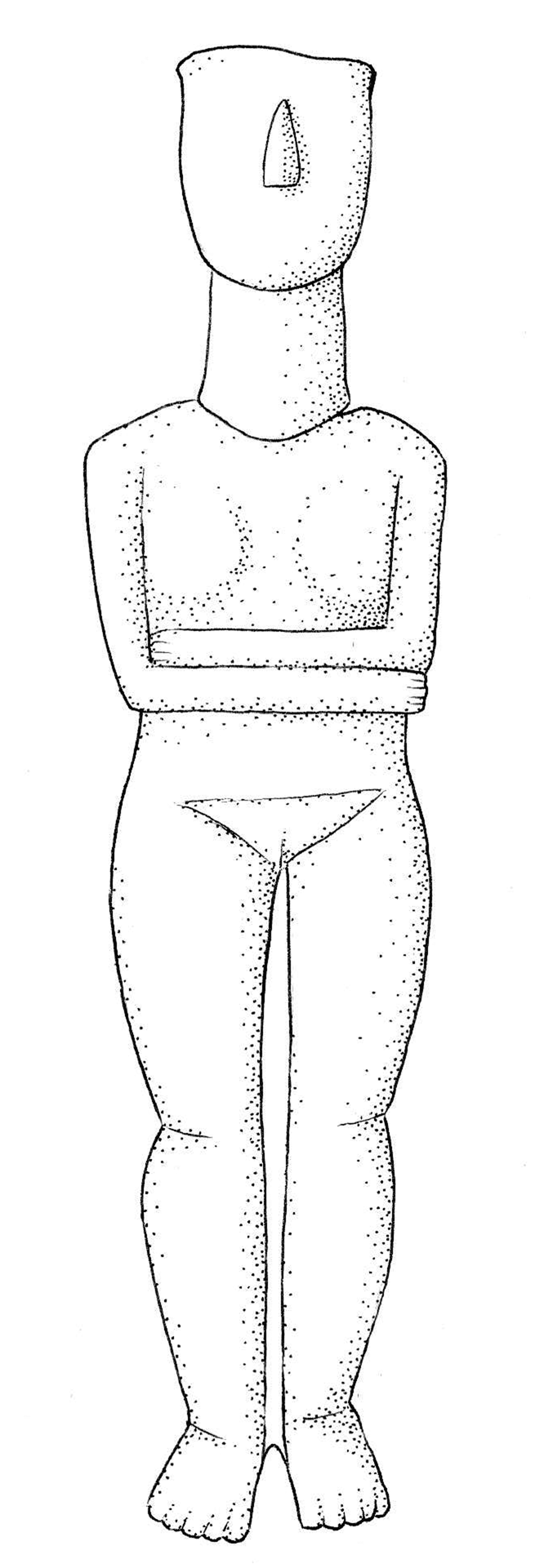
The Early Bronze Age (EBA) was characterized by the rapid emergence of novel social complexity across Eurasia. In the Cycladic islands of the third millennium bc, new forms of social organization were intimately bound up with the development of sophisticated marble sculpting traditions. Cycladic figurines are one of the most celebrated and enigmatic classes of artefacts in all of archaeology (see Figure 1). The ‘canonical’ or ‘folded arm’ figurines of the Early Cycladic II (EC II, c. 2800–2300 bc) are stylized, iconic depictions of women that were created in the thousands and circulated throughout the Cyclades and beyond. Since the twentieth century, the perceived artistic value of the figurines has resulted in catastrophic looting, leaving the vast majority of known forms without any secure context (Marthari et al. Reference Marthari, Renfrew and Boyd2017; Renfrew Reference Renfrew1991). With the scant evidence that remains, archaeologists and art historians alike have debated the symbolic meanings of the objects, with interpretations ranging from arguments that they were mother goddesses, fertility charms and the generic ‘prestige goods’. In recent decades, the enigmatic purpose of these marble figurines has deepened with the revelation that the sculpting traditions were involved in pan-Cycladic rituals centred on the island of Keros (Renfrew Reference Renfrew, Philaniotou, Brodie, Gavalas and Boyd2013; Renfrew et al. Reference Renfrew, Boyd and Ramsey2012). It is now clear that the figurines were not merely personal possessions or burial goods, but that they mediated highly organized behaviour on a regional scale. Over the course of generations, Cycladic islanders congregated at the site of Dhaskalio-Kavos to deposit fragmented figurines among other materials in what were significant acts of performance and festivity.
Example of a Canonical folded-arm figurine. (Drawing adaptation by Dr Céline Murphy.)

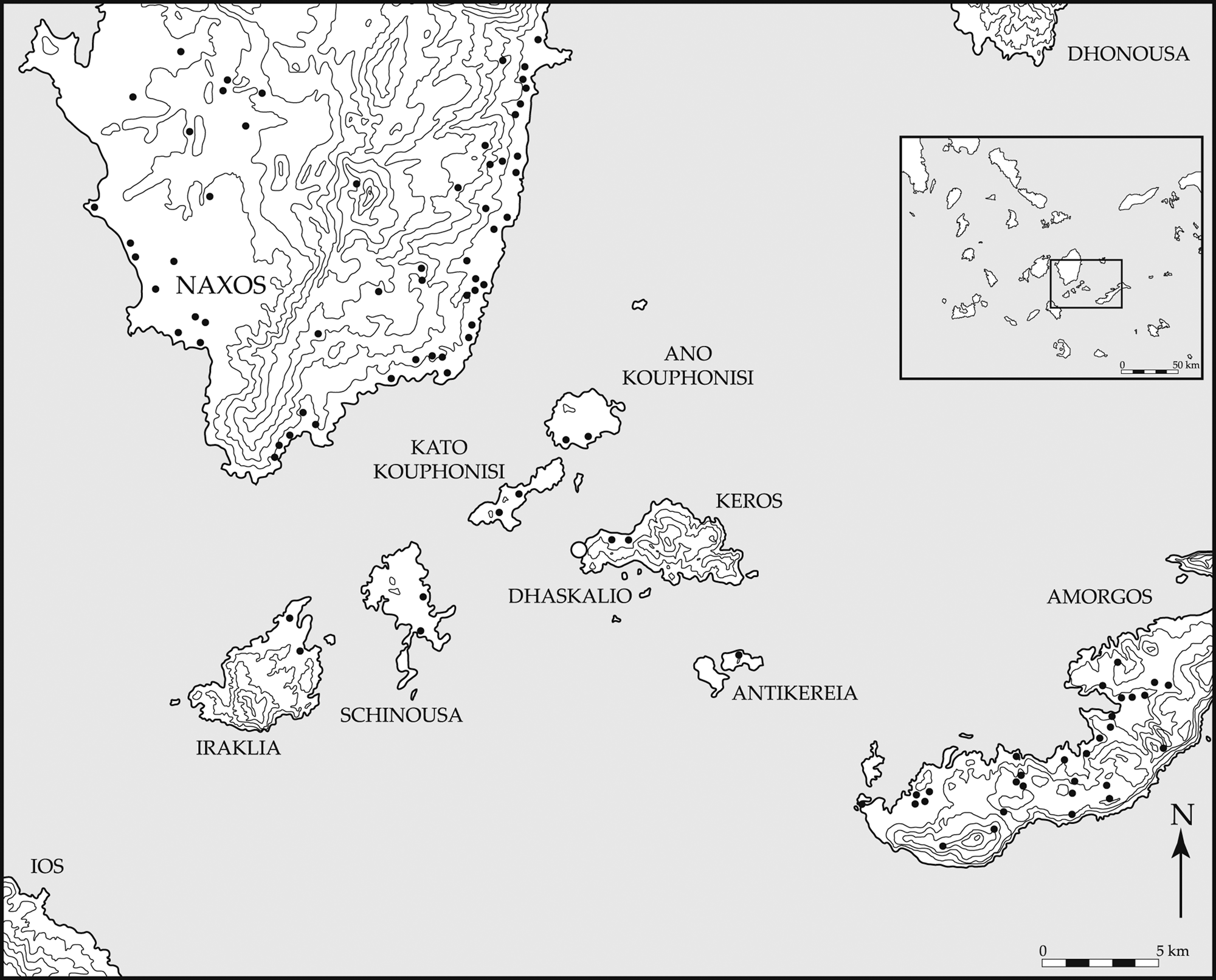
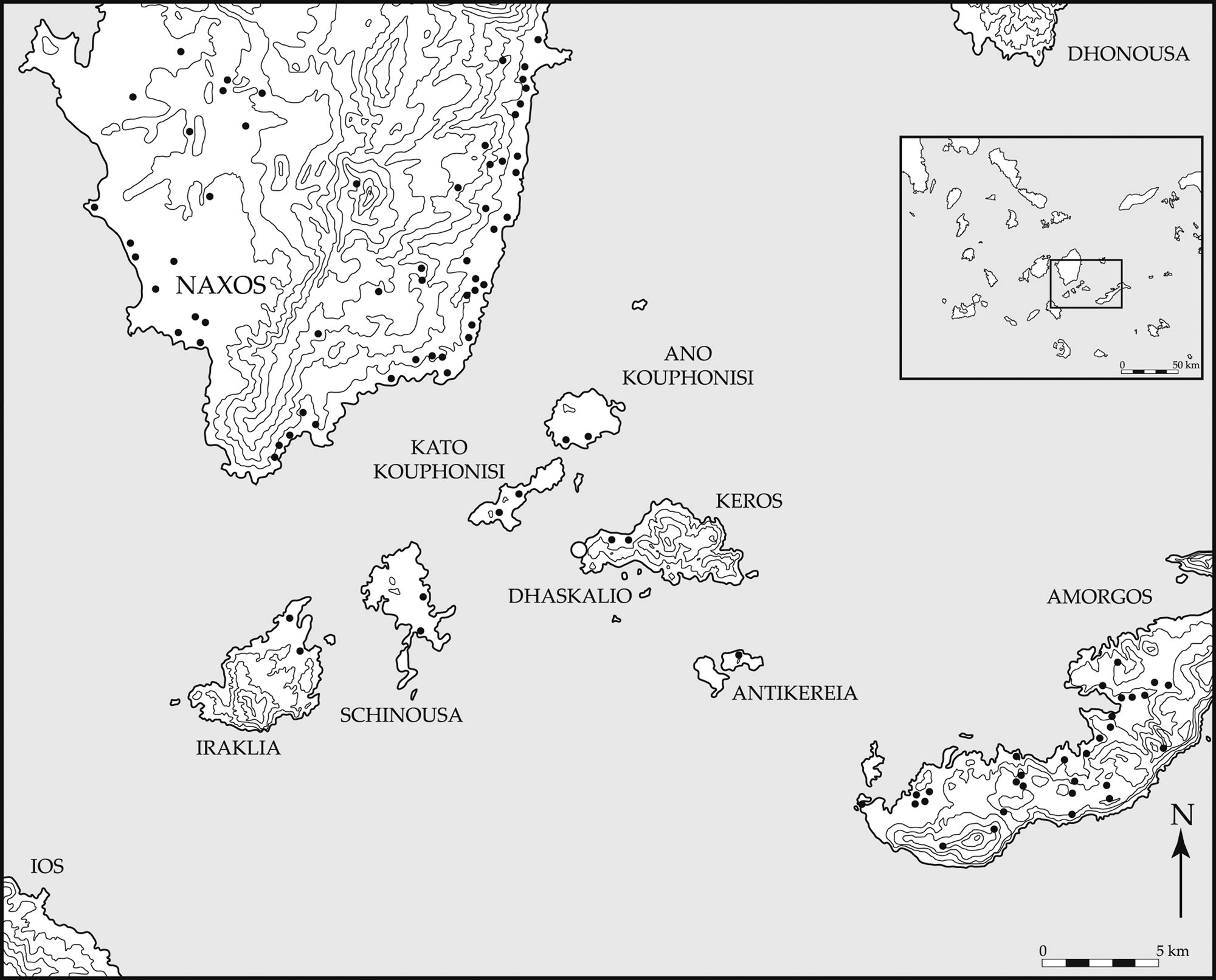
It is now clear that Cycladic communities were utilizing the figurines to organize their communities throughout the archipelago. The island of Keros is perhaps the most striking example of emergent complexity in the Aegean during the EBA. The site is emergent in the sense that self-organizing dynamics generated novel relationships and interactions that are not reducible to the linear effects of component processes, such as agricultural innovations, settlement expansion or increased trade. Dhaskalio-Kavos is complex in terms of the quantities and heterogeneity of interacting elements, the energy density and intensity of the interactions, as well as the scales at which these relationships were developing coherence. A variety of interpretations of the social complexity evidenced by Keros have been put forward. In light of the ritual and economic organization revealed by the site, Colin Renfrew has labelled this prehistoric polity the ‘Confederacy of Keros’ (Reference Renfrew2013). It is clear that the Cycladic canonical figurines played a key role in the activities at Dhaskalio-Kavos. However, the exact nature of this relationship remains deeply mysterious. The site has been described as a ‘symbolic attractor’ and is claimed to be the oldest known maritime sanctuary in the world (Renfrew et al. Reference Renfrew, Boyd and Ramsey2012). Prior to the most recent excavations, Cyprian Broodbank pointed out that Dhaskalio has many features of a trading settlement (2000, 258–62), an observation in keeping with the site's maritime centrality during the period (see Figure 2).
Keros and the Minor Cyclades. Dhaskalio is indicated with an open circle and surrounding early Bronze Age sites are represented with closed circles. (Source: Renfrew et al. Reference Renfrew, Philaniotou, Brodie, Gavalas, Margaritis, French and Sotirakopoulou2007.)
Interpretations of Dhaskalio and Kavos either focus on social cooperation through ritual or emphasize economic dominance by a specific group. Undoubtedly, a key feature of Keros’ story resides in the relationship between marble sculpting and maritime movement. The material wealth, ritualism and regional extent of Keros raise issues about the relationship between social cognition and scalar transformations in social organization (see Aston Reference Aston, Cowley and Vallée-Tourangeau2017; Reference Aston2019). Utilizing the framework of Material Engagement Theory (MET), which examines the dynamic interactions of brains, bodies and material culture that shape human cognitive development (Malafouris Reference Malafouris2008; Reference Malafouris2010b; Reference Malafouris2012; 2013; Reference Malafouris2015b; Reference Malafouris, Etzelmüller and Tewes2016a,Reference Malafouris, Wynn and Coolidgeb; Renfrew Reference Renfrew and Hodder2001; Reference Renfrew, DeMarrais and Renfrew2004), this article puts forward an interpretation of Keros from a social cognition perspective. MET is comprised of three core postulates; the extended mind, that is the idea that cognitive processes are entwined with the material environment; material agency, that is the argument that agency is an emergent and relational property of situated activity; and enactive signification, that is the argument that looks beyond representational mechanisms to examine the semiotic role of material signs. These three core principles are integrated by the concept of metaplasticity, which posits that the unique properties of human cognition emerge from the relationship between neural, material and cultural plasticity (Malafouris Reference Malafouris2009; Reference Malafouris2010a; Reference Malafouris2015a). If Cycladic material culture is treated as evidence of a cognitive feedback loop, the material record suggests that marble was a locus of value through which kinship dynamics were conceptualized and manipulated through the formation of collective attention and intentions. In these regards, the cognitive dynamics mediated through marble appear to have stabilized regimes of long-distance voyaging, enabling emergent scales of social interaction to develop on Keros.
This paper explores how Cycladic material culture, in particular the marble sculpting traditions of the period, shaped the dynamics of social cognitionFootnote 1 in ways that supported the emergence of novel social complexity on Keros. The human ability to generate complex forms of social organization is one of the most difficult problems in both archaeological research and the cognitive sciences due to the rapidity with which complex societies emerge in the material record, as well as assumptions about neural limitations upon cognitive processes. The two disciplines have traditionally intersected when exploring human evolution and the brain (e.g. Coolidge & Wynn Reference Coolidge and Wynn2018; Gamble et al. Reference Gamble, Gowlett and Dunbar2011). However, the gap between the stabilization of human brain size during the Middle Palaeolithic and the emergent cultural complexity evident since the Late Palaeolithic presents significant explanatory difficulties that Renfrew has labelled the ‘sapient paradox’ (Reference Renfrew, Mellars and Gibson1996). Further, the emergent social complexity of the past 10,000 years are not amenable to evolutionary analysis and resist teleological explanations which move from brains to culture in a linear expansion of social material complexity from symbolic thought (cf. Fenici & Garofoli Reference Fenici and Garofoli2017; Garofoli Reference Garofoli2017). Traditionally, the study of social cognition has emphasized neurocentric models and profit-maximizing calculations made by individuals from a third-person perspective.Footnote 2 The customary analytical tools used in the study of social cognition run into significant explanatory difficulties when confronting scalar changes in social organization. These complications are due to the fact that brain size has been conceptualized as a limit upon information processing abilities while large and densely connected societies imply an overwhelming burden of recursive knowledge (cf. Gallagher Reference Gallagher2017, 86–7). However, if material culture is understood to be entangled with the evolution of the brain, specifically in ways that alter neuroplastic development (Malafouris Reference Malafouris2010a; Reference Malafouris2015a), then it follows that material culture is capable of transforming scales of social interaction (Aston Reference Aston2019). This article seeks to demonstrate how the field of Cognitive Archaeology is not solely relegated to the depths of prehistory and human evolution, but is applicable to the more recent past and offers clarity as to how material culture is used to reshape the boundaries of social cognition and foster emergent complexity.
The following case study of Keros demonstrates how material culture transforms intersubjectivity and the possibilities of social organization. The relationship between material culture and social interaction during cognitive development provides a robust explanation for the diversity and scalar plasticity of human societies. From this perspective, material culture coordinates emergent social interaction as part of an extended cognitive system. In examining these dynamics, this article takes a multiscalar, multifactorial approach in its analysis as a means of accommodating the interdependent and bi-directional causal processes in which bodies, artefacts, societies and environments are enmeshed. Emergent complexity is not isolable or reducible to component processes or an initial set of conditions. Therefore, questions about human social complexity cannot be addressed through linear approaches to structure and function, whether in terms of cognitive mechanisms, social needs, or otherwise. To elucidate these dynamics, this paper explores both the emergence and development of Keros and how Cycladic material culture mediated and transformed social interactions at the site. Specifically, the attention-capturing properties of the human body and the development of human intersubjectivity reveal how Cycladic sculpture provided a robust perceptual anchor for the development of collective attention and activity. Skilled interactions with the figurines over the course of generations produced a shared semiotics of value that mediated collective knowledge and activity throughout the islands. In this way, Cycladic sculpture provided a regionally distributed sign system that enabled the coordination of social interactions across multiple scales. When considered in the context of Cycladic settlement patterns, seafaring practices and social dynamics, the evidence suggests that these marble value forms can be understood as kinshipping technologies, that is, technologies that enabled the islanders to conceptualize and manipulate notions of relatedness. The superabundance of marble artefacts, building materials and sea stones that have been uncovered at Dhaskalio-Kavos reveal how the material helped to mediate regional interactions and conceptually integrate them into stable social relationships centred on the island of Keros.
Interpretations of Keros
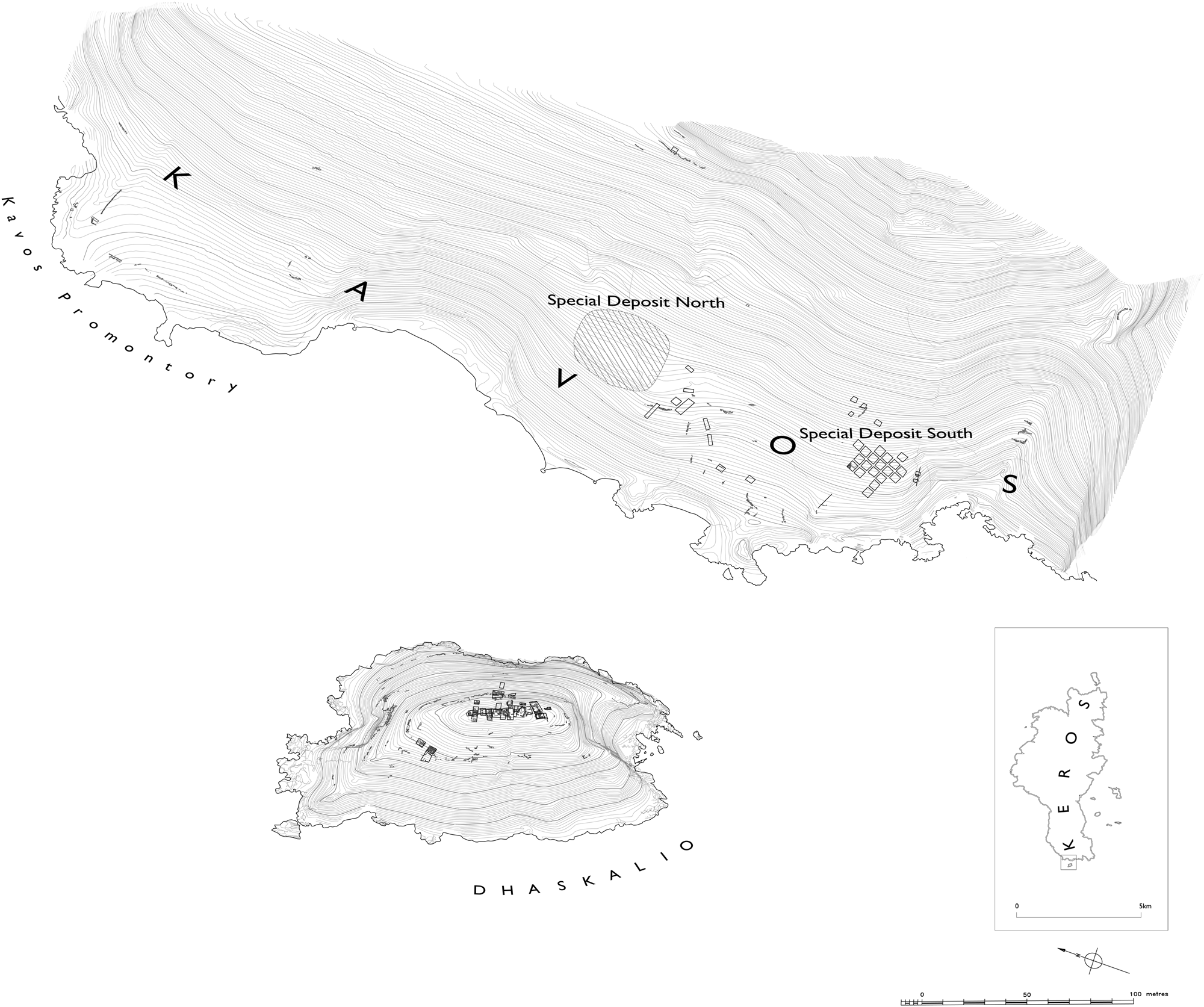
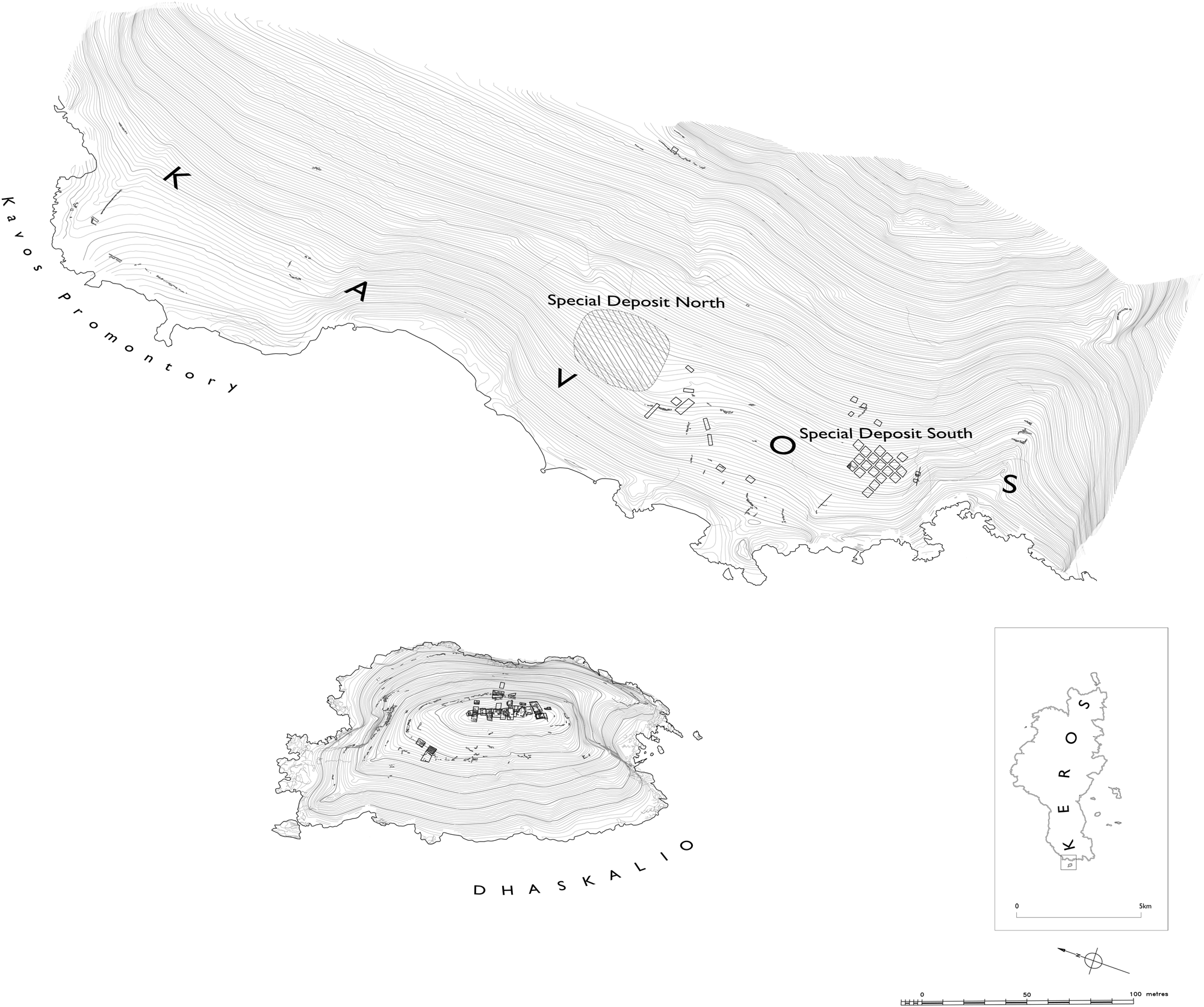
Revealing a sophisticated coordination of social behaviour, Cycladic islanders destroyed thousands of marble artefacts and voyaged from across the archipelago to deposit them on Keros. The ritual complex on Keros is primarily comprised of the ‘settlement’ on Dhaskalio and the Special Deposits of the Kavos area (see Figure 3). The site concentrated large quantities of marble into an area of roughly five hectares (Dixon Reference Dixon, Renfrew, Philaniotou, Brodie, Gavalas and Boyd2013; Gavalas Reference Gavalas, Renfrew, Philaniotou, Brodie, Gavalas and Boyd2013; Gavalas & Brodie Reference Gavalas, Brodie, Renfrew, Philaniotou, Brodie, Gavalas and Boyd2018; Renfrew Reference Renfrew, Renfrew, Philaniotou, Brodie, Gavalas and Boyd2018). Innumerable figurines and vessels, mostly fragmentary, were deposited in two large open-air sites of congregation known as the Special Deposits. Adjacent to these ritual deposits, the promontory of Dhaskalio consisted of a warren of buildings, halls, courtyards, promenades, stairways and drainage systems located on top of an inhospitable outcrop of rock (cf. Renfrew et al. Reference Nymo, Renfrew, Dixon, Renfrew, Philaniotou, Brodie, Gavalas and Boyd2013). Dhaskalio was built, in part, with thousands of metric tonnes of marble imported from Naxos to the site (Dixon Reference Dixon, Renfrew, Philaniotou, Brodie, Gavalas and Boyd2013) and was a location of intensive metal crafting (Bennet Reference Bennet2018). For centuries, flows of materials from across the Cyclades and broader Aegean gravitated towards Keros (Hilditch Reference Hilditch, Renfrew, Philaniotou, Brodie, Gavalas and Boyd2015; Hilditch et al. Reference Hilditch, Hein, Kilikoglou, Renfrew, Philaniotou, Brodie, Gavalas and Boyd2018, 464–5; Sotirakopoulou Reference Sotirakopoulou, Brodie, Doole, Gavalas and Renfrew2008; Reference Sotirakopoulou, Sotirakopoulou and Renfrew2016). The site undeniably mediated social interactions amongst seafarers, local islanders and communities from across the Cyclades and beyond.
Dhaskalio and the Special Deposits. (Source: Renfrew et al. Reference Renfrew, Philaniotou, Brodie and Gavalas2009.)
Interpretation of Keros’ function and significance has been open to notable debate. Broodbank has argued that Dhaskalio was a prominent trading settlement with a cemetery located in the Special Deposit North (Reference Broodbank2000, 223–46). Broodbank's argument was formulated before the discovery of the Special Deposit South, and the excavations of the past two decades have brought this interpretation into question. However, the view that Dhaskalio was a trading centre is still a valid position given the quantity and diversity of materials from across the Aegean found in the settlement. In juxtaposition, Colin Renfrew's description of the site as a maritime sanctuary for collective rituals has had the most influence upon interpretations of Keros (Renfrew Reference Renfrew, Philaniotou, Brodie, Gavalas and Boyd2013; Renfrew et al. Reference Renfrew, Boyd and Ramsey2012). Dhaskalio-Kavos has features indicative of both a ritual and trading centre, and it is in these contrasting features that it is possible to understand how the value of marble, the demands of long-distance voyaging and the dynamics of kinship generated novel social complexity at the site.
The patterns of behaviour evidenced on Keros do not easily slot into modern conceptual distinctions between social, cultural and economic activity. There are important insights as well as significant shortcomings concerning the ways in which the major interpretations of Keros have been framed. Broodbank's network analysis of the Cyclades shows how a matrix of canoeing technologies, settlement distributions, geographic formations and environmental dynamics made Keros a natural ‘centre of gravity’ for EBA maritime movement (Broodbank Reference Broodbank2000, 237–46; see also Knappett Reference Knappett2014; Rivers et al. Reference Rivers, Knappett, Evans and Knappett2013). However, Dhaskalio does not conform to the expectations of a settlement. Most significantly clear domestic spaces are conspicuously absent (cf. Renfrew et al. Reference Nymo, Renfrew, Dixon, Renfrew, Philaniotou, Brodie, Gavalas and Boyd2013). Furthermore, the argument that the Special Deposit North was a highly unique cemetery is not born out by the evidence. It is undeniable that some funerary practices occurred on the island, but the material record strongly suggests that this was not the primary focus of activity. Evidence for burial is comprised of a single intact cist and two other possible destroyed cists found in the vicinity of the Special Deposit North (Zapheiropoulou Reference Zapheiropoulou, Renfrew, Doumas, Marangou and Gavalas2007). Anonymous accounts from individuals believed to be involved in the looting of Keros also suggest that there were a small number of graves near the Special Deposit North (cf. Papamichelakis & Renfrew Reference Papamichelakis and Renfrew2010). Furthermore, though bone fragments have been found near the Special Deposits, the fact that none were discovered in the intact Special Deposit South supports a non-funerary interpretation (Moutafi Reference Moutafi, Renfrew, Philaniotou, Brodie, Gavalas and Boyd2015). In addition to this evidence, there are three partially constructed rock-shelters, found immediately to the south of the Special Deposit South, that contained the bodies of 13 persons (roughly half of which were non-adults) and were clearly intended as primary internments before secondary burials (Moutafi Reference Moutafi, Renfrew, Philaniotou, Brodie, Gavalas and Boyd2015, 503–4). Finally, Broodbank's hypothesis is most significantly undermined by the evidence that the Special Deposits appear to have developed prior to the floruit of Dhaskalio (Renfrew Reference Georgakopoulou, Renfrew, Philaniotou, Brodie, Gavalas and Boyd2018). In other words, ritual activities on Keros preceded the emergence of the most significant activity on Dhaskalio and it is unlikely to have had a cemetery prior to a settlement. If the site was indeed a trading centre of some nature, the activities on Dhaskalio appear to have developed as an outgrowth of the rituals at Kavos.
The complex social interactions that took place on Keros suggest an entanglement of regional communities, ritual activity and maritime interactions with the wider Aegean world. The causal primacy of the Special Deposits militates against Broodbank's argument that Dhaskalio-Kavos was a central settlement similar to nearby contemporaries such as Skarkos. The fact that ritual activities on Keros preceded most activity on Dhaskalio reveals a high degree of sustained attention and collective intention to focus social interactions upon the site. Though this evidence favours Renfrew's argument of a ritual sanctuary, it also complicates the narrative. Ritual activities at the Special Deposits involving the fragmentation of marble artefacts subsided as Dhaskalio became a location of intensive metallurgical production and the extensive importation of pan-Aegean material forms (Georgakopoulou Reference Georgakopoulou, Renfrew, Philaniotou, Brodie, Gavalas and Boyd2013; Reference Georgakopoulou, Renfrew, Philaniotou, Brodie, Gavalas and Boyd2018). If Keros was primarily a site of collective rituals involving Cycladic figurines, why do these practices seem to have largely vanished as Dhaskalio emerged, displaying characteristics more in keeping with a trading site? Evidence surrounding the development of Cycladic figurines in conjunction with the chronology of Keros provides a means of synthesizing Broodbank's and Renfrew's arguments. Specifically, ritual activity involving marble forms appears to have enabled Cycladic islanders to establish a stable, region-wide cultural regime of long-distance voyaging that transformed the dynamics of interaction on Keros and across the Aegean.
A brief history of Cycladic figurines and social interaction
Cycladic sculpting emerged amidst profound transformations in the intensity, density and extent of social interaction during the transition from the Neolithic to the Early Bronze Age. The Cyclades were first permanently settled during the Late Neolithic as part of a broader pattern of Aegean infilling during the period. Settlement in the islands consisted of villages in the range of 150 persons, located in similar ecological niches (Broodbank Reference Broodbank2000, 145–7; see also Phoca-Cosmetatou Reference Phoca-Cosmetatou and Phoca-Cosmetatou2011). It is during this period that the earliest developments in Cycladic sculpting are first evinced with the appearance of marble schematics and limited examples of naturalistic figurines (Renfrew Reference Renfrew1969). After roughly two millennia of Neolithic occupation, the villages were abandoned at the onset of the Bronze Age and the Cycladic islanders dispersed into homesteads and hamlets scattered across the archipelago (Broodbank Reference Broodbank2000, 153–6; see also Wagstaff & Cherry Reference Wagstaff, Cherry, Renfrew and Wagstaff1982). The settlements of the EC I (Early Cycladic I, c. 3200–2700 bc) were heavily dependent upon herding, exogamy and mobility, shifting across the landscape every few generations. Also during this period, cemeteries and marble artefacts first became widespread. After roughly 500 years of this highly decentralized form of organization, Cycladic islanders increasingly launched long-range expeditions, reaggregated into larger villages, developed the canonical figurines and began congregating on Keros. The changing dynamics and burdens of social interaction suggested by Cycladic settlement patterns of the Neolithic–Bronze Age transition provides a key for understanding how Cycladic marble sculpting generated a locus of collective attention and value. The shift from village communities to highly distributed and mobile groups necessitated a continual flow of bodies and materials as well as the ability to maintain collective identity over periods of prolonged absence. The circulation of marble can be understood as a means of anchoring collective attention, memory and knowledge in ways that substantiated Cycladic social reproduction through the creation, exchange and performative uses of a shared value form. In this way, sculpting generated a metaplastic medium through which concepts of relatedness could be perceived, enacted and manipulated at emergent scales.
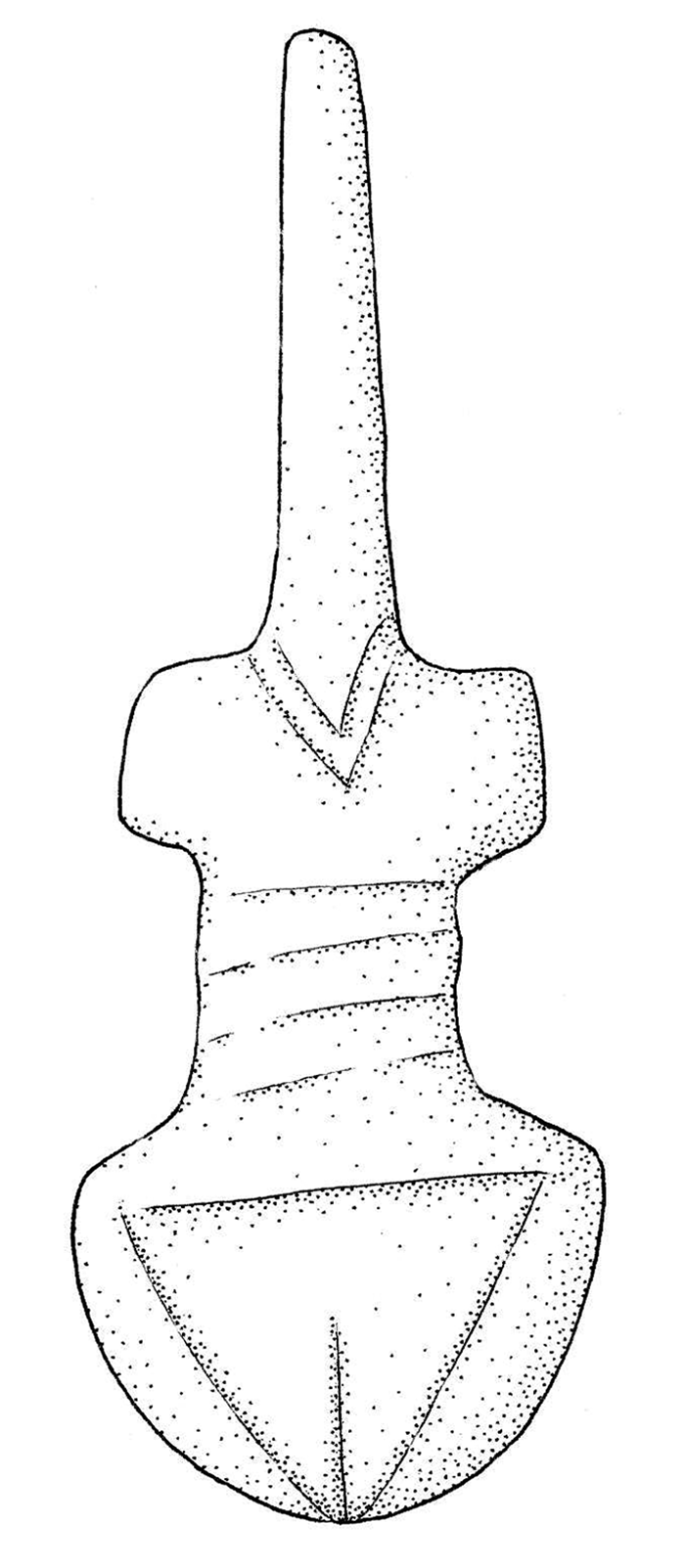
The marble sculpting traditions developed in conjunction with significant changes in settlement patterns and social interactions over the course of roughly three millennia. The Neolithic villages of the Cyclades provided a stable social geography through which the islanders could navigate their relationships. Settlements were relatively dense, fixed points within the maritime networks of the period. These patterns of habitation supported easy orientation and identification of communities, which were undoubtedly linked by dynamics such as intermarriage and group fission. There are a limited number of ‘naturalistic’ marble figurines from this period that depict the human form in detail. However, marble schematics and pebbles discovered in villages indicate the earliest foundations of the region's distinctive sculpting traditions (Renfrew Reference Renfrew, Marthari, Renfrew and Boyd2017; Televantou Reference Televantou, Marthari, Renfrew and Boyd2017). Schematic figurine styles, symmetrical pieces suggestive of torsos with necks and arms (see Figure 4), are the longest-lasting forms of the Cycladic traditions, with examples ranging from roughly 7000 years ago to the beginning of the Middle Bronze Age (c. 2000 bc). Collections of sea stones found alongside schematics imply that pebbles provided an essential form through which the sculpting practices emerged. Marble sea stones line the beaches of the Cyclades and are readily harvested. Their spheroid forms provide an ideal template for carving schematic figurines and were likely the basic scaffold through which Cycladic islanders learned to shape marble. Nonetheless, marble did not garner the kinds of attention and effort in the Neolithic that it did in the EBA.
Example of an EC I schematic figurine. (Drawing adaptation by Dr Céline Murphy.)
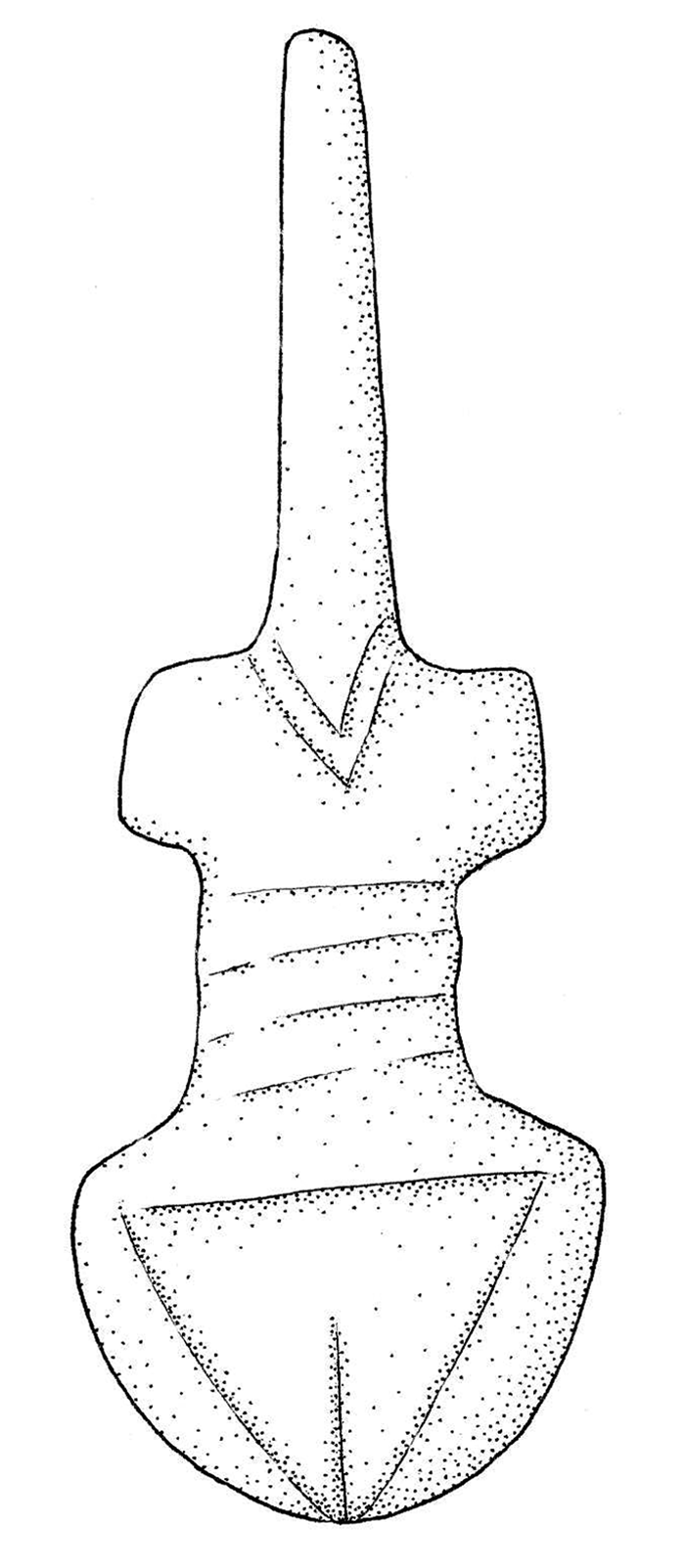
The transition to the EBA reconfigured the dynamics of Cycladic social interaction and the role of marble artefacts in these relationships. Group dispersal into decentralized settlements provides the most important key for understanding the emergence of Cycladic sculpting and the conceptual relationships the traditions mediated.Footnote 3 At a local scale, the shift from villages to homesteads and hamlets appears as a drastic reduction in complexity. Day-to-day interactions were simplified from consistent intimate relationships with multiple family groups and neighbours to a daily life dominated by the immediate family. However, this local simplification masks a global increase in the complexity of social relationships. In the distributed social environments of the EC I, the burdens of tracking and maintaining social relationships sharply increased. Not only were these communities heavily dependent upon exogamy, but, as Broodbank (Reference Broodbank2000, 84, 166–7) has convincingly articulated, they assuredly required systems of social storage (reciprocal obligations, debts and responsibilities) that enabled the successful occupation of marginal environments within the archipelago. It is in these contexts that the ease of accessing and shaping marble throughout the Cyclades provided a readily available means of stabilizing and coordinating social interactions.
The settlement patterns of the EC I fundamentally changed the burdens of social cognition. The decentralized mobility of homesteads, flocks and canoes generated a dynamic, fluid and interdependent social structure in which the difficulties and necessities of orientating, identifying and sustaining relationships drastically increased. The appearance of cemeteries suggests an anchoring of these relationships into the landscape, potentially acting as a means of identifying territory and lineage (cf. Broodbank Reference Broodbank2000, 153; Doumas Reference Doumas1977). It is in these funerary contexts that the Cycladic islanders first began to deposit marble pebbles, schematics and increasingly sophisticated naturalistic forms. As Broodbank notes (2000, 173), ‘it is to say the least striking that the boom in female figurines in the EBA coincides with the phase of maximum population dispersal in the Cyclades … in other words with the period when exogamy and competition for women would have been at its most pronounced.’ Given the context in which the Cycladic figurines emerged and that familial connections undoubtedly provided the primary heuristic through which social relationships were navigated (cf. Reference David-BarrettDavid-Barrett forthcoming), it is perhaps most useful to think of the figurines as a form of kinshipping technology. Kinshipping can be understood as the practices of creating, performing and sustaining concepts of relatedness (see also Carsten Reference Carsten2004; Ingold Reference Ingold, Bamford and Leach2009; Sahlins Reference Sahlins2013b; Viveiros de Castro Reference Viveiros de Castro, Bamford and Leach2009). In these regards, marble can be understood as a shared substance through which Cycladic society conceptualized its reproduction.
The relationship between the value of marble, kinship and Cycladic social organization emerged through collective attention and activities over the course of millennia. In the Cyclades, high-quality marble is superabundant and the material's value cannot be understood within a commodity framework (see Gregory Reference Gregory2015) nor as a result of rarity or exoticism (see Sahlins Reference Sahlins2013a). The availability and the relative ease of learning to work marble (at least in its most basic forms) negates traditional concepts of utility and exchange value, suggesting that the creation of value was dependent upon skill and shared meaning generated through material engagement. The ubiquity of the marble and particularly the smaller schematics that dominated the EC I, as well as their occasionally large concentrations in graves from the period (Rambach Reference Rambach, Marthari, Renfrew and Boyd2017), is suggestive of gifting dynamics because their production contradicts the logics of commodity accumulation. Since the raw material would have been impossible to control by any single group, the only available means of generating value with marble would have been through acts of skill, display and gifting. In addition, the superabundance of figurines and possible evidence for feasting on Keros during the later EC II–III shares a striking similarity to the kind of ‘potlatch’ dynamics first examined by Mauss ([1925] Reference Mauss2002). The relationship between kinship and gift has been recognized since Claude Lévi-Strauss argued that marriage was the paradigmatic example of gifting relationships ([1949] Reference Lévi-Strauss, Bell, von Sturmer and Needham1969). The anthropologist Chris Gregory, in his seminal Gifts and Commodities, argued (Reference Gregory2015, 98) that ‘the social organization of reproduction of things-gifts is governed by the methods of reproduction of people. The latter is a personification process which gives things-gifts a soul and a gender classification; the reproduction of things-gifts must be organized as if they were people.’ The emergence of Cycladic figurines, at a time when the cognitive burdens of tracking and maintaining social relationships had markedly intensified, strongly suggests that the artefacts circulated as part of a gifting economy that functioned to substantiate and maintain the reproduction of Cycladic bodies.
Taking into consideration the context of gifting and kinship, we can begin to explore how the value of the figurines was generated through acts of material engagement. The anthropologist David Graeber has argued that value forms enable the ‘importance of actions’ to be assessed by meaningfully incorporating them into social relationships (Reference Graeber2001, 69; see also Reference Graeber2013). This argument dovetails well with MET's concept of the material sign in which ‘meaning is not the product of representation but the product of “conceptual integration” between material and conceptual domains’ (Malafouris Reference Malafouris2013, 90). Value can be understood as a form of sustained, collective attention and it is by investigating the conceptual integration of bodies and the properties of marble that it is possible to appreciate how the sculpting traditions meaningfully incorporated Cycladic islanders into their communities. In order to understand how the shaping of marble generated a shared semiotic of value and kinship, we will now examine how the material agency of the artefacts shaped Cycladic perception and intersubjectivity.
The perception and semiotics of Cycladic bodies
Examining the emergence of Cycladic sculpting in relation to the transforming social interactions of the EBA necessitates an exploration of how body perception and attention-capture shape the development of human social cognition. Interpretations of the perceptual dimensions of Cycladic figurines have been dominated by art-historical perspectives which emphasize the visual appearances of the objects as isolated expressions of typological groupings (e.g. Getz-Preziosi Reference Getz-Preziosi1994). To date, Athena Hadji has been the only scholar to approach the perceptual dimensions of the figurines explicitly from the standpoint of cognitive science (2016). Hadji examines the broader multi-sensory relationship that incorporated the figurines into the contexts, performances and experiences of Cycladic society. She observes that learning to create such artefacts can ‘shape individual cognition literally through muscular training and neuronal adaptation; thus, they open new gateways to some of the statistically possible trillions of synapses in the human brain’ (Hadji Reference Hadji2016, 35). Though Hadji's paper explores very important features of perception and cognition, the examination of these dynamics is largely relegated to individual experiences of crafting and social contexts. Cycladic sculpture has not been examined with regard to body perception, attention-capture and the development of intersubjectivity. The attention-capturing properties of bodies reveals how Cycladic figurines focused collective attention and enabled the coordination of social interactions across multiple scales of organization.
Marble's ability to capture Cycladic attention, from the earliest pebbles and schematics to the construction of Dhaskalio, reveals the material was a locus of value through which islanders mediated their activities for generations. Marble's colour, luminosity and plasticity reveal important aspects of the material's agency and capacity to attract attention. However, the dynamics of body perception are perhaps the most significant factor in the ability of Cycladic sculpture to generate attentional focus. The human form draws attention in both peripheral and central vision (Downing et al. Reference Downing, Bray, Rogers and Childs2004). Furthermore, human facial recognition fixates upon the nose and saccades around the eyes (Hsiao & Cottrell Reference Hsiao and Cottrell2008). In short, there are nested patterns of attention-capture that move from the body to the face and attend to the eyes with the nose functioning to anchor gaze. These aspects of bodily and facial perception are significant because, by the time the canonical form was in use during the EC II, Cycladic islanders had begun to paint large, almond-shaped eyes upon the figurines (Hendrix Reference Hendrix2003) and the only facial feature consistently carved in marble was the nose. This evidence shows that Cycladic figurines align extremely well with the dynamics of bodily perception and can be understood as attention-capturing technologies in both individual and group contexts.
The figurines, both as they were observed and as they were made, reveal a clear integration with the fundamental dynamics of body perception and human social cognition. Haptic and visual perception of bodies and faces activates overlapping networks within the brain's fusiform and occipital face areas as well as the extrastriate and fusiform body areas (Costantini et al. Reference Costantini, Urgesi, Galati, Romani and Aglioti2011; Haxby et al. Reference Haxby, Hoffman and Gobbini2000; Peelen & Downing Reference Peelen and Downing2007; Spiridon et al. Reference Spiridon, Fischl and Kanwisher2006). These activation networks are implicated in proprioception, body schema, body image (Taylor et al. Reference Taylor, Wiggett and Downing2007) and the ability to differentiate self and other (Vocks et al. Reference Vocks, Busch, Grönemeyer, Schulte, Herpertz and Suchan2010) as well as goal-directed actions (Astafiev et al. Reference Astafiev, Stanley, Shulman and Corbetta2004). Significantly, the use of fine motor skills, as occurs during sculpting, activates networks within the cerebellum, pons and temporal lobe that are involved with proprioception and identity (Wynn & Coolidge Reference Wynn and Coolidge2014). In other words, intimate interactions with marble figurines were entangled with the capacity to perceive, identify and differentiate self and other, providing a source of attentional focus through which object recognition, self-awareness, body perception and social knowledge could be integrated.
The attention-capturing properties of the figurines and the interplay between self, other and object allow us to explore the role of artefacts in the development of Cycladic intersubjectivity. Human social cognition develops in early childhood through attention to bodies, faces and eyes. Infants fixate upon and imitate faces within hours of birth (Meltzoff & Moore Reference Meltzoff and Moore1983), demonstrating a fundamental capacity to differentiate self from others within the human motor-perception system (Trevarthen Reference Trevarthen and Bullowa1979). The development of facial recognition in infants begins with focusing upon the eye (Itier & Batty Reference Itier and Batty2009). Around six months old, infants begin to imitate adult emotional expression, preferentially attending to faces, bodies and movement (Gallagher Reference Gallagher2011, 69–75). Within the first year of life, human children begin engaging in joint attention through gaze following and monitoring (Trevarthen & Hubley Reference Trevarthen, Hubley and Lock1978). During the second year, humans increasingly participate in communicative gesturing such as cooperative pointing in order to form shared attention and joint activity (Tomasello & Rakoczy Reference Tomasello and Rakoczy2003, 125). In short, the presence and creation of Cycladic figurines during an islander's lifetime provided a powerful locus of interaction through which collective attention, activities and conceptual meanings could develop (cf. Alessandroni & Rodríguez Reference Alessandroni and Rodríguez2017). Ultimately, the evidence from the cognitive sciences shows that Cycladic sculpting was ideally suited for generating shared attention and understanding through pragmatic engagements and lifetime learning. The availability and ease of working the material, the perceptual properties of the figurines, their impact during childhood development, as well as their plasticity and mobility made them ideal semiotic forms to circulate amongst the dynamic maritime communities of the period.
To comprehend how attention-capture generated the collective knowledge and actions capable of scaling up social interaction requires an examination of how the artefacts generated semiotic relationships. Traditional approaches to the semiotics of artefacts focus upon symbolic content. Emphasis on propositional knowledge, such as beliefs and reasons, relegates the semiotic contributions of material culture to ‘stands for’ relationships between signs and referents, restricting analysis of semiosis to arbitrary mental abstractions. In juxtaposition to Cartesian approaches, MET has put forward the concept of enactive signification to examine the ways in which material culture generates non-representational sign relationships (see Garafoli & Iliopoulos Reference Garofoli and Iliopoulos2017; Iliopoulos Reference Iliopoulos2016a,b; Iliopoulos & Garafoli Reference Iliopoulos and Garofoli2016; Malafouris Reference Malafouris2013, 89–118). It is through an exploration of semiotics in terms of material processes and properties that MET examines how material culture generates meaning and coordinates development. Enactive signification shifts the focus from ‘what’ a material sign means to ‘how’ it is capable of supporting meaning-making activities (Malafouris Reference Malafouris2013, 90). In this sense, ‘the meaning of the material sign is expressive … the material sign, in most cases, does not stand for a concept but rather substantiates a concept’ (Malafouris Reference Malafouris2013, 97). In other words, a material sign concretizes meaningful relationships by mediating semiotic processes in ways that ecologically distribute the burdens of cognition. The ‘material sign does not refer to something existing separately from it, but is a constitutive part of what it expresses … it operates on the principle of participation rather than that of symbolic equivalency’ (Malafouris Reference Malafouris2013, 97). From this perspective, the production and circulation of artefacts can be interpreted as the means through which meaningful relationships are conceptualized and enacted as tangible realities. The combinatorial possibilities and projective capacities of material culture interactions substantiate, ground and blend semiotic processes enabling communities to shape, share, manipulate and transform meaning. The sculptures can therefore be understood as perceptual anchors upon which shared meanings were generated through joint attentional activities.
Examining the enactive signification of Cycladic figurines and their role in the emergent social complexity of the EBA requires an investigation of the perceptual, spatial and temporal relationships in which the artefacts were embedded. To this end, Charles Saunders Peirce's concepts of iconic and indexical signification provide an excellent starting point (Peirce [1902] Reference Peirce and Buchler2011; see also Iliopoulos Reference Iliopoulos2016b, 250–59; Knappett Reference Knappett2005, 85–106; Watts Reference Watts, Knappett and Malafouris2008). Peirce articulated three sign categories: iconic (physical resemblance), indexical (spatio-temporal correlations) and symbolic (arbitrary, learned relationships). Within this schema, Cycladic figurines are clearly primary icons of the body. However, the consistency and distribution of the canonical form reveals that the figurines functioned as secondary icons that are defined as conventional associations. In these associations, the objects were exemplars of a class of artefacts that substantiated a relational concept (Iliopoulos Reference Iliopoulos2016a). As Colin Renfrew has noted (Reference Renfrew, Philaniotou, Brodie, Gavalas and Boyd2013, 195), the figurines became a kind of ‘logo’ for Cycladic communities. The shared iconicity of the canonical figurines indicates factoral, part/whole relationships that can be understood as a kind of material synecdoche (see Knappett Reference Knappett2005, 85–106). The indexical properties of the Cycladic figurines reveal physical relationships of causality and contiguity through which meaning could be generated. Like smoke from a fire or a pointing finger, each figurine was a sign of its own crafting process as well as the attendant knowledge and associated value this implied, such as their use in rituals and burials. Likewise, the distribution and deposition of figurines made the objects indices of the relationships through which they were circulated. The figurines provided a stable and distributed scaffold through which islanders could conceptualize their communities and historical relationships as well as shape collective meaning through performative actions involving the figurines.
Canonical figurines created a perceptual target that reified the broader social contexts in which they were embedded and it is in these regards that the semiotics of fragmentation are clarified. Due to Cycladic marbles’ accessibility and ease of production, as well as the distribution and relational concepts embodied by sculpted forms, the fragmentation and deposition of marble on Keros should not be considered in terms of the destruction of value so much as its transformation. Hadji eloquently details the perceptual dynamics at play in the fragmentation of the object:
Intentional, communal, performative breaking, breaking as an agreed upon corporeal expression of a common yet unspoken cultural code is a multisensory experience par excellence … For the breaker, it is the peri-personal space where the act takes place … Moreover, the sound of breaking(s) as a marked interruption of either silence or, possibly, rhythmic chanting, would be heard and absorbed by all participants. The image of the object coming apart was also a shared sensory experience. (Hadji Reference Hadji2016, 37)
The destructions of figurines were undoubtedly profound attention-capturing acts with the ability to shape meaning amongst a large number of participants. From the perspective of an enactive semiotics, figurine fragments suggest factoral associations of part and whole, as well as indexical links to their breakage and transportation to Keros and the site's continuity and contiguity with the iconic forms. Their deposition on Keros implies an anchoring of these relationships to a specific geography and the patterns of movement involved in transporting them to the island. It is feasible that some of the canonical fragments found in burials and settlements around the Cyclades are related to activities at Kavos, but an exhaustive analysis has yet to occur.Footnote 4 If this is the case, then such fragments provided extended indexical associations between settlements, cemeteries and the activities on Keros. The factorality and mobility of canonical fragments potentially functioned as tokens of the relationships, obligations and histories of the people that participated in the rituals on Keros. Nonetheless, the semiotic and attention-capturing properties of the figurines enabled practitioners to manipulate concepts of value and relatedness at new scales through acts such as fragmentation.
Cycladic sculpture generated affordances for shared attention, beliefs and intentions through which Cycladic islanders could understand and participate in the activities of their broader community. The figurines can be understood to have materially extended concepts of relatedness by demarcating communities of practice and normative behaviours, manifesting a distinction between figurine practitioners and social outsiders. Creating and interacting with a widely distributed icon of the body provided a shared semiotics of value through which collective attention and activity could be sustained at a regional scale. The figurines were material signs of identity and relatedness through which Cycladic society was conceptualized and enacted. Kinshipping, gifting practices and ritualized performances involving marble artefacts extended the spatial and temporal boundaries of Cycladic social cognition. In this way, the collective attention and activities mediated by the figurines facilitated social organization at emergent scales, developing from homesteads to villages to regional confederacy during the course of the EBA.
The centre of attention
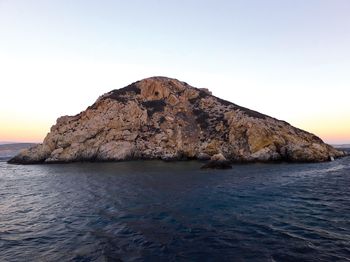
If the canonical figurines formed a locus of attention within groups and villages, then the island of Keros (Fig. 5) formed the nexus of attention between these communities. The Cycladic islanders deposited thousands of folded-arm figurine fragments upon the western slopes of Keros. Dhaskalio expanded rapidly as this peculiar behaviour began to subside. The clear majority (94 per cent) of statues most likely originated from Naxos, roughly four per cent are believed to come from Ios, two figurines from Paros and the remaining two per cent are unknown, potentially coming from Syros or Ios (Tambakopoulos & Maniatis Reference Tambakopoulos, Maniatis, Marthari, Renfrew and Boyd2017, 478). Other than the figurines, the deposits contain enormous quantities of marble and other stone vessel fragments as well as ceramic sherds. There are also substantial fragments of sauceboats, which appear to have originated from as far afield as Attica and the Argolid (Renfrew Reference Renfrew, Renfrew, Philaniotou, Brodie, Gavalas and Boyd2018, 553; Sotirakopoulou Reference Sotirakopoulou, Sotirakopoulou and Renfrew2016, 383). Islanders chose to bring materials, bodies, artefacts and foodstuffs by canoe to Kavos in order for their communities to interact at that specific location. It is also clear that the canonical form provided the central shared icon of these groups and that fragmentation of these figurines was essential to the conceptual relationships mediated by these congregations. Cycladic islanders undeniably formed a powerful association between Keros and their marble artefacts and went to great lengths to transport these materials to the island. Ultimately, the creation, fragmentation, transport and deposition of marble artefacts in the Special Deposits reveals a metaplastic entanglement of ECII communities, iconic forms and congregations on Keros.
The island of Keros with Dhaskalio on the far right as seen from Ano Kouphonisi. (Photograph: Author.)

The activities at Dhaskalio-Kavos span a period of roughly 500 years, during which time the cultural dynamics at the site underwent profound transformations. The chronology of the Keros complex has been subdivided into three phases (Renfrew Reference Renfrew, Renfrew, Philaniotou, Brodie, Gavalas and Boyd2018). During the early Keros-Syros Phase A, activity was predominantly focused upon the Special Deposits but includes limited evidence around the centre of Dhaskalio's eastern slope. The Keros-Syros period is followed by an Early Kastri Phase B, in which activity orientated away from the Special Deposits to focus upon Dhaskalio, culminating in a Late Kastri phase C, during which time activity at the Special Deposits appears to have ceased almost entirely. These transforming patterns of activity and the cultural assemblages associated with the various phases are the first most significant clues for interpreting the organizational dynamics through which Dhaskalio-Kavos emerged. Though a canonical figurine has never been discovered on Dhaskalio and while activities around the Special Deposits seem to have dwindled during the Early Kastri Phase B (Renfrew Reference Renfrew, Renfrew, Philaniotou, Brodie, Gavalas and Boyd2018), the intensive importation of marble to Dhaskalio reveals both a continuity and transformation of the material's value. The structural entwinement of marble into the architecture of Dhaskalio suggests a conceptual blending of the sculpting traditions and the activities on Keros with the building process. The polarities of depositing fragmented marble objects in the Special Deposits and the creation of Dhaskalio implies a refraction of value in which fragmentation preceded construction. It is in consideration of this transformation of value that it is possible to make sense of the development of Dhaskalio-Kavos and its broader socio-political significance as a centre of regional cooperation.
Geography, currents, voyaging ranges and settlement distribution all provide important insight into why the Minor Cyclades were a locus of social interaction and logical site for the emergence of social complexity. However, they tell us very little as to why the Dhaskalio-Kavos area was chosen, given the site's many peculiarities in terms of access, habitability and material assemblages. The defensibility and visual field provided by Dhaskalio offers some indication as to the site's strategic value, but the chronological primacy of the Special Deposits suggests that these features were not a principal concern when ritual activities were first established. The chronological priority of the Special Deposits relative to Dhaskalio complicates Broodbank's trading-centre thesis. If Dhaskalio was a settlement that flourished through trade, it did not begin its life as such, but resulted from prior acts of ritual congregation on Keros. Furthermore, Dhaskalio is a very odd location upon which to build a settlement. Beyond the difficulties of importing building materials and constructing upon its steep slopes, the site is relatively isolated. Dhaskalio-Kavos reveals a sustained, intergenerational effort on a regional scale to maintain and utilize the site, which only deepens the mystery as to why Cycladic communities chose such an inhospitable and difficult location to focus collective behaviour. In this regard, the deposition of sea stones on both Dhaskalio and Kavos sheds light onto some of the dynamics of congregation occurring at the site.
Mind the pebbles
Analyses of the symbolic dimensions of Keros have largely fixated on the preponderance of canonical figurines. One class of material evidence found at the site, that of limestone sea pebbles, has tended not to garner nearly as much enthusiasm. Nonetheless, the ritual deposition of these simple artefacts reveals a great deal about the conceptual relationships surrounding the physical movement and numbers of people involved in congregations on Keros. As discussed above, sea pebbles have been a relatively common feature of the Cycladic archaeological record dating back to the Neolithic. Marble pebbles provide an ideal template for shaping schematic figurines, and due to this relationship suggest a basic icon of the body. Likewise, marble pebbles are frequently found in the EC I cemeteries, revealing the long-held significance of sea stones in the Cyclades (Rambach Reference Rambach, Marthari, Renfrew and Boyd2017). The detection of a painted eye on a pebble from a grave on Despotiko from this same period (Hendrix Reference Hendrix2003, 430) further reinforces the point that these simple marble forms were identified with the body. This evidence suggests that the conceptual relationship between pebbles, schematics and bodies formed early during Cycladic engagements with marble, and indicates a continuity of meaning.
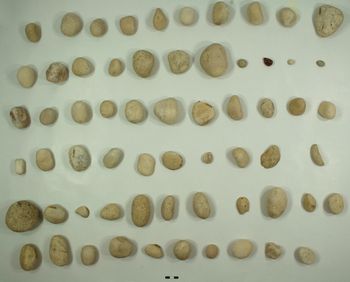
The ritual deposition of pebbles at Dhaskalio and Kavos not only implies continuity with earlier practices involving sea stones such as their placement in burials, but also reveals enactive signs that are distinctive to the site in terms of spatial ranges of movement, acts of congregation and the materials specified to signify these relationships. Over the course of Dhaskalio's development it became a common practice to retrieve fist-sized Kouphonisi limestone pebbles from the adjacent islands (Ano and Kato Kouphonisi) and transport them to the site. The sea stones are scattered, individually and in small clusters, across the entire site. Excavators realized their significance when they discovered a collection of hundreds of pebbles in the summit enclosure (Nymo et al. Reference Nymo, Renfrew, Dixon, Renfrew, Philaniotou, Brodie, Gavalas and Boyd2013; Fig. 6). A number of important semiotic relationships are revealed by this evidence. First, Kouphonisi limestone pebbles were a specified material form that required wayfaring to distinct locations to acquire, thereby producing indexical signs of this movement. Second, limestone is the geological precursor of marble and these sea stones share an iconic similarity with the marble pebbles observed throughout the early Cycladic record. The evidence suggests that these objects functioned as an iconic minimum of the body, indicating that the limestone forms found at Dhaskalio and Kavos indexed a microcosm of physical movement within the Kouphonisia. The form, quantities and accumulation of pebbles over time appear to have reified a semiotics of congregation and its attendant normative relationships.
Pebbles from the Summit Enclosure. (Source: Renfrew et al. Reference Nymo, Renfrew, Dixon, Renfrew, Philaniotou, Brodie, Gavalas and Boyd2013, fig. 27.4.)

The most significant find of pebbles on Dhaskalio, which reveals their clear role within a semiotics of congregation, comes from the promontory's summit enclosure. A total of 489 imported sea stones were discovered in the enclosure and over 1500 were documented across Dhaskalio during the 2006–2008 excavations (Nymo et al. Reference Nymo, Renfrew, Dixon, Renfrew, Philaniotou, Brodie, Gavalas and Boyd2013, 518). The exact dynamics of how they were brought to the promontory, whether by groups or specified persons, individually or en masse, is simply unknowable. Nonetheless, it is clear that the pebbles were ritualistically deposited, and the quantities and consistency of the act suggest the conceptualization of a defined community of congregants.Footnote 5 Further emphasizing the argument that sea stones provided an enactive semiotics of congregation are 728 catalogued pebbles which appear to have been largely clustered at the northern end of the Special Deposit South (Boyd Reference Boyd, Renfrew, Philaniotou, Brodie, Gavalas and Boyd2015, 377–8; Renfrew & Nymo Reference Renfrew, Nymo, Renfrew, Philaniotou, Brodie, Gavalas and Boyd2015).Footnote 6 These pebbles are almost entirely of Keros limestone, most likely gathered from the Kavos beach area beneath the Special Deposits. Thus, two similar behaviours are observed which function as indices of two significantly different spatial ranges of movement. Like the tracks of any animal, the movement of pebbles tell us that persons gathered these sea stones from distinct areas and carried them with the intent to place them in specific locations. Over generations, people gathered sea pebbles and carried them to the top of Dhaskalio and apparently to the northwestern side of the Special Deposit South. However, it is not entirely clear whether these activities were contemporaneous or if the pebbles at the Special Deposit South preceded the depositions on Dhaskalio (Boyd Reference Boyd, Renfrew, Philaniotou, Brodie, Gavalas and Boyd2015, 378). Nonetheless, it is possible to appreciate how dense accumulations of sea pebbles provided a perceptual target with which Cycladic islanders were able to conceptualize their relationships.
The pebbles from Dhaskalio and Kavos appear to have generated a quantitative and temporal relationship through a basic semiotic schema that blended a bodily icon with indices of bodily movement. Humans have an innate number sense capable of perceiving exact numerosity in groups of three and four (Malafouris Reference Malafouris2013, 108–9), beyond which humans begin to rely upon counting technologies such as tally marks, tokens and number systems to stabilize exact numerical thinking (Overmann Reference Overmann2016). Moreover, though precise calculations of large quantities require material scaffolds, human perception is extremely sensitive to changes in magnitude through addition and subtraction (Malafouris Reference Malafouris2013, 106–107; Overmann Reference Overmann2017, 363). The ability to estimate and appreciate general quantity through direct perception provides a key insight into the semiotic function of the limestone pebbles as part of a metaplastic relationship. Regardless of whether Cycladic islanders were taking exact counts of sea stones, their deposition provided a general sense of the quantities of humans that had performed acts of deposition. Magnitudinal shifts would have been observable over time through enlarging collections of pebbles. The accumulation of these simple signs suggests a rough-and-ready means of assessing the general quantities of (pebble-carrying/associated) persons that congregated at Dhaskalio and Kavos. In short, the pebbles can potentially be understood as a kind of proto-bureaucratic census taking.
Thousands of people potentially carried Kouphonisi limestones to Dhaskalio over the course of multiple generationsFootnote 7 as a means of indexing their acts of congregation. The steady accumulation of pebbles through acts of congregation indicates Cycladic islanders were able to perceive this flow of human beings over time through the addition and magnitudinal changes in the sea stones over time. The evidence for pebbles on Dhaskalio comes almost entirely from the Phase B and C periods (Renfrew & Nymo Reference Renfrew, Nymo, Renfrew, Philaniotou, Brodie, Gavalas and Boyd2015). Significantly, the placement of pebbles at the Special Deposit South appears to develop after the original practices of depositing fragmented ceramics, stone vessels and figurines began to subside in Phase B, implying both a transformation and continuity of tradition (Boyd Reference Boyd, Renfrew, Philaniotou, Brodie, Gavalas and Boyd2015, 377–8). This chronology strongly suggests that the deposition of pebbles on Dhaskalio and the Special Deposit South were relatively contemporary developments. Though the two practices show clear conceptual linkage, the difference between Kouphonisi and Keros limestone indicates a semiotic distinction between Dhaskalio and Keros. The placings of pebbles at the Special Deposit South, if they indeed occurred after major activities subsided, are likely best interpreted as acts of remembrance enabling later congregants to identify with the past rituals through a pilgrimage to and performance at the deposit (Boyd & Renfrew Reference Boyd, Renfrew, Renfrew, Philaniotou, Brodie, Gavalas and Boyd2018, 539). Ultimately, the Kouphonisi pebbles reveal a greater emphasis on movement within the Minor Cyclades, while the Keros pebbles show a much more immediate and direct association between the island itself and acts of congregation.
The depositing of sea stones and fragmented artefacts indicates modification of the landscape in ways that enabled histories of congregation to be physically perceived. The open air and dense accumulation of materials in both Special Deposits implies a similar magnitudinal relationship to the accrual of pebbles. The sheer quantity of broken materials attested to the scale of attendance at past rituals. These material accumulations indicate that the landscape of Dhaskalio-Kavos was modified in such a way that it enabled participants to perceive transformations in social interaction over time through an enactive semiotics of movement and congregation. The quantities, densities, spatial organization and temporalities of materials at Dhaskalio and Kavos enabled multiple scales of interaction to be conceptualized. This relationship between numerical cognition and the semiotics of congregation reveals an emphasis on tracking gatherings on Keros and maritime movement in the local area. However, these dynamics only evidence patterns of behaviour, not the causal processes that resulted in the particular significance of Keros, nor why activity was oriented away from the Special Deposits to focus upon Dhaskalio (Fig. 7). To understand the fragmentation and deposition of enormous quantities of materials on Keros, as well as the intensive effort of constructing Dhaskalio and its functions, it is necessary to examine the relationships between social cognition, kinship and seafaring that contextualizes the emergence of Dhaskalio-Kavos.
Dhaskalio from the south. (Photograph: Author.)

Canoes, communities and the voyaging cycle
Seafaring and Cycladic society were inextricably fused from the outset. The material agency of maritime technologies was critical for the creation of kinship networks and the reproduction of communities. The reorientation towards small-scale, local interaction networks during the EC I indicates an intensified emphasis upon maritime mobility in familial and social identity. In short, canoes were an essential locus of social organization that was deeply embedded into the constitution and reproduction of Cycladic society. The social interactions and material exchanges generated by Cycladic seafarers during the EBA clearly transformed regimes of value throughout the Aegean basin (Broodbank Reference Broodbank1989; Renfrew Reference Renfrew2011). The movements of Cycladic longboats made available exotic materials and techniques while intensifying interactions between a great multitude of peoples and cultural practices, a dynamic in which distance and knowledge were likely key sources of value (Broodbank Reference Broodbank1993; Reference Broodbank2000, 276–319). Long-range voyaging undoubtedly made Cycladic islanders conscious of the scale and diversity of Aegean societies and reshaped their concepts about community and social identity as well the possibilities of social organization.
The people of the Cyclades were becoming increasingly aware of a vast, rewarding and dangerous Aegean world as they began to aggregate into the first post-Neolithic villages. EC II communities likely experienced threats from external competition as well as growing local pressures and complexities produced by village-level organization. Multiple communities with populations in the hundreds, bolstered by extended hinterlands of smaller, related groups, were occupying and negotiating a shared environment. The complexity of such a social geography should not be underestimated. Cycladic communities existed within entanglements of kinship and local affiliations amidst a wider world filled with dangers and opportunities. The most readily available means of organizing cooperative responses to competitive pressures were assuredly the social ties and normative obligations made possible through affinal and consanguineal kinshipping practices. In this context, the circulation, distribution and use of the figurines may well have exerted a stabilizing effect upon these relationships by providing coherence and continuity of meaning for the society as part of an extended cognitive system.
Cycladic long-range voyaging has been framed as a prestige dynamic expressed primarily through the acquisition of exotic knowledge and materials from successful journeys. While there must have been status associated with skilled voyaging, to conceptualize long-range voyaging in terms of individual motivation in a prestige economy glosses over the enormous social complexities of organizing these feats. The establishment of an organized voyaging culture was a high-risk endeavour for the communities involved. Voyagers faced serious threats to their lives on the far horizons, while families faced those possibilities at home. The loss of a longboat would have been a disaster for a Cycladic community. A vessel containing a 25- to 40-person crew equates to roughly 10 per cent of a major EC II settlement, and therefore roughly a quarter of the able-bodied adults of a single Cycladic village (Broodbank Reference Broodbank2000, 256–8). Even without the social catastrophe of a vanished longboat, the extended absences of so many individuals invariably left communities more exposed to predation by other groups. Furthermore, if multiple Cycladic communities simultaneously deployed longboats for lengthy periods, this could potentially have exposed the whole region to incursions by hostile groups. Thus, it is important to appreciate the extent to which long-distance voyaging was not simply a matter of launching a canoe into the far reaches, but a fraught and dangerous proposition for an entire community.
Long-distance voyaging was undoubtedly motivated by shared conceptions of value, but this sense of value was only made possible through high degrees of trust. Voyagers needed a great deal of confidence in each other and communities needed to feel assured as to their own safety as well as the competence of the crews on whom the lives of their loved ones depended. Similarly, voyagers needed to feel confident that they were not leaving their homes and families at extreme risk. If, for example, a community such as Aplomata fielded a vessel, they needed to feel secure that they were not opening themselves up to raiding from a nearby community such as Koukounaries or Skarkos. Likewise, multiple contemporary communities engaging in voyages around the same time periods required mutual confidence that they were not exposing their shared territories to significant threat. Cooperative endeavour of the kind entailed by long-range voyaging thus demanded a high degree of shared knowledge and trust. Furthermore, raising the trust horizons of an extended Cycladic community demanded an understanding of the organization and timing of activities across the region. By mediating interactions through a shared semiotic of material engagement, the figurines were effective tools for increasing trust amongst the distal relationships of Cycladic society. In this way, we can begin to appreciate how the agency of marble and the semiotics of the figurines were metaplastically enfolded into the maritime environments of the Cycladic EBA.
Regimes of long-distance voyaging required islanders and their communities to navigate relationships at a global scale of Aegean communities, a regional scale of Cycladic settlements and a local scale of immediate families and specific communities. The growing period between planting and harvesting, roughly May through September, is also the period of the most moderate weather in the islands. It is also worth noting that the dispatching of voyagers during this timeframe would have reduced local resource pressure prior to the autumn harvest. It is this window of voyaging times that gives us the most insight into the broader social structuring of voyaging culture (cf. Agouridis Reference Agouridis1997; Broodbank Reference Broodbank2000, 92–6). Entwined into the ecology and agricultural practices of the Cyclades was a seasonal cycle that afforded cyclical voyaging. That is to say, the punctuated and repeating periods of travelling times provide a naturally calendrical, and therefore ritualistic, quality to voyaging activities. Thus, it is possible to appreciate how the risks and rewards of longboat journeys involved social pressures and demands that were distributed across multiple scales of interaction and mediated through a shared chronological framework and semiotics of value between communities. Likewise, juxtaposition to other Aegean communities undoubtedly brought Cycladic identities, relationships and solidarities into stronger relief. It is from this nexus of voyaging, social interaction, temporality and shared knowledge that we can now explore the emergence of Keros.
The emergence and transformation of the Keros confederacy
Cycladic islanders undoubtedly formed a powerful association between Keros and the canonical form, an association that both motivated and mediated relationships throughout the archipelago. The abundant materials in the Special Deposits attest to the sizable and repeated congregations that took place there. These gatherings not only initiated intensive activity upon Dhaskalio, but drew in participants from across the region. It is beyond doubt that the ceremonies of breakage were episodes of feasting; however, it remains unclear where these events took place and whether the activities in the Special Deposits were linked to feasting on Dhaskalio. The aggregation of bodies, the deposition of figurine fragments and the potential consumption of food from marble vessels prior to their destruction suggest an intermingling and absorption of bodily substances, possibly indicating a kinshipping metaphor in which sacred materials and a sacred environment were entwined with fundamental dynamics of sociality and social reproduction (see Sahlins Reference Sahlins2013b; Viveiros de Castro Reference Viveiros de Castro, Bamford and Leach2009). The materials present in the Special Deposits show that the most intensively involved communities were from the local island cluster (Hilditch Reference Hilditch, Renfrew, Philaniotou, Brodie, Gavalas and Boyd2015). Nonetheless, strong participation from the broader archipelago as wells as communities from mainland Greece are evident (Sotirakopoulou Reference Sotirakopoulou, Sotirakopoulou and Renfrew2016). These archaeological data contextualize well with the development of voyaging culture during the EC II and provide important insight into the transformation of activities at Dhaskalio and Kavos as an emergent property of local interaction, kinshipping, the value of marble and long-range voyages.
As long-range voyaging culture expanded, patterns of movement and connectivity shifted and transformed across the Aegean, undergoing enormous scalar shifts during the course of the Early Bronze Age. The regional circulation of materials during the early phases of the EC II was primarily between the Cyclades and mainland Greece. The geological formation of the Cyclades provides multiple easily navigable routes through the islands, with particularly dense connections to Euboea, Attica and the Argolid. It makes intuitive sense that the closer and safer passages between the Greek mainland and the Cyclades were the focal point for the early expansion of intra-regional exchange, and Phase A at Keros appears to attest to the dominance of these interaction networks at the time. Maritime voyages during the EC I–II transition appear to have largely occurred within a circuit that included the eastern portion of Attica and Euboea, northeastern Crete and southwestern Anatolia. This range of interaction shifted to cover almost the entire Aegean basin during the early EC II and then shifted northwards, away from Crete in the latter half of the period (Broodbank Reference Broodbank2000, 299–304; see also Kouka Reference Kouka, Brodie, Doole, Gavalas and Renfrew2008). Thus, we observe an initial phase of voyaging in which connections were first explored and established, leading to a floruit of pan-Aegean movement at the height of Dhaskalio-Kavos. This period of expansion was followed by a decline at the site as well as a reduction and reorientation of voyaging ranges, primarily away from Crete towards northwestern Anatolia. The Minor Cyclades formed the nexus of EBA maritime networks connecting mainland Greece, Crete and Anatolia. Evidence from the final phases of the Cycladic EBA suggests an increasing disruption of canoe-based networks attested to by increasing fortification and circumstantial evidence for the introduction of sailing technology (Broodbank Reference Broodbank2000, 341–9; Renfrew Reference Renfrew, Renfrew, Philaniotou, Brodie, Gavalas and Boyd2018, 556). It was having the geographic good fortune of being located at a natural and technical bottleneck in the energetic and material flows of the Aegean that enabled Cycladic islanders to generate novel forms of social complexity.
Keros formed the hub of an extended cognitive system which emerged through the metaplastic synergy of marble, seafaring, kinship and gifting, transforming social relationships across the Aegean. The connectivity of the Minor Cyclades suggests an impetus for collective organizational responses to the benefits and dangers of occupying such a strategic location. This interpretation squares well with the stratigraphy from Dhaskalio-Kavos. The establishment of ritual activities during Phase A occurred as long-range voyaging was rapidly expanding. Activity began to orientate around Dhaskalio during Phase B and the early development of the Kastri group, an assemblage that is primarily identified through the introduction of Anatolianizing materials (Angelopoulou Reference Angelopoulou, Brodie, Doole, Gavalas and Renfrew2008; Broodbank Reference Broodbank2000, 309–18) Importantly, the shift in material assemblage from Phase A to Phase B does not involve the subtraction or loss of any particular Keros-Syros forms. Rather, Phase B emerges through the addition of Anatolian techniques and styles, commensurate with the picture of increased connectivity at the zenith of the voyaging cultures. During Phase C of the late Kastri period, Anatolian styles were increasingly integrated with local Cycladic forms while ritual activities at the Special Deposits largely ceased before Dhaskalio eventually fell into disuse. The decline in rituals and activities at Dhaskalio-Kavos is consistent with the broader reorientation of voyaging towards the northern Aegean and growing disruptions of the maritime networks formed by longboats. It is from the association between the phasing of Dhaskalio, Kavos and the broad chronology of EC II voyaging that we can fit the final piece of the puzzle together in order to understand the likely function and transformation of activities at the site.
Fragmentation and creation
The families, clans, communities and tribes surrounding the Minor Cyclades during the EBA emerged from complex entanglements of lineage, affinity and affiliation that formed the contexts of Cycladic society. From the Neolithic onwards, the shaping of marble was metaplastically entwined with Cycladic identity and conceptions of value. By the EB II, the creation and circulation of figurines formed part of an extended sign system through which Cycladic islanders could perceive, conceptualize and mediate their relationships through engagement with shared value forms. The use of canonical figurines to concretize social identity developed in conjunction with the expansion of long-range voyaging, suggesting a material metaphor that conceptually blended the physical environment with bodies, community and maritime movement.
The floruit of marble sculpting occurred at a time when the scale and diversity of Aegean communities was becoming increasingly apparent. If it is accepted that the agency of marble generated an enactive semiotics of kinshipping values, then the history and function of Dhaskalio-Kavos becomes increasingly clear. The growing demands and possibilities of an emergent voyaging culture required a means of organizing these activities in ways that ensured the continued security and functionality of Cycladic communities during the extended absences of longboat crews. It is in these contexts that the canonical form provided the most consistent, widely distributed and powerful attention-capturing technology available to EC II communities. Faced with the opportunities and dangers of the wider Aegean world as well as the complexities of organizing substantial, heterarchical social relationships within the islands, the canonical form presents as an exceptionally potent tool for generating new scales of interaction. In this regard, one must consider the possibility that Dhaskalio-Kavos functioned to establish and organize maritime voyaging regimes as a ritual practice, a process that played a major role in generating the cultural transformations of the subsequent periods.
Keros formed a nexus in the circulation of bodies and materials throughout the Aegean. The fragmentation and placement of figurines in the centre of this gyre reveals a clear integration of the relationships substantiated through marble artefacts with broader regional movements in the archipelago. Evidence suggests that people potentially congregated on Keros in the hundreds, indicating that the island periodically hosted populations comparable to a large village, if not more (Renfrew Reference Renfrew, Renfrew, Philaniotou, Brodie, Gavalas and Boyd2018, 555). The size of these gatherings means that knowledge of when to congregate on Keros was widely shared. Voyaging season had an inherently calendrical structure and the regional centrality of Keros made the site ideally situated to harness the spatial and temporal patterns of Cycladic seafaring. Thus, it is fair to assume that congregation on Keros was closely linked to the voyaging cycle. A calendrical association between Keros and voyaging is the most plausible framework for shared knowledge about the appropriate times to journey to the island for acts of congregation. It is in this context of seasonal aggregation and ritual activity that one can appreciate the true importance of Keros in establishing a cultural regime of long-range voyaging.
Fragmentation and deposition conceptually integrated the location and environment of Keros with marble artefacts as well as acts of congregation and possibly communal feasting. These activities appear to have been reified through the later depositions of sea pebbles on both Dhaskalio and Kavos. Nonetheless, Keros’ central but relatively isolated position between three major islands suggests that the area was relatively ‘neutral’ territory. Furthermore, the high degree of interaction in the Minor Cyclades made the area a natural focal point of attention as well as contested space by the various groups traversing the area. These dynamics made the location a natural hub around which communities were forced to navigate and organize regional interactions. Given the dangers and rewards of the EC II, choosing such a location for congregation and then saturating it with the material signs of Cycladic social relationships was an exceptionally effective means of modifying the environment to facilitate collective identification. The creation of such a regional ‘sanctuary’ suggests a capacity for novel social and political creativity by affording social experiences and interactions that were distinct from the relationships and power dynamics of daily life in Cycladic communities (cf. Wengrow & Graeber Reference Wengrow and Graeber2015). Thus, Dhaskalio-Kavos not only presents itself as an emergent space for novel social interaction and intersubjectivity, but the behaviours attested to at Kavos begin to take on the appearance of an agreement or compact. In this way, these ritual acts generated a new form of community that mediated the burdens and necessities of coordinating social life in the islands.
Dhaskalio-Kavos was established through inter-island ceremonies that ritualistically enmeshed shared concepts of value and kinship with a fixed geographical location, marking it as a site of communal identity. From this perspective, the fracturing of figurines is suggestive of a covenant or pact enactively signified through the collective transformation of a shared icon, indexing a commitment to participate in a new form of social relationship. If the figurines were indeed a kinshipping technology, then they provided an ideal cognitive tool for reconceptualizing social solidarities. This is particularly the case of stateless societies such as those of the EBA in which kinship would have been the primary means of organizing social relationships. If some form of accord between Cycladic communities was reached on Keros, it would have been achieved through negotiations between those delegated to represent their respective groups in order to activate kinship networks in support of cooperative endeavour. Such an agreement only makes sense in the context of long-range voyaging, and the necessity of organizing this activity in ways that reduced risk to the participating communities. Congregation, feasting and the breakage of materials appears to have enabled Cycladic communities to negotiate the establishment of canoeing regimes on a regional scale in order to ensure the maximum security and rewards of launching expeditions. In such a scenario the benefits would be multiple, providing a place of aggregation for organizing journeys as well as a locus through which news, knowledge, techniques and materials could be concentrated, shared and disseminated. Such a dynamic of seasonal aggregation and dispersal clarifies a number of issues with the archaeology of Dhaskalio-Kavos in terms of the site's ritualistic and economic characteristics as well as its transformation over time.
If a regional voyaging culture was indeed organized through Keros, the island was likely, at least for the communities surrounding the Minor Cyclades, to be the ‘official’ starting or ending point of a cyclical journey and potentially both. Keros, as a ‘centre of gravity’, functioned to concentrate and organize the benefits of voyaging in a single location. The launching of an expedition or the return of a longboat implies a natural focus of attention for initiating acts of congregation. The ample evidence of metallurgy is potentially indicative of provisioning for journeys or the end result of voyages in which materials and new forms were brought to Dhaskalio for reproduction and distribution. In this regard, the Special Deposits might be best understood as the remnants of prehistoric ‘treaties’ that enabled a confederated polity to emerge through the expansion of voyaging practices.
The centuries-long physical transformations of Kavos and Dhaskalio reveal changing conceptual relationships and social interactions that are consistent with an emerging complexity catalysed through long-range voyaging. Not only was the value of marble expressed at the Special Deposits reconceptualized through the construction of Dhaskalio, but the evidence for the settlement's expansion is contiguous with the introduction of Kastri materials. It is a distinct possibility that the Kastri culture largely originated through the activities organized on Keros, which implies that the shift in behaviours on the island and across the region (cf. Angelopoulou Reference Angelopoulou, Brodie, Doole, Gavalas and Renfrew2008; Kouka Reference Kouka, Brodie, Doole, Gavalas and Renfrew2008) were generated in no small way through the activities at Dhaskalio-Kavos. As Cycladic voyaging culture gathered momentum, it began radically to alter the dynamics of the communities involved in the practices on Keros. In a sense, the value of the canonical form seems to have been subsumed by the island to enable more complex and sustained voyaging activities. During Phase B, the initial large-scale introduction of Anatolianizing forms began to produce a shift in activities and conceptions of value that refocused activities away from the Special Deposits. As the Keros complex continued to develop the reorientation of maritime networks away from Crete, an emphasis on exotic Anatolian forms, as well as possible ecological change and the introduction of sailing technology, potentially played a key role in the weakening and eventual breakdown of cultural coherence surrounding Dhaskalio-Kavos.
Conclusion
Ultimately, the relationship between marble and Cycladic intersubjectivity reveals the deeply entangled relationship between cognition, the material environment and the diversity of human cultures. It is increasingly imperative for scholars to create explanatory models that can explore the interdependence of human cognition, social organization and the ecological dynamics that make human complexity possible. Rather than viewing society as an epiphenomenon of individual brains and social complexity as a result of isolable cognitive functions (e.g. Theory of Mind), a material culture perspective on social cognition allows for a robust explanation of social complexity that is non-linear and context specific. Material culture provides a plastic scaffolding which enables human capacities for social organization to be reorganized and manipulated on a developmental scale whilst preserving such changes intergenerationally. The evolutionary relationship between hands, eyes, materials and the bodies of others reveals that it is not necessary to hypothesize about pre-evolved, hardwired cognitive modules when explaining human social complexity. Rather, the diversity and scalar potentials of human social organization is enfolded within the developmental plasticity of the brain and the material environment. In this paper, I have attempted to demonstrate how Material Engagement Theory provides a robust approach for engaging in an archaeology of social cognition. The material engagement approach draws from a broad array of scientific studies on perception, cognitive development and archaeological evidence, making use of often overlooked materials (such as pebbles) to offer a strong explanatory framework for interpreting archaeological phenomena. The application of MET to the subject of Cycladic sculpting, intersubjectivity and the emergence of Dhaskalio-Kavos helps to clarify the relationship between ecology, perception, semiotics and social interaction over archaeological timescales.
Cycladic marble sculpting emerged during a time in which the cognitive burdens of social interaction had markedly intensified. The intersubjective properties of Cycladic figurines provide a strong basis for understanding how the artefacts supported processes of meaning-making through material engagement. The development of human social cognition in early childhood through attention to bodies, faces and eyes reveals that the Cycladic figurines were ideally suited for generating collective attention and shared understanding through pragmatic engagements with the artefacts. Evidence strongly suggests that the artefacts circulated as part of a gifting economy which functioned to substantiate and maintain Cycladic kinship structures. As shared perceptual anchors through which collective attention could be sustained at a regional scale, the figurines provided semiotics of relatedness and value through which Cycladic social relationships could be conceptualized and preformed. These properties of the figurines made them ideal tools for raising the trust horizons and coordinating activities between communities engaged in rapidly intensifying maritime endeavours. Dhaskalio-Kavos and the Cycladic figurines are deeply enigmatic realities, and will remain so. However, the relationship between bodily perception, attention-capture, social interaction, kinship and gifting all provide insight into how Cycladic figurines helped to generate scalar shifts in collective organization. The idea that the activities at the special deposits established communal agreements and the trust necessary for sustained, intensive long-range voyaging is substantiated by the expansion of Dhaskalio, the introduction of the Kastri culture and the general patterns of maritime connectivity during the EBA. Dhaskalio-Kavos was both a ritual centre and a site of immense social, economic and political creativity. For roughly 500 years, Keros formed the centre of a kyklos in which the value of marble, kinship and seafaring extended the boundaries of social cognition and interaction, generating the dynamics through which the Bronze Age emerged. In this way, material engagement with marble reshaped cognitive development and social interaction, thereby enabling novel scales of social organization to emerge in the prehistoric Cyclades.
Acknowledgements
I would like to thank everyone involved in the 2018 excavations on Keros. My time there was a profound and joyful experience for which I will always be grateful. Special thanks to Céline Murphy, Ioanna Moutafi, Elizabeth Robertson and Rachel Robinson for their constructive feedback. I would also like to thank two anonymous reviewers for their detailed comments and suggestions which have greatly improved this article.