1. Introduction
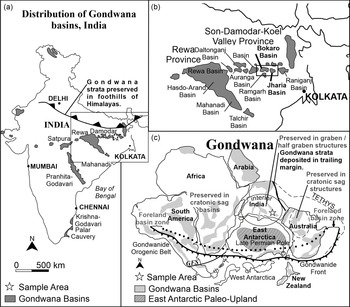
Deposition of the late Carboniferous to early Jurassic Gondwana strata of India (Fig. 1a, b) took place on a basement of Archaean and Proterozoic rocks between the northern Tethyan trailing margin and the interior of the Gondwana province of Pangaea, bounded in the far south by the active Gondwanide Orogen (Fig. 1c; Veevers & Tewari, Reference Veevers and Tewari1995). Deposition of Gondwana strata ceased with the break-up of Gondwana in the late Jurassic and early Cretaceous, followed by deposition of Cretaceous to Cenozoic rift-drift succession along India’s continental margins. Relics of the Gondwana successions (Lower and Upper Gondwana successions, collectively referred to as the Gondwana Supergroup) are preserved in interconnected to isolated areas and are informally referred to as Gondwana ‘basins’ (Fig. 1c; Veevers & Tewari, Reference Veevers and Tewari1995). These basins have been classified into four groups: (a) foreland basins immediately adjacent to the Gondwanide orogenic belt; (b) cratonic sag basins in the interior of Gondwana; (c) a series of fault-bounded basins extending from eastern southern Africa into the central part of India; and (d) trailing margin basins that flanked the original northern margin of Gondwana along the ancient Tethys Ocean (Fig. 1c).
(a) The distribution of the Gondwana basins across India and (b) the location of the Bokaro and Jharia coal basins in relation to the other basins along the Son–Damodar-Koel Valley. The exact location of the Gondwana strata preserved in the foothills of the Himalayas is not indicated on the map due to the relatively small size of the relicts. (c) The location of the Bokaro and Jharia coal basins in the context of Gondwana. The map of India is modified after Bhattacharya et al. (Reference Bhattacharya, Bandyopadhyay, Mahapatra and Banerjee2012) and Veevers & Tewari (Reference Veevers and Tewari1995). The map of Gondwana is modified after Mcloughlin (Reference Mcloughlin2001), after base map of Lawver and Scotese (Reference Lawver, Scotese and McKenzie1987). GFS refers to the Gastre Fault System (Rapela & Pankhurst, Reference Rapela, Pankhurst and Storey1992).

In India, fault-bounded basins, collectively referred to as the Gondwana Master Basin (Veevers & Tewari, Reference Veevers and Tewari1995), are the most widespread, with small relicts of possible original continental sag basins to the south of Chennai and west of Delhi and trailing margin basins in the foothills of the Himalayas (Fig. 1a). Of these the fault-bounded basins of Central India (Fig. 1a, b) are the most studied because of the large coal resources and characteristic Gondwana flora and fauna fossil assemblages that they contain (e.g. Acharyya, Reference Acharyya2019). However, due to uplift and erosion following the break-up of Gondwana, the original size and extent of these fault-bounded coal-bearing successions are not known and are therefore controversial topics in discussions of Indian geology. They are most commonly referred to in the literature as having been deposited in graben and/or half-graben structures (Veevers & Tewari, Reference Veevers and Tewari1995), implying that their original sizes were not much wider than what is currently preserved (Fox, Reference Fox1930; Biswas, Reference Biswas1999; Mishra et al. Reference Mishra, Chandra Sekhar, Venkata Raju and Vijay Kumar1999; Eyles et al. Reference Eyles, Mory and Eyles2003; Chakraborty & Ghosh, Reference Chakraborty and Ghosh2005). However, others contend that the normal faults bordering the basins are mainly post-depositional in age and that the original depositories may have been much larger and even interconnected prior to the break-up of Gondwana and subsequent erosion (Gee, Reference Gee1932; Chatterjee & Ghosh, Reference Chatterjee and Ghosh1970; Ahmed & Ahmed, Reference Ahmed and Ahmed1977). This leads to further uncertainty about the basin fills, including the provenance of the sediments, namely: Were sediments locally derived, as would be expected of syn-sedimentary graben or half-graben basins, or were they sourced more distally, as part of much larger depositional systems?
It is believed that detrital zircon age population studies, of which limited data have been published on the Indian successions (e.g. Li et al. Reference Li, Santosh and Indu2017), could assist in answering these questions. Therefore, a detrital zircon age study was undertaken on samples selected from the Gondwana successions, as preserved in the fault-bounded Bokaro and Jharia coal-bearing basins in central east India (Fig. 1a, b). The study was supplemented by a broad reconstruction of the genetic stratigraphy of the basin fills and palaeocurrent measurements at sites of sample collection. Earlier studies on the sources of sediments for the Indian Gondwana successions, based essentially on sedimentary inferences (e.g. Veevers & Tewari, Reference Veevers and Tewari1995), indicated that the Gondwana Master Basin system of India was sloping towards the Tethyan Ocean along the passive northeastern trailing margin of Gondwana (Fig. 1a). Sediments are thus considered to have been generally derived from the south and were therefore sourced from the Indian cratonic blocks and the postulated East Antarctic Palaeo-Upland (Fig. 1c; Veevers & Tewari, Reference Veevers and Tewari1995). The current study aims to evaluate those inferences based on U–Pb detrital zircon age data and investigate the extent to which the Gondwanide Orogeny, along the southern active margin of Gondwana, may have acted as a source to the Indian Gondwana successions. A secondary objective is to evaluate whether it is possible that the assumed East Antarctic Palaeo-Upland shielded India from receiving sediment from the Gondwanide Orogeny (Fig. 1c).
2. Regional geological setting
2.a. Basement geology of the Gondwana successions
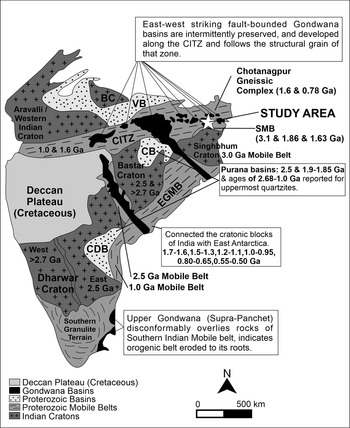
The Gondwana Supergroup overlies basement rocks of the Indian cratonic blocks with a marked angular unconformity. The cratonic blocks are believed to have been stabilized to their present-day configuration by 2.1 to 1.8 Ga and are composed of several Archaean continental nuclei of granite–greenstone terrains (e.g. Mukhopadhyay et al. Reference Mukhopadhyay, Ghosh, Nandi and Chaudhuri2006). There are five distinct cratonic blocks: the Dharwar, Bastar and Singhbhum cratons, which collectively define the Southern Indian cratonic block, and the Bundelkhand and Aravalli cratons defining the Northern Indian cratonic block (Fig. 2; Sharma & Mondal, Reference Sharma and Mondal2019).
Regional geological map of India showing the Gondwana basins, Proterozoic basins and mobile belts, as well as the Indian cratons. Modified after Mohanty (Reference Mohanty2015). BC – Bundelkhand Craton; VB – Vindhyan Basin; CITZ – Central Indian Tectonic Zone; CB – Chattisgarh Basin; EGMB – zastern Ghats Mobile Belt; CDB – Cuddapah Basin; SMB – Singhbhum Mobile Belt.

The Central Indian Tectonic Zone (CITZ; Fig. 2), with latest metamorphic ages of c. 1.0 Ga, overprinting earlier orogenic ages of c. 1.6 Ga (Bhandari et al. Reference Bhandari, Pant, Bhowmik and Goswami2011; Bhowmik et al. Reference Bhowmik, Wilde, Bhandari, Pal and Pant2012), sutures the southern and northern Indian cratonic blocks and bears testimony to evolution from earliest Mesoproterozoic to earliest Neoproterozoic (Bhownik, Reference Bhownik2019). Other Proterozoic mobile belts that fringe the Indian cratons include the ∼1.0 Ga Eastern Ghats Mobile Belt (EGMB; Paul et al. Reference Paul, Barman, McNaughton, Fletcher, Potts, Ramakrishnan and Augustine1990), the ∼0.5 Ga Western Ghats Mobile Belt (Biswal et al. Reference Biswal, Dewaele and Ahuja2007) and the ∼0.95 to 0.78 Ga and 1.6 to 1.4 Ga Chotanagpur Granite Gneiss Complex (CGGC) (Mukherjee et al. Reference Mukherjee, Dey, Ibanez-Mejia, Sanyal and Sangupta2018) incorporated in the CITZ (Fig. 2).
The regionally extensive EGMB, which occurs along the east coast of India, played a crucial role in connecting the cratonic blocks of India with East Antarctica. It is believed that the northern part of the EGMB evolved together with the Rayner Complex of East Antarctica as a single orogenic belt from 1.13 to 0.9 Ga (Bose & Dasgupta, Reference Bose and Dasgupta2018). The EGMB is regarded as a polycyclic granulite terrain with an evolutionary history that records various polymetamorphic events at ∼1.7 to 1.6 Ga, ∼1.5 to 1.3 Ga, ∼1.2 to 1.1 Ga, ∼1.0 to 0.95 Ga and ∼0.80 to 0.65 Ga. Pan-African (∼0.55–0.50 Ga) thermal metamorphic overprints are common along the western boundary zone of the EGMB (Mukhopadhyay & Basak, Reference Mukhopadhyay and Basak2009).
The Precambrian cratons in India also host large intracratonic basins with thick Proterozoic successions that developed during the Mesoproterozoic. These so-called Purana basins comprise unmetamorphosed sedimentary sequences and are key to understanding the origin and evolution of the continental crust. Unmetamorphosed sedimentary sequences within the Proterozoic basins of India are characterized by a high degree of commonality with respect to the lithological and lithofacies associations and depositional environments and occur in multiple unconformity-bounded sequences (Mukhopadhyay et al. Reference Mukhopadhyay, Ghosh, Nandi and Chaudhuri2006). Two of the largest erosional relicts of these basins, namely the Chattisgarh- and Cuddapah basins, host low-grade metamorphic sedimentary sequences in the lower part of the successions with a prominent detrital zircon age fraction of ∼2.5 Ga and ∼1.9 to 1.85 Ga (Bickford et al. Reference Bickford, Basu, Patranabis-Deb, Dhang and Schieber2011; Collins et al. Reference Collins, Patranabis-Deb, Alexander, Bertram, Falster, Gore, Mackintosh, Dhang, Saha, Payne, Jourdan, Backé, Halverson and Wade2015). However, a range of ages from 2.68 Ga to ∼1.0 Ga have been reported for an uppermost quartzite succession that overlies lower units with an erosional contact. The younger ∼1.0 Ga zircons in this quartzite unit, hosted by the regionally correlative Unconformity-bounded Sequence IV of the southern Purana basins (e.g. Wabo et al., Reference Wabo, De Kock, Beukes and Hegde2022), were derived from orogenic events in the Central Indian Tectonic Zone (CITZ) (Bickford et al. Reference Bickford, Basu, Patranabis-Deb, Dhang and Schieber2011).
To address the question of whether the fault-bounded Gondwana coal basins were sourced locally, as expected in graben or half-graben structures, or formed part of larger regional depositional systems, it is important to take note of certain details regarding the relationship between strata in the Gondwana basins and underlying rocks of the Indian cratonic blocks:
-
(a) The Archaean cratons of the Southern Indian Cratonic Block, namely the Singhbhum, Bastar and Dharwar cratons, all became amalgamated or sutured along ∼2.5 Ga orogenic belts with structural grains striking NNW. The fault-bounded Gondwana basins between the Singhbhum and Bastar cratons (i.e. the Hasdo, Mahanadi and Talchir basins) and those between the Bastar and Dharwar cratons further to the west (i.e. the Warhda- and Godavari Valley basins) are all preserved along these suture zones (Fig. 2), and the faults bounding them thus appear to represent reactivated older basement structural grains (Radhakrishna & Naqvi, Reference Radhakrishna and Naqvi1986; Rogers Reference Rogers1986; Acharyya, Reference Acharyya1997).
-
(b) Similarly, along the same lines, it is interesting to note that the E–W-striking fault-bounded Gondwana basins that are intermittently preserved and straddle the centre of the larger Indian shield are all developed along the CITZ and follow the structural grain of that zone (Fig. 2; Radhakrishna & Naqvi, Reference Radhakrishna and Naqvi1986; Biswas, Reference Biswas1999). This reiterates the suggestion that the bounding faults of these basins may merely represent reactivated older basement structural fabrics along the CITZ.
-
(c) A third observation is the fact that the N–NW-striking normal faults bounding the Gondwana basins situated between the Singhbhum and Bastar cratons and between the Bastar and Dharwar cratons propagate across the grain of the EGMB, so that Gondwana strata rest with marked angular unconformity on high-grade metamorphic rocks of this orogenic belt (Fig. 2; Veevers & Tewari, Reference Veevers and Tewari1995). Thus, the original orogenic mountain belt that accompanied formation of these metamorphic rocks at c. 1.0 Ga, and later also at 0.5 Ga, was already, at least in certain areas, peneplained and exhumed before deposition of the overlying Gondwana strata.
-
(d) Lastly, in the far south of the Indian Peninsula, late Triassic to early Jurassic strata of the Gondwana Supergroup (so-called Supra-Panchet Formation) of the Palar and Cauvery basins (Fig. 2) disconformably overlie high-grade 0.5 Ga metamorphic rocks of the South Indian Mobile Belt (Veevers & Tewari, Reference Veevers and Tewari1995), thereby indicating that this orogenic belt was also eroded to its roots prior to deposition of the Upper Gondwana strata.
2.b. Regional stratigraphic subdivision and structure of fault-bounded basins
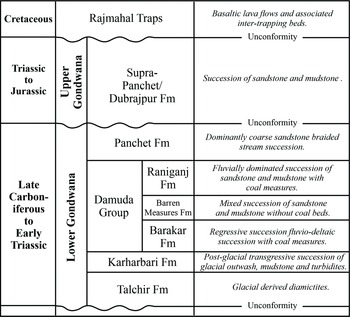
A characteristic feature of the Gondwana Supergroup in the fault-bounded basins of India is that their strata display a rather consistent internal stratigraphy from one outcrop area or basin to the other, over most of India (e.g. Veevers & Tewari, Reference Veevers and Tewari1995; Mukhopadhyay et al. Reference Mukhopadhyay, Mukhopadhyay, Rowychowdhury and Parui2010). Some lateral facies variations are present that give rise to local stratigraphic names (Mukhopadhyay et al. Reference Mukhopadhyay, Mukhopadhyay, Rowychowdhury and Parui2010), but for the most part the succession is divided into two major unconformity-bounded sequences: the lower succession, referred to as the Lower Gondwana (Upper Carboniferous to Lower Triassic), is disconformably overlain by the Upper Gondwana (Upper Triassic to Jurassic) sequence. A major middle Triassic erosional hiatus separates the two sequences (Fig. 3). The Lower Gondwana sequence comprises several characteristic lithostratigraphic units: from the base upwards, glacially derived diamictites (Talchir Formation); a post-glacial transgressive succession of glacial outwash, mudstone and turbidites (Karharbari Formation); a regressive fluvio-deltaic succession with coal measures (Barakar Formation); and a mixed succession of sandstone and mudstone without coal beds (Barren Measures), that grades upwards into a fluvially dominated succession of sandstone and mudstone with occasional coal beds (Raniganj Formation). The latter is overlain by a dominantly coarse-grained sandstone braided stream succession referred to as the Panchet Formation (Fig. 3). The Panchet Formation is disconformably overlain by a succession of sandstone and mudstone commonly referred to as the Supra-Panchet or Upper Gondwana succession which in the Rajmahal area (Fig. 1a) is referred to as the Dubrajpur Formation (Fig. 3). In the latter area the Dubrajpur Formation is in turn disconformably overlain by an early Cretaceous lava succession known as the Rajmahal Traps (Fig. 3; Veevers & Tewari, Reference Veevers and Tewari1995). A more detailed description of the various lithostratigraphic units of the Gondwana successions in the fault-bounded basins of Central India, with appropriate references, is provided in the online Supplementary Material at https://doi.org/10.1017/S0016756822000930.
Simplified stratigraphic subdivision of the Lower Gondwana succession (Upper Carboniferous to Lower Triassic Gondwana), which is disconformably overlain by Upper Gondwana succession (Upper Triassic to Jurassic) in the Damodar Valley (Veevers & Tewari, Reference Veevers and Tewari1995).

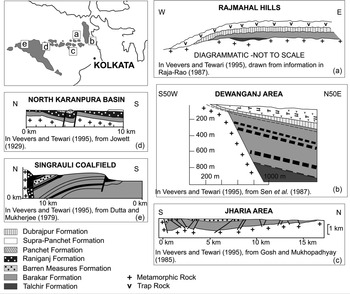
Cross-sections of some of the fault-bounded Gondwana basins of Central India by Veevers and Tewari (Reference Veevers and Tewari1995) illustrate faulting as being post-depositional, with no rapid facies change or coarsening towards the boundary faults (Fig. 4). Furthermore, since the Gondwana successions can be correlated from one basin to the other, it appears unlikely that these basins represent syn-depositional graben or half-graben structures. Rather, the basins were most likely initially more extensive and currently represent structurally controlled erosional relicts of the original depositories. The unconformity that developed at the base of the Supra-Panchet Formation (Upper Gondwana and correlative Dubrajpur Formation; Fig. 4a, b, d), as well as the possibility that some of the faulting may have preceded deposition of the Dubrajpur Formation of the Upper Gondwana sequence (Fig. 4b), is also illustrated by these cross-sections.
Structure of the Gondwana basins in India that show faulting to be post-depositional with no rapid facies change or coarsening towards the boundary faults. This implies that the Gondwana sequences in India were likely much more extensive prior to erosional events. Illustrated in (a), (b) and (c) is the development of an unconformity at the base of the Dubrajpur Formation (a correlative of the Supra-Panchet Formation) during the Triassic, which was due to active orogenesis along the southern margin of Gondwana. Modified after Veevers and Tewari (Reference Veevers and Tewari1995).

2.c. Structure and stratigraphy of the Bokaro and Jharia coal basins
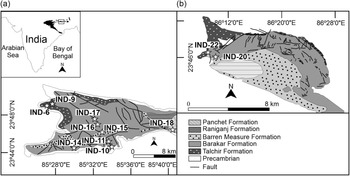
The Bokaro and Jharia coal basins of the Son–Damodar–Koel Valley Coal Province, sampled during this study, both appear to be represented by open double-plunging synclinal structures (Fig. 5). The fold axis of the syncline in the Bokaro coal basin strikes approximately E–W, while that of the Jharia coal basin is orientated to the NW (Fig. 5). The Jharia coal basin has a clear half-graben structure with a major post-depositional normal fault on its southern side and bedding dipping towards the fault (Figs. 4c, 5b). The Bokaro coal basin has a less well-defined fault on its northern side.
A simplified geological map showing stratigraphic units and the location of the rock samples that were collected from (a) the Bokaro (modified after Equeenuddin et al. Reference Equeenuddin, Tripathy, Sahoo and Ranjan2016) and (b) the Jharia (modified after Murthy & Rajanikanth, Reference Murthy and Rajanikanth2017) coal basins in the Jharkhand State of India. The locations of the Bokaro and Jharia coal basins are also provided in Figures. 1 and 4.

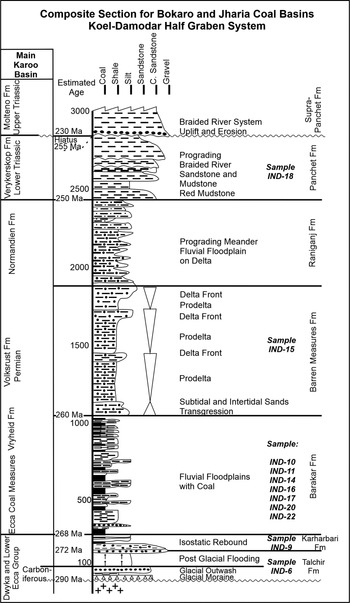
A composite genetic stratigraphic profile, compiled from data presented by Veevers and Tewari (Reference Veevers and Tewari1995) and Bhattacharya and Banerjee (Reference Bhattacharya and Banerjee2015), indicates that the Bokaro and Jharia coal basins of the Koel–Damodar half-graben system host a thickness of c. 3000 m of Gondwana strata (Fig. 6). The basal Talchir Formation is composed of glacial moraine deposits, gradationally overlain by glacial outwash conglomerates and sandstones, which in turn are overlain by fine-grained graded-bedded turbidites, that most probably represent part of the post-glacial drowning or transgressive event (Fig. 6). This transgressive succession is overlain by a succession of poorly sorted conglomerates and sandstones of the Karharbari Formation, that could represent isostatic rebound deposits (Fig. 6). It is in turn overlain by a succession of shale and sandstone, with interbedded coal beds of the Barakar Formation, thought to represent fluvial floodplain deposits. Deposition of the coal beds came to an end following a marine transgression, with excellent examples of shallow subtidal to intertidal well-sorted sandstones (Bhattacharya & Banerjee, Reference Bhattacharya and Banerjee2015) in the basal part of the overlying Barren Measures Formation (Fig. 6). However, the upper part of the Barren Measures Formation appears to be composed of stacked upward-coarsening prodelta to delta-front mudstones and fine-grained sandstones (Fig. 6). This succession then grades upwards into meandering river deposits composed of interbedded sandstone and mudstone, with occasional coal seams of the Raniganj Formation that is gradationally overlain by a sand-rich unit that most probably represents braided stream deposits and is classified as the Panchet Formation (Fig. 6).
Stratigraphic profile of the Gondwana sequence in the Bokaro and Jharia coal basins and the stratigraphic position at which samples were collected during the study. Also shown on the diagram are the correlating units of the Main Karoo Basin of southern Africa, which preserves the reference stratigraphy of the Upper Carboniferous to Triassic time (constructed using data from Veevers & Tewari, Reference Veevers and Tewari1995 and Bhattacharya & Banerjee, Reference Bhattacharya and Banerjee2015).

Age boundaries for the different formations, based on estimates by Veevers & Tewari (Reference Veevers and Tewari1995), are also presented on the composite stratigraphic profile (Fig. 6), since one purpose of this paper is to evaluate the maximum age of deposition of strata through the age of the youngest near-concordant detrital zircons or zircon age fraction present. Figure 6 also indicates that the succession in the basins has remarkable similarities to the rock types and the generic stratigraphy of the Main Karoo Basin in southern Africa, a feature also recognized by, for example, Veevers & Tewari (Reference Veevers and Tewari1995).
3. Zircon sample locations and analytical methods
3.a. Sample locations
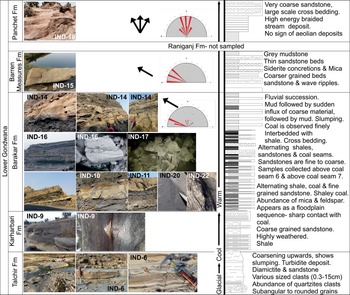
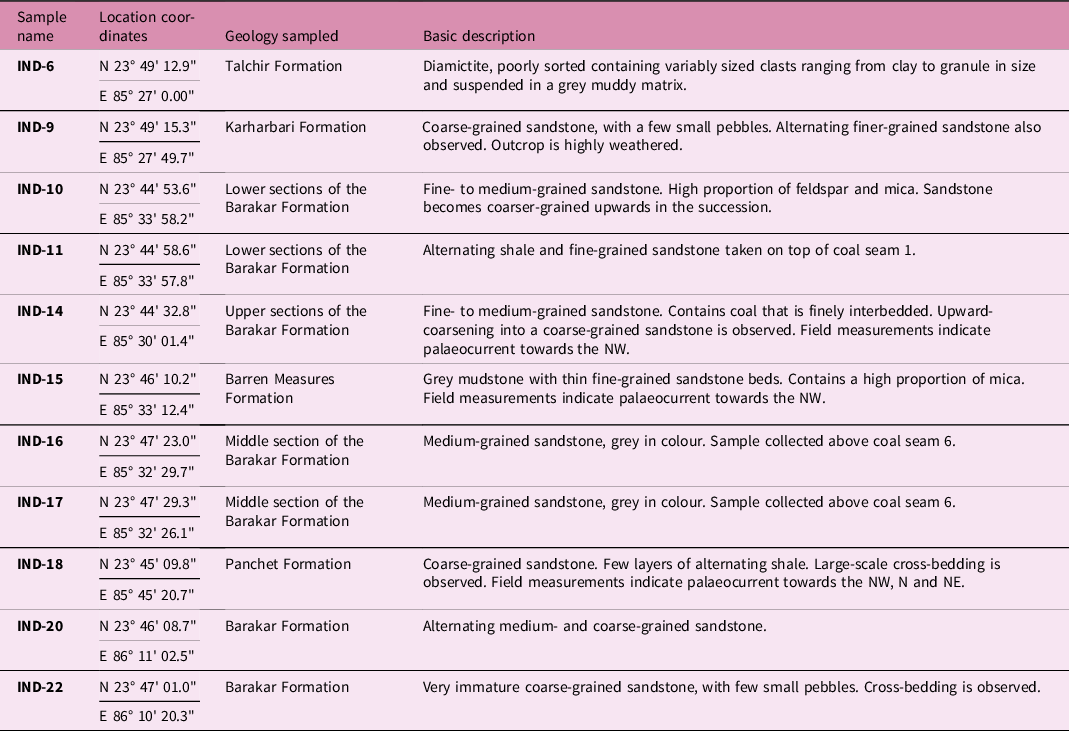
Eleven samples from strata of the Bokaro and Jharia coal basins were collected for detrital zircon extraction (Fig. 7). Their geographical positions are indicated on the geological maps of the two basins (Fig. 5) with their co-ordinates presented in Table 1 and stratigraphic position plotted on the composite profile (Fig. 6).
Field photographs illustrating the nature of sampling localities of the Lower Gondwana succession in India. Also shown are rose diagrams showing the palaeocurrent direction measured during field observations. A simplified stratigraphic column is shown on the right that summarizes field observations.

Sampling localities and basic description of rock samples collected from the Bokaro and Jharia coal basins, India

In the Bokaro coal basin, glaciogenic strata of the Talchir Formation (IND-6) and the sandstones of the Karharbari Formation (IND-9) were sampled along the banks of the Bokaro River, c. 1.4 km apart (Fig. 7). The arkosic sandstones of the lower Barakar Formation (IND-10) were collected c. 13 km SE of the sample location of IND-9 (Fig. 7). Sample IND-11 was collected directly on top of coal seam 1. Sandstones of the upper part of the Barakar Formation were sampled in a road cut c. 2.5 km NW of sample IND-11. The grey mudstones interbedded with thin sandstone beds of the Barren Measures Formation (IND-15) were sampled along the Bokaro River, while sandstones of the middle reaches of the Barakar Formation (IND-16) were collected on top of coal seams 6 and 7, respectively (Fig. 7). The coarse-grained sandstone beds of the uppermost unit of the Panchet Formation (IND-18) were collected along the Bokaro River, c. 20 km east of IND-10 (Fig. 7). Two samples were collected from the Jharia coal basin of eastern India: a sandstone (IND-20) and a granulestone (IND-22) of the Barakar Formation along the Bokaro River (Fig. 7). During this study, palaeocurrents measured at different sample localities are mainly directed to the northwest and north (Fig. 7). These directions are in general agreement with those documented by Casshyap (Reference Casshyap1973) from a regional study of cross-bedding directions of Barakar sandstones in virtually all of the Indian coal-bearing basins, and data presented by Veevers & Tewari (Reference Veevers and Tewari1995) for the Gondwana successions in general.
3.b. Detrital zircon analysis
Detrital zircon U–Pb age dating was performed at the Department of Geology, University of Johannesburg Laboratory for Laser Ablation Inductively Coupled Plasma Quadrupole Mass Spectrometry (LA-ICP-QMS), using an ASI Resonetics 193 nm laser system coupled to a Thermo X Series II quadrupole-based ICP-MS system. Sample preparation and extraction of zircons followed a standard procedure as described in Belyanin et al. (Reference Belyanin, Kramers, Vorster and Knoper2014).
U–Pb detrital zircon age determination was conducted using a standard-sample/standard-bracketing analysis method to efficiently correct for elemental fractionation and mass discrimination effects. Two standard reference materials were used, the primary standard being GJ1 (608.5 ± 0.4 Ma; Jackson et al. Reference Jackson, Pearson, Griffin and Belousova2004), while 91500 (1065 ± 0.4 Ma; Wiedenbeck et al. Reference Wiedenbeck, Allė, Corfu, Griffin, Meier, Oberli, Von Quadt, Roddick and Spiegel1995) was the secondary standard. The 15 s measurement of helium gas as a blank was followed by a 55 s single spot analysis of individual detrital zircon grains using a beam diameter of 30 µm. The same ablation conditions were used for the analysis of the standards and unknown samples using the following parameters: laser energy at 6 mJ, fluence at 1.21 J cm−2, transmission at 12,5 % and a 3 Hz repetition rate. The ablation of distinct cores, metamorphic overgrowths and fractures in detrital zircon grains were avoided where possible. Reduction of the acquired detrital zircon data was done using in-house developed data reduction software (see Vorster et al, Reference Vorster, Kramers, Beukes and Van Niekerk2016). The in-house software allows for the exportation of data in ASCII format in.csv files, which were imported into Microsoft® Excel for further calculation and interpretation of results. The Microsoft®Excel integrated Isoplot/Ex 3.00 software (Ludwig, Reference Ludwig2003) was used to calculate and plot the concordia ages. Concordia ages less than 10 % discordant were used to construct probability density plots for each sample, in accordance with the criterion of Košler & Sylvester (Reference Košler and Sylvester2003) that Pb–Pb ages with a discordancy of 5 to 10 % are considered reliable for use in sedimentary provenance studies. The detrital zircon age datasets of the strata of the Bokaro and Jharia coal basins were subjected to the 1-O (one minus overlap) assessment of the detzrcr software package (as proposed by Andersen et al. Reference Andersen, Kristoffersen and Elburg2018) to determine the extent to which the age distribution for the different formations changes throughout the sampled succession.
4. Zircon analytical results
4.a. Detrital zircon morphology and populations
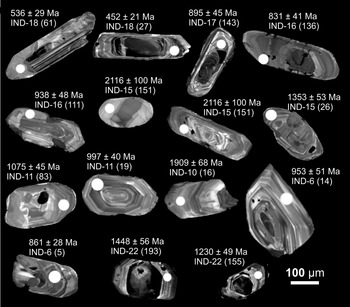
A total of 1364 detrital zircon grains were analysed from samples representing the Bokaro and Jharia coal basins, of which 730 zircon grains were less than 10 % discordant. In view of the fact that Nemchin & Cawood (Reference Nemchin and Cawood2006) argued that disregarding discordant age data could potentially introduce an unwanted bias, the Supplementary Material (available online at https://doi.org/10.1017/S0016756822000930) includes all data and cathodoluminescence (CL) images of both concordant and discordant grains. Detrital zircon populations in this study are defined as all detrital zircon grains contained within a given sedimentary rock formation. The nature of such a population can therefore merely be estimated by sampling and analysing a smaller number of zircon grains, known as the dataset. Each zircon population and dataset contains several smaller subsets which are characterized by age and are referred to as age fractions (Andersen et al. Reference Andersen, Elburg and Magwaza2019). The Th/U values of the grains have also been determined to differentiate between zircons of magmatic origin and those of very high-grade metamorphic origin. Zircon crystals derived from very high-grade metamorphic rocks typically have Th/U values less than ∼0.1, with rocks of igneous origin having greater ratios (Rubatto, Reference Rubatto2002; Hoskin & Schaltegger, Reference Hoskin and Schaltegger2003; Moeller et al. Reference Moeller, Kennedy and Kröner2003). With a few exceptions, all the zircon grains analysed during the study were originally from igneous or low- to high-grade metamorphic sources. Examples of CL scanning electron microscope (SEM) images of a selection of detrital zircon grains from the various formations are presented in Fig. 8 and are available in the online Supplementary Material. The detrital zircon grains are mainly sub-rounded to rounded, ranging from 70 to 420 μm in length. Most grains are elongate and none of the grains show evidence of metamorphic overgrowth (Fig. 8).
Cathodoluminescence SEM images of a selection of detrital zircon grains analysed in the study from the Bokaro and Jharia coal basins, with laser sampling position indicated by the white circle. The zircon grains are mainly sub-rounded to rounded and are elongated.

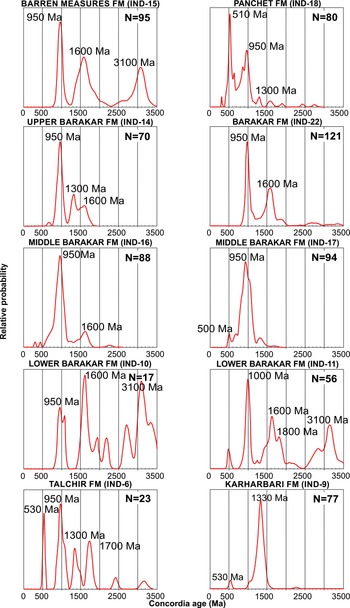
Probability density plots of the various samples, for zircon ages less than 10 % discordant, are shown in Fig. 9, stratigraphically ordered from the top downwards for comparison of age fractions between samples of the two basins studied. It is interesting to note that zircon age fractions present within the samples of the Bokaro and Jharia coal basins appear to be related to their stratigraphic position in the succession: the Talchir Formation sample, which produced 23 near-concordant zircon ages, displays a spread of major age peaks, including those at ∼530 Ma, ∼950 Ma, ∼1300 Ma and ∼1700 Ma (Fig. 9; Supplementary Table S1 and Fig. S1 at https://doi.org/10.1017/S0016756822000930). It is also the only sample of the succession in the Bokaro coal basin that displays a ∼2400 Ma age peak (although minor), together with a small Mesoarchaean age peak at ∼3140 Ma (Fig. 9). The youngest zircon age yielded in the sample is 500 ± 21 Ma (4.6 % discordance) (grain no. 22; Supplementary Table S1 and Fig. S1).
Probability density plot for the samples collected from the Bokaro and Jharia coal basins in India. The zircon age fractions that are present within the samples appear to be related to their stratigraphic position in the succession.

The immediately overlying sample from the Karharbari Formation produced 77 near-concordant zircon ages. In contrast to the Talchir Formation, the Karharbari Formation sample displays essentially a unimodal zircon age fraction, with ages ∼1330 Ma, tailing down to a small younger age fraction at ∼1030 Ma, combined with a small well-defined age peak at ∼530 Ma (Fig. 9; Supplementary Table S2 and Fig. S2 at https://doi.org/10.1017/S0016756822000930). The youngest zircon age yielded in the Karharbari Formation sample is 517 ± 38 Ma (1.0 % discordance) (grain no. 84; Supplementary Table S2 and Fig. S2). A 1-O value of 0.01 (Supplementary Table S2) was obtained for the pairwise comparison on the two datasets, implying that the detrital zircon age distribution of the Karharbari Formation overlaps that of the Talchir Formation. Values lower than 0.05 for 1-O assessment imply that if the data were to be represented by empirical cumulative distribution functions (ECDF; Supplementary Fig. S12), there would be an overlap of the confidence intervals associated with the functions of two formations along 95 % of the two graphs, making the age distribution of the two formations indistinguishable (Andersen et al. Reference Andersen, Kristoffersen and Elburg2018). A visual comparison of the two datasets clearly indicates that the two units have a ∼530 Ma and ∼1300 to ∼1330 Ma age component in common (Fig. 9), and the overlap in this region of the age probability density and ECDF diagrams is likely the reason for the low 1-O value.
The two samples from the lower section of the Barakar Formation (samples IND-10 and IND-11), although displaying similar zircon age fractions, differ to a large degree from those of the underlying Talchir and Karharbari formations. This is supported by the relatively high 1-O value of 0.31 when the age distribution of the lower section of the Barakar Formation is compared to that of the Karharbari Formation (Supplementary Tables S3 and S4 at https://doi.org/10.1017/S0016756822000930). The probability density plots for samples IND-10 and IND-11 were constructed using data from 17 and 56 near-concordant zircon grains respectively (Fig. 9; Supplementary Tables S3 and S4 and Figs. S3 and S4). These samples, in combination, comprise all six age fractions that are described for the two underlying Talchir and Karharbari formations, as well as a distinctive and well-defined Archaean age fraction that has two age peaks, namely an early Neoarchaean age peak and a Mesoarchaean age peak (Fig. 9). Additionally, sample IND-10 also comprises a prominent Eoarchaean age fraction and a late Palaeoproterozoic age fraction, while sample IND-11 comprises a small early Cambrian zircon age fraction. The youngest zircon ages yielded in sample IND-10 are 958 ± 34 Ma (5.9 % discordance) and 1056 ± 38 Ma (1.1 % discordance) (grain nos. 27 and 19; Supplementary Table S3 and Fig. S3). The youngest zircon age yielded in sample IND-11 is 470 ± 24 Ma (3.7 % discordance) (grain no. 88, Supplementary Table S4 and Fig. S4).
The older Palaeoproterozoic and Archaean zircon age fractions are, however, absent from the overlying middle and upper sections of the Barakar Formation samples from the Bokaro coal basin (samples IND-14, IND-16 and IND-17), as well as from the Barakar Formation samples from the Jharia coal basin (samples IND-20 and IND-22) (Fig. 9). The 1-O values obtained when comparing the lower section of the Barakar Formation to the middle and upper sections of the formations are 0.35 and 0.43 respectively (Supplementary Tables S5, S7 and S8 at https://doi.org/10.1017/S0016756822000930), indicating that the detrital zircon age distribution for the lower section of this formation is indeed rather distinct from those of the overlying sections of this formation within the Bokaro coal basin. The probability density plots for the middle section of the Barakar Formation were constructed using data from 182 near- concordant zircon ages (Supplementary Tables S7 and S8, and Figs. S7 and S8), while that for the upper part of the Barakar Formation produced 70 zircon ages (Supplementary Table S5 and Fig. S5). Samples from the Barakar Formation of the Jharia coal basin produced 130 near-concordant zircon ages (Supplementary Tables S10 and S11, and Figs. S10 and S11). These samples display dominant ∼950 Ma age peaks, combined with c. 1300 Ma and 1600 Ma age peaks, and occasionally minor age peaks around 500 Ma (Fig. 9). The youngest zircon ages yielded in the samples from the middle section of the Barakar Formation are 302 ± 23 Ma (6.3 % discordance) (grain no. 157; Supplementary Table S7 and Fig. S7) and 437 ± 23 Ma (4.8 % discordance) (grain no. 129; Supplementary Table S7 and Fig. S7). The youngest zircon age yielded in the sample from the upper section of the Barakar Formation is 655 ± 38 Ma (1.6 % discordance) (grain no. 31; Supplementary Table S5 and Fig. S5).
The detrital zircon age pattern of the Barren Measures Formation differs significantly from those of underlying units, as confirmed by 1-O values of 0.43 and 0.24 (Supplementary Table S6 at https://doi.org/10.1017/S0016756822000930), respectively obtained when comparing the detrital zircon age distribution of this formation to those of the middle and upper sections of the Barakar Formation. Here, the probability density plot (constructed using 95 near-concordant zircon ages) again comprises a wide spectrum of zircon age fractions. These include a prominent Archaean age fraction with zircon grains of Cambrian ages (Fig. 9; Supplementary Table S6 and Fig. S6). The youngest zircon age yielded in the sample is 887 ± 41 Ma (4.6 % discordance) (grain no. 105; Supplementary Table S6 and Fig. S6).
Zircon age fractions of the Panchet Formation near the top of the Lower Gondwana succession in the Bokaro coal basin again differ from the zircon age fractions of the underlying units. This is supported by 1-O values >0.05 obtained when comparing this formation to the underlying units in the succession (Supplementary Table S9 at https://doi.org/10.1017/S0016756822000930). The probability density plot of the Panchet Formation (80 near-concordant zircon ages; Supplementary Table S9 and Fig. S9) reveals a conspicuous dominant early Cambrian age fraction, combined with a prominent early Neoproterozoic age fraction that is nearly indistinguishable from the slightly older middle to late Neoproterozoic ages. A discernible minor proportion of older zircon ages around 1300 Ma is evident along with some Palaeoproterozoic grains and a single Neoarchaean-aged grain (IND-18; Fig. 9; Supplementary Table S9 and Fig. S9). The youngest zircon age for this formation is 306 ± 13 Ma (2.1 % discordance) (grain no. 18, Supplementary Table S9 and Fig. S9).
5. Discussion
5.a. Timing of deposition
Overall, the units of the Lower Gondwana succession of the Bokaro and Jharia coal basins have youngest detrital zircon ages that are much older than the proposed depositional age (Permian to Triassic; Nath & Maejima, Reference Nath Hota and Maejima2016) of the sediments, which is not based on well-constrained radiometric data but largely on biostratigraphic studies of the Gondwana successions (e.g. Naqvi, Reference Naqvi2005; Vaidyanadhan & Ramakrishnan, Reference Vaidyanadhan and Ramakrishnan2008). The youngest detrital zircon age components of both the Permo-Carboniferous Talchir- and early Permian Karharbari formations reflect a Cambrian age. The Ordovician age for the youngest zircon from the Barakar Formation is also older than the Permian age proposed in the literature (Nath Hota & Maejima, Reference Nath Hota and Maejima2016). For the middle Permian Barren Measures Formation (Nath Hota & Maejima, Reference Nath Hota and Maejima2016), the youngest grain is of Neoproterozoic age while the youngest late Carboniferous-aged grain yielded for the sample of the early Triassic Panchet Formation (Nath Hota & Maejima, Reference Nath Hota and Maejima2016) represents one of the youngest zircons analysed during this study.
It is concluded that the ages obtained for the samples of the Lower Gondwana succession do not contradict the proposed depositional ages of their respective unit but rather represent the age of the youngest source area available during the time of their deposition. The absence of Permian zircon grains in the samples is attributed to the absence of Palaeozoic-aged source areas surrounding the basin, given that the terrain is made up entirely of Precambrian rocks. It also indicates that the Gondwanide belt along the southern active margin of Gondwana (Fig. 1c) did not provide sediment to the Bokaro and Jharia basins at the time of deposition of the Lower Gondwana succession.
5.b. Provenance regions
5.b.1. Major age fractions
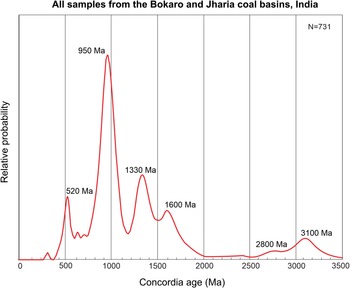
A compilation of probability density plots for all samples obtained for the Bokaro and Jharia coal basins, presented in a composite plot (Fig. 10), illustrates that there are essentially six major zircon age fractions present:
-
(a) A well-defined, but mostly subordinate, latest Neoproterozoic to earliest Cambrian age fraction with age peaks of c. 530 to 510 Ma, tailing down in some samples to older Neoproterozoic ages of c. 650 to 630 Ma.
-
(b) A major earliest Neoproterozoic, and in several samples the dominant, age fraction, with an age peak at c. 950 Ma. This is accompanied in some samples by a Mesoproterozoic peak at c. 1000 Ma or slightly older.
-
(c) A clear but mainly subordinate middle Mesoproterozoic age fraction, with a peak apex at c. 1330 to 1300 Ma. This age fraction accounts for the majority of zircon ages of the Karharbari Formation.
-
(d) A prominent earliest Mesoproterozoic zircon age fraction with an age peak of c. 1600 Ma in most samples.
-
(e) A less well-defined late Palaeoproterozoic zircon age fraction of c. 2100 to 1700 Ma in some samples.
-
(f) An Archaean zircon age fraction that typically comprises two zircon age fractions, namely zircons with early Neoarchaean ages of c. 2800 to 2750 Ma, coupled with a Mesoarchaean age fraction that peaks at c. 3100 Ma, tailing down into zircons with Eoarchaean ages.
Probability density plot compiled using the combined age fractions for all the formations sampled during the study to show the distribution of the zircon ages present in the Gondwana strata of the Bokaro and Jharia coal basins in India, displaying the six characteristic zircon age fractions present within the samples.

In considering possible sources for the six dominant zircon age categories, the Central Indian Tectonic Zone (CITZ) in the immediate vicinity of the Bokaro and Jharia coal basins is a compelling starting point. The CITZ comprises basement rocks formed during two major orogenic events at c. 1.6 Ga and 1.0 Ga (Bhandari et al. Reference Bhandari, Pant, Bhowmik and Goswami2011; Bhowmik et al. Reference Bhowmik, Wilde, Bhandari, Pal and Pant2012) (Fig. 11), including the 1.6 Ga Chotanagpur Gneissic Complex (Fig. 2; Shaw et al. Reference Shaw, Arima, Kagami, Fanning, Shiraishi and Motoyoshi1997; Mezger & Cosca, Reference Mezger and Cosca1999). Although possible sourcing of the zircons from the CITZ could account for the prominent ∼1.0 Ga and 1.6 Ga zircon age fractions present in the succession (Fig. 10), the CITZ as a primary source region is considered unlikely for two reasons. Firstly, the faults bounding the two basins are almost certainly post-depositional in age, thus suggesting that the Gondwana successions originally had a much wider distribution and possibly blanketed the CITZ, which therefore could not act as a source region to the Gondwana succession. Secondly, the other zircon age populations present in the samples from the Gondwana strata are not known from the CITZ, especially the early Cambrian (∼0.5 Ga) and common Mesoarchaean (∼1.3 Ga) age peaks (Fig. 10).
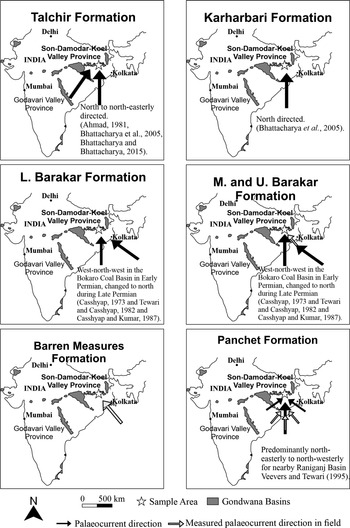
The location of the study area and palaeocurrent directions (black arrow) using data from various authors, with the related references provided in each block. Palaeocurrent directions that were measured in the field during the study are shown by the grey arrow. Map of India is modified after Veevers & Tewari (Reference Veevers and Tewari1995) and Bhattacharya et al. (Reference Bhattacharya, Bandyopadhyay, Mahapatra and Banerjee2012).

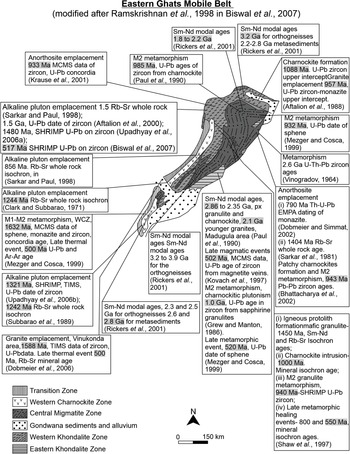
Sources for these zircon grains therefore need to be sought from outside the boundaries of the CITZ. Considering that transport directions in the Gondwana successions of south-central India were mainly northerly-directed towards the northern trailing margin of Gondwana (Figs. 1c, 11; see also Veevers & Tewari, Reference Veevers and Tewari1995; Veevers & Saeed, Reference Veevers and Saeed2008), provenance regions further south must also be considered. As already indicated by Veevers & Saeed (Reference Veevers and Saeed2008), the Eastern Ghats Mobile Belt (EGMB) could have been a major source region for these Gondwana successions as the EGMB hosts both 0.5 Ga and 1.3 Ga rock units, in close association with 1.0 Ga and 1.6 Ga granitoids and gneisses (Figs. 12, 13; Biswal et al. Reference Biswal, Dewaele and Ahuja2007; Mukhopadhyay & Basak, Reference Mukhopadhyay and Basak2009). The 1.3 Ga rock units in the EGMB are represented by a series of alkaline intrusions (Fig. 13; Mukhopadhyay & Basak, Reference Mukhopadhyay and Basak2009).
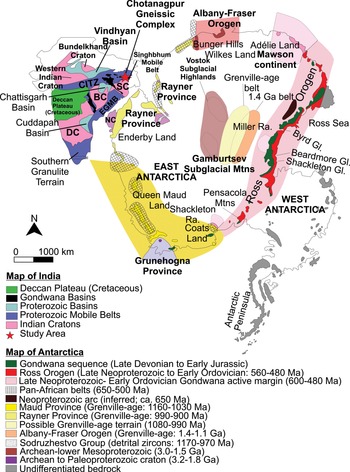
General geology of India and Antarctica, as well as the approximate location of India relative to Antarctica during the time of deposition of the Lower Gondwana succession in India. Modified after Mohanty (Reference Mohanty2015) and Elliot et al. (Reference Elliot, Fanning and SRW2015). CITZ – Central Indian Tectonic Zone; BC – Bastar Craton; SC – Singbhum Craton; DC- Dharwar Craton.

Geological map of the Eastern Ghats Mobile Belt and geochronological ages for various events in the EGMB (modified after Ramakrishnan et al. Reference Ramakrishnan, Nanda and Augustine1998 in Biswal et al. Reference Biswal, Dewaele and Ahuja2007).

The ‘bimodal’ character of the Archaean zircon age fraction is of interest because the early Neoarchaean ages at c. 2.75 Ga occur in conjunction with grains with ages older than 3.1 Ga. This combination of ages in Archaean cratons is characteristic of Superior-Type cratons as referred to by Pehrsson et al. (Reference Perhsson, Berman, Eglington and Rainbird2013) that typically contain Neoarchaean greenstone belts and granitoids in combination with older early Mesoarchaean to Palaeoarchaean granite–greenstone terrains. It is tempting to suggest that the Singhbhum Craton, immediately south of the Bokaro Coal Basin, could have sourced these zircons (Fig. 11). However, there is some uncertainty involved in this suggestion, as it is commonly believed that the greenstone belt of the Iron Ore Group of this craton is Mesoarchaean in age (Mukhopadhyay, Reference Mukhopadhyay2001). That would leave younger supracrustal mafic lavas of the Dhanjori succession and correlatives on the craton as possible 2.75 Ga source regions, which are not likely to be sourced from the immediate basement rocks (Olierook et al. Reference Olierook, Jiang, Jourdan and Chiaradia2019). With this in mind, the Singhbhum Mobile Belt, flanking the northern margin of the Singhbhum Craton (Figs. 2, 11), could be considered as a source region for some of the late Palaeoproterozoic zircons present in a few of the samples from the Bokaro coal basin because it hosts 1.86 Ga intrusive granophyres and 1.63 Ga rhyolites (Bhattacharya, 2016; Olierook et al. , Reference Olierook, Jiang, Jourdan and Chiaradia2019). However, as stated earlier, even these suggestions remain highly speculative as none of them satisfactorily explain the presence of the early Cambrian (0.5 Ga) and Mesoarchaean (1.3 Ga) zircon age fractions in the samples (Fig. 10).
The apparent stratigraphic control on variations in zircon age fractions of the Bokaro and Jharia coal basins is another aspect that needs to be considered. The sample of the glaciogenic Talchir Formation at the base of the Gondwana succession displays a wide range of zircon age fractions that include all six populations outlined in Fig. 10. These age fractions include the pertinent Cambrian (∼530 Ma) and Mesoproterozoic (∼1300 Ma) fractions that were most likely derived from distal sources situated far south of the basins in the EGMB. Zircon age fractions within the samples also appear to be ‘well-mixed’ and do not reveal a single dominant age fraction. This could be considered typical and what is expected from a glacial moraine derived from a large ice cap eroding a variety of bedrock. However, the essentially single 1300 Ma zircon age fraction revealed in the overlying Karharbari Formation, with only a minor Cambrian component, is difficult to explain. The sample obtained was from a poorly sorted sandstone that directly overlies the Talchir diamictites with an erosional contact.
The geological map of the Bokaro coal basin indicates that the Talchir and Karharbari formations are only developed along the northeastern and northern side of the basin (Fig. 5). Thus, the two samples from near the base of the lower Barakar Formation, samples IND-10 and IND-11, that were collected along the southern erosional limit of the basin, are not underlain by diamictite and fluvial strata and rest directly on basement rocks of the CITZ. However, these two samples host all the six major age populations also present in the Talchir Formation (Fig. 9). There are two possible explanations for this observation: glaciogenic deposits of the Talchir formation were eroded by the lower Barakar fluvial systems and re-sedimented into the rocks of the lower Barakar formation; or fluvial systems sampled a wide variety of basement rocks that comprise all the major zircon populations identified in Fig. 10, including the prominent bimodal Archaean populations that are typical of Superior-Type cratons according to the classification by Perhsson et al. (Reference Perhsson, Berman, Eglington and Rainbird2013). Immediately after the deposition of the sediments of the lower Barakar Formation, the zircon age distribution in the overlying middle to upper Barakar Formation sandstones becomes highly restricted, being dominated by ∼950 Ma, ∼500 Ma, ∼1300 Ma and ∼1600 Ma (Fig. 9) age peaks. This could imply that over a very wide area the floor of the Gondwana succession became blanketed by fluvial sediments from distal sources and covered Archaean basement rocks of the surrounding Bundelkhand, Singhbhum and Bastar cratons so that they could not supply sediment to the basins.
Following the tectono-sedimentary event that led to the transgression that marked the end of the Barakar coal measures, and the subsequent deposition of the overlying tidal to deltaic deposits of the Barren Measures Formation (Fig. 6), zircon grains were again sourced from the Archaean cratonic terrains by the contemporaneous fluvial systems, that must have been accompanied by renewed exposure of such terrains. Finally, the braided river deposits of the Panchet Formation sampled zircon grains from rock successions populated with Cambrian to early Neoproterozoic ages combined with mixing of older minor sources spanning the age range from the Mesoproterozoic to the Neoarchaean (sample IND-18; Fig. 9). An interesting aspect of this sample (IND-18) is the dominance, observed for the first time in the Gondwana succession of the Bokaro coal basin, of zircon grains with Cambrian ages of c. 510 Ma (Fig. 9). This could imply a larger contribution of zircons from the distal South Indian Granulite Belt, in which this Cambrian age is dominant (Fig. 2). The South Indian Granulite Belt is part of the group of orogenic belts that formed during the amalgamation of Gondwana (De Wit & Ransome, Reference De Wit and Ransome1992).
5.b.2. Comparison with other Indian coal-bearing basins
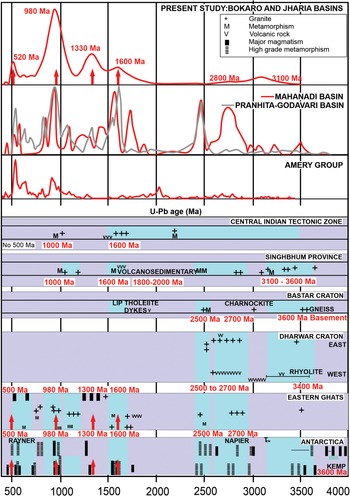
A comparison of detrital zircon age fractions of the Bokaro–Jharia Basin with those of the Mahanadi set of fault-bounded basins between the Singhbhum and Bastar cratons, as well as the Pranhita–Godavari basins between the Bastar and Dharwar cratons (Fig. 2), is made possible based on detrital zircon age data presented by Veevers & Saeed (Reference Veevers and Saeed2009) on these basins. Their data include analyses of samples from both the Lower Gondwana succession, up to correlatives of the Panchet Formation, and the upper Supra-Panchet succession. Selecting only their data from the Lower Gondwana sequence, there are remarkable similarities in the probability density distributions when compared with the probability density distributions of the Bokaro–Jharia coal basins (Fig. 14). The only major differences revealed are that the samples of the Pranhita–Godavari and Mahanadi basins display a prominent ∼2.5 Ga age fraction that is absent from the samples of the Bokaro–Jharia Basin, and that the bimodal Neoarchaean–Mesoarchaean cratonic age fraction present in the Bokaro–Jharia Basin samples is absent from the Pranhita–Godavari and Mahanadi basins (Fig. 14). A prominent Neoarchaean age fraction is, however, present in the samples from the Mahanadi Basin (Fig. 14).
Comparison of detrital zircon age fractions of the Bokaro–Jharia basin of this study with those presented by Veevers & Saeed (Reference Veevers and Saeed2009) for the Mahanadi and Pranhita–Godavari basins. Similarity of the zircon age fractions implies that the strata in the fault-bounded Gondwana basins in central east India formed part of a much wider regional depositional system and were not locally derived as would be expected of syn-sedimentary graben or half-graben basins.

These differences could reflect sourcing of sediment to the basins from different cratonic areas. For instance, the Dharwar Craton to the west of the Pranhita–Godavari Basin is known to host large volumes of ∼2.5 Ga granite–greenstone belts while the Bastar Craton hosts both ∼2.7 and 2.5 Ga granites (Fig. 2) (Mukhopadhyay et al. Reference Mukhopadhyay and Basak2009), similar to those that characterize the Rae-Type cratons (Perhsson et al. Reference Perhsson, Berman, Eglington and Rainbird2013) worldwide, which are distinguished by the presence of abundant 2.5 Ga granite–greenstone terrains, combined with 2.7 Ga Neoarchaean granite–greenstone terrains and minor older ones. The similarities of zircon populations in the ∼500 Ma to ∼1600 Ma interval would, however, strongly suggest that the Gondwana strata formed part of a much larger regional depositional system, as stated earlier, rather than having been deposited in smaller isolated syn-depositional graben structures, as commonly advocated (e.g. Veevers & Saeed, Reference Veevers and Saeed2009) (Fig. 14). The normal faults bordering the basins are therefore considered mainly post-depositional in age. It would also imply that these faults and the fault-bounded basins did not develop in Gondwana times due to large-scale far-field stress regimes equated with compression along the Gondwanide Orogenic Belt much further south as was suggested by De Wit & Ransome (Reference De Wit and Ransome1992).
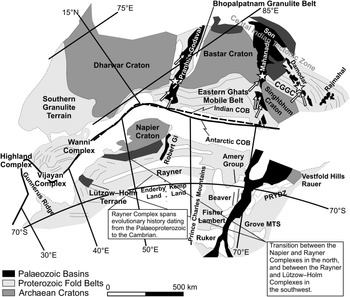
Considering that the Gondwana successions of the Pranhita–Godavari and Mahanadi basins extend across the rocks of the EGMB, possible source areas for the sediments of the Gondwana strata could also have been situated in Antarctica based on the reconstruction of Gondwana (Fig. 15). This is consistent with the northerly-directed palaeocurrents reported for these basins (Veevers & Saeed, Reference Veevers and Saeed2009). Rock units of Antarctica that could have been source regions to these basins include the Rayner Mobile Belt and Archaean cratonic terrains like the Napier Craton and Rauer Group (Fig. 15). Ages of ∼0.5 Ga, 1.1 to 0.95 Ga, 1.3 Ga and 1.6 Ga magmatism and high-grade metamorphism are known for the Rayner Mobile Belt and, therefore, could have contributed zircons of this age to the Gondwana successions of India (Veevers & Saeed, Reference Veevers and Saeed2008), and likely the Bokaro–Jharia coal basins.
Antarctica and conjugate India align together such that the restored continent–ocean boundaries (COB) overlap, from Veevers & Saeed (Reference Veevers and Saeed2009). Considering that palaeocurrents in the Mahanadi, Pranhita–Godavari and Bokaro–Jharia basins (indicated by three stars) are generally directed towards the north, possible source areas for the sediments of the Gondwana strata could be located in Antarctica. These include the Rayner Mobile Belt, as well as Archaean cratonic terrains like the Napier Craton and Rauer Group, East Antarctica. Modified after Veevers and Saeed (Reference Veevers and Saeed2009).

The Gondwana-aged Amery Group is also preserved in a graben structure that represents an extension of the Mahanadi graben structure in India. The faults bounding the succession are considered to be post-depositional in age, as are those in the Mahanadi basins (see maps presented by Veevers & Saeed, Reference Veevers and Saeed2008, Reference Veevers and Saeed2009). The samples of the Amery Group, studied by Veevers & Saeed (Reference Veevers and Saeed2008), are situated south of the Rayner Mobile Belt, and essentially only contain major zircon age populations of between 0.5 Ga and 0.95 Ga, with an additional age peak at ∼2.0 Ga. These samples lack the prominent 1.6 Ga, 2.5 Ga and Archaean age populations present in the Gondwana successions that disconformably overlie the EGMB and extend north of it. This would support the idea of Veevers & Tewari (Reference Veevers and Tewari1995) that the Gondwana successions in India were sourced in large part from a Central Antarctic Highland located in the area around the present-day Gamburtsev Subglacial Mountains hosting late Mesoproterozoic and early Neoproterozoic metamorphic complexes (Fig. 15). The Amery Group could thus be considered as a more proximal assemblage to this source terrain than to that of the Indian Gondwana basins. Also noteworthy is the fact that Veevers & Saeed (Reference Veevers and Saeed2008) mention the presence of a Permian-age (∼0.27 Ga) zircon in the Amery Group, which likely reflects the first identification of a zircon derived from the Gondwanide Orogenic Belt along the southern active margin of Gondwana in Antarctica (Fig. 15).
6. Conclusion
The study investigated detrital zircon grains extracted from the Lower Gondwana succession of the Bokaro and Jharia coal basins in India to gain insight into the provenance and geological history of the basins. The ages obtained for youngest detrital zircons (Cambrian to late Carboniferous) for most of the units sampled are older than the depositional ages suggested in the literature. Although these youngest ages do not contradict the depositional age conventionally associated with their respective unit, the newly obtained ages cannot be used to further constrain their maximum age of deposition. Instead, they represent the age of the youngest source area available during the time of their deposition. The absence of Permian zircons in the samples is attributed to the absence of Palaeozoic-aged source areas surrounding the respective basins given that the terrain is made up entirely of Precambrian rocks. The absence of Permian zircons also implies that the active Gondwanide Orogen in the south did not act as a source region to the Indian Gondwana Master Basin as defined by Veevers & Tewari (Reference Veevers and Tewari1995).
A compilation of probability density diagrams for individual stratigraphic units analysed, clearly illustrates the presence of six major zircon age fractions for the strata of the Bokaro and Jharia coal basins. These age fractions are: latest Neoproterozoic to earliest Cambrian (∼530 to 510 Ma) age fraction tailing down to older Neoproterozoic age fraction (∼650 to 630 Ma); earliest Neoproterozoic age fraction (∼950 Ma) that is occasionally accompanied by a second late Mesoproterozoic age fraction (∼1000 Ma or older); Middle Mesoproterozoic age fraction (∼1330 to 1300 Ma); a prominent earliest Mesoproterozoic zircon age fraction (∼1600 Ma); a less well-defined late Palaeoproterozoic zircon age fraction (∼2100 to 1700 Ma); and an Archaean zircon age fraction that typically comprises two smaller fractions, ∼2800 to 2750 Ma and ∼3100 Ma. Through a comparison of detrital zircon age fractions present in the Gondwana strata of the Bokaro–Jharia Basin, to that of the Mahanadi set of fault-bounded basins and the Pranhita–Godavari basins, using detrital zircon age data presented by Veevers & Saeed (Reference Veevers and Saeed2009), it is concluded that the Gondwana strata likely formed part of a much larger regional depositional system, and were not deposited in smaller isolated syn-depositional graben or half-graben structures as commonly advocated. Potential source regions to the Gondwana strata of the Bokaro and Jharia coal basins that were identified during the study include the EGMB, and various rock units in Antarctica, including the Rayner Mobile Belt and the Napier Craton and Rauer Group, East Antarctica. While it is possible that the CITZ, Singhbhum Craton and Singhbhum Mobile Belt could have supplied detritus to the Gondwana strata, the extent to which these rock units acted as a source to the basins is uncertain. However these rock units, while in close proximity to the Jharia and Bokaro coal basins, do not host large volumes of rock units with ages of ∼500 Ma and ∼1300 Ma, so they most likely did not act as major sources for the Gondwana sediments in the two coal basins under consideration. Since rocks with these early Cambrian and Mesoproterozoic ages are common in the EGMB and various rock units in Antarctica, they therefore are considered more probable source regions for the Gondwana strata in the fault-bounded Gondwana coal basins.
Supplementary material
To view supplementary material for this article, please visit https://doi.org/10.1017/S0016756822000930
Acknowledgements
The authors would like to thank the Karoo Research Initiative (KARIN), Palaeoproterozoic Mineralization (PPM) research fund (Department of Geology, University of Johannesburg) and DST-NRF-CIMERA who funded the study. JM acknowledges support from WBDST project No. 283 Sanc. (ST/S&T/10G-26/2017). Tata Steel Ltd and Mr Partha Banerjee are acknowledged for their hospitality and cooperation towards the study. The Laser Ablation Multi-Collector Inductively Coupled Plasma Mass Spectrometry (LA-MC-ICP-MS) equipment was funded by the National Equipment Programme (NRF-NEP) grant #93208. Thanks go to Henriette Ueckermann (University of Johannesburg, South Africa) for her assistance with the LA-MC-ICP-MS analysis.