Wedin et al. (Reference Wedin, Westberg, Crewe, Tehler and Purvis2009) and Westberg et al. (Reference Westberg, Purvis and Wedin2011) recently revised the Acarospora smaragdula group in Sweden and described the genus Silobia M. Westb. & Wedin for these species (Westberg et al. Reference Westberg, Purvis and Wedin2011), which formed a monophyletic group distinct from Acarospora s. str. in Wedin et al. (Reference Wedin, Westberg, Crewe, Tehler and Purvis2005) and Crewe et al. (Reference Crewe, Purvis and Wedin2006). In our search for possible older names for Silobia, we investigated Trimmatothelopsis Zschacke (Zschacke Reference Zschacke1934). Trimmatothelopsis was described to accommodate Verrucaria versipellis Nyl., which was known only from the type material from France (H-Nyl no. 4066!). The type of Trimmatothelopsis versipellis was studied by Roux & Navarro-Rosines (Reference Roux and Navarro–Rosinés2002) who suggested it to be an older synonym for Acarospora scyphulifera (= Silobia rhagadiza (Nyl.) M. Westb.), and Roux (Reference Roux2007) later accepted it as a distinct species, A. versipellis.
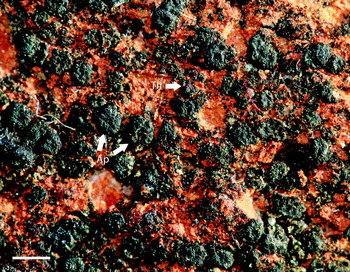
We have studied the type of Verrucaria versipellis which grows on a piece of brick and, as stated by Roux & Navarro-Rosines (Reference Roux and Navarro–Rosinés2002), is partly overgrown by cyanobacteria. Pieces of reddish brown and somewhat shiny squamules appear between the cyanobacteria, but the thallus is generally in poor condition (Fig. 1). In section, the thallus has a gelatinous epinecral layer above a thin (c. 10–20 µm) and indistinct cortex with small cells. There are no crystals in the cortex and no reaction when applying K. As the material is sparse, we did not investigate many thalline squamules, but Roux & Navarro-Rosines (Reference Roux and Navarro–Rosinés2002) mention that the algal layer is interrupted by hyphae, a characteristic feature of Silobia. Throughout the specimen there are many apothecia (Fig. 1) which in our opinion represent a different species infecting the thallus of a host. These are 0·4–0·8 mm wide, almost immersed in the host to raised, with a thick margin (as broad as the disc), indistinctly delimited from the disc. The surface of the margin and disc is black (also when wet), uneven, with small ridges and cracks. The disc is black, sometimes indistinctly umbonate. The hymenium is 140–200 µm tall, paraphyses slender (c. 1·0 µm) and frequently branched. The excipulum is c. 25 µm below the hymenium, composed of very narrow hyphae (c. 1 µm wide) and merges with the cortex at the surface. We saw no asci with spores in spite of several attempts and the apothecia are perhaps mostly immature. As the type is fairly small we did not want to use up too much of the material. In section the outer layer of the margin (up to 40 µm) and the epihymenium, is blackish brown and is at least partly strongly carbonized. In Polysporina, the carbonization begins at the surface of the excipulum and eventually also includes the epihymenium (Knudsen & Kocourková Reference Knudsen and Kocourková2008). In the type of Verrucaria versipellis the infection clearly includes thalline parts, resulting in host algae remaining in the apothecial margins. Several thalline squamules are also partly carbonized, indicating that these represent young infections.
Trimmatothelopsis versipellis (H-Nyl No. 4066) showing a small portion of host thallus (Th) and apothecia of Polysporina subfuscescens (Ap). Scale = 1 mm.

Thus our conclusion is that the apothecia belong to the lichenicolous Polysporina subfuscescens (Nyl.) K. Knudsen & Kocourk. This species shows a great variation in apothecium morphology (Knudsen & Kocourková Reference Knudsen and Kocourková2008) and can be rather similar to a Silobia in hymenial characters. The black, carbonized outer layer of the apothecia, the branched paraphyses, and the tall hymenium, are clearly characters consistent with P. subfuscescens rather than Silobia rhagadiza, which is the only known species in Silobia with the thallus characters found in this specimen. Polysporina subfuscescens is a species growing on various crustose lichens, including members of Silobia and other Acarosporaceae. It is an aggressive parasite and it is characteristic that it invades and eventually destroys the host, while suppressing host apothecium production. Knudsen & Kocourková (Reference Knudsen and Kocourková2008) list a number of synonyms and point out that many of these have been treated as lichens, based on the misconception that the thallus of the host is the thallus of the lichenicolous fungus. Trimmatothelopsis versipellis can now be added to this list.
Westberg et al. (Reference Westberg, Purvis and Wedin2011) did not regard the generic name Trimmatothelopsis as available for their new genus because of the unclear position of the type species, and accordingly described the genus as new. This decision is supported by the fact that Zschacke (Reference Zschacke1934: 593) referred only to the apothecia in his diagnosis when describing Trimmatothelopsis, where the feature pointed out was the presence of interascal hyphae (“Unterscheidet sich von Trimmatothele … nur durch das Vorhandensein von Hüllfäden.”). The apothecia of the lichenicolous fungus thus have to be regarded as the holotype of Trimmatothelopsis. The host lichen cannot be used for the interpretation of the generic name. Consequently, Trimmatothelopsis is an older name for Polysporina. The latter genus, however, is heterogenous according to our preliminary phylogenetic studies (data not shown). We will discuss the phylogeny of this genus and the taxonomic and nomenclatural implications in a forthcoming paper. For our present purpose, it is enough to conclude that the name Trimmatothelopsis does not threaten Silobia.
The species name Verrucaria versipellis Nyl. is based on a heterogenous type, as Nylander (Reference Nylander1877: 230) mentions both thallus and blackish, uneven apothecia (a characteristic trait of Polysporina) in the protologue. Hence we here lectotypify the name Verrucaria versipellis on the lichenicolous Polysporina-apothecia.
Investigated Species
Polysporina subfuscescens (Nyl.) K. Knudsen & Kocourk
Mycotaxon 105: 151 (2008);—Lecanora subfuscescens Nyl., Flora 56: 199 (1873); type: France, Colliure, 1872 (H-Nyl 24518—holotype, fide Knudsen & Kocourková Reference Knudsen and Kocourková2008 p. 151).
Syn. nov. Trimmatothelopsis versipellis (Nyl.) Zschacke, Rabh. Krypt. -Fl. ed. 2, 9(1,1): 593 (1934);—Verrucaria versipellis Nyl., Flora 60: 230 (1877); type: France, La Renaudière, Brin, 1876 (H-Nyl 4066, lichenicolous apothecia—lectotype, designated here!).
We would like to thank Per Magnus Jørgensen, Kerry Knudsen, Jens Klackenberg and the referees for helpful suggestions to improve the manuscript. Generous financial support was received from The Swedish Taxonomy Initiative, administered by The Swedish Species Information Center (ArtDatabanken). We thank the curator at H for loan of the type specimen.