




No CrossRef data available.
Article contents
Long-term neuropsychological outcomes of very low birth weight: Associations with early risks for periventricular brain insults
Published online by Cambridge University Press: 01 November 2004
Abstract
Few follow-up studies of children with very low birth weight (VLBW, <1,500 g) have examined neuropsychological sequelae at later ages or neonatal risks as predictors of these outcomes. The present study assessed cognitive skills at mean age 16 years in 48 participants with <750 g birth weight, 47 with 750–1,499 g birth weight, and 52 term-born controls. Our major objectives were to delineate the long-term cognitive consequences of VLBW, and to determine if risks for periventricular brain insults accounted for variations in outcomes. Analysis revealed poorer outcomes for the <750 g group than for term-born controls on nearly all measures, with specific impairments in visual–motor skills, spatial memory, and executive function. Predictors of outcome for participants with VLBW included lower birth weight, lower weight for gestational age, and a longer period of oxygen requirement for chronic lung disease. The longer-term consequences of VLBW are consistent with expectations based on early brain pathology and suggest limitations to functional plasticity. (JINS, 2004, 10, 987–1004.)
Information
- Type
- SYMPOSIA ARTICLE
- Information
- Journal of the International Neuropsychological Society , Volume 10 , Issue 7 , November 2004 , pp. 987 - 1004
- Copyright
- © 2004 The International Neuropsychological Society
INTRODUCTION
About 55,000 children per year are born in the United States at birth weights <1,500 g (3 lb, 5 oz), defined as very low birth weight (VLBW: Martin et al., 2002; Volpe, 2001). These children represent slightly more than 1% of annual live births. Advances in obstetric and neonatal care have yielded dramatic increases in the survival of these children over the past few decades, especially among the least mature neonates (Fanaroff et al., 2003; Hack et al., 1996a). The more extreme low birthweight subset of the VLBW population is identified on the basis of birth weight <1,000 (2 lb, 3 oz), <800 g (1 lb, 12 oz), or <750 g (1 lb 10 oz). Shortened gestational periods provide an alternative means for describing preterm infants. Gestational age, however, is less reliably measured than birth weight. For this reason, birth weight is often used as the major marker of prematurity (Cole et al., 2002).
Sequelae of VLBW include neurosensory deficits and other health problems (cerebral palsy, poor vision, hearing loss, seizures, pulmonary disease, growth impairments), cognitive weaknesses, poor academic achievement, and attention deficits and other behavior disorders (Taylor et al., 2000a). Outcomes are highly variable, ranging from severe motor and mental handicaps to more subtle developmental and cognitive disorders, such as learning disabilities and attention deficits (Whitfield et al., 1997). Some children with VLBW have no detectable impairments (Taylor et al., 2000b).
This variability is explained in part by the extent of prematurity and attendant medical complications. The children at greatest risk for sequelae are those with extremely low birth weight and/or neonatal complications. These complications include evidence for intraventricular hemorrhage (IVH) or periventricular leukomalacia (PVL) on neonatal cranial ultrasounds, birth hypoxia and chronic lung disease, septicemia, raised bilirubin levels, hypothyroxemia, and composite indices of neonatal medical complications (Brazy et al., 1993; Frisk & Whyte, 1994; Hopkins-Golightly et al., 2003; Horwood et al., 1998; Landry et al., 1993; Marlow et al., 1989; McGrath & Sullivan, 2002; Perlman, 2001; Taylor et al., 1998). Children with VLBW who are small for gestational age due to intrauterine growth failure are also considered at higher risk (Hutton et al., 1997; Pinto-Martin et al., 1999), though it is unclear if low weight for gestational age confers additional risk over and above the degree of low birth weight and neonatal medical complications (Hack, 1997). Factors that predict outcomes in term-born children of normal birth weight, such as sociodemographic status and the family environment, are also related to these outcomes in children born prematurely (Taylor et al., 2000a). Social–environmental factors, moreover, may moderate the effects of VLBW (Taylor et al., 1998, 2004).
Hypoxic ischemia, leading to germinal matrix IVH, associated hemorrhagic infarction, and PVL, is a primary cause of brain damage in preterm children (Perlman, 1998; Volpe, 1998, 2001) and thus the most likely reason for the adverse developmental consequences of VLBW. Infection is also considered a source of damage to the periventricular region (Dammann & Leviton, 1999). More severe grades of IVH and PVL have been documented in only a minority of children with VLBW; and the likelihood of these insults increase with the degree of prematurity (Inder & Volpe, 2000; Perlman, 1998). In view of recent magnetic resonance imaging (MRI) findings of diffuse white matter abnormality in 33 of 50 children with a mean birth weight of 1,086 g (Counsell et al., 2003), white matter pathology is likely to be substantially more common than suggested by cerebral ultrasound findings (Volpe, 2003).
Cerebral insults are most evident in sensorimotor, parietal–occipital, and temporal regions adjacent to the ventricles, the hippocampus and other subcortical structures, and circuits connecting these structures to the frontal lobes (Frisk & Whyte, 1994; Goto et al., 1994; Holling, 1999; Lou, 1996; Perlman, 2001; Peterson et al., 2000). Evidence of damage includes periventricular white matter abnormalities, reduction in white and gray matter volumes, and ventricular enlargement. Cortical development is also compromised (Inder et al., 1999). The nature of arterial border zones in the premature brain, together with the special vulnerability of white matter to proinflammatory cytokines and free radical attack at this stage in neural development, places periventricular and subcortical regions at greatest risk for injury (Perlman, 2001; Volpe, 2001). Hypoxic ischemia in term infants is more likely to result in multifocal cortical necrosis, especially to parasagittal areas and the depths of the sulci (Volpe, 2001).
If frontostriatal or temporal lobe/hippocampal pathology has similar effects in children with VLBW as in persons with later occurring lesions, the survivors of VLBW may be especially prone to deficits in visual–motor skills, memory, and executive function, at least relative to deficits in verbal–semantic skills (Aram & Eisele, 1992; Broadbent et al., 2002; D'Esposito & Postle, 2002; Knowlton, 2002; Salmon et al., 2001). Demonstration of specific deficits in the former ability domains in children with VLBW would help establish early structure–function relations and would support developmental congruence in these relations (Dennis et al., 1999). Evidence for specificity in impairment would also indicate constraints on neural plasticity (Taylor & Alden, 1997).
Major methodological difficulties faced in examining these relationships in the VLBW population are at least twofold. First, clinical management involves only gross assessment of neuropathology during the neonatal period, including neonatal cerebral ultrasounds and estimates of the likelihood of brain insult as indexed by other neonatal complications or the extent of prematurity (i.e., birth weight, gestational age, or birth weight relative to gestational age). MRI scans are rarely carried out for clinical management of preterm infants, and cranial ultrasounds are insensitive to more subtle white matter abnormalities (Inder et al., 2003; Maalouf et al., 1999). Second, the neuropathology associated with VLBW varies widely across individuals, with detectable brain damage being absent, relatively localized, or diffuse. This variation, together with the global effects on cognition that would be expected in cases of diffuse insult, may obscure specific neuropsychological consequences of localized periventricular lesions.
Nonetheless, deficits in the above-mentioned skills among cohorts of survivors are generally out of proportion to global impairments or to deficits in other cognitive domains. Deficits in motor and visual-perceptual skills, memory, and executive function are common sequelae of VLBW. These sequeale are present even in children without neurosensory disorders or mental retardation, or when controlling for IQ (Goyen et al., 1998; Hack et al., 1992; Holsti et al., 2002; Jacobson et al., 2001; Luoma et al., 1998; Roth et al., 1993; Selzer et al., 1992; Taylor et al., 2000c; Waber & McCormick, 1995; Whitfield et al., 1997). Numerous findings suggest more marked effects of VLBW on perceptual or performance skills than on language functions (Fletcher et al., 1997; Frisk & Whyte, 1994; Gabrielson et al., 2002; Luoma et al., 1998; Taylor et al., 2000b). Deficits on delayed memory tasks have been reported in preterm infants and preschoolers with VLBW (Espy et al., 2002; Rose, 1983; Ross et al., 1992, 1996). Specific impairments in working memory and spatial planning, relative to IQ or receptive vocabulary scores, have also been documented in young school-age children with <1,000 g birth weight (Frisk & Whyte, 1994; Harvey et al., 1999). Frisk and Whyte (1994) found that these deficits were related to presence of IVH or PVL as identified on neonatal ultrasound. Deficits in older school-age children with VLBW have been found on tasks assessing visual working memory and speed of visual processing, visual recognition memory, and spatial planning (Luciana et al., 1999; Rickards et al., 2001; Rose & Feldman, 1996).
Results from our own longitudinal study of children with VLBW offer further support for specific cognitive deficits (Taylor et al., 2004). Even when controlling for IQ, the children in this study with <750 g birth weight scored more poorly than term controls on tests of memory, visual–spatial skill, and executive function. Follow-up of the children between mean ages 7–14 years revealed increasing deficits over time in the <750 g group relative to controls on some tests of visual–motor skill and executive function, suggesting that these impairments may become even more pronounced with advancing age. Cognitive outcomes in a lower-risk 750–1,499 g group fell consistently between those of the <750 g group and term control children, though few deficits and no specific impairments could be detected in the heavier VLBW group.
The present study reports on the cognitive outcomes in our sample at a recently completed follow-up conducted at mean age 16 years. The rationale for undertaking this assessment was to assess executive function and memory more comprehensively than we had previously, to determine if the specific cognitive impairments we had observed in children with VLBW at younger ages would continue to be evident in later adolescence and early adulthood, and to examine neonatal risks for long-term neuropsychological deficits. Studies of outcomes in adults born preterm or with VLBW suggest persistent effects of prematurity on cognition, educational attainment, and behavior (Hack et al., 2002; Pharoah et al., 2003; Tideman, 2000). However, cognitive assessments at later ages have been largely limited to IQ testing. We do not know if individuals with VLBW continue to have specific weaknesses, or if these weaknesses resolve or lead to less differentiated global cognitive deficiency. Comprehensive testing also permitted a more detailed evaluation of the nature and specificity of cognitive impairments than was possible in our earlier follow-ups or in other studies.
Based on school-age outcomes of VLBW and on the widespread neuropathology likely present in some survivors, our first hypothesis was that children with VLBW would have poorer cognitive outcomes in general than term-born controls. In view of evidence for a gradient effect, with outcomes varying in relation to the degree of low birth weight and/or prematurity (Breslau et al., 1996; Horwood et al., 1998; Klebanov et al., 1994), we anticipated that cognitive sequelae of VLBW would be more evident in the <750 g group than in the 750–1,499 g group.
Given the previous support for specific neuropsychological consequences of VLBW, our second hypothesis was that cognitive impairments in our VLBW sample would be more evident on measures of visual–motor skills, memory, and executive function than on language testing. This hypothesis also examined the possibility that risks for early hypoxic ischemia and other insults to periventricular structures would result in long-term deficits similar to those found in later-onset lesions to this brain region. Two sets of secondary analyses were conducted to further explore the specificity of cognitive deficits. In one set of analyses, we repeated our primary group comparisons after excluding children with neurosensory disorders or low IQ; and in the second set, we repeated group comparisons for the total sample, controlling for verbal-semantic ability as measured by a vocabulary measure. The purpose of the first set of analyses was to determine if sequelae of VLBW could be detected in children without severe disabilities, and the aim of the second set was to identify areas of relative cognitive impairment.
Our final hypothesis was that cognitive outcomes for children in the two VLBW groups would be worse for individuals at higher risk for brain insult. Lacking more precise measures of neonatal brain insult, these risks were defined in terms of ultrasound findings of neonatal periventricular pathology, lower birth weight, lower weight for gestational age as an index of intrauterine growth retardation, and severity of chronic lung disease as measured by the duration of neonatal oxygen requirement. These factors increase the likelihood of hypoxic ischemia and associated early brain insults in the periventricular region and have been associated with poorer cognitive outcomes in children with VLBW (Farel et al., 1998; Hutton et al., 1997; Luciana et al., 1999; Perlman, 2001; Pinto-Martin et al., 1999; Rose & Feldman, 1996; Volpe, 2001).
METHODS
Sample Recruitment and Long-Term Follow-Up
The sample for this study included children and caregivers who were originally recruited for a longitudinal study of early school-age outcomes of extremely low birth weight (Hack et al., 1994) and who remained in the study at the long-term follow-up. The initial sample comprised the 65 children with <750 g birth weight, 65 children with 750–1,499 g birth weight, and 61 term-born controls. Children in the <750 g group were 93% of the survivors born at neonatal intensive care units in Region V of Ohio from July, 1982 through December, 1986. Children in the 750–1,499 g group were matched to those in the <750 g group based on hospital of birth, age, sex, and race. Term-born children were matched to those in the <750 g group based on school attended, age, sex, and race. Because of difficulties in recruitment, we were unable to find matches for all children in the <750 g group. However, the three groups were similar in background characteristics at the initial assessment and across subsequent follow-up during the middle school-age years (Hack et al., 1994; Taylor et al., 2000b, 2004).
In recruiting children for the most recent, or long-term, follow-up at mean age 16 years, we attempted to contact all families previously enrolled (Taylor et al., 2004). Of the 201 previous participants, 147 (73%) took part in this follow-up, including 48 in the <750 g group, 47 in the 750–1,499 g group, and 52 term-born controls. The long-term follow-up was conducted at a mean age of 16.8 years (SD = 1.2, range = 14.6–21.2). The mean interval between this assessment and initial recruitment was 10.0 years (SD = 0.6, range = 8.7–11.9). Mean grade level for the 129 participants still in high school was 10.5 (SD = 0.9, range = 9–12). The groups were similar in these characteristics, with no significant differences.
Reasons for drop-out included lack of ability to be tested (n = 3), moves out of the area (n = 11), inability to locate families (n = 27), and disinterest or lack of follow-through by families (n = 13). To assess attrition bias, we compared participants who dropped out with those remaining in follow-up in background characteristics. Results failed to reveal differences in the distributions of children by group, sex, or race. However, children who dropped out had lower socioeconomic status (SES) as measured by the Hollingshead Four Factor Index (Hollingshead, 1975) and lower initial cognitive ability as measured by a short-form of the Kaufman Assessment Battery for Children (Kaufman & Applegate, 1988) than did children who completed the study. Comparison of participants with VLBW who dropped out with those remaining in follow-up failed to reveal differences in neonatal risk factors.
Table 1 summarizes sample characteristics at the long-term follow-up for the three birthweight groups. Differences in birth weight, gestational age, and other neonatal factors reflected recruitment criteria. The groups were similar in sex and race distribution, as well as in SES and in age at follow-up. Eight participants had neurosensory impairments, including 5 in the <750 g group (1 with cerebral palsy, 2 with hearing impairment, and 2 with visual impairment), and 3 in the 750–1,499 g group (1 with cerebral palsy, 1 with hearing impairment, and 1 with both cerebral palsy and hearing impairment). None of the controls had these disabilities.
Sample characteristics at long-term follow-up

Procedures and Measures
The participants were assessed in a single half-day session. Although only results of cognitive testing are considered in this study, follow-up also included tests of academic achievement, parent interviews to obtain information about the family environment and participants' adaptive behavior skills, and parent and teacher ratings of behavior and school performance (Taylor et al., 2004). Test order was counterbalanced across participants and breaks were provided to reduce fatigue. Institutional review board approval and informed parental consent and child assent were obtained prior to participation.
Table 2 lists the tests comprising the neuropsychological battery by skill domain, together with brief descriptions of the procedures and dependent variables. Global cognitive function was assessed using a short form of the Wechsler Intelligence Scale for Children–Third Edition (WISC–III; Wechsler, 1991) or of the Wechsler Adult Intelligence Scale–Third Edition (WAIS–III; Wechsler, 1997). Prorated IQ was based on the Vocabulary and Block Design subtests (Sattler, 1992). The 53 participants aged 17 years and older who received the WAIS–III subtests were similarly distributed across the three groups. Tests of language, in addition to the Wechsler Vocabulary subtest, included measures of naming, word knowledge, pragmatic language, and fluency in generating letter–word associations. Visual–motor skills were surveyed using tests of fine motor dexterity, design copying, and visual matching/search, and spatial judgment. The California Verbal Learning Test, Second Edition (CVLT–II; Delis et al., 2000) provided a comprehensive assessment of verbal learning and memory. Nonverbal memory was measured using the spatial memory tasks from the Cambridge Neuropsychological Test Automated Battery (CANTAB; CeNes Cognition, 1996). To evaluate executive function, we administered other CANTAB tasks and the Contingency Naming Test (Anderson et al., 2000).
Neuropsychological test battery administered at long-term follow-up

The CANTAB was selected because of its sensitivity to frontostriatal and medial temporal lesions in adults and to the effects of preterm birth in children (Luciana, 2003; Luciana et al., 1999; Luciana & Nelson, 1998). CANTAB tasks are appropriate for persons of diverse cognitive abilities and assess several dimensions of executive function, including self-guided searching, set switching, spatial planning, and spatial working memory. The CANTAB was administered on a portable PC Pentium 233 MMX 64/4300 12.1-inch TFT color LCD touch-screen using Windows 98 software.
While we recognized that several of the measures could be grouped under multiple domains, classification of tests into domains was based on the primary demands of each test. For example, although some demands on memory and executive function are imposed by the language tests, they draw more heavily on verbal knowledge than do other tests in the battery. Classification of recall of the Rey-Osterrieth Complex Figure (ROCF; Bernstein & Waber, 1996) as a visual–motor rather than memory test was justified by evidence for shared loadings of ROCF copy and recall on a perceptual–planning factor (Taylor et al., 2002). Memory for spatial sequences (CANTAB Spatial Span) could be considered a measure of attention span or spatial working memory, and thus of executive function. Classification of this task as a memory measure was justified by its demands on nonverbal short-term memory (Luciana et al., 2001). Our decision to analyze individual test scores, rather than a smaller set of ability composites, reflected the lack of an empirical basis for combining scores and an interest in examining test sensitivity to the sequelae of VLBW.
Age-standardized scores were used for tests with norms that applied to all participants. In most instances, however, tests norms were not available for older participants or were of questionable applicability; hence raw scores were used for these measures. To reduce redundancy of measurement, most tests were represented by single scores. The only multiple-measure tests were the ROCF and California Verbal Learning Test, Second Edition (CVLT–II; Delis et al., 2000). The copy and recall administrations of the ROCF were examined separately due to the differing demands of these two procedures. Because structural and incidental scores on the ROCF were at ceiling levels for most participants, only the organization scores were analyzed. The multiple response measures obtained from the CVLT–II were reduced to three measures summarizing initial learning (Trials 1–5 Total score), recall (average score on the four recall trials), and recognition (Recognition Discriminability score).
Neonatal risks for hypoxic ischemia and other periventricular brain insults were assessed in terms of (1) the presence/absence of IVH, PVL, or dilated ventricles on neonatal cranial ultrasounds conducted during the neonatal hospitalization (based on the most severe abnormality observed), (2) birth weight in kilograms, (3) birth weight for gestational age as a measure of intrauterine growth failure, and (4) duration of oxygen requirement in weeks as a measure of chronic lung disease. Birth weight for gestational age was defined as the difference between actual weight and expected weight for gestational age in standard deviation units, using standards provided by Usher and McLean (1969). Birth weight was of interest due to the increased risk of brain insult with lower weight. The rationale for examining weight for gestational age is that this factor may also be associated with intrauterine hypoxic ischemia (Hutton et al., 1997). The length of oxygen requirement was used as a marker of chronic lung disease (also referred to as bronchopulmonary dysplasia, or BPD), a complication of VLBW that increases risks for chronic recurrent postnatal hypoxemia and other postnatal pulmonary complications (Eichenwald et al., 1997; Perlman, 2001). Birth weight was correlated with weight for gestational age (r = .53, p < .01) and length of oxygen requirement (r = −.44, p < .01), but weight for gestational age was not related to length of oxygen requirement (r = −.06). Because the duration of oxygen requirement was highly associated with the duration of ventilatory support and days of hospitalization (rs of .85 and .89, respectively, p < .01), the latter variables were not considered.
Data Analysis
Group differences in the neuropsychological outcomes listed in Table 2 were examined using analysis of covariance (ANCOVA), with SES, race, and sex as covariates. Preliminary analysis indicated that one or more of these factors was associated with most of the outcomes, but failed to reveal significant interactions of these factors with group. These factors were thus included as covariates in all analyses (a table summarizing the associations of these factors with the outcomes is available from the first author). Age and age2 were entered as additional covariates to adjust for the linear and quadratic effects of age on the raw scores. Differences between each VLBW group (<750 g, 750–1,499 g) and the term group were analyzed as preplanned contrasts. Given the substantial number of dependent measures, only effects with p < .01 were considered significant in these and all other analyses. Transformations were made to some scores to normalize distributions, but analyses were conducted on untransformed scores initially to aid in interpretability.
To gauge the extent and potential clinical significance of group differences, we also examined rates of deficient test scores. Expected scores were computed by regressing scores from the term-born participants on SES, sex, race, and (for raw score measures) age and age2. Deficits were then defined as scores that were more than 1 standard error of prediction below the expected scores (or above them for error measures). Comparisons of the rates, or odds, of these deficits in each VLBW group relative to term group were conducted via logistic regression.
To determine if long-term cognitive consequences of VLBW were present in children without severe disabilities, the above analyses were repeated after excluding the 26 participants (16 from the <750 g group, 7 from the 750–1,499 g group, and 3 term controls) with either a neurosensory disorder or prorated IQ < 70. We also repeated the above analyses on the total sample, but with the Wechsler Vocabulary scaled score included as an additional covariate. The latter analyses were justified by previous findings suggesting relative sparing of verbal–semantic abilities in children with VLBW (Frisk & Whyte, 1994). The performance component of IQ, Block Design, was highly correlated with many of the tests of executive function (e.g., its partial correlation with CANTAB Working Memory was .68, p < .01). Furthermore, Block Design could itself be construed as a measure of visual–motor skills or executive function. For these reasons, areas of relative deficit were identified by controlling for Vocabulary rather than IQ.
Linear regressions were conducted on scores of participants in the two VLBW groups to identify the neonatal risk factors that predicted variations in long-term cognitive outcomes. The covariates in these analyses were the same ones included in analysis of group differences. Analyses considered each neonatal risk factor separately. In preliminary analyses, absolute birth weight predicted many outcomes independent of group (<750 g vs. 750–1,499 g). This finding, along with the lack of evidence for differential effects of birth weight in the two groups, justified inclusion of birth weight as a continuous predictor of outcome in analysis of data from the aggregate VLBW sample. Following the primary analyses, risk factors that were separately related to outcomes were entered into regressions as sets to identify risks that predicted unique variance in cognitive performance.
RESULTS
Group Differences in Neuropsychological Performance (Total Sample)
Table 3 presents group means and standard deviations for each neuropsychological measure, together with results from the ANCOVAs and effect sizes for the group differences. The <750 g group scored more poorly at the long-term follow-up than the term controls on all measures except for the Boston Naming Test (Spreen & Strauss, 1998), CVLT–II composite delayed recall, and CANTAB Intradimensional–Extradimensional (IED) Shift. As evident from the effect sizes, the largest group differences were on tests of visual–motor skills, spatial memory, and executive function. Transformations that were made to correct for non-normal distributions in three scores (Verbal Cancellation: Mesulam, 1985; CANTAB Pattern Recognition; and CANTAB IED Shift) did not alter this pattern of findings. Analyses failed to reveal significant differences between the 750–1,499 g group and term controls, though nonsignficant trends (p < .1) in favor of the control group were found for Purdue Pegboard (Gardner, 1979) and Contingency Naming.
Results of group comparisons of neuropsychological outcomes

Secondary analyses provided additional support for impairments in executive function. ANCOVA conducted on other CVLT–II measures revealed that the <750 g group had significantly more recall intrusions, lower Recall Discriminability, and lower Semantic Clustering than the term group. On CANTAB Stockings of Cambridge, the <750 g group had significantly shorter “initial planning time” (suggesting poorer planning or greater impulsivity) and greater “subsequent planning time” (suggesting slower subsequent processing) than the term group. On CANTAB Spatial Working Memory, the <750 g group also had a significantly higher Strategy score, indicating a less organized search process.
According to results from logistic regression analysis, the group differences were clinically meaningful. As shown in Table 4, deficits on some measures were 3 or more times more common in the <750 g group than in the term group. Consistent with results from ANCOVA, differences in rates of impairment were found for all tests of visual–motor skills (including Block Design), as well as for measures of spatial memory and executive function, but not for the language measures. Relative to controls, the 750–1,499 g group also had higher rates of deficits on CANTAB Pattern Recognition Memory and Spatial Span. Figure 1 graphs the distribution of Block Design scaled scores to illustrate the effects of VLBW on score distributions.
Group differences in rates of neuropsychological deficits


Distribution of scaled scores on the Wechsler Block Design subtest for the three birthweight groups.
Evidence for Specificity of Deficits
Findings from analyses that excluded children with neurosensory disorders or IQ <70 provided further evidence for specific cognitive sequelae of <750 g birth weight. Even when excluding children with severe disabilities, the <750 g group scores significantly more poorly than term controls on measures of IQ (Wechsler Block Design and prorated IQ), visual–motor skills [Purdue Pegboard, Developmental Test of Visual Motor Integration (VMI, Beery, 1989), ROCF copy and recall, Judgment of Line Orientation (Spreen & Strauss, 1998)], memory (CANTAB Pattern Recognition Memory and Spatial Span), and executive function (CANTAB Stockings of Cambridge, Spatial Working Memory, and Rapid Visual Processing, and Contingency Naming). In contrast, the initial differences in Wechsler Vocabulary and the other language measures, as well as in verbal learning and memory, were no longer significant. Analysis that included the total sample but controlled for Vocabulary revealed a nearly identical pattern of findings, the only exceptions being that the group differences in IQ and CANTAB Rapid Visual Processing were no longer significant. Analysis of transformed scores for the three nonnormal measures yielded results similar to analysis of the untransformed scores.
Rates of deficits also continued to be higher in the <750 g group than in the term group after excluding children with neurosensory disorder or IQ <70. These differences were significant for Block Design, Purdue Pegboard, the VMI, ROCF copy, CANTAB Pattern Recognition Memory, Spatial Span, Stockings of Cambridge, and Spatial Working Memory, and Contingency Naming. Figure 2 illustrates group differences in rates of deficits for this subset of the sample.

Illustration of group differences in rates of deficit scores for the subset of the sample without neurosensory disorder and with Wechsler prorated IQ ≥ 70. CANTAB = Cambridge Neuropsychological Test Automated Battery. Deficits were defined as scores > 1 standard error of prediction below expectations based on the term group's performance, and considering the effects of socioeconomic status, race, sex, and age. For all three measures, rates (or odds) were significantly higher for the <750 g group relative to term group (for Purdue Pegboard, odds ratio, OR = 7.77, 95% confidence interval, CI = 2.44–24.68, p < .005; for CANTAB Pattern Recognition Memory, OR = 9.20, CI = 2.34–36.20, p < .005; and for CANTAB Stockings of Cambridge, OR = 5.17, CI = 1.79–14.92, p < .005). The findings demonstrate clinically significant group differences in visual–motor skills, visual memory, and spatial planning.
Predictors of Outcomes Within the VLBW Groups
Abnormality on cranial ultrasound failed to predict any of the cognitive measures. More severe indications of abnormality, including Grade III–IV IVH, PVL, and ventricular dilatation, also failed to predict any of the outcomes. Results of analyses of the other neonatal risk factors are summarized in Table 5. Consistent with the group comparisons, lower birth weight and lower weight for gestational age were related to many of the outcomes, but neither factor was related to the language measures. A longer period of oxygen requirement also predicted poorer outcomes on many of the tests, although the pattern of associations differed somewhat for this risk factor. Only oxygen requirement predicted Wechsler Vocabulary and the Synonyms subtest of the Comprehensive Assessment of Speech and Language (CASL; Carrow-Woodfolk, 1999), whereas only birth weight and weight for gestational age predicted ROCF recall and CANTAB Spatial Span. In analysis of the transformed scores, all three risk factors listed in Table 5 predicted CANTAB IED Shift, but results were otherwise similar to those from analysis of the untransformed measures.
Results from regression analyses relating neuropsychological outcomes at long-term follow-up to neonatal risk factors

To examine associations of the neonatal factors with outcomes that were independent of verbal–semantic skill, the above analyses were repeated with Vocabulary entered into the regressions as an additional covariate. In these analyses, lower birth weight predicted poorer performance on Block Design, all tests in the visual–motor skills domain, CANTAB Spatial Span, Spatial Working Memory, and Rapid Visual Processing, and Contingency Naming. A longer period of oxygen requirement predicted lower scores on Purdue Pegboard, Verbal Cancellation, CANTAB Spatial Working Memory, and Contingency Naming.
In analyses that included all three of the predictors listed in Table 5, oxygen requirement accounted for unique variance in Wechsler Vocabulary (B =−0.09, SE = 0.03, t = −2.80, p < .01), IQ (B = −0.53, SE = 0.19, t = −2.75, p < .01), Verbal Cancellation (B = −0.66, SE = 0.19, t = −3.58, p < .005), Purdue Pegboard (B = −0.20, SE = 0.05, t = −3.67, p < .005), and CANTAB Spatial Working Memory (B = 0.74, SE = 0.24, t = 3.08, p < .005). Birth weight accounted for unique variance in ROCF copy (B = 4.88, SE = 1.65, t = 2.95, p < .005), CANTAB Rapid Visual Processing (B = 6.70, SE = 2.08, t = 3.22, p < .005), and Contingency Naming (B = 0.32, SE = 0.11, t = 2.86, p < .01). Weight for gestational age did not account for unique variance in any of the outcomes.
Secondary analyses examined the effects of several additional neonatal risks, including neonatal jaundice as defined by indirect serum bilirubin >10 mg/dL, neonatal apnea, necrotizing enterocolitis, septicemia, and 5-min Apgar scores <6. Regression analyses failed to reveal any associations of these factors with the cognitive outcomes. Thus, of the factors available for study, lower birth weight, lower weight for gestational age, and a longer period of oxygen requirement were the major conveyors of risk for cognitive sequelae.
DISCUSSION
Support for Hypotheses
The findings of this study support all three of our hypotheses. First, neuropsychological impairments documented in previous follow-up studies of middle school-age children with VLBW (Botting et al., 1998; Rickards et al., 2001; Saigal et al., 2000; Taylor et al., 2000b, 2004) persisted into later adolescence and early adulthood. Consistent with past investigations, cognitive deficits were wide-ranging but most pronounced in children with the lowest birth weights (Breslau et al., 1996; Horwood et al., 1998; Klebanov et al., 1994; Korkman et al., 1996).
Despite limited evidence for gradient effects, the findings are also in accord with research indicating that risks for cognitive sequelae extend across the full range of <1,500 g birth weight (Breslau et al., 1996). Both VLBW groups had higher rates of some cognitive deficits than the term group, and outcomes for the 750–1,499 g group fell consistently between those for the 750 g and term groups (see Tables 3 and 4). Absolute birth weight, moreover, predicted outcomes for the total VLBW sample, with no evidence that this factor had differential effects in the two VLBW groups. Additionally, children with VLBW with longer periods of oxygen requirement had poorer outcomes on several measures even when controlling for birth weight and weight for gestational age. Recent increases in the survival of neonates born at the limits of viability justified recruitment of children with <750 g birth weight (Hack et al., 1996b), but this birth weight cannot be viewed as a threshold above which outcomes are uniformly positive.
Second, several findings indicated specific effects on cognition. Although the <750 g group had lower IQs than term controls, group differences were more pronounced on measures of visual–motor skills, memory, and executive function than on language tests; and no group differences were found on the Boston Naming Test. Differences between the <750 g group and term controls on the former measures could not be attributed to the greater prevalence of severe disabilities in the <750 g group, and these differences remained when controlling for verbal–semantic skills. Similarly, in regression analysis of outcomes for the aggregate VLBW sample, birth weight and weight for gestational age predicted visual-motor skills, memory, and executive function, but not language outcomes; and the former associations held up even when controlling for Vocabulary.
Luciana et al. (1999) documented deficits in executive function and spatial memory in a preterm sample using the CANTAB tasks. However, their sample was assessed between 7 and 9 years of age, controls were not matched to the preterm group in background characteristics, and other cognitive domains were not assessed. The present results extend their findings by demonstrating that deficits on CANTAB tasks persist to later ages and are accompanied by an uneven cognitive profile, with relative deficiencies in visual–motor skills as well as in those abilities measured by the CANTAB.
Third, cognitive outcomes in the VLBW sample were worse for individuals at higher risk for brain insult. Consistent with previous literature (Brazy et al., 1993; Horwood et al., 1998; Hutton et al., 1997; Landry et al., 1993; Marlow et al., 1989; Perlman, 2001; Pinto-Martin et al., 1999; Taylor et al., 1998), lower birth weight, lower weight for gestational age, and longer periods of oxygen requirement predicted poorer cognitive performance. The failure of periventricular abnormalities on neonatal ultrasounds to predict cognitive outcomes was unexpected in light of previous findings from our follow-up study and others (Frisk & Whyte, 1994; Jacobson et al., 2001; Leonard et al., 1990; McGrath & Sullivan, 2002; Roth et al., 1993; Selzer et al., 1992; Taylor et al., 1998). The relatively small sample size, reduced from earlier follow-ups by sample attrition, may have restricted our power to detect these associations. Another possibility is that longer-term outcomes are influenced primarily by insults to which ultrasounds are insensitive, such as the diffuse white matter abnormalities (Counsell et al., 2003; Volpe, 2003).
Birth weight, weight for gestational age, and length of oxygen requirement were associated with many of the same outcomes. However, the patterns of associations were somewhat different for these risk factors. Longer periods of oxygen requirement explained variability in language tests, while the weight indices did not. As further evidence for differential effects of the risk factors, the duration of oxygen requirement and weight indices accounted for unique variance in several scores. These findings are consistent with results from other studies of the effects of chronic lung disease on development (Farel et al., 1998; Hughes et al., 1999) and suggest that this neonatal complication of VLBW may predict more severe or generalized cognitive impairment. The differential pattern of risk–outcome associations also raises the possibility that the chronic lung disease has effects on development that cannot be explained by prematurity alone, perhaps due to brain insults secondary to recurrent hypoxemia and other postnatal complications of this condition (Durand et al., 1992; Garg et al., 1988; Perlman, 2001). The failure of weight for gestational age to account for unique variance in outcomes suggests that growth retardation may be of limited prognostic value independent of other neonatal complications (Hack, 1997). Alternatively, a larger sample may be needed to isolate the effects of this risk factor. The restriction in range of low weight for gestational age among children with VLBW, reflecting the improbability of survival at the lower extremes, sets natural constraints on the study of this predictor.
Study Implications
Given the vulnerability of periventricular white matter and subcortical regions to hypoxic-ischemia and other complications of prematurity (Dammann & Leviton, 1999; Volpe, 2003), the pattern of impairment observed in this study most likely reflects early and partially localized brain insult. Later-occurring damage to structures in this region, including frontostriatal circuits and parietal–occipital and temporal cortex, affects cognition in similar ways (Broadbent et al., 2002; Knowlton, 2002; Salmon et al., 2001). The concordance of the deficits in this VLBW sample with expectations based on adult structure–function relations suggests that these brain systems mediate behavior in a relatively fixed manner from an early age. The early establishment of brain functions has been documented in experimental studies of the effects of medial temporal lobe lesions on memory in primates (Bachevalier & Malkova, 2000), as well in human studies demonstrating early specialization for some spatial and language skills in the cerebral cortex and for motor control in the cerebellum (Bates & Roe, 2001; Dennis et al., 1999; Neville & Bavelier, 2001; Stiles, 2000). In common with these and other investigations (Taylor & Alden, 1997; Taylor et al., 2000d), the present findings imply constraints on early neural plasticity.
Evidence for wide-ranging cognitive impairments in this VLBW sample, including lowered IQ in many of the participants, may be explained by diffuse neonatal neuropathology or by the effects of injury to subcortical white matter and the subependimal germinal matrix on cortical development (Inder et al., 1999; Inder & Volpe, 2000; Perlman, 2001). Another possibility is that deficits in executive function and memory, even if due primarily to periventricular damage, could have generalized effects on cognitive development, including knowledge acquisition or growth in fluid intelligence (Bennetto et al., 2001; Schatz et al., 2000). We emphasize, however, that findings from this study and our previous follow-up of the VLBW sample (Taylor et al., 2004) fail to support a generalized slowing of cognitive development with increasing age. Early damage to frontostriatal circuits appear to have ongoing effects on some abilities without severely disrupting all processes of skill acquisition (Denckla & Reiss, 1997; Pennington, 1994).
A further study implication is that the “subcortical” profile of deficits observed in the present VLBW sample may be unique to preterm children. Hypoxic ischemia in full-term children is more likely to be associated with multiple areas of cortical–neuronal loss (Volpe, 2001). The latter insults would be expected to yield less uniform deficits in visual–perceptual abilities and executive function, greater impairment in verbal–semantic skills, and perhaps more frequent global cognitive dysfunction. Differential outcomes of hypoxic ischemia in preterm versus full-term children may nevertheless prove difficult to tease out. Differences of this sort would be obscured by the effects of early periventricular damage on cortical development, the sensitivity of the hippocampus to hypoxic ischemia occurring at any point in development, and the role of hippocampus in memory and spatial processing (Luciana et al., 1999).
The results have several additional implications for clinical practice. To begin with, many of the group differences had large effect sizes, with substantial group differences in rates of deficient test performance. Relative to term controls, one or both of the VLBW groups had higher rates of abnormal scores on tests of visual–motor skills, visual memory, and executive function. Higher rates of deficits were found in the <750 g group even when excluding participants with neurosensory disorders or low IQ, suggesting that the tests were sensitive to more subtle manifestations of sequelae. Group differences in rates of deficits for the total sample (see Table 4) took environmental risks such as low SES into account. Because practitioners typically do not adjust for the effects of background factors other than age in identifying deficient test performance, the relative risks of impaired test scores in children with VLBW seen for clinical assessments may be even higher than those suggested by our data.
VLBW also has more pronounced effects on some skills than on others. Language abilities appear to be relatively spared, though such sparing is likely to vary with the age at assessment and test demands (Frisk & Whyte, 1994; Luoma et al., 1998). In contrast, VLBW has pronounced effects on spatial recognition memory, spatial working memory, spatial planning, and attention shifting. Examination of performance parameters from the CVLT–II and CANTAB tasks provided additional insight into these cognitive deficiencies. Children with more extreme low birth weight were prone to excessive intrusions and poor use of semantic clustering in verbal recall. Moreover, they displayed impulsive responding, slowed response times, and poorly organized approaches to self-directed, multi-step tasks. This pattern of cognitive strengths and weaknesses has been noted in other studies of children with VLBW and is consistent with descriptions of children with nonverbal learning disabilities (Fletcher et al., 1997; Frisk & Whyte, 1994; Grunau et al., 2002; Rourke, 1989; Woods et al., 2000).
Contrary to expectations based on group differences in verbal learning at an earlier follow-up (Taylor et al., 2000c), the CVLT–II had limited sensitivity to the long-term effects of VLBW. This unexpected finding may reflect either the participants' familiarity with the procedure as a result of previous administrations of a similar task, or increases with age in the use of compensatory strategies, such as verbal rehearsal. Associations of birth weight and other neonatal risks with performance on the Judgment of Line Orientation Test are also noteworthy in view of questions regarding the effects of VLBW on “motor-free” measures of spatial ability (Foreman et al., 1997; Goyen et al., 1998; Jacobson et al., 2001). The present results suggest that children with VLBW are vulnerable to weaknesses in this area, though impaired executive function also may have contributed to deficient performance.
A final clinical implication is that survivors of VLBW who exhibit cognitive deficits are likely to have unique treatment needs, whether in primary or secondary school or in higher education programs. Their relatively good language skills may camouflage more significant weaknesses in learning, including difficulties in following complex instructions, poor organization, and slowness in acquiring information and in mastering new concepts. Methods that may enhance learning include direct teaching of organizational strategies, extra time and direction in preparing for and taking tests, use of verbal mediation, and repetition or alternative instructional approaches (Luciana et al., 1999; Thompson, 1999; Taylor et al., 2000c). Because cognitive weaknesses may be associated with attention or other behavior problems, behavior management may also be required (Botting et al., 1997; Woods et al., 2000).
Limitations
The study's most serious limitation was the lack of direct measures of neuropathology or brain oxygenation. VLBW survivors with more extreme low birth weight and longer periods of neonatal oxygen requirement were at higher risk for brain insults. However, we had no means to investigate the nature or extent of brain insult. Other limitations relate to sampling issues. Attrition occurred over the course of follow-up, with disproportional drop-out in lower SES families and in participants with lower general cognitive ability. Although the drop-out rate was low relative to the length of the follow-up period (10 years since initial recruitment) and SES was taken into account in the analysis, caution is advised in generalizing findings to the larger VLBW population. Despite our relatively large group of survivors with <750 g birth weight, another concern is that the size of the lower-risk 750–1,499 g group may have been insufficient to detect some of the more subtle cognitive consequences of VLBW in these children. Generalizations based on the present results are further limited by changes in neonatal intensive care practices since this VLBW sample was born. Because the increased survival of children with extremely low birth weight has been associated with higher morbidity rates (Hack et al., 1996b; Fanaroff et al., 2003), outcomes may be somewhat different for later-born cohorts. Studies of more recently born cohorts of children with VLBW, however, suggest outcomes similar to those observed in this and other samples of earlier cohorts (Anderson et al., 2003, in press).
Conclusions and Future Directions
Despite these limitations, this study is one of the few to investigate the later outcomes of more extreme low birth weight. A benefit of our recruitment procedure, which focused on children with <750 g birth weight, is that it provided for more variability in risks and outcomes than is typical in samples of children with VLBW. Other unique aspects of the study were the comprehensiveness of the test battery and assessment of neonatal risk factors as predictors of these outcomes. The findings indicate that neuropsychological deficits persist as survivors of VLBW enter later adolescence and early adulthood. These impairments are consistent with insult to the periventricular region, and neonatal risks are valid predictors of long-term outcome.
Further research using more direct measures of residual neuropathology, as well as more thorough assessment of environmental influences, is needed to understand the biological basis of variations in outcomes (Taylor et al., 2002). Rigorous measures of brain status will also be useful in investigating functional sparing, or the extent to which children can develop normally despite early brain insults. If sparing can be demonstrated, the factors associated with it may provide guidance as to how to promote better outcomes. We are currently examining brain volumes in our cohort using MRI morphometry. These findings will shed light on the effects of early periventricular insults on neural development and increase the precision with which we are able to map brain–behavior relations. To determine the broader functional implications of VLBW, we have also collected data on academic achievement and behavior. Future research will be required to better define the nature of neuropsychological strengths and weaknesses in this population and to explore implications for adult educational and vocational attainments and quality of life (Hack, 1999).
ACKNOWLEDGMENTS
This research was supported by Grant HD 26554 from the National Institute of Child Health and Human Development, H. Gerry Taylor, Principal Investigator. The authors acknowledge the assistance of Anne Birnbaum, Kristin Al-Rousan, and Michelle Monpetite in data collection and coding. We also wish to acknowledge Dr. Nancy Klein, our co-investigator in the larger school-age follow-up project, for her contributions to study design and implementation.
References
REFERENCES
Anderson, P.,
Anderson, V.,
Northam, E., &
Taylor, H.G.
(2000).
Standardization of the Contingency Naming Test (CNT) for
school-aged children: A measure of reactive flexibility.
Clinical Neuropsychological Assessment,
1,
247–273.Google Scholar
Anderson, P.,
Doyle, L.W., &
the Victorian Infant Collaborative Study Group.
(2003).
Neurobehavioral outcomes of school-age children born extremely low
birth weight or very preterm in the 1990s.
Journal of the American Medical Association,
289,
3264–3272.CrossRefGoogle Scholar
Anderson, P.,
Doyle, L.W., &
the Victorian Infant Collaborative Study Group.
(in press).
Executive functioning in school-aged children born very preterm or
with extremely low birth weights in the 1990s.
Pediatrics.
Aram, D.M. &
Eisele, J.A.
(1992).
Plasticity and recovery of higher cognitive functions following
early brain injury. In
I. Rapin &
S.J. Segalowitz (Eds.),
Handbook of neuropsychology: Volume 6. Child neuropsychology (pp.
73–92).
Oxford, UK:
Elsevier Science Publishers.
Bachevalier, J. &
Malkova, L.
(2000).
Neuropsychological indices of early medial temporal lobe
dysfunction in primates. In
H.S. Levin &
J. Grafman (Eds.),
Cerebral reorganization of function after brain damage (pp.
27–48).
New York:
Oxford University Press.
Bates, E. &
Roe, K.
(2001).
Language development in children with unilateral brain injury. In
C.A. Nelson &
M. Luciana (Eds.),
Handbook of developmental cognitive neuroscience (pp.
281–308).
Cambridge, MA:
The MIT Press.
Beery, K.E.
(1989).
Revised administration, scoring, and teaching manual for the
Developmental Test of Visual–Motor Integration.
Cleveland, OH:
Modern Curriculum Press.
Bennetto, L.,
Pennington, B.F.,
Porter, D.,
Taylor, A.K., &
Hagerman, R.J.
(2001).
Profile of cognitive functioning in women with the fragile X
mutation.
Neuropsychology,
15,
290–299.CrossRefGoogle Scholar
Bernstein, J.H. &
Waber, D.P.
(1996).
Developmental scoring system for the Rey-Osterrieth Complex Figure:
Professional manual.
Odessa, FL:
Psychological Assessment Resources.
Botting, N.,
Powls, A.,
Cooke, R.W.I., &
Marlow, N.
(1998).
Cognitive and educational outcome of very low birth weight children
in early adolescence.
Developmental Medicine and Child Neurology,
40,
652–660.Google Scholar
Botting, N.,
Powls, A.,
Cooke, R.W.I., &
Marlow, N.
(1997).
Attention deficit hyperactivity disorders and other psychiatric
outcomes in very low birthweight children at 12 years.
Journal of Child Psychology and Psychiatry,
38,
931–941.CrossRefGoogle Scholar
Brazy, J.E.,
Goldstein, R.F.,
Oehler, J.M.,
Gustafson, K.E., &
Thompson, R.J., Jr.
(1993).
Nursery Neurobiologic Risk Score: Levels of risk and relationships
with nonmedical factors.
Developmental and Behavioral Pediatrics,
14,
375–380.CrossRefGoogle Scholar
Breslau, N.,
Chilcoat, H.,
Del Dotto, J.E.,
Andreski, P., &
Brown, G.G.
(1996).
Low birth weight and neurocognitive status at six years of age.
Biological Psychiatry,
40,
389–387.CrossRefGoogle Scholar
Broadbent, N.J.,
Clark, R.E.,
Zola, S., &
Squire, L.R.
(2002).
The medial temporal lobe and memory. In
L.R. Squire &
D.L Schacter (Eds.),
Neuropsychology of memory
(3rd ed., pp.
3–23).
New York:
Guilford.
Carrow-Woolfolk, E.
(1999).
Comprehensive Assessment of Spoken Language, manual.
Circle Pines, MN:
American Guidance Service.
CeNeS Cognition.
(1996).
Cambridge Neuropsychological Test Automated Battery (CANTAB).
CeNeS Limited:
Cambridge, UK.
Cole, C.,
Hagadorn, J., &
Kim, C.
(2002).
Criteria for determining disability in infants and children: Low
birth weight. Evidence report/Technology Assessment No. 70,
Publication No. 03-E010.
Rockville, MD:
Agency for Healthcare Research and Quality, U.S. Department of
Health and Human Services.
Counsell, S.J.,
Allsop, J.M.,
Harrison, M.C.,
Larkman, D.J.,
Kennea, N.L.,
Kapellou, O.,
Cowan, F.M.,
Hajnal, J.V.,
Edwards, A.D., &
Rutherford, M.A.
(2003).
Diffusion-weighted imaging of the brain in preterm infants with
focal and diffuse white matter abnormality.
Pediatrics,
112,
1–7.Google Scholar
Dammann, O. &
Leviton, A.
(1999).
Brain damage in preterm newborns: Might enhancement of
developmentally regulated endogenous protection open a door for
prevention?
Pediatrics,
104,
541–550.Google Scholar
Delis, D.C.,
Kramer, J.H.,
Kaplan, E., &
Ober, B.A.
(2000).
CVLT–II: California Verbal Learning Test, Adult Version,
manual.
San Antonio, TX:
The Psychological Corporation.
Denckla, M.B. &
Reiss, A.L.
(1997).
Prefrontal–subcortical circuits in developmental disorders.
In
N.A. Krasnegor,
G.R. Lyon, &
P.S. Goldman-Rakic (Eds.),
Development of the prefrontal cortex: Evolution, neurobiology, and
behavior (pp.
283–293).
Baltimore:
Paul H. Brookes.
Dennis, M.,
Hetherington, C.R.,
Spiegler, B.J., &
Barnes, M.A.
(1999).
Functional consequences of congenital cerebellar dysmorphologies
and acquired cerebellar lesions of childhood. In
S.H. Broman &
J.M. Fletcher (Eds.),
The changing nervous system: Neurobehavioral consequences of early
brain disorders (pp.
172–198).
New York:
Oxford University Press.
D'Esposito, M. &
Postle, B.R.
(2002).
The neural basis of working memory storage, rehearsal, and control
processes: Evidence from patient and functional magnetic resonance
imaging studies. In
L.R. Squire &
D.L Schacter (Eds.),
Neuropsychology of memory
(3rd ed., pp.
215–224).
New York:
Guilford.
Durand, M.,
McEvoy, C., &
MacDonald, K.
(1992).
Spontaneous desaturations in intubated very low birth weight
infants with acute and chronic lung disease.
Pediatric Pulmonology,
13,
136–142.CrossRefGoogle Scholar
Eichenwald, E.C.,
Aina, A., &
Stark, A.R.
(1997).
Apnea frequently persists beyond term gestation in infants
delivered at 24 to 28 weeks.
Pediatrics,
100,
354–359.CrossRefGoogle Scholar
Espy, K.A.,
Stalets, M.M.,
McDiarmid, M.M.,
Senn, T.E.,
Cwik, M.F., &
Hamby, A.
(2002).
Executive function in preschool children born preterm: Application
of cognitive neuroscience paradigms.
Child Neuropsychology,
8,
83–92.CrossRefGoogle Scholar
Fanaroff, A.A.,
Hack, M., &
Walsh, M.C.
(2003).
The NICHD Neonatal Research Network: Changes in practice and
outcomes during the first 15 years.
Seminars in Perinatology,
27,
281–287.CrossRefGoogle Scholar
Farel, A.M.,
Hooper, S.R.,
Teplin, S.W.,
Henry, M.M., &
Kraybill, E.N.
(1998).
Very-low-birthweight infants at seven years: An assessment of the
health and neurodevelopmental risk conveyed by chronic lung
disease.
Journal of Learning Disabilities,
31,
118–126.CrossRefGoogle Scholar
Fletcher, J.M.,
Landry, S.H.,
Bohan, T.P.,
Davidson, K.C.,
Brookshire, B.L.,
Lachar, D.,
Kramer, L.A., &
Francis, D.J.
(1997).
Effects of intraventricular hemorrhage and hydrocephalus on the
long-term neurobehavioral development of preterm very-low-birthweight
infants.
Developmental Medicine and Child Neurology,
39,
596–606.Google Scholar
Foreman, N.
Fielder, A.,
Minshell, C.,
Hurrion, E., &
Sergienko, E.
(1997).
Visual search, perception, and visual-motor skill in
“healthy” children born at 27–32 weeks'
gestation.
Journal of Experimental Child Psychology,
64,
27–41.CrossRefGoogle Scholar
Frisk, V. &
Whyte, H.
(1994).
The long-term consequences of periventricular brain damage on
language and verbal memory.
Developmental Neuropsychology,
10,
313–333.CrossRefGoogle Scholar
Gabrielson, J.,
Hard, A.-L.,
Ek, U.,
Svensson, E.,
Carlsson, G., &
Hellstrom, A.
(2002).
Large variability in Performance IQ associated with postnatal
morbidity, and reduced Verbal IQ among school-aged children born
preterm.
Acta Paediatrica,
91,
1371–1378.Google Scholar
Gardner, R.
(1979).
The objective diagnosis of minimal brain dysfunction.
Cresshill, NJ:
Creative Therapies.
Garg, M.,
Kurzner, S.I.,
Bautista, D.B., &
Keens, T.G.
(1988).
Clinically unsuspected hypoxia during sleep and feeding in infants
with bronchopulmonary dysplasia.
Pediatrics,
81,
635–642.Google Scholar
Golden, C.J.
(1978).
Stroop Color and Word Test: Manual for clinical and experimental
uses.
Chicago:
Stoelting.
Goto, M.,
Ota, R.,
Sugita, I.M., &
Tanabe, Y.
(1994).
MRI changes and deficits of higher brain functions in preterm
diplegia.
Acta Paediatrica,
83,
506–511.CrossRefGoogle Scholar
Goyen, T.,
Lui, K., &
Woods, R.
(1998).
Visual-motor, visual-perceptual, and fine motor outcomes in
very-low-birthweight children at 5 years.
Developmental Medicine and Child Neurology,
40,
76–81.Google Scholar
Grunau, R.E.,
Whitfield, M.F., &
Davis, C.
(2002).
Pattern of learning disabilities in children with extremely low
birth weight and broadly average intelligence.
Archives of Pediatric and Adolescent Medicine,
156,
615–620.CrossRefGoogle Scholar
Hack, M.
(1997).
Effects of intrauterine growth retardation on mental performance and
behavior: Outcomes during adolescence and adulthood.
European Journal of Clinical Nutrition,
52
(suppl. 1),
65–71.Google Scholar
Hack, M.
(1999).
Consideration of the use of health status, functional outcome and
quality-of-life to monitor neonatal intensive care practice.
Pediatrics,
103,
319–328.Google Scholar
Hack, M.,
Breslau, N.,
Aram, D.,
Weissman, B.,
Klein, N., &
Borawski-Clark, E.
(1992).
The effect of very low birthweight and social risk on
neurocognitive abilities at school age.
Journal of Developmental and Behavioral Pediatrics,
13,
412–420.Google Scholar
Hack, M.,
Flannery, D.J.,
Schluchter, M.,
Cartar, L.,
Borawski, E., &
Klein, N.
(2002).
Outcomes in young adulthood for very-low-birth-weight infants.
New England Journal of Medicine,
346,
149–157.CrossRefGoogle Scholar
Hack, M.,
Friedman, H., &
Fanaroff, A.A.
(1996a).
Outcomes of extremely low birthweight infants.
Pediatrics,
98,
931–937.Google Scholar
Hack, M.,
Klein, N., &
Taylor, H.G.
(1996b).
School-age outcomes of children of extremely low birth weight and
gestational age.
Seminars in Neonatology,
1,
227–288.Google Scholar
Hack, M.,
Taylor, H.G.,
Klein, N.,
Eiben, R.,
Schatschneider, C., &
Mercuri-Minich, N.
(1994).
School-age outcomes in children with birth weights under 750 g.
New England Journal of Medicine,
331,
753–759.CrossRefGoogle Scholar
Harvey, J.M.,
O'Callaghan, M.J., &
Mohay, H.
(1999).
Executive function of children with extremely low birthweight: A
case study.
Developmental Medicine & Child Neurology,
41,
292–297.CrossRefGoogle Scholar
Holling, E.E.
(1999).
Characteristics of cranial ultrasound white-matter echolucencies
that predict disability: A review.
Developmental Medicine and Child Neurology,
41,
136–139.CrossRefGoogle Scholar
Hollingshead, A.
(1975).
Four Factor Index of Social Status.
New Haven, CT:
Yale University, Department of Sociology.
Holsti, L.,
Grunau, R.V.E., &
Whitfield, M.F.
(2002).
Developmental coordination disorder in extremely low birth weight
children at nine years.
Developmental and Behavioral Pediatrics,
23,
9–15.CrossRefGoogle Scholar
Hopkins-Golightly, T.,
Raz, S., &
Sander, C.J.
(2003).
Influence of slight to moderate risk for birth hypoxia on
acquisition of cognitive and language function in the preterm infant: A
cross-sectional comparison with preterm-birth controls.
Neuropsychology,
17,
3–13.CrossRefGoogle Scholar
Horwood, L.J.,
Mogridge, N., &
Darlow, B.A.
(1998).
Cognitive, educational, and behavioural outcomes at 7 and 8 years
in a national very low birthweight cohort.
Archives of Diseases of Children, Fetal and Neonatal Edition,
79,
F12–F20.CrossRefGoogle Scholar
Hughes, C.A.,
O'Gorman, L.A.,
Shyr, Y.,
Schork, M.A.,
Bozynski, M.E.A., &
McCormick, M.C.
(1999).
Cognitive performance at school age of very low birth weight
infants with bronchopulmonary dysplagia.
Developmental and Behavioral Pediatrics,
20,
1–8.Google Scholar
Hutton, J.L.,
Pharoah, P.O.D.,
Cooke, R.W.I., &
Stevenson, R.C.
(1997).
Differential effects of preterm birth and small gestational age on
cognitive and motor development.
Archives of Disease in Childhood,
76,
F75–F81.Google Scholar
Inder, T.E.,
Huppi, P.S.,
Sarfield, S.,
Kikinis, R.,
Zientara, G.P.,
Barnes, P.D.,
Jolesz, F., &
Volpe, J.J.
(1999).
Periventricular white matter injury in the premature infant is
followed by reduced cerebral cortical gray matter volume at term.
Annals of Neurology,
46,
755–760.3.0.CO;2-0>CrossRefGoogle Scholar
Inder, T.E.,
Anderson, N.J.,
Spencer, C.,
Wells, S.J., &
Volpe, J.J.
(2003).
Periventricular white matter injury in the premature infant: A
comparison between serial ultrasound and MRI at term.
American Journal of Neuroradiology,
24,
805–809.Google Scholar
Inder, T.E. &
Volpe, J.J.
(2000).
Mechanisms of perinatal brain injury.
Seminars in Neonatology,
5,
3–16.CrossRefGoogle Scholar
Jacobson, L.S.,
Frisk, V.A.,
Knight, R.M.,
Downie, A.L.S., &
Whyte, H.
(2001).
The relationship between periventricular braininjury and deficits
in visual processing among extremely-low-birth-weight (<1000 g)
children.
Journal of Pediatric Psychology,
26,
503–512.CrossRefGoogle Scholar
Kaufman, A. &
Applegate, B.
(1988).
Short forms of K-ABC Mental Processing and Achievement Scales at
age 4 to 12-1/2 years for clinical and screening purposes.
Journal of Clinical Child Psychology,
17,
359–369.CrossRefGoogle Scholar
Knowlton, B.
(2002).
The role of the basal ganglia in learning and memory. In
L.R. Squire &
D.L Schacter (Eds.),
Neuropsychology of memory
(3rd ed., pp.
143–153).
New York:
Guilford.
Klebanov, P.K.,
Brooks-Gunn, J., &
McCormick, M.C.
(1994).
School achievement and failure in very low birthweight children.
Developmental and Behavioral Pediatrics,
15,
248–256.Google Scholar
Korkman, M.,
Liikanen, A., &
Fellman, V.
(1996).
Neuropsychological consequences of very low birth weight and
asphyxia at term: Follow-up until school-age.
Journal of Clinical and Experimental Neuropsychology,
18,
220–233.CrossRefGoogle Scholar
Landry, S.H.,
Fletcher, J.M.,
Denson, S.E., &
Chapieski, M.L.
(1993).
Longitudinal outcome for low birth weight infants: Effects of
intraventricular hemorrhage and bronchopulmonary dysplasia.
Journal of Clinical and Experimental Neuropsychology,
15,
205–218.CrossRefGoogle Scholar
Leonard, C.H.,
Clyman, R.I.,
Piecuch, R.E.,
Juster, R.P.,
Ballard, R.A., &
Behle, M.B.
(1990).
Effect of medical and social risk factors on outcome of prematurity
and very low birth weight.
Journal of Pediatrics,
116,
620–626.CrossRefGoogle Scholar
Lou, H.C.
(1996).
Etiology and pathogenesis of Attention-Deficit Hyperactivity
Disorder (ADHD): Significance of prematurity and perinatal
hypoxic-haemodynamic encephalopathology.
Acta Paediatrica,
85,
1266–1271.CrossRefGoogle Scholar
Luciana, M.
(2003).
Practitioner review: Computerized assessment of neuropsychological
function in children: Clinical and research applications of the
Cambridge Neuropsychological Testing Automated Battery (CANTAB).
Journal of Child Psychology and Psychiatry,
44,
649–663.CrossRefGoogle Scholar
Luciana, M.,
Lindeke, L.,
Georgieff, M.,
Mills, M., &
Nelson, C.A.
(1999).
Neurobehavioral evidence for working-memory deficits in school-aged
children with histories of prematurity.
Developmental Medicine and Child Neurology,
41,
521–533.CrossRefGoogle Scholar
Luciana, M. &
Nelson, C.A.
(1998).
The functional emergence of prefrontally-guided working memory
systems in four- to eight-year-old children.
Neuropsychologia,
36,
273–293.CrossRefGoogle Scholar
Luciana, M.,
Sullivan, J., &
Nelson, C.A.
(2001).
Associations between phenylalanine-to-tyrosine ratios and
performance on tests of neuropsychological function in adolescents
treated early and continuously for phenylketonuria.
Child Development,
72,
1637–1652.CrossRefGoogle Scholar
Luoma, L.,
Herrgard, E., &
Martikainen, A.
(1998).
Neuropsychological analysis of the visuomotor problems in children
born preterm at ≤32 weeks gestation: A 5-year prospective
follow-up.
Developmental Medicine and Child Neurology,
40,
21–30.Google Scholar
Luoma, L.,
Herrgard, E.,
Martikainen, A., &
Ahonen, T.
(1998).
Speech and language development of children born at ≤32 weeks
gestation: A 5-year prospective follow-up study.
Developmental Medicine and Child Neurology,
40,
380–387.Google Scholar
Maalouf, E.F.,
Duggan, P.J.,
Rutherford, M.A.,
Counsell, S.J.,
Fletcher, A.M.,
Battin, M.,
Cowan, F., &
Edwards, A.D.
(1999).
Magnetic resonance imaging of the brain in a cohort of extremely
preterm infants.
Journal of Pediatrics,
135,
351–357.CrossRefGoogle Scholar
Marlow, N.,
Roberts, B.L., &
Cooke, R.W.I.
(1989).
Motor skills in extremely low birthweight children at the age of 6
years.
Archives of Disease in Childhood,
64,
839–847.CrossRefGoogle Scholar
Martin, J.A.,
Hamilton, B.E.,
Ventura, S., &
Menacker, F.
(2002).
Births: Final data for 2000.
National Vital Statistics Reports,
50,
1–104.Google Scholar
McGrath, M. &
Sullivan, M.
(2002).
Birth weight, neonatal morbidities, and school age outcomes in
full-term and preterm infants.
Issues in Comprehensive Pediatric Nursing,
25,
231–254.CrossRefGoogle Scholar
Mesulam, M.
(1985).
Principles of behavioral neurology.
Philadelphia:
F.A. Davis.
Milner, B.
(1964).
Some effects of frontal lobectomy in man. In
J.M. Warren &
K. Akert (Eds.),
The frontal granular cortex and behavior (pp.
313–334),
New York:
McGraw-Hill.
Milner, B.
(1971).
Interhemispheric differences and psychological processes.
British Medical Bulletin,
27,
272–277.CrossRefGoogle Scholar
Neville, H.J. &
Bavelier, D.
(2001).
Variability of developmental plasticity. In
J.L. McClelland &
R.S. Siegler (Eds.),
Mechanisms of cognitive development: Behavioral and neural
perspectives (pp.
271–287).
Mahwah, NJ:
Lawrence Erlbaum Associates.
Pennington, B.F.
(1994).
The working memory function of the prefrontal cortices:
Implications for developmental and individual differences in
cognition. In
M.M. Haith,
J. Benson,
R. Roberts, &
B.F. Pennington (Eds.),
The development of future oriented processes (pp.
243–289).
Chicago:
University of Chicago Press.
Perlman, J.M.
(1998).
White matter injury in the preterm infant: An important
determination of abnormal neurodevelopment outcome.
Early Human Development,
53,
99–120.CrossRefGoogle Scholar
Perlman, J.M.
(2001).
Neurobehavioral deficits in premature graduates of intensive
care—potential medical and neonatal environmental risk
factors.
Pediatrics,
108,
1339–1348.CrossRefGoogle Scholar
Peterson, B.S.,
Vohr, B.,
Staib., L.H.,
Cannistraci, C.J.,
Dolberg, A.,
Schneider, K.C.,
Katz, K.H.,
Westerveld, M.,
Sparrow, S.,
Anderson, A.W.,
Duncan, C.C.,
Makuch, R.W.,
Gore, J.C., &
Ment, L.R.
(2000).
Regional brain volume abnormalities and long-term cognitive outcome
in preterm infants.
Journal of the American Medical Association,
284,
1939–1947.CrossRefGoogle Scholar
Petrides, M. &
Milner, B.
(1982).
Deficits on subject-ordered tasks after frontal and temporal
lesions in man.
Neuropsychologia,
20,
249–262.CrossRefGoogle Scholar
Pharoah, P.O.D.,
Stevenson, C.J., &
West, C.R.
(2003).
General certificate of secondary education performance in very low
birthweight infants.
Archives of Disease in Childhood,
88,
295–298.CrossRefGoogle Scholar
Pinto-Martin, J.A.,
Whitaker, A.H.,
Feldman, J.F.,
Van Rossem, R., &
Paneth, N.
(1999).
Relation of cranial ultrasound abnormalities in low-birthweight
infants to motor or cognitive performance at ages 2, 6, and 9
years.
Developmental Medicine and Child Neurology,
41,
826–833.CrossRefGoogle Scholar
Rickards, A.L.,
Kelly, E.A.,
Doyle, L.W., &
Callanan, C.
(2001).
Cognition, academic progress, behavior and self-concept at 14 years
of very low birth weight children.
Developmental and Behavioral Pediatrics,
22,
11–18.CrossRefGoogle Scholar
Rose, S.A.
(1983).
Differential rates of visual information processing in fullterm and
preterm infants.
Child Development,
54,
1189–1198.CrossRefGoogle Scholar
Rose, S.A. &
Feldman, J.F.
(1996).
Memory and processing speed in preterm children at eleven years: A
comparison with full-terms.
Child Development,
67,
2005–2021.CrossRefGoogle Scholar
Ross, G.,
Boatright, S.,
Auld, P.A.M., &
Nass, R.
(1996).
Specific cognitive abilities in 2-year-old children with
subependymal and mild intraventricular hemorrhage.
Brain and Cognition,
32,
1–13.Google Scholar
Ross, G.,
Tesman, J.,
Auld, P.A.M., &
Nass, R.
(1992).
Effects of subependymal and mild intraventricular lesions on visual
attention and memory in premature infants.
Developmental Psychology,
28,
1067–1074.CrossRefGoogle Scholar
Roth, S.C.,
Baudin, J.,
McCormick, D.C.,
Edwards, A.D.,
Townsend, J.,
Stewart, A.L., &
Reynolds, E.O.R.
(1993).
Relation between ultrasound appearance of the brain of very preterm
infants and neurodevelopmental impairment at eight years.
Developmental Medicine and Child Neurology,
35,
755–768.Google Scholar
Rourke, B.P.
(1989).
Nonverbal learning disabilities: The syndrome and the model.
New York:
Guilford.
Saigal, S.,
Hoult, L.A.,
Streiner, D.L.,
Stoskopf, B.L., &
Rosenbaum, P.L.
(2000).
School difficulties at adolescence in a regional cohort of children
who were extremely low birthweight.
Pediatrics,
105,
325–331.CrossRefGoogle Scholar
Salmon, D.P.,
Heindel, W.C., &
Hamilton, J.M.
(2001).
Cognitive abilities mediated by frontal-subcortical circuits. In
D.G. Lichter &
J.L. Cummings (Eds.),
Frontal–subcortical circuits in psychiatric and neurological
disorders (pp.
114–150).
Guilford.
Sattler, J.M.
(1992).
Assessment of children (revised and updated third edition).
San Diego, CA:
Jerome M. Sattler.
Schatz, J.,
Kramer, J.H.,
Ablin, A., &
Matthay, K.K.
(2000).
Processing speed, working memory, and IQ: A developmental model of
cognitive deficits following cranial radiation therapy.
Neuropsychology,
14,
189–200.CrossRefGoogle Scholar
Selzer, S.C.,
Lindgren, S.D., &
Blackman, J.A.
(1992).
Long-term neuropsychological outcome of high risk infants with
intracranial hemorrhage.
Journal of Pediatric Psychology,
17,
407–422.CrossRefGoogle Scholar
Shallice, T.
(1982).
Specific impairments in planning.
Philosophical Transactions of the Royal Society of London Series B.
Biological Sciences,
298,
199–209.CrossRefGoogle Scholar
Spreen, O. &
Strauss, E.
(1998).
A compendium of neuropsychological tests: Administration, norms, and
commentary (2nd Ed.).
New York:
Oxford.
Stiles, J.
(2000).
Spatial cognitive development following prenatal or perinatal
focal brain injury. In
H.S. Levin &
J. Grafman (Eds.),
Cerebral reorganization of function after brain damage (pp.
201–217).
New York:
Oxford University Press.
Taylor, H.G. &
Alden, J.
(1997).
Age-related differences in outcomes following childhood brain
insults: An introduction and overview.
Journal of the International Neuropsychological Society,
3,
555–567.Google Scholar
Taylor, H.G.,
Burant, C.J.,
Holding, P.A.,
Klein, N., &
Hack, M.
(2002).
Sources of variability in sequelae of very low birth weight.
Child Neuropsychology,
8,
164–178.Google Scholar
Taylor, H.G.,
Klein, N., &
Hack, M.
(2000a).
School-age consequences of <750 g birth weight: A review and
update.
Developmental Neuropsychology,
17,
289–321.Google Scholar
Taylor, H.G.,
Klein, N.,
Minich, N., &
Hack, M.
(2000b).
Middle school-age outcomes in children with very low birthweight.
Child Development,
71,
1495–1511.Google Scholar
Taylor, H.G.,
Klein, N.,
Minich, N., &
Hack, M.
(2000c).
Verbal memory deficits in children with less than 750 g birth
weight.
Child Neuropsychology,
6,
49–63.Google Scholar
Taylor, H.G.,
Klein, N.,
Schatschneider, C., &
Hack, M.
(1998).
Predictors of early school age outcomes in very low birthweight
children.
Developmental and Behavioral Pediatrics,
19,
235–243.CrossRefGoogle Scholar
Taylor, H.G.,
Minich, N.M.,
Klein, N., &
Hack, M.
(2004).
Longitudinal outcomes of very low birth weight: Neuropsychological
findings.
Journal of the International Neuropsychological Society,
10,
149–163.CrossRefGoogle Scholar
Taylor, H.G.,
Schatschneider, C., &
Minich, N.M.
(2000d).
Longitudinal outcomes of Haemphilus influenzae meningitis in
school-age children.
Neuropsychology,
14,
509–518.Google Scholar
Thompson, S.
(1999).
The source for nonverbal learning disorders.
East Moline, IL:
LinguiSystems.
Tideman, E.
(2000).
Longitudinal follow-up of children born preterm: Cognitive
development at age 19.
Early Human Development,
58,
81–90.CrossRefGoogle Scholar
Usher, R. &
McLean, F.
(1969).
Intrauterine growth of live-born Causasian infants at sea level:
Standards obtained from measurements of 7 dimensions of infants born
between 25 and 44 weeks gestation.
Pediatrics,
74,
901–910.CrossRefGoogle Scholar
Volpe, J.J.
(1998).
Brain injury in the premature infant: Overview of clinical aspects,
neuropathology, and pathogenesis.
Seminars in Pediatric Neurology,
5,
135–151.CrossRefGoogle Scholar
Volpe, J.J.
(2001).
Neurology of the newborn
(4th ed.).
Philadelphia:
W.B. Saunders.
Volpe, J.J.
(2003).
Cerebral white matter injury of the premature infant—More
common than you think.
Pediatrics,
112,
176–179.CrossRefGoogle Scholar
Waber, D.P. &
McCormick, M.C.
(1995).
Late neuropsychological outcomes in preterm infants of normal IQ:
Selective vulnerability of the visual system.
Journal of Pediatric Psychology,
20,
721–735.CrossRefGoogle Scholar
Wechsler, D.
(1991).
WISC–III: Wechsler Intelligence Scale for Children–Third
Edition: Manual.
San Antonio, TX:
The Psychological Corporation.
Wechsler, D.
(1997).
WAIS–III: Wechsler Adult Intelligence Scale–Third
Edition: Administration and scoring manual.
San Antonio, TX:
The Psychological Corporation.
Whitfield, M.F.,
Grunau, R.V.E., &
Holsti, L.
(1997).
Extremely premature (≤800 g) schoolchildren: Multiple areas of
hidden disability.
Archives of Disease in Childhood,
77,
F85–F90.CrossRefGoogle Scholar
Woods, S.P.,
Weinborn, M.,
Ball, J.D.,
Tiller-Nevin, S., &
Pickett, T.C.
(2000).
Periventricular leukomalacia (PVL): An identical twin case study
illustration of white matter dysfunction and nonverbal learning
disability (NLD).
Child Neuropsychology,
6,
274–285.Google Scholar

Sample characteristics at long-term follow-up
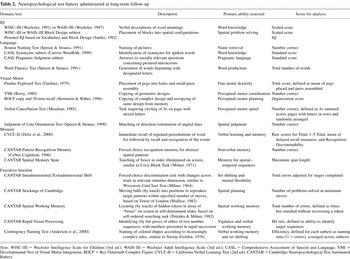
Neuropsychological test battery administered at long-term follow-up
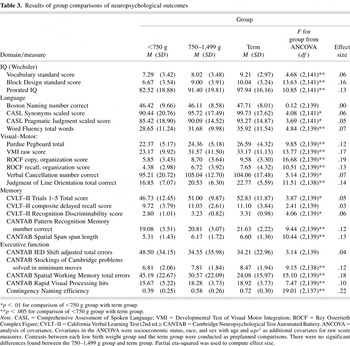
Results of group comparisons of neuropsychological outcomes
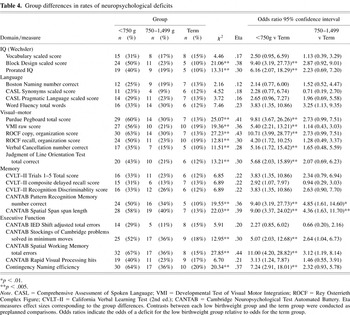
Group differences in rates of neuropsychological deficits
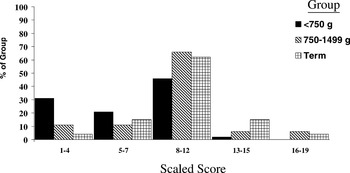
Distribution of scaled scores on the Wechsler Block Design subtest for the three birthweight groups.
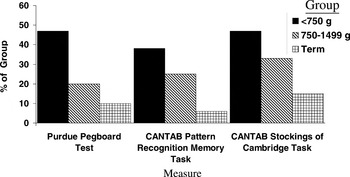
Illustration of group differences in rates of deficit scores for the subset of the sample without neurosensory disorder and with Wechsler prorated IQ ≥ 70. CANTAB = Cambridge Neuropsychological Test Automated Battery. Deficits were defined as scores > 1 standard error of prediction below expectations based on the term group's performance, and considering the effects of socioeconomic status, race, sex, and age. For all three measures, rates (or odds) were significantly higher for the <750 g group relative to term group (for Purdue Pegboard, odds ratio, OR = 7.77, 95% confidence interval, CI = 2.44–24.68, p < .005; for CANTAB Pattern Recognition Memory, OR = 9.20, CI = 2.34–36.20, p < .005; and for CANTAB Stockings of Cambridge, OR = 5.17, CI = 1.79–14.92, p < .005). The findings demonstrate clinically significant group differences in visual–motor skills, visual memory, and spatial planning.
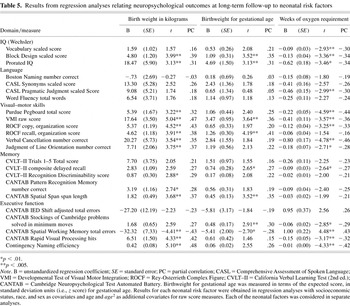
Results from regression analyses relating neuropsychological outcomes at long-term follow-up to neonatal risk factors
 You have
Access
- 129
- Cited by