During much of the early twentieth century, before the Nationalists or Guomindang (GMD) secured power in Nanjing, China was in political turmoil. The Nationalists were determined to build a unified and robust modern China. They nominally unified the country by 1929, but much remained to be done (Eastman Reference Eastman, Fairbank and Feuerwerker1986, 124). In eastern China, where the Nationalists’ presence was relatively strong, the GMD adopted a particularly crucial tactic to consolidate its power: the centralization of teachers schools. The Nationalists regarded the teachers school as an essential tool of state control rather than a mere educational institution. They believed that a centralized teachers school system was instrumental in enhancing their control of local societies (Cong Reference Cong2007, 3–17).
In 1932, the Nationalist government moved to further regulate the teachers schools. The government's first efforts to establish legal guidelines limiting the scope and reach of teachers schools began in late 1932 with the Teachers Schools Law (Shifan xuexiao fa) (Ministry of Education 1932). A further tightening of the guidelines occurred with the Teachers Schools Regulations (Shifan xuexiao guicheng) issued by the Ministry of Education a few months later (Ministry of Education 1933). At the heart of both revisions was an attempt to regulate who could establish and run teachers schools. The new rules stipulated with considerable precision that the establishment, conversion, and suspension of teachers schools had to be approved by the provincial, municipal, or county-level education administrative agencies. Furthermore, if a teachers school did not follow the prescribed procedures, the education administrative regulations clearly gave such agencies the authority to close any schools in breach of such guidelines (Ministry of Education 1933, 20). Thus, the letter of the law essentially outlawed private teachers schools, greatly strengthening GMD control over eastern Chinese society.
Meanwhile, the GMD regime kept a close eye on China's frontier regions. Anthropologist Stevan Harrell (Reference Harrell, Huang and Hsu1999, 137) argues that in the twentieth century, “no Chinese state has ever entertained the prospect of losing the periphery with anything but horror, and so inclusion of the periphery has become axiomatic for every government” (see also Leibold Reference Leibold2007, 1–5). The Nationalist government's concern was especially great given how it had risen from China's southernmost province, Guangdong. Even after it nominally unified China in 1929, the Nanjing central government only directly controlled the Lower Yangtze area, with many local warlords challenging the regime's authority across large swathes of the republic (Lin Reference Lin2011, 17–18). Under these circumstances, cooperating with strongmen from the frontier regions became an acceptable—indeed, indispensable—tactic for the Nationalists in order to claim influence over the more distant frontiers of China.
The Muslim warlord Ma Fuxiang (1876–1932), who was powerful in northwestern China, proved eager to seek allies outside the region to strengthen his power, which led to his partnering with the GMD central government (Lipman Reference Lipman1997, 167–75). Through this alliance, Ma Fuxiang gained national recognition, and the Nationalists could claim influence in the Northwest. Ma Fuxiang's complicated relationship with the GMD's gambit for an enhanced presence in northwestern China initially appeared entirely unrelated to the Nationalists’ regulations on teachers schools in eastern China. However, the two quickly intertwined in the case of the private Chengda Teachers School (Chengda shifan xuexiao, 1925–49).
With the promulgation of the Teachers Schools Regulations, the Nationalist regime ostensibly outlawed all private teachers schools. Historian Xiaoping Cong (Reference Cong2007, 134) even goes so far as to conclude that the Nationalist regime left “no room for future alternative experiments in teacher training.” However, Chengda proved a notable exception. Not only did Chengda remain private for an extended period long after the issuance of the Teachers Schools Regulations, but the GMD allowed and even encouraged Ma Fuxiang to fund it despite the clear knowledge that it remained a private school. If such high-profile transactions were largely overlooked, it is unlikely that the donations by Chiang Kai-shek (1887–1975) to Chengda in 1937 went unnoticed (Dagongbao 1937b, 4).
Nor was Chengda's special treatment entirely unique. The Shanghai Islamic Teachers School (Shanghai yisilan shifan xuexiao, 1928–37), its nominal successor the Gansu Pingliang Islamic Teachers School (Gansu Pingliang yisilan shifan xuexiao, 1939–41), and the Sichuan Wanxian Islamic Teachers School (Sichuan Wanxian yisilan shifan xuexiao, 1926–37) all continued as private teachers schools after the declaration of the regulations in 1933 (Li Jianbiao Reference Li2017, 66–87, 135–68; Wanxian Shizhi 2001, 1128). However, none of these other schools’ relations with the Chinese state were as complex as that of Chengda or had such strategic value for the GMD.Footnote 1
Similarly, the private Xibei Academy (Xibei gongxue, 1928–49) in Beijing outwardly appeared quite analogous to Chengda in that it also accepted generous government funding. Yet, it differed in several key ways. Foremost, the Xibei Academy was not a teachers school. While the academy had some affiliated primary schools, its main body was a middle school (Xibei gongxue Reference Xibei1934b). Because it was a private middle school, Beijing municipal regulations specifically allowed it to legally receive government funding. Indeed, in 1929, the mayor of Beijing cited these regulations to approve financing for the Xibei Academy (Xibei gongxue Reference Xibei1934a). By contrast, Chengda did not have such a clear legal standing to accept government subsidies. Another significant difference between the Xibei Academy and Chengda was that the former voluntarily admitted both Han Chinese and Muslim students, and Han students always outnumbered Muslim students (An Qinglan Reference An1939, 34–35; Sun Shengwu Reference Sun1940, 13). Chengda, on the other hand, did not accept Han Chinese students until it was nationalized in 1941. A focus on Chengda, because of the school's “central location and powerful patrons” and the special legal treatment it received from the state, offers a unique lens through which to understand Muslim educational institutions and China's state building in the twentieth century.Footnote 2
By asking how and why private Muslim teachers schools like Chengda received exceptional treatment from the state, this examination joins a growing body of scholarship that brings religion back to the center of the ongoing discussion about the building of the modern Chinese nation-state. It has been argued that religion is a modern concept and that the modernization of society requires a simultaneous reform of religion (Asad Reference Asad1993; van der Veer Reference van der Veer2001). Scholars of Chinese history have demonstrated religion's persistent influence in modern China, problematized the secularization of the Chinese society, and revealed the close interactions between religious groups and the state.Footnote 3 Yet, few works have focused on the complicated cooperative relationship between Muslim schools, Muslim warlords, and the Nationalist regime. In this relationship, the state and its partners purposely exploited the ambiguous definitions of Hui to its advantage in the frontier regions. Furthermore, the state's political calculations relating to the frontier profoundly influenced how certain aspects of Republican laws were implemented in Muslim schools like Chengda. In other words, the pliant ethno-religious connotations of Hui shielded Chengda from some unwanted regulations in some instances while allowing it to pursue its own agenda in others.
Before proceeding, it is necessary to define the usage and meaning of some key terms. “Frontier” regularly appears in this study. In Republican China, the phrase “Five Peoples Under One Union” (Wuzu gonghe) was often used to define which ethnic groups and territories constituted China. The frontier was generally conceived as the four “non-Han” territories of Hui, Tibet, Mongolia, and Manchuria. This study focuses on China's northwestern frontier (present-day Gansu, Ningxia, Qinghai, and Xinjiang). The northwestern frontier was largely a Muslim-majority region. However, Chinese Muslims or Hui lived not just in the Northwest but all over China. They were also different from the Uyghurs, another sizeable Muslim group in the Northwest, even as the Uyghurs, too, were often subsumed under the umbrella term of “Hui” in much of the central government's documentation. This common shift elided the region's diversity by categorizing the entire region as monolithically Muslim.
“Hui” and “Chinese Muslim” are the other two frequently employed terms. Although “Hui” and “Chinese Muslim” are used as synonyms in this study, they refer to those Muslims who traditionally live in the Chinese cultural areas. However, “Hui” was a highly ambiguous term in twentieth-century China. Depending on the context, it could be a religious category, an ethnic category, or a territorial category (Atwill Reference Atwill2018, 6; Cieciura Reference Cieciura and Lipman2016, 107–15). Nonetheless, the ambiguity and slippage of the term “Hui” could be advantageous to Chinese Muslims and the Republican state.
Chengda's Origin and the Different Treatment It Received
Starting from the late nineteenth century, especially after China's defeat in the First Opium War (1839–42), China's educational landscape underwent drastic changes. At that time, many Chinese elites felt that it was imperative to reform China (Liang Reference Liang1989, 89). Chinese intellectuals had long highlighted the value of education to fully tap into each individual's innate ability (Curran Reference Curran2005, 83). Therefore, educational reform tended to be seen as indispensable in any reform effort, including those promoted among Chinese Muslim elites. They called for Muslim educational reform and condemned traditional Islamic teaching methods and materials, especially jingtang jiaoyu (madrasa education) and the Han Kitab texts (a collection of Chinese Islamic texts) (Matsumoto Reference Matsumoto and Lipman2016, 171–78).
Despite Chinese Muslim elites’ strong identification with the mainstream educational reform movement, the Chinese state often failed to embrace Chinese Muslims’ desire for modern education with Islamic characteristics. Without central support and with a lack of strong central oversight in the years immediately following the 1911 Revolution, most Muslim communities took the matter into their own hands by creating Muslim educational alternatives like Chengda. The Chengda Teachers School was one of the longest operating and most influential Muslim schools in China during the first half of the twentieth century. Chengda began as a private school before becoming a nationalized public school around 1941 (Li Huaying Reference Li2006, 86–87; Mao Reference Mao2011, 144, 165).
In most cases, past scholarship has analyzed educational reforms of the Republican era in broad terms, paying only passing attention to private schools such as Chengda. Those scholars who have examined the relationship between Chengda and the Nationalist regime have tended to do so in relatively simplistic terms that treat the school's nationalization uncritically as a promotion in status (Matsumoto Reference Matsumoto2002; Reference Matsumoto and Lipman2016, 179–80). Other scholars, such as Yufeng Mao, have introduced a more nuanced version of the relationship between Chengda and the Nationalist regime. According to Mao (Reference Mao2011, 165–66), while Chengda maintained its independence, it actively pursued the dual causes of national salvation and religious revival, and only accepted being nationalized by the state in 1941 as a result of wartime contingencies and financial difficulties. Yet, Chengda's experience with the Nationalist regime reflects other important trends omitted in these earlier examinations. In particular, with the issuance of the Teachers Schools Regulations, private teachers schools were under pressure to nationalize as early as 1933, but even with such initiatives, Chengda continued to thrive as a private school. Insinuating that Chengda's longevity was solely a result of the Nationalist government's many shortcomings overlooks both the GMD's genuine political reach and Chengda's shrewd navigation of the Republican-era landscape.
There is overwhelming evidence that the GMD was eager to consolidate its power by controlling the teachers school system and serious about implementing the Teachers Schools Regulations (Minbao 1933, 3). Numerous examples exist of resistance to the regulations, but Nanjing repeatedly and assertively squelched a number of attempts to resist them (Shanghai Education Bureau 1934). As a result of such measures, the environment became progressively harsher for private teachers schools after 1933. Even the influential and reputable Private Xiehe Teachers School for Women (Sili Xiehe nüzi shifan xuexiao) in Guangzhou, established in 1911 by the American Presbyterian Church, was forced to convert itself into a regular middle school in 1935 by order of the Nationalist government (Cao Reference Cao1983, 205–6).
The experience of the Xiehe Teachers School for Women contrasts sharply with that of Chengda. Not only did the government delay serious efforts to nationalize Chengda until 1941, it actively supported Chengda while it was still a private teachers school. To understand why Chengda was treated differently, we need to pay particular attention to the GMD's frontier politics. Stated simply, the Nationalists treated Chengda differently because, in their eyes, the school was strategically crucial in projecting the regime's influence in the frontier regions.
In 1925, Chengda began as many private schools did in the first decades of the Republican era. It was founded in a Muslim neighborhood in Jinan City, Shandong Province, initially aiming to serve only its own community. Its establishment was not an outgrowth of state policy but rather a result of the state's failure to provide modern education. Initiated by a local Jinan Muslim, Mu Huating, Chengda's creation largely emerged out of a recognition that Jinan lacked a modern Muslim school (Ma Bozhong Reference Ma2006b, 161). Soon thereafter, a few other local Muslims and Tang Kesan (1882–1950), the prefect of Jinan, joined Mu Huating. Together, they founded Chengda. Meanwhile, they recruited an imam named Ma Songting (1895–1992) from Beijing to help run the school (Ma Bozhong Reference Ma2006b, 161–66; An Zuozhang and Liu Chunming Reference An and Chunming2008, 642).
Between 1921 and early 1929, thanks to the efforts of its founders, Chengda quickly took root in Jinan, even though some local Muslims were initially skeptical about Chengda's modern-style curriculum, which included the Chinese language and secular subjects such as history, geography, and mathematics (Mao Reference Mao2011, 149–53). However, in May 1928, when Jinan fell under the direct control of Japanese troops, Chengda endured a chaotic period, during which it was forced to suspend its classes. Ma Songting, a native of BeijingFootnote 4 and the director of general affairs of Chengda, decided to relocate the school to Beijing (Liu Dongsheng Reference Liu1993b, 63). Realizing that there was little to be gained by having the school remain in Jinan, most of the Jinan Muslim community actively cooperated with Ma Songting in his bid to move the school (Zhou Zhongren Reference Zhou2006, 5). At an emotional farewell party for Chengda, one of the school's founders compared its relocation with the hejira when the Prophet Muhammad departed Mecca for Medina (Ma Bozhong Reference Ma2006a, 209). Little did they know that in Beijing, Chengda would, with the ascendency of the Nationalists, become caught up in a complex blend of centralized efforts of state building and outreach to the distant frontiers.
Chengda, the Ma Family, and the Nationalists
In early 1928, after expanding its territory northward from Guangdong to the middle and Lower Yangtze River basin, the Nationalist government began a final military drive on Beijing to complete the unification of China, which culminated in June 1928 (Wilbur Reference Wilbur and Fairbank1983). Only a few weeks later, Chengda relocated to Beijing and quickly gained the support of Ma Fuxiang, the Muslim warlord and rising GMD leader. Amid the Nationalists’ rising influence, Ma Fuxiang embraced the GMD rhetoric and quickly forged a new alliance with Chiang Kai-shek. It was not a surprising move at the time. Since the GMD demonstrated its power in the Northern Expedition, many warlords adopted nationalistic rhetoric, though their level of loyalty varied considerably (Lipman Reference Lipman1997, 172–75). However, Ma Fuxiang seemed to have gained Chiang Kai-shek's trust, as he rose quickly through a diverse assortment of posts, becoming a member of the State Military Committee, Qingdao mayor, Anhui governor, chair of the Mongolian-Tibetan Commission (MTC; Meng Zang Weiyuanhui), and member of the State Council (Xu Reference Xu1991, 686).
Chiang Kai-shek showered Ma Fuxiang with promotions mainly because Ma Fuxiang's frontier background helped legitimize the GMD's claims to rule all of China. In an era when many local warlords continued to challenge Chiang Kai-shek's authority after the GMD had nominally unified China, Ma's growing prominence served the political aspirations of both men. In early May 1930, with disagreements between Chiang Kai-shek and local warlords on the rise, the central government in Nanjing announced its plan to hold a national Mongolian Affairs Conference (Lin Reference Lin2011, 21). From the outset, such a meeting probably never aspired to alter the reality of Mongolia's de facto independence (and the Nationalist's ongoing claims of control). Nevertheless, its symbolic meaning should not be underestimated.
Successfully organizing such a conference sought to enhance the Chiang Kai-shek government's claim as China's sole political authority and thereby justify its classification of other warlords’ efforts to undermine the Nanjing regime as illegitimate “rebellions” (panluan).Footnote 5 Ma Fuxiang was in a solid position to assist Chiang Kai-shek in advancing such a strategy. As a Muslim warlord born in the northwestern province of Gansu, Ma Fuxiang was more knowledgeable about frontier affairs than most of Chiang's political advisors in Nanjing. Moreover, Ma continued to possess political and military influence in the northwestern frontier region (Ding Mingjun Reference Ding2000, 94). Thus, the Nationalist government appointed him to chair the national Mongolian Affairs Conference (Wang Zhengru Reference Wang2012, 188–89).
The relationship between Ma Fuxiang and the Nanjing government echoes Uradyn Bulag's (Reference Bulag2002, 45–49) observation that the Muslim warlords’ continued influence depended on “demonstrating their ‘progressive’ fealty to China, but more importantly, on their ability to assure Tibetan and Mongol loyalty to China.” In the case of Ma Fuxiang, his ability to ensure the frontier regions’ loyalty to the central government continued to fuel his rise in the national government. On the other hand, Ma knew that if he lost the ability to ensure the adherence of the frontier regions, he would quickly fall out of favor with the Nanjing regime. Therefore, even as Ma Fuxiang's star rose within the Nationalist government, he sought to maintain and project influence in the frontier regions. Promoting educational reforms in the northwestern frontier served as a critical and effective area for Ma Fuxiang to demonstrate his influence in both spheres.
Controlling ethnic minority educational resources was a significant aspect of Nationalist frontier politics. The idea was to indoctrinate minority elites who could support the Nationalists and their policies (Lin Reference Lin2011, 31). Ma Fuxiang had displayed a strong devotion to Islamic culture and education long before he became an ally of the GMD. When he was young, Ma Fuxiang studied both Islamic and Confucian classics. He later sponsored multiple reprintings of Han Kitab texts (Lipman Reference Lipman1997, 168–69, 176–77). In 1915, Ma Fuxiang founded a Mongolian-Muslim teachers school and then founded more than sixty other primary schools for Muslims in Ningxia. These schools’ curricula often sought to blend Chinese, Western, and Islamic learning. However, because of financial difficulties and political unrest in northwestern China, most of these efforts were short-lived (Ding Mingjun Reference Ding2000, 139–42). Undeterred, Ma Fuxiang continued to believe in the power of educational reforms to advance his agenda. In a time when reform-minded elites were eager to use education to bring about social change, Ma Fuxiang's devotion to educational reform dovetailed neatly with his desire to maintain power in northwestern China.
After joining forces with the GMD and increasingly devoting more time to his duties in central China, Ma Fuxiang maintained his interest in establishing various academies and other educational ventures (Sun Shengwu Reference Sun1934). Ma soon embarked on developing a Muslim college in Beijing and reportedly constructed dozens of cottages behind the Beijing Dongsipailou Mosque (Dongsipailou Qingzhensi) as part of a future campus (Liu Dongsheng Reference Liu1993b, 63). Chengda's impending move to Beijing quickly altered Ma Fuxiang's plan.
In preparing for the school's relocation, Chengda's titular president, Tang Kesan, visited Beijing and approached Ma Fuxiang about a property that could serve as Chengda's campus in Beijing (Ding Mingjun Reference Ding2000, 144). As a government official, Tang Kesan did not have much time for Chengda's day-to-day affairs, but he was decisive in the school's ability to develop ties with an array of influential figures. Following his meeting with Tang, Ma Fuxiang's interest in Chengda grew. He immediately granted Chengda the use of his cottages behind the Dongsipailou Mosque. In addition, he dispatched his son, Ma Hongkui (1892–1970), to personally inspect the school after its arrival in Beijing. In his remarks, Ma Hongkui praised Chengda's management, but he urged the school's leadership to scale up its enrollment (Chengda Teachers School 1932, 8–9). Upon its arrival to Beijing, Chengda's enrollment had dropped to a paltry twelve students (Liu Dongsheng Reference Liu1993b, 63). Not unsympathetic to Chengda's plight, Ma Hongkui first donated 500 yuan and quickly offered another 100 yuan per month to Chengda to fund the school's daily expenditures toping to ensure its long-term success (Chengda Teachers School 1932, 9). Following the lead of the Ma family, Beijing Muslims from all walks of life contributed to the school's funding (Liu Dongsheng Reference Liu1993b, 72). However, none surpassed the Ma family.
Chengda's leadership quickly embraced and cultivated the patronage of the Ma family. When Chengda arrived in Beijing and reorganized its board in 1929, Ma Fuxiang was appointed its chair, and his son Ma Hongkui as its vice chair (Liu Dongsheng Reference Liu1993b, 63; Yuehua Press 1931, 13–15). The school quickly benefited from the Ma family's political clout. After Ma Fuxiang began to serve as the director of MTC around 1930, he reportedly promoted Chengda's president Tang Kesan to a key directorship within the MTC (Wang Zhengru Reference Wang2012, 230). Most significantly, around 1931, Ma Fuxiang's position in the MTC resulted in Chengda receiving monetary assistance every month from the commission (Ding Mingjun Reference Ding2000, 145). Ma Fuxiang passed away in 1932, but by then, he had already created a stable system that allowed Chengda to receive government funding from the MTC.
Chengda was not the only school that received financial support from the MTC. However, the MTC subsidized Chengda at 540 yuan per month in 1934, putting it behind only the National Beijing Mongolian-Tibetan School among the schools that received MTC support (Mongolian-Tibetan Commission 1934, 38; Wang Zhengru Reference Wang2012, 258). The MTC funding soon became the main source of cash, enabling Chengda to cover all its daily expenses (Wan Li Reference Wan1934, 23). For his part, Ma Hongkui followed in his father's footsteps, making large donations to Chengda. Even after he moved back to Ningxia in northwestern China, Tang Kesan would travel to his home to solicit his contributions (Ma Hongkui Reference Ma1937, 1).
Ma Fuxiang and Ma Hongkui's support of Chengda was not negligible or purely charitable in nature. The family had played a prominent role in reforming Muslim education since the 1910s. They supported many Muslim schools that aimed to modernize Muslim education, but not all were sponsored in an equal manner. For example, even though Ma Fuxiang had pledged support for the Shanghai Islamic Teachers School, when the time came to honor his commitment, he withheld the funds (Li Jianbiao Reference Li2017, 72–73). We can only speculate as to how this happened, but it is safe to conclude that the Islamic school in Shanghai was not the priority of the Ma family. Even in the case of the Xibei Academy, a cause close to the Ma family's heart, Ma Fuxiang only became the chair of the academy's board when fellow Muslim warlord Bai Chongxi (1893–1966) left that position in mid-1929 (Sun Shengwu Reference Sun1934). Given the Xibei Academy's clear legal basis to receive government funding, it appears the Ma family viewed Chengda as a more worthy recipient of its largesse. For these reasons, the Ma family's relationship with Chengda was unique.
The Ma family's unique relationship with Chengda had a lot to do with its desire to project influence into frontier education—a mission that came to the fore when Ma Fuxiang assumed control of the MTC's limited resources. The MTC's core charge was to enhance state control of China's frontier territories, including Mongolia, Tibet, Xinjiang, and the Northwest (Duan Jinsheng Reference Duan2012, 64–68). Central to this charge was sponsoring institutions that could cultivate the special talents required for administration of the frontier areas (Zhu Ci'en Reference Zhu2008, 84–85). In this light, Ma Fuxiang justified deploying MTC funding to Chengda, as the agency equaled its financial support for Chengda on a par with that being used to fund Mongolian and Tibetan educational institutions (Mongolian-Tibetan Commission 1934, 37–38).
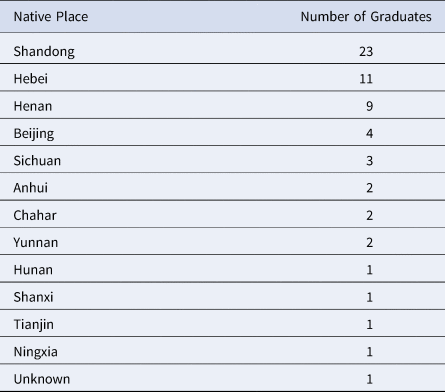
Ma Fuxiang's use of Chengda to promote the Nationalist's frontier agenda should not be seen as prejudiced or driven largely by self-interest. Chengda was a Muslim teachers school. Although there was a large Chinese Muslim population in northwestern China, Dru Gladney (Reference Gladney1991, 21–37), in his pathbreaking work, reminds us that Chinese Muslims were not homogeneous, differing in geography, economy, culture, language, and religious beliefs. Chengda's core constituency remained Chinese Muslims in eastern China. Although no longer limited to Shandong after it moved to Beijing, the school's recruitment was still overwhelmingly focused on eastern China. According to a survey conducted by the Ministry of Education, by the time of the outbreak of the Second Sino-Japanese War in 1937, Chengda had graduated sixty-one students. Only one of these students’ native place was in northwestern China.Footnote 6

Therefore, it is necessary to ask how the Ma family could legitimately connect supporting Chengda with projecting influence into education in the Muslim areas of northwestern China, particularly when Ma Fuxiang supported Chengda with MTC funds. Here, Ma Fuxiang took advantage of the terminological slippage embedded in the term “Hui.” As hinted at earlier, by the early twentieth century, most Chinese used the term “Hui” in both a religious and an ethnic sense, depending on its context. Even within Chinese Muslim communities, efforts to delineate its mean more precisely erupted into prolonged and contentious debates among Chinese Muslim elites. As historian Wlodzimierz Cieciura (Reference Cieciura and Lipman2016, 109–39) has convincingly demonstrated, some Muslim intellectuals asserted that Hui were simply Han Chinese who believed in Islam; others argued that Hui was an identity encompassing all Muslim groups in China and creating a larger pan-Islamic unity; and still others emphasized the differences between the Hui, who largely lived as a minority among Han Chinese in China proper, and those other Muslim ethnic groups, especially the Uyghurs, who resided outside China proper and in areas with few Han Chinese, and thus considered the Hui “an ethnicity unto themselves” exclusive of the other Muslim peoples of China.
While all three theories enjoyed varying degrees of popularity during the Republican period, it is still hard to identify with any precision exactly where complex historical figures like Ma Fuxiang and Ma Hongkui stood in relationship to their identities as Muslim, Hui, and Chinese. Nevertheless, throughout their political careers, especially after the late 1920s, Ma Fuxiang and his son promoted the unity of all Muslims within China and their integration “as citizens of the Chinese Republic and participants in Chinese culture” (Lipman Reference Lipman1997, 167–77). At some points, both expressed ideas that seem to support the theory that Chinese Muslims were Han Chinese who believed in Islam.
For example, in 1939, Chiang Kai-shek (1939, 5) claimed that he had once discussed the Hui identity issue with Ma Fuxiang, and Ma said to him that Islam in China was mostly the religion of the Han people. Gu Jiegang (Reference Gu1939, 1), an influential scholar in Republican China, also testified that Ma Hongkui once made a point that Chinese people who believed in Islam did not belong to a separate ethnicity, just like Chinese people who believed in Buddhism were not Indians, and Chinese people who believed in Christianity were not “Jews” [sic].Footnote 7 Given Ma Fuxiang and Ma Hongkui's positions on unity and integration, it is safe to argue that they wanted to deemphasize or even overlook the differences among Chinese Muslims. In this light, the Ma family found little contradiction in their support of Chengda, regardless of its location, as equivalent to sponsoring a Hui school that could cultivate unique Hui talents required for the modernization of the northwestern frontier region. In turn, among the Chinese public and within Nationalist circles, the Ma's relationship with Chengda enhanced their image as strongmen who could carry the Northwest forward.
By allying with the Nationalists and sponsoring modernization projects like Chengda, the Ma family acquired an unprecedented level of influence in northwestern China. In 1930, the Nationalist central government had a chance to appoint the governor of Gansu Province. Chiang Kai-shek first thought of Ma Hongkui. But, for some reason, Ma Fuxiang was convinced that his nephew Ma Hongbin, who was the governor of Ningxia at the time, was a better candidate. In his words, “if Ma Hongbin cannot manage Gansu well, no one can.” So Chiang Kai-shek followed his advice and appointed Ma Hongbin (Ding Mingjun Reference Ding2000, 98–99). Ma Hongbin's post in Ningxia was later inherited by Ma Fushou, an elder brother of Ma Fuxiang (Shi Lun Reference Shi2006, 68). Through their military and political network, the Ma family dominated large swaths of northwestern China, but that influence was short-lived and considerably weakened with Ma Fuxiang's death in 1932 (Ding Mingjun Reference Ding2000, 106; Wang Zhengru Reference Wang2012, 380–91).
Following his father's death, Ma Hongkui managed to maintain the family's influence in Ningxia, but he lacked the prestige necessary to inherit national posts like the chairmanship of the MTC from his father. The Ma family's notoriety did result in Ma Hongkui inheriting two positions from his father: the chairmanships of the boards of Chengda and the Xibei Academy (Liu Dongsheng Reference Liu1993b, 74; Sun Shengwu Reference Sun1934). Ma Hongkui understood the value for his family in supporting Muslim educational institutions and took his responsibility as the school's chair seriously. As mentioned earlier, he continued to use the financial resources of a northwestern province to fund Chengda, a school in Beijing.
Chengda's leadership also appreciated the fact that the Ma family's continued support of the school was based on its desire to serve as a modernizing force in the northwestern frontier. The leadership of the school knew that it was in their interest to help satisfy the Ma family's agenda. Consequently, after Chengda moved to Beijing, the idea of developing northwestern China occupied an increasingly prominent place in Chengda. After Ma Fuxiang's death, the school took steps to encourage students to serve in the Northwest after they graduated. Out of a graduating class of seventeen graduates in 1932, seven went to work in the northwestern province of Gansu as teachers (Chengda Teachers School 1941a; Yuehua Press 1932b, 70). Among the seven students, five worked for the same primary school that had been founded by Ma Fuxiang (Ma Yugui Reference Ma1934a, 17; Chengda Teachers School 1941a). It was hard to imagine why so many of these students would have chosen the same career path without the intervention of the school leadership and the support of the Ma family.
The Chengda pivot toward northwestern China did not stop with the 1932 graduates. Three years later, in 1935, among the next cohort, the Northwest remained a popular choice, with fourteen of the fifteen graduates taking up posts there. By the time of a survey in 1943, five still worked in northwestern China. Interestingly, in the same survey, only four of Chengda's first group of graduates were still in the Northwest, and these were mainly in Gansu (Ministry of Education 1943b). The departure from the Northwest of most of the graduates from the first group was likely caused by the Sino-Japanese War, as many Chinese Muslims joined forces with the GMD or Chinese Communist Party to fight the Japanese (Matsumoto Reference Matsumoto2002, 46–52).
The Chengda graduates consciously adapted the Nationalist rhetoric to justify their work. In 1934, Chengda invited its graduate Ma Yugui, who had been working in Gansu for two years, to deliver a report on campus. Ma Yugui (Reference Ma1934b, 14–15) claimed the fate of northwestern China was closely connected to the future of the party-state, and his job in the Northwest was to promote national awareness among Muslims through education so that they would rise up to protect the party-state in the future.
Ma Yugui admitted that his work in Gansu was not easy. Local Muslims were highly skeptical about modern education and questioned the value of books in Chinese. Ma Yugui (Reference Ma1934a, 17–18) pointed to this suspicion as a critical reason for the backwardness of the local society in the province. However, with the help of Ma Hongkui and other local authorities, Ma Yugui convinced locals to send their children to school. Had members of the Ma family, or the MTC, heard Ma Yugui's speech or read his report in 1934, they would have been pleased that their investment in Chengda had paid off, and that Chengda had become an important node in their efforts to gain influence in China's northwestern frontier.
Ironically, despite the success of Chengda graduates in promoting national consciousness in the Northwest, the Nationalist central government's actual influence in that region remained uneven throughout the 1930s. Even with the regime's persistent efforts to change the situation, they had made only limited progress. In some cases, the Nationalist government even had to abort plans to deploy troops in the northwestern frontier under pressure from local warlords (Lin Reference Lin2011, 37–48). The Nationalists’ experience in the Northwest was hardly an anomaly. They frequently encountered crises in other frontier regions as well. For example, in 1931, the Nationalists lost all of Manchuria to Japan. After its conquest of Manchuria, Japan continued its expansion into regions claimed by China (Iriye Reference Iriye, Fairbank and Feuerwerker1986, 492–510). By early 1933, Japanese troops were about to annex Rehe, another frontier province of China. Chiang Kai-shek had to send He Yingqin, one of his most trusted generals, to Beijing to take control of the situation. He Yingqin eventually signed the Tanggu Truce with the Japanese and temporarily ended the military conflict between China and Japan (Xiong Zongren Reference Xiong2016, 210–25).
As Nanjing confronted a swift sequence of frontier crises, the strategic value of Chengda became even more evident for the Nationalists and Chengda's leadership. In 1934, when the situation in China's northern frontier started to calm down, He Yingqin, together with Yuan Liang, the mayor of Beijing, visited the two Muslim schools in the city, Chengda and the Xibei Academy (Chengda Monthly Press 1934, 8). This visit was a recognition of the two schools’ strategic significance for the Nationalists. Although the majority of students in the Xibei Academy were Han Chinese, the academy continued to claim that it was a school for Chinese Muslims and the frontier regions. In return, the regime consistently provided the academy with generous subsidies (Xibei gongxue Reference Xibei1934c).
The Chengda leadership adopted similar strategies. In his speech expressing thanks for He and Yuan's visit, Chengda president Tang Kesan played up Chengda's relationship with the northwestern frontier. He even claimed that the establishment of Chengda had resulted from his realization of the backwardness (luohou) of Muslim education in the Northwest, though this was most likely not the case. For their part, He Yingqin and Yuan Liang encouraged Chengda and its students to be responsible for mobilizing Chinese Muslims for national salvation (Chengda Monthly Press 1934, 8–12).
Notably, the visit of GMD elites to Chengda took place after the school had technically become “illegal” under the Teachers Schools Regulations of 1933 (Ministry of Education 1933, 20). But, as long as Chengda was considered instrumental in controlling the frontier regions, the Nationalists overlooked such breaches. Several years later, when the Ministry of Education explained why it did not take any actions against the private Chengda Teachers School in the 1930s, it claimed, “We had announced that teachers schools should only be run by the government. However, considering that this school [Chengda] has a long history, and it was quite successful [in promoting education in the frontier regions], we not only did not intervene but supported its development in many ways” (Executive Yuan 1941).
Chengda's Agency and Frontier Politics in the Late 1930s
The strategic concern of Chengda's Nationalist sponsors allowed Chengda to avoid the fate of many other private teachers schools under GMD rule. By implicit agreement, the state chose not to enforce the law, and Chengda's leadership tried to satisfy the agenda of its GMD sponsors. Despite such close governmental ties, the school never lost its “Muslim character.” More specifically, it never relented in the pursuit of its goal of reviving and promoting Islamic culture. However, because of shifting political realities in the frontier regions, by the late 1930s, Chengda's strong pro-Muslim agenda was causing many in Nanjing to be increasingly apprehensive. Eventually, the revival and promotion of Islam resulted in clashes between the Chengda leadership and the Nationalist authorities.
Chengda was a Muslim school. Initially, the Chengda leadership and the Ma family agreed that reviving and promoting Islam was the primary mission of the school. Therefore, when Ma Fuxiang was the chair of Chengda's board, Article 1 of the school charter clearly stated that “the purpose of this school is to train competent teachers and promote Islam” (Yuehua Press 1932a, 67). Moreover, the Ma family often encouraged Chengda in the government's desire to promote Islam. In Chengda's first graduation ceremony, Ma Fuxiang (Reference Ma1932, 5) took the opportunity to urge all of the graduates to “work hard and carry forward the holy religion [Islam] to meet the expectations of all parties.” His son, Ma Hongkui (Reference Ma1932, 7–8), also claimed that Chengda's first group of graduates had tremendous responsibility for ensuring the future of Islam in China. Therefore, in principle, the Chengda leadership's promotion of Islam appeared to be entirely in accord with that supported by the Ma family and top GMD leaders.
Previous scholarship on Chinese Muslims largely accords with such conclusions. Jonathan Lipman (Reference Lipman1997, 167–211) has shown that many reform-minded Chinese Muslims argued that Chinese Muslims should integrate themselves into the rising modern Chinese nation-state. In the minds of those Muslims, the reasoning for the modernization of China and the modernization of Chinese Islam were not two distinctive projects; instead, being modern Chinese and modern Muslims were “mutually informing” (Ben-Dor Benite Reference Ben-Dor Benite2004, 96–97). This shared goal informed both the Ma family and Chengda leadership's broader promotion and revival of Islam; they believed that Islam supported, not hindered, the modernization of China. However, past scholarship has often elided the vast differences among reform-minded Chinese Muslims and precisely how the Hui should support China's modernization. Such nuanced differences in approach, as well as the changing frontier situation, rather than political antagonism, eventually led to a parting of ways between the Ma family and the Chengda leadership.
The first open indication of a rift occurred in 1937. In March 1937, Ma Hongkui unexpectedly wrote to Chengda to resign as the chair of the board and relinquish all his responsibilities to the school. To show that he was serious, Ma Hongkui published his resignation letter in influential newspapers, including Dagongbao and Zhongyang ribao (Cheng Reference Cheng1937, 7). In many ways, it is an odd moment to find such a rupture. By all outward measures, Chengda was still developing smoothly. The number of students who were enrolled in Chengda had increased from a dozen in 1929 to a hundred in 1936 (Ma Songting Reference Ma1936, 13).
Ma Hongkui had freely expressed his disapproval at the decisions made by Chengda's leadership before. He had long felt irritated that Chengda students were allowed to openly discuss marriage reform, military, and political issues in school periodicals. As early as 1934, Ma had demanded the Chengda leadership to change the way they managed the school, or he would sever his connections with them (Mao Reference Mao2011, 160–61). But, in 1934, after a fervent and ardent call from Tang Kesan and the Chengda student body Ma agreed to revoke his demand (Ma Hongkui Reference Ma1937, 1).
Yet, in 1937, the situation seemed different. Ma Hongkui (Reference Ma1937, 1) claimed in his letter that he resigned as a result of Chengda promoting “political activities in the name of Islamic education.” Like most students of the era, Chengda students’ views on social and political issues could easily be found in Chengda periodicals like Chengshi yuekan and Yuehua, with a frequency that suggested Chengda's leadership tolerated, if not actually condoned, the views expressed.Footnote 8 Ma was particularly angry at a 1937 report in Yuehua. That report used the term lingxiu (leader) to address a Chinese Muslim representative in a diplomatic event. Ma found this scandalous, since such a label was suitable only for the leader of the Nationalist government, and as such, the Muslim leadership should not have a separate lingxiu. In the end, Ma Hongkui (Reference Ma1937, 1) declared it had become too politically risky for him to continue to associate with Chengda. He could not change Chengda, but he could cut off all ties with it.
On the particular issue of the term lingxiu, one could argue that Ma Hongkui overreacted. In the Republican era, lingxiu could be used to describe any leader.Footnote 9 Nevertheless, Chengda's use of lingxiu reminded Ma Hongkui that his understanding of Islam's role in China was different from that of the Chengda leadership. For Ma Hongkui, Islam's central role was to unify Chinese Muslims under the Chinese regime. For Chengda's leadership, Islam could both unify Chinese Muslims and provide ideas and inspirations for China's modernizing projects. Therefore, the Chengda leadership tolerated students’ discussions of social and political issues, while Ma Hongkui found those discussions irritating. Ma Hongkui also had other reasons to be nervous about the disagreements between himself and the Chengda leadership.
It was precisely around this time that Japan was again threatening China from the north and putting considerable effort into luring Muslim leaders to its side (Matsumoto Reference Matsumoto2002, 39–40). The Japanese policymakers’ purpose for enlisting the cooperation of Chinese Muslims went beyond destabilizing the Chinese nation-state. They also hoped that, with the help of Chinese Muslims, the Japanese Empire could win the support of Muslims throughout the world, thereby undermining Western imperialism (Esenbel Reference Esenbel and Esenbel2017, 87–115; Hammond Reference Hammond2020, 31–67). As a powerful Muslim warlord, Ma Hongkui was reportedly one of the priority targets of Japanese intelligence agencies (Wang Ke Reference Wang2009, 96). In this delicate situation, the last thing Ma Hongkui wanted was to send a mixed message to the GMD central government and the Chinese public about where his loyalties lay.
For Ma Hongkui, in this situation, Chengda was a liability. In 1934, a GMD official had informed Chiang Kai-shek about Ma Hongkui's clash with the Chengda leadership and specifically warned Chiang that Chengda could become part of Japan's plot to use Islam to weaken China (Mao Reference Mao2011, 161–62). During the Sino-Japanese conflicts, the Japanese Empire was eager to represent itself as a protector of Islamic culture (Hammond Reference Hammond2020, 69–72). If Chengda decided to cooperate with the Japanese in the name of Islamic culture, the Ma family's prestige would have been further damaged. Indeed, later in 1937, the Japanese did approach Chengda leaders about working to establish pro-Japanese Muslim organizations in China, but the school refused to cooperate (Mao Reference Mao2011, 164). Regardless, Ma Hongkui viewed Yuehua's usage of lingxiu as incredibly reckless and thus raised his suspicions over Chengda's claim that Islam could play a more active role in China's modernization.
For Chengda, Ma Hongkui's resignation posed a new challenge. However, Tang Kesan, who was still the director of general affairs of the MTC, was able to ensure continued funding for Chengda (Liu Dongsheng Reference Liu1993b, 72). The MTC was an agency of the central government. Unlike his father, Ma Hongkui had limited, if any, influence over the policies of the central government. The Nanjing central government, for its part, decided against taking measures against Chengda. Instead, it continued to support the school (Dagongbao 1937a, 4). The choice is not surprising given that the Nationalist regime's presence in the Northwest was weak, and Chengda remained a prestigious institution to help the regime. Soon, however, the situation took a turn few Chinese desired or anticipated.
The Nationalization of Chengda
In July 1937, with the outbreak of the Second Sino-Japanese War, Chengda's development was once again stymied. With the help of the powerful Muslim general Bai Chongxi, Chengda relocated from Beijing to Bai's hometown, Guilin, in Guangxi Province (Mao Reference Mao2011, 164–65). Bai Chongxi had played a crucial role in inspiring Chinese Muslims to be more active in organized education and politics ever since the 1927 Northern Expedition (Xue Reference Xue1999, 1:13–14). His involvement greatly facilitated Chengda's relocation. Chengda started to move out of Beijing in early January 1938, and by February that year, it had begun to prepare for the resumption of classes in Guilin (Liu Dongsheng Reference Liu1993a, 71). In contrast, both the Xibei Academy and the Shanghai Islamic Teachers School ceased operation in 1937, though they were reestablished more than a year later (Li Jianbiao Reference Li2017, 101, 143; Sun Shengwu Reference Sun1940, 12–14). Regardless, these Muslim schools were among a large group of educational institutions that relocated to southwest China because of the Sino-Japanese War (Israel Reference Israel1998, 15). However, unlike many other colleges, the Nationalist government's changing frontier policy hit the Muslim schools, especially Chengda, hard after the relocation.
With the GMD's decision to move its capital to China's western frontiers in the face of total war with Japan, the frontier regions had transformed from a significant but often secondary issue into one upon which the survival of the Nationalist regime depended (Lin Reference Lin2011, 54–92). For the regime's security, the Nationalists in Chongqing now favored policies that allowed them to control all aspects of the frontier regions. As part of these reforms, in 1940, the Nationalist government announced that the education of frontier youth should be conducted in accordance with the general education administration system, and the Ministry of Education should be in charge (Press Bureau of the Executive Yuan 1947, 2–3). With this announcement, Chengda had little choice but to adhere to the Ministry of Education guidelines and undergo the process of nationalization (Ministry of Education 1943a, 23).
Initially, the Chengda leadership seemed to welcome the policy. Tang Kesan's preliminary response to the Ministry of Education was that “the teachers and students were all excited [about the nationalization] and grateful to the government for supporting the Muslim education.” Tang proposed two principles to guide the nationalization: first, the government should provide all the funding that the nationalized Chengda would need; second, the school's organization should remain completely intact (Gu Shusen Reference Gu1940). Years of experience dealing with the GMD had convinced Chengda's leadership that nationalization was only a formality with little fundamental change to Chengda.
The Ministry of Education soon responded to Tang Kesan's proposals, but in unanticipated ways. The ministry claimed all of Chengda's expenses were already covered by the government, and nationalization simply recognized this reality. The ministry then went a step further and asserted that after Chengda became a national school, the school should align with all current laws and regulations (Ministry of Education 1940). The ministry's statements indicated that Chengda should not expect “business as usual” after the nationalization. Upon learning of the government's intentions, the Chengda leadership tried to rebuff such a swift shift in the school's status. Ma Songting (Reference Ma1941), Chengda's longtime director of general affairs, now claimed that nationalizing Chengda ran counter to the school's original purpose, which was to “create enlightened imams and promote Islamic culture.” Ma Songting feared that once Chengda became a national school, it could no longer be a school for Muslims.
However, Ma Songting was in no position to challenge the decision of the Ministry of Education. It soon became clear the government had withheld the usual subsidies. The school had no choice but to turn to the Ministry of Education for help (Ministry of Education 1941). It is unknown whether it was the ministry's idea to delay the disbursement of funds on purpose to punish Chengda's resistance to nationalization or the delay had simply been one of the wartime contingencies. Nonetheless, the Chengda leadership gave in. In July 1941, Chengda was officially taken over by the state.
After Chengda became a national school, it conformed in all ways to the guidelines imposed by the national government on all teachers schools, including the swift reduction of its Muslim character. Perhaps the most apparent change with the Ministry of Education declaration is that the National Chengda School must open enrollment beyond just Muslim students and allow Han Chinese students to join the school. Meanwhile, the ministry asked the National Chengda School to focus its registration in the southwest provinces and prohibited Chengda from establishing enrollment agencies outside this region (Chengda Teachers School 1941b; National Chengda Teachers School 1942).
Other than the regulations governing teachers schools, the GMD also “remembered” that it had not implemented some other important laws and regulations in Chengda, particularly the cult of Sun Yat-sen. Since the late 1920s, the GMD had mandated that all schools, whether public or private, should perform the rituals of the cult of Sun Yat-sen, which typically included bowing to the image of Sun Yat-sen and to the flags of the party-state three times (Chen Yunqian Reference Chen2009, 192–209). Schools that ignored the full rituals were often threatened with closure.Footnote 10 Yet, the cult of Sun Yat-sen had never been practiced in Chengda before the nationalization. With clear directives from the Ministry of Education, the National Chengda Teachers School dutifully hung an image of Sun Yat-sen in its main hall for all Chengda teachers and students to bow to three times at least every week (Chengda Teachers School 1942).
Chengda students and faculty, even in a period of fervent nationalism, still found such practices an undesirable adjustment. In the months immediately after the school's shift in status, Tang Kesan tried to negotiate with the ministry about the requirement. Tang argued that the National Chengda School should still be a school first and foremost for Muslims, and the Islamic prohibition of idolatry made the worship of any object objectionable. He petitioned the Ministry of Education to allow Chengda's teachers and students to use Islamic rituals to express their utmost respect to Sun Yat-sen. However, the ministry rejected Tang's petition by claiming that the national rituals were above religious rituals and that the Islamic faith of Chengda's teachers and students should not become an excuse for them to avoid bowing to Sun's image three times, which was a national ritual (Chengda Teachers School 1942).
Tang Kesan's repeated entreaties to the Ministry of Education's instructions regarding the cult of Sun Yat-sen caused a growing distrust of Tang in the ministry. It wanted to ensure that the state's laws and regulations would be properly implemented in Chengda. At some point, the Minister of Education scorned the Chengda leadership by claiming that if it were not for figures like Ma Fuxiang and Bai Chongxi, the ministry would have closed the school much earlier (Xue Wenbo Reference Xue1999, 1:130). In 1942, the ministry finally succeeded in removing Tang from his post as the president of Chengda, claiming that Tang had not spent enough time on campus. A year later, Ma Songting also left Chengda (Liu Dongsheng Reference Liu1993a, 73).
With the support of the Ministry of Education, Xie Songtao and Ma Chunyi became president and director of general affairs of Chengda, respectively (Liu Dongsheng Reference Liu1993a, 73). This new leadership of Chengda was much more in line with the GMD's policies. For example, in late 1943, the new president Xie Songtao reported to the Ministry of Education that he had thoroughly reformed Chengda according to their instructions. He had removed an introductory-level class about Islam from the curriculum and tightened military training rules among students (Xie Songtao Reference Xie1943). After the Sino-Japanese War, the situation briefly improved at Chengda, but with the Communist victory in 1949, Chengda finally and permanently closed its doors (Mao Reference Mao2011, 165; Liu Dongsheng Reference Liu1993a, 77).
Chengda was not the only Islamic teachers school that was nationalized during the Sino-Japanese War. A similar series of events overtook the Pingliang Islamic Teachers School in Gansu Province—the nominal successor of the Shanghai Islamic Teachers School—in 1941 (Li Jianbiao Reference Li2017, 150–51; Ministry of Education 1943a, 23). What is interesting in the case of Pingliang is that before its nationalization, the parents of some students petitioned the Ministry of Education to punish the school's president, Da Pusheng, for his wrongdoings. In the petition letter, these parents claimed Da Pusheng had abused students and had taken advantage of the Pingliang school's special status—the central government had recognized the school as a private school and supported it financially, but did not interfere very much in how it was run—to embezzle school funding to fill his pockets and even to abuse students (Ma Wenlie Reference Ma1939).
We do not know how credible those parents’ accusations were. Still, their petition letter attests to the fact that the Nationalist government intentionally granted some preferential treatment to Islamic teachers schools. However, the GMD's preferential treatment came with a caveat. For example, similar to Chengda's promotion of national consciousness in the Northwest, the Pingliang Islamic Teachers School was expected to support and enhance the GMD's rule in Gansu. The Nationalists would task Pingliang's students with visiting wounded soldiers and propagandizing GMD policies (Li Jianbiao Reference Li2017, 145–46). In this way, Muslim education played an integral role in the GMD's state building.
Conclusion
Chengda's diverse experiences under Nationalist law and regulations reveal numerous unexplored trends and attitudes from the Republican period in Chinese history. To suggest Chengda's ability to remain private throughout much of the 1930s as a result of Nanjing's political frailty or that its nationalization in 1941 occurred solely because of financial precarity, both miss a complicated “triangular relationship.” A relationship that the Nationalists created in order to allow Chengda to play a role in the strategies regarding their seemingly more pressing frontier concerns.
On one side of the triangle, the Nationalists needed the cooperation of the northwestern Ma family to keep the northwestern frontier region under the Nationalist flag. The Ma family supported Chengda to assist the development of Muslim culture and also to show that they could exert influence in northwestern China and that they could bring the Northwest into the Nationalists’ vision of modern China. For Chengda, as long as its leaders could show that they had kept the Nationalists’ strategic concerns in mind, they did not have to worry about many of the GMD's regulations.
Similarly, the relationship relied on the terminological slippage of “Hui,” an ambiguity that allowed all three parties to profess that they were acting as honest brokers to disparate constituents. The Nationalists claimed they were influencing a Hui majority territory. The Ma family insisted they were supporting the Hui people. The Chengda leaders asserted they were promoting Hui religious culture. This relationship of convenience came to an end with the outbreak of the Second Sino-Japanese War. As the frontier regions became more central to the regime's survival, the Nationalists could no longer allow those regions to be administered differently. As a result, little room was left for Chengda's leadership to maneuver. Eventually, they had to accept the Ministry of Education's demand for nationalization. Similar events happened to the Pingliang Islamic Teachers School.
The experience of the Chengda Teachers School under Nationalist rule also suggests that despite the commonly held notion that Nationalist attitudes toward China's ethno-religiously diverse borderlands remained largely unformed was responsive, deliberate, and, even under significant wartime duress, able to enforce its institutional will on prominent educational institutions.
Acknowledgments
I am incredibly grateful to David G. Atwill. Without his generous help and numerous suggestions, I could not have finished this article. I am deeply indebted to the two anonymous JAS reviewers. This article is much improved as a result of their insightful comments. Special thanks to Ryan Holroyd for his detailed feedback. Finally, I want to thank David Luesink, Liu Chang, Peng Yongchang, Mao Di, and Kuan-yen Liu for sharing their thoughts on the article with me.
Author Bio
Bin Chen is a Lecturer in the School of Humanities and Social Science at the Chinese University of Hong Kong, Shenzhen.
Glossary
Da Pusheng 達浦生
Gansu Pingliang yisilan shifan xuexiao [Gansu Pingliang Islamic Teachers School] 甘肅平涼伊斯蘭師範學校
Han Kitab 漢克塔補
lingxiu [leader] 領袖
luohou [backwardness] 落後
Ma Fuxiang 馬福祥
Ma Hongbin 馬鴻賓
Ma Hongkui 馬鴻逵
Ma Songting 馬松亭
Meng Zang Weiyuanhui [Mongolian-Tibetan Commission] 蒙藏委員會
panluan [rebellions] 叛亂
Shanghai yisilan shifan xuexiao [Shanghai Islamic Teachers School] 上海伊斯蘭師範學校
Shifan xuexiao fa [Teachers Schools Law] 師範學校法
Shifan xuexiao guicheng [Teachers Schools Regulations] 師範學校規程
Sichuan Wanxian yisilan shifan xuexiao [Sichuan Wanxian Islamic Teachers School] 四川萬縣伊斯蘭師範學校
Sili Xiehe nüzi shifan xuexiao [Private Xiehe Teachers School for Women] 私立協和女子師範學校
Tang Kesan 唐柯三
Xibei gongxue [Xibei Academy] 西北公學
Xie Songtao 謝松濤