Introduction
Lecanora, one of the most diversified and taxonomically complicated lichen genera, comprises 75 species in the Czech Republic (Liška et al. Reference Liška, Palice and Slavíková2008). One of the most poorly understood groups is the L. subfusca group. It is characterized by apothecia with generally reddish brown discs, the presence of calcium oxalate crystals in the apothecial margin, and the presence of atranorin in the greyish white to grey thallus; almost all species have ellipsoid to broadly ellipsoid spores c. 10–20×6–9 µm (Brodo Reference Brodo1984). This group is considered here in a narrow sense (sensu Brodo Reference Brodo1984), but some authors (e.g. Magnusson Reference Magnusson1932; Poelt Reference Poelt1952; Ibáñez & Burgaz Reference Ibáñez and Burgaz1998; Edwards et al. Reference Edwards, Aptroot, Hawksworth, James, Smith, Aptroot, Coppins, Fletcher, Gilbert, James and Wolseley2009) also include the L. albella group, which is characterized by the absence of an apothecial cortex (except L. carpinea), strongly pruinose discs, and contains some species with xanthones (Kofler Reference Kofler1956; Imshaug & Brodo Reference Imshaug and Brodo1966).
The name of the group is derived from the taxon described by Linnaeus, Lichen subfuscus L.; Acharius (Reference Acharius1810) created the genus Lecanora and established the combination Lecanora subfusca (L.) Ach. with eight varieties, most of which are now regarded as species (Brodo & Vitikainen Reference Brodo and Vitikainen1984). Taxonomic revisions of the L. subfusca group were undertaken by Stizenberger (Reference Stizenberger1868) and Hue (Reference Hue1903). A further revision by Magnusson (Reference Magnusson1932) has proved useful in the present study, as he described several taxa and studied the anatomy with emphasis on the epihymenial granules, amphithecial crystals, and cortex characters. Another important work by Kofler (Reference Kofler1956) used polarized light to study crystals in the apothecia. Contributions by Poelt (Reference Poelt1952), Clauzade (Reference Clauzade1953), Makarevich (Reference Makarevich1971) and Motyka (Reference Motyka1977) added to our regional knowledge. The typification of many collections, mainly from the Acharius Herbarium in Helsinki, was made by Brodo & Vitikainen (Reference Brodo and Vitikainen1984). In a very valuable and critical monograph of North American species, Brodo (Reference Brodo1984) revised in detail the morphology, anatomy and chemistry of all taxa. His work was followed by several other monographs from Japan (Miyawaki Reference Miyawaki1988), Australasia (Lumbsch Reference Lumbsch1994), India (Upreti Reference Upreti1997), South and Central America (Guderley Reference Guderley1999), and Thailand (Papong & Lumbsch Reference Papong and Lumbsch2011). In Europe, Estonian taxa were investigated by Jüriado (Reference Jüriado1998), Iberian species by Ibáñez & Burgaz (Reference Ibáñez and Burgaz1998), and Lecanora growing on Rhododendron in the Alps by Hinteregger (Reference Hinteregger1994). Two new epiphytic species (L. barkmaniana, L. sinuosa) from Western Europe have been described (Aptroot & van Herk Reference Aptroot and van Herk1999; van Herk & Aptroot Reference van Herk and Aptroot1999). Guderley & Lumbsch (Reference Guderley and Lumbsch1999) studied taxa with polysporous asci. Useful data on the groups selected are present in several determination keys (Poelt & Vězda Reference Poelt and Vězda1981; Clauzade & Roux Reference Clauzade and Roux1985; Tønsberg Reference Tønsberg1992; Nimis & Bolognini Reference Nimis and Bolognini1993; Wirth Reference Wirth1995; Ryan et al. Reference Ryan, Lumbsch, Messuti, Printzen, Śliwa, Nash, Nash, Ryan, Diederich, Gries and Bungartz2004; Edwards et al. Reference Edwards, Aptroot, Hawksworth, James, Smith, Aptroot, Coppins, Fletcher, Gilbert, James and Wolseley2009; Wirth et al. Reference Wirth, Hauck and Schultz2013), and important chemical data are provided by Lumbsch & Feige (Reference Lumbsch and Feige1992, Reference Lumbsch and Feige1994, Reference Lumbsch and Feige1996), Elix et al. (Reference Elix, Venables, Lumbsch and Brako1994), and Elix & Lumbsch (Reference Elix and Lumbsch1996). Several other papers on the L. subfusca group deal mainly with saxicolous species (e.g. Brodo et al. Reference Brodo, Owe-Larsson and Lumbsch1994) or non-European species (e.g. Lumbsch Reference Lumbsch1995; Lü et al. Reference Lü, Josuu, Elix, Lumbsch, Wang, Koh and Hur2011; Papong et al. Reference Papong, Boonpragob and Lumbsch2011, Reference Papong, Boonpragob, Parnmen and Lumbsch2012).
Members of the Lecanora subfusca group were usually overlooked or misidentified in the Czech Republic, and many published records are dubious. This study provides detailed observations of the ecology and distribution of all epiphytic species in the Czech Republic, a critical revision of secondary metabolites, and numerous taxonomic notes, including comments on some traditionally used and problematic characters. Several synonymizations are proposed.
Material and Methods
Observations are based on material collected by the author from the Czech Republic and on specimens housed in BRNM, BRNU, CBFS, HOMP, OLM, PL, PRA, PRC, PRM and the personal herbaria of F. Bouda, J. P. Halda, J. Kocourková, A. Müller, Z. Palice, O. Peksa, D. Svoboda and L. Syrovátková. All specimens collected by the author are retained in his personal herbarium (abbreviation hb. JM). Type and comparative specimens were studied from GZU, H, L, PRM and UPS.
Microscopic descriptions are based on observations made on hand-cut sections mounted in water. The solubility of epihymenial crystals was studied in 50% HNO3. The amphithecium and apothecial cortex were observed in KOH. Crystals and granules in apothecia were observed in polarized light (using two polarized filters). For the terminology of anatomical characters, the work of Brodo (Reference Brodo1984) was followed. The presence of fumarprotocetraric acid or pannarin was primarily detected by a fresh ethanol solution of paraphenylenediamine (Pd), which was applied to the apothecial margin. Thin-layer chromatography (TLC), with a few minor modifications, followed the methods of Orange et al. (Reference Orange, James and White2001). Lichen compounds were applied on a set of three glass plates and placed into solvents A, B and C. A distance between starting and finishing line was usually c. 100 mm. A volume of added acetone into the test tube was two or three drops (according the quantity of testing material). Fatty acids were detected by dipping each of these into water tanks. Chloratranorin was not distinguished from atranorin. Selected samples were analyzed by HPLC following the methods of Feige et al. (Reference Feige, Lumbsch, Huneck and Elix1993). In the description of species, only total numbers of samples analyzed from the Czech Republic are mentioned. Specimens of rare or floristically interesting species are presented as ‘Selected specimens examined’.
Statistical analyses were carried out in R. 2.9.2. using the application R Commander. Rare species were excluded since they were data deficient. Only L. argentata, L. chlarotera and L. pulicaris were used for analyses. For graphs, L. allophana was also included. Altitude and bark pH preferences were tested according to the negative binomial linear model of Haldane (Reference Haldane1945) with interaction. This technique was used instead of the model with a Poisson structure of errors due to a high overdispersion (Crawley Reference Crawley2007). The normality of resulting residuals was verified by the Shapiro-Wilk test (Shapiro & Wilk Reference Shapiro and Wilk1965). A dispersed parameter theta for altitude was 7·7517, and for bark pH 676. Altitude data were acquired from herbarium labels or subsequently found via a map. Average bark pH values for all common phorophytes, determined from several sources (Barkman Reference Barkman1958; Bibinger Reference Bibinger1967; Bates & Brown Reference Bates and Brown1981; Wirth Reference Wirth1995; Marmor & Randlane Reference Marmor and Randlane2007), were as follows: Acer platanoides (5·75), A. pseudoplatanus (6·1), Alnus sp. (4·5), Betula pendula (4·3), Carpinus betulus (5·6), Fagus sylvatica (5·3), Fraxinus excelsior (5·3), Picea abies (3·65), Pinus sylvestris (3·4), Populus tremula (5·9), Quercus sp. (4·5), Sorbus aucuparia (4·9), Tilia sp. (5·1), etc. This procedure was employed for the following reasons: 1) to prevent destruction of the herbarium material during the measurements, 2) pH of old samples could change over time, and 3) for a comparison of historical and recent preferred substrata, it is better to use standardized values from more independent sources.
Distribution maps were created in ArcGIS, with recent (black circles) and historical (white circles) records indicated; 1990 was selected as the boundary since it is the period 1) after the strong impact of acid rain, 2) with a stabilized system of agricultural farming, and 3) with a high probability that the record still exists. Photographs of species including type specimens and apothecial sections are available on www.jjh.cz/foto.
Results and Discussion
Morphology – extreme forms
The main problem in the identification of single species within the L. subfusca group is the large morphological variability, especially in the size and shape of apothecia. The morphologies of thallus and apothecia are the main characters differentiating L. rugosella and L. subrugosa from L. chlarotera and L. argentata, respectively. In Europe, I regard the first taxa as extreme morphological forms of L. chlarotera and L. argentata following Lumbsch & Feige (Reference Lumbsch and Feige1994, Reference Lumbsch and Feige1996). The extreme morphotypes are characterized by 1) a thick, coarse and verrucose thallus, 2) constricted base of apothecia, 3) a thick, coarse, frequently flexuose, crenulate or verrucose apothecial margin, and 4) slightly larger ascospores with thick walls (more than 1 µm). Such morphotypes are conditioned ecologically, in most cases, dependent upon the availability of nutrients. Typical habitats for them are eutrophicated sites along roads and fields, dusty places, dying trees, subneutral and decaying bark. The occurrence of the typical form together with the extreme one was frequently observed in the field; for example, typical L. argentata gradually develops into ‘L. subrugosa’, which was growing on old or partly decaying bark of the same tree. On roadside trees, L. chlarotera and L. pulicaris frequently develop into extreme morphotypes on the bark of trees facing the road due to their exposure to nitrogen compounds derived from vehicle emissions, whereas bark on the reverse sides of such trees supports typical forms.
The large morphological variability of L. argentata has been confirmed by ITS molecular data, where several samples with different morphology including typical ‘L. subrugosa’ have formed one well-supported clade (J. Malíček, unpublished data). The lectotype of L. subrugosa is a typical extreme form of L. argentata with all characters (see above), which is relatively common in, for example, the Alps, but rare in the Czech Republic. In the case of L. rugosella, the type material is quite poor and represents an atypical form of L. chlarotera with a very thick apothecial margin and constricted bases of apothecia.
Separation of L. rugosella, L. subrugosa or both former species is traditionally kept by many authors, such as Poelt & Vězda (Reference Poelt and Vězda1981), Nimis & Bolognini (Reference Nimis and Bolognini1993), Wirth (Reference Wirth1995), Thomson (Reference Thomson1997), Jüriado (Reference Jüriado1998), Diederich & Sérusiaux (Reference Diederich and Sérusiaux2000), Ryan et al. (Reference Ryan, Lumbsch, Messuti, Printzen, Śliwa, Nash, Nash, Ryan, Diederich, Gries and Bungartz2004), Santesson et al. (Reference Santesson, Moberg, Nordin, Tønsberg and Vitikainen2004), Liška et al. (Reference Liška, Palice and Slavíková2008), Roux (Reference Roux2012) and Wirth et al. (Reference Wirth, Hauck and Schultz2013). An ecologically derived morphology of L. argentata was studied in more detail by Lumbsch & Feige (Reference Lumbsch and Feige1996), who emphasized the influence of the substratum in the creation of extreme forms and regarded L. subrugosa as a synonym of L. argentata.
Anatomy
Taxa known from the Czech Republic are characterized by the well-developed thalline margin, colourless hymenium and hypothecium, orange, red-brown to brown epihymenium, presence of apothecial cortex, and 8-spored asci of Lecanora s. str. type. Pycnidia were rarely found and no differences in the conidium size were observed. As an important taxonomic character, three types of epihymenia sensu Brodo (Reference Brodo1984) were distinguished. The chlarotera-type epihymenium is usually brown due to the mass of coarse (slowly soluble in HNO3) granules [1·0–2·5(–4·0) µm], which are concentrated at the tips of paraphyses. The red-brown pigment is absent or present. The pulicaris-type is mostly reddish brown with fine (insoluble in HNO3) granules of 0·5–1·0 µm, which are dispersed in the upper part of the hymenium. In the glabrata-type, the granules are absent and the pigment is orange to orange-red. Oil droplets are rarely present. In contrast to the former types, the pigment usually persists in KOH or changes to (reddish) brown.
The second important character is the type of amphithecium. The pulicaris-type has large crystals (>10 µm) and the allophana/campestris-type has small crystals (<10 µm). Rarely the crystals are absent in the pulicaris-type, but they may be broken into smaller middle-sized crystals in very old apothecia. Brodo's (Reference Brodo1984) concept in distinguishing the allophana-type from the campestris-type of amphithecium was not adopted in this study since the character of the amphithecium is extremely variable and problematic in the case of European epiphytic taxa. Hundreds of thin sections from apothecia of a different age and shape were examined in water and KOH, but the differences between the two types of amphithecium were usually difficult or impossible to see, and it probably changes during apothecial development. Nevertheless, the typical campestris-type of amphithecium is usually possible to observe in saxicolous L. campestris, which has a well-delimited cortex without entering amphithecial crystals. However, Brodo (Reference Brodo1984) noted the taxonomic importance of the different type of amphithecium for distinguishing the L. horiza from L. allophana and L. glabrata. According to my observations, the allophana-type is usually well developed in L. allophana, but in L. glabrata and L. horiza intermediate forms or more or less typical allophana-type predominate.
The third important character is the type of cortex. Brodo (Reference Brodo1984) distinguished three types: 1) allophana-type, which is gelatinous, indistinctly delimited from the medulla and contains crystals which are insoluble in KOH, 2) pulicaris-type, which is also gelatinous, distinctly delimited from the medulla and contains only crystals (granules) which are soluble in KOH, and 3) cinereofusca-type, which is non-gelatinous, usually indistinct and 0–15(–20) µm thick. The separation of an allophana and a pulicaris-type of cortex can be problematic, especially in species with the allophana/campestris type of amphithecium (see above).
Chemistry
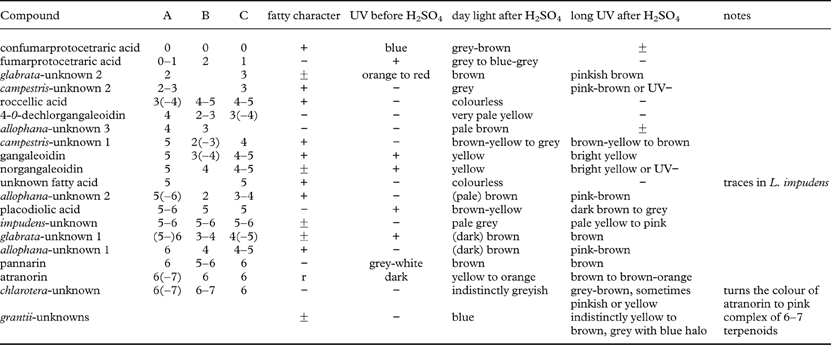
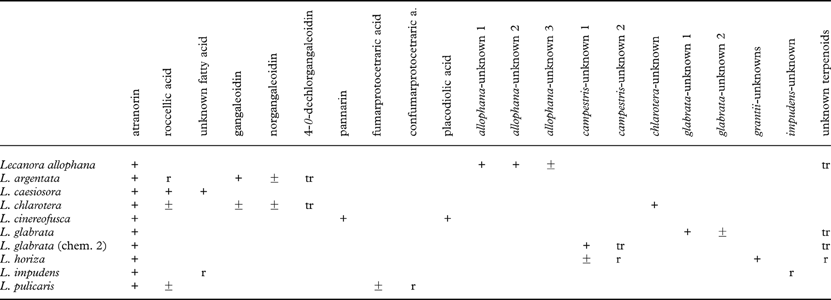
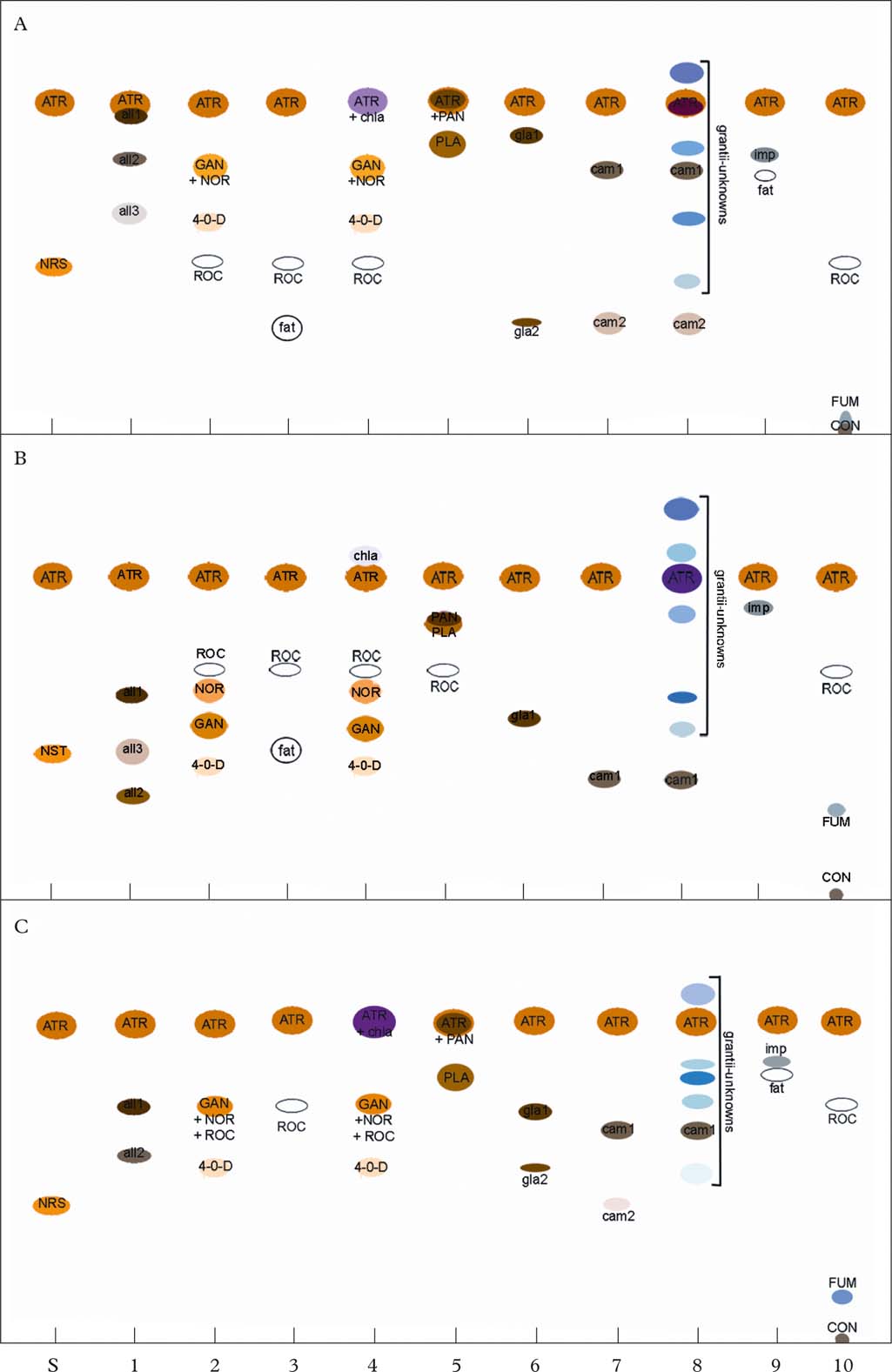
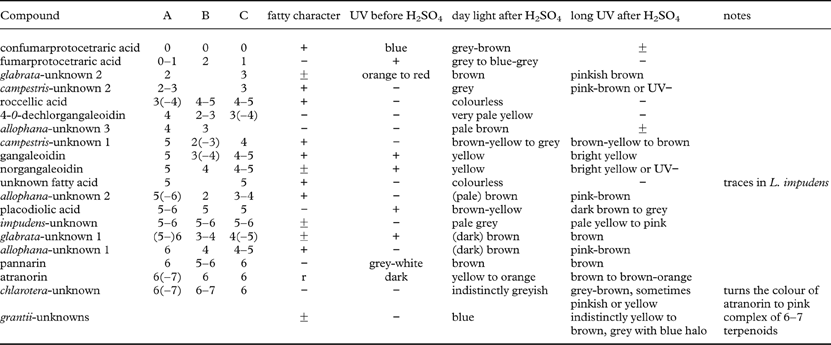
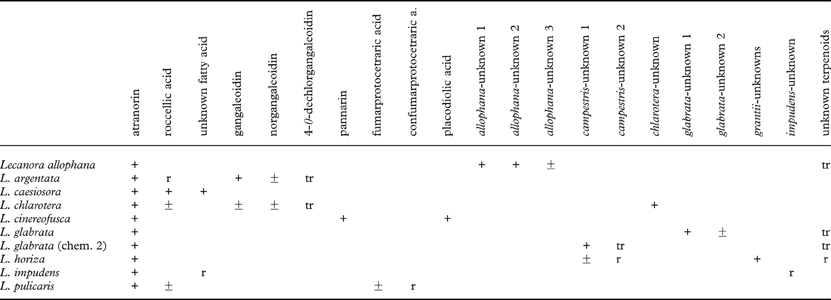
TLC analyses of secondary metabolites are very helpful in the identification of members of the L. subfusca group. In the case of sorediate species and poorly developed samples, analysis of lichen compounds is necessary. Czech epiphytic taxa have a more or less unique chemistry (see Table 2). Terpenoids are the most diversified group of metabolites, being produced mainly by species with small amphithecial crystals. Several terpenoids were unknown and are reported here for the first time (e.g. glabrata-unknowns). Taxa with large crystals contain the gangaleoidin chemosyndrome, roccellic acid, depsidones (fumarprotocetraric acid, rarely with related compounds, pannarin) or placodiolic acid. An overview of secondary products and spot characters is presented in Table 1 and graphically depicted in Fig. 1.
An overview of secondary metabolites occurring in the Lecanora subfusca group and their characteristics.
Lichen compounds detected in Czech epiphytic species of the Lecanora subfusca group: + =presence in all or nearly all specimens tested, ± =frequently present, r=rarely present, and tr=presence only in trace amount.
TLC chromatograms of acetone extracts of species of the Lecanora subfusca group. A, solvent A; B, solvent B; C, solvent C; S – standard, 1 – L. allophana, 2 – L. argentata, 3 – L. caesiosora, 4 – L. chlarotera, 5 – L. cinereofusca, 6 – L. glabrata, 7 – L. glabrata (chemotype 2), 8 – L. horiza, 9 – L. impudens, and 10 – L. pulicaris. ATR – atranorin, NRS – norstictic acid, all 1, 2 & 3 – allophana-unknowns 1, 2 & 3, GAN – gangaleoidin, NOR – norgangaleoidin, ROC – roccellic acid, fat – unidentified fatty acid, 4-0-D – 4-0-dechlorgangaleoidin, chla – chlarotera-unknown, PAN – pannarin, PLA – placodiolic acid, gla1 & 2 – glabrata-unknowns 1 & 2, cam1 & 2 – campestris-unknowns 1 & 2, imp – impudens-unknown, FUM – fumarprotocetraric acid, CON – confumarprotocetraric acid.
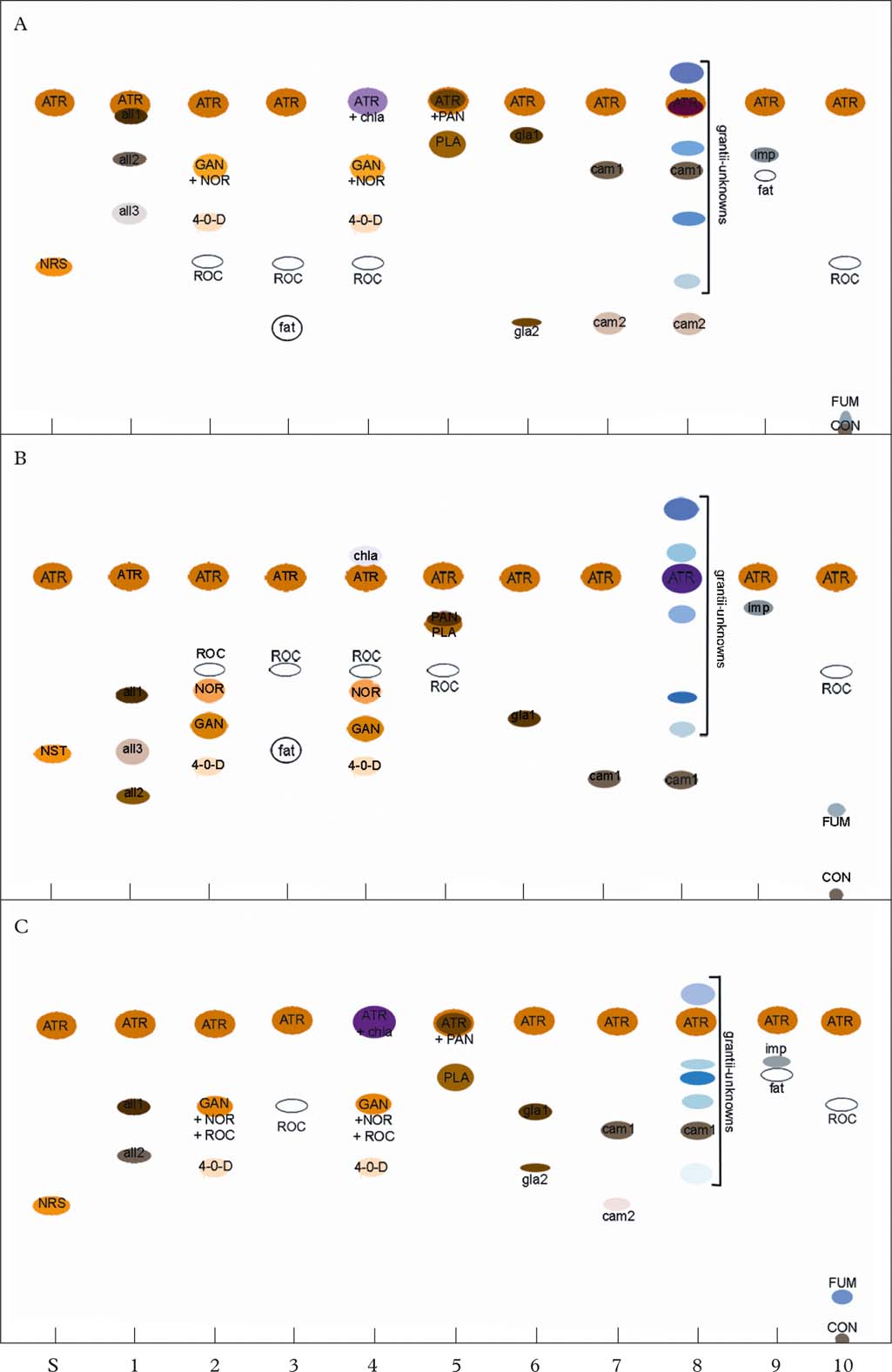
Individual Rf values are highly variable (±10%) and depend on many factors, such as atmospheric conditions, age of solvents, and probably on the amount of lichen compounds. The concentration of secondary metabolites on the plate strongly influences the fatty character and final colour of the spot. No differences were found between the TLC analyses of recent and historical collections were found. During analyses, photosynthetic pigments and terpenoids from the bark frequently accompanied lichen metabolites, so special care is necessary since terpenoids from bark can be very similar to lichen terpenoids on TLC plates. Bark terpenoids usually surround atranorin; the bark of Abies, Alnus, Juglans and Rhododendron is particularly rich in these compounds. TLC is optimal for routine identification of L. subfusca metabolites in order to distinguish all taxonomically important compounds. In comparison with HPLC, TLC does not separate, for example, gangaleoidin from all of its related substances. On the other hand, according to the standardized HPLC method (Feige et al. Reference Feige, Lumbsch, Huneck and Elix1993), it is impossible to detect several common metabolites, including fatty acids.
Ecological and substratum preferences
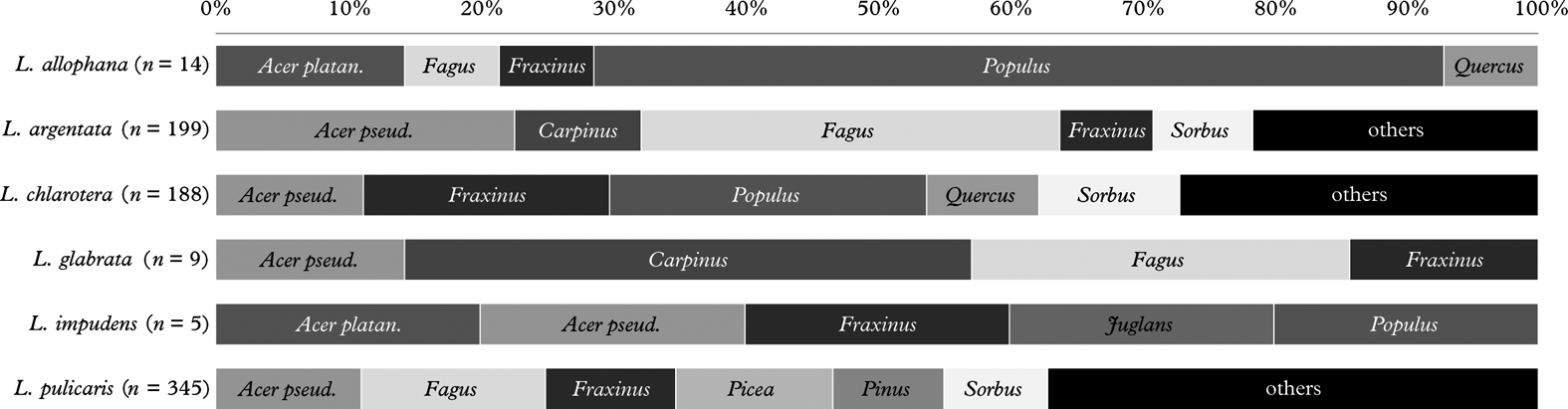
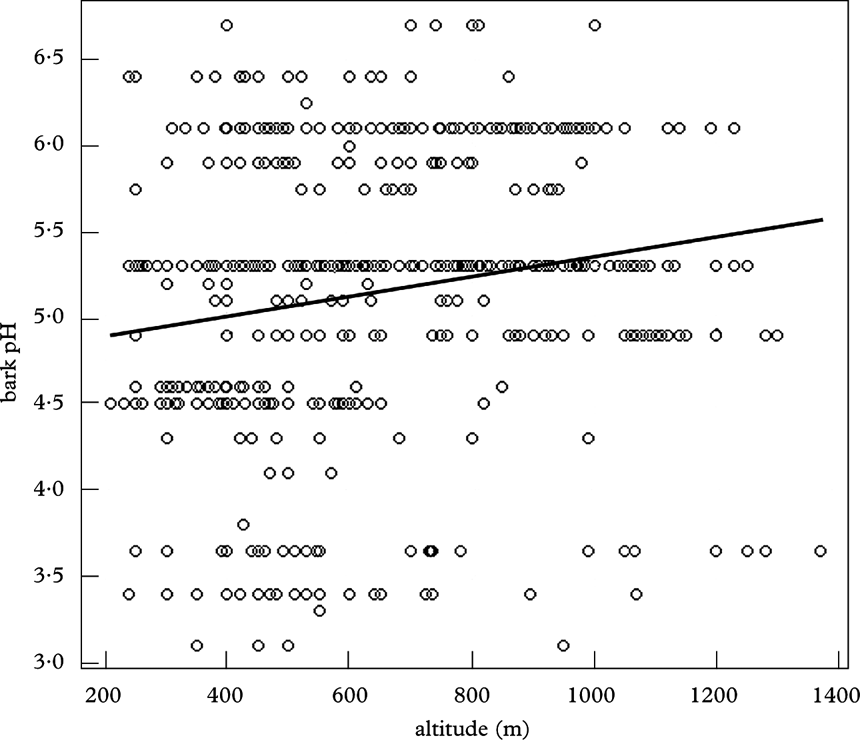
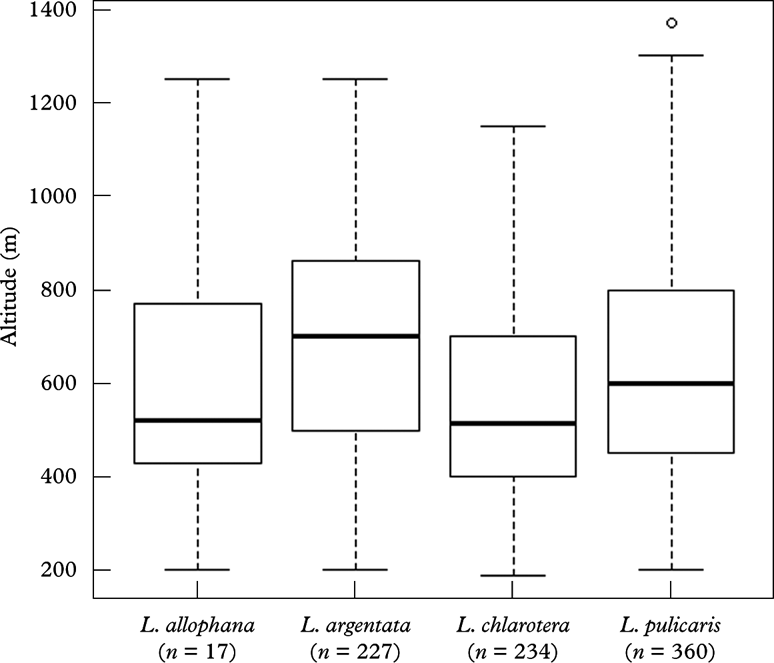
The epiphytic members of the L. subfusca group are characterized by a reasonably distinctive ecology, as summarized in species descriptions below (see also Fig. 2). According to field observations, some taxa are noticeably more abundant at higher altitudes on acid bark (e.g. L. pulicaris), others at lower altitudes on more basic bark (e.g. L. chlarotera). A data set acquired from herbarium labels was used for the statistical comparison of altitude and bark pH preferences of three common species (L. argentata, L. chlarotera and L. pulicaris). Firstly, there was a weak but significant interaction between altitude and bark pH and therefore this was filtered out from the final analyses, which confirmed a higher altitudinal preference for L. pulicaris in comparison to L. argentata and L. chlarotera (P=0·0061). Lecanora chlarotera probably prefers higher altitudes compared to L. argentata (P=0·0429) with a preferred altitude of 700–800 m (see Fig. 4), but this is strongly influenced by a preference for beech which is more frequent in mountainous areas.
The most frequent substrata of selected epiphytic species of the Lecanora subfusca group (based on data from Czech collections).

Relationship between altitude and bark pH based on data for substrata of all specimens examined. Continuous line, linear regression for all data (r 2=0·027, n=656, P=<0·001).

Altitude preferences for species in the Lecanora subfusca group. Thick line=median; lower and upper side of boxes=quartiles; bars=maximum and minimum values.

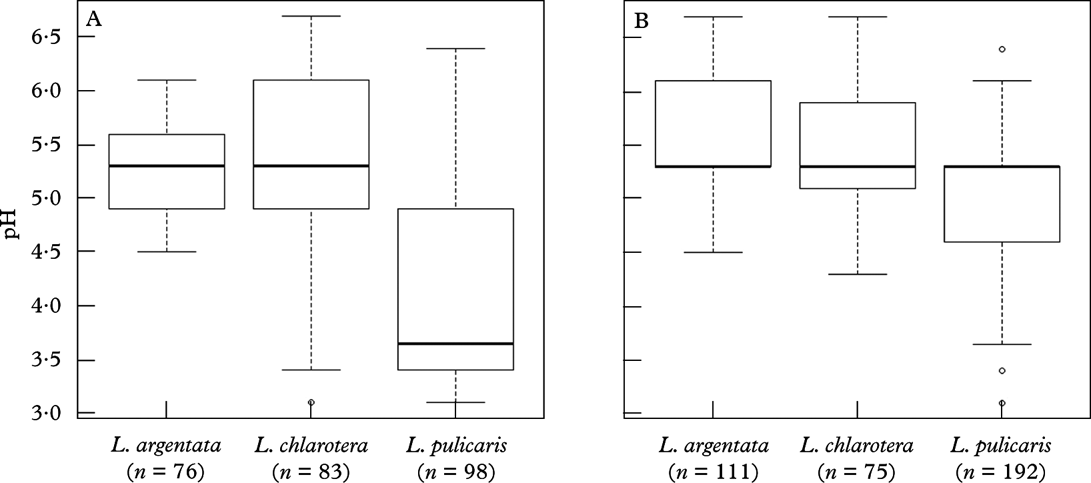
In the case of bark pH, L. pulicaris has a distinct preference for more acid bark (P=0·0093, Fig. 5A). However, it is actually much more complicated due to the acidification of substrata during the period of acid rain, which affected the whole country, more particularly the north (Moldan Reference Moldan1990). The shift of preferred bark pH of L. pulicaris before and after acidification (the boundary is 1970) was statistically significant (P<0·0001, compare Fig. 5A & B). Historical specimens come mostly from acid-barked trees (median of bark pH=3·65; average=4·12), whereas collections after 1970 were usually from slightly acid bark (median of bark pH=5·30; average=5·20). Slightly larger differences were observed when areas of low acid rain impact were excluded from the analysis. The primarily acidophilous L. pulicaris colonized a very wide range of substrata, including phorophytes with normally slightly acid to subneutral bark despite acidification; this has increased during the last few decades. However, acid rain had the opposite effect on the distribution of L. chlarotera, which used to be the most common member of the group and occupied a wide range of substrata (except strongly acidic bark). Recently, it has become restricted to the subneutral bark in the northern half of the country.
Bark pH preferences of the three most common species in the Lecanora subfusca group; A, before 1970; B, after 1970 (thick line=median; lower and upper side of boxes=quartiles; bars=maximum and minimum values).

A decrease in bark pH from 5·0 to 3·0 caused by sulphur content in the bark was observed by Johnsen & Søchting (Reference Johnsen and Søchting1973), and the occurrence of acidophilous lichens on subneutral bark caused by pollution is mentioned by Türk & Wirth (Reference Türk and Wirth1975). In the Czech Republic, a similar observation was made by Liška et al. (Reference Liška, Dětinský and Palice1996), who recorded a shift of rare epiphytes from conifers to the bark of deciduous trees. However, substratum acidification in the country was very uneven; mountain regions such as Krušné and Jizerské hory on the northern border of the Czech Republic were subjected to an extremely strong impact of acid rain, resulting in the death of thousands of hectares of forest, but to the south of the country (especially the Šumava Mountains) such influence was relatively slight (Moldan Reference Moldan1990).
Identification and diversity of epiphytic taxa in the Czech Republic
During this study, 877 specimens were examined, a quarter of which were collected by the author from different parts of the Czech Republic. Of the herbarium specimens examined, 71% had been misidentified or only identified in a broad sense. Most herbarium material was identified without major difficulties; only atypically developed, very poor or strongly infected samples remained unidentified. The large variability of single species is the main problem in identification.
Nine taxa were recorded from the country. The rare species L. cinereofusca, published here as a new for the Czech Republic, is known only from a single historical collection from an old-growth beech forest. Lecanora horiza is regarded as extinct and L. caesiosora was recorded only once growing as an epiphyte. The boreal L. circumborealis is excluded from the list of Czech lichens because it was reported from the country based on misidentified specimens.
By comparison, eight epiphytic species are known from Slovakia (Guttová et al. Reference Guttová, Lackovičová and Pišút2013), 16 from Austria (Hafellner & Türk Reference Hafellner and Türk2001; Tønsberg et al. Reference Tønsberg, Türk and Hofmann2001), 15 from Germany (Wirth et al. Reference Wirth, Hauck and Schultz2013), and nine from Poland (Fałtynowicz Reference Fałtynowicz2003; Kukwa & Kubiak Reference Kukwa and Kubiak2007).
Key to corticolous species of the Lecanora subfusca group in the Czech Republic
-
1 Thallus sorediate ... 2
Thallus without soralia ... 4
-
2(1) Thallus thick, verrucose, soralia large, 0·5–1·0 mm diam., rounded, flat to convex, indistinctly delimited; contains fatty acid(s) as major compounds ... L. caesiosora
Thallus thin to medium thick, soralia smaller, 0·3–0·6(–1·0) mm, concave to slightly convex, delimited by thin thalline rim or later confluent; terpenoids as major compounds or without lichen substances ... 3
-
3(2) Terpenoids allophana-unknowns present; apothecia frequently developed, larger than 1·0 mm, ascospores 14·0–20·0×8·0–11·0 µm ... L. allophana f. sorediata
Terpenoid impudens-unknown present or containing atranorin alone; thallus very rarely with apothecia, ascospores 10·0–14·0×5·5–8·0 µm ... L. impudens
-
4(1) Apothecial margin Pd+ orange to red ... 5
Apothecial margin Pd− ... 6
-
5(4) Apothecial margin smooth, apothecia sessile, epihymenium of pulicaris-type, Pd− in section, with fumarprotocetraric acid; widely distributed species ... L. pulicaris
Apothecial margin strongly crenulate, young apothecia immersed in thallus, epihymenium of chlarotera-type, Pd+ red in section, with pannarin; very rare species of light forest in humid areas ... L. cinereofusca
-
6(4) Amphithecium with small crystals (allophana or campestris-type), thallus with specific terpenoids ... 7
Amphithecium with large crystals (pulicaris-type), terpenoids usually absent ... 9
-
7(6) Apothecia large, 1·0–2·0 mm diam., constricted at base, margin relatively thick, ± flexuose, ascospores 14–20×8–11 µm, terpenoids allophana-unknowns present ... L. allophana
Apothecia 0·4–1·2 mm diam., sessile or with slightly constricted base, margin usually thin, ascospores 11–15×6–9 µm, terpenoids allophana-unknowns absent ... 8
-
8(7) Apothecia 0·4–0·8 mm diam.; terpenoids glabrata-unknowns present or rarely with campestris-unknowns; woodland species of smooth acid bark ... L. glabrata
Apothecia 0·5–1·2 mm diam.; terpenoids grantii-unknowns present; in Central Europe, a very rare lichen preferring an open landscape and nutrient-rich bark ... L. horiza
-
9(6) Epihymenial granules absent, pigment orange to orange-red, in KOH reddish brown, apothecial margin slightly crenulate; gangaleoidin usually present ... L. argentata
Epihymenial granules present, epihymenium red-brown to brown, pigment and granules soluble in KOH ... 10
-
10(9) Epihymenium red-brown, with fine granules dispersed between paraphyses (pulicaris-type), granules insoluble in HNO3, apothecial margin usually smooth, thallus mostly thin; gangaleoidin absent ... L. pulicaris
Epihymenium with coarse granules on paraphyses tips (chlarotera-type), granules slowly soluble in concentrated HNO3, apothecial margin at least slightly crenulate, thallus medium thick; gangaleoidin absent or present ... 11
-
11(10) Apothecia immersed when young, discs red-tinged, margin distinctly crenulate, epihymenium red to reddish brown, Pd+ red in section, epihymenial granules usually sparse ... L. cinereofusca
Apothecia sessile, discs pale brown or pinkish brown, margin slightly crenulate, epihymenium brown due to the layer of granules, Pd−; the substance chlarotera-unknown always present ... L. chlarotera
The Species
Lecanora allophana (Ach.) Nyl.
Flora 55: 250 (1872).—Lecanora subfusca var. allophana Ach., Lich. Univ., p. 395 (1810); type: Suecia, (H-ACH 1143a!—lectotype).
Lichen subfuscus L., Spec. plant. 2: 1142 (1753), nom. rejic.
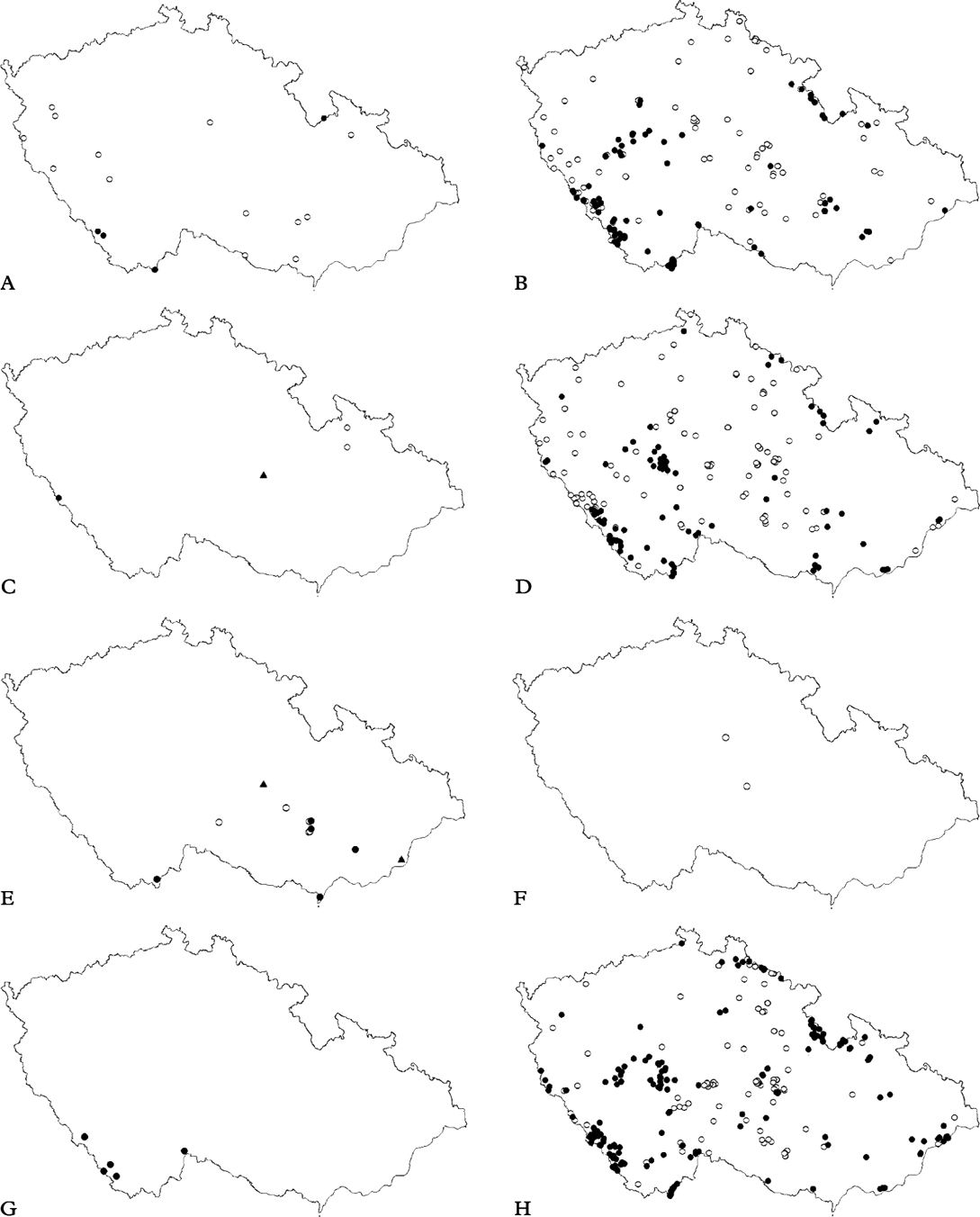
Distribution of species in the Lecanora subfusca group studied in the Czech Republic (•=recent localities after 1990; ○=historical localities). A, L. allophana; B, L. argentata; C, L. caesiosora and L. cinereofusca (▴); D, L. chlarotera; E, L. glabrata, chemotype 2 (▴); F, L. horiza; G, L. impudens; H, L. pulicaris.

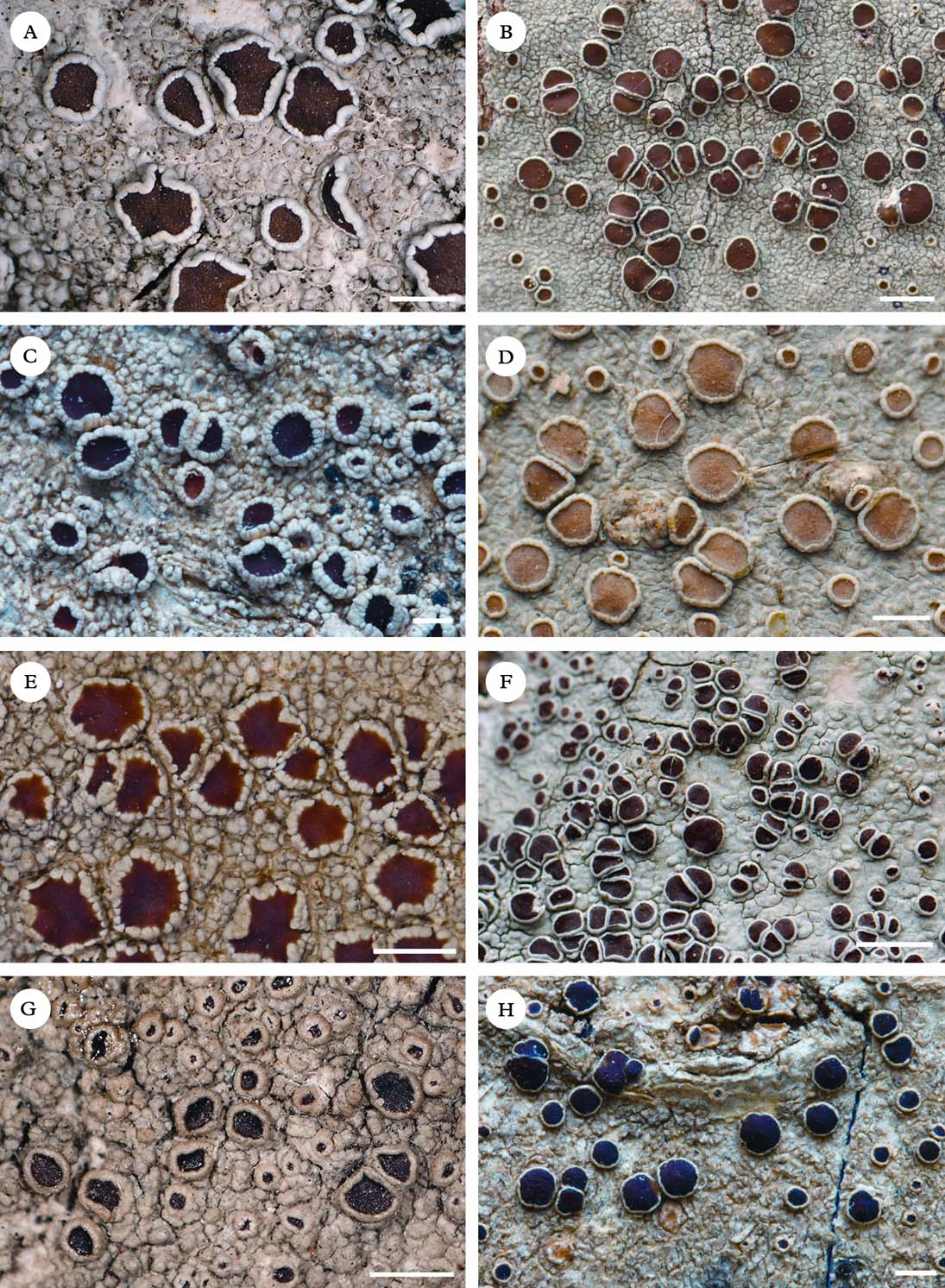
Habitus of selected species in the Lecanora subfusca group. A, Lecanora allophana; B, L. argentata – lectotype; C, L. argentata – extreme form, the lectotype of L. subrugosa; D, L. chlarotera – typical form; E, L. cinereofusca; F, L. glabrata – lectotype; G, L. horiza – type material (H-ACH 1193c); H, L. horiza – isosyntype of L. laevis (hb. H). Scales: A–H=1 mm. In colour online.
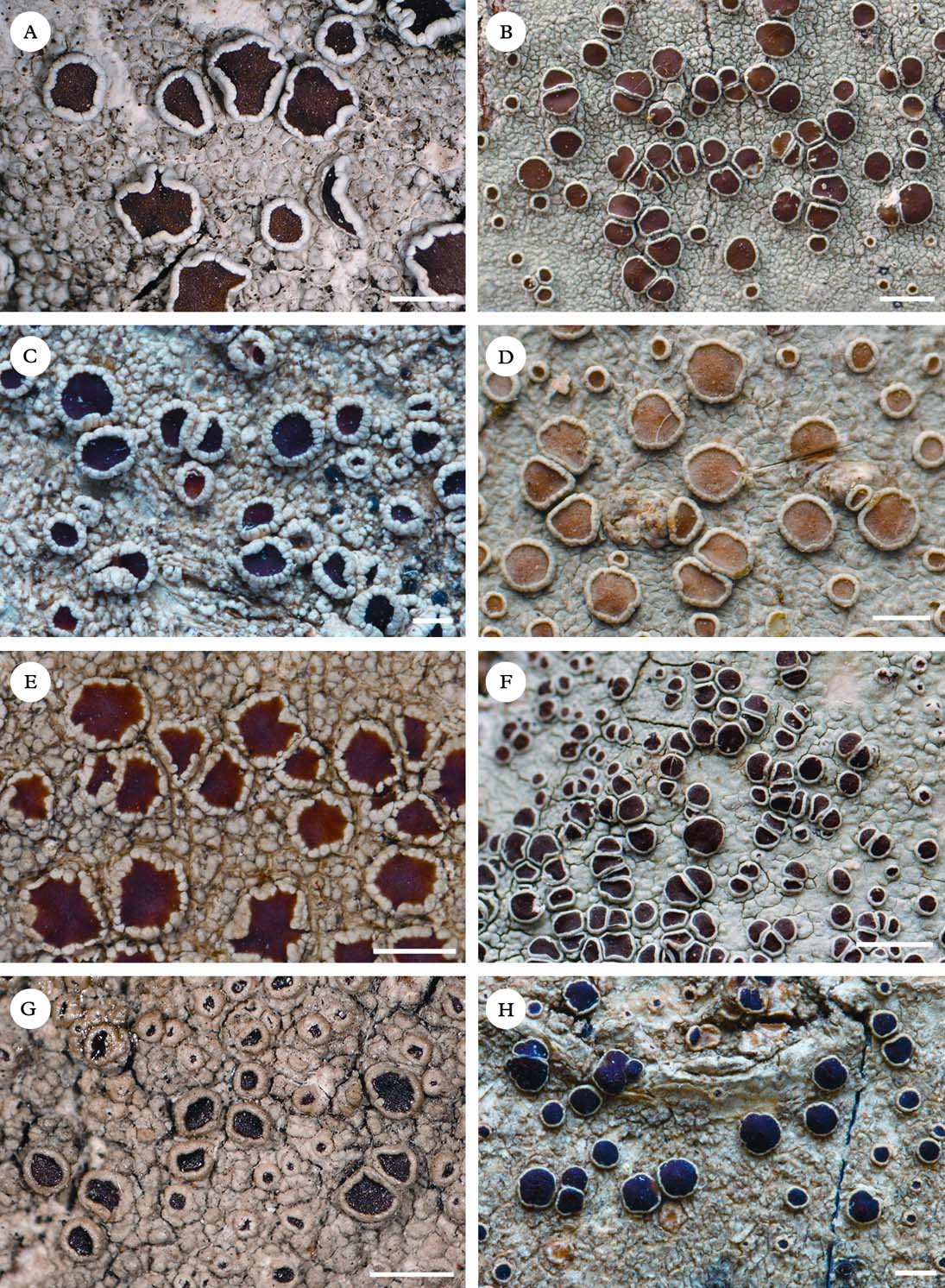
Thallus smooth to coarse, rarely verrucose; apothecia large, 0·6–2·0 mm diam., constricted at base, rarely sessile; discs distinctly reddish brown, in young apothecia sometimes slightly pruinose; thalline margin medium thick, smooth to slightly crenulate, often flexuose.
Epihymenium glabrata-type, clearly orange to orange-red, oil droplets (POL−) rarely present; amphithecium allophana/campestris-type, crystals occasionally sparse or partly overlapped by the algal layer; cortex often indistinctly delimited from medulla (‘pseudocortex’), with abundant amphithecial crystals insoluble in KOH, 15–40 µm at margin, 50–100 µm at base; ascospores 14·0–20·0(–22·0)×8·0–11·0 µm. Lecanora allophana f. sorediata (Schaer.) Vain. produces delimited, plane to convex soralia.
Apothecia are often present.
Chemistry
Specific terpenoids, allophana-unknowns 1 and 2, were detected in most specimens (absent in only two samples). Allophana-unknown 3 is present in low concentrations and produces a pale inconspicuous spot on TLC plates. It was recorded in 69% of the samples (n=16). Traces of other terpenoids, probably from bark, were occasionally detected.
Ecology
Lecanora allophana prefers slightly acid to subneutral bark and Populus tremula was its most common substratum in the Czech Republic, but it also occurs on Acer platanoides, Fraxinus excelsior, Fagus sylvatica and Quercus sp. In Central Europe, it also frequently occurs on Juglans regia. It is a lichen of open and extensively farmed landscape, and is very sensitive to substratum acidification, air pollution and eutrophication.
Distribution
Lecanora allophana has been collected at 18 localities in various parts of the country. The population decreased significantly due to acid rain, and it is now known from only four localities in southern Bohemia and northern Moravia. The sorediate form has been collected once in the south of Moravia. The species is more frequent in neighbouring countries, such as Slovakia, Austria and some parts of Germany.
Remarks
A very distinctive and easily recognizable species because of its large apothecia with constricted bases, the largest ascospores in the group, and specific terpenoids. Separation of L. impudens from the sterile sorediate form of L. allophana is very problematic (see under that species), but L. allophana is more often found with apothecia.
Number of specimens examined=18.
Selected specimens examined. Czech Republic: Southern Bohemia: Šumava Mts, Stožec Mt., c. 1060 m, Acer platanoides, 1993, Z. Palice (PRA); Šumava Mts, Pěkná, edge of boggy spruce forest, 735 m, c. 48°51′10–15″N, 13°55′E, Populus tremula, Z. Palice 5507c (PRA); Novohradské hory Mts, Pohoří na Šumavě, Acer platanoides, 2004, D. Svoboda, O. Peksa & M. Zahradníková (PRC). Northern Moravia: montes Králický Sněžník, ad ripam rivi “Kopřivák”, 800 m, Fagus sylvatica, 2001, J. Halda 4868 & M. Zmrhalová (hb. Halda). Southern Moravia: Kotelná, Pavlovské Kopce, c. 400 m, quercicola in colle, 1922, J. Suza (PRM; L. allophana f. sorediata!).
Lecanora argentata (Ach.) Malme
Lich. Suec. Exs. 5 (1897).—Parmelia subfusca var. argentata Ach., Method. Lich., 169 (1803); type: Suecia (H-ACH 1189a!—lectotype).
Lecanora subfuscata H. Magn., Acta horti Gothob. 7: 79 (1932); type: Sweden, Dalsland, Bäcke sn, Hjulserud á träd, 1914, S. & C. Bergström (UPS—lectotype).
Lecanora subrugosa Nyl., Flora 58: 15 (1875); type: Fennia, Tavastia australis, Hollola, Tiirismaa, sorbicola, 1873, E. Lang (H-NYL 27600!—lectotype).
Thallus thick, smooth, rarely verrucose, frequently rimose; apothecia sessile, crowded, 0·5–1·0(–1·5) mm diam.; discs reddish brown to dark reddish brown; margin slightly crenulate, in extreme forms thick, strongly crenulate or verrucose.
Epihymenium glabrata-type, distinctly orange to brownish red; amphithecium pulicaris-type with numerous large crystals; cortex usually distinctly developed, 10–20 µm at margin, 25–30 µm at base, degrading in old apothecia and in extreme forms; ascospores 11–15×6·5–9·0 µm.
Chemistry
Gangaleoidin is usually present (96% of specimens). Norgangaleoidin (= californin) and 4-0-dechlorgangaleoidin accompany gangaleoidin. However, 4-0-dechlorgangaleoidin is present in very low concentrations and usually indistinct on TLC plates. Roccellic acid has been detected in 9% of the samples (n=69), and norstictic acid has been found in several samples as a contaminant from Phlyctis argena or other lichens associated with L. argentata.
Ecology
Lecanora argentata clearly prefers smooth and slightly acid bark, being dominant mainly on Fagus sylvatica, Acer pseudoplatanus and Carpinus betulus. It is also found on other phorophytes (e.g. Fraxinus excelsior, Acer platanoides), but only in regions where L. argentata species is abundant. In the Czech Republic, it is concentrated in forested areas, mainly at higher altitudes (above 500 m). At lower altitudes it is rare, occurring at riverside sites and stream valleys, and is absent in intensively farmed regions and in regions with low precipitation. In Europe, it is a characteristic species of natural beech forests.
Distribution
Currently, L. argentata is concentrated mainly in southern and western Bohemia, being very common in the Šumava Mountains. In the past it was collected at many places in different parts of the country, but now it is absent in northern Bohemia due to acid rain.
Remarks
This species is relatively easily recognized by the combination of a non-granulose epihymenium, large crystals in the amphithecium and its ecology. It grows in similar places to L. glabrata, which has smaller apothecia, an allophana-type of amphithecium, and contains specific terpenoids.
Number of specimens examined=233.
Lecanora caesiosora Poelt
Denkschr. Regensb. bot. Ges. 26: 82 (1966) nom. nov.— Lecanora soralifera H. Magn., Bot. Notiser 1937: 135 (1937); type: Magnusson: Lich. sel. Scand. exs. 270b, Sweden, Västergötland: Partille, north-west of Tultered, 1936, A. H. Magnusson (UPS—holotype).
Lecanora cenisia var. soredians Suza, Sb. Klubu Přírodovedeckého v Brne 11: 152 (Reference Suza1929); type: Moravia, Sudeti or., Jeseníky, in monte Vozka (Fuhrmannstein), ad saxo schistosi in fissis subumbrosis, 1370 m, 1928, J. Suza, TLC: atranorin, roccellic acid, trace of unidentified fatty acid (PRM 639535!—holotype).
(Fig. 6C)
Thallus thick, verrucose; soralia large (0·5–1·0 mm diam.), convex, rounded, flat to convex, ±delimited, later partly confluent; apothecia as in L. cenisia, not found in the Czech epiphytic material, 1·0–2·0 mm diam., constricted at base; discs reddish brown to black, often lightly pruinose; margin crenulate to flexuose.
Epihymenium chlarotera-type, orange, reddish brown to olivaceous brown (then HNO3+ red); amphithecium pulicaris-type; cortex (20–)25–35 µm thick; ascospores 10·5–15·0×7·5–8·5 µm (Brodo et al. Reference Brodo, Owe-Larsson and Lumbsch1994).
Chemistry
Roccellic acid and probably rangiformic acid (minor) have been found in the only epiphytic specimen from the country. Additionally, traces of stictic acid as a contaminant have been detected. According to Brodo et al. (Reference Brodo, Owe-Larsson and Lumbsch1994), 89% of collections contain roccellic acid (sometimes with unidentified fatty acids) and 11% nephrosteranic acid.
Ecology
Lecanora caesiosora has been collected from bark of Sorbus aucuparia at an altitude of c. 1150 m. In the Alps, it also occurs on twigs of Rhododendron (Hinteregger Reference Hinteregger1994). It is primarily a saxicolous species, growing mainly on shaded siliceous rocks and overhangs in mountainous regions (Brodo et al. Reference Brodo, Owe-Larsson and Lumbsch1994). Saxicolous collections from the Czech Republic come from schistose rocks.
Distribution
The epiphytic population is currently known from a glacial cirque of the Černé jezero Lake in the Šumava Mts. It is a very rare species in the country, being reported from only two localities on rocks in the Jeseníky Mts (Suza Reference Suza1929; Vězda Reference Vězda1961, as L. cenisia var. soredians).
Remarks
This taxon is probably a sorediate form of L. cenisia. However, following the concept of Brodo et al. (Reference Brodo, Owe-Larsson and Lumbsch1994), the sorediate form at the species level is recognized in terms of the slightly different morphological variation, presence of nephrosteranic acid-chemotype, which is absent in L. cenisia, and differences in habitat preferences. The type specimen of L. cenisia var. soredians resembles a diminutive form of L. cenisia. It is characterized by its distinctly grey thallus, apothecia 1·0–1·2 mm diam., slightly crenulate margin, dark brown discs, reddish brown pigment in the epihymenium (pale brown in KOH), and a cortex expanded at the base up to 60 µm. Other characters correspond with the description published by Brodo et al. (Reference Brodo, Owe-Larsson and Lumbsch1994). The epiphytic L. exspersa is very similar to L. caesiosora, but differs in its thinner, non-verrucose thallus and the soralia which are distinctly smaller in L. exspersa, concave to flat and usually bordered by a thin thalline rim.
Number of epiphytic specimens examined=1.
Selected specimens examined. Czech Republic: Western Bohemia: Šumava Mts, Železná Ruda, glacial cirque orç Černé jezero lake, 49°10′35″N, 13°11′10″E, c. 1150 m, Sorbus aucuparia, 1995, Z. Palice 232 (PRA).
Lecanora chlarotera Nyl.
Bull. Soc. Linn. Normandie, sér. 2, 6: 274 (1872); type: In Germania prope Jenam, 1797, C. Steven (H-NYL 27347!—lectotype).
Lecanora crassula H. Magn., Meddn Göteb. Bot. Trädg. 7: 80 (1932).
Lecanora rugosa Nyl., Flora 55: 250 (1872).
Lecanora rugosella Zahlbr., Cat. Lich. Univers. 5: 524 (1928); type: Gallia (H-ACH 1193h!—lectotype).
Thallus medium thick to thick, smooth to slightly verrucose; apothecia sessile, usually crowded, 0·5–1·0 mm diam.; discs pale brown, pink-brown, rarely dark brown or red-brown, sometimes slightly pruinose (especially in old collections); margin relatively thick, smooth to crenulate.
Epihymenium chlarotera-type, brown due to the abundant presence of coarse granules, rarely with reddish brown pigment, granules slowly soluble in HNO3; amphithecium pulicaris-type; cortex 10–25 µm at margin, up to 40 µm at base; ascospores 11·0–15·0×7·0–8·5 µm.
Chemistry
The species is well characterized by the presence of the compound “chlarotera-unknown”, which is probably related to a terpenoid or usnic acid and is present in the form of coarse epihymenial granules. In the case of sparse granules, the characteristic spot turning atranorin to pink is absent or almost absent on TLC plates. Roccellic acid has been detected in 56% of samples. Gangaleoidin and norgangaleoidin are present in 54% of specimens (n=57). Traces of 4-0-dechlorgangaleoidin have been found in one collection. Roccellic acid is usually present in specimens without gangaleoidin, but commonly both substances occur together.
Ecology
Lecanora chlarotera distinctly prefers slightly acid to subneutral bark, mainly occurring on Populus spp., Fraxinus excelsior, Acer pseudoplatanus, Sorbus aucuparia, Quercus spp. and Juglans regia, and rarely grows on wood. It occurs in open landscape (in avenues, solitary trees, borders of forests, gardens) and in young and light deciduous forests; it is very rare in woodlands. Lecanora chlarotera is very sensitive to bark acidification. It has been recorded from lowlands to submontane areas, but is rare in mountains (above 1000 m). It is sparse in agricultural landscapes and along the less frequently used roadsides. It appears to tolerate continental climatic conditions in the Czech Republic, being the most common member of the L. subfusca group in warm and dry areas.
Distribution
In the past, L. chlarotera was the most abundant species of the L. subfusca group in the country, but today it is common only in southern Bohemia and Moravia, which have not been so strongly affected by acid rain and air pollution. It is rare in the northern half of the Czech Republic, where it is concentrated on suitable habitats such as old avenue trees with subneutral bark.
Remarks
Lecanora chlarotera is a very variable taxon in Europe (especially in southern Europe) and probably comprises more taxa. Czech populations are relatively uniform. Very similar species are, for example, L. salicicola (high mountain element differing in the thin apothecial margin and complete absence of gangaleoidin), L. rubicunda (southern element containing norstictic acid), and L. meridionalis (southern element with dark pigmented discs and dark green to olive epihymenial pigment).
The coarse epihymenial granules (‘chlarotera-unkown’) present on tips of paraphyses are a very effective anti-herbivory mechanism. Species with fine granules in the epihymenium or without them frequently have a hymenium damaged by snails. It is very common, especially in L. argentata, but in L. chlarotera the hymenium usually remains without traces of such grazing. Coarse epihymenial granules have a similar anti-herbivorous effect to a pruina on apothecial discs (Nimis & Skert Reference Nimis and Skert2006). On the other hand, L. chlarotera is frequently parasitized by lichenicolous fungi such as Stigmidium congestum, Lichenoconium lecanorae and Vouauxiella lichenicola.
Number of specimens examined=237.
Lecanora cinereofusca H. Magn.
Meddn Göteb. Bot. Trädg. 7: 86 (1932); type: [USA] Maryland, Benfield, on Magnolia glauca, 1907, C. C. Plitt (UPS—lectotype).
Lecanora degelii Schauer & Brodo, Nova Hedw. 11: 528 (Reference Schauer and Brodo1966).
Thallus smooth to coarse; apothecia immersed in thallus when young, later sessile, 0·6–1·5 mm diam. (up to 1·0 mm in the Czech collection); discs red to brown-red; margin relatively thick, distinctly crenulate to discontinuous.
Epihymenium chlarotera-type, orange-red, Pd+ red with the formation of clusters of crystals, granules often sparse; amphithecium pulicaris-type, but crystals frequently rare, eventually absent; cortex indistinct or 10–15 µm thick; ascospores 10·0–14·0×7·0–9·0 µm, thin-walled.
Chemistry
The epihymenium, and sometimes also the apothecial margin, react Pd+ orange to red due to the presence of pannarin, which is characteristic for this species. Placodiolic acid has also been detected in the Czech specimen. Brodo (Reference Brodo1984) mentioned roccellic acid in L. cinereofusca, but this has not been recorded in the material analyzed, including reference collections from Austria and Germany.
Ecology
The only collection from the Czech Republic is from bark of Fagus sylvatica. In the Alps, it grows on Acer pseudoplatanus, Abies alba, Alnus sp. and Salix sp. (Schauer & Brodo Reference Schauer and Brodo1966). Lecanora cinereofusca clearly prefers natural humid woodlands in oceanic and suboceanic areas. It also occurs on trees on the banks of lakes and rivers surrounded by natural forest vegetation. The Czech collection comes from an old-growth beech forest reservation at an altitude of c. 800 m.
Distribution
This species was collected in 1904 from the forest reservation on the top of Žákova hora Mountain in the Žďárské vrchy Mts. Despite intensive research in this locality in recent years, L. cinereofusca has not been found again. Žákova hora Mountain was formerly a very important locality for many rare lichens, but the forest has been greatly influenced by acid rain and the lichen flora has changed significantly. Lecanora cinereofusca is considered to be extinct in the country. In Europe, it is reported from the Alps, Scandinavia, Scotland (Edwards et al. Reference Edwards, Aptroot, Hawksworth, James, Smith, Aptroot, Coppins, Fletcher, Gilbert, James and Wolseley2009) and Slovakia, where it is regarded as a taxon indicating ecological forest continuity (Pišút Reference Pišút1997).
Remarks
Lecanora cinereofusca is a very distinctive species characterized by the presence of pannarin, immersed young apothecia, reddish discs and a strongly crenulate to partly disappearing apothecial margin. It resembles the very rare species L. insignis, which differs in its larger, thick-walled ascospores (16–21×8–12 µm), absence of placodiolic acid and a preference for conifers (Abies, Picea).
Specimen examined. Czech Republic: Western Moravia: Na buku na vrcholu Žákové hory, leg. F. Kovář 1904 (OLM 7062).
Lecanora glabrata (Ach.) Malme
Svensk Bot. Tidskr. 6: 100 (1912).—Lecanora subfusca var. glabrata Ach., Lich. univ., 393 (1810); type: Helvetia (H-ACH 1192a!—lectotype).
Lecanora subfuscata f. glabrata (Ach.) Poelt, Ber. bayer. bot. Ges. 29: 61 (1952).
Thallus thin to medium thick, usually smooth; apothecia sessile, typically small, 0·4–0·8 mm diam.; discs reddish brown to dark brown, plane to later convex; margin thin, smooth, disappearing in some specimens.
Epihymenium glabrata-type, orange to red-orange; amphithecium allophana/campestris-type, small crystals abundant; cortex in KOH ± distinctly delimited from the medulla, 15–25 µm at margin, expanded up to 60 µm at base, with or without amphithecial crystals; ascospores 11–14(–16)×6–8 µm.
Chemistry
Two chemotypes have been found by a critical examination. The common strain is characterized by the specific terpenoid glabrata-unknown 1, usually accompanied by glabrata-unknown 2, which has been recorded in four samples (n=11). Probably both terpenoids are usually present, but sometimes in very low concentrations. Occasionally, traces of other terpenoids have also been found. Three collections (from OLM) belong to chemotype 2, which contains campestris-unknowns and often traces of several additional terpenoids. This chemotype has been detected in many specimens, especially from Slovenia, but also from several other south European countries. The terpenoids grantii-unknowns published by Brodo (Reference Brodo1984) have not been recorded in European material.
Ecology
Lecanora glabrata is ecologically very similar to L. argentata, and both species frequently occur at the same site. It grows mainly on bark of Fagus and Carpinus, and rarely on Acer pseudoplatanus and Fraxinus excelsior. Lecanora glabrata is a characteristic lichen of beech forests, but prefers humid sites such as valleys of streams and rivers. Most of the Czech records come from lowlands, but it is frequently recorded in the mountain areas of surrounding countries.
Distribution
The chemotype with glabrata-unknowns (alternatively without terpenoids) has been recorded from 11 localities in the country, mostly in southern Moravia. It is a rare species, but more frequently found in deep valleys in the area of Moravian Karst. The second chemotype is only known from two historical localities.
Remarks
Lecanora glabrata is very similar to L. horiza, which differs in its chemistry and usually larger apothecia; L. horiza also prefers different phorophytes in open habitats. Extremely developed morphological forms of L. glabrata can be confused with poorly developed L. allophana. In the Czech Republic, both former species are distinct in their chemistry, so in such cases TLC is necessary for correct identification. In the field, L. glabrata is often associated with L. argentata, which has larger apothecia, paler plane discs, and a thicker crenulate margin.
Number of specimens examined=13.
Selected specimens examined. Czech Republic: Southern Bohemia: Novohradské hory Mts, Pohorská ves, Smrčina Mt. 48°39′44″N, 14°40′38″E, 900 m, Fagus sylvatica, 2010, J. Malíček 2965, I. Černajová & Z. Palice (hb. JM). Southern Moravia: Břeclav, nature reserve Ranšpurk, a flood-plain forest S of Lanžhot, 150 m, Carpinus, 2001, Z. Palice 8707 (PRA); Chřiby Mts, Salaš, valley of Bunčovský brook 2 km ENE of village, 49°08′45″N, 17°22′13″E, 260 m, Fagus sylvatica, 2010, J. Malíček 2600 (hb. JM); Moravský kras, Lažánky, Suchý žleb valley, near Kateřinská jeskyně cave, Carpinus betulus, 2007, J. Malíček 568 (hb. JM). Western Moravia: Fagicola, Roštýn prope, Třešť, J. Suza (BRNM); Vrchol Žákovy hory, F. Kovář? (chemotype 2, OLM). Eastern Moravia: U Brumova, 1909, J. Mastný (chemotype 2; two specimens in OLM).
Lecanora horiza (Ach.) Lindsay
Trans. Bot. Soc Edinburgh 9: 96 (1869).—Lecanora subfusca var. horiza Ach., Lich. Univ.: 394 (1810); type: Gallia (H-ACH 1193d!—lectotype).
Lecanora laevis Poelt, Ber. dt. bot. Ges. 29: 64 (Reference Poelt1952); type: C. Flagey: Lichenes Algerienses no. 113, C. sur les jeunes frênes près de l'hôpital civil de Constantine, C. Flagey (H!—isosyntype).
Lecanora parisiensis Nyl., Bull. Soc. Bot. Fr. 13: 368 (1866); type: Paris, Bagneaux, ad juglandem, W. Nylander (H-NYL 27674!—lectotype).
Thallus smooth to coarse or verrucose; apothecia sessile to slightly constricted at base, 0·5–1·2 µm diam.; discs deeply reddish brown to brown, glossy when young, in sunny sites usually glossy also in later stages of development, rarely with thin pruina on young apothecia; margin thin to medium thick, smooth.
Epihymenium glabrata-type; amphithecium allophana/campestris-type; cortex usually distinctly delimited (better seen in KOH), 10–25 µm thick, at base expanding up to 40–60(–80) µm, composed of branched hyphae (2–3 µm thick), with fine granules soluble in KOH, amphithecial crystals usually not entering into the cortex, but sometimes interspersed in the basal part; ascospores 12·0–15·0×7·0–9·0 µm.
Chemistry
A complex of terpenoids ‘grantii-unknowns’ is characteristic for this species. These substances are typical for the bright blue colour on TLC plates; it is a complex of six to seven spots, some of which overlap atranorin, which is violet in colour. In the case of low concentrations, at least one or two spots are present on the plates. The former two compounds correspond to lgr-1 and lgr-2 in Brodo (Reference Brodo1984) for North American L. grantii, as well as populations of L. horiza. Minor terpenoid campestris-unknown 1 frequently accompanies grantii-unknowns, but very rarely campestris-unknown 2 is also present. Occasionally traces of several other unknown terpenoids have been detected. The two Czech samples analyzed contained two or three grantii-unknowns and no campestris-unknowns.
Ecology
Both Czech collections are from wood; elsewhere, L. horiza grows on various phorophytes with slightly acid to subneutral bark, especially Juglans, Aesculus, Populus, Fraxinus, Acer and Ulmus (Brodo Reference Brodo1984; Edwards et al. Reference Edwards, Aptroot, Hawksworth, James, Smith, Aptroot, Coppins, Fletcher, Gilbert, James and Wolseley2009). In Great Britain, it is also known from gravestones and bricks of churches. It prefers open landscape and tolerates eutrophication.
Distribution
It has been collected only twice in the Czech Republic (from Kolín in 1853 and Havlíčkův Brod at the end of the 19th century). It has also been recorded from nearby Mt Falkenstein on the German side of the Šumava-Bayerischer Wald Mts (Poelt Reference Poelt1952, as L. laevis). All literature records (Vězda & Liška Reference Vězda and Liška1999, see under L. allophana) are erroneous. Lecanora horiza has an Atlantic-Mediterranean distribution (Ibáñez & Burgaz Reference Ibáñez and Burgaz1998), and is extremely rare in Central Europe.
Remarks
Lecanora horiza is a taxonomically problematic species and requires a detailed molecular study. The Mediterranean populations are variable and possibly include more taxa. Lecanora laevis Poelt is regarded here as a morphological form of L. horiza; it differs from typical L. horiza in its larger apothecia (0·8–1·2 mm) with more constricted bases, and generally paler thallus and apothecial margin. However, it seems to be only a morphotype from ± shady sites. Lecanora horiza is anatomically congruent with saxicolous L. campestris. Brodo (Reference Brodo1984) mentioned chemical differences between these taxa, but the author has observed no important characters in the chemistry of European populations. Preliminary molecular results show both lichens as genetically distinct species (Malíček & Powell Reference Malíček and Powell2013). The Mediterranean L. sienae B. de Lesd. may be a well-defined taxon from the L. horiza complex, but it needs further investigation.
Number of specimens examined=2.
Selected specimens examined. Czech Republic: Central Bohemia: Kolín, 1853, Veselský (PRM). Eastern Bohemia: Německý Brod, J. Novák (PRM).
Lecanora impudens Degel.
Svensk bot. Tidskr. 38: 50 (1944); nom. nov. for Pertusaria farinacea H. Magn., Bot. Not. 1942: 15 (1942); type: Sweden, Södermanland: Botkyrka, Tullinge gård, on Ulmus in an avenue, 1938, A. H. Magnusson 16125 (UPS 65900!—holotype).
Lecanora maculata (Erichs.) Almb., Bot. Not. 1952: 251 (1952); Pertusaria maculata Erichs., Rabenh. Kryptog. Flora Deutsch. 5: 646 (1936).
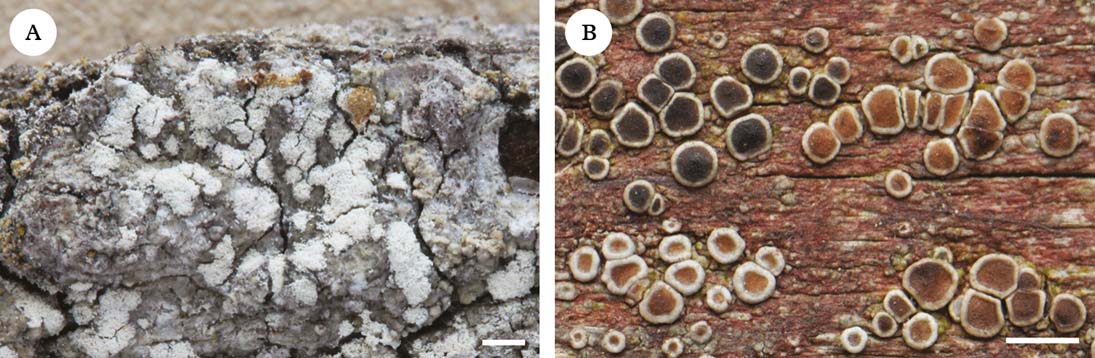
Habitus of selected species in the Lecanora subfusca group. A, Lecanora impudens; B, L. pulicaris. Scales: A & B=1 mm. In colour online.
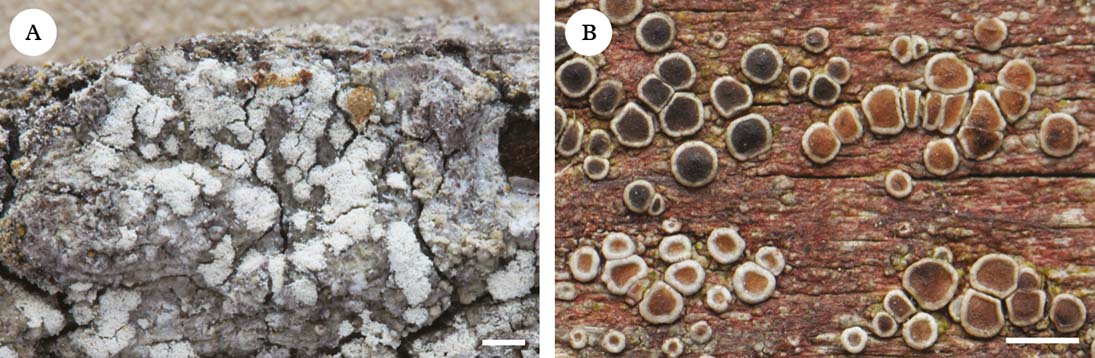
Thallus thin to medium thick, usually smooth; soralia more or less delimited, 0·3–0·6(–1·0) mm diam., sometimes slightly confluent, rounded, concave or flat when young, later convex, thin thalline rim along the base of soralia often present, mainly in young soralia; soredia finely granulose, greyish to more often yellowish; apothecia not recorded in the Czech material, but according to Brodo (Reference Brodo1984) are sessile to slightly constricted at base, 0·5–1·0 mm diam.; discs reddish brown; margin smooth, later sorediate.
Epihymenium glabrata-type; amphithecium allophana/campestris-type; cortex indistinctly delimited from the medulla, c. 20 µm laterally, (35–)47–85 µm at base; ascospores 10·0–14·0(–15·5)×5·5–8·0 µm (Brodo Reference Brodo1984).
Chemistry
Three Czech samples contained only atranorin (n=5). The terpenoid impudens-unknown and trace of fatty acid that were both reported by Tønsberg (Reference Tønsberg1992), and which were also detected in the type material, but only found in one collection from the Czech Republic (JM 5071). Another specimen (JM 4736) contained traces of two or three unknown terpenoids (possibly from bark, but one of them could be impudens-unknown in a very low concentration). The higher concentration of impudens-unknown is very probably situated in apothecia and their primordia. Norstictic acid is occasionally present in trace amounts in European material (including the holotype). It is not clear if this substance is only a contaminant from associated lichens or the minor product of L. impudens.
Number of specimens tested=5.
Ecology
Lecanora impudens is ecologically similar to L. allophana. It prefers open landscape and light natural deciduous forests, and occurs on slightly acid to subneutral bark. In the Czech Republic it was collected on Acer platanoides, A. pseudoplatanus, Fraxinus excelsior, Juglans regia and Populus sp. Lecanora impudens is intolerant of eutrophicated sites and areas with a strong impact of acid rain. According to Poelt & Vězda (Reference Poelt and Vězda1981), it prefers mountain regions.
Distribution
It is known from only five localities in the Czech Republic, four of which are situated in the Šumava Mts. Historical specimens of L. impudens reported by Erichsen (Reference Erichsen and Zahlbruckner1936, Reference Erichsen1940) as Pertusaria maculata belong to different species (Biatora chrysantha, Buellia griseovirens and Pertusaria pupillaris). Lecanora impudens seems to be a rare taxon in the Czech Republic, but is very probably overlooked or misidentified.
Remarks
Lecanora impudens is easily confused with sterile L. allophana f. sorediata. Several authors (e.g. Poelt & Vězda Reference Poelt and Vězda1981; Clauzade & Roux Reference Clauzade and Roux1985; Schreiner & Hafellner Reference Schreiner and Hafellner1992; Wirth Reference Wirth1995) regarded both species as identical. Here, based on chemistry, both taxa have been distinguished. Brodo (Reference Brodo1984) separated them on the basis of soredia size and nature of soralia. Here, no differences in the morphology of the thallus and soralia have been found amongst European material. The chemotypes with only atranorin seem to be very problematic; theoretically, they can belong to L. allophana, which very rarely contains no terpenoids according to TLC or the terpenoids are produced in very low concentrations.
Number of specimens examined=5.
Selected specimens examined. Czech Republic: Southern Bohemia: Šumava National Park, Nová Pec, virgin spruce-beech forest on Hraničník Mt., 48°45′02″N, 13°54′43″E, 1200 m, Acer pseudoplatanus, 2012, J. Malíček et al. 4736 (hb. JM); Šumava Mts, Bližná, along road at E border of village, 48°43′17″N, 14°05′48″E, 760 m, Fraxinus excelsior, 2012, J. Malíček 5071 (hb. JM); Šumava Mts, Želnava, a scree-forest c. 1·5 km NE of village, 48°49′06″N, 13°59′13″E, 945 m, Acer platanoides, 2010, J. Malíček & Z. Palice 13581 (PRA); Šumava Mts, Kvilda, at roadside direction to Horská Kvilda, 49°02′N, 13°35′E, 1065–1070 m, Populus sp., 2003, Z. Palice 8179 (PRA); Jindřichův Hradec, Fabián, “Lesovna v Dubovnici”, 49°02′N, 14°58′50″E, 540 m, Juglans, 2002, M. Kukwa & Z. Palice 6800 (PRA).
Lecanora pulicaris (Pers.) Ach.
Syn. Meth. Lich., p. 336 (1814).—Patellaria pulicaris Pers., Ann. Wetter. Gesellsch. Ges. Naturk. 2: 13 (1811) [1810]; type: Hercynia [Germany, Harz] (L—holotype?).
Lecanora chlarona (Ach.) Nyl., Flora 55: 250 (1872).
Lecanora coilocarpa (Ach.) Nyl., in Norrlin, Not. Sällsk. Fauna et Fl. Fenn. Förh. 13: 330 (1873) [1871–1874].
Lecanora pinastri (Schaer.) H. Magn., Meddn Göteb. Bot. Trädg. 7: 82 (1932).
Thallus mostly thin and smooth, rarely thick and verrucose; apothecia sessile or with slightly constricted bases, 0·4–1·2 mm diam.; discs pale brown to black; margin smooth, rarely coarse, usually thin.
Epihymenium pulicaris-type, reddish brown, in dark-coloured discs occasionally with olive-black pigment, numerous fine granules dispersed mostly between paraphyses in upper part of the hymenium; amphithecium pulicaris-type, especially in poorly developed apothecia crystals are sparse or absent; cortex 15–25 µm at margin, 25–45 µm at base; ascospores 11·0–15·0×6·5–10·0 µm.
Chemistry
Fumarprotocetraric acid is present in 68% of the specimens (tested by Pd+ red spot reaction). In the case of lower concentrations, the spot reaction is yellow-orange. In 15% of specimens no Pd-reaction was observed. The remaining specimens (17%) were mixed populations of both chemotypes. According to Brodo (Reference Brodo1984), fumarprotocetraric acid is present in all specimens, but only in low concentrations. However, preliminary HPLC results show a complete absence of this substance in selected samples, as also noted by Lumbsch & Feige (Reference Lumbsch and Feige1994). However, many publications and determination keys (e.g. Ibáñez & Burgaz Reference Ibáñez and Burgaz1998; Edwards et al. Reference Edwards, Aptroot, Hawksworth, James, Smith, Aptroot, Coppins, Fletcher, Gilbert, James and Wolseley2009) present this lichen metabolite as constant in all specimens. The reason(s) for the presence or absence of fumarprotocetraric acid are very interesting. Surely, it does not depend on ecological conditions and distributional patterns, since thalli of both chemotypes are commonly intermixed on one piece of bark. The most likely reason is genetic differences or the presence of a closely related chemical compound impossible to detect by TLC. In 58% of specimens (n=60), roccellic acid has been found, mostly in samples without fumarprotocetraric acid. As a rare minor substance, confumarprotocetraric acid was detected in two specimens.
Ecology
The ecological amplitude of L. pulicaris is very wide. Primarily it is an acidophilous species, but it frequently grows on slightly acid, or more rarely on subneutral, bark especially in areas influenced by acid rain. In regions with no or minimal impact of substratum acidification, it prefers Picea abies, Pinus sylvestris, Fagus sylvatica and Sorbus aucuparia. In the northern part of the Czech Republic, it is common on phorophytes such as Fraxinus excelsior, Acer platanoides and A. pseudoplatanus. It avoids strongly eutrophicated and dusty sites. Lecanora pulicaris is the most frequent Czech member of the L. subfusca group growing on wood. On one occasion it was collected from serpentinite rock. This taxon occurs in open landscapes as well as woodlands from the lowlands to the alpine belt, but its distribution is centred in mountainous areas.
Distribution
It is the most frequent member of the L. subfusca group, being distributed all over the country, especially in the northern part. Lecanora pulicaris is relatively rare in warm and lowland areas.
Remarks
Lecanora pulicaris is an extremely variable taxon, making identification difficult. The presence of fumarprotocetraric acid is unique for this species, and it is the only Czech species with fine epihymenial granules insoluble in HNO3. Additionally, the thin thallus seems to be a distinctive character. The boreal species, L. circumborealis, differs in the markedly thickened amphithecial cortex, which reaches 22–38 µm at the margin and 35–65(–90) µm at the base, and has larger ascospores (13·0–17·5×8·0–11·0 µm) with thicker walls, and usually dark-coloured discs (Brodo Reference Brodo1984). The similar L. hybocarpa reported from Western Europe (Ryan et al. Reference Ryan, Lumbsch, Messuti, Printzen, Śliwa, Nash, Nash, Ryan, Diederich, Gries and Bungartz2004) has a thicker crenulate apothecial margin and usually pinkish brown discs. The Western European L. sinuosa resembles an extreme form of L. pulicaris or L. hybocarpa, but differs from L. pulicaris in its thick verrucose thallus, very thick, flexuose, coarse to crenulate apothecial margin, which is distinctly elevated above pink-brown discs, and, according to van Herk & Aptroot (Reference van Herk and Aptroot1999), also in the presence of gangaleoidin in some collections.
Number of specimens examined=367.
I am grateful to František Bouda, Irwin M. Brodo, Ivana Černajová, Josef P. Halda, Jana Kocourková, Aleš Müller, Walter Obermayer, Zdeněk Palice, Ondřej Peksa, David Svoboda, Lada Syrovátková, Jan Vondrák and the curators of BRNM, BRNU, H, HOMP, L, OLM, PRA and UPS for providing loan material from their collections, help in the field, or useful advice on this project. M. Weiser willingly helped with statistical analyses, Pavel Hrouzek undertook HPLC analyses of several samples, Pavel Martinec generated the distribution maps, and Jiří Hadinec and Jiří Liška helped with the interpretation of old herbarium labels. Mark R. D. Seaward provided useful criticism and kindly revised the English, and two anonymous reviewers helped to improve the manuscript. The study was supported by grant no. 647412 from The Charles University Grant Agency.