INTRODUCTION
The genus Sarcocystis is a large heterogeneous group of cyst-forming coccidian parasites with over 210 named species found in mammals, birds and reptiles (Odening et al. Reference Odening1998). These parasites are characterized by an obligatory prey-predator two-host life cycle, asexual multiplication with a formation of sarcocysts in the striated muscles of the intermediate host, sexual multiplication in the intestine of the definitive host and endogenous sporulation of oocysts (Dubey et al. Reference Dubey, Speer and Fayer1989).
To our knowledge 30 named Sarcocystis species forming sarcocysts in the muscle tissues of birds belonging to at least 13 avian orders are known (Kutkienė et al. Reference Kutkienė, Prakas, Sruoga and Butkauskas2012). During the past 10–15 years, Sarcocystis species in birds were described combining the results of morphological and DNA investigations (Tanhauser et al. Reference Tanhauser, Yowell, Cutler, Greiner, Mackay and Dame1999; Dubey et al. Reference Dubey, Rosenthal and Speer2001; Kutkienė et al. Reference Kutkienė, Prakas, Sruoga and Butkauskas2009, Reference Kutkienė, Prakas, Sruoga and Butkauskas2010, Reference Kutkienė, Prakas, Sruoga and Butkauskas2012; Olias Reference Olias, Gruber, Hafez, Heydorn, Mehlhorn and Lierz2010a, Reference Olias, Olias, Lierz, Mehlhorn and Gruberb).
Sarcocysts in the blackbird (Turdus merula) found in Europe were named S. turdi by Brumpt (Reference Brumpt1913). This species could be found in the taxonomic lists of Sarcocystis (Wenyon, Reference Wenyon1926; Kalyakin and Zasukhin, Reference Kalyakin and Zasukhin1975; Levine and Tadros, Reference Levine and Tadros1980; Levine, Reference Levine1986) until it was crossed off by Odening (Reference Odening1998) as nomen nudum. To our knowledge, later Sarcocystis cysts in the blackbird were not discovered. They were found in the fieldfare (Turdus pilaris) in Russia, in the red-throated thrush (Turdus ruficollis) and in the black-throated thrush (Turdus atrogularis) in Kazakhstan, but more detailed investigations have not been carried out (Pak and Eshtokina, Reference Pak, Eshtokina and Panin1984; Grikienienė and Iezhova, Reference Grikienienė and Iezhova1998; Pinayeva et al. Reference Pinayeva, Pak and Kokhno1998).
The results of cyst morphology and DNA analysis of Sarcocystis turdusi sp. nov. from the blackbird are presented in this paper.
MATERIALS AND METHODS
Material
Between 2003 and 2011, 44 blackbirds from different districts of Lithuania were investigated for the presence of Sarcocystis cysts. Samples of dead birds were obtained from the bird ringing stations or taxidermists.
Light microscopy
In order to detect and morphologically characterize Sarcocystis cysts, samples of leg muscles of each bird were examined using previously described methods (Kutkienė et al. Reference Kutkienė, Prakas, Sruoga and Butkauskas2010).
Transmission electron microscopy (TEM)
A mature sarcocyst from 1 blackbird was fixed and examined by TEM in the previously described way (Kutkienė et al. Reference Kutkienė, Prakas, Sruoga and Butkauskas2010).
DNA analysis
Genomic DNA was extracted from a few mature sarcocysts, which were isolated from the leg muscle fibres of 3 infected blackbirds using the NucleoSpin Tissue Kit, (Macherey-Nagel, Düren, Germany) in accordance with the manufacturer's recommendations. Fragments of 28S rDNA, full length 18S rDNA and ITS–1 region were amplified using 7 primer pairs KL-P1F\KL-P1R, KL-P2F\KL-P2R, SarAF\SarAR, SarBF\SarBR, SarCF\SarCR, SarDF\SarDR, P-ITSF\P-ITSR (Kutkienė et al. Reference Kutkienė, Prakas, Sruoga and Butkauskas2010). PCRs were performed in the final 25 μl volume comprised of 1 PCR buffer (with 50 mM KCl), 0·2 mM dNTP, 0·2 μM of each primer, 2·5 mM MgCl2, 1 U Taq DNA polymerase (MBI Fermentas, Vilnius, Lithuania), and 0·04 μg template DNA. PCRs were carried out with an initial denaturing at 95 °C for 5 min, 5 cycles at 94 °C for 45 s, at 64 °C for 60 s, at 72 °C for 70 s, followed by 30 cycles at 94 °C for 45 s, at 58 °C for 60 s, at 72 °C for 70 s and ended with the final extension at 72 °C for 10 min. The amplification products were analysed using 1·7% agarose gel and purified with the help of exonucleases ExoI and FastAP. PCR products were sequenced directly with an ABI Prism 377 automatic DNA sequencer using the same primers as for PCR reactions. The identified sequences were compared with the sequences listed in the GenBank by searching with the BLAST program megablast (http://www.ncbi.nlm.nih.gov/BLAST/). Sequence identity values were determined on the European Molecular Biology Open Software Suite (http://www.ebi.ac.uk/emboss/align/). Sequences were aligned using MUSCLE algorithm (Edgar, Reference Edgar2004). Phylogenetic relationships were assessed using the Bayesian method by the MrBayes program, version 3. 1. 2 (Ronquist and Huelsenbeck, Reference Ronquist and Huelsenbeck2003). The most complex evolutionary model available, i.e. GTR + I + G model, was chosen for a phylogenetic analysis.
RESULTS
Having studied 44 blackbirds, cysts of Sarcocystis were found in 24 (54·5%) individuals. Infection intensity fluctuated from 1 to 200 (mean = 21, median = 5) cysts in 28 oat grain size (∼ 1 g) sections of leg muscles. Under the light microscope, only 1 morphological type of cyst was found in all birds studied. By TEM, 1 cyst from 1 blackbird was examined and proposed as a new Sarcocystis species.
Sarcocystis turdusi sp. nov.
Description
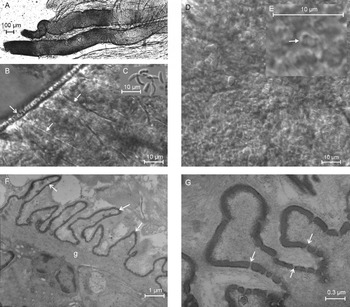
Cysts were ribbon-shaped, long (the largest fragment found amounted to 7 mm) and of different thickness (25–206 μm) (Fig. 1A). Under the light microscope, the wall of the sarcocyst amounted up to 3·5 μm, had clearly visible finger-like protrusions and looked like a band sewn on the surface of the cyst (Fig. 1B). The cyst content was divided into large chambers by septa (Fig. 1B). With the help of a computerized image analysis system it was possible to see irregularly shaped protrusions with concave tops on the cyst wall surface (Fig. 1D, E). Orange segment-shaped cystozoites were 6·2 × 1·4 (5·5–7·2 × 1·2–1·5) μm (n = 13) (Fig. 1C). By TEM, a cyst wall was 2·5–4·4 μm thick (with the ground substance), had club or irregularly shaped, sometimes branched protrusions, which differed in size and were situated at different distances from one another (Fig. 1F). The parasitophorous vacuolar membrane had many indentations and was lined by the electron-dense layer that, in some places, was interrupted (Fig. 1G). The ground substance layer continued into the interior of the cyst as septa. The cyst wall of this sarcocyst resembled somewhat cyst wall type-4 (Dubey and Odening, Reference Dubey, Odening, Samuel, Pybus and Kocan2001).
Morphology of Sarcocystis turdusi sp. nov. (A) Cysts of S. turdusi in the leg muscles of the blackbird. Fresh preparation. (B–E) Light micrographs (computerized image analysis system). Fresh preparations. (B) Fragment of the cyst. Note cyst wall with protrusions (arrow) and clearly visible septa (arrows with white arrowheads). (C) Cystozoites. (D) Cyst wall surface with protrusions. (E) High magnification of the top of cyst wall protrusions. Note irregular shape and concavity of the top of the protrusion (arrow). (F, G) Electron micrographs of the cyst wall fragments. (F) Club-or irregularly shaped cyst wall protrusions (arrows). (G) High magnification of protrusions. Arrows pointed at invaginations of parasitophorous vacuolar membrane. g, ground substance.

Molecular analysis
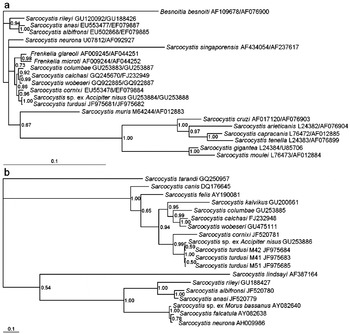
Three S. turdusi isolates from 3 different blackbird individuals were identical in the 1793 bp of the 18S rDNA and in the 1469 bp of the 28S rDNA. The complete 18S rDNA and 28S rDNA sequences were deposited in GenBank with Accession numbers JF975681 and JF975682, respectively. Furthermore, S turdusi and Sarcocystis sp. ex Accipiter nisus, isolated from sporocysts found in sparrowhawks (Accipiter nisus) had the same nucleotide composition within overlapping 1450 bp long fragments of 28S rDNA and 1630-bp long fragments of 18S rDNA. The investigated sequences were most similar to the sequences of Sarcocystis species parasitizing birds and also to 2 Frenkelia species. According to a phylogenetic tree of the fused sequences of 18S rDNA and 28S rDNA, S. turdusi was grouped with S. columbae, S. calchasi, S. wobeseri, S. cornixi and Sarcocystis sp. ex Accipiter nisus, with high bifurcation support (Fig. 2a). These species formed a sister group to 2 representatives of genus Frenkelia. Other Sarcocystis species from birds, i.e. S. rileyi, S. anasi and S. albifronsi, were grouped separately.
The phylogram of the genus Sarcocystis species based on (a) fused partial 18S rDNA and 28S rDNA sequences and (b) ITS-1 region sequences. Multiple sequence alignments consisted of (a) 3425 nucleotide positions including gaps, from which 1817 belonged to 18S rDNA and 1608 belonged to 28S rDNA and of (b) 691 nucleotide positions including gaps. The phylogenetic tree was constructed using the Bayesian methods, scaled according to the branch length and rooted on (a) Besnoitia besnoiti and (b) S. tarandi. The numbers in the figure show the posterior probability support values. GenBank Accession numbers of all taxa are given after the species name.

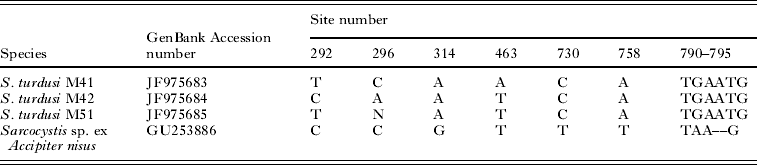
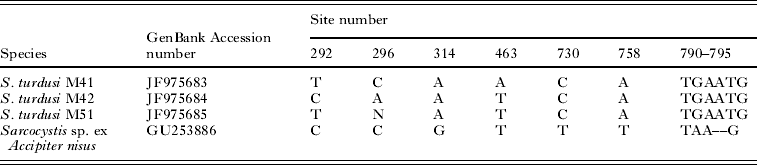
The complete ITS–1 region sequences of S. turdusi obtained from 3 blackbirds were deposited in GenBank with Accession numbers JF975683-JF975685. Sequences of 3 isolates differed from each other by 2–3 nucleotide substitutions (99·6–99·8% sequence identity) (Table 1). Sequence identities between S. turdusi and Sarcocystis sp. ex Accipiter nisus were a bit lower and ranged between 99·0% and 99·1% (sequences differed by 5–6 nucleotide substitutions). Comparing ITS–1 region sequences, the extent of genetic similarity of S. turdusi with other Sarcocystis species was significantly smaller and accounted for <78%. On the basis of the phylogram constructed from ITS–1 region sequences, high support was established to joining 3 S. turdusi isolates with S. kalvikus, S. columbae, S. calchasi, S. wobeseri, S. cornixi and Sarcocystis sp. ex Accipiter nisus, whereas S. felis and S. canis were sister species (Fig. 2b) Inside this phylogenetic group the lowest sequence identity value between two Sarcocystis species, i.e. S. calchasi and S. wobeseri was 93%. Genetic data of ITS–1 region shows that sequence differences between S. turdusi M41, M42, M51 isolates and Sarcocystis sp. ex Accipiter nisus must be regarded as genetic differences of the intraspecific level. On the basis of the results of a genetic investigation the sparrowhawk can be said to be a possible definitive host of S. turdusi.
Variable sites within the ITS-1 region of Sarcocystis turdusi and Sarcocystis sp. ex Accipiter nisus
Taxonomic summary
Type intermediate host: common blackbird (Turdus merula).
Locality: Šilutė district (near the Baltic Sea), western Lithuania.
Definitive host: unknown.
GenBank Accession numbers: JF975681 (18S rDNA), JF975682 (28S rDNA), JF975683-JF975685 (ITS-1 region).
Specimens deposited: histological preparations, TEM material and DNA samples are deposited at the Institute of Ecology, Nature Research Centre, Vilnius, Lithuania.
Etymology: the Latin name of Turdidae family is used for a species name.
DISCUSSION
Despite the fact that cysts of Sarcocystis were found in the blackbird as far back as the end of the nineteenth century, no detailed investigations into these parasites have been conducted (Bütschli, Reference Bütschli and Bronn1880–82). According to the results of this study, prevalence of S. turdusi infection in this bird species is high and exceeds 54·5%. High prevalence of infection is evidently caused by nutrition peculiarities. Blackbirds pick insects, grubs, earthworms and molluscs on the loose soil and with this food they might ingest oocysts/sporocysts excreted by the definitive hosts. Potential definitive hosts of S. turdusi might be the main predators of the blackbird such as the sparrowhawk and the red fox (Vulpes vulpes) (Logminas, Reference Logminas1990).
When comparing the results of a morphological examination of sarcocysts obtained in this work with analogous data in the literature about other species of Sarcocystis in birds, it can be stated that a cyst wall of similar morphology has not been identified for any known Sarcocystis species parasitizing birds (Odening, Reference Odening1998). The cyst wall ultrastructure of S. turdusi from the blackbird faintly resembles cyst wall type-4 of S. sigmodontis from the rodent hispid cotton rat (Sigmodon hispidus) (Dubey and Odening, Reference Dubey, Odening, Samuel, Pybus and Kocan2001). However the majority of protrusions of S. turdusi were longer and had a more diverse shape. According to Odening (Reference Odening1998), cyst wall type-4 was established for a few more Sarcocystis species, i.e. S. chalcidicolubris, S. felis, S. gongyli, S. murinotechis, S. podarcicolubris infecting lizards, rodents, felids.
Phylogenetic analysis showing the evolutionary relatedness to the definitive host rather than the intermediate host inside the phylogenetic groups of Sarcocystinae has been reported several times (Doležel et al. Reference Doležel, Koudela, Jirků, Hypša, Oborník, Votýpka, Modrý, Šlapeta and Lukeš1999; Holmdahl et al. Reference Holmdahl, Morrision, Ellis and Huong1999; Šlapeta et al. Reference Šlapeta, Modrý, Votýpka, Jirků, Lukeš and Koudela2003; Morrison et al. Reference Morrison, Bornstein, Thebo, Wernery, Kinne and Mattsson2004; Dahlgren et al. Reference Dahlgren, Gouveia-Oliveira and Gjerde2008). In the present study, Sarcocystis species from birds were placed in 2 separate well-supported phylogenetic groups in the phylogenetic trees; the first group encompassed S. turdusi, S. cornixi, S. wobeseri, S. calchasi and S. columbae and the second group contained S. rileyi, S. anasi, S. albifronsi and S. falcatula. On the basis of transmission experiments the hypothesis can be suggested that birds serve as definitive hosts of the first phylogenetic group and mammals serve as definitive hosts of the second one. Furthermore, closely related S. turdusi, S. columbae, S. calchasi, S. wobeseri and S. cornixi also share similar morphometric characteristics of cystozoites which are relatively small (1·4–1·8 × 6·1–8·1 μm) and are banana- or lancet-shaped (Kutkienė et al. Reference Kutkienė, Prakas, Sruoga and Butkauskas2009, Reference Kutkienė, Prakas, Sruoga and Butkauskas2010; Olias Reference Olias, Gruber, Hafez, Heydorn, Mehlhorn and Lierz2010a, Reference Olias, Olias, Lierz, Mehlhorn and Gruberb). Cystozoites of S. falcatula had similar dimensions (2·2 × 6·9 μm), but were a little wider; whereas cystozoites of S. rileyi, S. anasi and S. albifronsi were significantly larger (Box et al. Reference Box, Meier and Smith1984; Kutkienė et al. Reference Kutkienė, Sruoga and Butkauskas2006, Reference Kutkienė, Sruoga and Butkauskas2008).
Birds of prey act as definitive hosts of numerous Sarcocystis species (Černá, Reference Černá1984; Svobodova, Reference Svobodova1996; Yabsley et al. Reference Yabsley, Ellis, Stallknecht and Howerth2009). Recently, it was shown that sparrowhawks and goshawks (Accipiter gentilis) that originated from Northern Germany were highly infected with S. calchasi, S. columbae and Sarcocystis sp. ex Accipiter nisus (Olias et al. Reference Olias, Olias, Krücken, Lierz and Gruber2011). On the basis of the results of the DNA analysis presented in this article, S. turdusi and Sarcocystis sp. ex Accipiter nisus may be the same species; however cross-transmission experiments are needed for the final approval of this hypothesis. Across most of Lithuania, sparrowhawks and goshawks are a fairly common breeding species that have stable populations and are regarded as short- or medium-distance migrants (Stratford, Reference Stratford1999; Žalakevičius, Reference Žalakevičius2007). Small passerine birds, thrushes, finches, tits, warblers, starlings, buntings and sparrows are the most important preys of sparrowhawks. On the contrary, goshawks are less specialized as predators of birds, they feed on birds – jays, finches, thrushes, woodpeckers, doves, jackdaws, hooded crows and small mammals – voles, moles, squirrels (Logminas, Reference Logminas1990). According to the genetic results available, S. turdusi is most likely transmitted by European Accipiter hawks, and ecological data are in agreement with this hypothesis.
ACKNOWLEDGEMENTS
The authors are grateful to Mrs I. Žalakevičienė from the Centre of Innovative Medicine, Department of Experimental and Clinical Medicine, for her help in carrying out the electron microscopy investigations.