INTRODUCTION
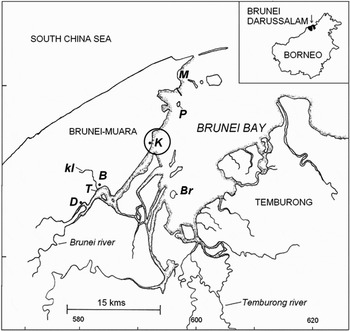
Species of Thais are typically rocky shore inhabitants, though incursions into estuarine systems have been made during their evolutionary history (Tan, Reference Tan1999). Thais gradata (Jonas, 1846) occurs naturally on mangrove trunks and pneumatophores in the Brunei estuarine system (Sungai Brunei Estuary and Brunei Bay; Figure 1), and is especially abundant on artificial piers and embankments built to support water villages, facilitate transportation and retain waters (Marshall et al., Reference Marshall, Santos, Leung and Chak2008). Although apparently obligated to associate with hard surfaces for egg capsule deposition, and confined to such surfaces landwards in the estuary, sediment-based individuals have been observed towards their seaward limit. This pattern may partly reflect habitat degradation and reduced prey availability in the landward sediments, considering the prevailing physicochemical conditions there (reduced salinity, pH and dissolved oxygen; Marshall et al., Reference Marshall, Santos, Leung and Chak2008). An association with barnacles (Balanus amphitrite) on hard surfaces throughout their distribution-range suggests a feeding relationship. The present study describes a mass local migration of T. gradata from their hard surface habitat to an adjacent mud sediment bank in response to chance colonization by the mytilid, Musculista senhousia (Benson, 1842). Although this mussel broadly inhabits the Brunei Bay and is readily harvested by local fishermen, it is usually spatially separated from T. gradata by preference for areas not influenced by the eutrophic Sungai Brunei Estuary (Figure 1).
The Brunei bay and estuarine system. Urban development characterizes the Brunei–Muara district, particularly around Bandar (B) and along the Sungai Kedayang (kl). Thais monitoring stations between 2003 and 2008 included Damuan (D), Tamoi (T), Bandar (B), Kota Batu (K; encircled and focus of present study) and Pulau Bedukang (P). No Thais snails occurred at Muara (M) or seaward of this station. Established populations of Musculista mussels are known at Pulau Baru Baru (Br).

The Asian date mussel Musculista senhousia is a globally important invasive species, particularly relevant to Europe, North America, Australia and New Zealand (Crooks, Reference Crooks1996, Reference Crooks1998; Creese et al., Reference Creese, Hooker, De Luca and Wharton1997; Mistri, Reference Mistri2002, Reference Mistri2004; Hayward et al., Reference Hayward, Grenfell, Sabaa and Morley2008). Although capable of inhabiting hard substrata, it is better known to colonize muddy sediments in sheltered bays and lagoons, forming extensive beds of individuals woven together in a mat of byssal cocoons (Morton, Reference Morton1974). Due to interest in monitoring and controlling M. senhousia invasions, most studies on its predation have concerned non-native populations, and little is known about its natural predators. In general, predators include such diverse groups of animals as crabs, ducks, seabirds and fish (Yamamuro et al., Reference Yamamuro, Oka and Hiratsuka1998; Crooks, Reference Crooks2002; Mistri, Reference Mistri2002, Reference Mistri2004). Only one study concerns gastropod predation of M. senhousia, for a population introduced to California (Reusch, Reference Reusch1998). Further to describing the predator–prey interaction between T. gradata and M. senhousia, data are herein presented on aggregation behaviour and reproduction of this whelk. They suggest a coordinated population-level response to opportunistically available prey, and the facilitation of rapid energy transfer from food resource to whelk propagation. Previous published studies on T. gradata include descriptions of reproductive, imposex and shell properties, with little known about the ecology or feeding of this species (Tan, Reference Tan1999; Marshall et al., Reference Marshall, Santos, Leung and Chak2008).
MATERIALS AND METHODS
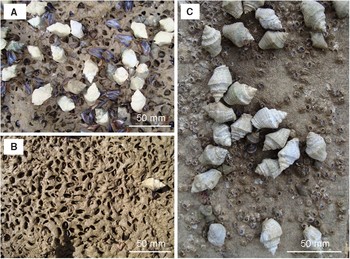
The Brunei estuarine system is characterized by a steep physicochemical gradient, with salinity and pH respectively varying between 30 and 5 psu and 8 and 6.5 pH (Marshall et al., Reference Marshall, Santos, Leung and Chak2008). Reduced dissolved oxygen and elevated dissolved carbon dioxide levels imply natural (from mangroves) and anthropogenic eutrophication of the system. Thais gradata has been the subject of regular monitoring at five stations along this gradient between 2003 and 2008 (Figure 1). Individuals are usually confined to hard intertidal substrata (mangrove trunks and pneumatophores, and artificial embankments such as jetties and piers) at the landward stations (Damuan, Tamoi, Bandar and Kota Batu), though occasional observations of sediment-dwelling individuals have been made at the most seaward station where these whelks are found (Pulau Bedukang; Figure 1; Marshall et al., Reference Marshall, Santos, Leung and Chak2008). On 3 July 2008, the entire population of T. gradata at Kota Batu was found to have migrated from the jetty structure it usually inhabited to an adjacent mud bank (0.4 m above Chart Datum), to aggregate and feed on a newly-established M. senhousia colony (approximately 30 m2; Figure 2). The jetty extended around 40 m offshore and contained a terminal T-piece running over 60 m long-shore. Thus, while some whelks on the jetty were in close proximity to the newly-colonized mussel bed, others had migrated over much longer distances. Whelks attacked mussels and formed aggregations on only a part of the bed (around a third of the total area; Figure 2). Other fauna associated with the mudflat included predatory whelks Nassarius olivaceus (Nassariidae) and Pugilina sp. (Melongenidae), which were however not found to feed on the mussels, as well as infaunal deep-burrowing polychaetes, bivalves (Geloina, Dosinia, Lanternula and Solen sp.) and a brachiopod (Lingula sp.). Unlike T. gradata, these animals have a limited distribution along the Sungai Brunei estuary (Figure 1). Populations of T. gradata and M. senhousia at Kota Batu were surveyed over 5 days (4, 5, 16, 17 July and 1 August 2008).
(A) Whelk-invaded mussel bed showing opened shells of dead mussels removed from the byssal cocoon mat; (B) whelk-free Musculista mussel bed, with an individual whelk shown for scale. Shell valve closure during aerial emersion leaves a gap in the mud around each live individual; (C) Thais whelks that had returned to a jetty pillar to feed on barnacles following the collapse of Musculista mussel population.

Densities and size–frequencies were determined on 4 and 5 July. Whelk density was estimated from 8 samples (6.25 × 10⁻² m2) and mussel density from 9 samples (3.2 × 10⁻³ m2), taken from each of the whelk-invaded and whelk-free mussel beds. Substratum samples (5 cm deep) were removed, washed and sieved on site, and all collected organisms counted and sized (digital Vernier calipers or plastic ruler to at least 0.5 mm). Shell length was measured for the mussels and aperture length for the whelks (because their shell lengths are highly variable in relation to food availability and environmental conditions; Marshall et al., Reference Marshall, Santos, Leung and Chak2008). Dead mussels were distinguished from live ones by gaping shell valves. A total of 358 whelks and 441 mussels were examined. Statistical comparisons of shell size for live and dead mussels in the whelk-invaded bed and live mussels in the whelk-free bed were based on a random sample of 78 individuals for each group. Statistica version 6 was used for all statistical analyses.
Whelk feeding rate was determined in the laboratory for individuals collected from Kota Batu and mussels (shell length = 13–34 mm) collected from Pulau Baru Baru (Figure 1). Following starvation for 4 days, whelks held individually in mesh bags (N = 9–12) were presented with a mussel each day for 6 consecutive days (24 psu, 28°C). The number of whelks that had opened a mussel, and whether and where drilling had occurred were recorded daily. Consumption of fresh mussel tissue in relation to whelk tissue weight was calculated for the last four days, based on measurements of mussel shell length (24–31 mm) and direct measurements of the fresh tissue weight of the whelks at the end of the experiment. Mussel shell length (SL) was converted to fresh weight (FW) using a prior-determined relationship, as follows: FW (mg) = −208.5+15.3 SL (mm); r = 0.92; P < 0.001; N = 28. All of the 20 mussels held separately in a bag in the experimental aquarium survived for 10 days, confirming the health of the mussels used in the experiments.
Despite abundant hard surface space above the sediment on the jetty, whelks preferentially deposited egg capsules in one of three communal nests (between 17 July and 1 August) formed on an old tyre in the sediment and on two separate wooden jetty pillars. The combined surface area of the nests was estimated at 0.66 m2. Using this area, egg capsule density (based on 20 haphazardly-collected samples of 7.07 × 10⁻⁴ m2 from the nests), and a laboratory-estimated number of eggs laid per female, the number of whelk females contributing to the nest eggs was estimated. Although the M. senhousia community at Kota Batu appeared healthy when first surveyed (4 and 5 July), the entire population had died before 16 July. The cause of this mortality is unknown, but possibilities include algal bloom intoxication (Chua et al., Reference Chua, Chou and Sadorra1987) and hypoxic water exposure (Yamamuro et al., Reference Yamamuro, Oka and Hiratsuka1998, Reference Yamamuro, Hiratsuka and Ishitobi2000; Mistri, Reference Mistri2002).
RESULTS
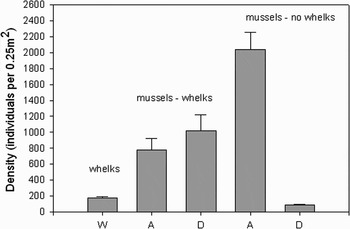
Figure 3 shows densities of T. gradata and M. senhousia in whelk-invaded and whelk-free mussel beds. Although mussels were removed from the bed during whelk feeding (Figure 2A), this occurred at a low incidence and there was no significant difference for the combined density of alive and dead mussels between whelk-invaded and whelk-free mussel beds (t = 0.952; P = 0.355). The live mussel density in the whelk-invaded mussel bed was, however, distinctly reduced and dead mussel density was distinctly elevated (Figure 3). These comparative densities for alive and dead mussels indicate that predation primarily caused the mortality in the whelk-invaded bed. The predator to prey ratio based on average densities of alive and dead mussels in the invaded bed was slightly greater than 1:10.
Density of whelks in the mussel bed studied (W), and the densities of mussels under whelk attack (mussels–whelks) and in a whelk-free area (mussels–no whelks). A, indicates live mussels and D indicates dead mussels. Mean±1 SE (individuals. 0.25 m−2), where N = 8 for whelk density and N = 9 for the density of each mussel condition. Mussels–no whelks A > mussels–whelks A = mussels–whelks D (Tukey HSD test; F = 11.537; P = 0.0003; Cochran C = 0.4607).

Left skewing of the whelk size distribution indicates that the population comprised mostly adults, suggesting local migration with limited recruitment (Figure 4A), consistent with earlier observations of an essentially hard surface whelk population before mussel colonization. The size–frequency distribution was invariable among the three mussel groups (alive with whelks, dead with whelks and alive without whelks; Kruskal–Wallis test: H = 4.56; P = 0.1020; N = 234; for all paired comparisons P > 0.1064; Figure 4). The prey size consumed thus matches the available prey size, and while this suggests a lack of prey size selection, such an effect would be better demonstrated using a broader prey size range than that of the studied population (Figure 4). The population structure further constrained information about selection, by invading whelks, of an area of the mussel bed based on prey size; there was no evidence that feeding aggregations were biased towards areas having larger mussels (Figure 4).
Size–frequency distributions of whelks and mussels. (A) Aperture length of Thais whelks (N = 358); (B & C) shell length of live and dead mussels, respectively, under whelk attack; and (D) live mussels in whelk-free bed (N = 78 for each mussel condition). Median for (B), (C) and (D) is respectively, 21.5, 20.5 and 20.0 mm, and mean, respectively, 20.9, 20.4 and 20.01 mm.

The laboratory experiments showed that the daily percentage of whelks (N = 9–12) that had opened a mussel was 85.8±5.2 (mean±SE; N = 6 days). Regular observations on one day showed that five of the 12 whelks had approached, opened, consumed and abandoned a mussel within 7 hours. Of 47 mussels opened in total, 40.4% had not been drilled, while drilling always occurred at the shell margin in the other cases (59.6%). Fresh weight of mussel tissue consumed over 4 days, as a percentage of whelk body weight, was 90.7±0.07 (mean±SE; N = 9), while the maximum tissue consumed during this period by one individual was 118% of its body weight. Four of the 12 snails used, laid egg capsules during the course of the experiments.
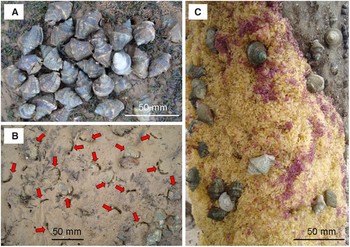
Following the field mussel mortality, non-feeding resting aggregations of whelks persisted in the sediment, while other whelks returned to the jetty pillars to feed on barnacles and/or reproduce (Figures 2 & 5). Some aggregations comprised more than 80 individuals in close contact, which sometimes became partially buried in the sediment during consecutive tidal cycles (Figure 5). In follow up visits more than a month later, large numbers of whelks had either remained dispersed in the sediment or had become reposed in clumps of 6–12 individuals. From the mean egg capsule density of 375 capsules.sample−1 (or 5.3 × 10⁵ capsules.m−2), the area of the three nests of 0.66 m2, and the production of 100 egg capsules per female, around 3500 females are estimated to have contributed to the nests between 17 July and 1 August (Figure 5).
Aggregation of non-feeding, resting Thais individuals (A) on the sediment surface, and (B) partially buried in the sediment (arrowed); (C) communal nest of egg capsules (14 days old) on a jetty pillar, showing several individuals depositing eggs. Egg capsules were attached to each other, in contrast to the deposition of each capsule to the substratum in laboratory observations. Non-viable egg capsules rapidly turn purple.

DISCUSSION
The estuarine-dwelling whelk Thais gradata exhibits highly opportunistic feeding behaviour and habitat use. Its typical hard surface habitat and barnacle feeding is abandoned during a population wide local migration leading to aggregation and feeding on sediment-based Musculista senhousia mussels, following chance colonization of these mussels. Although M. senhousia is typically a colonizing species characterized by high fecundity, quick growth and a short life cycle (usually annual; Crooks, Reference Crooks1996; Mistri, Reference Mistri2002), ongoing monitoring showed that no mussel colonization had occurred at the study locality for at least the preceding 5 years (Marshall et al., Reference Marshall, Santos, Leung and Chak2008). At the time of the study, the mussel colony was immature and comprised a single cohort of relatively similar-sized individuals; median and maximum shell lengths were respectively <22 and 27 mm (Figure 4) compared to a maximum shell length of 33 mm for an established colony elsewhere in the Brunei Bay (Pulau Baru Baru; Figure 1) and that reported in other studies (George & Nair, Reference George and Nair1974; Crooks, Reference Crooks1996; Reusch, Reference Reusch1998; Mistri, Reference Mistri2002). Colony immaturity and limited recruitment is further indicated by the relatively low density within the mussel bed; the recorded mean density was around 8400 individuals.m−2 in the whelk-free bed compared to reported densities of between 15 000 and 23 000 individuals.m−2 (Creese et al., Reference Creese, Hooker, De Luca and Wharton1997; Reusch, Reference Reusch1998; Mistri, Reference Mistri2002).
Indications that the mussel colony had developed within a 9 month period preceding this study have implications for novel mussel prey recognition. Musculista mussels are arguably novel prey considering that the Thais population at Kota Batu had not encountered them for generations, while populations at more physicochemical extreme locations in the Sungai Brunei estuary have probably never encountered these mussels (see Marshall et al., Reference Marshall, Santos, Leung and Chak2008). Recognition of and attraction to novel bivalve prey probably depends on the level of feeding specialization (Morton, Reference Morton1990, Reference Morton1999, Reference Morton2008; Taylor & Morton, Reference Taylor and Morton1996). Some predatory whelks attack novel prey in preference to natural prey while the opposite is found in others (Morton, Reference Morton and Morton1994; Reusch, Reference Reusch1998). In contrast to the opportunistic and generalist feeding mode exhibited by T. gradata, other mud-dwelling whelks at the study site were not found to attack the Musculista mussels. Furthermore, generalist feeding is known among rocky shore congenerics of T. gradata, and is shown to relate to the diversity of available prey and the ecological and geographical distributions of a species (Taylor, Reference Taylor and Morton1980; Tong, Reference Tong1986; Taylor & Morton, Reference Taylor and Morton1996). Although switching of diet from native to introduced species is widespread among predatory whelks (Reusch, Reference Reusch1998; Rilov et al., Reference Rilov, Gasmith and Benayhu2002; Morton, Reference Morton2008), the extent to which this involves habitat variation is, however, not well known.
Opportunistic feeding traits of T. gradata are further suggested by non-selection of prey size and the capacity to open rapidly and to consume large quantities of Musculista prey. The selection of an optimal size to ensure that the energetic cost of feeding does not exceed the energy gained is probably more applicable to specialist feeders than to opportunists such as Thais (Hughes & Dunkin, Reference Hughes and Dunkin1984; Morton, Reference Morton2004). While a test of this is constrained here by invariable prey size, mussel size did not deter the whelks from undergoing en masse prey transition from barnacles to mussels. Under laboratory conditions T. gradata individuals often accessed the mussels in <7 hours and consumed nearly their own body weight of mussel tissue in 4 days. This prey consumption rate contrasts strikingly with that of other predatory whelks; for example, Linatella caudata showed a mean consumption rate of 28% of its body weight in a week and Hexaplex trunculus consumed 40% of its body weight in 5 weeks (Morton, Reference Morton1990; Peharda & Morton, Reference Peharda and Morton2006). Although these laboratory consumption rates may overestimate natural feeding rates considering that the prey was deprived of its natural defences (such as a byssal cocoon and embedment in the sediment; see Morton, Reference Morton2004) and that whelks had probably not reached satiation, concomitant with a non-feeding, resting state (see Figure 5), these data nevertheless indicate a considerable capacity for rapid food intake by T. gradata. This may link with a capacity to produce spawn and reproductive materials (capsule and albumen) rapidly, which in another Thais species constitutes 81% of the visceral mass (Stickle, Reference Stickle1973; Rochette et al., Reference Rochette, Tétreault and Himmelman2001). Rapid access of the mussels by T. gradata seemingly relates to their mode of attack. In a manner similar to that of several congenerics, this involves either edge-drilling or no drilling at all (Tong, Reference Tong1986; Morton & Britton, Reference Morton, Britton, Wells, Walker, Kirkman and Lethbridge1993; Morton, Reference Morton2008), methods which affect more rapid access than wall drilling for example (Dietl & Herbert, Reference Dietl and Herbert2005).
Aggregation behaviour is commonly observed in muricid whelks, including many Thais species (Feare, Reference Feare1971; Spight, Reference Spight1974; Taylor & Morton, Reference Taylor and Morton1996). While the functional role of this differs among species, it generally provides protection from physical elements (Feare, Reference Feare1971; Moran, Reference Moran1985) or is important in feeding and/or reproduction (Stickle, Reference Stickle1973; Brown & Alexander, Reference Brown and Alexander1994; Rochette et al., Reference Rochette, Tétreault and Himmelman2001; Stewart & Creese, Reference Stewart and Creese2004). As an example, group feeding in Stramonita (=Thais) haemastoma improved removal of tissue from oysters (Brown & Alexander, Reference Brown and Alexander1994). Similar benefits could derive from T. gradata aggregations, whereby some individuals (especially juveniles) could feed on abandoned mussels opened by others in the group. Furthermore, there are obvious benefits of group feeding in cases where whelks are much smaller than the prey and several individuals are required to open a single prey item (this has been observed for T. gradata preying upon Meretrix in the laboratory; D.J.M., unpublished data). Arguably, aggregations may not have a functional role, but rather may coincidentally relate to the combination of whelk abundance and aggregated prey. However, the non-random (clumped) distribution of T. gradata over uniformly-distributed mussels in the Musculista bed suggests a functional role for the aggregations in this case. Indeed, the possibility exists for multiple functions, including both feeding and reproductive functions, considering the observation of non-feeding, resting aggregations in the sediment (Figure 5). These potentially allow synchronization of mating which would be necessary to form communal nests. Aggregations relating to patterns of reproduction and spawning have also be observed in T. lamellosa (Stickle, Reference Stickle1973), and the link between aggregation, feeding and reproduction has been described for Buccinum undatum (Rochette et al., Reference Rochette, Tétreault and Himmelman2001). Interestingly, the aggregations shown by sediment-dwelling T. gradata are not observed in whelks inhabiting the hard substratum in the Brunei estuarine system. During the Musculista-induced feeding and reproductive cycle of T. gradata, all female whelks returned to the hard substratum to deposit egg capsules preferentially in communal nests, despite an abundance of hard surface on the nearby jetty. While strong evolutionary selection seemingly underlies nest-forming behaviour, the benefits derived from this are not entirely clear.
Thais gradata is abundant broadly across the Brunei estuarine system and is more physiologically tolerant of the prevailing extreme and variable water conditions (pH and salinity) than much potential prey. Constraints on organismal and population growth as prey diversity and abundance declines across this estuarine system could be offset by the whelk's flexibility of habitat use and feeding behaviour, and an ability to form feeding and reproductive aggregations. Specifically, by undertaking ecological transitions between hard and soft substrata, generalist feeding, and rapid prey consumption, T. gradata can capitalize on chance colonization of benthic sediment prey species, in addition to their typical hard substratum prey. Furthermore, synchronization of mating through the formation of reproductive aggregations could be important in maintaining populations, by increasing the efficiency with which energy is transferred from prey resource to reproductive propagation, when prey becomes available by chance.
ACKNOWLEDGEMENTS
I am indebted to my wife Mariam for her help in the field. Brian Morton (Natural History Museum, UK) kindly provided important literature and helpful comments on a draft manuscript. The Ministry of Development, Government of Brunei Darussalam, provided financial support.