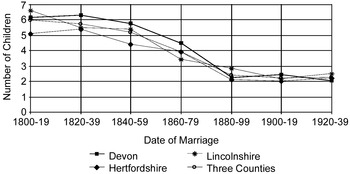
Between 1800 and 1939 the average size of the English landed gentry family fell from 5.96 children per married couple to 2.25 (see fig. 1). Reproductive patterns in gentry society exhibited early signs of demographic behavior that would become the norm for the rest of the population by the mid-twentieth century.Footnote 1 The conscious limitation of fertility has been an important component of modern society, having been linked with a series of significant developments, not the least of which is the state provision of universal welfare and education.Footnote 2 The evolution of gentry fertility patterns also poses specific implications for understanding the national fertility decline and the history of landed society.
Building on contemporary observations of changing reproductive behavior, many scholars have commented on the early changes in family size among elite groups.Footnote 3 Some have argued that the small family was “diffused” through society after having been initially adopted by elites.Footnote 4 More recent studies have overlooked the behavior of small elite groups such as the landed gentry. The general impression has been that landowners were insignificant in statistical terms since their adoption of family limitation had little overall impact on the national fertility rate, which was increasing for much of the nineteenth century and peaked between 1876 and 1877.Footnote 5
Specialists in the history of the gentry and aristocracy generally explain changing reproductive behavior with reference to the “decline” of landed society. They focus particularly on the decline of rentier incomes as a result of the agricultural depression in the last quarter of the nineteenth century. F. M. L. Thompson, for instance, concluded that the shrinking size of the landed family “suggests that faith in the future has tight limits.”Footnote 6
Contracting landed incomes were undoubtedly one factor in the reproductive behavior of some couples. Financial problems with the estate were an important ingredient of earlier declines in fertility among the English and Welsh landed classes.Footnote 7 However, declining incomes cannot explain the observed changes in this period in isolation. Demographers have frequently shown that declining fertility must have resulted from a broad interplay of factors, which altered over time and between different stages of the process.
This article will examine the reproductive behavior of the landed gentry of three English counties: Devon, Hertfordshire, and Lincolnshire.Footnote 8 It will explore the statistical pattern of average gentry family sizes and then turn to the probable causes of the decline. Issues of social and gender identity and mentality underlay these demographic changes, as well as economic pressures: a rise in the numbers of gentry men attending public school in the nineteenth century and later an expansion in landed women's roles are likely to have been among the social and cultural factors in the conscious control of family size among the gentry.
The landed gentry families who form the object of this study were sampled from the Parliamentary Return of Owners of Land (London, 1873–75). The data on completed family size was obtained for a smaller subset of families whose data were contained in Burke's Landed Gentry (London, 1914–39) and Burke's Peerage and Baronetage (London, 1949–64). The three selected counties of Devon, Lincolnshire, and Hertfordshire contrasted in terms of geography, agriculture, and, crucially, the relative effects of the agricultural depression.Footnote 9
No objective criteria existed for the inclusion of families in Burke's Landed Gentry and Burke's Peerage and Baronetage and the definition of these families as “the gentry.” The decision whether to include a family was left to the sole discretion of the editors of the series (originally J. B. Burke) according to their “social acceptability.”Footnote 10 Questions have been raised over the reliability of the demographic information in Burke’s. In particular, T. H. Hollingsworth commented on the vague nature of some of the data on births and marriages for the medieval and
Mean family size. Sources: Parliamentary Return of Owners of Land (London, 1873–75); Burke's Landed Gentry (London, 1937–65); Burke's Peerage (London, 1949–64).

early modern individuals.Footnote 11 The original respondents to the Burke’s “census” in 1834 relied on their own often sparse and unreliable genealogical sources to provide the editors with the information they required on earlier medieval and early modern generations of their families. The demographic information on the modern descendants is, however, far more reliable as it was provided by relatives with more accurate vital details.
The decline of gentry fertility found in the genealogies was a fairly steady process that began among couples marrying between 1820 and 1839 (fig. 1). The steepest reductions occurred among the two cohorts marrying between 1860 and 1899, for whom the average number of children dropped by 45 percent. This represented over 75 percent of the total decline in family size across the period. But the process had begun among the couples marrying earlier, whose smaller families represented 15 percent of the total decline; those married between 1880 and 1899 decreased the size of their families to 2.23 children, and the average remained around this level for the two remaining cohorts of the period. The transition of gentry fertility behavior was complete by the outbreak of the First World War.
Women could, and did, give birth quite late into the marriage, up until menopause, which most demographers would assume occurs between the ages of 45 and 50. Since the average age at marriage for this sample was around twenty-five, some couples will not have completed their fertility within the twenty-year cohort periods presented on the graph. Indeed, the fertility behavior of these couples will be interpreted as an effect of social, economic, and cultural factors for a significant period of time after the end of the period. The midpoint of the period 1800–1845 was 1822. Thus, the fertility behavior of the cohort that married between 1800 and 1845 was mainly related to contextual conditions between 1810 and 1835, and the same factors should be borne in mind for the later marriage cohorts. In
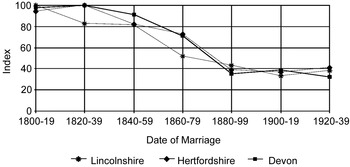
Relative index of peak nineteenth-century fertility. Sources: Parliamentary Return of Owners of Land (London, 1873–75); Burke's Landed Gentry (London, 1937–65); Burke's Peerage (London, 1949–64).

particular, the steep declines from the marriages between 1860 and 1900 were related mainly to contextual factors between 1870 and 1890.
The gentry families of the three counties all began a decline in fertility at different points. Among the first marriage cohort, the Hertfordshire gentry produced the smallest families. The nineteenth-century decline, though, was initially confined to the earliest cohorts of the Lincolnshire gentry. This can be seen more clearly when the family sizes of each successive cohort in the three counties are expressed as a relative index of peak nineteenth-century fertility (fig. 2). In the early stages of the decline, there were high rates of deviation from the averages as small subsets of the gentry began to have smaller families.Footnote 12 In Devon and Lincolnshire, the decline seems to have gained greater momentum after 1860.
Overall, the dramatic declines in family size among the gentry began from the marriages of 1860–79, but a smaller subset of families who married earlier in the nineteenth century began reducing the number of children in marriage to a lower level a generation before. The gentry cohorts marrying between 1860 and 1879 produced an average of four children. The gentry family of two and three children was firmly established by the couples marrying in the 1880s and 1890s. This process of decline in fertility slightly predated the wider transition of modern British fertility, but it was in line with the forerunners of the process among the middle classes. The average number of children born to British couples stood at 6.2 in the 1860s and declined to 5.3 by 1881, 3.3 in the 1900s, and 2.4 by 1921.Footnote 13 Certain parts of the professional middle classes exhibited fertility trends comparable to those of the landed gentry. Medical professionals had particularly small families much earlier than other sections of the population. The marriages of 1881, for those between the ages of twenty and twenty four, produced an average of 4.2 children,
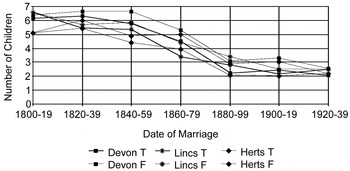
Childlessness and reproduction. Devon T indicates Devon total couples and Devon F indicates Devon fertile couples who produced one or more children. The spaces between the two lines for each county indicate the effect of childless couples on the overall average number of children. Sources: Parliamentary Return of Owners of Land (London, 1873–75); Burke's Landed Gentry (London, 1937–65); Burke's Peerage (London, 1949–64).

while those of the same age group marrying in 1901 produced an average of 3.0 children.Footnote 14
The decline in gentry fertility is a well-known pattern. In his longitudinal analysis of the demography of the British peerage, T. H. Hollingsworth found earlier and steeper declines in family size among the “secondary universe” of the titled aristocracy.Footnote 15 Jessica Gerard showed that the marriages of landowners born between 1825 and 1849 produced an average of 4.5 children.Footnote 16 The main innovation here lies in the interpretation of the trends, which will include reference to other demographic data.
A number of endogenous demographic factors brought about the decline of the large gentry family, many of which undoubtedly resulted from exogenous factors. Childlessness was among the most important of these. Figure 3 compares the family size of fertile gentry couples that produced one or more children with the total mean average including childless couples. There were various periods when childlessness distorted and “pulled down” the figures on the overall average number of children, exaggerating the rate of decline in positive fertility.
In Devon, the declines between the cohorts of 1800–1819 and 1840–59 resulted from a rise in numbers of childless families from 5 percent to 15 percent of all first marriages. Among fertile Devon couples, there was a slight increase in
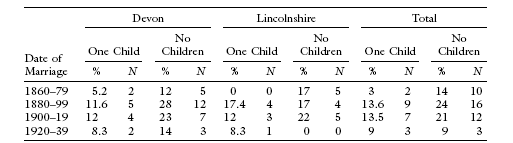
Childless and One-Child Families in Devon and Lincolnshire as a Proportion of Total Marriages, 1860–1939
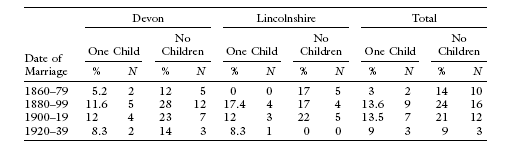
Sources.— Parliamentary Return of Owners of Land (London, 1873–75); Burke's Landed Gentry (London, 1937–65); Burke's Peerage (London, 1949–64).
Note.— N = number of cases.
family size to 6.65 in this period. In Lincolnshire, the early phases of contraction were arrested, between the marriages of 1820 and 1859, by the rising size of the families of fertile couples. The precipitous decline from the marriages of the 1860s was more gradual among the fertile couples, although it was still pronounced. Marriages that produced one or more children also showed different patterns from the combined totals for the marriages of 1860–79 in Hertfordshire.
The rates of childlessness among the sample were relatively high (table 1). If all women included in the sample had married at an early age and made no attempt to control their fertility, a figure of around 5 percent of all marriages would be the expected norm. However, childlessness did not account for the whole of the reduction of family size. Similarly, childlessness became more common as, by the late nineteenth century, large sections of British society, to varying extents, were controlling the size of their families. The “very small family” of zero or one child became an increasingly significant factor in the British fertility decline from the 1870s onward.Footnote 17 Anderson argues that this behavior was part of a growing practice of conscious and effective fertility limitation begun among small and “pioneering” subsections of the married population. Families that had previously been seen as “unnaturally small” were becoming increasingly acceptable. The professional middle classes had the highest proportions of very small families in Anderson's sample for the period between 1890 and 1925.Footnote 18
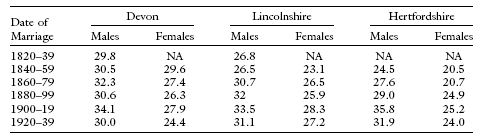
The sampled gentry applied additional conscious controls in the earlier period as well. There was a general rise in the average age at marriage for men and women over this period (table 2), with the exception of Devon women. Since fertility rates are generally higher among younger couples and decrease with age, particularly after the age of thirty, the point at which marriage occurred affected the average number of children born to each family and may also help explain the rising number of childless marriages.
The motivations for this behavior were probably complex and diverse. Some late marriages could have reflected a lack of “suitable” partners or a restriction on marriage settlements. However, they occurred across a range of wealth levels and
Average Age at Marriage
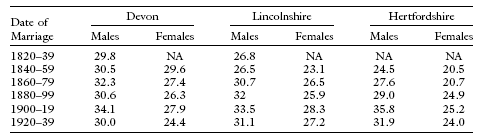
Sources.— Burke's Landed Gentry; Burke's Peerage; National Census Household Returns, 1881, PRO RG/11; National Census Household Returns, 1851, PRO HO/107.
Note.— NA = not available. The Census Household Enumerator's Books were used to establish many of the gentry women's date of birth in order to identify their age at marriage. This information is often absent from Burke's Gentry and Burke's Peerage. However, a number of birth dates have not been traced for those who had died before the 1851 census or were simply missing from the returns. Thus the coverage of female gentry for average age at marriage is not complete. Much of the data on female age at marriage was taken from the 1851 and 1881 National Census because Burke's does not list the date of birth for many women. Since few of those who married in the earliest period were located in the census from 1851 onward, averages could not be established for any of the three counties.
before the major declines in landed incomes of the late nineteenth century. Many, therefore, probably indicated decisions to control family size.Footnote 19
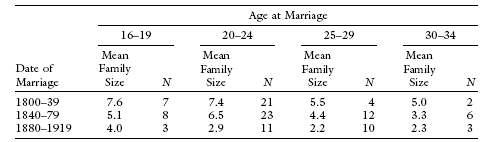
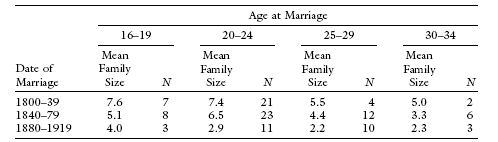
table 3 shows the extent of variation in the size of Devon families according to the female age at marriage.Footnote 20 The age at which couples married was most significant in the marriages occurring between 1840 and 1879, marriages that intersect with one of the crucial periods in the fertility decline between 1850 and 1870. Those marrying between the ages of thirty and thirty-four would produce families almost half the size of those marrying in their early twenties. Into the later period, between the marriages of 1880 and 1919, a family size of two to
Variation in the Family Size of Devon Gentry Couples by Female Age at Marriage
Sources.— Parliamentary Return of Owners of Land (London, 1873–75); Burke's Landed Gentry (London, 1937–65); Burke's Peerage (London, 1949–64).
Note.— N = number of cases. See note for table 2 on the coverage of female landed gentry for average age at marriage.
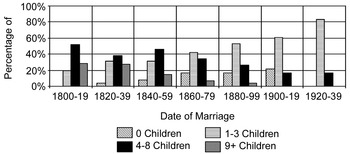
Distribution of Lincolnshire marriages. Sources: Parliamentary Return of Owners of Land (London, 1873–75); Burke's Landed Gentry (London, 1937–65); Burke's Peerage (London, 1949–64).

three children had become the standard for most couples, even for those marrying at between twenty and twenty-four years of age.
Into the second half of the nineteenth century, the limitation of fertility within marriage seems to have increased in significance. The spread of controlled fertility in marriage is reflected in the changing distribution of family size among fertile couples in Lincolnshire (fig. 4). In Devon and Lincolnshire, the small family of between one and three children had constituted around 20 percent of first marriages at the beginning of the period. By the marriages of 1920–39, this figure had risen to 83 percent in Lincolnshire and 73 percent in Devon.
As a whole, the figures show that there were some “early starters” in the development of the small family, many of whom may have relied on late marriage. After the 1860s, a growing proportion of gentry couples chose to limit the number of children produced within marriage. While late marriage probably continued to be an important method of control, it ceased to be of such significance in completed family size after the late nineteenth century. There was a high and rising level of infertility among gentry families, but this was not enough to explain the complete transition to the small family and never of such magnitude as to have led to the demographic extinction of any significant numbers of families. By the early twentieth century, the small family pervaded the gentry to a far greater extent than the large family, so often associated with country-house life, had ever done. Indeed, no gentry couples marrying after 1900 produced families of nine or more children. This raises the question of why gentry couples adopted and developed these pioneering patterns of reproductive behavior.
The main explanations thus far have emphasized the financial problems caused by the agricultural depression. The depression of agricultural prices began in the late 1870s and lasted until the late 1890s, leading to a general decline in the value of land and rents that continued until the Edwardian period. Ultimately these problems forced many gentry families to sell their estates, usually at opportune periods when the value of land was increasing. There were two particularly concentrated spates of land sales in England and Wales, between 1910 and 1921, interrupted by the First World War. By 1921, between 6 and 8 million acres had been sold from gentry and aristocratic landowners, mainly to tenant farmers, constituting 25 percent of the total surface area of England and Wales, the largest exchange of land since the dissolution of the monasteries in the sixteenth century. Around two-thirds of the gentry had sold their estates by 1952.Footnote 21 One-third of the families sampled for this study had sold by 1939, generally from the mid-1890s onward. Declining rental incomes would have been among the factors influencing reproductive behavior. The long-term reduction of incomes would have influenced the decision of some couples to remain childless or to marry late. This pattern has been observed among the professions during the late nineteenth century, as has the abstention from marriage altogether.Footnote 22
However, several factors undermine the idea of a direct relationship between wealth and fertility among the gentry. First, rates of marriage remained buoyant in this sampled group and did not follow patterns observed in the professions.Footnote 23 Second, there is some evidence that declines in agricultural incomes were offset by diversification into other forms of liquid investments, especially into colonial stocks and shares.Footnote 24 Third, given that there was no general decline in incomes among the middle classes, all of whom reduced their fertility in various different ways during this period, it is improbable that financial problems alone would account for modified reproductive behavior among the gentry.
Finally, agricultural depression could not have been a direct causal factor. The differences in reproductive change among the three county groups do not reflect the regional diversity of the effects of the agricultural depression.Footnote 25 Since Hertfordshire agriculture suffered the most during the depression, followed by Lincolnshire and then Devon, the small family would have developed first and most rapidly during the late nineteenth century in Hertfordshire.
Also, reduced incomes are unlikely to have translated directly into a smaller family size. Existing research on the fertility decline suggests that more fundamental types of attitudinal change are required before such behavior could become possible or quite so common.Footnote 26 Given this, and the general weight attached to socialization, values, and attitudes by historical demographers, it is argued that some of the most significant factors in the smaller gentry family may have been changes in men's education and an expansion in the roles played by landed women. Both were part of a general shift in perceptions relating to “the family,” “fatherhood,” and “motherhood.” This shift can be examined through various themes, beginning with male education.
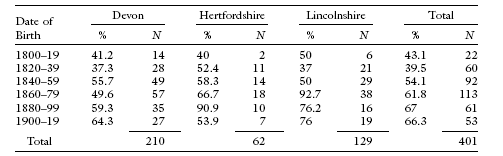
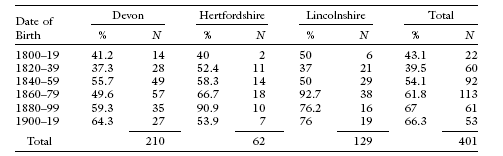
Rises in the consumption of institutional education could have had an impact on fertility on several levels. During the early and mid-eighteenth century, the gentry had generally preferred to educate their sons at home with a private tutor or at a local grammar school.Footnote 27 Public schooling was fairly common for gentry men born between 1800 and 1819. But beginning in the 1840s (except in Devon) greater proportions of gentry boys entered the public schools, so throughout the period after 1880 around two-thirds of boys, eldest and younger brothers alike, attended them (table 4).
Fees for public school education doubled between 1868 and 1892, creating an “income squeeze” on family finances.Footnote 28 After 1870 very few landowners would have enjoyed much of an increase in their rental income, even if some did not experience any real declines.Footnote 29 However, these pressures were not specific to the gentry and should not be associated with “the decline of landed society” in isolation. Banks found similar pressures at work among the upper-middle classes during the early stages of their fertility decline and into the later nineteenth century during “the great depression.”Footnote 30
Also, the provision of public school education by gentry parents reflected changing perceptions of the family, the parent, and notions of masculinity. The rising popularity of these institutions among elites was part of a growing belief in the separation of men from the home and an emphasis on the importance of homosocial interactions. The public life of men was in tension, for much of this period, with the cult of domesticity that placed high value on a man's presence and involvement in the
Public School Education
Sources.— F. D. Boase, Modern English Biography in Six Volumes (London, 1968); Who Was Who, 8 vols. (London, 1897–1997); H. E. C. Stapleton, Eton School Lists 1853–1892 (London, 1900); Eton Register, Being a Continuation of Stapleton's Eton School Lists, 1893–1899 (Eton, 1901); J. Foster, The Members of the University of Oxford: Vol. II, 1715–1886 (London, 1887); J. A. Venn, A Biographical List of All Known Students, Graduates and Holders of Office at the University of Cambridge, from the Earliest Times to 1900 (Cambridge, 1922–54); A. S. Mahood, ed., The Register of Blundell's School: Part II, 1882–1932 (Exeter, 1935); A. Fisher, ed., The Register of Blundell's School: Part I, 1770–1882 (Exeter, 1904); Harrow School Register (Harrow, 1900).
Note.— N = number of cases. The 401 gentry sons found to have been to a public school were part of a sample of 870 gentry sons, eldest and younger brother inclusive, from 131 gentry families in the three counties. This sample is made up of 93 percent of the sample of families used for the data on reproductive behavior. The calculations here take account of child mortality. None who died before the age of twelve (none of whom attended a school) were included. The search in school alumni books was far from exhaustive, but it suffered from a problem of diminishing returns. The figures quoted here are minimum estimates, and there were, undoubtedly, larger numbers of sons enrolled in lesser-known schools.
private sphere.Footnote 31 Membership and attachment to a gentlemen's club could signify a desire to seek a domestic environment away from the pressures of marriage and children rather than a simple “flight from domesticity.”Footnote 32 However, within this negotiated tension, there was a growing belief that a man's formative years should be spent in the company of other men. The correct environment for the socialization of boys became the public school, and for the sociability of the gentleman, the club.Footnote 33 Both institutions rose dramatically in number and in popularity as the period progressed. This was particularly the case in the years after 1870, during which, John Tosh argues, the cult of domesticity broke down under the pressure of ideals that emphasized more adventurous and heroic types of manliness, as well as changes in women's status.Footnote 34 Overall, the ideal of paternity and fatherhood gradually became less important as a primary means of defining masculinity and male identity, particularly from the late nineteenth century onward. As the proportion of gentry men attending boarding schools rose, this culture of masculinity became increasingly entrenched. Accelerated fertility decline after the 1870s can be closely linked chronologically with the crisis of masculinity during the “flight from domesticity.”
Several historians of modern Britain have identified domesticity as among the key elements of a middle-class, rather than gentry, identity.Footnote 35 The smaller domestic setting and the more work-centered lives of the middle classes provided the environments necessary for domestic virtue. There was not such a clear separation of “work” and “home” among the gentry elite, ensconced as they were in country houses that functioned as centers of business as well as sociability. Estate business permeated the everyday lives of the landed gentry to a greater extent than it did those of the middle classes. Country houses were less “private,” were subject to regular rounds of long-term visitors, and often employed more domestic servants.
However, several factors suggest that similar patterns of change may have altered gentry masculinities and affected patterns of reproduction. The ownership of a landed estate was only a part of the overall life-course and experience of landed gentry men. The average age of inheritance was relatively high.Footnote 36 Although some inherited early, the majority had already married and many had conceived their first child before taking on the responsibilities and lifestyle of a landowner. Those younger sons who inherited unexpectedly would have planned their families on the basis of a different future than their eldest brothers. Even after inheritance, large proportions of the gentry lived in quite modest houses and could not afford the steady stream of family visitors as often as the wealthier gentry. Equally, the privacy of middle-class households may be exaggerated. Middle-class houses served social functions. As Amy Milne-Smith has argued, gentlemen's clubs did reflect a growing need to find more privacy away from a busy house.Footnote 37 There is evidence, then, that the gentry were subject to similar changes in ideologies of masculinity and the family.
The gentlemanly ideology of public school masculinity was inculcated within an environment of “intense communalism,” created partly by the system of boarding.Footnote 38 The gentleman was expected to exhibit a certain type of attitude and behavior that revealed a “strong character,” “inner nobility,” and emotional and physical self-control.Footnote 39 Many contemporary commentators also stressed “forbearance” in the expected behavior of men of this social status. Forbearance, or self-control, was often linked to interpersonal skills, such as conversation, as well as to financial prudence.Footnote 40 Sexuality was also an important conceptual part of this behavioral ideal.Footnote 41 In 1850, Sir A. Edmonstone suggested that true gentility could be achieved “by a rigid course of self-denial, by a severe rein on every appetite and affection.”Footnote 42 Self-control was often isolated as a clear indicator of “the quality,” in juxtaposition with the unfettered instincts and irresponsible behavior of the lower classes, along with other ideals such as “truth” and “honor.”Footnote 43 The ideology of self-control and self-denial has clear implications for interpreting changes in reproductive behavior. Simon Szreter found that the moralistic reforming ideals of Victorian evangelicalism and elite cultures of gentility were very important in the early declines of fertility among the upper and middle classes, and he has emphasized self-control and prudence as among the most significant.Footnote 44 He linked these ideals of behavior directly to sexual abstinence within marriage, as well as rises in the average age at marriage.Footnote 45 John Raymond de Symons Honey also describes boarding-school education as separative and transformative, and he makes the point that public schools often promulgated “alternative values” to those of the family and the home.Footnote 46
Arthur Acland, who later inherited the Acland estates in the southwest of England and in Wales, went against the wishes of his family when marrying and taking an occupation.Footnote 47 He explained to his father that the friends he met at school influenced this separation from domestic values:
When I go back over all the different friends I have seen much of since I went to Rugby, Christ Church, Keble College and at present, I can hardly remember one whom I ever talked with intimately whose fathers were not in a different position from mine by which I mean they represented money not territorial position … what I believe has characterised them all [his school friends] has been that I could not find grounds of sympathy with them with reference to our relations to home. They all had views of independence towards home … which to me were quite startling … I have let all this influence me unconsciously a great deal—and by no means for the good.Footnote 48
Sir George Kekewich explained his early departure from his governess and entry into boarding school with reference to his parents’ perceptions of his social and gender development as a “gentry man.”Footnote 49 He wrote: “As I grew older … I gradually, like every other boy, became less and less amenable to feminine control, and began, as the phrase goes, to run wild.”Footnote 50 He went on to describe his “association” with the “farm boys” and noted his parents’ observation of his changed behavior. “For one thing,” he reflected, “they taught me bad language, which I employed quite innocently in addressing my mother.” The key point in this decision came when his parents thought that he was becoming “too averse to family society.”Footnote 51 The decision to send George away for his education was based, according to him, on his lack of young gentry masculine behavior.Footnote 52 For at least parts of the landed gentry, public school was perceived to be an important stage in the development of their male offspring as “men” and as “gentlemen.”
The increasing incidence of public school education and the wider propagation of gentlemanly ideals resulting from this behavior can thus be considered one of the possible elements in the formation of mentalities and behavioral patterns conducive to the development of smaller families. This whole area also helps explain the shared experience of fertility decline among the gentry and the upper-middle classes, particularly the professions. The sheer weight of influence exerted by education on men of the gentry and the upper-middle classes meant that public schools must have played a significant role in these changes.Footnote 53 The gradual changes in the status, roles, and expectations of gentry women from the late nineteenth century in the context of a broader realignment of female identities were also significant.Footnote 54
From the late nineteenth century onward, middle-class and landed women attended boarding schools in larger numbers and began to be admitted into universities.Footnote 55 At the beginning of the nineteenth century, most girls of a middle-class or upper-class background had been educated by private tutors at home or in small private schools. Starting in the 1840s, the ladies’ boarding schools challenged the dominance of these smaller institutions. Pioneers such as David Laing at Queen's College and Elizabeth Reid at Bedford College led the way, and they were followed by others, such as Dorothy Beale at Cheltenham Ladies’ College.Footnote 56 One key feature of such schools was the higher number of students admitted. Whereas local private schools had generally catered to around twenty pupils, the large public institutions commonly taught between 100 and 300 girls, and some admitted as many as 1,000.Footnote 57 Similar advances were also made in matching the curriculum of girls’ education to that of boys, including a focus on sports.Footnote 58
These changes in secondary education fed into developments in the tertiary sphere, particularly from the 1870s onward. A fourfold increase in the number of women admitted to English universities took place between 1900 and 1935, and female students at Oxford and Cambridge increased by a factor of three. By 1935, 8,526 women were registered as students at English universities, or 23 percent of all university students. Women of the upper classes made up 21 percent of total female entrants.Footnote 59 Particularly into the twentieth century, more women took occupations or became involved in voluntary work in the cities before marrying. The advances made in married women's freedoms built on legal reforms of the late nineteenth century that had, to a certain extent, improved their ability to control property and obtain child custody.Footnote 60 For contemporaries, the “new woman” provoked concern and consternation.Footnote 61
On the basis of the information in Burke's Landed Gentry and Burke's Peerage and Baronetage, 40 percent of gentry women born after 1850 were educated in public schools and 21 percent went on to university, and this is undoubtedly a minimum estimate.Footnote 62 Gentry women generally lived in the countryside for longer periods of time than gentry men or women of the urban middle classes. However, they involved themselves in local philanthropic and charitable activities throughout this period and made frequent and extended visits to friends and relations in county towns and increasingly to London, particularly as transport links improved. There were several married gentry women who negotiated these higher levels of freedom and independence. Eleanor Acland (née Cropper) of Killerton, Devon, was one such example.
Eleanor was the daughter of Charles Cropper, the owner of a papermaking business and a lesser gentry landowner in Kendal, Westmorland.Footnote 63 She was awarded a first-class degree in history from Somerville College, Oxford, in 1900, and she went on to become a published author and an active campaigner for the Liberal Party.Footnote 64 During her early writing career, Eleanor rented a flat in West London, where she stayed for most of the year.Footnote 65 While living there, she met Francis Dyke Acland, the son of Sir Arthur Herbert Dyke Acland, thirteenth baronet of Killerton House, in Devon, whose public school experiences were discussed above. In the 1870s, the Acland family owned around 30,000 acres in England and Wales, which Francis inherited as the fourteenth baronet in 1926.Footnote 66
Eleanor and Francis married in August 1905, and they went on to have three boys and a girl, Ellen, who was killed in an accident on the estate in 1924 at the age of eleven. Although this number of children was above the average for the period, it was far lower than the eight-children families more common in earlier Acland generations, and it was part of a downward trend in the size of the clan begun in the mid-nineteenth century.Footnote 67 Some of the factors and strategies contributing to this trend can be found in the couple's letters.
In one letter, Francis discussed their first child, Richard, and prospects for their second child, Arthur. As part of an ongoing discussion, the remaining letters of which have not been located, Francis stated: “I don’t think you need become mentally active again until you’ve finished feeding him [Richard]. Then if we leave six months or so between that and starting another you might really try to get the article about Mary finished.”Footnote 68
Francis's views on pregnancy hardly meet current contemporary standards of enlightenment, but there is evidence that Eleanor's writing career, informal and casual though it may have been, was a factor in the decisions the couple made with regard to childbirth and childrearing. Her intellectual and professional needs and requirements were, at the very least, a consideration that exerted some influence on family planning.
These negotiations apparently resulted in a “stopping” strategy. The births of the four children were concentrated into the first eight years of their marriage. Their first child, Richard, was born 26 November 1906. The letter referred to above was written 14 January 1907, and the couple seem to have waited for a slightly shorter period of time than they had planned, roughly three months after weaning Richard, before conceiving another. Their second child, Arthur Geoffrey, was born sixteen months after Richard, in May 1908. The couple then waited for two years until the birth of their third child, Cuthbert, in November 1910. Three years after Cuthbert's birth, their daughter Ellen was born in October 1913.Footnote 69 No further children were born in the remaining twenty years of the marriage, after Eleanor's thirtieth birthday and before her death in 1933.
There may have been many other factors involved in Eleanor and Francis's decision to stop producing children, possibly including biological problems with conception. No doubt Francis's busy public life as a major landowner and MP also played a part. Both his public and private lives would have been affected by notions of fatherhood and family learned through the socializing effects of family and school. But the available evidence from the early stages in their marriage suggests that Eleanor's career also significantly influenced their reproductive choices. Given wider developments in gender relations, it seems likely that there was a growing number of gentry women whose concepts of their role in the family and of motherhood substantially determined the size and nature of the family from the late nineteenth century onward.
The middle and upper classes experienced these changes to varying extents during roughly the same period, although in slightly different ways. This shared ground of experience, mentality, and identity within shifting boundaries of social closure in elite society offers the most likely explanation for the concomitant shifts in gentry reproductive behavior. Public schools and changing notions of gender and family cannot, of course, explain the demographic change in isolation. However, this alternative explanation illustrates the complexity of the possible factors involved.
The large landed gentry family of five or more children has been a key element in popular and academic visions of landed society. The super-sized gentry or aristocratic family living in a densely staffed country house has been taken to reflect their superior wealth and social connections. However, the downward trend in the size of gentry families illustrates that the image of the large gentry clan is a misrepresentation.
Developments in identity and mentality, particularly in relation to gender and social status, were among some of the most important factors in these changes, along with financial pressures. The importance of shifting systems of socialization and altered definitions of gender identities illustrate that changes in gentry reproductive behavior were likely to have been an experience that was shared with sections of the middle classes.
This research lends support to studies stressing the cultural boundaries to fertility change in the modern period, rather than those of social class. Szreter argues that fertility decline was not a unitary process of change that spread through stratified diffusion “down” through the social classes. Rather, the British fertility decline was characterized by a series of minute fissures along cultural and linguistic lines. Small-scale social groups, termed “communication communities,” shared similar motivations for, and experiences of, fertility change. They defined themselves as social groups in the Weberian sense: as “intermarrying” and “interdining” sections of society.Footnote 70
The gentry were part of a communication community involved in an exchange process through which a culture of restricted fertility developed. Along with the upper middle classes, the gentry were becoming an integral part of what Szreter describes as the “gentlemanly milieu” or the “patrician world.”Footnote 71 Verification of this comes from some other key aspects of gentry behavior during the period.
In terms of marriage patterns, choices of occupation, and club affiliations, the gentry exhibited a close and developing relationship with the higher professions and, to a lesser extent, to moneyed and business wealth.Footnote 72 The armed forces, medicine, and the legal profession were three areas of particular significance. These three professions were, of course, the “ancient” or “traditional” professions, and the gentry's links with these groups, as opposed to the “new professions,” may exhibit the extent to which landed families remained socially conservative during this period.
However, professionals also reduced the size of their families from the 1850s or 1860s onward.Footnote 73 The gentry's association with the army, doctors, and lawyers is of particular significance since these professional groups exhibited among the very lowest levels of fertility from the mid-nineteenth century onward.Footnote 74 The methods by which these groups achieved smaller families varied. Szreter has pointed out variations in the marriage patterns between army officers on the one hand and lawyers and medical professionals on the other. Men of the armed forces selected particularly young wives, while doctors and lawyers married especially older women.Footnote 75 The gentry exhibited behavior somewhere between these two patterns. Thus the story of the gentry's fertility decline did not exactly follow those of their peers within the “gentlemanly milieu.” Nevertheless, the broader evidence on sociability and fertility does underline the importance of their membership of this pioneering group.
These findings also bear significance for the broader history of the landed gentry. The concepts of “decline” and “survival through decline” cannot account in full for the changes in gentry reproductive behavior in the nineteenth and early twentieth century. While there were certainly aspects of both real and perceived decline that contributed to the development of the small gentry family, the idea cannot be applied as a causal explanation. Two to three children became the dominant form of family size in England during the early twentieth century and the gentry exhibited an early form of this behavior.
The gentry did not always react to the rapidly shifting social and economic environment of the period but often pioneered what we now consider to be modern forms of lifestyle through transformations and adaptations in their social lives of significant proportions. Neither could they be described as the “embattled elite” fighting against the forces of a rising bourgeois plutocracy.Footnote 76 On the contrary, through the lifestyle changes they adopted, they were increasingly fusing and merging with the upper sections of the urban middle classes in social and cultural terms. It was more likely to have been the deepening involvement of the landed gentry in the “patrician milieu” that explains their demographic history than the singularity of their experience of social, economic, and political decline as a class.
Appendix
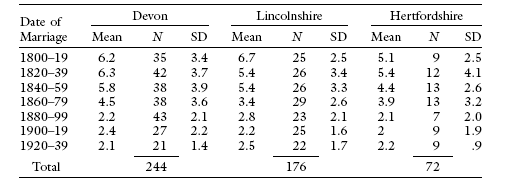
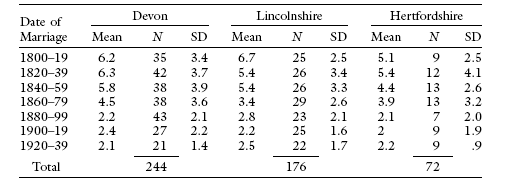
Mean Average Family Size with Standard Deviation
Sources.— Parliamentary Return of Owners of Land (London, 1873–75); Burke's Landed Gentry (London, 1937–65); Burke's Peerage (London, 1949–64).
Note.— N = number. Standard deviation (SD) is a measurement of the extent to which data points deviated from the mean average and, thus, reflect the commonality of average family size among the sampled families.
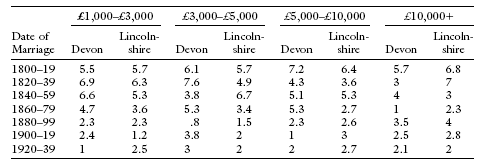
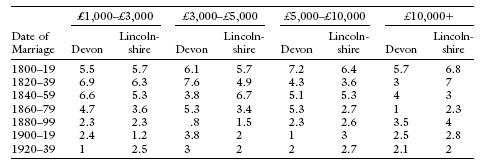
Variation in Family Size according to Landed Income
Sources.— Parliamentary Return of Owners of Land (London, 1873–65); Burke's Landed Gentry (London, 1937–65); Burke's Peerage (London, 1949–64).
Note.— The figures for this table have been affected by the small samples in this type of analysis. For this reason the Hertfordshire gentry have not been included. The wealthiest families were smaller in number, and this explains the higher degree of erratic variations in patterns from one marriage cohort to the next. It should be noted that average family size did drop below two per married couples among different wealth groups at various points, although it did not for the sampled population as a whole. However, this may also be a function of the sample sizes.