

Introduction
Technological change, globalisation and the rise of knowledge intensive work are often associated with declining job quality (Green, Reference Green2006). However, high job quality may have positive effects not only on the well-being and mental and physical health of individuals but also on society and the economy as a whole, leading to greater productivity, competitiveness and economic growth (Dahl et al., Reference Dahl, Nesheim, Olsen, Guillén and Dahl2009). Thus, since 2000, the main goal of the European Union has been not only the creation of jobs and the reduction of unemployment but also the improvement of job quality (European Commission, 2007). At the same time, a shift towards new welfare, i.e. a stronger emphasis on labour market participation through activation and not on income replacement, has been a major issue in labour market reforms in Europe (Eichhorst et al., Reference Eichhorst, Kaufmann, Konle-Seidl, Reinhard, Eichhorst, Kaufmann and Konle-Seidl2008; Taylor-Gooby et al., Reference Taylor-Gooby, Gumy and Otto2015). In this sense, a new means-tested welfare benefit has been introduced in Germany that emphasises the activation of all welfare recipients. In this article, I address the question whether new welfare policies can foster more and better jobs, by analysing the effectiveness of major active labour market programmes (ALMPs) on employment prospects and job quality for unemployed welfare recipients in Germany.
Many studies evaluate the effectiveness of ALMPs for unemployed individuals on employment probability; however, only a few studies take outcome variables concerning job quality such as earnings and stable employment into account but often not for welfare recipients. To my knowledge, I am the first to analyse the effects of participation in ALMPs on various dimensions of job quality for unemployed welfare recipients in Germany.
In Germany, welfare recipients in particular may suffer from low job quality because they are forced to accept any reasonable job, including those below their productivities, and are subject to the threat of benefit sanctions. However, it is possible that many would take low-quality jobs anyway, because welfare recipients are often characterised by employment impediments – such as a lack of education, a migration background, health problems or long-term unemployment – and do not have the potential to obtain high-quality jobs even with considerable support from job centres. Thus, participation in a programme may also not increase the probability of working in a high-quality job, particularly if the programme focuses on the most disadvantaged welfare recipients. Based on descriptive methods, previous studies have already shown that the exit from welfare is largely unsustainable (Graf and Rudolph, Reference Graf and Rudolph2009) and that former welfare recipients mostly take low-quality jobs, such as jobs in the low-wage sector or non-permanent jobs (Achatz and Trappmann, Reference Achatz and Trappmann2009). However, these findings do not mean that job centres cannot achieve at least some success with respect to certain dimensions of job quality, such as stable employment. Furthermore, for some welfare recipients, obtaining even low-quality jobs constitutes success.
I present empirical evidence on the effectiveness of four major ALMPs (One-Euro-Jobs, classroom training, in-firm training and further vocational training) compared with non-participation on various dimensions of job quality for unemployed welfare recipients in Germany. I use a matching approach and rich administrative data of the German Federal Employment Agency. The data are based on all individuals who enter welfare receipt without any contributory employment between 1 October 2005 and 30 September 2006. Furthermore, I can consider long-term consequences of ALMPs on job quality because the observation period is up to December 2010.
As dimensions of job quality, I consider the employment quality and the work quality. Information on employment quality is available in administrative data: the type of employment, the taking of regular employment without welfare receipt, real monthly gross earnings and stable employment. However, information on work quality is not available in administrative data. Thus, I measure work quality by a new occupation-specific indicator, the so-called occupational exposure.
Institutional framework
Since 2005, Germany has had a two-tier system that includes a time-limited unemployment insurance benefit (unemployment benefit I (UB I)) and a means-tested welfare benefit (unemployment benefit II (UB II)). Individuals who could work at least 3 hours per day receive UB II if their (household) income is not sufficient to achieve a minimum standard of living. Thus, unemployed individuals, UB-I-recipients, employed individuals, and individuals who are not available for employment (e.g. because of caring for children or the elderly or participating in education or in ALMPs) can receive UB II. In this article, I consider only unemployed UB-II-recipients. With the introduction of UB II, an emphasis on ‘work first’ and activation has been introduced in Germany (Clasen, Reference Clasen and Clasen2011). As a means of activation, various ALMPs for UB-II-recipients exist.
I consider One-Euro-Jobs, short-term training (classroom training and in-firm training) and further vocational training in the period between 2005 and 2008 and describe the main institutional features of these programmes in the following.
One-Euro-Jobs (Arbeitsgelegenheiten in der Mehraufwandsvariante) was introduced in 2005 with UB II (regulated in Article 16 d Social Code (SC) II) and is a public employment programme providing additional jobs of public utility that would not exist without the subsidy. One-Euro-Jobs is a programme of last resort for hard-to-place individuals and pays 1 to 2 Euros per hour in addition to UB II. Thus, the primary goal of One-Euro-Jobs is not integration into regular employment but rather to increase the employability of welfare recipients. Furthermore, One-Euro-Jobs may be used by job centres to test welfare recipients’ willingness to work. One-Euro-Jobs should be designed in such a way that welfare recipients have sufficient time to search for a job. On average, One-Euro-Jobs has a duration of up to half a year and a working time of 30 hours per week (Department for Statistics of the Federal Employment Agency, 2006-2009).
Short-term training (regulated in Article 48–52 SC III and available for UB-II-recipients via Article 16 SC II) is a short qualification programme and can be carried out in a classroom (classroom training) or in a company (in-firm training). Both types of short-term training involve three types of training with different durations and aims. Application training (up to 2 weeks) aims to increase the effectiveness of job searches and/or may test willingness to work. Aptitude tests (up to 4 weeks) test the aptitude to work in a specific job or occupation. Skill training (up to 8 weeks) increases human capital by providing short courses, such as computer or language training. The maximum duration is 12 weeks if different types of training are combined.
Further vocational training (regulated in Article 77-87 SC III and available for UB-II-recipients via Article 16 SC II) is a long qualification programme. Welfare recipients receive a voucher to choose a provider and training course, which are provided by an online platform (Kursnet) of the Federal Employment Agency. The vouchers are valid for 3 months, and training providers should be located within a one-day commuting zone (Dörr et al., Reference Dörr, Fitzenberger, Kruppe, Paul and Strittmatter2017). The caseworker specifies the objective, educational content and maximum duration of the training course. Further vocational training involves two different types: training courses and degree courses (retraining programmes). Training courses last several months to 1 year, take place in a classroom or in a company and provide professional and practical skills. Degree courses last up to 3 years, and individuals can obtain a vocational degree. Furthermore, better educated individuals participate more often in further vocational training than other unemployed individuals because they are more likely to receive and redeem a voucher (Kruppe, Reference Kruppe2009). The goal of further vocational training is to increase welfare recipients’ human capital and productivity. Furthermore, further vocational training aims at adapting welfare recipients’ skills to the changing requirements of the labour market or to changing individual conditions, such as health problems.
The assignment into these programmes relies primarily on the discretion of the caseworker (Bernhard et al., Reference Bernhard, Wolff and Jozwiak2006). However, the assignment decision is integrated into the institutional framework including legal requirements as well as strategies and approaches of the respective job centre. Furthermore, the assignment of welfare recipients into the programmes by the caseworker depends on the goals of the programmes and the characteristics of the welfare recipients. Ultimately, the caseworker has the final decision about programme assignment and if an unemployed welfare recipient refuses to participate in a programme, he/she also risks his/her benefits due to sanctions.
The effects of ALMPs on job quality: theory and previous evidence
The potential effects of participating in ALMPs on job quality may be twofold and depend on the considered ALMP. Participation in a programme may lead to a treatment effect or to a compulsion effect (Van Ours, Reference Van Ours2007). Both effects imply that unemployed individuals may take jobs more quickly but with a different level of job quality. First, positive effects on job quality (treatment effect) may emerge, as the attractiveness of the participants to a potential employer increases: participation in a programme may increase the human capital or job search effectiveness of the participants, leading to high-quality jobs compared with non-participation. Second, negative effects on job quality (compulsion effect) may occur because participation in programmes may increase the concessions that participants must make, such as decreasing the reservation wages. Furthermore, unemployed individuals may avoid programme participation because it reduces their available time for leisure, non-market work or household activities. Thus, they may take a job very quickly; however, it may be a low-quality job. Furthermore, the threat of benefit sanctions for refusing or cancelling participation in a programme may work in the same direction.
The effects of participation in ALMPs on job quality are a priori unclear and must be quantified by empirical research. So far, many studies analyse the employment effects of various ALMPs for different groups of individuals in various countries (Card et al., Reference Card, Kluve and Weber2010; Greenberg et al., Reference Greenberg, Michalopoulos and Robins2003; Kluve, Reference Kluve2010). However, studies evaluating ALMPs mostly do not consider effects on job quality for Germany or other countries (Card et al., Reference Card, Kluve and Weber2010). One reason for this lack of consideration is that most evaluation studies use administrative data with limited job quality information. Only a few studies take outcome variables concerning employment quality into account (e.g. earnings or stable employment) but often not for welfare recipients. However, welfare recipients in particular may suffer from low job quality.
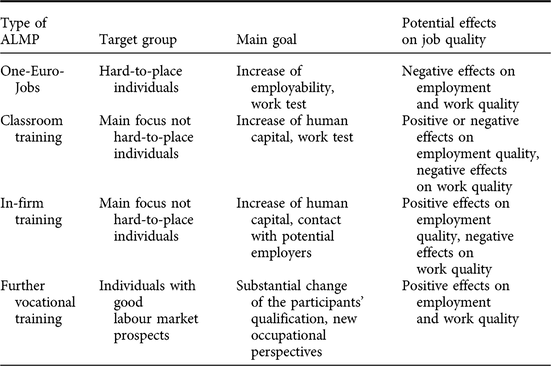
In the following, I describe the potential effects and previous evidence of the considered programmes on job quality for German welfare recipients. As different programmes are directed at different participant groups and goals, their potential effects on job quality may vary (Table 1). Because the focus of One-Euro-Jobs is on hard-to-place individuals and, thus, on individuals with a low potential of finding a high-quality job, participation in a One-Euro-Job may increase the participants’ employability; however, it is unlikely that it will increase the probability of taking a high-quality job. Additionally, One-Euro-Jobs may be used by job centres to test welfare recipients’ willingness to work; thus, participants could make more concessions and take a low-quality job compared to if they did not participate.
Potential effects of considered ALMPs on job quality
Empirical evidence on the effects of One-Euro-Jobs on job quality for German welfare recipients is scarce. Most studies consider only employment effects finding lock-in effects in the short run and positive regular employment effects after 1 or 2 years but negative effects to leave welfare receipt (Hohmeyer, Reference Hohmeyer2012; Hohmeyer and Wolff, Reference Hohmeyer and Wolff2010; Reference Hohmeyer and Wolff2012). Only the study of Hohmeyer and Wolff (Reference Hohmeyer and Wolff2010) considers earnings as an outcome. They find negative or slightly positive earnings effects for participation in One-Euro-Jobs for German welfare recipients.
Classroom training or in-firm training may enhance the participants’ human capital by providing short courses. Participants can even obtain a certificate. In-firm training provides internships serving as pathways to regular employment in the same company (Kopf, Reference Kopf2013). Furthermore, classroom training or in-firm training does not focus on hard-to-place individuals. Thus, classroom training or in-firm training may show positive effects on employment quality but not on work quality. Because classroom training may also be used by job centres to test welfare recipients’ willingness to work, positive effects on employment quality may not arise.
For German welfare recipients, most studies on short-term training analyse employment effects. These studies find nearly no lock-in effects and positive effects on regular employment (Kopf, Reference Kopf2013; Wolff and Jozwiak, Reference Wolff and Jozwiak2007). Two studies also analyse the effects of short-term training on job quality for German welfare recipients. Kopf (Reference Kopf2013) finds positive effects on stable employment (defined as being at least 6 or 12 months in regular employment) for participation in classroom aptitude training and classroom skill training, but not for West German women, and for participation in in-firm training. Thomsen et al. (Reference Thomsen, Walter and Aldashev2013) find positive effects for participation in aptitude training and skill training on the exit rate from welfare conditional on taking contributory employment for male natives and immigrants.
Further vocational training is the only programme that changes the participants’ qualification substantially and even offers new occupational perspectives; thus, it should increase the probability of taking high-quality jobs for all dimensions of job quality. Further vocational training should enable individuals to increase their chances of finding a high-quality job because it provides long qualification programmes that should increase participants’ human capital. Furthermore, further vocational training is also directed at individuals with good labour market prospects who are characterised by a high potential of increasing their chances of finding a high-quality job. Participants in further vocational training obtain a certificate or even a vocational degree that may lead to more stable jobs by reducing the risk of unemployment (Bernhard and Kruppe, Reference Bernhard and Kruppe2012). Thus, participation in further vocational training may reveal positive effects on all dimensions of job quality.
Previous studies on further vocational training for welfare recipients in Germany concentrate on employment effects and find positive regular employment effects in the medium run after a period of lock-in effects (Bernhard and Kruppe, Reference Bernhard and Kruppe2012; Kruppe and Lang, Reference Kruppe and Lang2018).
Method
I apply a static causal model, the so-called Roy-Rubin model (Roy, Reference Roy1951; Rubin, Reference Rubin1974), to estimate causal treatment effects. I am interested in the average effects of participation in one of the four programmes (D=1) versus non-participation (D=0) on job quality (Y) for participants (average treatment effect on the treated (ATT)).
 $ATT = E\left( {{Y^1} - {Y^0}{\rm{|}}D = 1} \right) = E({Y^1}|D = 1) - E({Y^0}|D = 1)$
However, the fundamental evaluation problem arises because the outcomes for an individual are not observable for participation and non-participation at the same time. If I compare the outcomes of participants and non-participants directly, a selection bias arises because participants and non-participants are not randomly assigned to the programmes. The matching approach solves this selection bias by assigning to each participant one or more non-participants with similar covariates X. Because matching on all covariates X is not feasible (curse of dimensionality), I use matching on propensity scores as balancing scores by estimating the probability of participation in a programme versus non-participation conditional on a set of covariates X in a probit model.
Different assumptions must hold to identify the effects. First, the Stable Unit Treatment Value Assumption (SUTVA) – i.e. an individual’s treatment and outcomes must not depend on other individuals’ treatment and outcomes – must hold (Rubin, Reference Rubin1980). If the programmes are not large in scale, this assumption is likely to hold (Frölich, Reference Frölich2004). Because I consider One-Euro-Jobs with a very high number of participants in the period under consideration, this assumption may not hold. However, if the counterfactual world is similar, e.g. there is only a marginal increase or decrease in the scale of the policy (Frölich, Reference Frölich2004), the assumption is likely to hold. Second, the Conditional Independence Assumption (CIA) must hold. The CIA states that potential outcomes are independent of the treatment if all covariates that jointly influence the treatment and outcomes are controlled for (Caliendo and Kopeinig, Reference Caliendo and Kopeinig2008). If the CIA is valid conditional on covariates, it is also valid conditional on balancing scores such as propensity scores (Rosenbaum and Rubin, Reference Rosenbaum and Rubin1983). Third, a common support or overlap must exist: participants and non-participants must have a positive probability of being both participant and non-participant (Caliendo and Kopeinig, Reference Caliendo and Kopeinig2008). Furthermore, the distributions of the propensity scores of participants and non-participants must overlap to find for each participant sufficient non-participants with similar propensity scores (Frölich, Reference Frölich2004).
Data
Data and implementation
I use rich administrative data from the German Federal Employment Agency. The data are based on all individuals aged 18 to 57 years who enter UB-II-receipt without any contributory employment between 1 October 2005 and 30 September 2006.Footnote 1 , Footnote 2
I consider four types of ALMPs: One-Euro-Jobs, classroom training, in-firm training and further vocational training. A simple distinction into participants and non-participants is not possible. Considering individuals who never participate in a programme as the control group is selective, and implies conditioning on the future. Thus, I use the dynamic treatment approach of Sianesi (Reference Sianesi2004) to define the treatment and control groups up to a certain point in time (start window). To avoid selection, the start window should be as small as possible but large enough to provide a sufficient number of observations. I tested several start windows: individuals may start one of the four programmes within 2 months (61 days), 4 months (122 days) and 6 months (183 days) after entry into the sample. Because the results are quite similar across the different start windowsFootnote 3 , I focus on the 6-month period in the following. Thus, programmes start between October 2005 and April 2007.
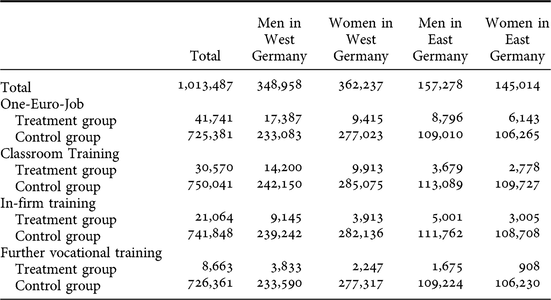
Furthermore, programmes must occur during the same welfare spell. Thus, I define permanent UB-II-receipt (with gaps of less than 31 days) without contributory employment until the start of a programme as an exit condition. To apply the exit condition to the control group, I calculate random programme dates for the control group by randomly drawing durations from the empirical distribution of durations of each of the four programmes that start up to 6 months after entry into the sample (Lechner, Reference Lechner1999). Thus, the sample sizes of the control groups are not the same for all four programmes. Table 2 presents the sample sizes and the number of observations for the treatment and control groups for each of the four ALMPs. The sample consists of 1,013,487 individuals, of which more than 70% are from West Germany. The number of observations for the treatment groups ranges between 908 and 17,387 individuals in the subgroups.
Number of observations
Source: Integrated Employment Biographies, UB-II-Receipt History, own calculations.
Outcomes
Various dimensions of job quality, such as wages, working hours and autonomy, exist and have an impact on individuals’ well-being; however, a precise definition of job quality is difficult to formulate. Furthermore, assessing job quality is difficult because the institutional context plays a role. Thus, the concept of job quality is multi-dimensional and elusive (Green, Reference Green2006; Munoz de Bustillo et al., Reference Munoz de Bustillo, Fernández-Macías, Esteve and Antón2011). Additionally, the determinants of obtaining and keeping a good job are for the most part unknown. Studies that analyse the role of socio-economic characteristics for the job quality provide only hints: job quality mostly increases by occupational and educational level and is higher for men and individuals with non-permanent contracts.
I focus on single dimensions of job quality and define outcome variables for job quality considering employment and work quality. Employment quality comprises employment dimensions that are related to the employment contract. First, I consider the type of employment. Taking regular employment might be an indicator for high job quality because the employment is subject to social contributions and not subsidised. Thus, taking minor employment that is not subject to social contributions and only pays up to 400 EurosFootnote 4 or taking subsidised employment might be characterised by low job quality. Part-time regular employment might also be associated with low job quality because gaps in the social contribution may emerge. While atypical jobs, such as part-time, minor or subsidised jobs, are often considered precarious, this need not be the case (Kraemer, Reference Kraemer2008). If individuals have sufficient (household) income, perform atypical jobs voluntarily, avoid unemployment or can use atypical jobs as stepping stones to regular employment, then atypical jobs may not diminish job quality to such a great extent. Second, I consider the taking of regular employment without UB-II-receipt. Individuals stop receiving welfare benefits if their (household) income is sufficiently high to meet the basic needs of their households. If the wages from taking regular employment are sufficiently high, welfare recipients’ households may stop receiving welfare, which may imply high job quality. However, exiting welfare also depends on the household structure, whether the household members are already employed and the amount of earnings already received from employment in a household (and other non-welfare income). For example, if a welfare recipient takes a part-time job and his/her partner already receives some earnings from employment, the household income may be sufficiently high to stop receiving welfare. Third, I consider real monthly gross earnings from contributory and minor employment.Footnote 5 High job quality can be proxied by pay because individuals with higher pay also have better working conditions and more autonomy and pay is highly correlated with the skills required for a job (OECD, 2001). As the last outcome variable for employment quality, I include stable employment defined as the stability of the first regular employment that lasted at least 12 months to check whether the integration into the labour market is sustainable and involves high job quality.
Finally, I consider the work quality dimension that comprises the activity of the work itself and the working conditions. Thus, I include the occupational exposure of Kroll (Reference Kroll2011) by merging occupations of the German classification of occupations 1988 of the first regular employment. Kroll assigns items from the BiBB/BAuAFootnote 6 employee surveys from 2006 to five dimensions: 1) physical exposure (e.g. lifting heavy loads or working while standing), 2) exposure through working environment (e.g. noise, toxins or gases at work), 3) mental exposure (e.g. time and performance pressure or rapid work pace), 4) time exposure (e.g. unusual working hours or shift work) and 5) social exposure (e.g. no self-organisation or conflicts between colleagues). Using multi-level regression models, Kroll calculates an overall exposure index for each occupation with values from 1 to 10. I use the categorisation of Kroll (Reference Kroll2011), which defines three categories of occupational exposure by considering deciles: the upper two deciles (values 9 and 10) are categorised as high, the lower two deciles (values 1 and 2) as low and the remaining deciles as medium (values 3 to 8). If the occupational exposure is high, job quality is low. Individuals in a job with high occupational exposure may suffer from health problems in the long term and might not be able to perform the job for a long time. However, in times with increasing retirement ages it is very important to keep the employability of individuals for a long time. Furthermore, many welfare recipients are already characterised by health problems; thus, it would be essential for them to take a job with low occupational exposure.
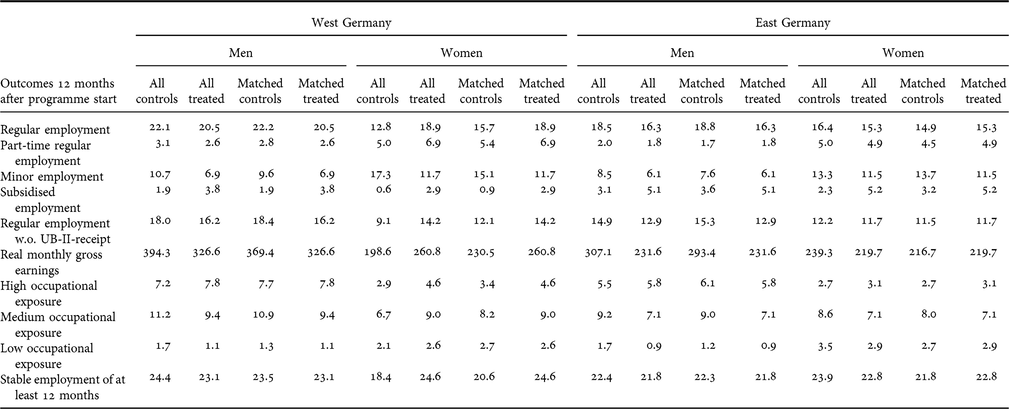
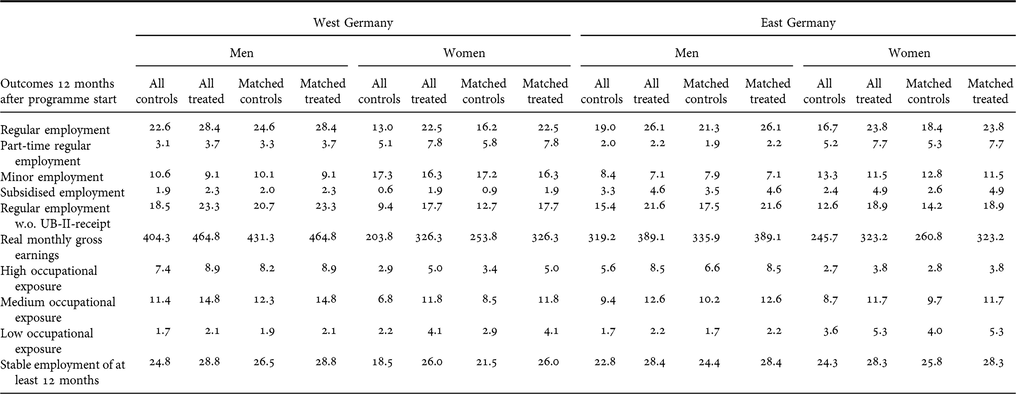
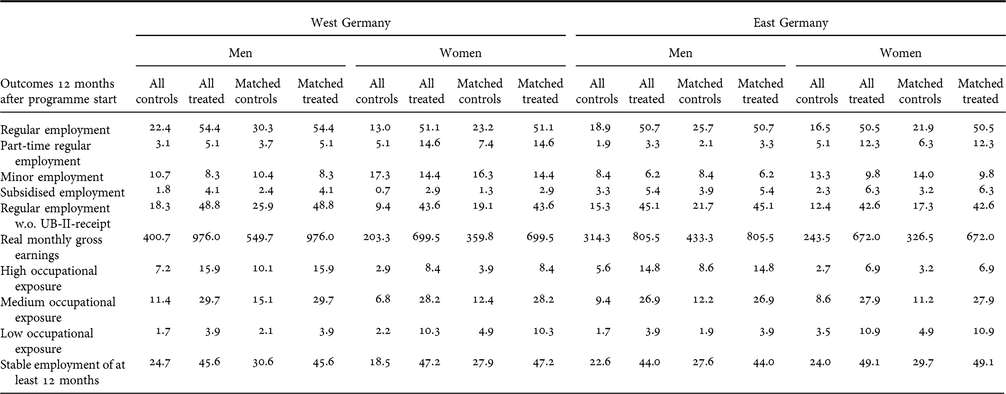
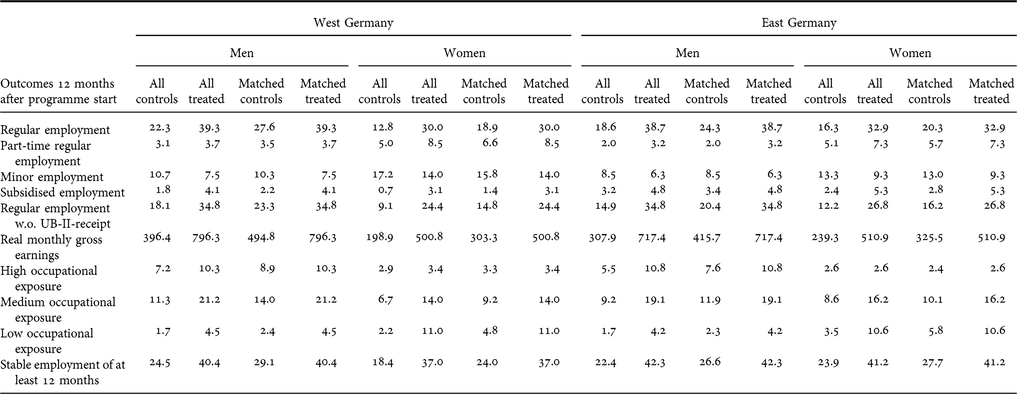
Outcomes are measured for 1 month up to 44 months after the (random) start of the programmes. Because the upper limit of the observation window is December 2010 and the programmes start between October 2005 and April 2007, the upper limit of the observation window is set at 44 months to be identical for all the sample members.Footnote 7 If individuals do not take a job of a certain type, e.g. part-time regular employment, or do not have a job at all, the outcome variables are zero. Thus, I estimate the effects of programme participation on the probability of taking a job of a certain type, such as part-time regular employment, compared with not taking such a job. The latter includes other job types as well as not taking a job at all. Tables 3 through 6 present descriptive statistics on the outcomes for all the controls, treated individuals, matched controls and matched treated individuals 12 months after programme start.
One-Euro-Jobs–outcomes for all and matched controls and treated (in % or Euros)
Source: Integrated Employment Biographies, UB-II-Receipt History, own calculations.
Classroom training–outcomes for all and matched controls and treated (in % or Euros)
Source: Integrated Employment Biographies, UB-II-Receipt History, own calculations.
In-firm training–outcomes for all and matched controls and treated (in % or Euros)
Source: Integrated Employment Biographies, UB-II-Receipt History, own calculations.
Further vocational training–outcomes for all and matched controls and treated (in % or Euros)
Source: Integrated Employment Biographies, UB-II-Receipt History, own calculations.
Propensity score estimation
Assignment into programmes depends on legal requirements, selection by caseworkers (depending on the welfare recipient’s employment prospects, success in completing a specific programme and regional labour market conditions) and self-selection by welfare recipients (Lechner et al., Reference Lechner, Miquel and Wunsch2011). Because I include rich information on the individuals and their households as determinants of the propensity scores to model the selectivity into the programmes, the CIA is likely to hold. I include a comprehensive set of pre-treatment variables measured before or at entry into the sample: sociodemographic variables (age, partner and education), variables on the labour market history (cumulated durations of (non–)employment and benefit receipt, previous ALMP participation and variables on the last contributory job, such as occupational exposure, earnings, industry type or time since last contributory employment), variables on a household basis (partner, partner characteristics, number of children and equivalent household income from welfare receipt), and regional variables on a district level (regional basic typeFootnote 8 for 2003, unemployment rate, vacancies per unemployed individual and long-term unemployed individuals per unemployed individual). The comprehensive data on the labour market histories should also capture unobservable variables, such as motivation (Caliendo et al., Reference Caliendo, Mahlstedt and Mitnik2017).
Results
Matching quality
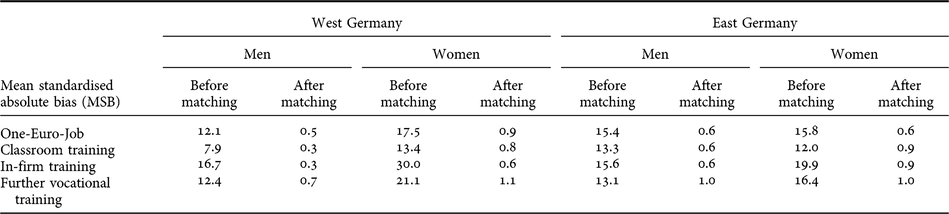
Because I condition on the propensity score and not on all covariates, I control for balancing. Table 7 presents the mean standardised absolute bias (MSB) for the four programmes. The MSB is defined as the distance in the marginal distribution of the covariates for all of the covariates included in estimating the propensity scores. Caliendo and Kopeinig (Reference Caliendo and Kopeinig2008) state that a reduction of the bias to 3% to 5% after matching is sufficient. The MSB ranges between 7.9% and 30% before matching. After matching, the MSB falls below the critical value of 3%. I also calculate t-tests for each covariate included in the probit estimation. The means should not differ between the treated and controls after matching. The results display no significant differences between the treated and controls after matching for each programme and subgroup.Footnote 9 Furthermore, the common support requirement and the overlap assumption must be fulfilled. As the results show, no one in the treatment group is out of the common support region. Furthermore, the shapes of the propensity score distributions of the treated are similar to those of the controls, although the controls have lower propensity score values, and the distribution of the treated sufficiently overlaps with the distribution of the respective controls.Footnote 10
Mean standardised absolute bias
Source: Integrated Employment Biographies, UB-II-Receipt History, own calculations.
Effects on dimensions of job quality
Next, I present the effects of programme participation on the different dimensions of job quality. I display the average treatment effects on the treated (ATT) in a half-year interval after programme start (1, 6, 12, 18, 24, 30, 36 and 42 months) calculated by nearest neighbour matching with five neighbours and with replacement. The effectiveness of the four ALMPs applies for the respective participant group compared with non-participation.
Effects of participation in One-Euro-Jobs
After a short period of lock-in effects (ranging from −0.8 to −2.9 percentage points), the effects of One-Euro-Job participation on regular employment turn positive 1 year after programme start for women, in particular in West Germany: 2.7 percentage points 1 year after programme start (Table 8). This effect is remarkable given that, 1 year after programme start, only 15.7% of the matched controls worked in regular employment (Table 3). The effects on regular employment without UB-II-receipt, the effects on real monthly gross earnings and stable employment of at least 12 months are in line with the effects on regular employment. Women show positive regular employment effects without UB–II-receipt that are slightly smaller than the regular employment effects and positive effects on real monthly gross earnings of up to 40 Euros 30 months after programme start. The effects on stable employment of at least 12 months are significant and positive, with 3.7 percentage points for West German women and 1.5 percentage points for East German women. Thus, positive effects of participation in One-Euro-Jobs arise for some dimensions of employment quality for women. However, some dimensions of employment quality do not imply an increase in the probability of taking a high-quality job. Positive effects on part-time regular employment with up to 2.8 percentage points occur for women, implying an increased probability to start low-quality jobs; however, women may also prefer to work part-time. Furthermore, positive effects on subsidised employment occur for men and women. Because One-Euro-Jobs is a first step towards integration into regular employment, taking regular employment is not the primary goal.
ATT for One-Euro-Jobs on job quality (in percentage points or Euros)
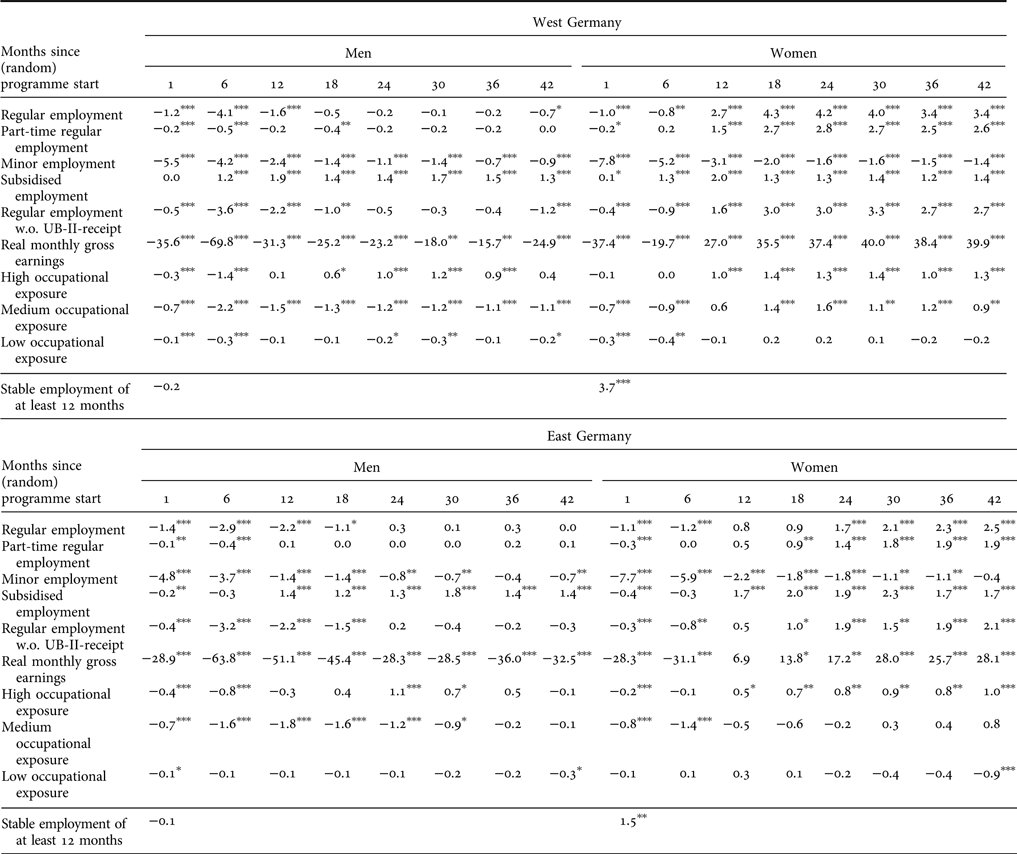
Source: Integrated Employment Biographies, UB-II-Receipt History, own calculations. Notes: Significance levels: *** 1%, ** 5%, * 10%.
Regarding the work quality measured by occupational exposure, the positive effects on regular employment for women are driven by low-quality jobs. East German women reveal positive effects on high occupational exposure, whereas West German women also show positive effects on medium occupational exposure. Although the regular employment effects are not well-determined or negative for men, the effects on occupational exposure are positive for high occupational exposure (between 0.6 and 1.2 percentage points).
Because One-Euro-Jobs focuses on hard-to-place individuals, participation might not increase the probability of taking a high-quality job. For men, this hypothesis is true. However, positive effects on some dimensions of employment quality but not work quality occur for women. The low effectiveness of One-Euro-Jobs on job quality could be due to the work test function, i.e. participants may make concessions to avoid programme participation, or due to the fact that One-Euro-Jobs tries only to stabilise the employability of participants.
Effects of participation in classroom training
Half a year after programme start, the effects of participation in classroom training on regular employment turn positive for all subgroups (Table 9). West German women reach regular employment effects with up to 5.7 percentage points 1 year after programme start. Again, given the gross outcomes for the matched controls 1 year after programme start (Table 4), the effects on regular employment are remarkable, especially for West German women. The effects on regular employment without UB-II-receipt are similar to the regular employment effects but for the most part slightly smaller. The effects on real monthly gross earnings are positive from half a year after programme start onwards, in particular for women (up to 63.8 Euros 1 year after programme start). The effects on stable employment of at least 12 months are also positive and well-determined (up to 4 percentage points for West German women). Thus, these dimensions of employment quality reveal positive effects for all subgroups participating in classroom training compared with non-participation.
ATT for classroom training on job quality (in percentage points or Euros)
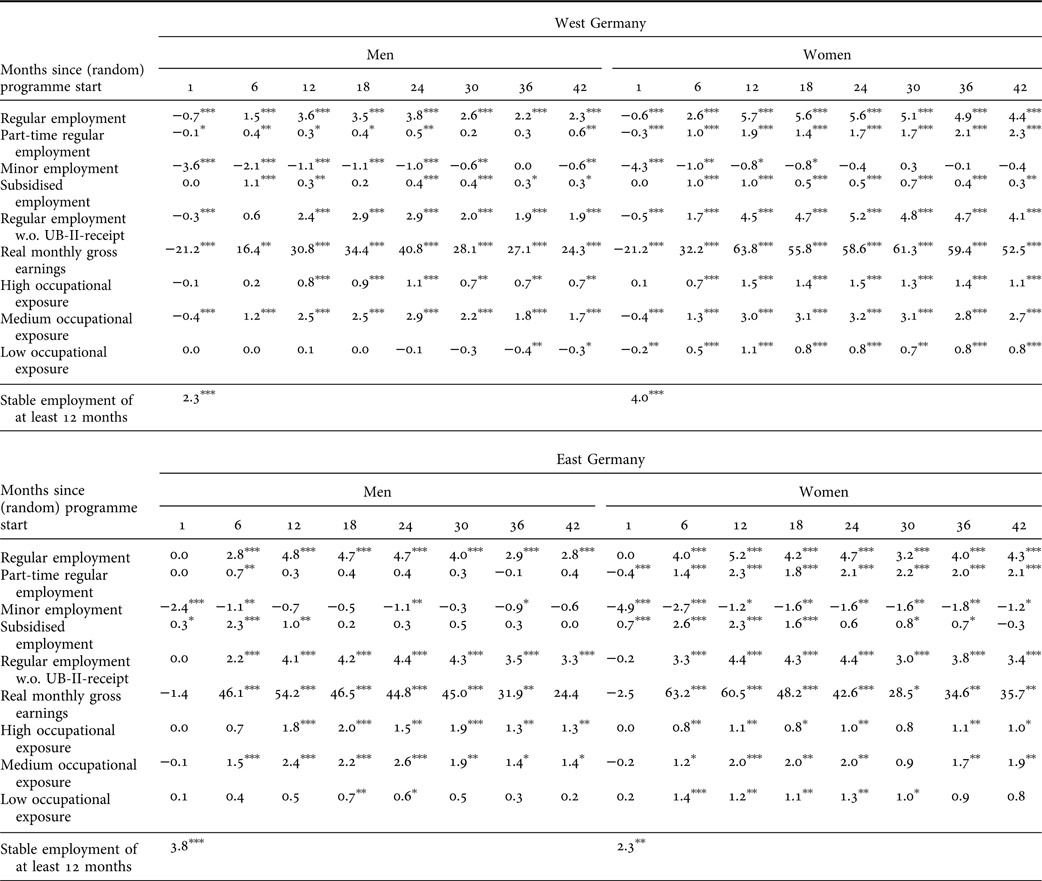
Source: Integrated Employment Biographies, UB-II-Receipt History, own calculations. Notes: Significance levels: *** 1%, ** 5%, * 10%.
However, some dimensions of employment quality do not imply an increase in the probability of taking high-quality jobs. I find some positive effects on part-time regular employment, especially for women (up to 2.3 percentage points). The effects on minor employment are negative; however, the effects on subsidised employment show some positive effects, in particular for East German women (up to 2.6 percentage points half a year after programme start). Regarding work quality, I find the highest positive effects on medium occupational exposure. For women, even positive effects on low occupational exposure occur.
The potential effects of classroom training on job quality may be twofold. Because classroom training does not focus on hard-to-place individuals and increases participants’ human capital, positive effects on some dimensions of employment quality may arise. Because classroom training may also be used by job centres to test welfare recipients’ willingness to work, positive effects on employment quality may not arise. Because classroom training increases the chances of finding a high-quality job for only some dimensions of employment quality (such as regular employment, gross monthly earnings or stable employment) and not for work quality, both effects may play a role.
Effects of participation in in-firm training
As early as 1 month after programme start, well-determined and positive regular employment effects of participation in in-firm training arise for all subgroups (Table 10), in particular for women (up to 28.3 percentage points 1 year after programme start for East German women). In-firm training is very effective – given the gross outcomes for the matched controls (Table 5) and that in-firm training is a short and inexpensive programme. Furthermore, taking regular employment is mostly conditional on stopping UB–II–receipt because I also find similar effects on regular employment without receiving UB II. The effects on real monthly gross earnings vary between approximately 153 and 452 Euros. Although women are characterised by higher regular employment effects than men, men are characterised by higher earnings effects (mostly significant differences). Stable employment of at least 12 months reveals positive effects, especially for women: East German women show 19.2 percentage points higher stable employment when participating in in-firm training than when they do not participate. Thus, participation in in-firm training increases the probability of taking a high-quality job in terms of these dimensions of employment quality.
ATT for in-firm training on job quality (in percentage points or Euros)
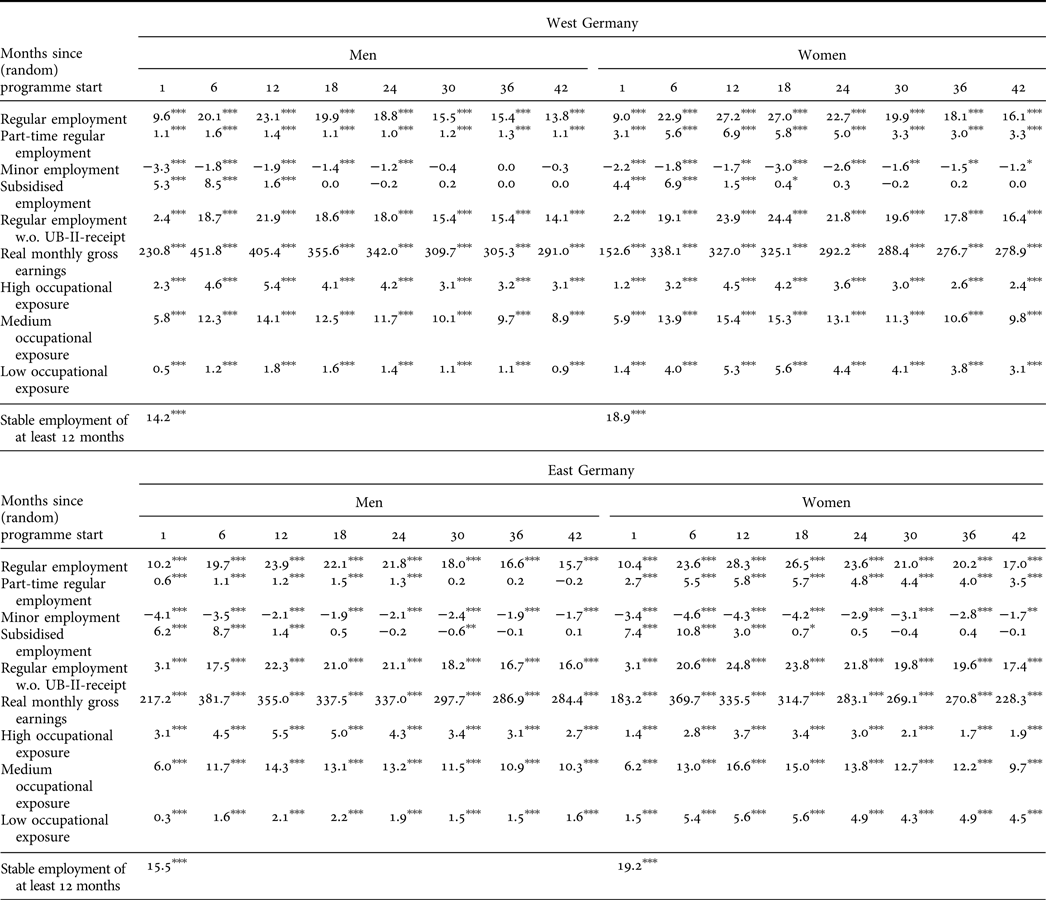
Source: Integrated Employment Biographies, UB-II-Receipt History, own calculations. Notes: Significance levels: *** 1%, ** 5%, * 10%.
However, the increase is mainly driven by medium occupational exposure. Furthermore, I also observe positive effects on part-time regular employment (up to 1.6 percentage points half a year after programme start for men and up to 6.9 percentage points 1 year after programme start for women). In particular, in the first year after programme start, the effects on subsidised employment are mostly significant and positive, implying stepwise integration into the labour market (first in-firm training and second subsidised employment).
Compared with the effects of participation in One-Euro-Jobs and classroom training on job quality, in-firm training is very effective at obtaining a high-quality job for some dimensions of employment quality, such as regular employment, gross monthly earnings, regular employment without receiving UB II and stable employment. Contact with potential employers serving as a pathway to good jobs may be a plausible explanation because in-firm training is carried out within a firm. Furthermore, participants may acquire firm- and sector-specific human capital. However, the results could also reflect deadweight losses, i.e. employers hire participants whom they would have hired anyway without programme participation. In summary, participation in in-firm training increases the chances of obtaining a high-quality job for some dimensions of employment quality. The increase in employment success is mainly driven by medium occupational exposure.
Effects of participation in further vocational training
At the beginning, lock-in effects between -1.5 and -2.4 percentage points occur for participation in further vocational training (Table 11). Already half a year after programme start, the effects on regular employment turn positive. East German men reveal regular employment effects of up to approximately 19.6 percentage points 2 years after programme start, whereas the effects for all other subgroups vary between 10 and 15 percentage points 1 year after programme start onwards. Because further vocational training is typically a long qualification programme, the positive regular employment effects, even half a year after programme start, are remarkable. However, the average planned duration of further vocational training in the sample is short (7 months). The effects on regular employment without UB-II-receipt, on real monthly gross earnings and on stable employment of at least 12 months, are in line with the effects on regular employment. The earnings effects vary between 283 and 396 Euros for men and between 180 and 292 Euros for women 1 year after programme start and onwards. The effects on stable employment are above 10 percentage points for all subgroups. Thus, participation in further vocational training implies an increase in the probability of taking a high-quality job for some dimensions of employment quality.
ATT for further vocational training on job quality (in percentage points or Euros)
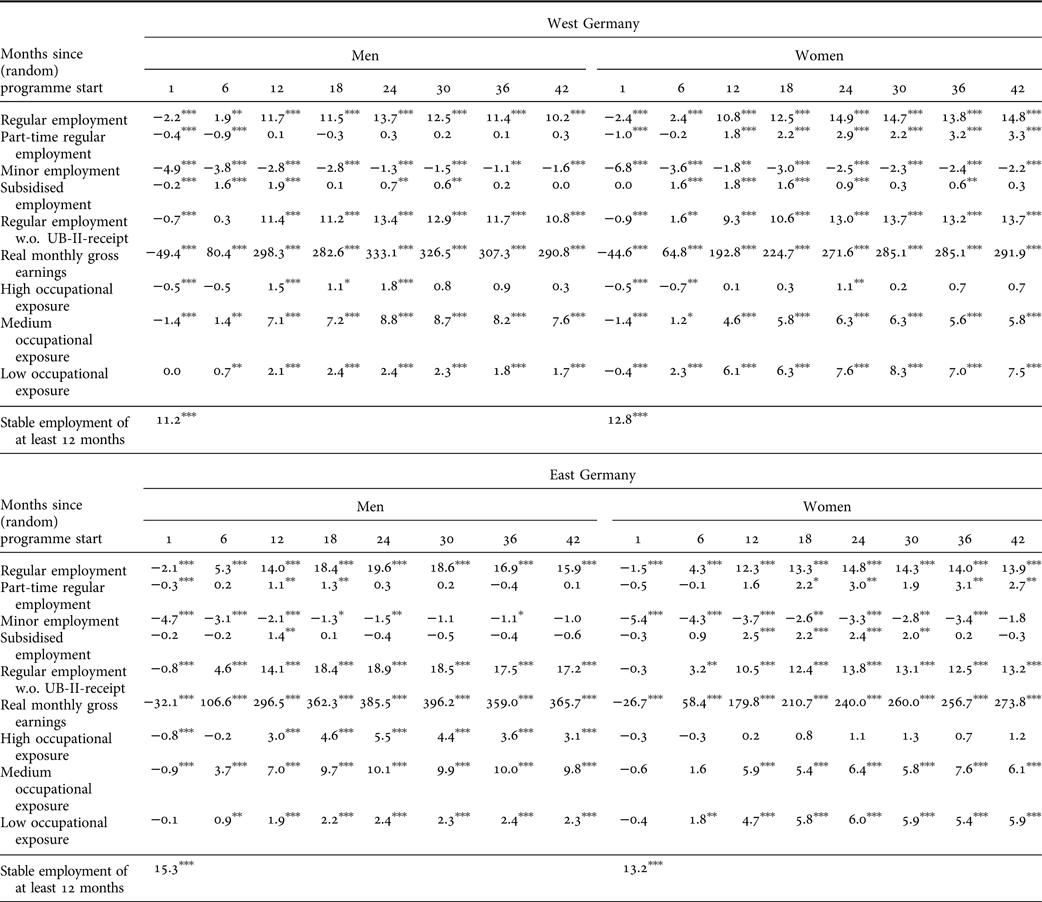
Source: Integrated Employment Biographies, UB-II-Receipt History, own calculations. Notes: Significance levels: *** 1%, ** 5%, * 10%.
However, West German women in particular show positive effects on part-time regular employment. The effects on subsidised employment are also positive, although mostly not for men. For men, the increase in employment success is driven by medium occupational exposure. For women, especially in West Germany, the increase is mostly driven by low occupational exposure.
In summary, further vocational training should enable individuals to increase their chances of finding a high-quality job because it provides long qualification programmes and is directed at individuals with good labour market prospects. Participation in further vocational training increases the probability of obtaining a high-quality job for men and women for some dimensions of employment quality (regular employment, earnings and stable employment). For men, the increase is mainly driven by medium occupational exposure. However, for women, especially in West Germany, it is driven by low occupational exposure. Thus, participation in further vocational training is very effective for West German women not only in terms of employment quality but also in terms of work quality.
Summary and conclusions
In Germany, welfare recipients in particular may suffer from low job quality because they are forced to accept any reasonable job and are subject to the threat of benefit sanctions. In this article, I address the question whether activation can foster more and better jobs by analysing the effectiveness of major ALMPs on employment prospects and job quality for unemployed welfare recipients in Germany.
Using rich administrative data and a matching approach, this article is the first to analyse the effects of participation in four major ALMPs – One-Euro-Jobs, classroom training, in-firm training and further vocational training – for German welfare recipients on various dimensions of job quality. I consider the employment quality (type of employment, taking of regular employment without welfare receipt, real monthly gross earnings and stable employment) and the work quality measured by occupational exposure.
The results imply that all four programmes increase the probability of holding a high-quality job for some dimension of job quality, especially the employment quality, and that negative effects on job quality do not dominate. Although welfare recipients must take every reasonable job and are often characterised by employment impediments, participation in an ALMP helps to obtain a high-quality job compared with non-participation. The effects differ among programmes and the dimensions of job quality; however, even participation in One-Euro-Jobs increases the probability of taking a high-quality job in terms of some dimensions of employment quality, although only for women. Participation in classroom training also reveals positive effects on some dimensions of employment quality for all subgroups. Participation in in-firm training is very effective at obtaining a high-quality job for some dimensions of employment quality. However, further vocational training is most effective because it increases the chances of finding a high-quality job not only in terms of employment quality but also in terms of work quality, especially for West German women. Furthermore, some dimensions of job quality are negatively associated with job quality, such as positive effects on part-time employment or subsidised employment. However, for welfare recipients characterised by employment impediments, merely increasing the probability of holding a high-quality job in terms of some dimensions of job quality or obtaining part-time regular employment or subsidised employment may constitute success.
Regarding previous studies on the effectiveness of ALMPs on taking regular employment for welfare recipients, the effects in this article are consistent but slightly more beneficial: programme participation ends in a later time period between 2006 and 2008 – a period with falling unemployment rates and rising employment stocks – compared with previous studies where participation ended during a period of rising or stable unemployment rates and falling or stable employment stocks.
In this article, I show that studies analysing the effectiveness of ALMPs only on the employment probability do not go far enough. It is very important that job centres focus on job quality, such as stable jobs, because otherwise individuals will become unemployed again. Because participation in a programme mostly increases the probability of taking jobs and holding a high-quality job for some dimensions of job quality, job centres should focus on the activation of unemployed welfare recipients. In particular, the activation of West German women is beneficial because they profit the most from programme participation. The higher effectiveness of ALMPs for women in countries with a low female labour market participation, such as West Germany, is in line with the literature (Bergemann and Van den Berg, Reference Bergemann and Van den Berg2008). Thus, the activation of women could also be advisable for other comparable countries. Furthermore, qualification seems to play a major role in job quality. Further vocational training – the programme that changes the participants’ qualification substantially and even offers new occupational perspectives – is the only programme that is able to increase the probability of taking a high-quality job in terms of low occupational exposure.
Because little research has been done on the effectiveness of ALMPs on job quality, further research should put a stronger focus on job quality outcomes for Germany and other countries. Several issues remain for future research. The most relevant are as follows: first, future studies should analyse other ALMPs, subgroups or dimensions of job quality to obtain further insights into the effectiveness of ALMPs on job quality, and, second, it would be interesting to analyse which programme works better in direct comparison with other programmes.
Acknowledgements
In particular, I would like to thank Joachim Wolff, Regina T. Riphahn, Britta Matthes, Katrin Hohmeyer and Eva Kopf for their very helpful comments.
Funding
The author received no financial support for the research, authorship, and/or publication of this article.


 Open access

