It is testament to the current security of music theory and analysis within the academy that recent years have witnessed a trio of substantial publications which, while augmenting the music-analytical literature on the ‘Bach to Brahms (and beyond)’ repertoire, more particularly celebrate – and, in two cases, capture – the pedagogical legacy of three scholars (my title honours a fourthFootnote 1 ), two now deceased, another two centrally concerned with Schenkerian theory. Explorations in Schenkerian Analysis Footnote 2 is a Gedenkschrift for Edward Laufer, who died in 2014. Its 15 chapters reach from Bach (the C major Prelude noch einmal) to Debussy; Laufer, whose reluctance to publish restricted his principal influence to those he directly taught, is present only in the form of an interview from 2003. That same year saw the death of David Lewin, described by Richard Cohn as ‘the most original and far-ranging theorist of his generation’.Footnote 3 And Cohn provides the introduction to David Lewin’s Morgengruß, the first publication of the text of a 1974 Yale graduate lecture that had been circulating informally ever since.Footnote 4 Although Lewin’s approach is by no means exclusively Schenkerian, he straightforwardly acknowledges the role of Schenkerian theory in aspects of that approach; meanwhile, the Preface to Explorations records that ‘a projected volume on the teaching of Schenkerian analysis’ was a large-scale casualty of Laufer’s death.Footnote 5
*
Laufer was a pupil of Ernst Oster, himself a pupil of Schenker’s pupil Oswald Jonas; and Oster was ‘a very dear friend and wonderful mentor’ to Carl Schachter, whose The Art of Tonal Analysis: Twelve Lessons in Schenkerian Theory is the third of the three volumes mentioned above, and my central concern here.Footnote 6 As Joseph Straus notes in his Preface (p. vii), despite the distinction of Schachter’s published work, ‘perhaps his greatest impact has been felt in the classroom’. For over half a century that classroom was in the Mannes College of Music in New York (where Oster himself also taught), and no-one taught by him or who has shared a conference programme with him will miss the sense of Schachter’s distinctive voice and delivery (‘It’s a perfectly beautiful voice leading’; ‘What Haydn does here is really incredibly beautiful’: pp. 89, 228) in this edited transcript of a doctoral seminar given at the CUNY Graduate Center in 2012. While the Morgengruß volume presents a cleaned-up, edited version of a text crafted for oral delivery, these 12 ‘Lessons’ dealing with Schachter’s and Schenker’s most revered composers catch the analyst in full flight, mid-performance.
Not everything, though, makes the translation from voice to page with equal success. The characteristic asides and anecdotes of the classroom – a swipe at new-fangled register notation (p. 30), a digression on Chopin and Delacroix (p. 57) – often sit uneasily, breaking the flow of the discussion even while usually germane to the matter at hand. One might ask why the decision was taken to record these seminars in book format at all rather than as videos, perhaps with a backup website to carry the music examples which greatly support the text here, although their inconsistent sizing is a visual irritation.
If the various asides often seem a dispensable intrusion upon Schachter’s main concerns, the editing process has, conversely, worked to suppress what would normally be considered an indispensable part of a graduate seminar: dialogue between speaker and participants. The sole record of this appears in the Postlude (pp. 273–80), which gives Schachter’s responses to ‘questions submitted in writing by students in the class’ (p. 273), which filled the final hour of the 12 three-hour sessions. It is difficult to imagine that questions would not have arisen during each seminar concerning analytical detail; and while Schachter frequently posits one reading of a passage before rejecting it in favour of another, and for carefully explained reasons (the opening of Lesson 5, for example, p. 89), the pedagogical function of these seminars could perhaps have been more fully captured. (Indeed, one interpolated anecdote conveys a lively sense of Schenker’s interaction with his own students in a seminar context, pp. 31–2).
Another dialogue is missing here: that with the rich and continuing Schenkerian literature. Straus and Schachter may reasonably have decided that any reference to work published after 2012 would seem anachronistic: thus, the analyses of ‘Der Wegweiser’ and ‘Frühlingstraum’ from Winterreise (pp. 60–61 and 82–8) remain untouched by Lauri Suurpää’s book on that cycle; and my own research on the development of Interruption can offer nothing to Schachter’s brief discussion (pp. 37–8), where, beyond noting that ‘Schenker came upon the notion of interruption rather late in his analytic career’ and concluding that by his death ‘I doubt he had thought out all aspects of interruption’, Schachter is silent.Footnote 7 Even so, the list of ‘Works Cited’ (pp. 285–7) contains nothing originally published beyond 2006, and is heavily reliant on material from two or three decades earlier. There is a glancing reference (p. 113) to a single article by Peter H. Smith, whose ‘revisionist’ work on aspects of Schenkerian theory has been highly influential; and one might have expected some reference to the work of Danuta Mirka in a discussion of ‘Rhythm, Hypermeter, and Phrase’ (Lesson 10, pp. 187–221), where Schachter discusses ‘compound 4/4 time’ in the slow movement of Mozart’s ‘Hunt’ String Quartet in B♭, K458 (pp. 210–12).Footnote 8
In short, readers familiar with Schachter’s work and its background tradition will quickly recognize his reliance on a distinctly circumscribed, nay ‘canonical’ bibliography. If I seem to labour this and other presentational points, I do so in order to raise the related questions ‘what is this book for?’ and ‘to whom is it directed?’. In the latter case, its origin in a graduate seminar provides an obvious answer. Schachter’s CUNY audience was clearly expected to possess more than basic familiarity with Schenkerian theory: this is not a ‘how-to-do-it’ guide. I was, nevertheless, struck by Schachter’s opening with consideration of the linear progression (Zug) as a ‘basic concept’ in Schenkerian thought (p. 1), along with that of the neighbour note.Footnote 9 Nor does the book proceed as an ordered progression of topics; the italicized preamble to each Lesson sometimes adumbrates specific issues to be addressed, but not invariably.
The reservation until the final Lesson of a detailed account of a large-scale Beethoven sonata-form first movement (the ‘Waldstein’, Op. 53) is a suitably culminatory stroke; even so, teachers of things Schenkerian (on this side of the Atlantic, at least) might wonder why a graduate audience might need the long digression on negotiating I–V progressions (pp. 157–62) or to be told of ‘the great importance of two-measure units in the phrase structure of a great deal of Classical and nineteenth-century music’ (p. 197). Similarly, given the evidently advanced participants, one wonders why – unless for simply pragmatic reasons – Schachter elected not ‘to try to discuss an Ursatz or other concepts of deep st[r]ucture’ (p. 8) in relation to the chorale ‘O Gott, du frommer Gott’, one of the principal examples of the opening Lesson.
*
The fundamental answer to my first question must be that the book is a tribute to Schachter himself; we hear not just the analyst’s voice, but are offered ‘A [Self] Portrait of the Artist’, depicting ‘the music and the musical issues that have concerned him most deeply’ (p. vii).Footnote
10
This hardly limits it uses; while not a basic textbook, it is replete with insightful and subtle readings based on a lifetime’s experience (recall, too, that Schachter, like Schenker, is a very accomplished pianist) of a range of pieces against which the relatively junior student can test his or her own analyses. Only rarely did I find myself disagreeing with details, such as the location of
 $$\hat{3}$$
at bar 57 of Chopin, Prelude in G-sharp minor (Ex. 3. 1, p. 47): I would place this in bar 56, with
 $$\hat{2}$$
as the a♯1 of bar 57. (The differing treatment of the right-hand cadential figures in bars 7, 15, and 23 of the Menuet II from Bach’s French Suite No. 2 (Example 2. 1, p. 21), is also questionable, unless the consequence of a printing error.)
Likely to be of greater interest to advanced students of Schenkerian theory are those broader questions of interpretation and technique which Schachter raises; these are the focus of what follows, not least because they invite one to move beyond the narrower confines of Schenkerian thought, or (conversely) to reconsider how such wider musical concerns are addressed in Schenkerian thought.
One such question concerns the analysis of repeated passages, and particularly the matter of priority among iterations. Many will be familiar with Schenker’s practice of generally not even indicating such repetitions: one statement typically stands for all.Footnote
11
Here the matter arises in relation to the ‘Gavotte en Rondeaux’ from Bach’s Violin Partita No. 3 in E (Ex. 6. 1, pp. 104–5 and 113–15), and again in Schachter’s analysis of the first movement of Beethoven’s String Quartet in B-flat, Op. 18 No. 6 (Ex. 8. 1, pp. 155–7 and 162). In neither case, in fact, is there a literal repeat: the Bach example involves the repetition at the dominant of a phrase first stated in the tonic (bars 25–28 and 29–32), while the issue in the Beethoven movement is the beginning of the ‘second theme’ (bars 45ff), where
 $$\hat{3}\,/\,{\rm V}$$
appears in the upper voice, whereas ‘according to Schenkerian convention, [the second theme is] supposed to begin on scale-degree
 $$\hat{5}$$
(C in F major)’ (p. 162).
I have no quibble with the details of Schachter’s two readings. What I would underline is his drawing on the axiom that ‘usually in Schenkerian analysis, if one has an immediate repetition of something, the first statement is considered the principal one’ (p. 113); later, he asks us to ‘recall my mistrust of analyses where, if we have the continuation of a pattern, we take the second statement as the predominant thing; I almost always prefer to take the first statement as the main thing, with the second statement as a weaker echo’ (p. 162).
Granted that pattern continuation and repetition are not necessarily the same thing, there is an obvious context in which Schachter’s axiom is typically turned on its head: namely, when a series of nested statements of a linear progression – above all, an Urlinie progression – is in play. The Bach ‘Gavotte’ offers a classic instance. In the opening ritornello, ‘the upper voice has two descents from G♯ (scale-degree
 $$\hat{3}$$
) to E (scale-degree
 $$\hat{1}$$
) – first leading to the downbeat of measure 4 and then to the downbeat of measure 8 – but I don’t like taking the first of those at face value’ (p. 107; emphasis mine). Schachter reads the internal Urlinie of the ritornello (bars 1–8) as a
 $$\hat{3}$$
-line, with the first descent to e2 (bar 4) as a descent into an inner voice (Ex. 6. 6, p. 109): an entirely defensible, orthodox reading. But this is only the first of five identical statements of the ritornello (only the fourth (bar 64) differs slightly, beginning on I6/3 rather than I5/3); ultimately, it is the last iteration, not the first, that will be understood as the bearer of the definitive Urlinie descent (see Ex. 6. 17, p. 122).
The same issue, writ large, arises in the first movement of the ‘Waldstein’ Sonata, the final analysis in the book. Schachter argues that while the recapitulation of the second theme (bars 204–211) faithfully reprises the
 $$\hat{3}-\hat{2}-\hat{1}$$
descent of its exposition counterpart, there is no available scale-degree
 $$\hat{4}$$
to connect this with the prevailing
 $$\hat{5}$$
from the first theme, to complete ‘what is supposed to be the final descent of the upper voice’; this, ‘one of the structural anomalies of this movement’ (p. 258), is made good (indeed, ‘corrected’, p. 259) in the coda, where f3 (bar 282) is introduced and resolves correctly downward two bars later, at the start of the only ‘complete, intact statement of the second theme in C major’, whereupon follows the descent to
 $$\hat{1}$$
(Ex. 12. 12, p. 260).
‘But’, asks Schachter, ‘which of these two is the main descent of the Urlinie?’ (p. 260). He leaves the question undecided, noting only that one’s chosen view ‘give[s] you very different readings of the large-scale form and structure of the piece’. After digressing to other parts of the movement (involving the repetition of earlier music examples and their associated text) he returns to the coda to claim that ‘the resolution of the Urlinie really takes place here, … not in the recapitulation’: the later iteration again outweighs the earlier one. After comparing the ‘Appassionata’ Sonata and the Adagio of Mozart’s Violin Sonata in E-flat, K481 (the subject of Lesson 7, pp. 126–53), he opines that ‘there’s no way to read [the ‘Waldstein’] in Schenkerian terms other than having the coda house the resolution of the Urlinie’ (p. 268).
But why not? Prior to this claim, Schachter draws upon ‘the emphases built into the composition’ to make a parallel case for the Adagio of K481. And just before that he observes the prevalence of massive codas in middle-period Beethoven. Earlier still he suggests that
one of the things that, perhaps, Beethoven was trying to do was to bring a kind of inner dynamic to the resolution of the Urlinie, making it rather needing of improvement at first, and then, toward the very end of the movement, bringing it into a more satisfactory form’ (p. 260).
Lurking behind this is a received notion of middle-period Beethoven, together with concepts of end-weightedness and the ‘resolving’ role of the coda, which incline the analyst to invest the later descent to
 $$\hat{1}$$
with greater significance than the former.Footnote
12
The Schenkerian reading is thus inflected by broader, historical perceptions of musical style. At the same time these are perceptions deeply influenced by Schenker’s own intuitions about (Beethoven’s) music.
Issues of analytical priority in the context of repetition touch upon the broader question of sameness: must ‘the same music’ – the very notion is inherently problematic – always be analysed in the same way? With the Bach ‘Gavotte’, Schachter’s discussion started from the consideration of a phrase stated first in the tonic and repeated immediately in the dominant. A larger-scale, form-defining case of transposed repetition arises in the analysis of sonata-form movements, where a non-tonic second theme in the exposition will conventionally be recapitulated in I. Toward the end of his analysis of the first movement of Beethoven’s Quartet, Op. 18 No. 6 Schachter introduces this as ‘a basic question of analytic ethics, namely, whether or not it is okay to analyze the same music differently at two different places in a movement’. The situation in this movement is, he notes, ‘reasonably common’. If the exposition second theme prolongs
 $$\hat{2}$$
of the Urlinie, the corresponding scale-degree in the recapitulation must be
 $$\hat{5}$$
. If the Urlinie itself proceeds from
 $$\hat{5}$$
, this is unproblematic; but if the Urlinie proceeds from
 $$\hat{3}$$
, then the appearance of the second group in the recapitulation means that ‘the final descent will seem to be
 $$\hat{5}-\hat{4}-\hat{3}-\hat{2}-\hat{1}$$
instead of
 $$\hat{3}-\hat{2}-\hat{1}$$
’, a situation referred to by Schenker as Überhöhung (p. 172).
Notwithstanding his ethical admonitions, Schachter’s conscience seems serene: ‘[Schenker] didn’t make a big fuss about it, and I try not to make a big fuss about it either’.Footnote 13 But he admits that there is a choice to be made, and that other analysts have qualms about treating expositions and recapitulations differently in this respect. The deciding factor is context:
I think almost all decent [!] Schenkerian analysts would, at least on some occasions, analyze similar material differently, because the context is different. The whole point is that if the context is different, the material is also different (p. 172).
While the specific sonata-form context which gives rise to the issue is indeed a common one, a graduate seminar might want to ponder other possibilities, such as a sonata-form movement displaying an
 $$\hat{8}$$
-line Urlinie. Interruption in the case of an
 $$\hat{8}$$
-line takes the form
 $$\hat{8}-\hat{5}\,//\,\hat{5}-\hat{1}$$
, as opposed to
 $$\hat{8}-\hat{2}\,//\,\hat{8}-\hat{1}$$
. Applied to sonata form, this has the consequence that whereas the exposition proceeds from
 $$\hat{8}$$
, the recapitulation proceeds from
 $$\hat{5}$$
, so that even the untransposed first-theme area must be fundamentally reconceived.Footnote
14
Nor is sonata form the sole province of situations in which music that is ostensibly ‘the same’ might be interpreted differently. Consider the Scherzo of Beethoven’s Piano Sonata in C, Op. 2 No. 3. The melodic prominence of g2 renders this the most likely candidate for the Kopfton of an Urlinie which makes its descent to c2 in the reprise of the A section at bar 55, if not already at bar 47 (a more detailed analysis would, admittedly, need to ponder the location of and support for scale-degree
 $$\hat{4}$$
). The Trio might initially be assimilated as the composing-out of a large-scale neighbouring
 $$\hat{6}$$
(Schachter analyses it, independently of the Scherzo, as a
 $$\hat{5}$$
-line: pp. 187–91 and Ex. 10. 1). But the Trio is not self-contained, and the prominent f3 reached over chord IV in bar 100 is swiftly reharmonized as a climactic V7 arpeggiated (bars 102–104) through five octaves in preparation for the return of the Scherzo. The pressure for downward resolution of this f3 surely now invites reconsideration of what is literally the same music (the pianist reads the same score) heard at the outset: in particular, the repeated f3–e3 progressions in bars 61–63, seemingly a non-structural coda detail the first time round, now assume a changed significance. The ramifications of this reinterpretation reach beyond the Scherzo and into the finale, which immediately reascends from the two-line octave to reach f3 in bar 3 and at corresponding reappearances of this theme. The end of the movement precisely reprises, vertically rather than arpeggiated, the earlier climactic V7 (third movement, bars 102–104) to stage a further resolution to e3/I engendering the final close. Analysis along these lines might encourage performers to think about how one might perhaps project the very ‘differentness’ of the Scherzo reprise: when is a repeat not a repeat?
*
Rondo form itself relies heavily on tonally unchanged repeats of a distinct thematic unit. Schachter explores rondo not only in Lesson 6 (the Bach ‘Gavotte’) but also in Lesson 7, on the Adagio of Mozart’s K481. As a preamble here (pp. 123–5) he considers, in relation to Mozart’s treatment of the form, a provocative issue that has already surfaced in his reading of the Bach movement (see pp. 121–3 and Ex. 6. 19, p. 124). In certain cases – the slow movement of the Piano Concerto in C minor, K491 being one – the tonic return of the rondo theme (ritornello) may be overridden by a longer-range tonal progression between two episodes: or, as Schachter puts it, given a five-part rondo A1–B–A2–C–A3, ‘motion from B to C may coexist with motion from B to A2 and A2 to C’ (p. 123 and Ex. 6. 20, p. 125). In other words, what is posited here is a conflict (or counterpoint) between a Schenkerian conception of form and a more conventional, surface-orientated conception in which tonic-key returns of principal thematic material would always be perceived as formal markers.
In the slow movement of K491, the first return of the ritornello is notably brief, positioned between episodes in C minor and A-flat major, moving to V7 to prepare the final ritornello. Schachter proposes ‘a direct connection between the C minor and A-flat major episodes, with the return to tonic in the A2 rondo theme as a sort of interpolation within a coherent progression that spans the movement’ (p. 123). He proceeds to hint that the resultant I–vi–IV–V7–I progression spanning the movement ‘is very prevalent in music, especially in larger sonata-rondo forms’ (p. 125), but does not develop this suggestion beyond touching on the finale of Mozart’s Piano Concerto in A, K488, and noting Beethoven’s use of the same progression in late sonata-form movements such as the first movements of the Ninth Symphony and the Piano Sonata in C minor, Op. 111.
In order fully to grasp the basis for Schachter’s K491 analysis one must revert to his article ‘Either/Or’, on which the discussion here is based.Footnote 15 In the source article, Schachter discusses Schenker’s understanding of rondo form as a combination of the two three-part forms ABA and ACA, together with his belief that the rondo principle is not compromised by variation or abridgement of the rondo theme itself.Footnote 16 Schachter admits nonetheless that the brevity of the first return in K491 influences his own reading, as also does his perception of motivic and ‘coloristic’ links between the two episodes B and C.
In The Art of Tonal Analysis, it is not entirely clear whether Schachter’s remark about the prevalence of the tonal scheme of the slow movement of K491 ‘especially in larger sonata-rondo forms’ is meant to imply that the ‘coexistence’ of motions he perceives in the Bach and Mozart examples is likewise characteristic of sonata-rondo form more generally. In Der freie Satz, Schenker does not identify sonata-rondo form as such: indeed, in the brief discussion of rondo form he twice cites the finale of Beethoven’s Op. 2 No. 3 but identifies it only as a ‘Rondo’. Moreover, he explicitly distinguishes rondo from sonata form: ‘the significant difference between the rondo and the sonata form lies in the fact that the latter involves a forward thrust to
 $$\hat{2}\,/\,{\rm V}$$
… ; this motion is not present in the rondo’.Footnote 17
But such a ‘forward thrust’ is characteristic of sonata-rondo, where the B section appears in the dominant and functions as a sonata-form second group, to be recapitulated in the tonic.Footnote
18
From the perspective of Schenker’s mature theory, we may ask which specific Ursatz form(s) underlies sonata-rondo. There is the particular question of how to understand the tonic return and reprised rondo theme following the B section: should one take this as concluding one large-scale cadential progression and initiating another (the original starting-point of Schachter’s discussion of K491)? Or is the tonic here part of a larger dominant prolongation initiated in the B section?
Perhaps most relevant among Schenker’s own examples of rondo form in Der freie Satz is his reading of Mozart’s Rondo in D, K485, a work better regarded as a sonata form, having a repeated, rare monothematic exposition and a similarly repeated development and recapitulation, with partial returns of the ‘rondo’ theme in G, F and B-flat major along the way.Footnote 19 Schenker notates the dominant-key second group as merely the upper fifth of the tonic, moving chromatically up to create V7 prior to the subdominant return of the ‘rondo’ theme at bar 71. This leads to V at bar 90, to complete a large-scale I–IV–V–I progression at the recapitulation. A second progression, I–♭III–V–I, then governs the music up to the coda.
In the published graph, only this second progression is beamed; it is unclear whether Schenker understood this as of different status from the first progression. A draft version of the graph preserved in the Ernst Oster Collection (OC 38/399), however, presents a beamed first progression also; and the associated text (OC 38/398–9, not retained in Der freie Satz) emphasizes that Mozart was guided not by any ‘law’ concerning repetition of the rondo theme but rather by the progress of the bass through its allotted contrapuntal route, in comparison to which reprises of the rondo theme were incidental.Footnote 20 There is here a commonality between Schenker’s thought and Schachter’s Bach and Mozart readings: reappearances of the rondo theme are not regarded as per se form-determinative and transcending other tonal connections.
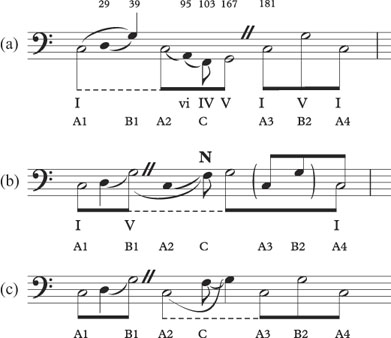
But K485 lacks the tonic-key restatement (Schachter’s ‘A2’) of the rondo theme so vital to sonata-rondo form. Nonetheless, Schenker’s reading of a prolonged chord I across the exposition up to the subdominant at bar 71 suggests that one might read the finale of, say, Beethoven’s Op. 2 No. 3 (a movement not discussed by Schachter) similarly, with the dominant-key area (bar 29ff) understood as an upper-fifth prolongation of I across bars 1–76, embracing the truncated return of the principal theme (‘A2’) before the developmental passage leading through A minor (vi) to the central subdominant episode (IV, bar 103) and yielding to the dominant pedal (bar 167) that prepares the recapitulation at bar 181 (Ex. 1a).
Beethoven, Piano Sonata in C, Op. 2 No. 3, Finale: three possible bass arpeggiations
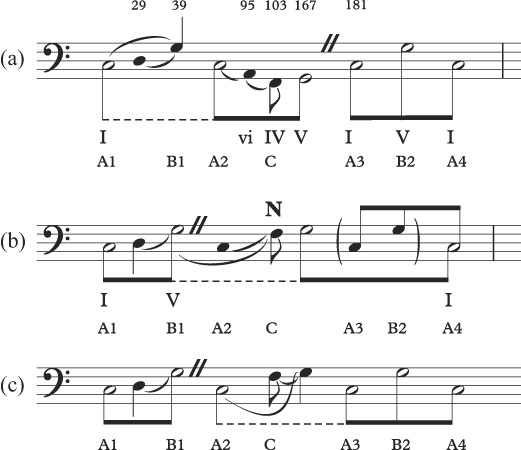
But my interpretation fails to support Schachter’s posited coexistence of ‘motion from B to C’ and ‘motion from B to A2 and A2 to C’. Example 1b suggests how one might understand this movement in such terms; it further attempts to read it in relation to Schenker’s account in Der freie Satz of sonata-form interruption.Footnote
21
Now the move to V at bar 39 (‘B1’) is reinterpreted as the dividing dominant, prolonged across the tonic return at bar 69 and into the recapitulation second group before resolving to the final
 $$\hat{1}$$
/I in the closing bars. However, the ‘motion from B to C’, whereby the subdominant episode is cast as a chromatic lower neighbour either side of V, seems unsatisfactory. Example 1c sketches a third possibility: the dominant-key area (‘B1’) yields to the return of I (A2) at bar 69; this, rather than bar 181, is effectively understood as the tonic recapitulation, within which the succeeding developmental/episodic space is contained much as in Example 1a. Yet even here Schachter’s ‘motion from B to C’ cannot be contained.
*
While much of the preceding discussion has been framed in narrowly Schenkerian terms, one need not worry at the niceties of graphic representations such as those in Ex. 1 in order to acknowledge the broader reach of Schachter’s concerns. There are, unsurprisingly, implications for performance and listener perception in the differing construals of form reviewed here, as also in the wider topics of repetition and ‘sameness’; meanwhile, Schachter’s almost throwaway remark about the importance to sonata-rondo form of a particular tonal progression (I–vi–IV–V–I) directs one beyond the individual piece and beyond an individual compositional style to the histories of form and genre themselves.
Such broader issues, including a nod towards research on the perceptibility of long-range tonal and motivic connections, begin to surface in Lesson 9 – the shortest – on Beethoven’s ‘La Malinconia’ from Op. 18 No. 6 (pp. 173–86). It is a characteristic demonstration of Schachter’s wide cultural knowledge, citing Dürer, Keats, Burton, Pseudo-Aristotle, Shakespeare, Empson and Munch, and its examination of tonal structure is penetrating and convincing. Even so, and despite the rich complexity of these 44 bars, it is perhaps the least satisfying part of the book. The preamble promises to treat ‘musical narrativity and the concept of the compositional idea from a Schenkerian perspective’ (p. 173); but these are barely touched upon, and the words ‘narrativity’ and ‘compositional idea’ are absent from the main text. A ‘narrative’ of sorts is set in train by Schachter’s understanding of the deceptive progression of bars 11–12 (V7/c resolves as an augmented sixth, skewing the harmony towards B minor) as the moment when the music ‘seems to start to lose its way’ (p. 175). This ‘wrong turn’ is followed by ‘disorientation’ and spiralling descending motion ‘seemingly without direction’ until the ‘surprising arrival on C [bar 28] corrects [the] “wrong turn” of m. 12’: such is the story conveyed in the ‘road map’ of the whole (Ex. 9. 7, p. 182).
But the story seems to falter at the C major-minor chord of bars 28–29; certainly, no attempt is made to read the remainder hermeneutically. This is the more regrettable since Schachter understands ‘La Malinconia’ as a prolongation of chord I with a major-minor shift, rather than as an open-ended I–V progression (Ex. 9. 5, p. 180) preparing the finale proper. Could the E–E♭ move at bars 28–29 not be related somehow to the large-scale D–D♭ governing Schachter’s global reading? And might not both steps originate in the b♭–a shift in the cello, bars 7–8 – that innocent yet cataclysmic move that sows the seed of g–f♯ in bars 11–12 and alters the preceding B-flat major for ever? (The omission of such considerations seems odd in light of Schachter’s remarks on motivic parallelisms on p. 183.) What of the relationship of ‘La Malinconia’ to the following Allegretto quasi Allegro, into which it will intrude twice before the quartet concludes? Schachter does not ask or tell.
As to ‘the compositional idea from a Schenkerian perspective’, Schachter’s target here is not entirely clear to me. The preliminary observation that the melancholy temperament has not always been understood purely negatively is promising; and the association between melancholy and artistic inspiration made by Keats and earlier writers (pp. 173–4) would seem to offer interesting and novel hermeneutic possibilities. Yet Schachter’s subsequent descriptions of the music going ‘off the rails’ (p. 175), his invocation of neurosis (p. 176) and disorder (p. 179), and his eventual reference to ‘Beethoven’s representation of craziness’ plainly indicate an alliance of melancholy with mental instability, even if that last description comes in the context of the observation that ‘“La Malinconia” does not sound totally crazy at all’. This follows the grand claim that ‘studying a piece like “La Malinconia” raises important questions about the ethics and the aesthetics both of creating and judging a work of art’ (p. 186); but as with the promised discussion of ‘narrativity’, the conversation never really takes off, Schachter preferring to ponder prolonged diminished sevenths in the last 12 bars or so. To claim that Beethoven ‘writes something that is notably restrained in the way in which it depicts an extreme emotional disorganization’ (p. 186) might invite an investigation of the sketches for ‘La Malinconia’;Footnote 22 and to speak of aesthetic judgement and artistic quality inevitably raises Schenker’s conception of ‘Das Meisterwerk in der Musik’ and his understanding of the relationship between ‘mastery’ and his insight into the behaviour of (some) tonal music.
*
Nevertheless, if matters like the relationship of ‘craziness’ to artistic endeavour yield eventually to the dispassionate accounting of voice-leading details, this Lesson does remind us – if we need reminding – that a Schenkerian mindset need not be entirely divorced from broader hermeneutical enquiry. Such enquiry is naturally prompted when considering texted music, about which Schachter has contributed some distinguished essays.Footnote 23 Here, prior to the two songs from Winterreise mentioned above, he devotes the closing pages (pp. 10–19) of Lesson 1 to an analysis of Schubert’s ‘Du bist die Ruh’, D. 776. The neighbour-note motions b♭1–c2–b♭1 and e♭2–d2–e♭2, presented in separate voices in the piano introduction, are understood to represent the two lovers in Rückert’s poem. When the singer enters they are combined into one voice, just as the protagonist imagines a time when he and his lover will achieve ‘a complete merging of the[ir] two identities’ (p. 16). (Curiously, Schachter’s Ex. 1. 10 shows the singer’s melody in bars 8–11 in terms of two voices, with downward and upward stems respectively.)
Writing of the modal mixture which yields G♭ and C♭ chords in the final strophe (bars 54ff), Schachter notes how this creates ‘a very rich and very beautiful darkness, just as the poem is talking about illumination, radiance’ (p. 17; the relevant text is ‘Dies’ Augenzelt, von deinem Glanz allein erhellt’). The transition from darkness to light is achieved by the switch from G♭ back to G in bar 59, and by ‘the transfer of the culminating A♭ [bar 60] to a higher octave’ (p. 18). This octave transfer is posited on the basis that the Urlinie lies in the one-line register: Schachter’s Ex. 1. 11 (p. 18) is presumably intended to show that the
 $$\hat{5}-\hat{1}$$
descent underlying the first two strophes also underlies that of the third: the a♭2 of bars 60 and 74 is the upwardly transferred
 $$\hat{4}$$
of the descending line which will resume when the music of bars 22–25 and 45–48 reappears at bars 62–65 and 76 onward (omitted from Schachter’s example).
Yet Schachter’s reading of the Urlinie in this song is problematic. He argues that while the Urlinie
 $$\hat{1}$$
, e♭1, is reached at bar 65,
the second time (m. 79), the vocal line ends with the singer on B♭ and the E♭ doesn’t come until the final chord in the piano part. Thus the Urlinie completes itself before the final cadence of the song occurs. The singer seems to end in a state of expectation for something that is to happen in the future … (p. 18)
But how can the Urlinie be complete before the final cadence if the closing
 $$\hat{1}$$
is withheld until the final chord? Or, if it completes in the vocal part at bar 65, what (Schenkerian!) reason for expectation might the singer have at the end of the song?
Before addressing this, consider some musical details that Schachter ignores. Firstly, the b♭1 which initiates the first neighbour-note figure in the introduction can be heard to proceed by step to e♭1 at bar 7, completing a
 $$\hat{5}-\hat{1}$$
progression. Simultaneously, while e♭2 at bar 4 brings the second neighbour-note figure in a new voice, a third voice enters with b♭2 at bar 5, establishing a registral highpoint that will be abruptly abandoned after bar 7: once the singer enters, e♭2 becomes the upper boundary of the vocal and piano lines (Schachter discusses the piano-vocal doubling on p. 15 in relation to the contested f♭2 of bar 70) throughout the first and second strophes. It will be breached only in the third, when voice and piano push beyond e♭2 to the ‘climactic’ a♭2 of bar 60. Climactic indeed; but a somewhat compromised climax. Hitherto, all cadential chords in the vocal phrases have fallen in even-numbered (‘weak’) bars of predominantly four-bar phrases. Here in the third strophe, the A-flat major chord falls on the seventh bar of an eight-bar phrase; the eighth bar itself is silent. Bar 60 is ‘climactic’ because something is missing from bar 61 (and its counterpart, bar 75): that something is surely an E-flat major chord supporting b♭2, avoided since bar 7. We might even understand that b♭2 as the Augenzelt (‘an eye-tent or eye-canopy’, in Schachter’s translation, p. 15) which the protagonist desires to be completely (ful)filled by his beloved.
But the b♭1–b♭2 ascent begun at bar 54 remains incomplete. The concluding pitch is vouchsafed only to the piano; the singer can but drop back to the lower register, to achieve his desire for (melodic) Erfüllung there. The piano goes with him. But the second attempt (bars 68ff), when Schubert repeats the fifth quatrain of Rückert’s poem, is different: at bar 77 a new voice enters, answering the singer’s ‘O füll es ganz’, and indeed trumping it by answering a♭1–e♭2 with e♭2–b♭2. This all reaches back to bars 4–5: the answering figure at bar 77 effectively conjoins the two separate voices introduced there and reactivates b♭2.
What all this means to suggest is that the beginning of the song both projects Erfüllung, in the sense of the completed Urlinie space
 $$\hat{5}-\hat{1}$$
, but also projects a literally and metaphorically higher space to which the singer will aspire but which is accessible only to the piano. In the end b♭2 is left hanging: it ‘resolves’ only by leap down to e♭2 in bar 79, rather than retracing the stepwise path by which it was so recently gained for the last time. All this complicates the question of overall Urlinie completion in the song. Schachter observes that the singer is ultimately unable to reach e♭1 and remains poised on
 $$\hat{5}$$
; but aside from the hanging b♭2, the reiteration in bars 79–80 of the new, answering voice (and whose voice is this, indeed?) in the lower octave also asserts b♭1 strongly, and the connection that Schachter evidently makes between the vocal f1 of bar 78 and the e♭1 in the final piano chord is unpersuasive. And whereas Schachter’s seems an essentially positive reading – some future event may hang in the air at the end of the song, but the longed-for union of the two lovers is already effected by the end of the protagonist’s first phrase (p. 16) – I incline toward a more negative interpretation, sensing an eternal frustration of desire rather than its fulfilment.
*
My analysis of ‘Du bist die Ruh’ tests the consequences for interpretation when we turn Schenkerian analysis against itself, and problematize fundamental tenets such as Urlinie descent. This touches upon one of the student questions recorded in the Postlude. Schachter was asked to comment on
the tension one often finds in the Schenkerian literature between those …, who conceive of Schenkerian analysis as a naturalized theory of functional monotonality and those …, who treat Schenkerian analysis as an artistic analytical enterprise (p. 276).
His response begins by recalling that Schenker regarded music as art (Kunst) rather than science (Wissenschaft); and he aligns himself more with the ‘artistic’ end of the questioner’s spectrum, observing that ‘this gets to the question of why we analyze music in the first place …. We analyze music because we respond to it. That’s the central thing’. Responding to an earlier question concerning ‘the largest unsolved question in music theory, music analysis, and musicology’, Schachter (perhaps with ‘La Malinconia’ in mind) opts for ‘the problem of quality’, and gives another reason for engaging in music analysis: ‘when you analyze a piece, you want to love the piece more as a result of that analysis’ (p. 274). Compare the very similar remarks of Julian Rushton, many years earlier, on the teaching of music analysis: ‘We analyse music because we wish to know it intimately, the better to enjoy it. This process, … is the consequence of love’.Footnote 24 The year before that claim, Rushton had published The Musical Language of Berlioz, an investigation of an individual musical style that makes sustained use of Schenkerian reductive techniques.Footnote 25 Coincidentally, it is Berlioz’s music that Schachter cites, in answer to another question, as a good example of music ‘contemporary with the core Schenkerian repertoire that would not conform completely to his theoretical ideas’ (p. 277).
Rushton’s book, published more than three decades ago at a period when music analysis, and Schenkerian analysis above all, was in its ‘formalist’ high summer, was already a fine example of the adoption of Schenkerian technique to serve ‘an artistic analytical enterprise’ rather than to demonstrate ‘a naturalized theory of functional monotonality’. The very title of Schachter’s book – The Art of Tonal Analysis (emphasis mine) – both bears on his answer to his questioner and alludes to several of Schenker’s own writings: ‘The Art of Improvisation’; the unfinished, posthumously published The Art of Performance; even the early ‘The Decline of the Art of Composition’.Footnote 26 This last title, even if negatively in its context, reminds us of the centrality to Schenker’s thinking of musical creation, and his mission to recuperate a compositional tradition that he considered lost. Thus it is odd to find Schachter suggesting that young musicians may find perplexing the relevance of music analysis to performance or composition, and that in any case ‘Schenker would not at all claim that his approach has any relevance to composition, because he considered it rather an approach to analyzing compositions’ (p. 277).Footnote 27
The art of improvisation could be said to touch on composition on one side and performance on another. A relationship between composition, improvisation and music analysis was proposed by Kofi Agawu in 2004: ‘When analysis is realigned with composition, we restore to it a measure of improvisation, … and reconfigure its epistemological requirements to privilege play’.Footnote 28 Nor does Agawu neglect the possibility that analysis may itself be considered a kind of performance, a view forcefully articulated more recently by Giles Hooper:
Typically, analysts and theorists simply offer their take on one, and only one, of the hearings they believe to be afforded by the score; and so, instead of the insidious constraint of an ideological position, they are … proffering a particular way of hearing a piece that serves to enrich and multiply our potential interpretations of it. Just as do performers.
Hooper offers this view to bolster the fact that he knows ‘few analysts – Schenkerian or otherwise – who would explicitly posit their structural interpretation as the one and only inviolable and universal model which all analysts must accept and all performers must acknowledge’.Footnote 29 Schachter is not above believing that his students’ analytical judgements may sometimes be simply ‘wrong’; even so, he is clear too that ‘when you do analysis … you are leaving the realm of fact and entering the realm of value’ (p. 278), and more than once in this book he defends analytical decisions as plausible or tenable, even though his preferred reading is different.
In common parlance, we refer to the particular ‘hearing’ of a work communicated through performance as the performer’s ‘interpretation’. We are comfortable, too, with the idea of a performer’s individual characteristics, or style, which we might easily think of as his or her individual ‘voice’. Herein, perhaps, lies another similarity between performer and theorist/analyst. Now, within sight of the centenary of Schenker’s complaint that ‘for more than a century, a theory has been taught which claims to provide access to the art of music, but in fact does quite the opposite’,Footnote 30 Carl Schachter’s voice continues to remind us that Schenker bequeathed not merely a theory of tonal music but an artistic mode, something performative, to be cultivated, refined and applied; a means of engagement with music in the myriad encounters which it affords us.