Introduction
The Amazon holds the largest and most biodiverse tropical forest in the world (Raven et al. Reference Raven, Gereau, Phillipson, Chatelain, Jenkins and Ulloa Ulloa2020), providing essential ecosystem services that include contributing to global climate balance (Pires et al. Reference Pires, Benchimol, Cruz and Peres2023). Despite its importance, this forest has been increasingly threatened over the last 40 years by deforestation and consequent forest fragmentation, as well as by other human pressures such as forest degradation (Lapola et al. Reference Lapola, Pinho, Barlow, Aragão, Berenguer and Carmenta2023). As of 2023, more than 21% of Brazil’s Amazon forest had been cleared (INPE 2022). The expansion of anthropogenic activities has destroyed a vast area of forest, especially along the region’s southern and eastern edges, known as the ‘arc of deforestation’, covering all or part of the Brazilian states of Pará, Mato Grosso, Acre, Maranhão and Rondônia (IPAM 2023). The arc of deforestation is characterized by a vast array of variably sized forest fragments, mostly isolated within cattle pastures and agricultural croplands (Fearnside Reference Fearnside2005). Due to unprecedented deforestation rates in the Amazon – widely recognized as the principal driver of biological depletion – measures based on scientific evidence are necessary for effective conservation actions (e.g., Bogoni et al. Reference Bogoni, Peres and Ferraz2020).
Despite empirical evidence of the consequences of deforestation and fragmentation of Amazonian habitats, deforestation in Rondônia is rampant (Chaves et al. Reference Chaves, Mataveli, Conceição, Adami, Petrone and Sanches2024). This state has a unique history of colonization and settlement projects (Gomes et al. Reference Gomes2012), rubber cycles and infrastructure projects (e.g., the Madeira-Mamoré Railway and the BR-364 and BR-319 highways). The impacts of this history include depletion of biodiversity in the state’s unique tropical ecoregions, including hyper-diverse areas such as the Rondônia endemism zone (Borges & da Silva Reference Borges and da Silva2012, Marsh et al. Reference Marsh, Sica, Burgin, Dorman, Anderson and Mijares2022). Rapid land-use change in the state necessitates the application of robust ecological metrics to assess the intensity, extent and magnitude of natural-habitat conversion and allow analysis of the effects of these changes. Especially in a scenario in which multifaceted vertebrate declines are observed (Goebel et al. Reference Goebel, Bogoni, Longo, Palmeirim, Fermiano and da Silva2025), these metrics are essential in order to analyse the effects of these changes and define conservation strategies.
Understanding vegetation-cover dynamics and configurations over time is necessary to infer the degree of threat, and these are measurable using landscape ecology metrics (e.g., Vancine et al. Reference Vancine, Muylaert, Niebuhr, Oshima, Tonetti and Bernardo2024). These metrics allow comparison of landscapes with different territorial extents and over different periods. Deforestation and fragmentation induce significant changes in the composition and configuration of the landscape (i.e., changes in the physical structure and spatial organization of ecosystems), which constrain populations and ecosystem services (Melo et al. Reference Melo, Arroyo-Rodríguez, Fahrig, Martínez-Ramos and Tabarelli2013). Native Amazonian ecosystems have been giving way to anthropogenic habitats, causing simplification in species diversity as fragmentation intensifies, with the remaining fragments becoming smaller, affecting species richness and abundance (Palmeirim et al. Reference Palmeirim, Santos-Filho and Peres2020, Goebel et al. Reference Goebel, Bogoni, Longo, Palmeirim, Fermiano and da Silva2025), while increased isolation limits movement patterns and affects species distributions (Fahrig Reference Fahrig2003, Reference Fahrig2017). The forest fragments are subject to edge effects that alter vegetation structure, reducing food resources and increasing vulnerability to forest fires (Malcolm Reference Malcolm1994). Fragmentation also promotes interference with ecosystem functions such as pollination and seed dispersal, degrading the integrity of forest environments (Galetti et al. Reference Galetti, Alves-Costa and Cazetta2003, Laurance et al. Reference Laurance, Camargo, Fearnside, Lovejoy, Williamson and Mesquita2018, Pires et al. Reference Pires, Benchimol, Cruz and Peres2023). There are also cumulative impacts that include invasions of alien species (Young et al. Reference Young, McCauley, Galetti and Dirzo2016), disease outbreaks and increased competition between species (Palmeirim et al. Reference Palmeirim, Santos-Filho and Peres2020).
We analysed spatial and temporal changes in vegetation cover and configuration in Rondônia between 1986 and 2020, employing annual satellite images on a 5-year basis. We calculated landscape metrics, including vegetation cover, fragment size, number of fragments, edge area, mean isolation, functional connectivity and vegetation overlap and distances from protected areas (PAs; which are known as ‘conservation units’ in Brazil) and Indigenous territories (ITs; similar to Vancine et al. Reference Vancine, Muylaert, Niebuhr, Oshima, Tonetti and Bernardo2024). We expected that, over time, the metrics would respond to the fragmentation context of Rondônia, showing reductions in vegetation cover and connectivity and increases in the number of fragments, edge area and mean isolation but habitat conservation in PAs and ITs (Vancine et al. Reference Vancine, Muylaert, Niebuhr, Oshima, Tonetti and Bernardo2024). We provide insights into habitat fragmentation with a view to improving conservation policies and an analytical framework that could be replicated in other tropical regions, as well as fostering international collaborations.
Methods
Study area
Our study area was Rondônia (in the south-western Brazilian Amazon), to which many people from non-Amazonian parts of Brazil migrated in the 1970s and 1980s after the construction and paving of the BR-364 highway and implementation of colonization and settlement projects supported by the Brazilian Federal Government (Fearnside Reference Fearnside1987). Rondônia (7–13°S, 59–66°W) covers an area of 237 765 km2 (IBGE 2023), or 4.6% of Brazil’s Legal Amazon region. It currently has 52 municipalities (counties), and, with c. 1 580 000 inhabitants, it is the fourth most populous of the nine states in the Legal Amazon (IBGE 2023). However, its human development index (0.690) is ranked 7th in the Legal Amazon and 18th among Brazil’s 27 states (IBGE 2023). Rondônia has the 5th largest gross domestic product in the Legal Amazon and is 22nd in the country, with an economy based on agriculture, livestock, food industry and extractive activities (IBGE 2023).
The predominant vegetation is Amazonian open and dense tropical forests, but in c. 10% of the state the original vegetation is savannahs such as cerrado or other non-forest formations (Fearnside Reference Fearnside1997). Rondônia’s main water courses are the Madeira, the Machado (or Ji-Paraná) and the Guaporé rivers (Gomes Reference Gomes2012). Biodiversity in Rondônia is composed of 1724 known plant species, 118 snakes (Bernarde et al. Reference Bernarde, Albuquerque, Barros and Turci2012), 802 birds, 147 amphibians and 211 mammals (Marsh et al. Reference Marsh, Sica, Burgin, Dorman, Anderson and Mijares2022).
Land-use and land-cover dataset and classification
Our assessments of vegetation-cover dynamics and landscape structure were based on the classification of land use and land cover (LULC) provided by the open-source MapBiomas project (Souza Jr et al. Reference Souza, Shimbo, Rosa, Parente, Alencar and Rudorff2020). We used a 34-year series of changes in LULC between 1986 and 2020 using images every 5 years, following Vancine et al. (Reference Vancine, Muylaert, Niebuhr, Oshima, Tonetti and Bernardo2024): 1986, 1990, 1995, 2000, 2005, 2010, 2015 and 2020. The classification is from MapBiomas Collection 7.1 in Raster format (GeoTIFF) with a spatial resolution of 30 m and Datum WGS-84 in the Universal Transverse Mercator (UTM) coordinate system. We defined two vegetation classes for the analyses: ‘forest vegetation’ (FV) and ‘natural vegetation’ (NV), which also includes forest (Table S1). In FV we only considered habitats classified by MapBiomas as ‘forest’, whereas NV included both ‘forest’ and non-forest formations: ‘savannahs’, ‘wetlands’, ‘grasslands’ and ‘other types of natural vegetation’.
Vectorial data for PAs and ITs, as well as geospatial data on roads and the geographical limits of Rondônia, were obtained from the Brazilian Institute of Geography and Statistics platform (IBGE 2021a, 2021b). We selected only roads that were built, paved and in operation. Data on roads were used to exclude areas of FV and NV overlapping these constructions and thus prevent overestimation of the areas of vegetation (Antongiovanni et al. Reference Antongiovanni, Venticinque and Fonseca2018, Vancine et al. Reference Vancine, Muylaert, Niebuhr, Oshima, Tonetti and Bernardo2024). Using the roads dataset, we tested the effects of these constructions on deforestation, considering that these roads allow access to previously inaccessible areas (Barber et al. Reference Barber, Cochrane, Souza and Laurance2014). All datasets were rasterized with a resolution of 30 m and reprojected to UTM Zone 20S and Datum SIRGAS2000. The roads were rasterized using a parameter that creates ‘densified lines’, meaning that all cells touched by the line will be defined as part of the path (Vancine et al. Reference Vancine, Muylaert, Niebuhr, Oshima, Tonetti and Bernardo2024).
Metrics used in the spatial and temporal analyses
All maps were built in QGIS 3.22 LTR software (QGIS Development Team 2023) using Natural Earth delimitations (1:10 000 000). All landscape metrics were processed using GRASS GIS 8.2.1 (Neteler et al. Reference Neteler, Bowman, Landa and Metz2012) and R 4.3.0 (R Core Team 2023) via the rgrass (Bivand Reference Bivand2022) and LSMetrics packages in R (BBS Niebuhr et al., pers. comm. 2025). We calculated seven landscape metrics: vegetation cover, number of fragments, mean fragment size, edge area, mean isolation, functional connectivity and vegetation overlap and distance from PAs and ITs (Table S1). Vegetation cover was calculated as the amount of vegetation (FV, NV and each vegetation forest and natural class; see Table S2) divided by the total area of Rondônia. The number and size of fragments allowed us to account for the area of the remaining fragments, in addition to examining the increase, reduction or stability of these areas throughout the landscape. We also summarized the fragment size data by calculating their means per year (i.e., arithmetic mean). The fragments were defined using the ‘rule of eight neighbours’, which can define areas connected by pixels in eight directions (Turner & Gardner Reference Turner and Gardner2015). The edge area was calculated for different depths (Table S2), allowing us to estimate the amount and percentage of forest area subject to edge effects.
We used two functional connectivity metrics for different gap-crossing distances, which calculate the capabilities of species to cross non-natural habitats (Table S2). First, we calculated the sum of the areas of all fragments closer than the range-crossing distance, which we considered to be the available functional area (Awade & Metzger Reference Awade and Metzger2008) or the amount of functional habitat (i.e., suitable and well-connected habitat; van Moorter et al. Reference Van Moorter, Kivimäki, Panzacchi, Saura and Brandão Niebuhr2023). Second, we calculated the mean cluster size (i.e., arithmetic mean assumed to represent the expected size) and compared it with the largest cluster size in the study region (Vancine et al. Reference Vancine, Muylaert, Niebuhr, Oshima, Tonetti and Bernardo2024). In the isolation metric, we used an index adapted from the ‘empty space function’ developed by Ribeiro et al. (Reference Ribeiro, Metzger, Martensen, Ponzoni and Hirota2009) and Vancine et al. (Reference Vancine, Muylaert, Niebuhr, Oshima, Tonetti and Bernardo2024), and we created a Euclidean-distance map of all fragments, from which all distance values were extracted, and the mean isolation distance (i.e., the arithmetic mean) was calculated. This process was repeated over several steps for the different size classes (Tables S2 & S3). Mean isolation provides insights into the importance of fragments as ‘stepping stones’. We also calculated the amounts of FV and NV that overlap with PAs (PAs in 2022) and ITs (ITs in 2021), as well as the shortest Euclidean distance from each FV and NV pixel to these areas (Tables S1 & S2). We analysed vegetation scenarios considering only trimmed scenarios, where the area occupied by roads was removed (‘trimmed’) from the forest area. The scenarios were ‘forest vegetation with roads trimmed’ and ‘natural vegetation with roads trimmed’. Scenarios in which the roads were not trimmed did not yield differences from our analyses, although an effect of including areas occupied by roads has been found in other Brazilian ecosystems such as the Atlantic Forest (Vancine et al. Reference Vancine, Muylaert, Niebuhr, Oshima, Tonetti and Bernardo2024) and Caatinga (Antongiovanni et al. Reference Antongiovanni, Venticinque and Fonseca2018).
Results
Vegetation cover
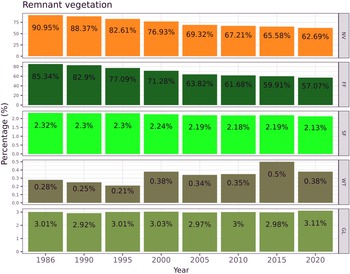
Vegetation cover in Rondônia decreased over the 34 years from 1986 to 2020 (Fig. 1) from 85.34% (20.3 Mha) to 57.1% (13.6 Mha) for FV, while NV decreased from 91% (21.6 Mha) to 62.7% (14.9 Mha; Fig. 2 & Tables S3 & S4). Savannahs, grasslands and wetlands contributed significantly to the composition of NV (Fig. 2). Over the 34-year period there was a 0.19% reduction in savannah formations. Compared to 1986, the area of wetlands in 2015 had increased by 0.15%, and in 2020 it had decreased by 0.12%, while grasslands had increased by 0.10% (Fig. 2).
Vegetation dynamics over 1986–2020 at 5-year intervals for the whole of Rondônia (Brazilian Amazon). In 2020, we highlighted the remaining natural vegetation (NV) and the limits of protected areas and Indigenous territories.

Percentages of the different types of vegetation cover in the state of Rondônia (natural vegetation (NV) with roads trimmed) from 1986 to 2020. FF = forest formations; GL = grasslands; SF = savannah formations; WT = wetlands.

Distribution, size and number of forest and natural habitat fragments
The number of fragments increased over the years (Fig. 3). Considering all natural vegetation classes over the 1986–2020 period there were 100 874 fragments, of which 77 730 had forest-only vegetation cover (Fig. 3a). In 1990, the numbers of NV and FV fragments were nearly equal, at 32 440 and 29 316, respectively, but by 1995 the number of NV fragments had grown to 52 889. The mean size of fragments fell sharply between 1990 and 1995, with a drop of 42.2% (671.5 to 388.3 Mha) for FV and of 42.6% (646.2 to 370.9 Mha) for NV. In 2020, the mean size of FV and NV fragments was c. 150 ha (mean ± SD = 154 ± 226 ha; Fig. 3b & Tables S3 & S4).
Distributions of (a) the thousands of fragments and (b) mean size of fragments of forest vegetation and natural vegetation (including forests) in Rondônia from 1986 to 2020 (with roads trimmed).

We observed a reduction in the size of the fragments of FV and NV over the 1986–2020 period for all years and scenarios (Fig. S1 & Table S4), mainly in vegetation fragments larger than 1 000 000 ha, the total areas of which decreased by 24% for FV and 22% for NV. For fragments in the 2500–1 000 000 ha range there was little variation in the total number. There was an increase in the number of fragments in the 1–2500 ha range, but there was a decrease in the number of fragments smaller than 1 ha (Fig. S1).
Core and edge areas
The percentages of all FV and NV that was less than 1020 m from an edge increased over the 34 years, from 50% to 52% for FV and from 35% to 50% for NV (Fig. 4a,b). The percentages of areas less than 500 m from an edge also increased, from 33.4% to 40.6% for FV and from 24.7% to 34.6% for NV. The percentages of areas less than 2520 m from an edge remained at 75% for FV and increased from 65% to 75% for NV. The maximum edge distances were 23 353 m for FV and 26 281 m for NV, showing that NV had larger central areas (Fig. 4a,b). For distances over 240 m from an edge there was an inversion of the trend in the percentages of vegetation: the percentages of vegetation in FV and NV decreased over the years as a result of the conversion of the core areas of the fragments into edge areas (Fig. 4c,d).
Cumulative percentages of (a,b) area and (c,d) per edge-proximity class for the forest vegetation and natural vegetation (including forests) remaining (with roads trimmed) in Rondônia. Note: log10 scale of the edge distance continuum is shown in (a,b), but a non-log10 scale of the distances in categorical data is shown in (c,d).

Functional connectivity
We found that the mean functionally connected area also declined over the years. Considering functional connectivity for species that cannot cross non-habitat (i.e., gap crossing equals 0 m), the mean functionally connected area of FV decreased by 78.6% (816.2 to 174.3 ha), and for NV it decreased by 82.7% (860.0 to 147.6 ha; Fig. 5a,b). The same pattern occurs for all gap-crossing classes. For values above 1200 m, connectivity showed an increase in 2015; however, it had declined by 2020. In the 1200- and 1500-m gap-crossing classes, NV was greater in 2010, but by 2020 it had dropped dramatically in the 1500-m class (Fig. 5). Above 600 m the largest cluster size did not change, showing a limit value for functional connectivity in Rondônia for all years analysed (Fig. 5c,d).
(a,b) Expected cluster size (mean functional size; ha on log10 scale) of functionally connected forest vegetation and natural vegetation fragments for different functional distance values with roads trimmed (metres), and (c,d) largest functionally connected vegetation cluster (% of total remaining forest vegetation and natural vegetation) estimated at various functional distances (metres) for Rondônia.

Mean isolation
Mean isolation occurred across all size classes of the remaining fragments (Fig. 6a,b). There were peaks in 2005 and 2020 for both FV and NV, reaching the highest values in the historical series in 2020, with mean isolation between fragments of c. 2.5 km (Fig. 6). The 500-ha class had the highest mean isolation, followed by the 350- and 250-ha classes. In 2020, the 500-ha fragments had mean isolations of 2647 m for FV and 2341 m for NV. For FV and NV, we observed increases in mean isolation for areas from 200 to 500 ha in 2000, a reduction in 2005 and 2010 (except for the 500-ha class) and a large increase in 2020.
Influence of smallest fragment size (ha) on isolation (m) in Rondônia: (a) forest vegetation fragments and (b) natural vegetation fragments. Fragment sizes: 0 ha (all), 50 ha, 100 ha, 150 ha, 200 ha, 250 ha, 350 ha, 500 ha and 1000 ha. Percentages of remaining vegetation in Rondônia (area and percentage) by distance class (metres, with roads trimmed and railways) from protected areas: (c) forest vegetation and (d) natural vegetation (including forests); and from Indigenous territories: (e) forest vegetation and (f) natural vegetation (including forests).

Distance from protected areas and Indigenous territories
PAs covered 328 026 915 ha (13.8%) and ITs covered 486 647 ha (20.5%) of Rondônia in 2020. Our results indicate 2.7 Mha (20.4%) of FV and 3.2 Mha (21.8%) of NV in PAs (Fig. 6c,d) and 4.5 Mha (33.6%) of FV and 4.7 Mha (32.2%) of NV in ITs. Only 1.9% of the FV and NV outside of PAs and ITs was within 1 km of a PA, and 1.6% of the FV and NV outside of PAs and ITs was within 1 km of an IT (Fig. 6). In contrast, 63.2% of FV and 61.4% of NV are over 10 km from a PA, and 53.1% of FV and 54.3% NV are over 10 km away from an IT (Fig. 6).
Discussion
Our results show dramatic changes in the spatial and temporal dynamics of landscape structure in Rondônia. Over a period of 34 years there was a huge reduction in natural vegetation cover (from 21.6 to 14.9 Mha), mainly due to agriculture and ranching expansion and urban growth (Souza Jr et al. Reference Souza, Shimbo, Rosa, Parente, Alencar and Rudorff2020). Fragmentation also greatly increased, totalling more than 70 000 fragments of FV and 90 000 fragments of NV. Fragments are progressively decreasing in size (with a mean size reduced to 150 ha by 2020), contributing edge effects and isolation from other fragments or PAs and ITs.
We observed a clear increase in smaller fragments and reductions in large remnants in the state, which can have a direct impact on maintaining the diversity and population size of multiple taxonomic groups, as has been found in other studies of Amazonian fragments (Laurance et al. Reference Laurance, Camargo, Fearnside, Lovejoy, Williamson and Mesquita2018, Palmeirim et al. Reference Palmeirim, Emer, Benchimol, Storck-Tonon, Bueno and Peres2022, Goebel et al. Reference Goebel, Bogoni, Longo, Palmeirim, Fermiano and da Silva2025). Fragments with larger areas tend to shelter more species and provide more ecosystem functions, which ensure human well-being and agricultural productivity (Pires et al. Reference Pires, Benchimol, Cruz and Peres2023). As predicted by Piontekowski et al. (Reference Piontekowski, Ribeiro, Matricardi, Junio, Bussinguer and Gatto2019), there was a major decrease in Rondônia’s vegetation cover and increase in the number of fragments. A similar pattern has been found in the Tapajós basin in the states of Pará and Mato Grosso (Borges et al. Reference Borges, Mancilla, Siqueira, Vancine, Ribeiro and de Souza Maia2022). Although the number of fragments has increased continuously in Rondônia, there was a reduction in the rate of increase between 2005 and 2010 (Fig. 3), coinciding with the creation of the Action Plan for the Prevention and Control of Deforestation in the Amazon (PPCDAM) in 2004 (MMA 2011), as well as other factors that reduced the rate of deforestation during that period (Fearnside Reference Fearnside2017, West & Fearnside Reference West and Fearnside2021).
In addition to effects related to the amount of habitat, from 2010 onwards there was an increase in isolation and loss of connectivity between the remaining fragments of vegetation. The degree of isolation limits the species colonization process (Palmeirim et al. Reference Palmeirim, Santos-Filho and Peres2020) and interferes with small fragments acting as stepping stones that connect smaller areas with large remnants and thereby maintaining genetic flow (Pires et al. Reference Pires, Benchimol, Cruz and Peres2023). Edge effects have also increased, causing deleterious changes in vegetation structure, food webs, microclimate and the carbon cycle (Benchimol & Peres Reference Benchimol and Peres2015). Fragmentation, as measured by metrics such as ours, generates persistent deleterious effects (Haddad et al. Reference Haddad, Brudvig, Clobert, Davies, Gonzalez and Holt2015) through species composition changes, leading to a boom in generalist species (Palmeirim et al. Reference Palmeirim, Santos-Filho and Peres2020).
Between 2012 and 2015, large infrastructure projects were implemented in Rondônia (e.g., road networks and hydroelectric dams), having a negative effect on landscapes due to greater deforestation and fragmentation rates (Escada et al. Reference Escada, Maurano and da Silva2013, Cabral et al. Reference Cabral, Saito, Pereira and Laques2018). Roads play a crucial role in this process, exacerbating the extent and rate of deforestation (Laurance et al. Reference Laurance, Goosem and Laurance2009) in the Amazon, they facilitate access to previously inaccessible forest areas, allowing agricultural expansion, illegal logging, mining and urban development (Laurance et al. Reference Laurance, Goosem and Laurance2009, Reference Laurance, Peletier-Jellema, Geenen, Koster, Verweij and Van Dijck2015, Barber et al. Reference Barber, Cochrane, Souza and Laurance2014, Fearnside Reference Fearnside2022). Roads contribute to soil erosion, changes in drainage patterns and increased risk of forest fires, further amplifying the harmful effects on ecosystems (Laurance et al. Reference Laurance, Peletier-Jellema, Geenen, Koster, Verweij and Van Dijck2015). Understanding the role of roads in the deforestation process is crucial to developing strategies for conservation in the Amazon.
As a result of the deforestation and fragmentation in Rondônia, the largest vegetation remnants are now located in PAs and ITs (Fig. 1), and 63% of the remaining vegetation outside of PAs and ITs is more than 10 km from the nearest PA or IT. Because deforestation outside PAs and ITs is overwhelming, these areas are essential for biodiversity conservation in the Amazon (Qin et al. Reference Qin, Xiao, Liu, Sa e Silva, Shimabukuro, Arai and Fearnside2023). PA and IT creation is one of the most important mechanisms for slowing biodiversity loss and maintaining ecological functions and ecosystem services (Godet & Devictor Reference Godet and Devictor2018, Gatagon-Suruí et al. Reference Gatagon-Suruí, Oliveira, Goebel, Ribeiro, Santos, Mittermeier and Rylands2024). The isolation of PAs reduces the likelihood of species colonizing or recolonizing other fragments and leads to population declines, reducing these species’ reproductive potentials and genetic flows (Estrada et al. Reference Estrada, Garber, Gouveia, Fernández-Llamazares, Ascensão and Fuentes2022). As a cascade effect, population decline can affect forest dynamics by reducing seed dispersal (Magioli et al. Reference Magioli, Rios, Benchimol, Casanova, Ferreira and Rocha2021). Food resources that are essential for Indigenous people and other traditional groups for population growth and cultural development may suffer declines in abundance and biomass, which can have critical consequences for subsistence (Flores et al. Reference Flores, Montoya, Sakschewski, Nascimento, Staal and Betts2024).
PAs are more capable of reducing deforestation, degradation and carbon emissions than non-PAs (Sze et al. Reference Sze, Childs, Carrasco and Edwards2022). They are effective for connecting smaller unprotected fragments, generally on private properties (Noss et al. Reference Noss, Dobson, Baldwin, Beier, Davis and Dellasala2012). Based on our results, we suggest that new PAs need to be created, in addition to preventing damaging human actions through efficient inspections and the application of resources to environmental protection. Although these areas play a vital role in Rondônia, over the 2020–2023 period, the state government’s policies were focused on reducing or extinguishing state PAs (e.g., Fearnside & Cruz Reference Fearnside and Cruz2018). Forestry policies were also weakened (Moreira et al. Reference Moreira, Maciel, Fernandes Netto and Vieira2022). Environmental damage from these policies contributes to ongoing climate change, including a lengthening dry season in the southern and south-western Amazon (Costa & Pires Reference Costa and Pires2010, Butt et al. Reference Butt, de Oliveira and Costa2011, Fu et al. Reference Fu, Yin, Li, Arias, Dickinson and Huang2013, Leite-Filho et al. Reference Leite-Filho, Costa and Fu2020), which threatens agricultural activities (Costa et al. Reference Costa, Fleck, Cohn, Abrahão, Brando and Coe2019, Fearnside Reference Fearnside2020, Leite-Filho et al. Reference Leite-Filho, Soares-Filho, Davis, Abrahão and Börner2021). The increasing frequency of extreme weather events in this region, which is also linked to deforestation and global warming, adds to this threat (da Silva et al. Reference da Silva, Brown, Sampaio, Silva, dos Santos and Lima2023).
Our chrono-sequence of deforestation and fragmentation in Rondônia indicates the existence of effects on fauna and flora that are still poorly investigated through on-site research, reflecting deficiencies in biodiversity knowledge (Bogoni et al. Reference Bogoni, Peres and Ferraz2022). Negative effects related to health and well-being might also increase, as Rondônia has a high risk of producing emerging zoonotic diseases due to anthropogenic pressures and social vulnerability (Ellwanger et al. Reference Ellwanger, Kulmann-Leal, Kaminski, Valverde-Villegas, Veiga and Spilki2020, Reference Ellwanger, Fearnside, Ziliotto, Valverde-Villegas, Veiga and Vieira2022). This highlights the complexity and interconnectedness of the environmental phenomena that influence ecosystems, as well as the need for greater understanding of this complexity.
Our findings, based on landscape metrics of spatial and temporal changes in the landscape over three decades, should inform Brazilian government policies to reduce and control deforestation in the Amazon. The changes in Rondônia’s landscape are similar to those found in the Atlantic Forest, which shows an even greater degree of isolation between its fragments (Vancine et al. Reference Vancine, Muylaert, Niebuhr, Oshima, Tonetti and Bernardo2024, Amaral et al. Reference Amaral, Metzger, Rosa, Adorno, Gonçalves and Pinto2025). However, the Atlantic Forest has a history of degradation spanning more than 500 years, while the changes in Rondônia are a mere 50 years old (Fearnside Reference Fearnside1989). Our information and interpretations should be used to guide the development of public policies before Rondônia’s landscapes reach a point of no return. Our results help us to understand the causes and consequences of landscape change, generating crucial information for compensating environmental services (Qin et al. Reference Qin, Xiao, Liu, Sa e Silva, Shimabukuro, Arai and Fearnside2023). The implementation of appropriate laws would help counter the pressure to reduce the number and size of PAs and ITs and would favour the implementation of conservation projects, including ecological corridors. Such actions might be financed by, for example, the Amazon Fund (https://www.amazonfund.gov.br/en/home/). Natural vegetation has greater value than deforested areas, but redirecting the course of development towards more sustainable actions requires strong measures to prevent unsustainable development (Fearnside Reference Fearnside2018); otherwise, the outlook in the Amazon will become increasingly bleak.
Conclusions
Our understanding of the dynamics of deforestation and consequent fragmentation in Rondônia reveals drastic reductions in forest cover, size of forest fragments and connectivity between natural areas. There has been an increase in the number of fragments in the area exposed to edge effects and in the isolation of fragments, which affects PAs and ITs. We warn that these environmental impacts on a landscape scale have severe ecological and socioeconomic consequences, especially for traditional and Indigenous peoples. We emphasize the urgency of conservation and restoration actions.
Greater investment is needed in inspection technology and in on-the-ground control actions, especially close to highways, which are key drivers of deforestation. Of key importance is promoting connectivity between small fragments and large areas and planning the management of a landscape matrix to minimize edge effects and improve the connectivity of natural areas. We contribute to the evidence base for conservation policies in Rondônia and other Amazonian states. Stopping the political attacks that aim to reduce and weaken the existing PA network is vital. We reinforce the appeal to create new PAs, for more efficient supervision in natural areas and to defend fragments in private properties against the expansion of agribusiness frontiers throughout the Amazon. The landscape metrics and interpretation methods we used can be applied to any biogeographical region, giving this study the potential to positively influence practices and policies on a global scale.
Supplementary material
To view supplementary material for this article, please visit the link available at https://doi.org/10.1017/S0376892925000086.
Data availability
Data will be made available on request.
Acknowledgements
We thank the postgraduate programme in Environmental Sciences at UNEMAT (Cáceres campus), Coordination for the Improvement of Higher Education Personnel (CAPES), São Paulo Research Foundation (FAPESP) and the MapBiomas project for providing land-use data.
Author contributions
LGAG: conceptualization, methodology, data curation, investigation, formal analysis, writing – original draft, writing – review & editing, project administration. MHV: conceptualization, methodology, data curation, investigation, formal analysis, validation, supervision, writing – review & editing, JAB: investigation, validation, supervision, writing – review & editing. GRL: conceptualization, investigation, validation, writing – review & editing. MALC: conceptualization, investigation, validation, writing – review & editing. PMF: validation, supervision, writing – review & editing. AFP: conceptualization, investigation, validation, supervision, writing – review & editing. MdSF: validation, supervision, writing – review & editing.
Financial support
This work was supported by the Coordination for the Improvement of Higher Education Personnel (CAPES) with grants granted to LGAG (Postgraduate in the Legal Amazonia) and GRL. MHV was supported by grant #2022/01899-6, São Paulo Research Foundation (FAPESP). PMF thanks the National Council for Scientific and Technological Development (CNPq; 311103/2015-4; 406941/2022-0), Rede Clima (FINEP/Rede Clima 01.13.0353-00) and the National Institute for Research in Amazonia (INPA; PRJ15.125).
Competing interests
The authors declare none.
Ethical standards
This study meets all ethical standards. The datasets used in this manuscript are available on the MapBiomas platform (https://brasil.mapbiomas.org/).