Introduction
Attitudes are usually defined as positive or negative reactions to an object (e.g. Bohner, Reference Bohner, Hewstone and Stroebe2001; Ajzen, Reference Ajzen2005). In the context of language attitudes, this object is a language, its speakers, features, varieties and/or linguistic usage (Baker, Reference Baker1992: 17). Attitudes towards different language varieties also reflect attitudes towards wider social, cultural, political and geographical contexts of these varieties, and to some extent rely on ‘speakers’ own cultural background and stereotypes of particular cultures or societies that their own culture has mediated' (Bredella, Reference Bredella and Bredella1991: 59). As Holmes (Reference Holmes2001: 343) suggests, people generally do not hold opinions towards languages in a vacuum, but ‘develop attitudes towards languages which reflect their views about those who speak the languages, and the contexts and functions with which they are associated’.
In this case study we examine the attitudes of Croatian university students of TEFL towards native and outer circle non-native English language varieties, and towards EIL/ELF, that is, an English that ‘will increasingly derive its norms of correctness and appropriacy from its own usage rather than that of the UK or the US’ (Seidlhofer, Reference Seidlhofer2001: 15). We were primarily interested in the participants' impressions of different varieties of English, based both on their exposure to these varieties and on stereotypes they hold about their speakers and contexts.
This is the first English language attitude study conducted in Croatia that focuses explicitly on the perception of English varieties from the inner and outer circles (in the sense of Kachru, Reference Kachru1986), and to an extent follows up on our previous research on students' awareness and tolerance of different English varieties (Drljača Margić & Širola, Reference Drljača Margić and Širola2010).
Previous research and the present study
A number of studies have focused on comparing attitudes to English varieties – broadly speaking, on how the respondents perceived each variety, often in relation to others. These studies compared attitudes to either native varieties only, in both native and non-native contexts (e.g. Ladegaard, Reference Ladegaard1998; Bayard et al., Reference Bayard, Weatherall, Gallois and Pittam2001; Jarvella et al., Reference Jarvella, Bang, Lykke Jakobsen and Mees2001; Evans, Reference Evans, Langer and Davies2005, Reference Evans2010), or – more relevantly for the present study – both native and non-native varieties, primarily in non-native contexts (e.g. Dalton-Puffer et al., Reference Dalton-Puffer, Kaltenboeck and Smit1997; Hu, Reference Hu2004, Reference Hu2005; Lee, Reference Lee2009; Paunović, Reference Paunović2009).
The present study differs from the previous research in two important aspects. First, in examining attitudes to non-native English varieties, it focuses on outer circle varieties, which have tended to be neglected in research on attitudes towards English varieties. Second, it does not examine attitudes to a local expanding circle variety, such as the Austrian non-native accent of English (Dalton-Puffer et al., Reference Dalton-Puffer, Kaltenboeck and Smit1997) or China English (e.g. Hu, Reference Hu2005). Our respondents' attitudes to Croatian English might seem an obvious avenue of research for us to have explored, and an explanation is thus perhaps in order.
The tradition of EFL teaching in Croatia is a long one, and unlike the other former Communist countries in Central and Eastern Europe, for most of the post-World-War-2 period Croatia (as part of what was then Yugoslavia) had not been a Soviet satellite or kept largely isolated from aspects of modern Western culture, including English-language media products. It was English and German, not Russian, that reigned supreme as foreign languages in Croatian schools and extracurricular language courses (as an aside, those facts do not always seem to be appreciated in discussions of post-transition spread and status of English, which assume a more-or-less homogeneous ‘Eastern Bloc’). Croatians have thus long been exposed to English on a daily basis and have tended to acquire it from an early age. The motivation to master a/the global language in addition to Croatian – which is in public discourse routinely referred to as a small language, reinforcing the belief held by the vast majority of native Croatian speakers that they or their children cannot fully participate in the modern world speaking only Croatian – is very strong. The level of exposure to English via the Internet and television is high in Croatia; foreign-language films and TV programmes are subtitled, not dubbed, the only exceptions to this being children's cartoons and some documentaries. All these factors combined have led to a perception among native speakers of Croatian that the level of English language proficiency in the country is relatively high.
This is perhaps the reason why the concept of Croatian English or English with a Croatian accent as a distinct variety of English has never been considered. A number of Croatian linguists have discussed the concept of Hrengleski/Crenglish (e.g. Vilke & Medved-Krajnović, Reference Vilke, Medved-Krajnović and Granić2006), in line with Franglais, Swenglish or Dutchlish, but they use the term only to describe ‘everyday Croatian saturated with English’ (Vilke & Medved-Krajnović, Reference Vilke, Medved-Krajnović and Granić2006: 778). The idea of Croatian English on a par with, say, Austrian English, Russian English or Chinese English simply does not exist for Croatian speakers of English. When explicitly asked what variety of English they speak, some might mention that it is ‘the typical English that Croatians speak’, but most will claim that they speak either American or British English (Drljača Margić & Širola, Reference Drljača Margić, Širola, Bayyurt and Akcan2013).
Participants
The sample comprised first-year TEFL MA students, 28 in total, at the University of Rijeka, who were finishing a course in English as a Global Language. All the students were native speakers of Croatian and non-native speakers of English. They had had at least seven years of formal English instruction, exclusively in British and/or American English.
The participants had had no prior formal instruction in other native and non-native varieties previous to the course. They did, however, have at least some knowledge of the historical, geographical and cultural aspects of the countries in which varieties of English are spoken, acquired during the course of their primary and secondary education. In addition, during the English as a Global Language course they had been exposed to different native and non-native varieties of English, as well as to the concept of EIL/ELF. As the course curriculum includes an account of the contexts in which English has spread in different territories, resulting in numerous varieties in the three Kachruvian circles, the students learned about the existence, geographic and historical context, and sociolinguistic status of these varieties. Their required reading included descriptions of various linguistic features – phonetic/phonological, morphosyntactic, semantic, lexical – of English varieties, sometimes with examples of written texts in these varieties. Audio files (predominantly from the International Dialects of English Archive and Schneider, Reference Schneider2010) of native speakers of various varieties reading texts or engaging in conversation with interviewers were played in class.
Research questions
The study focused on the following research questions:
1. How do the respondents perceive each English variety (with a particular focus on possible differences between the perception of native and non-native varieties, as well as between the perception of various native and various non-native varieties)?
2. Which varieties do the respondents deem to be most useful to know, as opposed to which varieties they would most like to know (anticipating that there would be a difference between a personal desire to learn a variety on the one hand and the perception of the variety's utility on the other)?
Research method
The data were collected by means of a questionnaire in English. The first part of the questionnaire asked the respondents to choose adjectives from a list that they would associate with each of the eight varieties of English listed (Australian, British, Indian, American, Nigerian, Irish, Jamaican and EIL). The following adjectives were provided: ‘correct’, ‘prestigious’, ‘authentic’, ‘formal’, ‘informal’, ‘ugly’, ‘broken’, ‘proper’, ‘beautiful’, ‘sophisticated’, ‘incorrect’, ‘unnecessary’, ‘standard’, ‘crude’, ‘corrupted’, ‘exotic’, ‘comprehensible’, ‘simple’ and ‘pure’. These were chosen on the basis of a pilot study, where they had been the most frequent answers given to the open-ended question ‘List at least three adjectives that you would associate with the following variety of English’.
The second part of the questionnaire asked the respondents to list, out of all native and non-native varieties of English, up to five that they would most like to have a mastery of. Finally, the third part asked them to list up to five varieties that they thought were the most useful to know.
Results and discussion
Attitudes towards outer circle non-native varieties show a significant degree of homogeneity when it comes to traits most often associated with them: ‘informal’, ‘broken’, ‘incorrect’ and ‘exotic’. This homogeneity might be due to these varieties being rather unfamiliar to the respondents in about equal measure. Jamaican English is, however, described as ‘exotic’ to a larger extent (79% of the respondents) than Indian and Nigerian English (32% and 50%, respectively), perhaps because it might be perceived by the respondents less as a variety spoken in a particular country than in terms of a particular (sub)culture, as suggested by the following comment:
#17: Jamaican is the language of musical people.
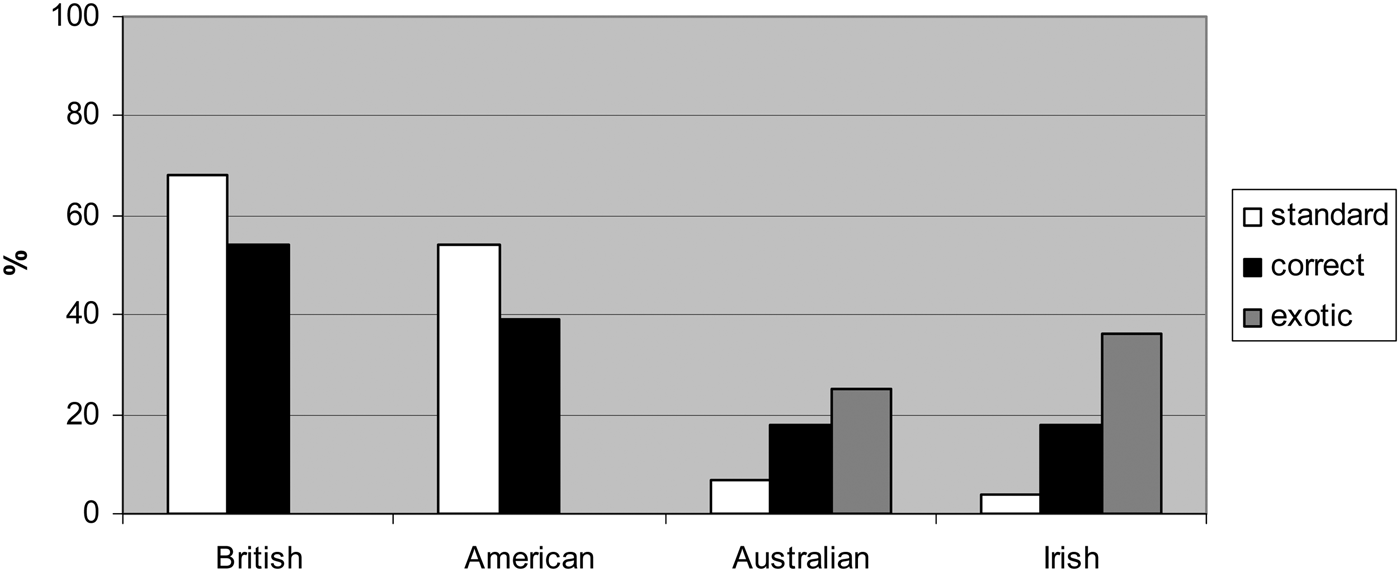
By contrast, attitudes towards native varieties exhibit a high level of heterogeneity. Australian and Irish English tend to be attributed some of the same characteristics as outer circle non-native varieties, e.g. ‘exotic’ (25% and 36%, respectively, as opposed to 0% for British and American English). This indicates that the notion of exoticism is far more readily attributed to less familiar varieties, with the respondents probably resorting to stereotypes. For ‘standard’ (7% and 4%, respectively) and ‘correct’ (18% for both) the results for Australian and Irish English are also much closer to those for outer circle non-native varieties (where the average is 11% for ‘correct’ and 5% for ‘standard’) than to those for British and American English (68% and 54% respectively for ‘standard’; 54% and 39% for ‘correct’ – see Figure 1).
Respondents' perception of British, American, Australian and Irish English in terms of standardness, correctness and exoticism

Furthermore, as can be deduced from Figure 1, British English is seen as more ‘standard’ and ‘correct’ than American English. Moreover, there are clear differences in the perception of these two varieties when it comes to ‘prestige’, ‘formality’ and ‘sophistication’. American English is seen as ‘simple’ and ‘informal’ by a significant percentage of respondents (50% and 39%, respectively), and 4% even consider it ‘corrupted’. By contrast, no respondents at all characterise British English as ‘informal’ or ‘corrupted’, and only 3.5% as ‘simple’. This is in line with the findings of several previous studies, in both English native contexts (e.g. Evans, Reference Evans, Langer and Davies2005; Drljača Margić, Reference Drljača Margić, Tomović and Vujić2011, the latter particularly with respect to Americanisms as opposed to Briticisms) and English non-native contexts (e.g. Ladegaard, Reference Ladegaard1998; Jarvella et al., Reference Jarvella, Bang, Lykke Jakobsen and Mees2001; Paunović, Reference Paunović2009; Evans, Reference Evans2010; Drljača Margić & Širola, Reference Drljača Margić, Širola, Bayyurt and Akcan2013), where American English was ranked less favourably than British in terms of standardness, correctness and prestige.
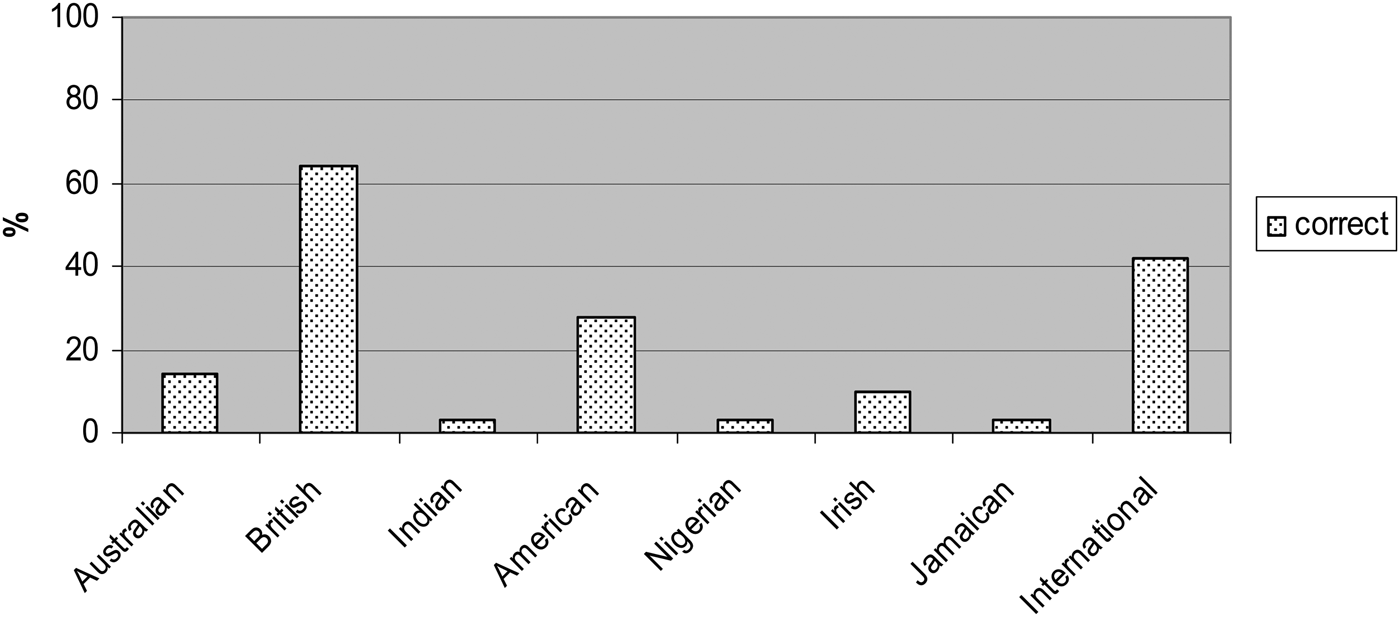
EIL is seen as a ‘simple’ and ‘comprehensible’ variety that is nevertheless perceived as ‘standard’ and ‘correct’. Interestingly, as shown in Figure 2, EIL is considered to be more ‘correct’ than all native varieties except British English.
Respondents' perception of English varieties in terms of correctness
When asked which varieties of English they would most like to have a mastery of, the respondents primarily chose British (43%) and American English (29%) (which is similar to the results obtained by Paunović, Reference Paunović2009 and Vodopija Krstanović & Brala Vukanović, Reference Vodopija Krstanović, Brala Vukanović, Vukanović and Krstanović2011), followed by International English (21%). Some provide their reasons:
#5: British and American English because they are the basis and the standards.
#6: British and American English are widely understood and the most widely spread; most elements used in international communication are taken from British and American.
#7: Although I believe all varieties are equally authentic, correct and important, British English still holds a special and prestigious place in my hierarchy of English language varieties.
#9: I still regard British English as the ‘ideal’ variety because of the traditional and cultural connotations.
#13: American English sounds natural.
#15: International English provides mobility.
#28: I would like to have a mastery of British English just to show off.
Irish English is the only other native variety chosen as a most desirable one (by 7% of respondents), and a further 35% put it in the second or third position. This is perhaps partly attributable to the fascination that many Croatians feel for Ireland and various aspects of Irish culture. As for other native varieties, only Australian, Scottish and Canadian English even get a mention here. Here are the relevant respondents' comments:
#8: Irish and Australian are authentic.
#15: Irish is beautiful; I would like to learn it for my own pleasure.
#17: Irish and Scottish are full of life and energy.
#21: I would like to master Irish just for fun.
The only outer circle non-native varieties present in the responses are Jamaican English (11% for second or third position) and Indian English (29% for fourth or fifth position). The presence of Jamaican English here might be attributed to the stereotypical perception of Jamaica as an exotic location, evoking mental pictures of music and a carefree attitude to life; the presence of Indian English is probably also due to its association with exoticism.
As for which variety the respondents deem most useful to know, American English takes first place (43%), followed by EIL (32%); British English takes third place (25%). Here is a selection of comments:
#2: American and British are still the norm, more or less.
#3: British English – because it is still taught in schools.
#10: American and British are the most useful because they are the most global.
#12: International English is useful for cross-cultural communication and understanding.
#27: International English gives us some kind of assurance that we will be understood and understand others.
Out of other native varieties, only Australian English receives a measure of support here (18% for third place), closely followed by Irish and Canadian (which are only mentioned in fourth and fifth place). As for non-native varieties, Indian English is put in second place by 7% of respondents, and other outer circle non-native varieties are hardly mentioned.
Although the notions of standard, prestige and correctness are significantly less frequently associated with American English than with British English, and although more participants express a desire to have a mastery of British English, they rated American English as the most useful variety. This does not come as a surprise if we take into consideration that American English is at present the world's most influential language in the fields of science, technology, commerce and (pop) culture.
The difference between a personal desire to learn a variety and its perceived utility is also obvious with Irish English (as a native variety) and Jamaican English (as a non-native variety); although they are listed among the varieties that some respondents would like to learn, they get hardly a mention among the varieties that respondents think would be useful to learn.
Conclusion
Our MA programme's English as a Global Language course was devised with the primary aim of ‘remedying’ (Lee, Reference Lee2009: 240) the students' lack of awareness of English language diversity, a task that should arguably have been undertaken much earlier in the course of their formal education. It is of particular importance that EFL learners, especially those who are being trained as EFL teachers, become (more) aware of different English varieties (i.e. World Englishes). In addition, as argued in Choi (Reference Choi2007) and Drljača Margić & Širola (Reference Drljača Margić and Širola2010), exposure to various English varieties has a considerable impact on the level of students' acceptance/tolerance of those varieties: more exposure leads to greater acceptance/tolerance.
The findings of the present study show that the respondents still largely describe British and American English as more standard and correct than other native varieties, and native varieties as more standard and correct than non-native varieties. This hierarchy is mirrored in their personal desires to learn a variety and their perceptions of the variety's utility. In other words, when it comes to which varieties they deem to be most useful to know and to which varieties they would most like to know, the respondents largely remain loyal to the ones traditionally taught.
The findings, however, also reveal that EIL/ELF has appeared as an additional most attractive and useful variety. Even though the majority of our respondents hold British and American English in highest regard, EIL/ELF is joining the two native varieties that tend to dominate EFL discourse. This might indicate, first, that EIL/ELF is perhaps in our students' perception emerging as a variety ‘in its own right’ (Jenkins, Reference Jenkins2007: 2), and, second, that some students are modifying the majority's binary approach to English – according to which only British and American English are seen as proper, correct, standard and superior to all others – and developing a sensibility for the situational appropriacy of specific varieties.
 BRANKA DRLJAČA MARGIĆ is an Assistant Professor and Head of the English and Applied Linguistics Section of the Department of English, University of Rijeka, Croatia. She obtained her PhD in Linguistics from the University of Zagreb. Her research interests include language contact, language attitudes, World Englishes and the presence of English in academic and research settings. She is currently running the ‘Internationalisation of Study Programmes at the University of Rijeka’ project, and is involved in the EU-funded ‘Advancing the European Multilingual Experience’ and ‘Multilingual Education – The Advancement of Language Learning and Intercultural Skills’ projects. Email: bdrljaca@ffri.hr
 DORJANA ŠIROLA is a Senior Assistant Lecturer in the Department of English, University of Rijeka, Croatia. She holds an M.Phil. in English and Applied Linguistics from the University of Cambridge and a D.Phil. in General Linguistics & Comparative Philology from the University of Oxford. In addition to World Englishes, her research interests include writing systems, the interface between writing and phonology, historical and comparative linguistics, Restsprachen and language variation. Email: dsirola@ffri.hr